PRESENTATION
ON
MICROGRID
PRESENTED BY
 ABHISHEK PARADHI- 122148001
 GOVIND HAIBATE-122148005
 MAHESH JADHAV -122148007
CONTENT
 CONCEPT OF MICROGRID
 TYPES OF MICROGRID
 CONTROL OF MICROGRID
 ENERGY STORAGE
 ENERGY MANAGEMENT
 FUTURE SCOPE
FOSSIL FUEL DEPLATION
Microgrid Could be the answer to our Energy Crisis
Image source:https://jennsolar.com/education/fossil-fuel-
MICROGRID
SYSTEM
 A Microgrid is an Integrated energy system with :
-Distributed Generation Resources (DER)
-Energy Storage Systems (ESS)
-End Use Load
-Various Types of Electrical Loads
 Objective of the microgrids :
-To Deliver Electricity In Sustainable, Economical &
Secure
- Integration of Renewable Energy into The Grid
- Accelerate Development of Smart Grid
COMPONENTS OF MICROGRID
 Distributed Generation
 Loads
 Energy Storage System
 Static Disconnect Switch
 Controller
 Point of Common Coupling
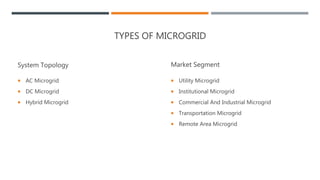
TYPES OF MICROGRID
System Topology
 AC Microgrid
 DC Microgrid
 Hybrid Microgrid
Market Segment
 Utility Microgrid
 Institutional Microgrid
 Commercial And Industrial Microgrid
 Transportation Microgrid
 Remote Area Microgrid
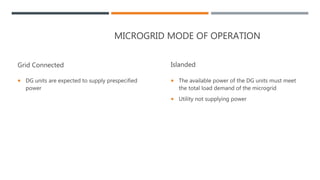
MICROGRID MODE OF OPERATION
Grid Connected
 DG units are expected to supply prespecified
power
Islanded
 The available power of the DG units must meet
the total load demand of the microgrid
 Utility not supplying power
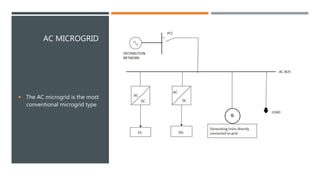
AC MICROGRID
 The AC microgrid is the most
conventional microgrid type
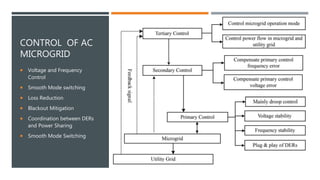
CONTROL OF AC
MICROGRID
 Voltage and Frequency
Control
 Smooth Mode switching
 Loss Reduction
 Blackout Mitigation
 Coordination between DERs
and Power Sharing
 Smooth Mode Switching
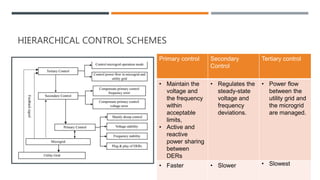
HIERARCHICAL CONTROL SCHEMES
Primary control Secondary
Control
Tertiary control
• Maintain the
voltage and
the frequency
within
acceptable
limits,
• Active and
reactive
power sharing
between
DERs
• Regulates the
steady-state
voltage and
frequency
deviations.
• Power flow
between the
utility grid and
the microgrid
are managed.
• Faster • Slower • Slowest
CONTROL OF AC
MICROGRID
 COMMUNICATION BASED CONTROL SCHEMES
 Centralized Control Schemes
 Distributed Control Schemes
 AC Master Slave Control
Approach Prospects Problems
1. Centralized Control Schemes • Improved power sharing in
transient and steady-state
conditions.
• Excellent voltage and frequency
regulation.
• High bandwidth is required.
• Higher implementation cost
2. Distributed Control Schemes • Constant voltage and power
sharing.
• Can tolerate single point of
failure.
• Reduce the modularity of the
system.
3. AC Master Slave Control • Improved power sharing in the
steady-state condition.
• High current overshoot and high
bandwidth communication.
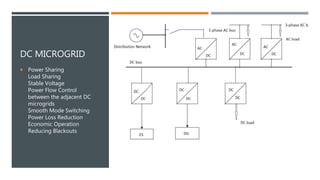
DC MICROGRID
 Power Sharing
 Load Sharing
 Stable Voltage
 Power Flow Control
between the adjacent DC
microgrids
 Smooth Mode Switching
 Power Loss Reduction
 Economic Operation
 Reducing Blackouts
CONTROL OF DC MICROGRIDS
 Power Sharing
• Load Sharing
 Stable Voltage
 Power Flow Control Between The Adjacent DC Microgrids
 Smooth Mode Switching
 Power Loss Reduction
 Economic Operation
 Reducing Blackouts
CONTROL OF
DC MICROGRID
 Distributed Control
 Decentralized Control
 Centralized Control
 Image
Source:Stability_and_Control_Aspects_of_Microgrid_Archite
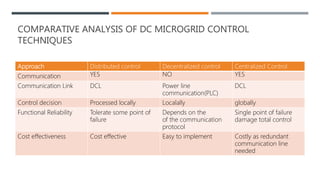
COMPARATIVE ANALYSIS OF DC MICROGRID CONTROL
TECHNIQUES
Approach Distributed control Decentralized control Centralized Control
Communication YES NO YES
Communication Link DCL Power line
communication(PLC)
DCL
Control decision Processed locally Localally globally
Functional Reliability Tolerate some point of
failure
Depends on the
of the communication
protocol
Single point of failure
damage total control
Cost effectiveness Cost effective Easy to implement Costly as redundant
communication line
needed
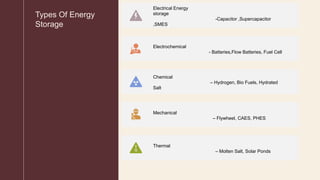
Types Of Energy
Storage
Electrical Energy
storage
-Capacitor ,Supercapacitor
,SMES
Electrochemical
- Batteries,Flow Batteries, Fuel Cell
Chemical
– Hydrogen, Bio Fuels, Hydrated
Salt
Mechanical
– Flywheel, CAES, PHES
Thermal
– Molten Salt, Solar Ponds
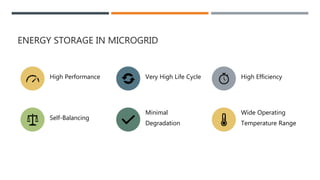
ENERGY STORAGE IN MICROGRID
High Performance Very High Life Cycle High Efficiency
Self-Balancing
Minimal
Degradation
Wide Operating
Temperature Range
ENERGY MANAGEMENT
 Presence of multiple, small DER units with significantly different power capacities and characteristics
 Potentially no dominant source of energy generation during an autonomous mode; i.e., lack of infinite bus
 Fast response of electronically coupled DER units that can adversely affect voltage/angle stability when
appropriate provisions are not in place
ENERGY MANAGEMENT
 The microgrid PMS assigns real and reactive power reference for DG Units to
1. Efficiently share real/reactive power requirements to DG units
2. Quickly respond to disturbances and transients due to the changes in the system operating mode.
3. Determine the final power generation set-points of the DG units
4. Provide a means for re-synchronization of the autonomous microgrid with the main grid for reconnection
MICROGRID ADVANTAGES
 In peak load periods it prevents utility grid failure by reducing the load on the grid
 Significant environmental benefits made possible by the use of low or zero emission generators.
 A major advantage of a Microgrid, is its ability, during a utility grid disturbance, to separate and
isolate itself from the utility seamlessly with little or no disruption to the loads within the
Microgrid.
 The use of both electricity and heat permitted by the close proximity of the generator to the user,
thereby increasing the overall energy efficiency.
 Microgrid can act to mitigate the electricity costs to its users by generating some or all of its
electricity needs.
MICROGRID DISADVANTAGES
 Electrical energy needs to be stored in battery banks thus requiring Maintenace and more space.
 Resynchronization with the utility grid is difficult.
 Issues such as standby charges and net metering may pose obstacles for Microgrid
FUTURE RESEARCH AREAS
 Communication systems architecture, protocols, and tools are essential in microgrid implementation to ensure
stable, reliable, and optimal operation
 Microgrid control studies will improve system reliability, efficiency and power quality
 Development of energy storage system integrated to microgrid
FUTURE SCOPE
IN THE NEAR FUTURE WHEN
COST OF MICROGRID
SYSTEM WILL BE
AFFORDABLE THEN
MICROGRIDS WILL BECOME
MORE POPULAR AND
CONVENTIONAL GRID WILL
BE REPLACED BY MICRO
GRID.
RESEARCH ARE GOING
SUCH AS TO INCREASE
STABILITY AND RELIABILITY
OF THE MICROGRID FOR
EFFECTTIVE WORKING.
REFERENCES
 A.L. Dimeas, and N.D. Hatziargyriou, “Operation of a multiagent system for microgrid control,” IEEE Trans.
Power Syst., vol. 20, no. 3, pp. 1447–1457, Aug. 200
 F. Katiraei, and R. Iravani, “Power management strategies for a microgrid with multiple distributed generation
units,” IEEE Trans. Power Syst., vol. 21, no. 4, pp. 1821–1831, Nov. 2006
 F. Katiraei, A. Dimeas, R. Iravani, N. Hatziargyriou, ”Microgrids management,” IEEE Power Energy Mag., vol. 6,
no. 3, May 2008, pp. 54-65.
THANK YOU

microgrid final (2).pptx

  • 1.
    PRESENTATION ON MICROGRID PRESENTED BY  ABHISHEKPARADHI- 122148001  GOVIND HAIBATE-122148005  MAHESH JADHAV -122148007
  • 2.
    CONTENT  CONCEPT OFMICROGRID  TYPES OF MICROGRID  CONTROL OF MICROGRID  ENERGY STORAGE  ENERGY MANAGEMENT  FUTURE SCOPE
  • 3.
    FOSSIL FUEL DEPLATION MicrogridCould be the answer to our Energy Crisis Image source:https://jennsolar.com/education/fossil-fuel-
  • 4.
    MICROGRID SYSTEM  A Microgridis an Integrated energy system with : -Distributed Generation Resources (DER) -Energy Storage Systems (ESS) -End Use Load -Various Types of Electrical Loads  Objective of the microgrids : -To Deliver Electricity In Sustainable, Economical & Secure - Integration of Renewable Energy into The Grid - Accelerate Development of Smart Grid
  • 5.
    COMPONENTS OF MICROGRID Distributed Generation  Loads  Energy Storage System  Static Disconnect Switch  Controller  Point of Common Coupling
  • 6.
    TYPES OF MICROGRID SystemTopology  AC Microgrid  DC Microgrid  Hybrid Microgrid Market Segment  Utility Microgrid  Institutional Microgrid  Commercial And Industrial Microgrid  Transportation Microgrid  Remote Area Microgrid
  • 7.
    MICROGRID MODE OFOPERATION Grid Connected  DG units are expected to supply prespecified power Islanded  The available power of the DG units must meet the total load demand of the microgrid  Utility not supplying power
  • 8.
    AC MICROGRID  TheAC microgrid is the most conventional microgrid type
  • 9.
    CONTROL OF AC MICROGRID Voltage and Frequency Control  Smooth Mode switching  Loss Reduction  Blackout Mitigation  Coordination between DERs and Power Sharing  Smooth Mode Switching
  • 10.
    HIERARCHICAL CONTROL SCHEMES Primarycontrol Secondary Control Tertiary control • Maintain the voltage and the frequency within acceptable limits, • Active and reactive power sharing between DERs • Regulates the steady-state voltage and frequency deviations. • Power flow between the utility grid and the microgrid are managed. • Faster • Slower • Slowest
  • 11.
    CONTROL OF AC MICROGRID COMMUNICATION BASED CONTROL SCHEMES  Centralized Control Schemes  Distributed Control Schemes  AC Master Slave Control Approach Prospects Problems 1. Centralized Control Schemes • Improved power sharing in transient and steady-state conditions. • Excellent voltage and frequency regulation. • High bandwidth is required. • Higher implementation cost 2. Distributed Control Schemes • Constant voltage and power sharing. • Can tolerate single point of failure. • Reduce the modularity of the system. 3. AC Master Slave Control • Improved power sharing in the steady-state condition. • High current overshoot and high bandwidth communication.
  • 12.
    DC MICROGRID  PowerSharing  Load Sharing  Stable Voltage  Power Flow Control between the adjacent DC microgrids  Smooth Mode Switching  Power Loss Reduction  Economic Operation  Reducing Blackouts
  • 13.
    CONTROL OF DCMICROGRIDS  Power Sharing • Load Sharing  Stable Voltage  Power Flow Control Between The Adjacent DC Microgrids  Smooth Mode Switching  Power Loss Reduction  Economic Operation  Reducing Blackouts
  • 14.
    CONTROL OF DC MICROGRID Distributed Control  Decentralized Control  Centralized Control  Image Source:Stability_and_Control_Aspects_of_Microgrid_Archite
  • 15.
    COMPARATIVE ANALYSIS OFDC MICROGRID CONTROL TECHNIQUES Approach Distributed control Decentralized control Centralized Control Communication YES NO YES Communication Link DCL Power line communication(PLC) DCL Control decision Processed locally Localally globally Functional Reliability Tolerate some point of failure Depends on the of the communication protocol Single point of failure damage total control Cost effectiveness Cost effective Easy to implement Costly as redundant communication line needed
  • 16.
    Types Of Energy Storage ElectricalEnergy storage -Capacitor ,Supercapacitor ,SMES Electrochemical - Batteries,Flow Batteries, Fuel Cell Chemical – Hydrogen, Bio Fuels, Hydrated Salt Mechanical – Flywheel, CAES, PHES Thermal – Molten Salt, Solar Ponds
  • 17.
    ENERGY STORAGE INMICROGRID High Performance Very High Life Cycle High Efficiency Self-Balancing Minimal Degradation Wide Operating Temperature Range
  • 18.
    ENERGY MANAGEMENT  Presenceof multiple, small DER units with significantly different power capacities and characteristics  Potentially no dominant source of energy generation during an autonomous mode; i.e., lack of infinite bus  Fast response of electronically coupled DER units that can adversely affect voltage/angle stability when appropriate provisions are not in place
  • 19.
    ENERGY MANAGEMENT  Themicrogrid PMS assigns real and reactive power reference for DG Units to 1. Efficiently share real/reactive power requirements to DG units 2. Quickly respond to disturbances and transients due to the changes in the system operating mode. 3. Determine the final power generation set-points of the DG units 4. Provide a means for re-synchronization of the autonomous microgrid with the main grid for reconnection
  • 20.
    MICROGRID ADVANTAGES  Inpeak load periods it prevents utility grid failure by reducing the load on the grid  Significant environmental benefits made possible by the use of low or zero emission generators.  A major advantage of a Microgrid, is its ability, during a utility grid disturbance, to separate and isolate itself from the utility seamlessly with little or no disruption to the loads within the Microgrid.  The use of both electricity and heat permitted by the close proximity of the generator to the user, thereby increasing the overall energy efficiency.  Microgrid can act to mitigate the electricity costs to its users by generating some or all of its electricity needs.
  • 21.
    MICROGRID DISADVANTAGES  Electricalenergy needs to be stored in battery banks thus requiring Maintenace and more space.  Resynchronization with the utility grid is difficult.  Issues such as standby charges and net metering may pose obstacles for Microgrid
  • 22.
    FUTURE RESEARCH AREAS Communication systems architecture, protocols, and tools are essential in microgrid implementation to ensure stable, reliable, and optimal operation  Microgrid control studies will improve system reliability, efficiency and power quality  Development of energy storage system integrated to microgrid
  • 23.
    FUTURE SCOPE IN THENEAR FUTURE WHEN COST OF MICROGRID SYSTEM WILL BE AFFORDABLE THEN MICROGRIDS WILL BECOME MORE POPULAR AND CONVENTIONAL GRID WILL BE REPLACED BY MICRO GRID. RESEARCH ARE GOING SUCH AS TO INCREASE STABILITY AND RELIABILITY OF THE MICROGRID FOR EFFECTTIVE WORKING.
  • 24.
    REFERENCES  A.L. Dimeas,and N.D. Hatziargyriou, “Operation of a multiagent system for microgrid control,” IEEE Trans. Power Syst., vol. 20, no. 3, pp. 1447–1457, Aug. 200  F. Katiraei, and R. Iravani, “Power management strategies for a microgrid with multiple distributed generation units,” IEEE Trans. Power Syst., vol. 21, no. 4, pp. 1821–1831, Nov. 2006  F. Katiraei, A. Dimeas, R. Iravani, N. Hatziargyriou, ”Microgrids management,” IEEE Power Energy Mag., vol. 6, no. 3, May 2008, pp. 54-65.
  • 25.