A
SEMINAR PRESENTATION
on
MICRO SMART GRID
SUBMITTED TO:-
MR. HEMANT KAUSHIK
ASSIT. PRO.
EE(DEPATMENT)
SUBMITTED BY:-
RAHUL KUMAR
13EREEE025
BRANCH- EE
2/27/2017 1multilevel inverter
Introduction
• Introduction to Microgrid.
• Microgrid Operating Modes.
• The Need of Microgrid.
• Interconnected Microgrids – Power Parks.
• Environmental Aspects.
• Conventional Grid versus Microgrid.
• Advantages & Disadvantages of Microgrid.
• Future Directions on Microgrid Research.
• References.
3/29/2017 2
Introduction To Microgrid
• What is Microgrid?
– It is a small-scale power supply network that is
designed to provide power for a small community.
– It enables local power generation for local loads.
– It comprises of various small power generating
sources that makes it highly flexible and efficient.
3/29/2017 3
Introduction To Microgrid
• What is Microgrid?
– It is connected to both the local generating units and
the utility grid thus preventing power outages.
– Excess power can be sold to the utility grid.
– Size of the Microgrid may range from housing estate
to municipal regions.
3/29/2017 4
Introduction To Microgrid
• Microgrid Components
– Distributed Generation
– Loads
– Immediate storage
– Controller
– Point of Common Coupling
3/29/2017 5
3/29/2017 6
Typical Microgrid is shown below:
Microgrid Operating Modes
• Grid Connected Mode:
– Utility grid is active.
– Static switch is closed
– All the feeders are being
supplied by utility grid.
3/29/2017 7
Microgrid Operating Modes
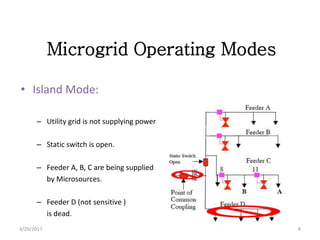
• Island Mode:
– Utility grid is not supplying power
– Static switch is open.
– Feeder A, B, C are being supplied
by Microsources.
– Feeder D (not sensitive )
is dead.
3/29/2017 8
The Need Of Microgrid
– Microgrid could be the answer to our energy crisis.
– Transmission losses gets highly reduced.
– Microgrid results in substantial savings and cuts
emissions without major changes to lifestyles.
– Provide high quality and reliable energy supply to
critical loads3/29/2017 9
Interconnected Microgrids
Interconnected Microgrids – Power Parks
– Practical size of Microgrids is limited to a few MVA.
– For larger loads, it is desirable to interconnect many
Microgrids to form a larger Microgrid network called
Power Parks.
– The advantages of this Microgrid structure insures
greater stability and controllability for the Power
Parks.
3/29/2017 10
Environmental Aspects
– Microgrid encourages the use of the renewable
energy sources.
– Large land use impacts are avoided.
– CO2 Emissions are reduced.
3/29/2017 11
Conventional Grid vs. Microgrid
– Efficiency of conventional grid is very low as
compared to Microgrid.
– Large amount of energy in the form of heat is
wasted in conventional grid.
– Power sources in case of Microgrid (often referred
to as Microsources) are small and are located in
close proximity to load.3/29/2017 12
Advantages & Disadvantages
• Microgrid Advantages
– A major advantage of a Microgrid, is its ability, during a
utility grid disturbance, to separate and isolate itself from
the utility seamlessly with little or no disruption to the
loads within the Microgrid.
– In peak load periods it prevents utility grid failure by
reducing the load on the grid.
– Significant environmental benefits made possible by the
use of low or zero emission generators.
3/29/2017 13
Advantages & Disadvantages
• Microgrid Advantages
– The use of both electricity and heat permitted by
the close proximity of the generator to the user,
thereby increasing the overall energy efficiency.
– Microgrid can act to mitigate the electricity costs
to its users by generating some or all of its
electricity needs.
3/29/2017 14
Advantages & Disadvantages
• Microgrid Disadvantages
– Voltage, frequency and power quality are three main
parameters that must be considered and controlled to
acceptable standards whilst the power and energy balance is
maintained.
– Electrical energy needs to be stored in battery banks thus
requiring more space and maintenance.
– Resynchronization with the utility grid is difficult.
3/29/2017 15
Advantages & Disadvantages
• Microgrid Disadvantages
– Microgrid protection is one of the most important
challenges facing the implementation of Microgrids.
– Issues such as standby charges and net metering may
pose obstacles for Microgrid.
– Interconnection standards needs to be developed to
ensure consistency. IEEE P1547, a standard proposed
by Institute of Electrical and Electronics Engineers
may end up filling the void.
3/29/2017 16
Future Directions on Microgrid
Research
• To investigate full-scale development, field demonstration, experimental
performance evaluation of frequency and voltage control methods under
various operation modes.
• Transition between grid connected and islanded modes on interaction
phenomena between distribution generation and high penetration of
distributed generation.
• Transformation of Microgrid system today into the intelligent,
robust energy delivery system in the future by providing significant
reliability and security benefits.
3/29/2017 17
Thank You
3/29/2017 18
Queries?
3/29/2017 19

Rahul[1]

  • 1.
    A SEMINAR PRESENTATION on MICRO SMARTGRID SUBMITTED TO:- MR. HEMANT KAUSHIK ASSIT. PRO. EE(DEPATMENT) SUBMITTED BY:- RAHUL KUMAR 13EREEE025 BRANCH- EE 2/27/2017 1multilevel inverter
  • 2.
    Introduction • Introduction toMicrogrid. • Microgrid Operating Modes. • The Need of Microgrid. • Interconnected Microgrids – Power Parks. • Environmental Aspects. • Conventional Grid versus Microgrid. • Advantages & Disadvantages of Microgrid. • Future Directions on Microgrid Research. • References. 3/29/2017 2
  • 3.
    Introduction To Microgrid •What is Microgrid? – It is a small-scale power supply network that is designed to provide power for a small community. – It enables local power generation for local loads. – It comprises of various small power generating sources that makes it highly flexible and efficient. 3/29/2017 3
  • 4.
    Introduction To Microgrid •What is Microgrid? – It is connected to both the local generating units and the utility grid thus preventing power outages. – Excess power can be sold to the utility grid. – Size of the Microgrid may range from housing estate to municipal regions. 3/29/2017 4
  • 5.
    Introduction To Microgrid •Microgrid Components – Distributed Generation – Loads – Immediate storage – Controller – Point of Common Coupling 3/29/2017 5
  • 6.
  • 7.
    Microgrid Operating Modes •Grid Connected Mode: – Utility grid is active. – Static switch is closed – All the feeders are being supplied by utility grid. 3/29/2017 7
  • 8.
    Microgrid Operating Modes •Island Mode: – Utility grid is not supplying power – Static switch is open. – Feeder A, B, C are being supplied by Microsources. – Feeder D (not sensitive ) is dead. 3/29/2017 8
  • 9.
    The Need OfMicrogrid – Microgrid could be the answer to our energy crisis. – Transmission losses gets highly reduced. – Microgrid results in substantial savings and cuts emissions without major changes to lifestyles. – Provide high quality and reliable energy supply to critical loads3/29/2017 9
  • 10.
    Interconnected Microgrids Interconnected Microgrids– Power Parks – Practical size of Microgrids is limited to a few MVA. – For larger loads, it is desirable to interconnect many Microgrids to form a larger Microgrid network called Power Parks. – The advantages of this Microgrid structure insures greater stability and controllability for the Power Parks. 3/29/2017 10
  • 11.
    Environmental Aspects – Microgridencourages the use of the renewable energy sources. – Large land use impacts are avoided. – CO2 Emissions are reduced. 3/29/2017 11
  • 12.
    Conventional Grid vs.Microgrid – Efficiency of conventional grid is very low as compared to Microgrid. – Large amount of energy in the form of heat is wasted in conventional grid. – Power sources in case of Microgrid (often referred to as Microsources) are small and are located in close proximity to load.3/29/2017 12
  • 13.
    Advantages & Disadvantages •Microgrid Advantages – A major advantage of a Microgrid, is its ability, during a utility grid disturbance, to separate and isolate itself from the utility seamlessly with little or no disruption to the loads within the Microgrid. – In peak load periods it prevents utility grid failure by reducing the load on the grid. – Significant environmental benefits made possible by the use of low or zero emission generators. 3/29/2017 13
  • 14.
    Advantages & Disadvantages •Microgrid Advantages – The use of both electricity and heat permitted by the close proximity of the generator to the user, thereby increasing the overall energy efficiency. – Microgrid can act to mitigate the electricity costs to its users by generating some or all of its electricity needs. 3/29/2017 14
  • 15.
    Advantages & Disadvantages •Microgrid Disadvantages – Voltage, frequency and power quality are three main parameters that must be considered and controlled to acceptable standards whilst the power and energy balance is maintained. – Electrical energy needs to be stored in battery banks thus requiring more space and maintenance. – Resynchronization with the utility grid is difficult. 3/29/2017 15
  • 16.
    Advantages & Disadvantages •Microgrid Disadvantages – Microgrid protection is one of the most important challenges facing the implementation of Microgrids. – Issues such as standby charges and net metering may pose obstacles for Microgrid. – Interconnection standards needs to be developed to ensure consistency. IEEE P1547, a standard proposed by Institute of Electrical and Electronics Engineers may end up filling the void. 3/29/2017 16
  • 17.
    Future Directions onMicrogrid Research • To investigate full-scale development, field demonstration, experimental performance evaluation of frequency and voltage control methods under various operation modes. • Transition between grid connected and islanded modes on interaction phenomena between distribution generation and high penetration of distributed generation. • Transformation of Microgrid system today into the intelligent, robust energy delivery system in the future by providing significant reliability and security benefits. 3/29/2017 17
  • 18.
  • 19.

Editor's Notes

  • #6  Each feeder has several circuit breakers and power and voltage flow controllers. The power and voltage controller near each microsource provides the control signals to the source, which regulates feeder power flow and bus voltage at levels prescribed by the Energy Manager.
  • #11 Interconnected microgrids (power parks) allows us to feed the power