
Solar Mini-grid, Micro-grid and Nano-grid
Presented By:
Md. Jannatul Nayim Giyem
Id: 163-33-3647
Md. Asrafur Rahman
Id: 172-33-4002
Md. Arafat Sarker
Id: 172-33-4124
Tilottoma Datta
Id: 172-33-4196
Arifur Rahman
Id: 172-33-4126
Spring’2019
Section A L2_T3
Department of EEE
Daffodil International University
Presented To:
Abu Shahir Md. Khalid Hasan
Lecturer
Department of EEE
Daffodil International University
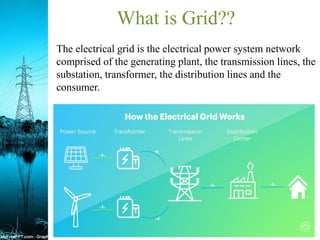
What is Grid??
The electrical grid is the electrical power system network
comprised of the generating plant, the transmission lines, the
substation, transformer, the distribution lines and the
consumer.
Mini-grid
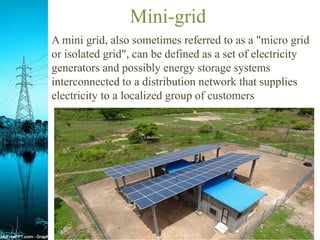
A mini grid, also sometimes referred to as a "micro grid
or isolated grid", can be defined as a set of electricity
generators and possibly energy storage systems
interconnected to a distribution network that supplies
electricity to a localized group of customers
Micro-grid
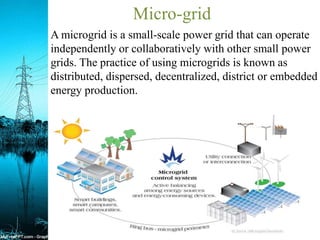
A microgrid is a small-scale power grid that can operate
independently or collaboratively with other small power
grids. The practice of using microgrids is known as
distributed, dispersed, decentralized, district or embedded
energy production.
Nano-grid
Micro-grids are distributed generation systems connected
to end-users that are stand alone or connected to an
electrical network. Solar nano-grids are based on micro-
grids but are smaller in size.
What is solar mini grid?
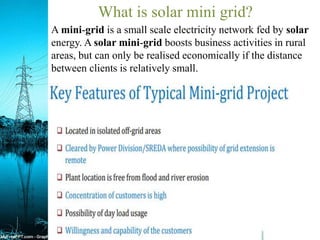
A mini-grid is a small scale electricity network fed by solar
energy. A solar mini-grid boosts business activities in rural
areas, but can only be realised economically if the distance
between clients is relatively small.
What is Nano-Grid:
Nano-grids are small micro
grids, typically serving a single
building or a single load.
Navigant Research has
developed its own definition of a
nano-grid as being 100 kW for
grid-tied systems and 5 kW for
remote system. In many ways,
nano-grids appear to be an even
more radical rewiring and
rethinking of the world’s energy
future than microgrids.
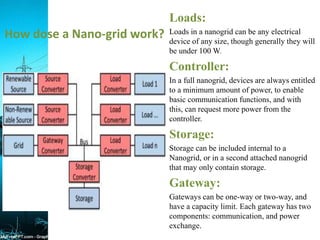
How dose a Nano-grid work?
Loads:
Loads in a nanogrid can be any electrical
device of any size, though generally they will
be under 100 W.
Controller:
In a full nanogrid, devices are always entitled
to a minimum amount of power, to enable
basic communication functions, and with
this, can request more power from the
controller.
Storage:
Storage can be included internal to a
Nanogrid, or in a second attached nanogrid
that may only contain storage.
Gateway:
Gateways can be one-way or two-way, and
have a capacity limit. Each gateway has two
components: communication, and power
exchange.
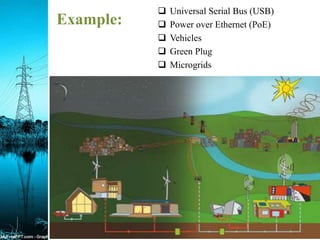
Example:
 Universal Serial Bus (USB)
 Power over Ethernet (PoE)
 Vehicles
 Green Plug
 Microgrids
Benefits & environmental effect
Mini Grid
 Cheaper
 not connected to a main grid
 Independent
 no emission of harmful substances
 590 million people in Africa currently live without access to
electricity.
 little maintenance
Micro grid
 Electric reliability
 Enhances resilience/recovery
 Lower energy costs for consumers and businesses
 Improves the environment and promotes clean energy
 Strengthens the central grid
 Brings economic value to society
NenoGrid
 Scalable at all levels (DC, High Voltage)
 Starting load could be small to reduce the cost of installation
 Unlike AC grid, Scaling up the generation is simple (just adding in
parallel). No synchronization required
 Any standard load can be used
 No maintenance is necessary by the end customer.
 Pre-paid meter makes collection significantly easy
 Supports irrigation pumps for farming.
Economically impacts & users
 A bit more costly than regular supplier
 Regular Maintenance costly
 Not much user friendly (professional only)
Thanks for Your Concern

Solar Mini grid, Nano grid, Micro grid

  • 1.
  • 2.
    Presented By: Md. JannatulNayim Giyem Id: 163-33-3647 Md. Asrafur Rahman Id: 172-33-4002 Md. Arafat Sarker Id: 172-33-4124 Tilottoma Datta Id: 172-33-4196 Arifur Rahman Id: 172-33-4126 Spring’2019 Section A L2_T3 Department of EEE Daffodil International University Presented To: Abu Shahir Md. Khalid Hasan Lecturer Department of EEE Daffodil International University
  • 4.
    What is Grid?? Theelectrical grid is the electrical power system network comprised of the generating plant, the transmission lines, the substation, transformer, the distribution lines and the consumer.
  • 5.
    Mini-grid A mini grid,also sometimes referred to as a "micro grid or isolated grid", can be defined as a set of electricity generators and possibly energy storage systems interconnected to a distribution network that supplies electricity to a localized group of customers
  • 6.
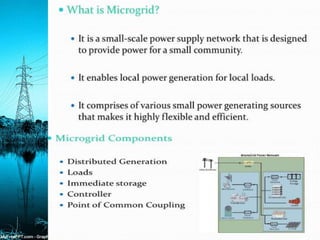
    Micro-grid A microgrid isa small-scale power grid that can operate independently or collaboratively with other small power grids. The practice of using microgrids is known as distributed, dispersed, decentralized, district or embedded energy production.
  • 7.
    Nano-grid Micro-grids are distributedgeneration systems connected to end-users that are stand alone or connected to an electrical network. Solar nano-grids are based on micro- grids but are smaller in size.
  • 8.
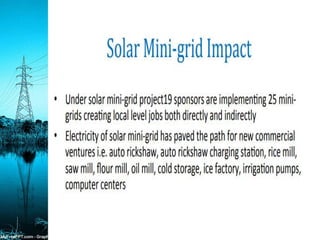
    What is solarmini grid? A mini-grid is a small scale electricity network fed by solar energy. A solar mini-grid boosts business activities in rural areas, but can only be realised economically if the distance between clients is relatively small.
  • 15.
    What is Nano-Grid: Nano-gridsare small micro grids, typically serving a single building or a single load. Navigant Research has developed its own definition of a nano-grid as being 100 kW for grid-tied systems and 5 kW for remote system. In many ways, nano-grids appear to be an even more radical rewiring and rethinking of the world’s energy future than microgrids.
  • 16.
    How dose aNano-grid work? Loads: Loads in a nanogrid can be any electrical device of any size, though generally they will be under 100 W. Controller: In a full nanogrid, devices are always entitled to a minimum amount of power, to enable basic communication functions, and with this, can request more power from the controller. Storage: Storage can be included internal to a Nanogrid, or in a second attached nanogrid that may only contain storage. Gateway: Gateways can be one-way or two-way, and have a capacity limit. Each gateway has two components: communication, and power exchange.
  • 17.
    Example:  Universal SerialBus (USB)  Power over Ethernet (PoE)  Vehicles  Green Plug  Microgrids
  • 18.
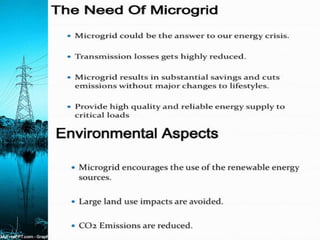
    Benefits & environmentaleffect Mini Grid  Cheaper  not connected to a main grid  Independent  no emission of harmful substances  590 million people in Africa currently live without access to electricity.  little maintenance Micro grid  Electric reliability  Enhances resilience/recovery  Lower energy costs for consumers and businesses  Improves the environment and promotes clean energy  Strengthens the central grid  Brings economic value to society
  • 19.
    NenoGrid  Scalable atall levels (DC, High Voltage)  Starting load could be small to reduce the cost of installation  Unlike AC grid, Scaling up the generation is simple (just adding in parallel). No synchronization required  Any standard load can be used  No maintenance is necessary by the end customer.  Pre-paid meter makes collection significantly easy  Supports irrigation pumps for farming. Economically impacts & users  A bit more costly than regular supplier  Regular Maintenance costly  Not much user friendly (professional only)
  • 20.