1
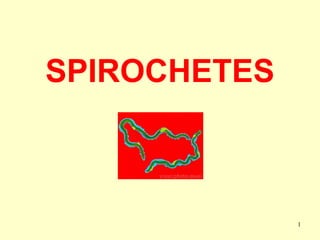
SPIROCHETES
2
Spirochetes
Spirochetes -are elongated motile,
flexible bacteria twisted spirally along the
long axis.
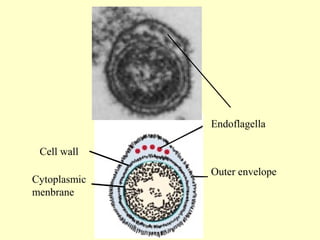
spirochetes contain – endoflegalla which
are polar flagella along the helical
protoplasmic cylinder and situated
between the outer membrane and cell
wall
Cell wall
Cytoplasmic
menbrane
Endoflagella
Outer envelope
4
Human pathogens
Genera Treponema
Borreilia
Leptospira
5
How they appear
6
Comparative Morphology of
Spirochetes
7
Genus Species Disease
Treponema pallidum ssp. pallidum
pallidum ssp. endemicum
pallidum ssp. pertenue
carateum
Syphilis
Bejel
Yaws
Pinta
Borrelia burgdorferi
recurrentis
Many species
Lyme disease (borreliosis)
Epidemic relapsing fever
Endemic relapsing fever
Leptospira interrogans Leptospirosis
(Weil’s Disease)
Spirochaetales Associated
Human Diseases
8
What are Treponema
Greek words
Tripos – Turn
Nema Meaning thread
Relatively short and slender
With fine spirals pointed and round
ends
May be pathogenic or commensals
in the mouth
9
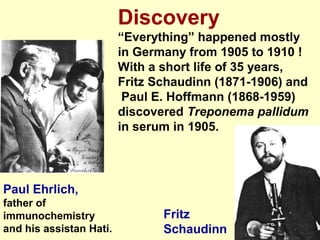
Discovery
“Everything” happened mostly
in Germany from 1905 to 1910 !
With a short life of 35 years,
Fritz Schaudinn (1871-1906) and
Paul E. Hoffmann (1868-1959)
discovered Treponema pallidum
in serum in 1905.
Paul Ehrlich,
father of
immunochemistry
and his assistan Hati.
Fritz
Schaudinn
10
Syphilis
Named from poem
published by the Italian
physician and poet
Girolamo Fracastoro –
shepherd [' epərd]fromʃ
Hispaniola named
Syphilis who angered
Apollo and was given
the disease as
punishment
11
Treponema pallidum
Biological Characteristics
Gram-negative spirochetes
Spirochete from Greek for “coiled hair”
Extremely thin and can be very long
Tightly coiled helical cells with tapered
ends
12
Trepanoma pallidum
Biological Characteristics
Motile, sluggish in viscous['v skəs]environmentsɪ
Size: 0.2 μm in width and 5-l5 μm in length
Structure
• Multilayer cytoplasmic membrane
• Flagella-like fibrils
• Cell wall
• Outer sheath (outer cell envelope)
• Capsule-like outer coat
13
Treponema pallidum
Spiral spirochete can
be seen on fresh
primary or secondary
lesions by dark field
microscopy or
fluorescent antibody
techniques
14
Dark field Microscopy
T. pallidum in the direct fluorescent antibody test
16
Treponema pallidum
Difficult to culture
※ Nichols strain: virulent, cultured in rabbit testis or
anterior chamber of eye, slow growth (doubling time is
30 hr), if cultured in rabbit testis fragments containing
amino acids, the virulence will be lost and Nichols strain
become to Reiter strain.
※ Reiter strain: non-virulent, infected rabbit testis fragments.
17
Cultivation of .. ?
Treponemes cannot be
cultivated in laboratory
media and are maintained
by subculture in
susceptible animals.
TP can cultured in cotton tail
rabbit epithelial cell and
maintain its virulence
Histology:Histology:
Treponema pallidumTreponema pallidum grow in Rabbit’s testisgrow in Rabbit’s testis
Brown color stained with Fontana silver impregnation stain
19
Antigenic structure
The Antigens are complex
Infection with Treponema will induce 3
types of Antigens
Reagin (Antibodies ) – STS
20
Second Group Antigen
T.pallidum
Present in T.pallidum
and Nonpathogenic
cultivable treponemes
21
Third Antigen
• Polysaccharide
species specific
• Positive only in
sera of patients
infected with
pathogenic
Treponema
22
The bacteria rapidly enter the
lymphatic's and widely disseminated via
the bloodstream and may lodge in any
organ. The exact infectious dose for man
is not known, but in experimental animals
fewer than ten organisms are sufficient to
initiate infection.
Pathology
23
Penetration:
T. pallidum enters the body via skin and mucous
membranes through abrasions during sexual contact
Also transmitted transplacentally
Dissemination:
Travels via the lymphatic system to regional lymph
nodes and then throughout the body via the blood
stream
Invasion of the CNS can occur during any stage of
syphilis
Pathology
Transmission
※ sexual contact
※ congenitally
※ blood transfusion
△ Acquired syphilis
※ venereal syphilis
※ syphilis caused by blood transfusion
△ Congenital syphilis
venereal syphilis
27
Primary Disease
Chancre: single lesion, non-tender & firm with
a clean surface, raised border & reddish
color
Usually on the cervix, vaginal wall, anal canal
Draining lymph nodes enlarged & non-tender
28
Primary Syphilis- Penile
Chancre
Clinical Manifestations
Source: CDC/ NCHSTP/ Division of STD Prevention, STD Clinical Slides
29
Basic lesion of syphilis
The chancre is
painless and most
frequently on the
external genitalia,
but it may occur on
the cervix, perianal
area, in the mouth
or anal canal.
30
Primary Syphilis - Chancre
31
Primary Syphilis - Chancre
Primary stage
※ 3 weeks after infection
※ primary lesion —hard
chancre
※ rich in TP
※ infectious highly
※ 4~8w disease course
※ subside spontaneously
33
The chancre usually heals
spontaneously within 3-6 weeks, and 2-
10 weeks later the symptoms of
secondary syphilis develop. These are
highly variable and widespread but most
commonly involve the skin where macular
or pustular lesions develop, particularly
on the trunk and extremities. The lesions
of secondary syphilis are highly
infectious.
Chancre
34
Secondary Syphilis
35
Secondary Syphilis
36
Secondary Syphilis
37
Secondary syphilis
Secondary stage
△ 2~10w after primary stage
※ systemic spread
※ many organisms
※ skin, particularly
△ flu-like symptoms,
rash anywhere on the body
△ rich in TP
△ infectious highly
△ 3w~3m disease course
△ subside spontaneously
39
Relapse of the lesions of secondary
syphilis is common, and latent syphilis is
classified as early (high likelihood of
relapse) or late (recurrence unlikely).
Individuals with late latent syphilis are not
generally considered infectious, but may
still transmit infection to the fetus during
pregnancy and their blood may remain
infectious.
Progress of Disease
40
Following secondary disease, host
enters latent period
•First 4 years = early latent
•Subsequent period = late latent
About 40% of late latent patients
progress to late tertiary syphilitic
disease
Latent Stage Syphilis
41
Affects 2/3 of untreated cases
Gummata: rubbery tumors
Bone deformities
Blindness
Loss of coordination
Paralysis
Insanity
Tertiary Syphilis
△ 5~10 years after infection
△ granulomatous lesions in
skin , bone, and liver
△ degenerative changes in the
central nervous
△ cardiovascular lesions
△ few TP in lesion and blood
Tertiary stage
['ænjər zəm]ɪ
Acquired Syphilis
Primary and secondary syphilis also called early syphilis.
△ infectious highly
△ destructive small
Tertiary syphilis also called late syphilis.
△ infectious small
△ long course of disease
△ destructive highly
44
Passed from
mother to
fetus during
pregnancy
Congenital Syphilis
T. pallidum in the pregnant woman
placenta
Blood circulation of the fetus
Systemic infection of the fetus
Abortion or death of
the fetus
Syphilitic newborn infant
Congenital Syphilis
△ Hutchinson’s teeth
△ Saddlenosema
△ Periostitis
△ A variety of central nervous system anomalies
△ pyoderma……
Congenital Syphilis
Periostitis
1.Microscopic diagnosis
Exudate from skin
lesions(chancre or rash)
Tissue specimens
△ Dark-field
△ Direct fluorescent
antibody staining
△ Silver stain
Microbiological Diagnosis
48
Dark field Microscopy
T. pallidum in the direct fluorescent antibody test
Histology:Histology:
Treponema pallidumTreponema pallidum grow in Rabbit’s testisgrow in Rabbit’s testis
Brown color stained with Fontana silver impregnation stain
51
General screening test, can be adapted to
automation.
CANNOT be performed on CSF.
Antigen
VDRL cardiolipin antigen is modified with choline
chloride to make it more stable
attached to charcoal particles to allow macroscopic
reading
antigen comes prepared and is very stable.
Serum or plasma may be used for testing, serum
is not heated.
Rapid Plasma Reagin Test - RPR
52
Every Pregnant women Needs
Screening
53
Biologic False-Positive
Test Results
Positive STS in persons with no
history or clinical evidence of syphilis
Acute BFP: those that revert [r 'v rt]ɪ ɜː
恢复 to negative in less than 6
months
Chronic BFP: persist > 6 months
54
Prevention & Treatment of Syphilis
Penicillin remains drug of choice
•WHO monitors treatment recommendations
•7-10 days continuously for early stage
•At least 21 days continuously beyond the early
stage
Prevention with barrier methods (e.g.,
condoms)
55
Genus Species Disease
Treponema pallidum ssp. pallidum
pallidum ssp. endemicum
pallidum ssp. pertenue
carateum
Syphilis
Bejel
Yaws
Pinta
Borrelia burgdorferi
recurrentis
Many species
Lyme disease (borreliosis)
Epidemic relapsing fever
Endemic relapsing fever
Leptospira interrogans Leptospirosis
(Weil’s Disease)
Spirochaetales Associated
Human Diseases
Borrelia burgdorferi
Histopathology showing Borrelia burgdorferi spirochetes
in Lyme disease. Dieterle silver stain.
Hard tick
Lyme disease rash
59
Genus Species Disease
Treponema pallidum ssp. pallidum
pallidum ssp. endemicum
pallidum ssp. pertenue
carateum
Syphilis
Bejel
Yaws
Pinta
Borrelia burgdorferi
recurrentis
Many species
Lyme disease (borreliosis)
Epidemic relapsing fever
Endemic relapsing fever
Leptospira interrogans Leptospirosis
(Weil’s Disease)
Spirochaetales Associated
Human Diseases
60
Leptospirosis
61
Scientific Beginning
It was first described by Adolf Weil in
1886 when he reported an "acute
infectious disease with enlargement of
spleen, jaundice and nephritis".
Leptospira was first observed in 1907
from a post mortem renal tissue slice.
62
Leptospirosis - Zoonosis
[zo ' n s s]ʊ ɒ ə ɪ
Leptospirosis is an acute arthropod-
zoonotic[ zo ə'no t k] infection of worldwideˌ ʊ ʊ ɪ
significance caused by spirochete Leptospira
interrogans
World: 25 serogroups , 273
serotypes
China: 19 serogroups , 161
serotypes
63
Leptospirosis also called as Weil’s
Disease after its inventor
.
64
Epidemiology
Rainfall; Contaminated environment;
Poor Sanitation; Inadequate drainage facilities;
Presence of rodents, cattle & stray dogs;
Walking/ working bare foot poses high risk
Difficult to pinpoint the source of infection
Any person can get infected, if exposed to
contaminated and environment
65
Epidemiology
Leptospirosis causes several animal infections
Most wide spread zoonotic infection in Nature
Human infections are accidentally associated with
contamination of water, other materials contaminated
with excreta and animal flesh.
Animal carriers often excrete upto 100 million
leptospira per ml of urine
66
Epidemiology - Occupation
Certain occupational
groups such as
agriculture workers
in rice and cane
fields, miners and
sever cleaners are
potential victims
67
How Man gets Infected
• Water the great source
Drinking
Swimming
Bathing, as the urine of
rodents chronically
contaminate water
sources
Children get infected
when in contact with
infected Dogs
68
Walking in Flood Waters can Infect
• With the rats comes
the threat of illnesses
such as Weil's
Disease, which is
transmitted to
humans via
contaminated water
and is carried by up to
30 percent of the
rodent population.
— natural focus infection disease
△ Susceptible population :
— fieldworker , farmer, stock 家畜
man ,
youngsters in countryside△ Epidemic season :
— summer and autumn
70
Leptospirosis – A Major Zoonotic Infection
Weil's disease is comparatively rare, though
'mild' cases of leptospirosis happen everywhere.
It is believed that leptospirosis is one of the
most common zoonotic infections in the world.
Millions of people are infected each year, but
information and treatment can be limited,
especially in the developed world where cases
are considered 'rare' by the medical community.
71
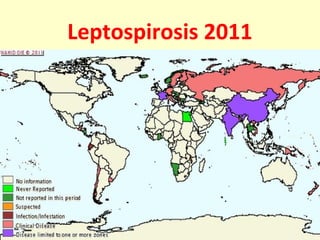
Leptospirosis 2011
72
Reservoirs
Wild and domestic animals rodents,
livestock (cattle, horses, sheep, goats),
canines['ke na n], and wild mammals areɪ ɪ
the reservoir for leptospirosis. Many
animals have prolonged leptospiruria
without suffering from the disease
themselves.
73
What causes Leptospirosis
Leptospirosis is a bacterial disease that
affects humans and animals. Leptospira
bacteria are found worldwide and there are
many different types or serovars capable of
causing disease. Disease caused by Leptospira
bacteria is most common in temperate or
tropical climates .
74
Morphology
• The Leptospira appear
tightly coiled thin flexible
Spirochetes 5 – 15
microns long.
• Fine spiral of 0.1 – 0.2
microns
• One end appears bent
forms a hook.
• Actively motile
• Seen best with dark field
Microscopy.
75
Greater Understanding with Electron
Microscopy
• Electron Microscopy
show thin axial
filament and a
delicate membrane
• In dark field it may
appear as chain of
miniature cocci.
76
Animals spread Leptospirosis
Rats, Mice, Wild Rodents,
Dogs, Swine, Cattle are
principle source of infection
The above animals excrete
Leptospira both in active
infection and Asymptomatic
stage
The Leptospira survive and
remain viable for several
weeks in stagnant water.
77
Modes of Transmission
1. Direct contact with urine or tissue of infected animal
Through skin abrasions, intact mucus membrane
2. Indirect contact
Broken skin with infected soil, water or vegetation
Ingestion of contaminated food & water
3. Droplet infection
Inhalation of droplets of infected urine
78
Transmission
Environment Human
polluti
on
Survive
Urine
Tissue
Feces
Infection
Animal Source
Human infection is accidental
No human to human transmission
79
Pathogenic Strains x Non pathogenic
Leptospirosis
There are several species of Leptospira only
few are pathogenic to Humans, rest to some
Animals and Many in Nature as saprophytes
Leptospira Interrogans is Pathogenic there are
200 serovars.
Leptospira biflexa( 双曲) Non Pathogenic
there are 60 serovars
Further classifications are made on shared
antigens
80
Culturing of Leptospira
• Leptospira grows best under
aerobic [e'ro b k] conditions atʊ ɪ
28 to 30 best demonstrated in℃ ℃
Semi Solid agar media

Optimal growth after 1 – 2 weeks
Leptospirosis
3.Disease:
meningitis
hepatic dysfunction
renal dysfunction
rash
1. Entry (broken
or nomal skin or
mucosa)
2. Spread
4.Exit
82
Pathogenesis
Leptospira are present in the water bodies
Enter through breaks in the skin ( cuts and abrasions ) and
mucous membranes
Enters through Mouth – Nose – Conjunctive
Rarely enters though ingestion.
Incubation period 1 – 2 weeks
When it multiples in blood stream produces fever.
May establish organ involvement in Kidney and Liver,
May produce hemorrhage and necrosis in the tissues
and initiates dysfunction of these organs
83
PATHOGENESIS
leptospira
skin, mucosa
Initial stage leptospiremia toxic symptoms
(1~3days) three symptoms:
fever, myalgia, fatigue;
three signs:
conjunctival suffussion;
muscle tenderness;
enlargement of lymphonodes;
Clinical Illnesses
Types Anicteric (common 95% recover)
Icteric ( Weil’s Syndrome) (rare, fatal)
Hepato-renal syndrome
Hemorrhagic syndrome with ARF
Atypical pneumonia syndrome
Aseptic meningo-encephalitis
Myocarditis, Chronic uveitis
85
Clinical Presentation
Anicteric
Common, mild
< 2% Mortality
Icteric
Rare, Severe
15% Mortality
90%ofCases
10%ofCases
86
Presenting with Jaundice is significant and
Important, serious manifestation
87
Weil’s Syndrome
Weil's syndrome is a severe form of leptospirosis
that causes a continuous fever, stupor, and a
reduction in the blood's ability to clot, which leads
to bleeding within tissues. Blood tests reveal
anaemia. By the third to sixth day, signs of kidney
damage and liver injury appear. Kidney
abnormalities may cause blood in the urine and
painful urination. Liver injury tends to be mild and
usually heals completely.
88
May present as
Atypical Pneumonia
89
Hepatitis - Leptospirosis
• Hepatitis is the frequent
complication
• Elevation of serum
creatine phospholipase
enzyme raise
differentiates from Viral
hepatitis where the
enzyme is not raised
Specimens :
Microbiological Diagnosis
△ Blood (the first week of illness)
△ Urine (the second week of illness)
△ CSF (the patient with meningeal irritation sign)
Etiological [ i t ' ləd ] examinationsˌ ː ɪ ɒ ʒɪ
△ Direct microscopy
◎ Dark-ground microscopy
◎ Silver stain
◎ Fluoresent antibody staining
△ Culture isolation and identification : Korthof
liquid medium
△ Animal test
△ Molecular diagnostics
92
Leptospira under the Microscope
Long, Thin, Highly Coiled
Dark Field Microscopy FL
Serological examinations
Paired serum
△ Microscopic agglutination test ( MAT )
△ Indirect agglutination test
△ Complement fixation test
△ IFA
△ ELISA
94
Treatment
Antibiotic of choice is Benzyl Penicillin
given by injection in doses of 5 mega units in
a day, for 5 days.
95
Control of Leptospirosis
• Rodent control is
most important.
• Human’s should avoid
contact with water
contaminated by
animals.
96
Vaccination in humans
Vaccination for humans is justified where they
cannot be separated from animal sources or where the
animals cannot be immunized successfully
Necessity of human vaccinated will arise where
people live and work in proximity [pr k's m ti]toɑː ɪ ə
rodents in wet, tropical conditions, in wet rice planting
and harvesting, in military operations, or working in
sewers 阴沟 .
Yet no universally accepted vaccine
is available for humans
97
Vaccination of Animals
Vaccinating animals have a dual purpose
1 Protecting animals
2 Protecting humans who may contract
['k ntrækt]leptospirɑː a from them
It is probably true as that immunization of
animals will prevent leptospirosis in people in
contact with them.
Several other vaccines in use to suit local
needs.
Exercises:
Reagin Gummata
1.What are the 3 major groups of SPIROCHETES that
cause human disease?
2.What is the PATHOGENESIS of the TREPONEMA?
a) Incubation? b) Primary lesion? c) Secondary lesion?
d) Tertiary lesion?
3.What’s the pathgenicity of Leptospira?

17 spirochetes

  • 1.
  • 2.
    2 Spirochetes Spirochetes -are elongatedmotile, flexible bacteria twisted spirally along the long axis. spirochetes contain – endoflegalla which are polar flagella along the helical protoplasmic cylinder and situated between the outer membrane and cell wall
  • 3.
  • 4.
  • 5.
  • 6.
  • 7.
    7 Genus Species Disease Treponemapallidum ssp. pallidum pallidum ssp. endemicum pallidum ssp. pertenue carateum Syphilis Bejel Yaws Pinta Borrelia burgdorferi recurrentis Many species Lyme disease (borreliosis) Epidemic relapsing fever Endemic relapsing fever Leptospira interrogans Leptospirosis (Weil’s Disease) Spirochaetales Associated Human Diseases
  • 8.
    8 What are Treponema Greekwords Tripos – Turn Nema Meaning thread Relatively short and slender With fine spirals pointed and round ends May be pathogenic or commensals in the mouth
  • 9.
    9 Discovery “Everything” happened mostly inGermany from 1905 to 1910 ! With a short life of 35 years, Fritz Schaudinn (1871-1906) and Paul E. Hoffmann (1868-1959) discovered Treponema pallidum in serum in 1905. Paul Ehrlich, father of immunochemistry and his assistan Hati. Fritz Schaudinn
  • 10.
    10 Syphilis Named from poem publishedby the Italian physician and poet Girolamo Fracastoro – shepherd [' epərd]fromʃ Hispaniola named Syphilis who angered Apollo and was given the disease as punishment
  • 11.
    11 Treponema pallidum Biological Characteristics Gram-negativespirochetes Spirochete from Greek for “coiled hair” Extremely thin and can be very long Tightly coiled helical cells with tapered ends
  • 12.
    12 Trepanoma pallidum Biological Characteristics Motile,sluggish in viscous['v skəs]environmentsɪ Size: 0.2 μm in width and 5-l5 μm in length Structure • Multilayer cytoplasmic membrane • Flagella-like fibrils • Cell wall • Outer sheath (outer cell envelope) • Capsule-like outer coat
  • 13.
    13 Treponema pallidum Spiral spirochetecan be seen on fresh primary or secondary lesions by dark field microscopy or fluorescent antibody techniques
  • 14.
  • 15.
    T. pallidum inthe direct fluorescent antibody test
  • 16.
    16 Treponema pallidum Difficult toculture ※ Nichols strain: virulent, cultured in rabbit testis or anterior chamber of eye, slow growth (doubling time is 30 hr), if cultured in rabbit testis fragments containing amino acids, the virulence will be lost and Nichols strain become to Reiter strain. ※ Reiter strain: non-virulent, infected rabbit testis fragments.
  • 17.
    17 Cultivation of ..? Treponemes cannot be cultivated in laboratory media and are maintained by subculture in susceptible animals. TP can cultured in cotton tail rabbit epithelial cell and maintain its virulence
  • 18.
    Histology:Histology: Treponema pallidumTreponema pallidumgrow in Rabbit’s testisgrow in Rabbit’s testis Brown color stained with Fontana silver impregnation stain
  • 19.
    19 Antigenic structure The Antigensare complex Infection with Treponema will induce 3 types of Antigens Reagin (Antibodies ) – STS
  • 20.
    20 Second Group Antigen T.pallidum Presentin T.pallidum and Nonpathogenic cultivable treponemes
  • 21.
    21 Third Antigen • Polysaccharide speciesspecific • Positive only in sera of patients infected with pathogenic Treponema
  • 22.
    22 The bacteria rapidlyenter the lymphatic's and widely disseminated via the bloodstream and may lodge in any organ. The exact infectious dose for man is not known, but in experimental animals fewer than ten organisms are sufficient to initiate infection. Pathology
  • 23.
    23 Penetration: T. pallidum entersthe body via skin and mucous membranes through abrasions during sexual contact Also transmitted transplacentally Dissemination: Travels via the lymphatic system to regional lymph nodes and then throughout the body via the blood stream Invasion of the CNS can occur during any stage of syphilis Pathology
  • 24.
    Transmission ※ sexual contact ※congenitally ※ blood transfusion
  • 25.
    △ Acquired syphilis ※venereal syphilis ※ syphilis caused by blood transfusion △ Congenital syphilis
  • 26.
  • 27.
    27 Primary Disease Chancre: singlelesion, non-tender & firm with a clean surface, raised border & reddish color Usually on the cervix, vaginal wall, anal canal Draining lymph nodes enlarged & non-tender
  • 28.
    28 Primary Syphilis- Penile Chancre ClinicalManifestations Source: CDC/ NCHSTP/ Division of STD Prevention, STD Clinical Slides
  • 29.
    29 Basic lesion ofsyphilis The chancre is painless and most frequently on the external genitalia, but it may occur on the cervix, perianal area, in the mouth or anal canal.
  • 30.
  • 31.
  • 32.
    Primary stage ※ 3weeks after infection ※ primary lesion —hard chancre ※ rich in TP ※ infectious highly ※ 4~8w disease course ※ subside spontaneously
  • 33.
    33 The chancre usuallyheals spontaneously within 3-6 weeks, and 2- 10 weeks later the symptoms of secondary syphilis develop. These are highly variable and widespread but most commonly involve the skin where macular or pustular lesions develop, particularly on the trunk and extremities. The lesions of secondary syphilis are highly infectious. Chancre
  • 34.
  • 35.
  • 36.
  • 37.
  • 38.
    Secondary stage △ 2~10wafter primary stage ※ systemic spread ※ many organisms ※ skin, particularly △ flu-like symptoms, rash anywhere on the body △ rich in TP △ infectious highly △ 3w~3m disease course △ subside spontaneously
  • 39.
    39 Relapse of thelesions of secondary syphilis is common, and latent syphilis is classified as early (high likelihood of relapse) or late (recurrence unlikely). Individuals with late latent syphilis are not generally considered infectious, but may still transmit infection to the fetus during pregnancy and their blood may remain infectious. Progress of Disease
  • 40.
    40 Following secondary disease,host enters latent period •First 4 years = early latent •Subsequent period = late latent About 40% of late latent patients progress to late tertiary syphilitic disease Latent Stage Syphilis
  • 41.
    41 Affects 2/3 ofuntreated cases Gummata: rubbery tumors Bone deformities Blindness Loss of coordination Paralysis Insanity Tertiary Syphilis
  • 42.
    △ 5~10 yearsafter infection △ granulomatous lesions in skin , bone, and liver △ degenerative changes in the central nervous △ cardiovascular lesions △ few TP in lesion and blood Tertiary stage ['ænjər zəm]ɪ
  • 43.
    Acquired Syphilis Primary andsecondary syphilis also called early syphilis. △ infectious highly △ destructive small Tertiary syphilis also called late syphilis. △ infectious small △ long course of disease △ destructive highly
  • 44.
    44 Passed from mother to fetusduring pregnancy Congenital Syphilis
  • 45.
    T. pallidum inthe pregnant woman placenta Blood circulation of the fetus Systemic infection of the fetus Abortion or death of the fetus Syphilitic newborn infant Congenital Syphilis
  • 46.
    △ Hutchinson’s teeth △Saddlenosema △ Periostitis △ A variety of central nervous system anomalies △ pyoderma…… Congenital Syphilis Periostitis
  • 47.
    1.Microscopic diagnosis Exudate fromskin lesions(chancre or rash) Tissue specimens △ Dark-field △ Direct fluorescent antibody staining △ Silver stain Microbiological Diagnosis
  • 48.
  • 49.
    T. pallidum inthe direct fluorescent antibody test
  • 50.
    Histology:Histology: Treponema pallidumTreponema pallidumgrow in Rabbit’s testisgrow in Rabbit’s testis Brown color stained with Fontana silver impregnation stain
  • 51.
    51 General screening test,can be adapted to automation. CANNOT be performed on CSF. Antigen VDRL cardiolipin antigen is modified with choline chloride to make it more stable attached to charcoal particles to allow macroscopic reading antigen comes prepared and is very stable. Serum or plasma may be used for testing, serum is not heated. Rapid Plasma Reagin Test - RPR
  • 52.
    52 Every Pregnant womenNeeds Screening
  • 53.
    53 Biologic False-Positive Test Results PositiveSTS in persons with no history or clinical evidence of syphilis Acute BFP: those that revert [r 'v rt]ɪ ɜː 恢复 to negative in less than 6 months Chronic BFP: persist > 6 months
  • 54.
    54 Prevention & Treatmentof Syphilis Penicillin remains drug of choice •WHO monitors treatment recommendations •7-10 days continuously for early stage •At least 21 days continuously beyond the early stage Prevention with barrier methods (e.g., condoms)
  • 55.
    55 Genus Species Disease Treponemapallidum ssp. pallidum pallidum ssp. endemicum pallidum ssp. pertenue carateum Syphilis Bejel Yaws Pinta Borrelia burgdorferi recurrentis Many species Lyme disease (borreliosis) Epidemic relapsing fever Endemic relapsing fever Leptospira interrogans Leptospirosis (Weil’s Disease) Spirochaetales Associated Human Diseases
  • 56.
    Borrelia burgdorferi Histopathology showingBorrelia burgdorferi spirochetes in Lyme disease. Dieterle silver stain.
  • 57.
  • 58.
  • 59.
    59 Genus Species Disease Treponemapallidum ssp. pallidum pallidum ssp. endemicum pallidum ssp. pertenue carateum Syphilis Bejel Yaws Pinta Borrelia burgdorferi recurrentis Many species Lyme disease (borreliosis) Epidemic relapsing fever Endemic relapsing fever Leptospira interrogans Leptospirosis (Weil’s Disease) Spirochaetales Associated Human Diseases
  • 60.
  • 61.
    61 Scientific Beginning It wasfirst described by Adolf Weil in 1886 when he reported an "acute infectious disease with enlargement of spleen, jaundice and nephritis". Leptospira was first observed in 1907 from a post mortem renal tissue slice.
  • 62.
    62 Leptospirosis - Zoonosis [zo' n s s]ʊ ɒ ə ɪ Leptospirosis is an acute arthropod- zoonotic[ zo ə'no t k] infection of worldwideˌ ʊ ʊ ɪ significance caused by spirochete Leptospira interrogans World: 25 serogroups , 273 serotypes China: 19 serogroups , 161 serotypes
  • 63.
    63 Leptospirosis also calledas Weil’s Disease after its inventor .
  • 64.
    64 Epidemiology Rainfall; Contaminated environment; PoorSanitation; Inadequate drainage facilities; Presence of rodents, cattle & stray dogs; Walking/ working bare foot poses high risk Difficult to pinpoint the source of infection Any person can get infected, if exposed to contaminated and environment
  • 65.
    65 Epidemiology Leptospirosis causes severalanimal infections Most wide spread zoonotic infection in Nature Human infections are accidentally associated with contamination of water, other materials contaminated with excreta and animal flesh. Animal carriers often excrete upto 100 million leptospira per ml of urine
  • 66.
    66 Epidemiology - Occupation Certainoccupational groups such as agriculture workers in rice and cane fields, miners and sever cleaners are potential victims
  • 67.
    67 How Man getsInfected • Water the great source Drinking Swimming Bathing, as the urine of rodents chronically contaminate water sources Children get infected when in contact with infected Dogs
  • 68.
    68 Walking in FloodWaters can Infect • With the rats comes the threat of illnesses such as Weil's Disease, which is transmitted to humans via contaminated water and is carried by up to 30 percent of the rodent population.
  • 69.
    — natural focusinfection disease △ Susceptible population : — fieldworker , farmer, stock 家畜 man , youngsters in countryside△ Epidemic season : — summer and autumn
  • 70.
    70 Leptospirosis – AMajor Zoonotic Infection Weil's disease is comparatively rare, though 'mild' cases of leptospirosis happen everywhere. It is believed that leptospirosis is one of the most common zoonotic infections in the world. Millions of people are infected each year, but information and treatment can be limited, especially in the developed world where cases are considered 'rare' by the medical community.
  • 71.
  • 72.
    72 Reservoirs Wild and domesticanimals rodents, livestock (cattle, horses, sheep, goats), canines['ke na n], and wild mammals areɪ ɪ the reservoir for leptospirosis. Many animals have prolonged leptospiruria without suffering from the disease themselves.
  • 73.
    73 What causes Leptospirosis Leptospirosisis a bacterial disease that affects humans and animals. Leptospira bacteria are found worldwide and there are many different types or serovars capable of causing disease. Disease caused by Leptospira bacteria is most common in temperate or tropical climates .
  • 74.
    74 Morphology • The Leptospiraappear tightly coiled thin flexible Spirochetes 5 – 15 microns long. • Fine spiral of 0.1 – 0.2 microns • One end appears bent forms a hook. • Actively motile • Seen best with dark field Microscopy.
  • 75.
    75 Greater Understanding withElectron Microscopy • Electron Microscopy show thin axial filament and a delicate membrane • In dark field it may appear as chain of miniature cocci.
  • 76.
    76 Animals spread Leptospirosis Rats,Mice, Wild Rodents, Dogs, Swine, Cattle are principle source of infection The above animals excrete Leptospira both in active infection and Asymptomatic stage The Leptospira survive and remain viable for several weeks in stagnant water.
  • 77.
    77 Modes of Transmission 1.Direct contact with urine or tissue of infected animal Through skin abrasions, intact mucus membrane 2. Indirect contact Broken skin with infected soil, water or vegetation Ingestion of contaminated food & water 3. Droplet infection Inhalation of droplets of infected urine
  • 78.
  • 79.
    79 Pathogenic Strains xNon pathogenic Leptospirosis There are several species of Leptospira only few are pathogenic to Humans, rest to some Animals and Many in Nature as saprophytes Leptospira Interrogans is Pathogenic there are 200 serovars. Leptospira biflexa( 双曲) Non Pathogenic there are 60 serovars Further classifications are made on shared antigens
  • 80.
    80 Culturing of Leptospira •Leptospira grows best under aerobic [e'ro b k] conditions atʊ ɪ 28 to 30 best demonstrated in℃ ℃ Semi Solid agar media  Optimal growth after 1 – 2 weeks
  • 81.
    Leptospirosis 3.Disease: meningitis hepatic dysfunction renal dysfunction rash 1.Entry (broken or nomal skin or mucosa) 2. Spread 4.Exit
  • 82.
    82 Pathogenesis Leptospira are presentin the water bodies Enter through breaks in the skin ( cuts and abrasions ) and mucous membranes Enters through Mouth – Nose – Conjunctive Rarely enters though ingestion. Incubation period 1 – 2 weeks When it multiples in blood stream produces fever. May establish organ involvement in Kidney and Liver, May produce hemorrhage and necrosis in the tissues and initiates dysfunction of these organs
  • 83.
    83 PATHOGENESIS leptospira skin, mucosa Initial stageleptospiremia toxic symptoms (1~3days) three symptoms: fever, myalgia, fatigue; three signs: conjunctival suffussion; muscle tenderness; enlargement of lymphonodes;
  • 84.
    Clinical Illnesses Types Anicteric(common 95% recover) Icteric ( Weil’s Syndrome) (rare, fatal) Hepato-renal syndrome Hemorrhagic syndrome with ARF Atypical pneumonia syndrome Aseptic meningo-encephalitis Myocarditis, Chronic uveitis
  • 85.
    85 Clinical Presentation Anicteric Common, mild <2% Mortality Icteric Rare, Severe 15% Mortality 90%ofCases 10%ofCases
  • 86.
    86 Presenting with Jaundiceis significant and Important, serious manifestation
  • 87.
    87 Weil’s Syndrome Weil's syndromeis a severe form of leptospirosis that causes a continuous fever, stupor, and a reduction in the blood's ability to clot, which leads to bleeding within tissues. Blood tests reveal anaemia. By the third to sixth day, signs of kidney damage and liver injury appear. Kidney abnormalities may cause blood in the urine and painful urination. Liver injury tends to be mild and usually heals completely.
  • 88.
  • 89.
    89 Hepatitis - Leptospirosis •Hepatitis is the frequent complication • Elevation of serum creatine phospholipase enzyme raise differentiates from Viral hepatitis where the enzyme is not raised
  • 90.
    Specimens : Microbiological Diagnosis △Blood (the first week of illness) △ Urine (the second week of illness) △ CSF (the patient with meningeal irritation sign)
  • 91.
    Etiological [ it ' ləd ] examinationsˌ ː ɪ ɒ ʒɪ △ Direct microscopy ◎ Dark-ground microscopy ◎ Silver stain ◎ Fluoresent antibody staining △ Culture isolation and identification : Korthof liquid medium △ Animal test △ Molecular diagnostics
  • 92.
    92 Leptospira under theMicroscope Long, Thin, Highly Coiled Dark Field Microscopy FL
  • 93.
    Serological examinations Paired serum △Microscopic agglutination test ( MAT ) △ Indirect agglutination test △ Complement fixation test △ IFA △ ELISA
  • 94.
    94 Treatment Antibiotic of choiceis Benzyl Penicillin given by injection in doses of 5 mega units in a day, for 5 days.
  • 95.
    95 Control of Leptospirosis •Rodent control is most important. • Human’s should avoid contact with water contaminated by animals.
  • 96.
    96 Vaccination in humans Vaccinationfor humans is justified where they cannot be separated from animal sources or where the animals cannot be immunized successfully Necessity of human vaccinated will arise where people live and work in proximity [pr k's m ti]toɑː ɪ ə rodents in wet, tropical conditions, in wet rice planting and harvesting, in military operations, or working in sewers 阴沟 . Yet no universally accepted vaccine is available for humans
  • 97.
    97 Vaccination of Animals Vaccinatinganimals have a dual purpose 1 Protecting animals 2 Protecting humans who may contract ['k ntrækt]leptospirɑː a from them It is probably true as that immunization of animals will prevent leptospirosis in people in contact with them. Several other vaccines in use to suit local needs.
  • 98.
    Exercises: Reagin Gummata 1.What arethe 3 major groups of SPIROCHETES that cause human disease? 2.What is the PATHOGENESIS of the TREPONEMA? a) Incubation? b) Primary lesion? c) Secondary lesion? d) Tertiary lesion? 3.What’s the pathgenicity of Leptospira?

Editor's Notes