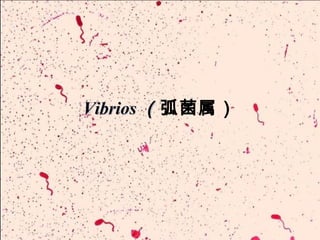
VibriosVibrios ((弧菌属)
※ Vibrio cholerae (霍乱弧菌) -gastroenteritis
※ Vibrio parahaemolyticus (副溶血性弧菌) -
gastroenteritis, wound infection, bacteremia
※ Vibrio vulnificus (嗜盐弧菌) -wound infection,
bacteremia
Overview
※※ G-G- vibrio
※※ CCurves or comma shapedurves or comma shaped
※※ Non-spore formingNon-spore forming
※※ Highly motile-single polar flagellaHighly motile-single polar flagella
※※ OxidaseOxidase (( ++ ))
※※ Facultative anaerobeFacultative anaerobe
※※ Tolerate alkaline condition to pH9.0Tolerate alkaline condition to pH9.0
※※ RReadily cultivatedeadily cultivated,, simple nutritional requirementssimple nutritional requirements
※※ Associated with salt waterAssociated with salt water
CharacteristicsCharacteristicsOverview
two groupstwo groups
1.1. non-halophilicnon-halophilic vibrios: includingvibrios: including V. choleraeV. cholerae andand
other species that are able to grow in media withoutother species that are able to grow in media without
added salt.added salt.
2.2. halophilichalophilic ((喜盐的) vibros: species which do notvibros: species which do not
grow in media without added salt.grow in media without added salt.
V. choleraeV. cholerae andand V. parahaemolyticusV. parahaemolyticus are pathogensare pathogens
of humans.of humans.
ClassificationClassification
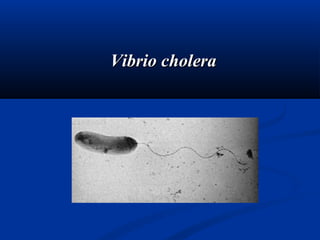
Vibrio choleraVibrio cholera
Cholera
▲ one of the most serious infectious diseases.
▲ also an infectious disease that international quarantine (国
际检疫) .
▲ It is in the second place of the most serious infectious
deseases in the Communicable Disease Prevention Law of
China. So it is also called the No.2 disease in China.
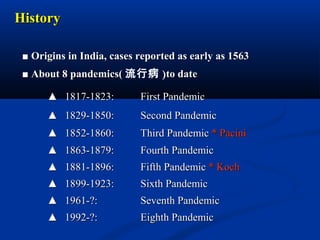
HistoryHistory
▲▲ 1817-1823:1817-1823: First PandemicFirst Pandemic
▲▲ 1829-1850:1829-1850: Second PandemicSecond Pandemic
▲▲ 1852-1860:1852-1860: Third PandemicThird Pandemic * Pacini* Pacini
▲▲ 1863-1879:1863-1879: Fourth PandemicFourth Pandemic
▲▲ 1881-1896:1881-1896: Fifth PandemicFifth Pandemic * Koch* Koch
▲▲ 1899-1923:1899-1923: Sixth PandemicSixth Pandemic
▲▲ 1961-?:1961-?: Seventh PandemicSeventh Pandemic
▲▲ 1992-?:1992-?: Eighth PandemicEighth Pandemic
■■ Origins in India, cases reported as early as 1563Origins in India, cases reported as early as 1563
■■ About 8 pandemics(About 8 pandemics( 流行病 )to dateto date
Causative Agent DiscoveryCausative Agent Discovery
■■ John Snow (1813-1858):John Snow (1813-1858):
■■ Water borne transmissionWater borne transmission
of Cholera (1855)of Cholera (1855)
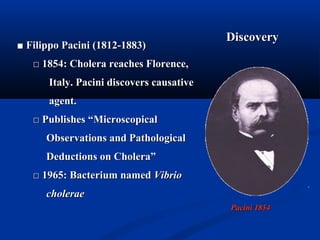
DiscoveryDiscovery
■■ Filippo Pacini (1812-1883)Filippo Pacini (1812-1883)
□□ 1854: Cholera reaches Florence,1854: Cholera reaches Florence,
Italy. Pacini discovers causativeItaly. Pacini discovers causative
agent.agent.
□□ Publishes “MicroscopicalPublishes “Microscopical
Observations and PathologicalObservations and Pathological
Deductions on Cholera”Deductions on Cholera”
□□ 1965: Bacterium named1965: Bacterium named VibrioVibrio
choleraecholerae
Pacini 1854Pacini 1854
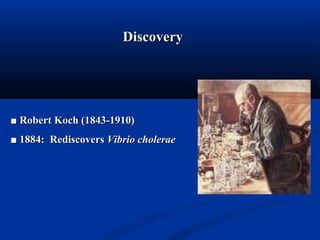
■■ Robert Koch (1843-1910)Robert Koch (1843-1910)
■■ 1884: Rediscovers1884: Rediscovers Vibrio choleraeVibrio cholerae
DiscoveryDiscovery
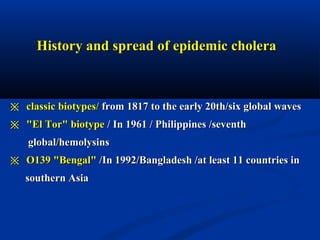
History and spread of epidemic choleraHistory and spread of epidemic cholera
※※ classic biotypes/classic biotypes/ from 1817 to the early 20th/six global wavesfrom 1817 to the early 20th/six global waves
※※ "El Tor" biotype"El Tor" biotype / In 1961 / Philippines /seventh/ In 1961 / Philippines /seventh
global/hemolysinsglobal/hemolysins
※※ O139 "Bengal"O139 "Bengal" /In 1992/Bangladesh /at least 11 countries in/In 1992/Bangladesh /at least 11 countries in
southern Asiasouthern Asia
Vibrio choleraeVibrio cholerae
▲▲ Antigenic structureAntigenic structure
※※ Common heat-labile flagellar H antigenCommon heat-labile flagellar H antigen
※※ O lipopolysaccharide :O lipopolysaccharide : serologic specificityserologic specificity
△△ More than 150 O antigen serogroupsMore than 150 O antigen serogroups
△△ Only O1 and O139 serogroups cause AsiaticOnly O1 and O139 serogroups cause Asiatic
[ e i'æt k] choleraˌ ɪʃ ɪ[ e i'æt k] choleraˌ ɪʃ ɪ
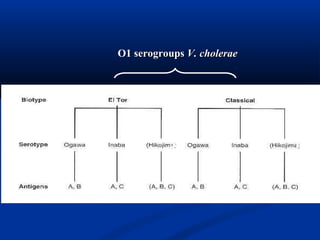
■ Three serotypes: Ogawa■ Three serotypes: Ogawa 小川型 , Inaba, Inaba 稻叶型 ,,
HikojimaHikojima 彦岛型
■■ Two biovars : classic and El TorTwo biovars : classic and El Tor
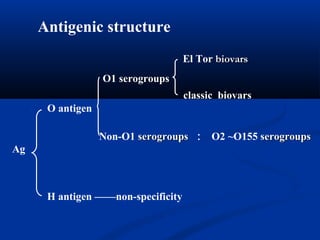
Antigenic structure
Ag
O antigen
H antigen ——non-specificity
O1 serogroupsserogroups
Non-O1 serogroupsserogroups : O2 ~O155 serogroupsserogroups
El Tor biovarsbiovars
classicclassic biovarsbiovars
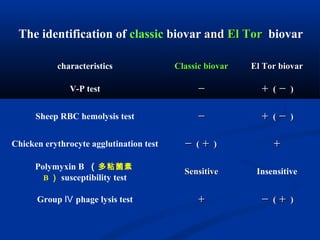
The identification of classic biovar andand El TorEl Tor biovar
characteristics Classic biovarClassic biovar El Tor biovarEl Tor biovar
V-P test -- ++ (( -- ))
Sheep RBC hemolysis test -- ++ (( -- ))
Chicken erythrocyte agglutination test -- (( ++ )) ++
Polymyxin B (多粘菌素
B ) susceptibility test
SensitiveSensitive Insensitive
Group phage lysis testⅣ ++ -- (( ++ ))
小
川
型
稻
叶
型
彦
岛
型
小
川
型
稻
叶
型
彦
岛
型
O1 serogroupsserogroups V. choleraeV. cholerae
Vibrio choleraeVibrio cholerae
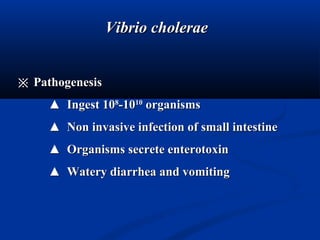
※※ PathogenesisPathogenesis
▲▲ Ingest 10Ingest 1088
-10-101010
organismsorganisms
▲▲ Non invasive infection of small intestineNon invasive infection of small intestine
▲▲ Organisms secrete enterotoxinOrganisms secrete enterotoxin
▲▲ Watery diarrhea and vomitingWatery diarrhea and vomiting
Pathogenesis
1. cholera toxin: coded by ctxA and ctxB gene in Prophage
2. flagella and pili
3. other toxic factors : such as Hly A(hemolytic-cytolytic A),
hap (hemagglutinin/protease), capsule and Special LPS
toxicity epitopes in O139 serogroups.
4. Enzymes: such as IgA1 Protease, mucinase ['mju s ne s]ː ɪ ɪ 粘
蛋白酶
Major pathogenic substances
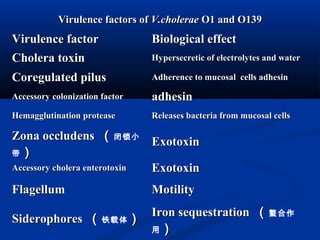
Virulence factors ofVirulence factors of V.choleraeV.cholerae O1 and O139O1 and O139
Virulence factorVirulence factor Biological effectBiological effect
Cholera toxinCholera toxin Hypersecretic of electrolytes and waterHypersecretic of electrolytes and water
Coregulated pilusCoregulated pilus Adherence to mucosal cells adhesinAdherence to mucosal cells adhesin
Accessory colonization factorAccessory colonization factor adhesinadhesin
Hemagglutination proteaseHemagglutination protease Releases bacteria from mucosal cellsReleases bacteria from mucosal cells
Zona occludensZona occludens ((闭锁小
带 ))
ExotoxinExotoxin
Accessory cholera enterotoxinAccessory cholera enterotoxin ExotoxinExotoxin
FlagellumFlagellum MotilityMotility
SiderophoresSiderophores ((铁载体 )) Iron sequestrationIron sequestration ((螯合作
用 ))
Pathogenesis
Cholera ToxinCholera Toxin
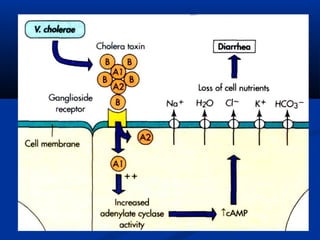
 Cholera toxin activates theCholera toxin activates the
adenylate [ə'den le t]ɪ ɪadenylate [ə'den le t]ɪ ɪ
cyclasecyclase
in cells of the intestinalin cells of the intestinal
mucosa leading tomucosa leading to
increasedincreased levels oflevels of
intracellularintracellular cAMPcAMP, and, and
the secretion of Hthe secretion of H220,0,
NaNa+sodium+sodium
, K, K++
, Cl, Cl-chlorine-chlorine
, and, and
HCOHCO33
--
into the lumen of theinto the lumen of the
small intestinesmall intestine
 The toxin has beenThe toxin has been
characterized and containscharacterized and contains 55
binding (B) subunitsbinding (B) subunits ofof
11,500 daltons, an11,500 daltons, an activeactive
(A1) subunit(A1) subunit of 23,500 daltons,of 23,500 daltons,
andand a bridging piece (A2)a bridging piece (A2) ofof
5,500 daltons that links A15,500 daltons that links A1
to the 5B subunits.to the 5B subunits.
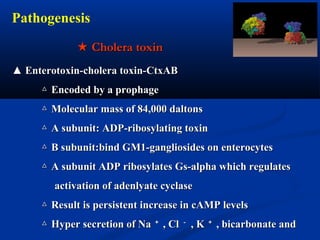
★★ Cholera toxinCholera toxin
▲▲ Enterotoxin-cholera toxin-CtxABEnterotoxin-cholera toxin-CtxAB
△△ Encoded by a prophageEncoded by a prophage
△△ Molecular mass of 84,000 daltonsMolecular mass of 84,000 daltons
△△ A subunit: ADP-ribosylating toxinA subunit: ADP-ribosylating toxin
△△ B subunit:bind GM1-gangliosides on enterocytesB subunit:bind GM1-gangliosides on enterocytes
△△ A subunit ADP ribosylates Gs-alpha which regulatesA subunit ADP ribosylates Gs-alpha which regulates
activation of adenlyate cyclaseactivation of adenlyate cyclase
△△ Result is persistent increase in cAMP levelsResult is persistent increase in cAMP levels
△△ Hyper secretion of NaHyper secretion of Na ++
, Cl, Cl --
, K, K ++
, bicarbonate and, bicarbonate and
Pathogenesis
Pathogenesis
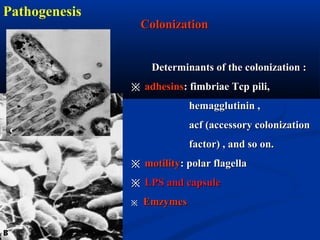
ColonizationColonization
Determinants of the colonization :Determinants of the colonization :
※※ adhesinsadhesins: fimbriae Tcp pili,: fimbriae Tcp pili,
hemagglutinin ,hemagglutinin ,
acf (accessory colonizationacf (accessory colonization
factor) , and so on.factor) , and so on.
※※ motilitymotility: polar flagella: polar flagella
※※ LPS and capsuleLPS and capsule
※※ EmzymesEmzymes
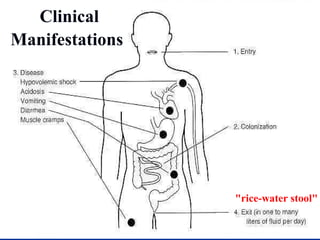
Vibrio choleraeVibrio cholerae--Clinical manifestationsClinical manifestations
▲▲ Asymptomatic colonization to fatal diarrheaAsymptomatic colonization to fatal diarrhea
▲▲ Onset 2-3 days after ingestionOnset 2-3 days after ingestion
▲▲ Abrupt onset of watery diarrhea and vomitingAbrupt onset of watery diarrhea and vomiting
▲▲ Rice water stoolsRice water stools
▲▲ Severe fluid and electrolyte loss-dehydration, metabolicSevere fluid and electrolyte loss-dehydration, metabolic
acidosis [ æs 'do s s]ˌ ɪ ʊ ɪacidosis [ æs 'do s s]ˌ ɪ ʊ ɪ ((酸中毒 ), hypovolemic, hypovolemic
[ha p 'və lem k]shock(ɪ ɒ ʊ ɪ[ha p 'və lem k]shock(ɪ ɒ ʊ ɪ 血容量减少性休克) , renal, renal
failurefailure
▲▲ Death 60% if untreated, 1% if treated for fluid lossDeath 60% if untreated, 1% if treated for fluid loss
Clinical
Manifestations
"rice-water stool"
Immunity to CholeraImmunity to Cholera
※※ Secretory IgA, as well as IgG and IgM in serum exudate,Secretory IgA, as well as IgG and IgM in serum exudate,
can be detected in the intestinal mucosa of immunecan be detected in the intestinal mucosa of immune
individuals.individuals.
※※ Vibriocidal antibodies reach a peak 8-10 days after theVibriocidal antibodies reach a peak 8-10 days after the
onset of clinical illness, and then decrease, returning toonset of clinical illness, and then decrease, returning to
the baseline 2 - 7 months later.the baseline 2 - 7 months later.
Bacteriological DiagnosisBacteriological Diagnosis
■■ Specimens: stool, vomitus.Specimens: stool, vomitus.
■■ MethodsMethods
□□ hanging drop testhanging drop test
□□ Stained smearStained smear
□□ Culture: alkaline peptone water or alkaline peptoneCulture: alkaline peptone water or alkaline peptone
agar plate, and thiosulfate [ θa o 's lfe t]ˌ ɪ ʊ ʌ ɪagar plate, and thiosulfate [ θa o 's lfe t]ˌ ɪ ʊ ʌ ɪ –citrate––citrate–
bile-salts (TCBS) agar plate.bile-salts (TCBS) agar plate.
□□ Quick immunological methods:Quick immunological methods:
immunofluorescent “ball” test; PCR, etc.immunofluorescent “ball” test; PCR, etc.
※※ Rapid intravenous fluid and electrolyteRapid intravenous fluid and electrolyte replacementreplacement
※※ Most antibiotics and chemotherapeutic agents haveMost antibiotics and chemotherapeutic agents have
no value in cholera therapy.no value in cholera therapy.
TreatmentTreatment
Prevention & ControlPrevention & Control
■■ ImmunizationImmunization
▲▲ Active Immunity induced by:Active Immunity induced by:
△△ A parenteral [pə'rentərəl]A parenteral [pə'rentərəl] 肠胃外的肠胃外的 vaccine of wholevaccine of whole
killed bacteria has been used widelykilled bacteria has been used widely
△△ attenuatedattenuated V. choleraeV. cholerae
△△ Toxoid (not good antigen)Toxoid (not good antigen)
■■ Preventing contamination of food and water e.g. boilingPreventing contamination of food and water e.g. boiling
water, covering foodwater, covering food
■■ Strengthen health educationStrengthen health education :: Personal and domestic hygienePersonal and domestic hygiene
■■ Prevention of contamination of water suppliesPrevention of contamination of water supplies
▲▲ Improvement of sewage systemsImprovement of sewage systems
■■ Antibiotic prophylaxisAntibiotic prophylaxis
Exercises:
1. Please briefly describe the mechanism of cholera
toxin

11 vibrios

  • 1.
  • 2.
    ※ Vibrio cholerae(霍乱弧菌) -gastroenteritis ※ Vibrio parahaemolyticus (副溶血性弧菌) - gastroenteritis, wound infection, bacteremia ※ Vibrio vulnificus (嗜盐弧菌) -wound infection, bacteremia Overview
  • 3.
    ※※ G-G- vibrio ※※CCurves or comma shapedurves or comma shaped ※※ Non-spore formingNon-spore forming ※※ Highly motile-single polar flagellaHighly motile-single polar flagella ※※ OxidaseOxidase (( ++ )) ※※ Facultative anaerobeFacultative anaerobe ※※ Tolerate alkaline condition to pH9.0Tolerate alkaline condition to pH9.0 ※※ RReadily cultivatedeadily cultivated,, simple nutritional requirementssimple nutritional requirements ※※ Associated with salt waterAssociated with salt water CharacteristicsCharacteristicsOverview
  • 4.
    two groupstwo groups 1.1.non-halophilicnon-halophilic vibrios: includingvibrios: including V. choleraeV. cholerae andand other species that are able to grow in media withoutother species that are able to grow in media without added salt.added salt. 2.2. halophilichalophilic ((喜盐的) vibros: species which do notvibros: species which do not grow in media without added salt.grow in media without added salt. V. choleraeV. cholerae andand V. parahaemolyticusV. parahaemolyticus are pathogensare pathogens of humans.of humans. ClassificationClassification
  • 5.
  • 6.
    Cholera ▲ one ofthe most serious infectious diseases. ▲ also an infectious disease that international quarantine (国 际检疫) . ▲ It is in the second place of the most serious infectious deseases in the Communicable Disease Prevention Law of China. So it is also called the No.2 disease in China.
  • 7.
    HistoryHistory ▲▲ 1817-1823:1817-1823: FirstPandemicFirst Pandemic ▲▲ 1829-1850:1829-1850: Second PandemicSecond Pandemic ▲▲ 1852-1860:1852-1860: Third PandemicThird Pandemic * Pacini* Pacini ▲▲ 1863-1879:1863-1879: Fourth PandemicFourth Pandemic ▲▲ 1881-1896:1881-1896: Fifth PandemicFifth Pandemic * Koch* Koch ▲▲ 1899-1923:1899-1923: Sixth PandemicSixth Pandemic ▲▲ 1961-?:1961-?: Seventh PandemicSeventh Pandemic ▲▲ 1992-?:1992-?: Eighth PandemicEighth Pandemic ■■ Origins in India, cases reported as early as 1563Origins in India, cases reported as early as 1563 ■■ About 8 pandemics(About 8 pandemics( 流行病 )to dateto date
  • 8.
    Causative Agent DiscoveryCausativeAgent Discovery ■■ John Snow (1813-1858):John Snow (1813-1858): ■■ Water borne transmissionWater borne transmission of Cholera (1855)of Cholera (1855)
  • 9.
    DiscoveryDiscovery ■■ Filippo Pacini(1812-1883)Filippo Pacini (1812-1883) □□ 1854: Cholera reaches Florence,1854: Cholera reaches Florence, Italy. Pacini discovers causativeItaly. Pacini discovers causative agent.agent. □□ Publishes “MicroscopicalPublishes “Microscopical Observations and PathologicalObservations and Pathological Deductions on Cholera”Deductions on Cholera” □□ 1965: Bacterium named1965: Bacterium named VibrioVibrio choleraecholerae Pacini 1854Pacini 1854
  • 10.
    ■■ Robert Koch(1843-1910)Robert Koch (1843-1910) ■■ 1884: Rediscovers1884: Rediscovers Vibrio choleraeVibrio cholerae DiscoveryDiscovery
  • 11.
    History and spreadof epidemic choleraHistory and spread of epidemic cholera ※※ classic biotypes/classic biotypes/ from 1817 to the early 20th/six global wavesfrom 1817 to the early 20th/six global waves ※※ "El Tor" biotype"El Tor" biotype / In 1961 / Philippines /seventh/ In 1961 / Philippines /seventh global/hemolysinsglobal/hemolysins ※※ O139 "Bengal"O139 "Bengal" /In 1992/Bangladesh /at least 11 countries in/In 1992/Bangladesh /at least 11 countries in southern Asiasouthern Asia
  • 12.
    Vibrio choleraeVibrio cholerae ▲▲Antigenic structureAntigenic structure ※※ Common heat-labile flagellar H antigenCommon heat-labile flagellar H antigen ※※ O lipopolysaccharide :O lipopolysaccharide : serologic specificityserologic specificity △△ More than 150 O antigen serogroupsMore than 150 O antigen serogroups △△ Only O1 and O139 serogroups cause AsiaticOnly O1 and O139 serogroups cause Asiatic [ e i'æt k] choleraˌ ɪʃ ɪ[ e i'æt k] choleraˌ ɪʃ ɪ ■ Three serotypes: Ogawa■ Three serotypes: Ogawa 小川型 , Inaba, Inaba 稻叶型 ,, HikojimaHikojima 彦岛型 ■■ Two biovars : classic and El TorTwo biovars : classic and El Tor
  • 13.
    Antigenic structure Ag O antigen Hantigen ——non-specificity O1 serogroupsserogroups Non-O1 serogroupsserogroups : O2 ~O155 serogroupsserogroups El Tor biovarsbiovars classicclassic biovarsbiovars
  • 14.
    The identification ofclassic biovar andand El TorEl Tor biovar characteristics Classic biovarClassic biovar El Tor biovarEl Tor biovar V-P test -- ++ (( -- )) Sheep RBC hemolysis test -- ++ (( -- )) Chicken erythrocyte agglutination test -- (( ++ )) ++ Polymyxin B (多粘菌素 B ) susceptibility test SensitiveSensitive Insensitive Group phage lysis testⅣ ++ -- (( ++ ))
  • 15.
  • 16.
    Vibrio choleraeVibrio cholerae ※※PathogenesisPathogenesis ▲▲ Ingest 10Ingest 1088 -10-101010 organismsorganisms ▲▲ Non invasive infection of small intestineNon invasive infection of small intestine ▲▲ Organisms secrete enterotoxinOrganisms secrete enterotoxin ▲▲ Watery diarrhea and vomitingWatery diarrhea and vomiting
  • 17.
    Pathogenesis 1. cholera toxin:coded by ctxA and ctxB gene in Prophage 2. flagella and pili 3. other toxic factors : such as Hly A(hemolytic-cytolytic A), hap (hemagglutinin/protease), capsule and Special LPS toxicity epitopes in O139 serogroups. 4. Enzymes: such as IgA1 Protease, mucinase ['mju s ne s]ː ɪ ɪ 粘 蛋白酶 Major pathogenic substances
  • 18.
    Virulence factors ofVirulencefactors of V.choleraeV.cholerae O1 and O139O1 and O139 Virulence factorVirulence factor Biological effectBiological effect Cholera toxinCholera toxin Hypersecretic of electrolytes and waterHypersecretic of electrolytes and water Coregulated pilusCoregulated pilus Adherence to mucosal cells adhesinAdherence to mucosal cells adhesin Accessory colonization factorAccessory colonization factor adhesinadhesin Hemagglutination proteaseHemagglutination protease Releases bacteria from mucosal cellsReleases bacteria from mucosal cells Zona occludensZona occludens ((闭锁小 带 )) ExotoxinExotoxin Accessory cholera enterotoxinAccessory cholera enterotoxin ExotoxinExotoxin FlagellumFlagellum MotilityMotility SiderophoresSiderophores ((铁载体 )) Iron sequestrationIron sequestration ((螯合作 用 ))
  • 19.
    Pathogenesis Cholera ToxinCholera Toxin Cholera toxin activates theCholera toxin activates the adenylate [ə'den le t]ɪ ɪadenylate [ə'den le t]ɪ ɪ cyclasecyclase in cells of the intestinalin cells of the intestinal mucosa leading tomucosa leading to increasedincreased levels oflevels of intracellularintracellular cAMPcAMP, and, and the secretion of Hthe secretion of H220,0, NaNa+sodium+sodium , K, K++ , Cl, Cl-chlorine-chlorine , and, and HCOHCO33 -- into the lumen of theinto the lumen of the small intestinesmall intestine  The toxin has beenThe toxin has been characterized and containscharacterized and contains 55 binding (B) subunitsbinding (B) subunits ofof 11,500 daltons, an11,500 daltons, an activeactive (A1) subunit(A1) subunit of 23,500 daltons,of 23,500 daltons, andand a bridging piece (A2)a bridging piece (A2) ofof 5,500 daltons that links A15,500 daltons that links A1 to the 5B subunits.to the 5B subunits.
  • 20.
    ★★ Cholera toxinCholeratoxin ▲▲ Enterotoxin-cholera toxin-CtxABEnterotoxin-cholera toxin-CtxAB △△ Encoded by a prophageEncoded by a prophage △△ Molecular mass of 84,000 daltonsMolecular mass of 84,000 daltons △△ A subunit: ADP-ribosylating toxinA subunit: ADP-ribosylating toxin △△ B subunit:bind GM1-gangliosides on enterocytesB subunit:bind GM1-gangliosides on enterocytes △△ A subunit ADP ribosylates Gs-alpha which regulatesA subunit ADP ribosylates Gs-alpha which regulates activation of adenlyate cyclaseactivation of adenlyate cyclase △△ Result is persistent increase in cAMP levelsResult is persistent increase in cAMP levels △△ Hyper secretion of NaHyper secretion of Na ++ , Cl, Cl -- , K, K ++ , bicarbonate and, bicarbonate and Pathogenesis
  • 21.
    Pathogenesis ColonizationColonization Determinants of thecolonization :Determinants of the colonization : ※※ adhesinsadhesins: fimbriae Tcp pili,: fimbriae Tcp pili, hemagglutinin ,hemagglutinin , acf (accessory colonizationacf (accessory colonization factor) , and so on.factor) , and so on. ※※ motilitymotility: polar flagella: polar flagella ※※ LPS and capsuleLPS and capsule ※※ EmzymesEmzymes
  • 23.
    Vibrio choleraeVibrio cholerae--ClinicalmanifestationsClinical manifestations ▲▲ Asymptomatic colonization to fatal diarrheaAsymptomatic colonization to fatal diarrhea ▲▲ Onset 2-3 days after ingestionOnset 2-3 days after ingestion ▲▲ Abrupt onset of watery diarrhea and vomitingAbrupt onset of watery diarrhea and vomiting ▲▲ Rice water stoolsRice water stools ▲▲ Severe fluid and electrolyte loss-dehydration, metabolicSevere fluid and electrolyte loss-dehydration, metabolic acidosis [ æs 'do s s]ˌ ɪ ʊ ɪacidosis [ æs 'do s s]ˌ ɪ ʊ ɪ ((酸中毒 ), hypovolemic, hypovolemic [ha p 'və lem k]shock(ɪ ɒ ʊ ɪ[ha p 'və lem k]shock(ɪ ɒ ʊ ɪ 血容量减少性休克) , renal, renal failurefailure ▲▲ Death 60% if untreated, 1% if treated for fluid lossDeath 60% if untreated, 1% if treated for fluid loss
  • 24.
  • 25.
    Immunity to CholeraImmunityto Cholera ※※ Secretory IgA, as well as IgG and IgM in serum exudate,Secretory IgA, as well as IgG and IgM in serum exudate, can be detected in the intestinal mucosa of immunecan be detected in the intestinal mucosa of immune individuals.individuals. ※※ Vibriocidal antibodies reach a peak 8-10 days after theVibriocidal antibodies reach a peak 8-10 days after the onset of clinical illness, and then decrease, returning toonset of clinical illness, and then decrease, returning to the baseline 2 - 7 months later.the baseline 2 - 7 months later.
  • 26.
    Bacteriological DiagnosisBacteriological Diagnosis ■■Specimens: stool, vomitus.Specimens: stool, vomitus. ■■ MethodsMethods □□ hanging drop testhanging drop test □□ Stained smearStained smear □□ Culture: alkaline peptone water or alkaline peptoneCulture: alkaline peptone water or alkaline peptone agar plate, and thiosulfate [ θa o 's lfe t]ˌ ɪ ʊ ʌ ɪagar plate, and thiosulfate [ θa o 's lfe t]ˌ ɪ ʊ ʌ ɪ –citrate––citrate– bile-salts (TCBS) agar plate.bile-salts (TCBS) agar plate. □□ Quick immunological methods:Quick immunological methods: immunofluorescent “ball” test; PCR, etc.immunofluorescent “ball” test; PCR, etc.
  • 27.
    ※※ Rapid intravenousfluid and electrolyteRapid intravenous fluid and electrolyte replacementreplacement ※※ Most antibiotics and chemotherapeutic agents haveMost antibiotics and chemotherapeutic agents have no value in cholera therapy.no value in cholera therapy. TreatmentTreatment
  • 28.
    Prevention & ControlPrevention& Control ■■ ImmunizationImmunization ▲▲ Active Immunity induced by:Active Immunity induced by: △△ A parenteral [pə'rentərəl]A parenteral [pə'rentərəl] 肠胃外的肠胃外的 vaccine of wholevaccine of whole killed bacteria has been used widelykilled bacteria has been used widely △△ attenuatedattenuated V. choleraeV. cholerae △△ Toxoid (not good antigen)Toxoid (not good antigen) ■■ Preventing contamination of food and water e.g. boilingPreventing contamination of food and water e.g. boiling water, covering foodwater, covering food ■■ Strengthen health educationStrengthen health education :: Personal and domestic hygienePersonal and domestic hygiene ■■ Prevention of contamination of water suppliesPrevention of contamination of water supplies ▲▲ Improvement of sewage systemsImprovement of sewage systems ■■ Antibiotic prophylaxisAntibiotic prophylaxis
  • 29.
    Exercises: 1. Please brieflydescribe the mechanism of cholera toxin