Laboratory diagnosis in infections
produced by
Treponema, Borrelia, Leptospira
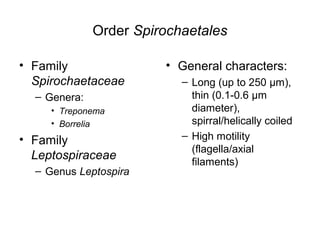
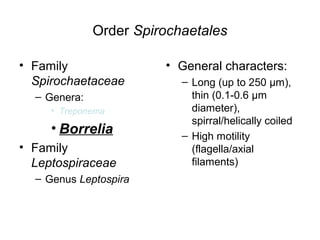
Order Spirochaetales
• Family
Spirochaetaceae
– Genera:
• Treponema
• Borrelia
• Family
Leptospiraceae
– Genus Leptospira
• General characters:
– Long (up to 250 µm),
thin (0.1-0.6 µm
diameter),
spirral/helically coiled
– High motility
(flagella/axial
filaments)
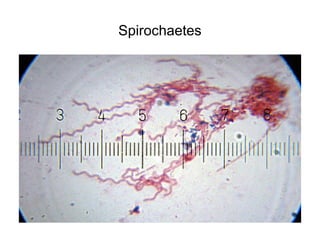
Spirochaetes
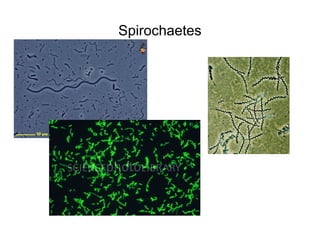
Spirochaetes
GenusTreponema
• Comensals: human upper respiratory mucosa, genital
mucosa (e.g. Treponema phagedenis) – cultivable
• Pathogens: non-cultivable
• Treponema pallidum
– ssp. pallidum – syphilis - STI
– ssp. endemicum – bejel (endemic syphilis) – Africa, Australia
– ssp. pertenue – pian – granulomatous skin lesions →
degenerative lesions in lymph nodes and bones
• Treponema carateum – pinta – persistens skin lesions
(papulae) → mutilating scars
Treponema pallidum
• Causative agent of syphilis
• Transmission via:
– sexual intercourse
– mother to child (transplacentar, intra-partum) – congenital
syphilis
• Evolution stages (if untreated):
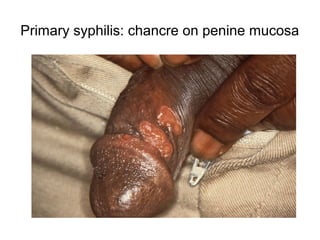
– Primary: 15 days after infecting contact; chancre – painless
ulceration at the entry site (penis, vagina, oral mucosa)
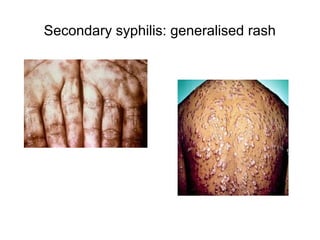
– Secondary: 45 days after chancre; skin rash
– Tertiary: after latency of 5-15 years; destructive lesions of CNS,
cardiovascular, muscles, bones, etc
Primary syphilis: chancre on penine mucosa
Secondary syphilis: generalised rash
Tertiary syphilis (patient is not infectious)
• 3 forms:
– gummatous (15%): gummas = soft, tumor-like balls of
inflammation on the skin, bones, and liver
– neurosyphilis (6.5%):
• Early: meningitis
• Late: general paresis / tabes dorsalis
(myelopathy), dementia
– cardiovascular (10%): aortic aneurisms
Treponema pallidum
- Laboratory diagnosis -
Collection of specimens:
• chancre secretion (primary syphilis)
• secretion from skin lesions (secondary syphilis)
– choose most recent lesion, remove crust, press lesion in order to
cause bleeding, collect serous exudate
• blood for serlogy (all stages)
Specimens from lesions must be examined asap
(treponemae are not viable for a long time outside the
body)
Treponema pallidum
- Microscopy -
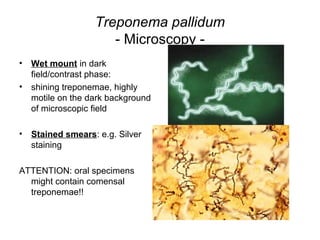
• Wet mount in dark
field/contrast phase:
• shining treponemae, highly
motile on the dark background
of microscopic field
• Stained smears: e.g. Silver
staining
ATTENTION: oral specimens
might contain comensal
treponemae!!
Treponema pallidum
- Serology -
Diagnosis based on antigenic structure:
– Cardiolipinic Ag – present in all treponemae + other bacteria
– Proteic Ag (Reiter) – Genus-specific (present in all treponeame)
– Treponema pallidum specfic Ag
Diagnostic tests:
• Nonspecific (nontreponemic):
– VDRL (flocculation)
– Bordet-Wasserman reaction (complement fixation)
• Specific (treponemic):
– TPI (Treponema pallidum immobilization) test
– passive hemagglutination
Treponema pallidum
- Serology - continued
Nonspecific, nontreponemic tests:
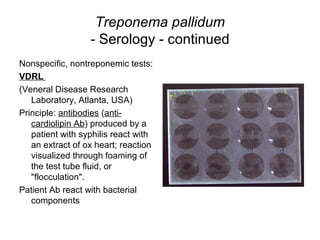
VDRL
(Veneral Disease Research
Laboratory, Atlanta, USA)
Principle: antibodies (anti-
cardiolipin Ab) produced by a
patient with syphilis react with
an extract of ox heart; reaction
visualized through foaming of
the test tube fluid, or
"flocculation".
Patient Ab react with bacterial
components
Treponema pallidum
- Serology - continued
Nonspecific, nontreponemic tests (continued):
Bordet-Wasserman test:
Principle: Ab in patient serum will inactivate serum
complement in the presence of ”reagines” (produced by
infected tissues in response to bacterial infection);
Treponema pallidum
- Serology - continued
Specific treponemic tests
TPI (Treponema pallidum immobilization):
• Principle: specific anti-Treponema pallidum Ab in patient
serum, in the presence of complement, immobilize
actively motile T. pallidum obtained from testes of syphils
infected rabbits
Passive hemagglutination:
• Principle: specific anti-Treponema pallidum Ab in patient
serum cause agglutination of treponemic Ag adsorbed
on the surface of red blood cells
Treponema pallidum
- Antibiotic sensitivity -
• Penicillin – i.v.
• Alternatively (in case of allergy):
– Doxycycline, tetracycline, azithromycin
– OR – desensitization – to enable
administration of penicillin
• Pregnant women with syphilis must
receive penicillin to prevent congenital
syphilis
Order Spirochaetales
• Family
Spirochaetaceae
– Genera:
• Treponema
• Borrelia
• Family
Leptospiraceae
– Genus Leptospira
• General characters:
– Long (up to 250 µm),
thin (0.1-0.6 µm
diameter),
spirral/helically coiled
– High motility
(flagella/axial
filaments)
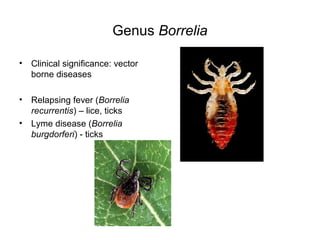
Genus Borrelia
• Clinical significance: vector
borne diseases
• Relapsing fever (Borrelia
recurrentis) – lice, ticks
• Lyme disease (Borrelia
burgdorferi) - ticks
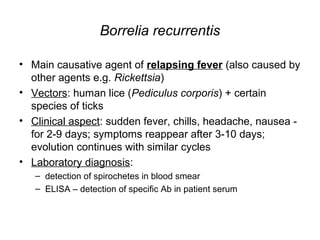
Borrelia recurrentis
• Main causative agent of relapsing fever (also caused by
other agents e.g. Rickettsia)
• Vectors: human lice (Pediculus corporis) + certain
species of ticks
• Clinical aspect: sudden fever, chills, headache, nausea -
for 2-9 days; symptoms reappear after 3-10 days;
evolution continues with similar cycles
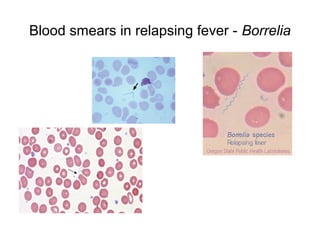
• Laboratory diagnosis:
– detection of spirochetes in blood smear
– ELISA – detection of specific Ab in patient serum
Blood smears in relapsing fever - Borrelia
Borrelia burgdorferi
• Clinical significance: Lyme disease (boreliosis) – disease
described for the 1st time in Lyme Connecticut USA
1976)
• Reservoir: birds, dogs, horses
• Transmission via tick bites; incubation 1-3 weeks
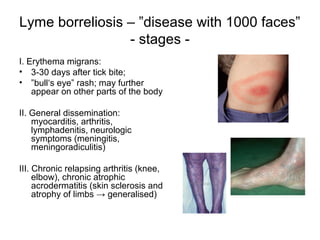
Lyme borreliosis – ”disease with 1000 faces”
- stages -
I. Erythema migrans:
• 3-30 days after tick bite;
• ”bull‘s eye” rash; may further
appear on other parts of the body
II. General dissemination:
myocarditis, arthritis,
lymphadenitis, neurologic
symptoms (meningitis,
meningoradiculitis)
III. Chronic relapsing arthritis (knee,
elbow), chronic atrophic
acrodermatitis (skin sclerosis and
atrophy of limbs → generalised)
Borrelia burgdorferi
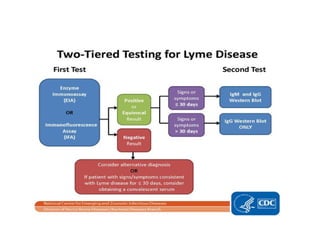
- Laboratory diagnosis -
• ELISA for the detection of specific Ab (IgM and IgG) in
patient serum
• Confirmatory tests: immunoblot (Western blot)
• Specific choice and sequence of tests – depends on
stage of disease (described in diagnostic guidelines)
Lyme disease
TREATMENT:
• early stages: doxycycline, amoxicillin, cefuroxime
• later stages: intravenous ceftriaxone or penicillin
PREVENTION:
• Prevention of tick bites
• Safe removal of ticks
• http://www.cdc.gov/lyme/prev/index.html
Order Spirochaetales
• Family
Spirochaetaceae
– Genera:
• Treponema
• Borrelia
• Family
Leptospiraceae
– Genus Leptospira
• General characters:
– Long (up to 250 µm),
thin (0.1-0.6 µm
diameter),
spirral/helically coiled
– High motility
(flagella/axial
filaments)
Genus Leptospira
General characters:
• aerobic, helicoidal, flexible, 6-20 µm length, 0.1 µm
diameter, motile, terminal “hook” at each end
Species:
• Leptospira interrogans – pathogenic
– Serotypes: L. canicola, L. icterohemorrhagiae, L. pomona, etc
• Leptospira biflexa – saprophitic – present in water
Genus Leptospira
- Clinical significance -
• Zoonosis – domestic and wild animals
• Human infection:
– contact with water, soil - contaminated with animal urine
– occupational exposure: veterinarians, farmers, field workers,
hunters, etc
– Germs may penetrate intact skin / microlesions → rapid blood
dissemination → organs (liver, kidney, eye), CSF
• Disease – Leptospirosis: mild clinical forms → severe
icteric disease with hepatic & renal disfunctions
Leptospirosis
- continued -
• Incubation: 3-30 days
• First stage: germs present in blood and CSF ~ 1 week
• Further stages: germs eliminated in urine – from 2nd
week; urine elimination persists 2-3 months
• Laboratory diagnosis:
– Bacteriology
– Serology
– Experimental disease
Leptospirosis
- Bacteriologic diagnosis -
• Collection of specimens: blood, CSF, urine, peritoneal
fluid
• Specimens must be centrifuged to increase the chance
of direct detection in sediment
• Microscopy:
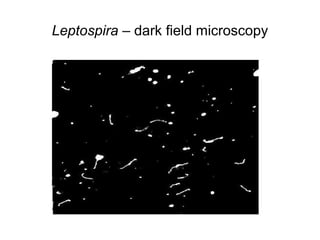
– Wet mounts examined in dark field
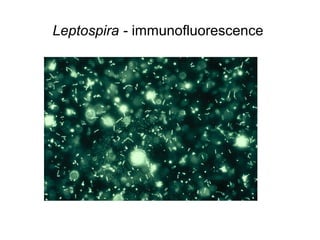
– Immunofluorescence (fluorescent antibodies)
Leptospira – dark field microscopy
Leptospira - immunofluorescence
Leptospirosis
- Bacteriologic diagnosis - continued
• Culture media: liquid/semisolid media containing blood +
bovine serum + other ingredients
– 1st week – blood culture (rarely positive growth)
– After 1st week – urine culture, experimental disease in animals
– Incubation at room temperature, dark, very slow growth (6-14
days, up to 3-4 months) – not adequate for diagnostic purposes
• Serology:
– microscopic agglutination with Leptospira antigens
– ELISA

Treponema borrelia leptospira

  • 1.
    Laboratory diagnosis ininfections produced by Treponema, Borrelia, Leptospira
  • 2.
    Order Spirochaetales • Family Spirochaetaceae –Genera: • Treponema • Borrelia • Family Leptospiraceae – Genus Leptospira • General characters: – Long (up to 250 µm), thin (0.1-0.6 µm diameter), spirral/helically coiled – High motility (flagella/axial filaments)
  • 3.
  • 4.
  • 5.
    GenusTreponema • Comensals: humanupper respiratory mucosa, genital mucosa (e.g. Treponema phagedenis) – cultivable • Pathogens: non-cultivable • Treponema pallidum – ssp. pallidum – syphilis - STI – ssp. endemicum – bejel (endemic syphilis) – Africa, Australia – ssp. pertenue – pian – granulomatous skin lesions → degenerative lesions in lymph nodes and bones • Treponema carateum – pinta – persistens skin lesions (papulae) → mutilating scars
  • 6.
    Treponema pallidum • Causativeagent of syphilis • Transmission via: – sexual intercourse – mother to child (transplacentar, intra-partum) – congenital syphilis • Evolution stages (if untreated): – Primary: 15 days after infecting contact; chancre – painless ulceration at the entry site (penis, vagina, oral mucosa) – Secondary: 45 days after chancre; skin rash – Tertiary: after latency of 5-15 years; destructive lesions of CNS, cardiovascular, muscles, bones, etc
  • 7.
    Primary syphilis: chancreon penine mucosa
  • 8.
  • 9.
    Tertiary syphilis (patientis not infectious) • 3 forms: – gummatous (15%): gummas = soft, tumor-like balls of inflammation on the skin, bones, and liver – neurosyphilis (6.5%): • Early: meningitis • Late: general paresis / tabes dorsalis (myelopathy), dementia – cardiovascular (10%): aortic aneurisms
  • 10.
    Treponema pallidum - Laboratorydiagnosis - Collection of specimens: • chancre secretion (primary syphilis) • secretion from skin lesions (secondary syphilis) – choose most recent lesion, remove crust, press lesion in order to cause bleeding, collect serous exudate • blood for serlogy (all stages) Specimens from lesions must be examined asap (treponemae are not viable for a long time outside the body)
  • 11.
    Treponema pallidum - Microscopy- • Wet mount in dark field/contrast phase: • shining treponemae, highly motile on the dark background of microscopic field • Stained smears: e.g. Silver staining ATTENTION: oral specimens might contain comensal treponemae!!
  • 12.
    Treponema pallidum - Serology- Diagnosis based on antigenic structure: – Cardiolipinic Ag – present in all treponemae + other bacteria – Proteic Ag (Reiter) – Genus-specific (present in all treponeame) – Treponema pallidum specfic Ag Diagnostic tests: • Nonspecific (nontreponemic): – VDRL (flocculation) – Bordet-Wasserman reaction (complement fixation) • Specific (treponemic): – TPI (Treponema pallidum immobilization) test – passive hemagglutination
  • 13.
    Treponema pallidum - Serology- continued Nonspecific, nontreponemic tests: VDRL (Veneral Disease Research Laboratory, Atlanta, USA) Principle: antibodies (anti- cardiolipin Ab) produced by a patient with syphilis react with an extract of ox heart; reaction visualized through foaming of the test tube fluid, or "flocculation". Patient Ab react with bacterial components
  • 14.
    Treponema pallidum - Serology- continued Nonspecific, nontreponemic tests (continued): Bordet-Wasserman test: Principle: Ab in patient serum will inactivate serum complement in the presence of ”reagines” (produced by infected tissues in response to bacterial infection);
  • 15.
    Treponema pallidum - Serology- continued Specific treponemic tests TPI (Treponema pallidum immobilization): • Principle: specific anti-Treponema pallidum Ab in patient serum, in the presence of complement, immobilize actively motile T. pallidum obtained from testes of syphils infected rabbits Passive hemagglutination: • Principle: specific anti-Treponema pallidum Ab in patient serum cause agglutination of treponemic Ag adsorbed on the surface of red blood cells
  • 16.
    Treponema pallidum - Antibioticsensitivity - • Penicillin – i.v. • Alternatively (in case of allergy): – Doxycycline, tetracycline, azithromycin – OR – desensitization – to enable administration of penicillin • Pregnant women with syphilis must receive penicillin to prevent congenital syphilis
  • 17.
    Order Spirochaetales • Family Spirochaetaceae –Genera: • Treponema • Borrelia • Family Leptospiraceae – Genus Leptospira • General characters: – Long (up to 250 µm), thin (0.1-0.6 µm diameter), spirral/helically coiled – High motility (flagella/axial filaments)
  • 18.
    Genus Borrelia • Clinicalsignificance: vector borne diseases • Relapsing fever (Borrelia recurrentis) – lice, ticks • Lyme disease (Borrelia burgdorferi) - ticks
  • 19.
    Borrelia recurrentis • Maincausative agent of relapsing fever (also caused by other agents e.g. Rickettsia) • Vectors: human lice (Pediculus corporis) + certain species of ticks • Clinical aspect: sudden fever, chills, headache, nausea - for 2-9 days; symptoms reappear after 3-10 days; evolution continues with similar cycles • Laboratory diagnosis: – detection of spirochetes in blood smear – ELISA – detection of specific Ab in patient serum
  • 20.
    Blood smears inrelapsing fever - Borrelia
  • 21.
    Borrelia burgdorferi • Clinicalsignificance: Lyme disease (boreliosis) – disease described for the 1st time in Lyme Connecticut USA 1976) • Reservoir: birds, dogs, horses • Transmission via tick bites; incubation 1-3 weeks
  • 22.
    Lyme borreliosis –”disease with 1000 faces” - stages - I. Erythema migrans: • 3-30 days after tick bite; • ”bull‘s eye” rash; may further appear on other parts of the body II. General dissemination: myocarditis, arthritis, lymphadenitis, neurologic symptoms (meningitis, meningoradiculitis) III. Chronic relapsing arthritis (knee, elbow), chronic atrophic acrodermatitis (skin sclerosis and atrophy of limbs → generalised)
  • 23.
    Borrelia burgdorferi - Laboratorydiagnosis - • ELISA for the detection of specific Ab (IgM and IgG) in patient serum • Confirmatory tests: immunoblot (Western blot) • Specific choice and sequence of tests – depends on stage of disease (described in diagnostic guidelines)
  • 25.
    Lyme disease TREATMENT: • earlystages: doxycycline, amoxicillin, cefuroxime • later stages: intravenous ceftriaxone or penicillin PREVENTION: • Prevention of tick bites • Safe removal of ticks • http://www.cdc.gov/lyme/prev/index.html
  • 26.
    Order Spirochaetales • Family Spirochaetaceae –Genera: • Treponema • Borrelia • Family Leptospiraceae – Genus Leptospira • General characters: – Long (up to 250 µm), thin (0.1-0.6 µm diameter), spirral/helically coiled – High motility (flagella/axial filaments)
  • 27.
    Genus Leptospira General characters: •aerobic, helicoidal, flexible, 6-20 µm length, 0.1 µm diameter, motile, terminal “hook” at each end Species: • Leptospira interrogans – pathogenic – Serotypes: L. canicola, L. icterohemorrhagiae, L. pomona, etc • Leptospira biflexa – saprophitic – present in water
  • 28.
    Genus Leptospira - Clinicalsignificance - • Zoonosis – domestic and wild animals • Human infection: – contact with water, soil - contaminated with animal urine – occupational exposure: veterinarians, farmers, field workers, hunters, etc – Germs may penetrate intact skin / microlesions → rapid blood dissemination → organs (liver, kidney, eye), CSF • Disease – Leptospirosis: mild clinical forms → severe icteric disease with hepatic & renal disfunctions
  • 29.
    Leptospirosis - continued - •Incubation: 3-30 days • First stage: germs present in blood and CSF ~ 1 week • Further stages: germs eliminated in urine – from 2nd week; urine elimination persists 2-3 months • Laboratory diagnosis: – Bacteriology – Serology – Experimental disease
  • 30.
    Leptospirosis - Bacteriologic diagnosis- • Collection of specimens: blood, CSF, urine, peritoneal fluid • Specimens must be centrifuged to increase the chance of direct detection in sediment • Microscopy: – Wet mounts examined in dark field – Immunofluorescence (fluorescent antibodies)
  • 31.
    Leptospira – darkfield microscopy
  • 32.
  • 33.
    Leptospirosis - Bacteriologic diagnosis- continued • Culture media: liquid/semisolid media containing blood + bovine serum + other ingredients – 1st week – blood culture (rarely positive growth) – After 1st week – urine culture, experimental disease in animals – Incubation at room temperature, dark, very slow growth (6-14 days, up to 3-4 months) – not adequate for diagnostic purposes • Serology: – microscopic agglutination with Leptospira antigens – ELISA