Streptococcus
Dr. Amirul Huda Bhuiyan
Lecturer
Department of Microbiology
Shaheed Syed Nazrul Islam Medical College, kishorganj
Streptococci General criteria
• Gram positive, cocci, arrange in pairs or chains
• Nutritionally fastidious, require complex media supplemented with blood or serum
• Most are facultative anaerobe, but do not use O2 metabolically
• Some are capnophilic and others are anaerobic
• Ferment carbohydrate and produce lactic acid.
• No gas production
• Catalase negative, Non motile
Streptococcus pneumoniae Streptococcus pyogens
Staphylococcus
• Arrange in cluster
• Grow in ordinary media
• Colony – pin head, large
• Selective media – Mannitol salt agar
• Catalase – positive
• Produce thick pus
• Penicillin – usually resistant
Streptococcus
• Arrange in chain
• Require enriched media
• Colony - small, pin point
• Selective media - Crystal Violet Blood Agar
• Catalase – negative
• Produce thin pus
• Penicillin – usually sensitive
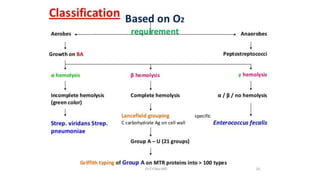
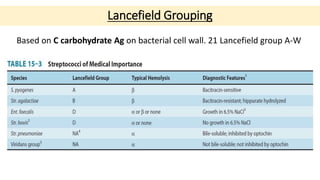
Lancefield Grouping
Based on C carbohydrate Ag on bacterial cell wall. 21 Lancefield group A-W
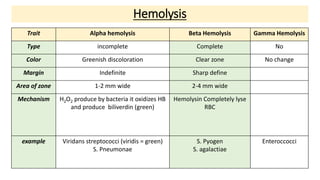
Hemolysis
Trait Alpha hemolysis Beta Hemolysis Gamma Hemolysis
Type incomplete Complete No
Color Greenish discoloration Clear zone No change
Margin Indefinite Sharp define
Area of zone 1-2 mm wide 2-4 mm wide
Mechanism H2O2 produce by bacteria it oxidizes HB
and produce biliverdin (green)
Hemolysin Completely lyse
RBC
example Viridans streptococci (viridis = green)
S. Pneumonae
S. Pyogen
S. agalactiae
Enteroccocci
S. Pyogens
• Gram positive, spherical / oval cocci
• Non-motile, non sporing
• 0.5 to 1 µm in diameter
• They divide in a plane perpendicular to the long axis of the chain
• Form long chain, when recovered from liquid culture
• May arrange in short chain, clusters or pairs in gram stains of samples from
infected tissue
Antigenic structure
A. Capsule
• Many strains produce hyaluronic acid capsule
• such strains grow as mucoid colony on Blood Agar,
• These are highly virulent
• Anti-phagocytic effect
• Non-immunogenic (chemically Identical to hyaluronic acid of host so,
not recognize as foreign)
B. Cell wall composition –
• Outer layer of protein and lipoteichoic acid
• Middle layer of group specific C carbohydrate (rhamnose & N
acetylglucosamine)
• Inner layer of peptidoglycan
M protein
• Most important virulence factor
• determines the type of S. pyogenes
• Appears as hair-like projections on Streptococcal cell wall
M Protein
• Antiphagocytic activity
• S. pyogenes is not infectious in the absence of M Protein
• It is antigenic and antibody to M Protein provides type specific immunity
• More than 100 different types of M Proteins have been identified by
serological means
• Individual may suffer from recurrent infections with strains expressing
different versions of M Protein
M protein
Depending on M protein there are
• Rheumatogenic strain – Causes primarily rheumatic fever
• Nephritogenic strain- Causes primarily AGN
Enzymes
A. Streptokinase (Fibrinolysin)
• Two types – Streptokinase A & B
• Catalyses conversion of plasminogen to plasmin it then cleaves fibrin and fibrinogen
• Result in lyses of clots and fibrin deposits, thrombi and emboli
• Facilitate rapid spread of S. pyogenes in infected tissues by breaking the fibrin barrier
• In contrast, S. aureus aims at hiding behind a wall of fibrin and produce a localized abscess
• It is used for treatment of pulmonary emboli and of coronary artery and venous thrombi
• Anti-streptokinase antibody are useful marker of infection
B. Deoxyribonucleases / Streptodornase / DNAase
• Four types (Dnase) are produced – DNAase A, B, C, D
• DNase B is the most common form
• They liqufy DNA (thick) which was released from dead neutrophil and
make the pus thin
• Thus act as ‘spreading factor’ by liquefying purulent exudates
• Antibiotics thus gain better access and infection recover quickly
B. Deoxyribonucleases / Streptodornase / DNAa
Use
• Mixture of streptokinase and streptodornase are used to liquefy exudate
and facilitate removal of pus & necrotic tissue
• Anti Dnase B is of great value in diagnosing AGN following skin infection,
not sore throat (streptolysin O is irreversibly inhibited by skin cholesterol;
so S. pyogenes fail to produce ASO in cutaneous infections.)
C. Hyaluronidase
• Spreading factor.
• Streptococcus causes spreading type of skin infection because this enzymes
breaks hyaluronic acid, the ground substance of connective tissue.
• Strains produce large amount of hyaluronidase (M4, M22) are non-
capsulated.
Toxins
A. Hemolysin / Streptolysin
Two types- Streptolysin O and Streptolysin S
Streptolysin O
• Oxygen labile, heat labile, Immunogenic.
• Hemolytic in reduce state.
• Responsible for complete hemolysis around the colony. Inhibited by
cholesterol
Mechanism
• Lyse RBC = Binds with cholesterol containing cell membrane leads to
production of holes
• Degranulation and lysis of PMNs
• Inhibit phagocytosis by macrophage
• Impairs respons of lymphocyte to mitogen
• Cytotoxic for platelet and cardiac tissues
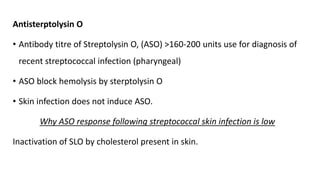
Antisterptolysin O
• Antibody titre of Streptolysin O, (ASO) >160-200 units use for diagnosis of
recent streptococcal infection (pharyngeal)
• ASO block hemolysis by sterptolysin O
• Skin infection does not induce ASO.
Why ASO response following streptococcal skin infection is low
Inactivation of SLO by cholesterol present in skin.
Streptolysin S:
• Oxygen stable.
• Cell-bound, not antigenic (low molecular wt˂20,000 D).
• Produced in the presence of serum. S indicate serum stable
• Responsible for hemolysis in media.
Mechanism
• Interact with membrane phospholipid in exerting toxic effect
• Can lyse erythrocytes, leukocytes and platelets.
• Kills phagocytes by releasing the lysosomal contents after engulfment.
Pyrogenic (Erythrogenic) Exotoxins
• Produced by both the scarlet fever strains and new invasive S. pyogenes strains.
• Four serologically distinct toxins (Spe A, B, C and F).
Spe A and C called erythrogenic toxin.
• Responsible for scarlet fever; extensive rash.
• Antibody prevents rash.
• Associated with streptococcal toxic shock syndrome, necrotizing fasciitis
(exotoxin B) rash of scarlet fever.
Pyrogenic (Erythrogenic) Exotoxins
• They are superantigens (except for Spe B, which is a cysteine protease) and may
exhibit the following biological activities:
• Enhances release of pro-inflammatory cytokines, e.g. IL-1,2, TNF-α , INF-γ (pyrogenicity)
• causes skin rash
• Inflammation
• Hypotensive shock
• Organ failure
• Immuno-suppression
Diseases by S. pyogens
Fig- rash of scarlet fever Fig- Necrotizing fascitis
Infection deep in subcutaneous tissues that spreads along fascial planes,
destroying muscle and fat
• Initially cellulitis followed by bullae (fluid filled blisters; bulla is singular),
gangrene, systemic toxicity, multi-organ failure.
• Prompt medical intervention is essential.
Necrotizing fasciitis: (“flesh-eating bacteria”)
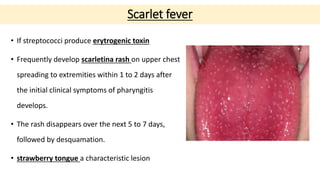
Scarlet fever
• If streptococci produce erytrogenic toxin
• Frequently develop scarletina rash on upper chest
spreading to extremities within 1 to 2 days after
the initial clinical symptoms of pharyngitis
develops.
• The rash disappears over the next 5 to 7 days,
followed by desquamation.
• strawberry tongue a characteristic lesion
Streptococcal Toxic Shock Syndrome (TSS)
• Occurs in invasive and bactaraemic infection, particularly in necrotizing
fasciitis.
• Multisystem toxicity following soft tissue infection progressing to shock and
organ failure.
• This disease results from release of pyrogenic exotoxin A and B.
• Superantigen, stimulate T cell and release cytokines that mediate shock and
tissue injury.
Acute rheumatic fever (ARF)
• Develops within 2-3 weeks following pharyngitis.
• Streptococcal skin infection do not cause RF.
• Autoimmune disease
Pathogenesis: cross-reactivity of heart and joint tissues with antibody formed
against M protein (Type II Hypersensitivity).
Prevention- if treated with penicillin within first 10 days following initiation of
pharyngitis.
• Commonly involved M type 1, 3, 5, 6, 18.
• Inflammatory reaction characterized by fever, arthritis, carditis, chorea,
erythema marginatum or subcutaneous nodules.
• ASO titre and ESR elevated
• Morbidity & mortality linked to subsequent disease of heart valve
(Rheumatic Heart Disease)
• Recurrences common, lifelong penicillin therapy needed.
Acute rheumatic fever (ARF)
Acute Glomerulonephritis
• Acute inflammation of renal glomeruli
• Occur after either pharyngeal or skin infection (most common)
• Following 2-3 weeks of respiratory (pharyngitis) or 1-2 weeks of cutaneous
(pyoderma) streptococcal infection.
• Associated with M types 2, 4, 12 & 49 (most frequent) .
• Granular accumulations of immunoglobulin due to deposition of immune
complexes on the basement membrane of kidney (Type III Hypersensitivity)
• Rheumatic fever can be reactivated by recurrent streptococcal infections,
whereas nephritis does not
Acute Glomerulonephritis
Lab diagnosis
A. Specimen:
• Can be obtained from throat or skin
• Swab, pus, sputum, blood.
• Serum obtained for antibody detection.
B. Gram staining and microscopy
• Gram positive cocci arranged in chains or pairs with pus cells.
C. Culture (Definitive diagnosis)
• small pinpoint, dome shaped colonies surrounded by a large zone of
beta haemolysis in blood agar.
• Encapsulated cells produce mucoid colonies
D. Biochemical test Catalase negative. Differentiates from Staphylococcus
Bacitracin test:
• To distinguishing between Group A beta-hemolytic streptococci (bacitracin POS)
and other beta-hemolytic streptococci that are isolated from pharyngeal swabs
• 95% sensitivity for Grp A strep
• When grown on blood agar, Group A streptococci are sensitive to (killed by) the
antibiotic bacitracin
• Bacitracin Sensitive - S.pyogenes
• Bacitracin Resistant - S.agalactiae
E. rapid test Antibody detection
• Detect S. pyogenes directly in throat swab without culture.
• Diagnostic kits use specific antibody to detect group specific Abs to detect group A CHO Ag
in the swab material.
Anti DnaseB
• Positive following streptococcal skin infection. Important in diagnosing AGN.
ASO titre
• Titre high soon after Group A streptococcal infection-within 3 to 4 wks
• Indicate previous infection, as the time of development of RF culture is usually negative.
• Unreliable in AGN.
Treatment
• Oral penicillin V or amoxicillin for streptococcal pharyngitis.
• For penicillin-allergic patients, oral cephalosporin or macrolides can be used.
• For severe systemic infection- combined use of I/V penicillin and aminoglycosides
recommended.
• Patient with a history of rheumatic fever require long term penicillin therapy as
prophylaxis to prevent recurrence of the disease.
• Resistance found in – tetracyclines, sulphonamides, erythromycin and newer
macrolids (e.g. azithromycin, clarithromycin)
Pneumococci
• Formerly called Diplococcus pneumonia.
• This was one of the first pathogenic bacteria observed by Gram stain.
Morphology
• Gram-positive cocci, non-motile, encapsulated (polysaccharide)
• Lancet shaped (oval with somewhat pointed ends)
• Arranged in pair or short chains in specimen.
• It has fastidious nutritional requirements and can grow only on enriched media
supplemented with blood products.
• Produce alpha hemolysis on blood agar
• Ferment carbohydrates, producing lactic acid as the primary metabolic byproduct.
Capsular polysaccharide (SSS)
• Virulent strains are covered with a complex polysaccharide capsule.
• currently, 94 serotypes are recognized.
• Encapsulated strains are pathogenic whereas
• Noncapsulated strains are avirulent.
• It has antiphagocytic and antigenic activity.
• Provide type specific immunity.
Structure
Capsular swelling (Quellung) reaction
Pneumococcal capsule reacts with the type specific antiserum and becomes
apparently swollen and become more easily visible under the microscope.
Cell wall carbohydrate
• The peptidoglycan layer is typical of gram-positive cocci.
• ‘C’ polysaccharide or C substance exposed on cell surface - It
precipitates a serum globulin fraction [CRP].
Structure
Toxin
Pneumolysin
• It is a cytosolin similar to streptolysin O.
• It retain within the cytosol of intact pneumococci.
• It is released by autolysin from interior of the bacterium.
• Binds with cholesterol in mammalian host cell membrane and creates pore.
• It may contribute to pathogenesis by destroying ciliated epithelial cells and
phagocytic cells.
Autolysin
• Hydrolase/ amidase present in inactivated form in cell wall.
• Activated by surface active substances, β-lactam antibiotics, bile or
aging and results in cell lysis.
• Autolysis of aged cells produce colonies with depressed center
(Draughtsman colony).
Toxin
Enzymes
IgA proteases
• It enhances the ability of the organism to colonize the mucosa of
the upper respiratory tract by inactivating secretory IgA Ab
Hyaluronidase
• Facilitate spread of the organism
• Pneumonia
• Bronchopneumonia – secondary infection following viral infection
• Meningitis – pneumococcus spread from the pharynx to meninges via
blood because of coexistent bacteremia
• Bacteremia and sepsis
• Sinusitis and otitis media
• Other suppurative infection- empyema, pericarditis, suppurative arthritis.
Diseases
• S. pneumoniae
• S. aureus
• K. pneumonia
• S. pyogens
• H. influenzae
• Fusobacterium species
• L. pneumophilia
• Bacteroids melaninogenicus
• Anaerobic cocci (Peptostreptococcus, peptococcus)
Causes of pneumonia
Specimen
• According to site of lesion
• Blood, Sputum, nasopharyngeal swab, CSF, Pus, aspirate from sinus
Smear preparation and microscopy
• Gram staining - Demonstration of gram positive lancet shaped
diplococci surrounded by an unstained halo of capsule
Lab diagnosis
Culture
• Streptococcus grows in enriched
media like Blood agar media with
5-10% CO2 at 37 C
• Young culture of encapsulated
bacteria produce circular,
glistening, dome-shaped colonies.
Lab diagnosis
Biochemical reaction
• Bile solubility test- undergo rapid autolysis when exposed to bile on an
isolated colony
• Optochin sensitivity- sensitive. A zone of inhibition is seen around the
colony
• Ferments glucose, lactose, sucrose and inulin giving acid only.
Lab diagnosis
Trait Viridans streptococci Pneumococci
Shape Round Lancet
Arrangement Chains Pairs
Central depression No Yes
Capsule No Yes
Quellung reaction No Yes
Inuslin fermentation No Yes
Optochin sensitivity No Yes
Bile solubility No Yes
Pathogenicity to mice No Yes
• Penicillin is the drug of choice for susceptible strain
• For resistant strains and penicillin-allergic patients, cephalosporin,
erythromycin, chloramphenicol or vancomycin can be used.
• Serious pneumococcal diseases should be treated with combination of
antibiotics. Vancomycin with ceftriaxone commonly used as empiric
treatment.
Treatment
Pneumococcal conjugate vaccine (PCV13)
• Recommended for all children younger than 5 years old, all adults 65
years or older, and people 6 years or older with certain risk factors.
Pneumococcal polysaccharide vaccine (PPSV23)
• Recommended for all adults 65 years or older. People 2 to 64 years of
age who are at high risk of pneumococcal disease should also receive
PPSV23.
immunization
Streptococci

Streptococci

  • 1.
    Streptococcus Dr. Amirul HudaBhuiyan Lecturer Department of Microbiology Shaheed Syed Nazrul Islam Medical College, kishorganj
  • 3.
    Streptococci General criteria •Gram positive, cocci, arrange in pairs or chains • Nutritionally fastidious, require complex media supplemented with blood or serum • Most are facultative anaerobe, but do not use O2 metabolically • Some are capnophilic and others are anaerobic • Ferment carbohydrate and produce lactic acid. • No gas production • Catalase negative, Non motile
  • 4.
  • 5.
    Staphylococcus • Arrange incluster • Grow in ordinary media • Colony – pin head, large • Selective media – Mannitol salt agar • Catalase – positive • Produce thick pus • Penicillin – usually resistant Streptococcus • Arrange in chain • Require enriched media • Colony - small, pin point • Selective media - Crystal Violet Blood Agar • Catalase – negative • Produce thin pus • Penicillin – usually sensitive
  • 8.
    Lancefield Grouping Based onC carbohydrate Ag on bacterial cell wall. 21 Lancefield group A-W
  • 9.
    Hemolysis Trait Alpha hemolysisBeta Hemolysis Gamma Hemolysis Type incomplete Complete No Color Greenish discoloration Clear zone No change Margin Indefinite Sharp define Area of zone 1-2 mm wide 2-4 mm wide Mechanism H2O2 produce by bacteria it oxidizes HB and produce biliverdin (green) Hemolysin Completely lyse RBC example Viridans streptococci (viridis = green) S. Pneumonae S. Pyogen S. agalactiae Enteroccocci
  • 10.
    S. Pyogens • Grampositive, spherical / oval cocci • Non-motile, non sporing • 0.5 to 1 µm in diameter • They divide in a plane perpendicular to the long axis of the chain • Form long chain, when recovered from liquid culture • May arrange in short chain, clusters or pairs in gram stains of samples from infected tissue
  • 12.
    Antigenic structure A. Capsule •Many strains produce hyaluronic acid capsule • such strains grow as mucoid colony on Blood Agar, • These are highly virulent • Anti-phagocytic effect • Non-immunogenic (chemically Identical to hyaluronic acid of host so, not recognize as foreign)
  • 13.
    B. Cell wallcomposition – • Outer layer of protein and lipoteichoic acid • Middle layer of group specific C carbohydrate (rhamnose & N acetylglucosamine) • Inner layer of peptidoglycan M protein • Most important virulence factor • determines the type of S. pyogenes • Appears as hair-like projections on Streptococcal cell wall
  • 14.
    M Protein • Antiphagocyticactivity • S. pyogenes is not infectious in the absence of M Protein • It is antigenic and antibody to M Protein provides type specific immunity • More than 100 different types of M Proteins have been identified by serological means • Individual may suffer from recurrent infections with strains expressing different versions of M Protein
  • 15.
    M protein Depending onM protein there are • Rheumatogenic strain – Causes primarily rheumatic fever • Nephritogenic strain- Causes primarily AGN
  • 16.
    Enzymes A. Streptokinase (Fibrinolysin) •Two types – Streptokinase A & B • Catalyses conversion of plasminogen to plasmin it then cleaves fibrin and fibrinogen • Result in lyses of clots and fibrin deposits, thrombi and emboli • Facilitate rapid spread of S. pyogenes in infected tissues by breaking the fibrin barrier • In contrast, S. aureus aims at hiding behind a wall of fibrin and produce a localized abscess • It is used for treatment of pulmonary emboli and of coronary artery and venous thrombi • Anti-streptokinase antibody are useful marker of infection
  • 17.
    B. Deoxyribonucleases /Streptodornase / DNAase • Four types (Dnase) are produced – DNAase A, B, C, D • DNase B is the most common form • They liqufy DNA (thick) which was released from dead neutrophil and make the pus thin • Thus act as ‘spreading factor’ by liquefying purulent exudates • Antibiotics thus gain better access and infection recover quickly
  • 18.
    B. Deoxyribonucleases /Streptodornase / DNAa Use • Mixture of streptokinase and streptodornase are used to liquefy exudate and facilitate removal of pus & necrotic tissue • Anti Dnase B is of great value in diagnosing AGN following skin infection, not sore throat (streptolysin O is irreversibly inhibited by skin cholesterol; so S. pyogenes fail to produce ASO in cutaneous infections.)
  • 19.
    C. Hyaluronidase • Spreadingfactor. • Streptococcus causes spreading type of skin infection because this enzymes breaks hyaluronic acid, the ground substance of connective tissue. • Strains produce large amount of hyaluronidase (M4, M22) are non- capsulated.
  • 20.
    Toxins A. Hemolysin /Streptolysin Two types- Streptolysin O and Streptolysin S Streptolysin O • Oxygen labile, heat labile, Immunogenic. • Hemolytic in reduce state. • Responsible for complete hemolysis around the colony. Inhibited by cholesterol
  • 21.
    Mechanism • Lyse RBC= Binds with cholesterol containing cell membrane leads to production of holes • Degranulation and lysis of PMNs • Inhibit phagocytosis by macrophage • Impairs respons of lymphocyte to mitogen • Cytotoxic for platelet and cardiac tissues
  • 22.
    Antisterptolysin O • Antibodytitre of Streptolysin O, (ASO) >160-200 units use for diagnosis of recent streptococcal infection (pharyngeal) • ASO block hemolysis by sterptolysin O • Skin infection does not induce ASO. Why ASO response following streptococcal skin infection is low Inactivation of SLO by cholesterol present in skin.
  • 23.
    Streptolysin S: • Oxygenstable. • Cell-bound, not antigenic (low molecular wt˂20,000 D). • Produced in the presence of serum. S indicate serum stable • Responsible for hemolysis in media. Mechanism • Interact with membrane phospholipid in exerting toxic effect • Can lyse erythrocytes, leukocytes and platelets. • Kills phagocytes by releasing the lysosomal contents after engulfment.
  • 24.
    Pyrogenic (Erythrogenic) Exotoxins •Produced by both the scarlet fever strains and new invasive S. pyogenes strains. • Four serologically distinct toxins (Spe A, B, C and F). Spe A and C called erythrogenic toxin. • Responsible for scarlet fever; extensive rash. • Antibody prevents rash. • Associated with streptococcal toxic shock syndrome, necrotizing fasciitis (exotoxin B) rash of scarlet fever.
  • 25.
    Pyrogenic (Erythrogenic) Exotoxins •They are superantigens (except for Spe B, which is a cysteine protease) and may exhibit the following biological activities: • Enhances release of pro-inflammatory cytokines, e.g. IL-1,2, TNF-α , INF-γ (pyrogenicity) • causes skin rash • Inflammation • Hypotensive shock • Organ failure • Immuno-suppression
  • 27.
    Diseases by S.pyogens Fig- rash of scarlet fever Fig- Necrotizing fascitis
  • 28.
    Infection deep insubcutaneous tissues that spreads along fascial planes, destroying muscle and fat • Initially cellulitis followed by bullae (fluid filled blisters; bulla is singular), gangrene, systemic toxicity, multi-organ failure. • Prompt medical intervention is essential. Necrotizing fasciitis: (“flesh-eating bacteria”)
  • 29.
    Scarlet fever • Ifstreptococci produce erytrogenic toxin • Frequently develop scarletina rash on upper chest spreading to extremities within 1 to 2 days after the initial clinical symptoms of pharyngitis develops. • The rash disappears over the next 5 to 7 days, followed by desquamation. • strawberry tongue a characteristic lesion
  • 30.
    Streptococcal Toxic ShockSyndrome (TSS) • Occurs in invasive and bactaraemic infection, particularly in necrotizing fasciitis. • Multisystem toxicity following soft tissue infection progressing to shock and organ failure. • This disease results from release of pyrogenic exotoxin A and B. • Superantigen, stimulate T cell and release cytokines that mediate shock and tissue injury.
  • 31.
    Acute rheumatic fever(ARF) • Develops within 2-3 weeks following pharyngitis. • Streptococcal skin infection do not cause RF. • Autoimmune disease Pathogenesis: cross-reactivity of heart and joint tissues with antibody formed against M protein (Type II Hypersensitivity). Prevention- if treated with penicillin within first 10 days following initiation of pharyngitis.
  • 32.
    • Commonly involvedM type 1, 3, 5, 6, 18. • Inflammatory reaction characterized by fever, arthritis, carditis, chorea, erythema marginatum or subcutaneous nodules. • ASO titre and ESR elevated • Morbidity & mortality linked to subsequent disease of heart valve (Rheumatic Heart Disease) • Recurrences common, lifelong penicillin therapy needed. Acute rheumatic fever (ARF)
  • 33.
    Acute Glomerulonephritis • Acuteinflammation of renal glomeruli • Occur after either pharyngeal or skin infection (most common) • Following 2-3 weeks of respiratory (pharyngitis) or 1-2 weeks of cutaneous (pyoderma) streptococcal infection. • Associated with M types 2, 4, 12 & 49 (most frequent) .
  • 34.
    • Granular accumulationsof immunoglobulin due to deposition of immune complexes on the basement membrane of kidney (Type III Hypersensitivity) • Rheumatic fever can be reactivated by recurrent streptococcal infections, whereas nephritis does not Acute Glomerulonephritis
  • 35.
    Lab diagnosis A. Specimen: •Can be obtained from throat or skin • Swab, pus, sputum, blood. • Serum obtained for antibody detection. B. Gram staining and microscopy • Gram positive cocci arranged in chains or pairs with pus cells.
  • 36.
    C. Culture (Definitivediagnosis) • small pinpoint, dome shaped colonies surrounded by a large zone of beta haemolysis in blood agar. • Encapsulated cells produce mucoid colonies
  • 37.
    D. Biochemical testCatalase negative. Differentiates from Staphylococcus
  • 38.
    Bacitracin test: • Todistinguishing between Group A beta-hemolytic streptococci (bacitracin POS) and other beta-hemolytic streptococci that are isolated from pharyngeal swabs • 95% sensitivity for Grp A strep • When grown on blood agar, Group A streptococci are sensitive to (killed by) the antibiotic bacitracin • Bacitracin Sensitive - S.pyogenes • Bacitracin Resistant - S.agalactiae
  • 40.
    E. rapid testAntibody detection • Detect S. pyogenes directly in throat swab without culture. • Diagnostic kits use specific antibody to detect group specific Abs to detect group A CHO Ag in the swab material. Anti DnaseB • Positive following streptococcal skin infection. Important in diagnosing AGN. ASO titre • Titre high soon after Group A streptococcal infection-within 3 to 4 wks • Indicate previous infection, as the time of development of RF culture is usually negative. • Unreliable in AGN.
  • 41.
    Treatment • Oral penicillinV or amoxicillin for streptococcal pharyngitis. • For penicillin-allergic patients, oral cephalosporin or macrolides can be used. • For severe systemic infection- combined use of I/V penicillin and aminoglycosides recommended. • Patient with a history of rheumatic fever require long term penicillin therapy as prophylaxis to prevent recurrence of the disease. • Resistance found in – tetracyclines, sulphonamides, erythromycin and newer macrolids (e.g. azithromycin, clarithromycin)
  • 42.
    Pneumococci • Formerly calledDiplococcus pneumonia. • This was one of the first pathogenic bacteria observed by Gram stain.
  • 43.
    Morphology • Gram-positive cocci,non-motile, encapsulated (polysaccharide) • Lancet shaped (oval with somewhat pointed ends) • Arranged in pair or short chains in specimen. • It has fastidious nutritional requirements and can grow only on enriched media supplemented with blood products. • Produce alpha hemolysis on blood agar • Ferment carbohydrates, producing lactic acid as the primary metabolic byproduct.
  • 44.
    Capsular polysaccharide (SSS) •Virulent strains are covered with a complex polysaccharide capsule. • currently, 94 serotypes are recognized. • Encapsulated strains are pathogenic whereas • Noncapsulated strains are avirulent. • It has antiphagocytic and antigenic activity. • Provide type specific immunity. Structure
  • 45.
    Capsular swelling (Quellung)reaction Pneumococcal capsule reacts with the type specific antiserum and becomes apparently swollen and become more easily visible under the microscope.
  • 46.
    Cell wall carbohydrate •The peptidoglycan layer is typical of gram-positive cocci. • ‘C’ polysaccharide or C substance exposed on cell surface - It precipitates a serum globulin fraction [CRP]. Structure
  • 47.
    Toxin Pneumolysin • It isa cytosolin similar to streptolysin O. • It retain within the cytosol of intact pneumococci. • It is released by autolysin from interior of the bacterium. • Binds with cholesterol in mammalian host cell membrane and creates pore. • It may contribute to pathogenesis by destroying ciliated epithelial cells and phagocytic cells.
  • 48.
    Autolysin • Hydrolase/ amidasepresent in inactivated form in cell wall. • Activated by surface active substances, β-lactam antibiotics, bile or aging and results in cell lysis. • Autolysis of aged cells produce colonies with depressed center (Draughtsman colony). Toxin
  • 49.
    Enzymes IgA proteases • Itenhances the ability of the organism to colonize the mucosa of the upper respiratory tract by inactivating secretory IgA Ab Hyaluronidase • Facilitate spread of the organism
  • 50.
    • Pneumonia • Bronchopneumonia– secondary infection following viral infection • Meningitis – pneumococcus spread from the pharynx to meninges via blood because of coexistent bacteremia • Bacteremia and sepsis • Sinusitis and otitis media • Other suppurative infection- empyema, pericarditis, suppurative arthritis. Diseases
  • 51.
    • S. pneumoniae •S. aureus • K. pneumonia • S. pyogens • H. influenzae • Fusobacterium species • L. pneumophilia • Bacteroids melaninogenicus • Anaerobic cocci (Peptostreptococcus, peptococcus) Causes of pneumonia
  • 52.
    Specimen • According tosite of lesion • Blood, Sputum, nasopharyngeal swab, CSF, Pus, aspirate from sinus Smear preparation and microscopy • Gram staining - Demonstration of gram positive lancet shaped diplococci surrounded by an unstained halo of capsule Lab diagnosis
  • 53.
    Culture • Streptococcus growsin enriched media like Blood agar media with 5-10% CO2 at 37 C • Young culture of encapsulated bacteria produce circular, glistening, dome-shaped colonies. Lab diagnosis
  • 54.
    Biochemical reaction • Bilesolubility test- undergo rapid autolysis when exposed to bile on an isolated colony • Optochin sensitivity- sensitive. A zone of inhibition is seen around the colony • Ferments glucose, lactose, sucrose and inulin giving acid only. Lab diagnosis
  • 56.
    Trait Viridans streptococciPneumococci Shape Round Lancet Arrangement Chains Pairs Central depression No Yes Capsule No Yes Quellung reaction No Yes Inuslin fermentation No Yes Optochin sensitivity No Yes Bile solubility No Yes Pathogenicity to mice No Yes
  • 57.
    • Penicillin isthe drug of choice for susceptible strain • For resistant strains and penicillin-allergic patients, cephalosporin, erythromycin, chloramphenicol or vancomycin can be used. • Serious pneumococcal diseases should be treated with combination of antibiotics. Vancomycin with ceftriaxone commonly used as empiric treatment. Treatment
  • 58.
    Pneumococcal conjugate vaccine(PCV13) • Recommended for all children younger than 5 years old, all adults 65 years or older, and people 6 years or older with certain risk factors. Pneumococcal polysaccharide vaccine (PPSV23) • Recommended for all adults 65 years or older. People 2 to 64 years of age who are at high risk of pneumococcal disease should also receive PPSV23. immunization