PRESENTED BY
Mrs.J.JEBA, M.Sc.,M.Phil.
ASSOCIATE PROFESSOR
ANNASAMY RAJAMMAL
COLLEGE OF NURSING,
ATHIYOOTHU
TYPHOID
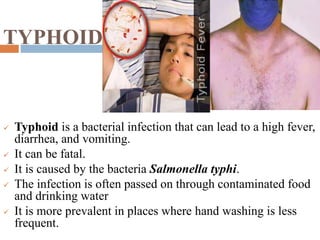
 Typhoid is a bacterial infection that can lead to a high fever,
diarrhea, and vomiting.
 It can be fatal.
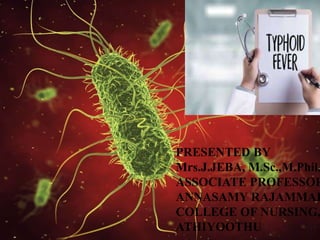
 It is caused by the bacteria Salmonella typhi.
 The infection is often passed on through contaminated food
and drinking water
 It is more prevalent in places where hand washing is less
frequent.
HISTORY
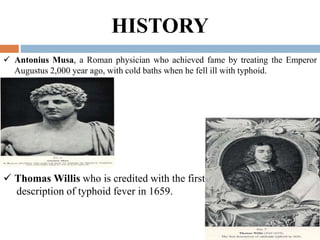
 Antonius Musa, a Roman physician who achieved fame by treating the Emperor
Augustus 2,000 year ago, with cold baths when he fell ill with typhoid.
 Thomas Willis who is credited with the first
description of typhoid fever in 1659.
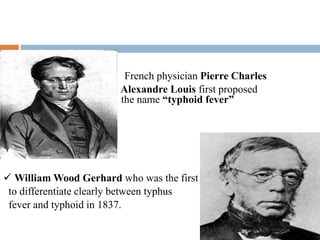
 French physician Pierre Charles
 Alexandre Louis first proposed
 the name “typhoid fever”
 William Wood Gerhard who was the first
to differentiate clearly between typhus
fever and typhoid in 1837.
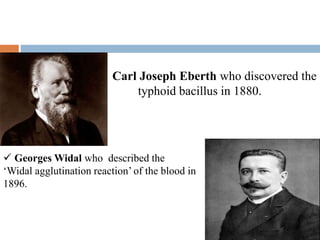
 Carl Joseph Eberth who discovered the
 typhoid bacillus in 1880.
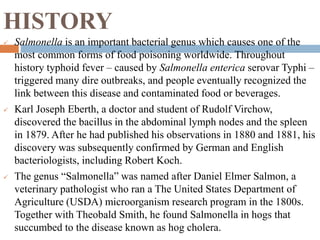
 Georges Widal who described the
‘Widal agglutination reaction’ of the blood in
1896.
HISTORY
 Salmonella is an important bacterial genus which causes one of the
most common forms of food poisoning worldwide. Throughout
history typhoid fever – caused by Salmonella enterica serovar Typhi –
triggered many dire outbreaks, and people eventually recognized the
link between this disease and contaminated food or beverages.
 Karl Joseph Eberth, a doctor and student of Rudolf Virchow,
discovered the bacillus in the abdominal lymph nodes and the spleen
in 1879. After he had published his observations in 1880 and 1881, his
discovery was subsequently confirmed by German and English
bacteriologists, including Robert Koch.
 The genus “Salmonella” was named after Daniel Elmer Salmon, a
veterinary pathologist who ran a The United States Department of
Agriculture (USDA) microorganism research program in the 1800s.
Together with Theobald Smith, he found Salmonella in hogs that
succumbed to the disease known as hog cholera.
The story of Mary Mallon
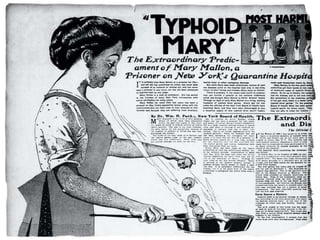
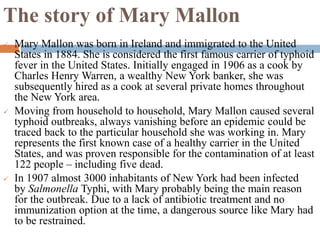
 Mary Mallon was born in Ireland and immigrated to the United
States in 1884. She is considered the first famous carrier of typhoid
fever in the United States. Initially engaged in 1906 as a cook by
Charles Henry Warren, a wealthy New York banker, she was
subsequently hired as a cook at several private homes throughout
the New York area.
 Moving from household to household, Mary Mallon caused several
typhoid outbreaks, always vanishing before an epidemic could be
traced back to the particular household she was working in. Mary
represents the first known case of a healthy carrier in the United
States, and was proven responsible for the contamination of at least
122 people – including five dead.
 In 1907 almost 3000 inhabitants of New York had been infected
by Salmonella Typhi, with Mary probably being the main reason
for the outbreak. Due to a lack of antibiotic treatment and no
immunization option at the time, a dangerous source like Mary had
to be restrained.
 After police intervened and Salmonella had been found in
Mary’s stool, she was transferred to North Brother Island
to Riverside Hospital, where she was quarantined in a
cottage.
 As she was the first known healthy carrier of typhoid
fever in the United States, she did not understand how
someone healthy could spread disease; hence she tried to
fight back.
 Although the New York Supreme Court dismissed her
petition for release, the city’s new health commissioner
Ernst J. Lederle took pity on Mallon and released her on
the promise that she will never again work as a cook.
 Nevertheless, she was found to be working as a cook,
which was again causing typhoid outbreaks.
 She was sent back to North Brother Island, where she
lived until her death in 1938.
 There is still much speculation regarding the treatment
that Mary received at the hands of the New York’s
Department of Health.
 Instead of working with her to make her realize she was a
risk factor, the state quarantined her twice and turned her a
laboratory pet.
 This case is often cited as an example of how the health
care system provokes prejudiced social attitudes towards
disease carriers.
Salmonella-A Very complex group
 Contains more > 2,000 sp
 Typed on the basis of Serotyping, and species typing
Divided into two groups
 1. Enteric fever group, 2.Food poisoning group – Septicemias.
 Enteric Fever (Typhoid Fever )-Caused by Salmonella typhi,
and other Groups called as Paratyphi A, B, C.
 Salmonella typhi - Causes Typhoid
 Salmonella Paratyphi A,B,C Causes Paratyphoid fevers.
 Food Poison group
 Spread from Animals – Humans
 Causes Gastroenteritis – Septicemias, Localized Infection
CAUSES
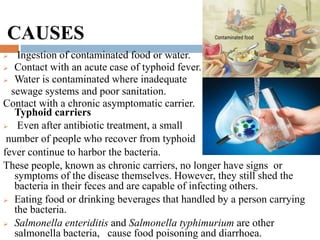
 Ingestion of contaminated food or water.
 Contact with an acute case of typhoid fever.
 Water is contaminated where inadequate
sewage systems and poor sanitation.
Contact with a chronic asymptomatic carrier.
Typhoid carriers
 Even after antibiotic treatment, a small
number of people who recover from typhoid
fever continue to harbor the bacteria.
These people, known as chronic carriers, no longer have signs or
symptoms of the disease themselves. However, they still shed the
bacteria in their feces and are capable of infecting others.
 Eating food or drinking beverages that handled by a person carrying
the bacteria.
 Salmonella enteriditis and Salmonella typhimurium are other
salmonella bacteria, cause food poisoning and diarrhoea.
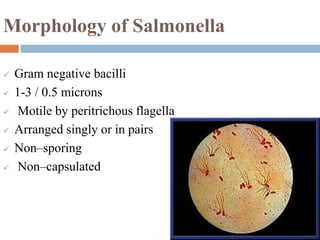
Morphology of Salmonella
 Gram negative bacilli
 1-3 / 0.5 microns
 Motile by peritrichous flagella
 Arranged singly or in pairs
 Non–sporing
 Non–capsulated
Cultural Characters
 Aerobic / Facultative anaerobic
 Grows on simple media – Nutrient agar
 Temp 15 – 41ºc / 37º c
 PH=6.5-7.5
MEDIUM
 Deoxycholate Citrate Agar (DCA) medium
 Salmonella – Shigella Agar medium
 Wilson & Blair bismuth sulfite medium
 Xylose Lysine Deoxycholate (XLD) medium
 Tetrathionate broth
 Selenite F Broth
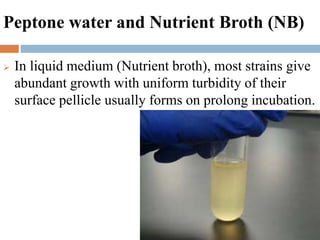
Peptone water and Nutrient Broth (NB)
 In liquid medium (Nutrient broth), most strains give
abundant growth with uniform turbidity of their
surface pellicle usually forms on prolong incubation.
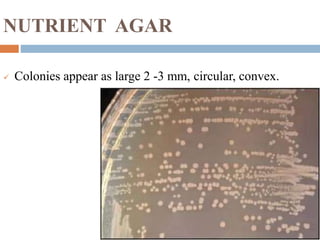
NUTRIENT AGAR
 Colonies appear as large 2 -3 mm, circular, convex.
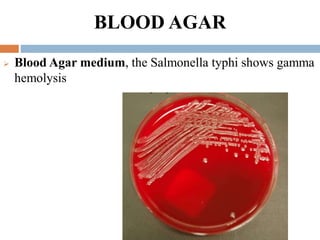
BLOOD AGAR
 Blood Agar medium, the Salmonella typhi shows gamma
hemolysis
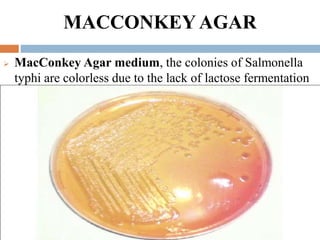
MACCONKEY AGAR
 MacConkey Agar medium, the colonies of Salmonella
typhi are colorless due to the lack of lactose fermentation
WILSON BLAIR BISMUTH
SULPHITE AGAR
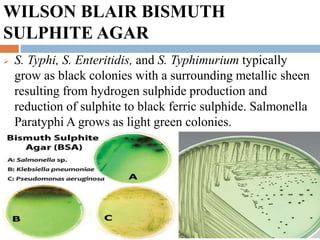
 S. Typhi, S. Enteritidis, and S. Typhimurium typically
grow as black colonies with a surrounding metallic sheen
resulting from hydrogen sulphide production and
reduction of sulphite to black ferric sulphide. Salmonella
Paratyphi A grows as light green colonies.
Selenite F broth & Tetrathionate broth
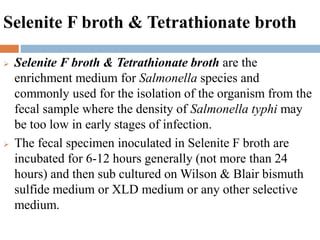
 Selenite F broth & Tetrathionate broth are the
enrichment medium for Salmonella species and
commonly used for the isolation of the organism from the
fecal sample where the density of Salmonella typhi may
be too low in early stages of infection.
 The fecal specimen inoculated in Selenite F broth are
incubated for 6-12 hours generally (not more than 24
hours) and then sub cultured on Wilson & Blair bismuth
sulfide medium or XLD medium or any other selective
medium.
Xylose Lysine Dextrose Agar (XLD)
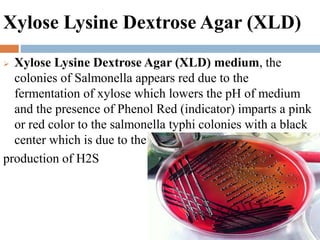
 Xylose Lysine Dextrose Agar (XLD) medium, the
colonies of Salmonella appears red due to the
fermentation of xylose which lowers the pH of medium
and the presence of Phenol Red (indicator) imparts a pink
or red color to the salmonella typhi colonies with a black
center which is due to the
production of H2S
Salmonella Shigella Agar medium
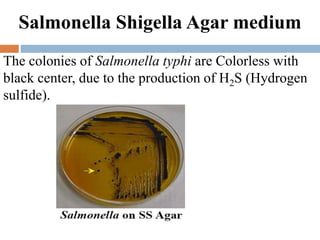
The colonies of Salmonella typhi are Colorless with
black center, due to the production of H2S (Hydrogen
sulfide).
Antigenic structure of Salmonella
 Salmonella possess following antigens:
 Flagella antigen (H)
 Somatic antigen (O)
 Surface antigen (Vi)- found in some species
 Several strains carry fimbriae.
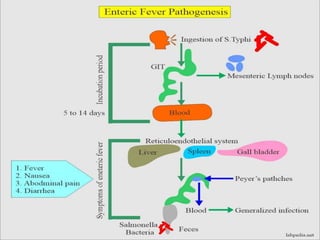
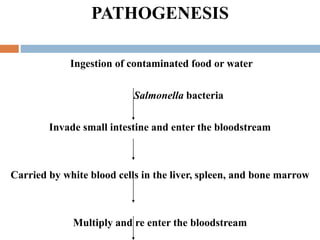
Ingestion of contaminated food or water
Salmonella bacteria
Invade small intestine and enter the bloodstream
Carried by white blood cells in the liver, spleen, and bone marrow
Multiply and re enter the bloodstream
PATHOGENESIS
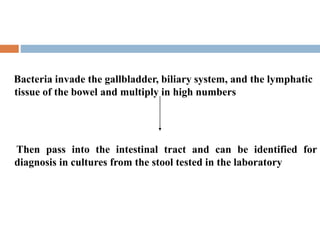
Bacteria invade the gallbladder, biliary system, and the lymphatic
tissue of the bowel and multiply in high numbers
Then pass into the intestinal tract and can be identified for
diagnosis in cultures from the stool tested in the laboratory
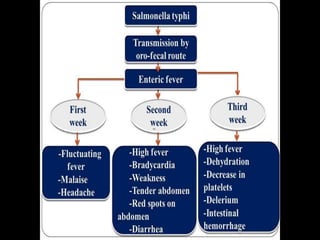
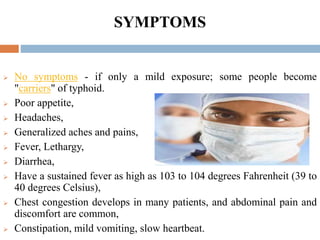
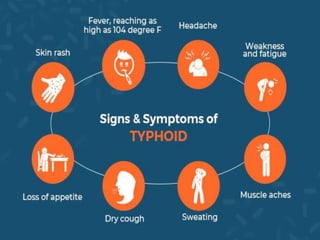
SYMPTOMS
 No symptoms - if only a mild exposure; some people become
"carriers" of typhoid.
 Poor appetite,
 Headaches,
 Generalized aches and pains,
 Fever, Lethargy,
 Diarrhea,
 Have a sustained fever as high as 103 to 104 degrees Fahrenheit (39 to
40 degrees Celsius),
 Chest congestion develops in many patients, and abdominal pain and
discomfort are common,
 Constipation, mild vomiting, slow heartbeat.
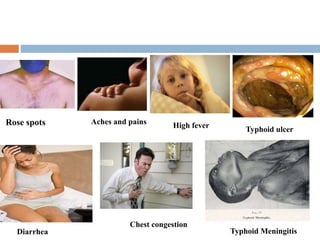
Rose spots High fever
Diarrhea Typhoid Meningitis
Aches and pains
Chest congestion
Typhoid ulcer
Time frame
 Occurs gradually over a few weeks after exposure to the
bacteria. Sometimes children suddenly become sick.
 The condition may last for weeks or even a month or longer
without treatment.
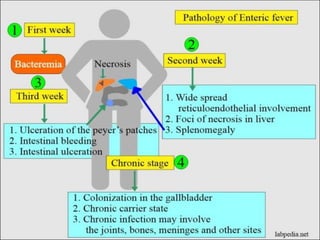
First-Stage Typhoid Fever
 The beginning stage is characterized by high fever, fatigue,
weakness, headache, sore throat, diarrhea, constipation,
stomach pain and a skin rash on the chest and abdominal area.
 Adults are most likely to experience constipation, while
children usually experience diarrhoea.
Second stage
 Second-stage typhoid fever is characterized by weight
loss, high fever, severe diarrhea and severe constipation.
 Also, the abdominal region may appear severely
distended.
Typhoid State
 When typhoid fever continues untreated for more than two
or three weeks, the effected individual may be delirious or
unable to stand and move, and the eyes may be partially
open during this time.
 At this point fatal complications may emerge.
Complications
Intestinal bleeding or holes
 Intestinal bleeding or holes in the intestine are the most
serious complications of typhoid fever.
 They usually develop in the third week of illness. In this
condition, the small intestine or large bowel develops a
hole.
 Contents from the intestine leak into the stomach and can
cause severe stomach pain, nausea, vomiting and
bloodstream infection (sepsis). This life-threatening
complication requires immediate medical care.
Other possible complications include:
 Inflammation of the heart muscle (myocarditis)
 Inflammation of the lining of the heart and valves
(endocarditis)
 Infection of major blood vessels (mycotic aneurysm)
 Pneumonia
 Inflammation of the pancreas (pancreatitis)
 Kidney or bladder infections
 Infection and inflammation of the membranes and fluid
surrounding your brain and spinal cord (meningitis)
 Psychiatric problems, such as delirium, hallucinations and
paranoid psychosis
DIAGNOSIS
Diagnosis of typhoid fever is made by
 Blood, bone marrow, or stool cultures test
 Widal test
 Slide agglutination
 Antimicrobial susceptibility testing
CULTURE TEST
 For the culture, a small sample of blood, stool, urine
or bone marrow is placed on a special medium that
encourages the growth of bacteria.
 The culture is checked under a microscope for the
presence of typhoid bacteria.
WIDAL TEST
" A test involving agglutination of typhoid bacilli when they are
mixed with serum containing typhoid antibodies from an
individual having typhoid fever; used to detect the presence
of Salmonella typhi and S. paratyphi."
STANDARD TEST TUBE METHOD
Take four sets of 8 test tubes and label them 1 to 8 for O,H,AH and BH antibody
detection.
Pipette it to the tube No.1 of all sets 1.9 ml of isotonic saline.
To each of the remaining tubes (2 to 8) add 1.0 ml of isotonic saline.
To the tube No. 1 tube in each row add 0.1 ml of the serum sample to be tested and mix
well.
Transfer 1ml of the diluted serum from tube no.1 to tube no.2 and mix well.
Discard the 1ml of the diluted serum from tube no.8 of each set.
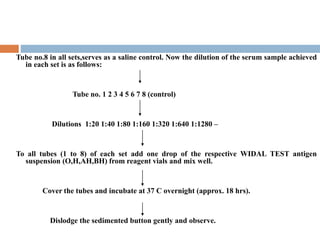
Tube no.8 in all sets,serves as a saline control. Now the dilution of the serum sample achieved
in each set is as follows:
Tube no. 1 2 3 4 5 6 7 8 (control)
Dilutions 1:20 1:40 1:80 1:160 1:320 1:640 1:1280 –
To all tubes (1 to 8) of each set add one drop of the respective WIDAL TEST antigen
suspension (O,H,AH,BH) from reagent vials and mix well.
Cover the tubes and incubate at 37 C overnight (approx. 18 hrs).
Dislodge the sedimented button gently and observe.
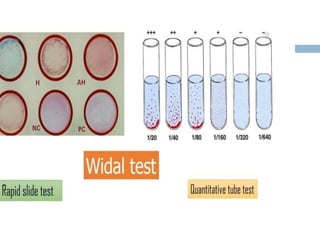
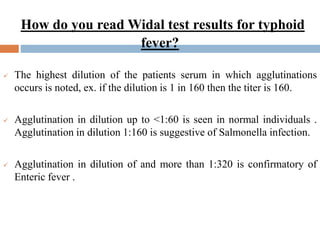
How do you read Widal test results for typhoid
fever?
 The highest dilution of the patients serum in which agglutinations
occurs is noted, ex. if the dilution is 1 in 160 then the titer is 160.
 Agglutination in dilution up to <1:60 is seen in normal individuals .
Agglutination in dilution 1:160 is suggestive of Salmonella infection.
 Agglutination in dilution of and more than 1:320 is confirmatory of
Enteric fever .
 Ciprofloxacin (Cipro).
 Azithromycin (Zithromax)
 Ceftriaxone
 Ampicillin
 Chloramphenicol
 Amoxicillin
MEDICATION
OTHER TREATMENTS
Drinking fluids. This helps prevent the dehydration
that results from a prolonged fever and diarrhea. If
severely dehydrated, may need to receive fluids
through a vein (intravenously).
Surgery. If intestines become torn,need surgery to
repair the hole.
Prevention
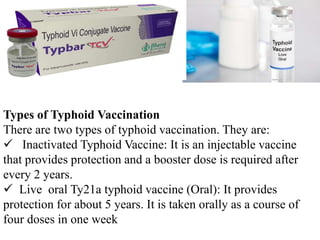
Types of Typhoid Vaccination
There are two types of typhoid vaccination. They are:
 Inactivated Typhoid Vaccine: It is an injectable vaccine
that provides protection and a booster dose is required after
every 2 years.
 Live oral Ty21a typhoid vaccine (Oral): It provides
protection for about 5 years. It is taken orally as a course of
four doses in one week
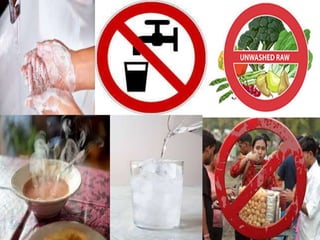
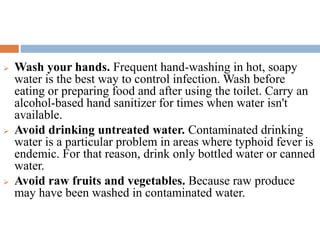
 Wash your hands. Frequent hand-washing in hot, soapy
water is the best way to control infection. Wash before
eating or preparing food and after using the toilet. Carry an
alcohol-based hand sanitizer for times when water isn't
available.
 Avoid drinking untreated water. Contaminated drinking
water is a particular problem in areas where typhoid fever is
endemic. For that reason, drink only bottled water or canned
water.
 Avoid raw fruits and vegetables. Because raw produce
may have been washed in contaminated water.
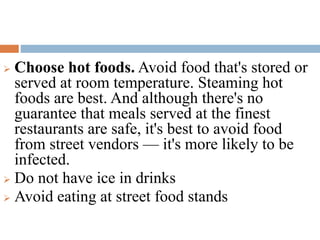
 Choose hot foods. Avoid food that's stored or
served at room temperature. Steaming hot
foods are best. And although there's no
guarantee that meals served at the finest
restaurants are safe, it's best to avoid food
from street vendors — it's more likely to be
infected.
 Do not have ice in drinks
 Avoid eating at street food stands
Salmonella  typhi

Salmonella typhi

  • 1.
    PRESENTED BY Mrs.J.JEBA, M.Sc.,M.Phil. ASSOCIATEPROFESSOR ANNASAMY RAJAMMAL COLLEGE OF NURSING, ATHIYOOTHU
  • 2.
    TYPHOID  Typhoid isa bacterial infection that can lead to a high fever, diarrhea, and vomiting.  It can be fatal.  It is caused by the bacteria Salmonella typhi.  The infection is often passed on through contaminated food and drinking water  It is more prevalent in places where hand washing is less frequent.
  • 4.
    HISTORY  Antonius Musa,a Roman physician who achieved fame by treating the Emperor Augustus 2,000 year ago, with cold baths when he fell ill with typhoid.  Thomas Willis who is credited with the first description of typhoid fever in 1659.
  • 5.
     French physicianPierre Charles  Alexandre Louis first proposed  the name “typhoid fever”  William Wood Gerhard who was the first to differentiate clearly between typhus fever and typhoid in 1837.
  • 6.
     Carl JosephEberth who discovered the  typhoid bacillus in 1880.  Georges Widal who described the ‘Widal agglutination reaction’ of the blood in 1896.
  • 7.
    HISTORY  Salmonella isan important bacterial genus which causes one of the most common forms of food poisoning worldwide. Throughout history typhoid fever – caused by Salmonella enterica serovar Typhi – triggered many dire outbreaks, and people eventually recognized the link between this disease and contaminated food or beverages.  Karl Joseph Eberth, a doctor and student of Rudolf Virchow, discovered the bacillus in the abdominal lymph nodes and the spleen in 1879. After he had published his observations in 1880 and 1881, his discovery was subsequently confirmed by German and English bacteriologists, including Robert Koch.  The genus “Salmonella” was named after Daniel Elmer Salmon, a veterinary pathologist who ran a The United States Department of Agriculture (USDA) microorganism research program in the 1800s. Together with Theobald Smith, he found Salmonella in hogs that succumbed to the disease known as hog cholera.
  • 9.
    The story ofMary Mallon  Mary Mallon was born in Ireland and immigrated to the United States in 1884. She is considered the first famous carrier of typhoid fever in the United States. Initially engaged in 1906 as a cook by Charles Henry Warren, a wealthy New York banker, she was subsequently hired as a cook at several private homes throughout the New York area.  Moving from household to household, Mary Mallon caused several typhoid outbreaks, always vanishing before an epidemic could be traced back to the particular household she was working in. Mary represents the first known case of a healthy carrier in the United States, and was proven responsible for the contamination of at least 122 people – including five dead.  In 1907 almost 3000 inhabitants of New York had been infected by Salmonella Typhi, with Mary probably being the main reason for the outbreak. Due to a lack of antibiotic treatment and no immunization option at the time, a dangerous source like Mary had to be restrained.
  • 10.
     After policeintervened and Salmonella had been found in Mary’s stool, she was transferred to North Brother Island to Riverside Hospital, where she was quarantined in a cottage.  As she was the first known healthy carrier of typhoid fever in the United States, she did not understand how someone healthy could spread disease; hence she tried to fight back.
  • 11.
     Although theNew York Supreme Court dismissed her petition for release, the city’s new health commissioner Ernst J. Lederle took pity on Mallon and released her on the promise that she will never again work as a cook.  Nevertheless, she was found to be working as a cook, which was again causing typhoid outbreaks.  She was sent back to North Brother Island, where she lived until her death in 1938.
  • 12.
     There isstill much speculation regarding the treatment that Mary received at the hands of the New York’s Department of Health.  Instead of working with her to make her realize she was a risk factor, the state quarantined her twice and turned her a laboratory pet.  This case is often cited as an example of how the health care system provokes prejudiced social attitudes towards disease carriers.
  • 13.
    Salmonella-A Very complexgroup  Contains more > 2,000 sp  Typed on the basis of Serotyping, and species typing Divided into two groups  1. Enteric fever group, 2.Food poisoning group – Septicemias.  Enteric Fever (Typhoid Fever )-Caused by Salmonella typhi, and other Groups called as Paratyphi A, B, C.  Salmonella typhi - Causes Typhoid  Salmonella Paratyphi A,B,C Causes Paratyphoid fevers.  Food Poison group  Spread from Animals – Humans  Causes Gastroenteritis – Septicemias, Localized Infection
  • 14.
    CAUSES  Ingestion ofcontaminated food or water.  Contact with an acute case of typhoid fever.  Water is contaminated where inadequate sewage systems and poor sanitation. Contact with a chronic asymptomatic carrier. Typhoid carriers  Even after antibiotic treatment, a small number of people who recover from typhoid fever continue to harbor the bacteria. These people, known as chronic carriers, no longer have signs or symptoms of the disease themselves. However, they still shed the bacteria in their feces and are capable of infecting others.  Eating food or drinking beverages that handled by a person carrying the bacteria.  Salmonella enteriditis and Salmonella typhimurium are other salmonella bacteria, cause food poisoning and diarrhoea.
  • 15.
    Morphology of Salmonella Gram negative bacilli  1-3 / 0.5 microns  Motile by peritrichous flagella  Arranged singly or in pairs  Non–sporing  Non–capsulated
  • 16.
    Cultural Characters  Aerobic/ Facultative anaerobic  Grows on simple media – Nutrient agar  Temp 15 – 41ºc / 37º c  PH=6.5-7.5
  • 17.
    MEDIUM  Deoxycholate CitrateAgar (DCA) medium  Salmonella – Shigella Agar medium  Wilson & Blair bismuth sulfite medium  Xylose Lysine Deoxycholate (XLD) medium  Tetrathionate broth  Selenite F Broth
  • 18.
    Peptone water andNutrient Broth (NB)  In liquid medium (Nutrient broth), most strains give abundant growth with uniform turbidity of their surface pellicle usually forms on prolong incubation.
  • 19.
    NUTRIENT AGAR  Coloniesappear as large 2 -3 mm, circular, convex.
  • 20.
    BLOOD AGAR  BloodAgar medium, the Salmonella typhi shows gamma hemolysis
  • 21.
    MACCONKEY AGAR  MacConkeyAgar medium, the colonies of Salmonella typhi are colorless due to the lack of lactose fermentation
  • 22.
    WILSON BLAIR BISMUTH SULPHITEAGAR  S. Typhi, S. Enteritidis, and S. Typhimurium typically grow as black colonies with a surrounding metallic sheen resulting from hydrogen sulphide production and reduction of sulphite to black ferric sulphide. Salmonella Paratyphi A grows as light green colonies.
  • 23.
    Selenite F broth& Tetrathionate broth  Selenite F broth & Tetrathionate broth are the enrichment medium for Salmonella species and commonly used for the isolation of the organism from the fecal sample where the density of Salmonella typhi may be too low in early stages of infection.  The fecal specimen inoculated in Selenite F broth are incubated for 6-12 hours generally (not more than 24 hours) and then sub cultured on Wilson & Blair bismuth sulfide medium or XLD medium or any other selective medium.
  • 24.
    Xylose Lysine DextroseAgar (XLD)  Xylose Lysine Dextrose Agar (XLD) medium, the colonies of Salmonella appears red due to the fermentation of xylose which lowers the pH of medium and the presence of Phenol Red (indicator) imparts a pink or red color to the salmonella typhi colonies with a black center which is due to the production of H2S
  • 25.
    Salmonella Shigella Agarmedium The colonies of Salmonella typhi are Colorless with black center, due to the production of H2S (Hydrogen sulfide).
  • 26.
    Antigenic structure ofSalmonella  Salmonella possess following antigens:  Flagella antigen (H)  Somatic antigen (O)  Surface antigen (Vi)- found in some species  Several strains carry fimbriae.
  • 30.
    Ingestion of contaminatedfood or water Salmonella bacteria Invade small intestine and enter the bloodstream Carried by white blood cells in the liver, spleen, and bone marrow Multiply and re enter the bloodstream PATHOGENESIS
  • 31.
    Bacteria invade thegallbladder, biliary system, and the lymphatic tissue of the bowel and multiply in high numbers Then pass into the intestinal tract and can be identified for diagnosis in cultures from the stool tested in the laboratory
  • 33.
    SYMPTOMS  No symptoms- if only a mild exposure; some people become "carriers" of typhoid.  Poor appetite,  Headaches,  Generalized aches and pains,  Fever, Lethargy,  Diarrhea,  Have a sustained fever as high as 103 to 104 degrees Fahrenheit (39 to 40 degrees Celsius),  Chest congestion develops in many patients, and abdominal pain and discomfort are common,  Constipation, mild vomiting, slow heartbeat.
  • 34.
    Rose spots Highfever Diarrhea Typhoid Meningitis Aches and pains Chest congestion Typhoid ulcer
  • 36.
    Time frame  Occursgradually over a few weeks after exposure to the bacteria. Sometimes children suddenly become sick.  The condition may last for weeks or even a month or longer without treatment. First-Stage Typhoid Fever  The beginning stage is characterized by high fever, fatigue, weakness, headache, sore throat, diarrhea, constipation, stomach pain and a skin rash on the chest and abdominal area.  Adults are most likely to experience constipation, while children usually experience diarrhoea.
  • 37.
    Second stage  Second-stagetyphoid fever is characterized by weight loss, high fever, severe diarrhea and severe constipation.  Also, the abdominal region may appear severely distended. Typhoid State  When typhoid fever continues untreated for more than two or three weeks, the effected individual may be delirious or unable to stand and move, and the eyes may be partially open during this time.  At this point fatal complications may emerge.
  • 38.
    Complications Intestinal bleeding orholes  Intestinal bleeding or holes in the intestine are the most serious complications of typhoid fever.  They usually develop in the third week of illness. In this condition, the small intestine or large bowel develops a hole.  Contents from the intestine leak into the stomach and can cause severe stomach pain, nausea, vomiting and bloodstream infection (sepsis). This life-threatening complication requires immediate medical care.
  • 39.
    Other possible complicationsinclude:  Inflammation of the heart muscle (myocarditis)  Inflammation of the lining of the heart and valves (endocarditis)  Infection of major blood vessels (mycotic aneurysm)  Pneumonia  Inflammation of the pancreas (pancreatitis)  Kidney or bladder infections  Infection and inflammation of the membranes and fluid surrounding your brain and spinal cord (meningitis)  Psychiatric problems, such as delirium, hallucinations and paranoid psychosis
  • 41.
    DIAGNOSIS Diagnosis of typhoidfever is made by  Blood, bone marrow, or stool cultures test  Widal test  Slide agglutination  Antimicrobial susceptibility testing
  • 42.
    CULTURE TEST  Forthe culture, a small sample of blood, stool, urine or bone marrow is placed on a special medium that encourages the growth of bacteria.  The culture is checked under a microscope for the presence of typhoid bacteria.
  • 43.
    WIDAL TEST " Atest involving agglutination of typhoid bacilli when they are mixed with serum containing typhoid antibodies from an individual having typhoid fever; used to detect the presence of Salmonella typhi and S. paratyphi."
  • 45.
    STANDARD TEST TUBEMETHOD Take four sets of 8 test tubes and label them 1 to 8 for O,H,AH and BH antibody detection. Pipette it to the tube No.1 of all sets 1.9 ml of isotonic saline. To each of the remaining tubes (2 to 8) add 1.0 ml of isotonic saline. To the tube No. 1 tube in each row add 0.1 ml of the serum sample to be tested and mix well. Transfer 1ml of the diluted serum from tube no.1 to tube no.2 and mix well. Discard the 1ml of the diluted serum from tube no.8 of each set.
  • 46.
    Tube no.8 inall sets,serves as a saline control. Now the dilution of the serum sample achieved in each set is as follows: Tube no. 1 2 3 4 5 6 7 8 (control) Dilutions 1:20 1:40 1:80 1:160 1:320 1:640 1:1280 – To all tubes (1 to 8) of each set add one drop of the respective WIDAL TEST antigen suspension (O,H,AH,BH) from reagent vials and mix well. Cover the tubes and incubate at 37 C overnight (approx. 18 hrs). Dislodge the sedimented button gently and observe.
  • 47.
    How do youread Widal test results for typhoid fever?  The highest dilution of the patients serum in which agglutinations occurs is noted, ex. if the dilution is 1 in 160 then the titer is 160.  Agglutination in dilution up to <1:60 is seen in normal individuals . Agglutination in dilution 1:160 is suggestive of Salmonella infection.  Agglutination in dilution of and more than 1:320 is confirmatory of Enteric fever .
  • 48.
     Ciprofloxacin (Cipro). Azithromycin (Zithromax)  Ceftriaxone  Ampicillin  Chloramphenicol  Amoxicillin MEDICATION
  • 49.
    OTHER TREATMENTS Drinking fluids.This helps prevent the dehydration that results from a prolonged fever and diarrhea. If severely dehydrated, may need to receive fluids through a vein (intravenously). Surgery. If intestines become torn,need surgery to repair the hole.
  • 50.
  • 51.
    Types of TyphoidVaccination There are two types of typhoid vaccination. They are:  Inactivated Typhoid Vaccine: It is an injectable vaccine that provides protection and a booster dose is required after every 2 years.  Live oral Ty21a typhoid vaccine (Oral): It provides protection for about 5 years. It is taken orally as a course of four doses in one week
  • 53.
     Wash yourhands. Frequent hand-washing in hot, soapy water is the best way to control infection. Wash before eating or preparing food and after using the toilet. Carry an alcohol-based hand sanitizer for times when water isn't available.  Avoid drinking untreated water. Contaminated drinking water is a particular problem in areas where typhoid fever is endemic. For that reason, drink only bottled water or canned water.  Avoid raw fruits and vegetables. Because raw produce may have been washed in contaminated water.
  • 54.
     Choose hotfoods. Avoid food that's stored or served at room temperature. Steaming hot foods are best. And although there's no guarantee that meals served at the finest restaurants are safe, it's best to avoid food from street vendors — it's more likely to be infected.  Do not have ice in drinks  Avoid eating at street food stands