Zoonoses pathogens
A zoonosis or zoonose is any infectious disease that can
be transmitted between species (in some instances, by a vector)
from animals to humans or from humans to animals (the
latter is sometimes called reverse zoonosis or anthroponosis).
In a study of 1415 pathogens known to affect humans, 61%
were zoonotic .
Overview
Zoonosis
History
Interactions between animals and
humans have occurred since the
beginning of time.
As animals became domesticated
and a close bonds developed
between animals and humans, the
occurrence of zoonotic diseases
increased.
Significant Zoonitic Pandemics
1700s, Mongols invaded Europe
Mongols carried plague with them
This lead to “black death” or plague
pandemic
Killed 1/3 of European population
Significant Zoonitic Pandemics
Early 1900’s
“Spanish flu” transmitted from pigs
to humans
Decimated 20 million people
worldwide
Continues to pose a threat to
humans
Today’s threat involving zoonotic
diseases is considered to be partly
due to human involvement in which
the artificial multiplication of these
pathogens can be used as
biological terrorism.
Contemporary Threats
Prevalence
Largely Unknown
Both serological studies and anecdotal
discussion have been used to generate
estimates
1997 a study trying to assess the
prevalence of antibodies against
Bartonella henselae and B. quintana
was done at a veterinary conference.
The results indicated that 7.1% of the
veterinary population had antibodies
which was no different from the general
population studies at an earlier time.
Types of Pathogens
 Viruses
 Bacteria
 Fungi
 Others
 Rickettsia
 Protozoa
 Parasites
Always assume every
animal is shedding
pathogens
How Diseases Spread
Fecal-oral
Fecal contamination is not always
obvious
Many pathogens may survive for
long periods of time in the
environment.
Parvovirus ringworm and some
worm eggs can survive for years
How Diseases Spread
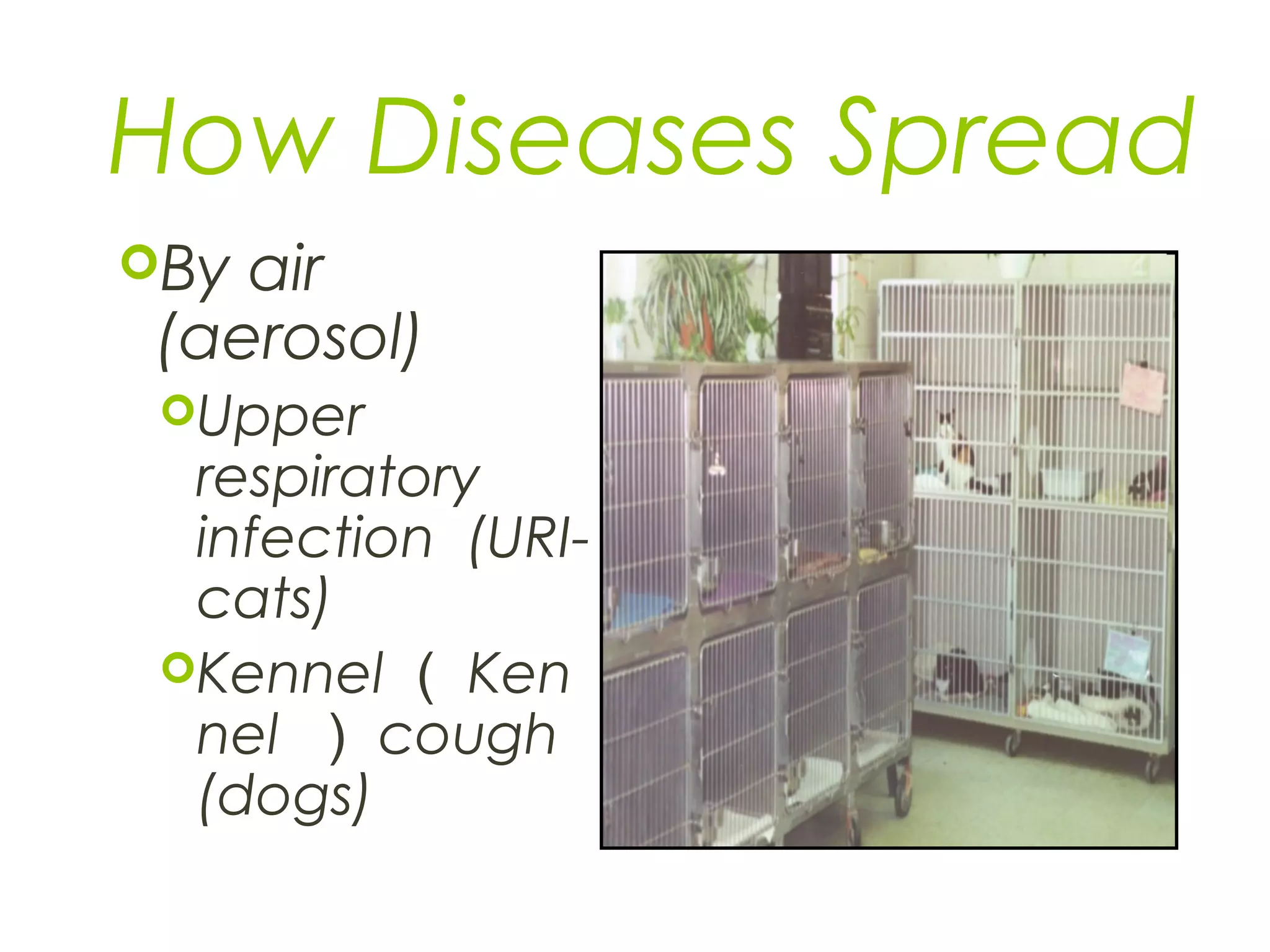
By air
(aerosol)
Upper
respiratory
infection (URI-
cats)
Kennel ( Ken
nel ) cough
(dogs)
How Diseases Spread
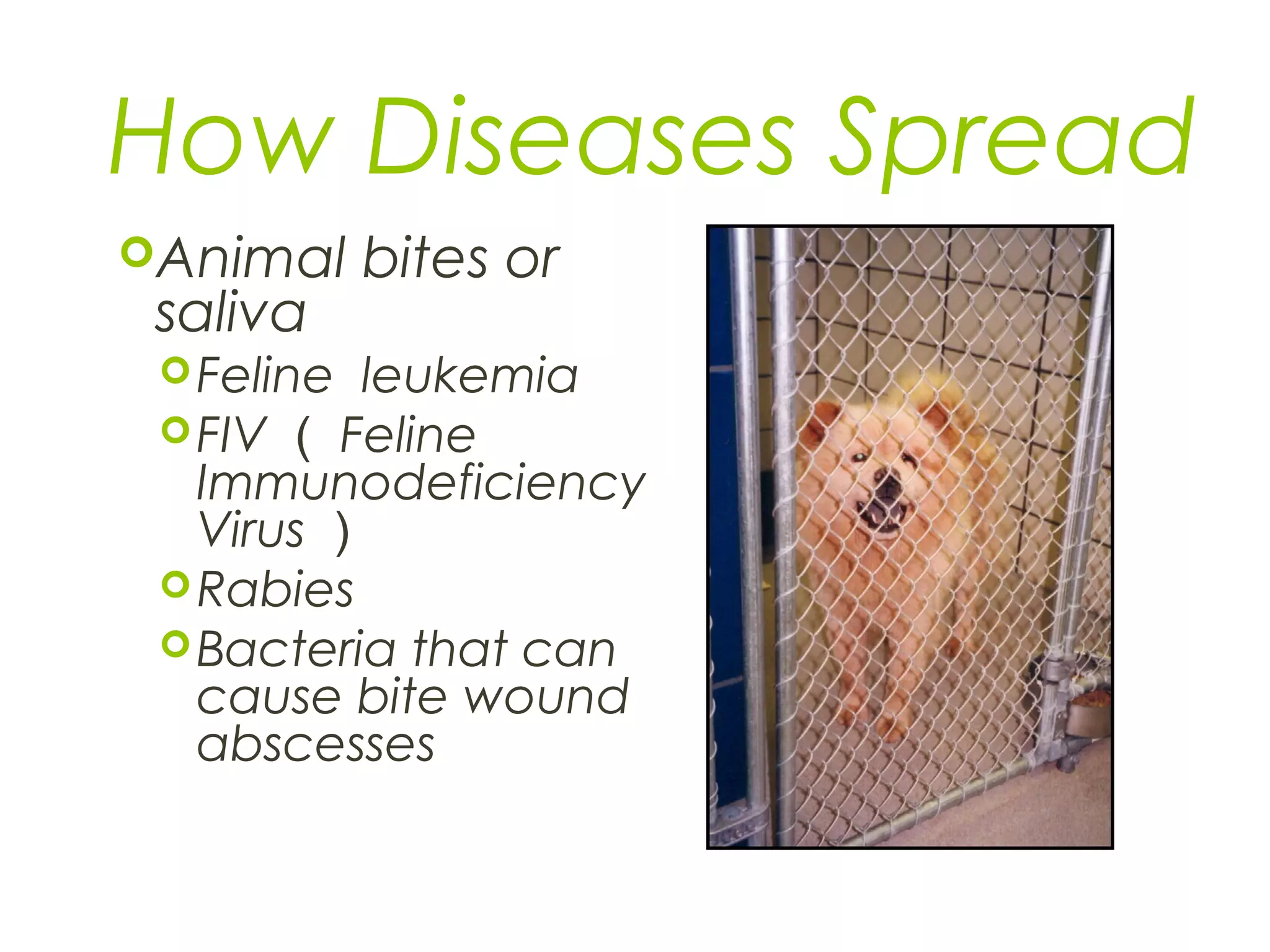
Animal bites or
saliva
Feline leukemia
FIV ( Feline
Immunodeficiency
Virus )
Rabies
Bacteria that can
cause bite wound
abscesses
How Diseases Spread
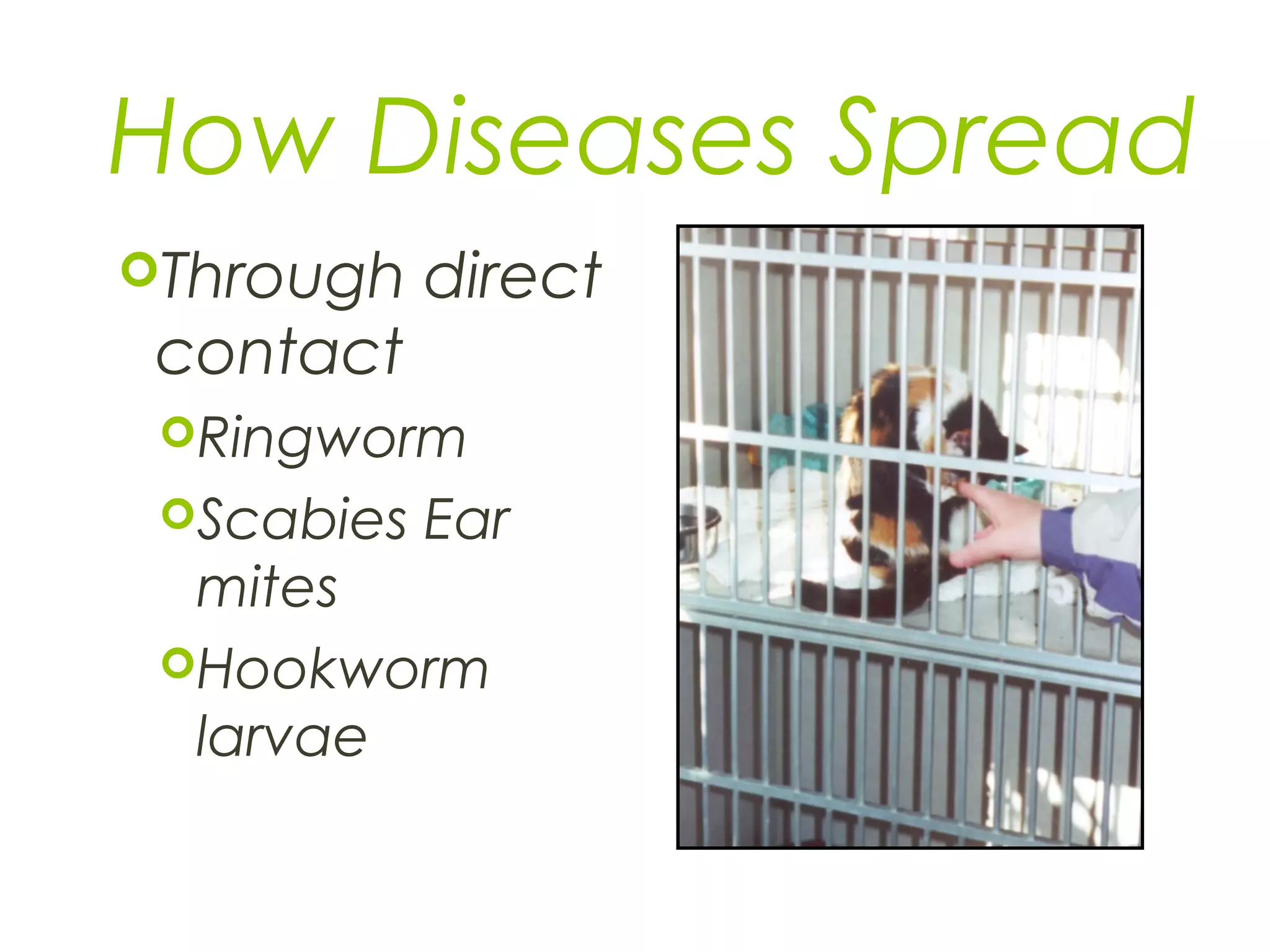
Through direct
contact
Ringworm
Scabies Ear
mites
Hookworm
larvae
How Diseases Spread
 By insect “vectors”
 Mosquitoes spread heartworms and encephalitis
 Fleas spread tapeworms, cat scratch fever,
plague, typhus, etc.
 Ticks spread Lyme disease, Rocky Mountain
Spotted Fever, and more
 Vectors must be controlled in the shelter
 Eliminate standing water (mosquitos)
 Treat fleas on animals and in environment
 Keep grass cut to limit ticks
How Diseases Spread
By infected objects (fomites)
Ringworm spread by spores on pet
hair
Cage walls, toys, and bedding
Peoples’ hands – including staff!
12 Tips to Help You Avoid
Zoonotic Diseases
 Stay current on appropriate vaccinations (tetanus,
rabies)
 Wash hands frequently with antibacterial soap
 before eating or smoking
 After handling each animal or cage
 Wear long pants and sturdy shoes or boots
 Use gloves
 Wear safety glasses and mask when spray cleaning
 Disinfect scratches and bite wounds thoroughly,
then cover them.
12 Tips to Help You Avoid
Zoonotic Diseases
 Don’t allow animals to lick your face or any
open wounds
 Learn safe & humane animal-handling
techniques, and user proper equipment
 Seek assistance when handling questionable
animals
 Report any bites or injuries to supervisor
 Tell your physician where you work
 Consider other work if you are
immunosuppressed.
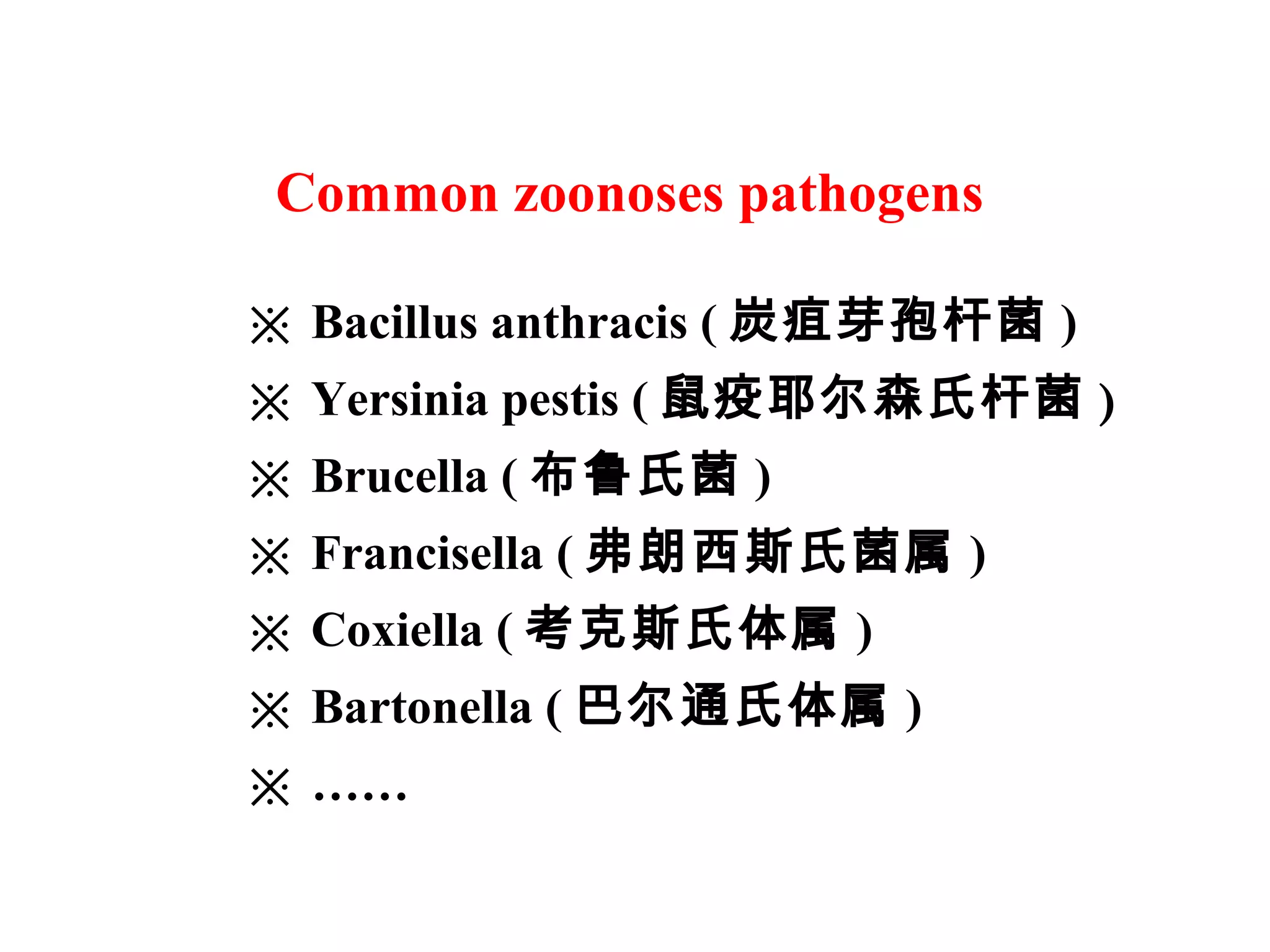
※ Bacillus anthracis ( 炭疽芽孢杆菌 )
※ Yersinia pestis ( 鼠疫耶尔森氏杆菌 )
※ Brucella ( 布鲁氏菌 )
※ Francisella ( 弗朗西斯氏菌属 )
※ Coxiella ( 考克斯氏体属 )
※ Bartonella ( 巴尔通氏体属 )
……※
Common zoonoses pathogens
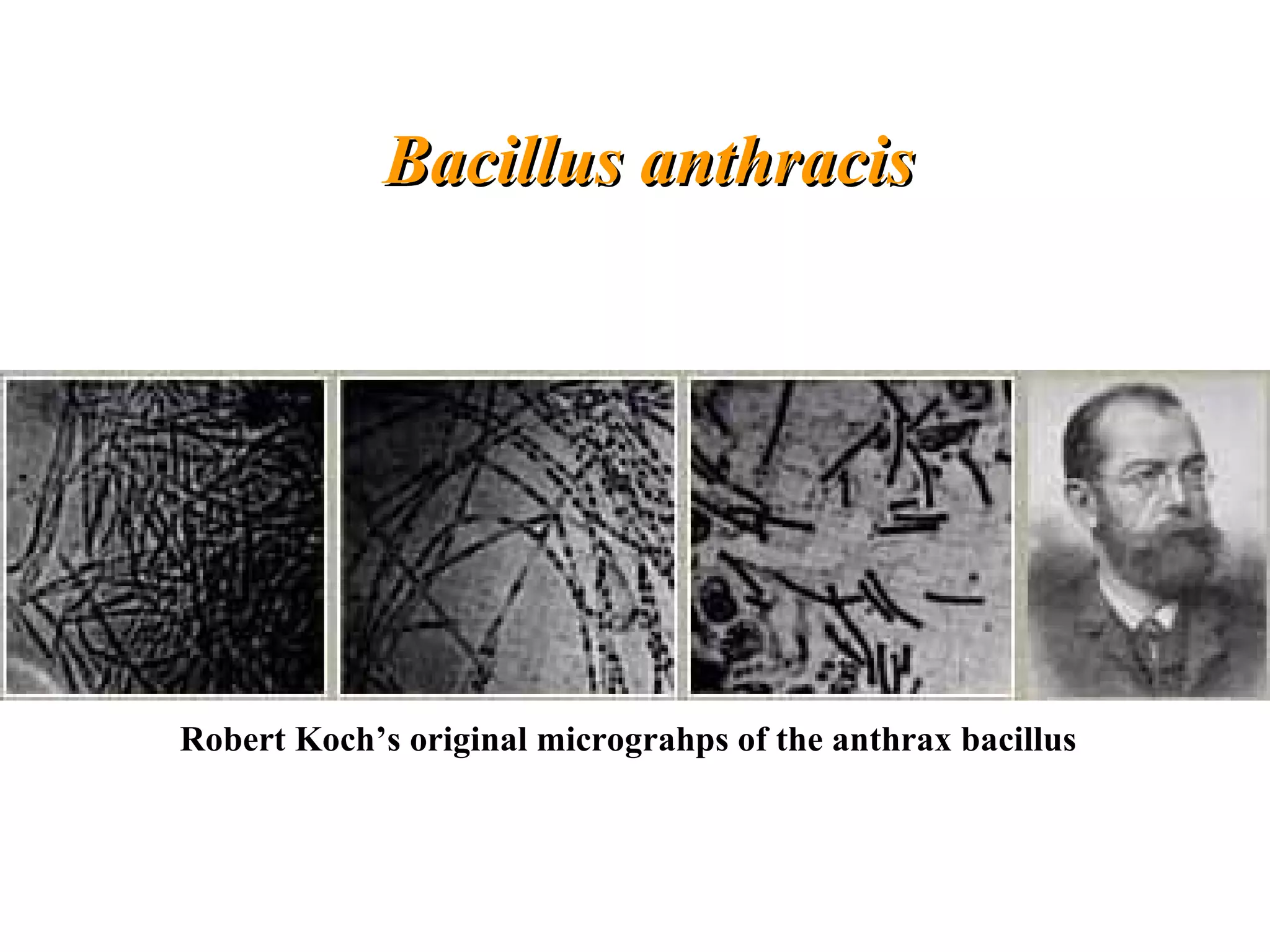
Bacillus anthracisBacillus anthracis
Robert Koch’s original micrograhps of the anthrax bacillus
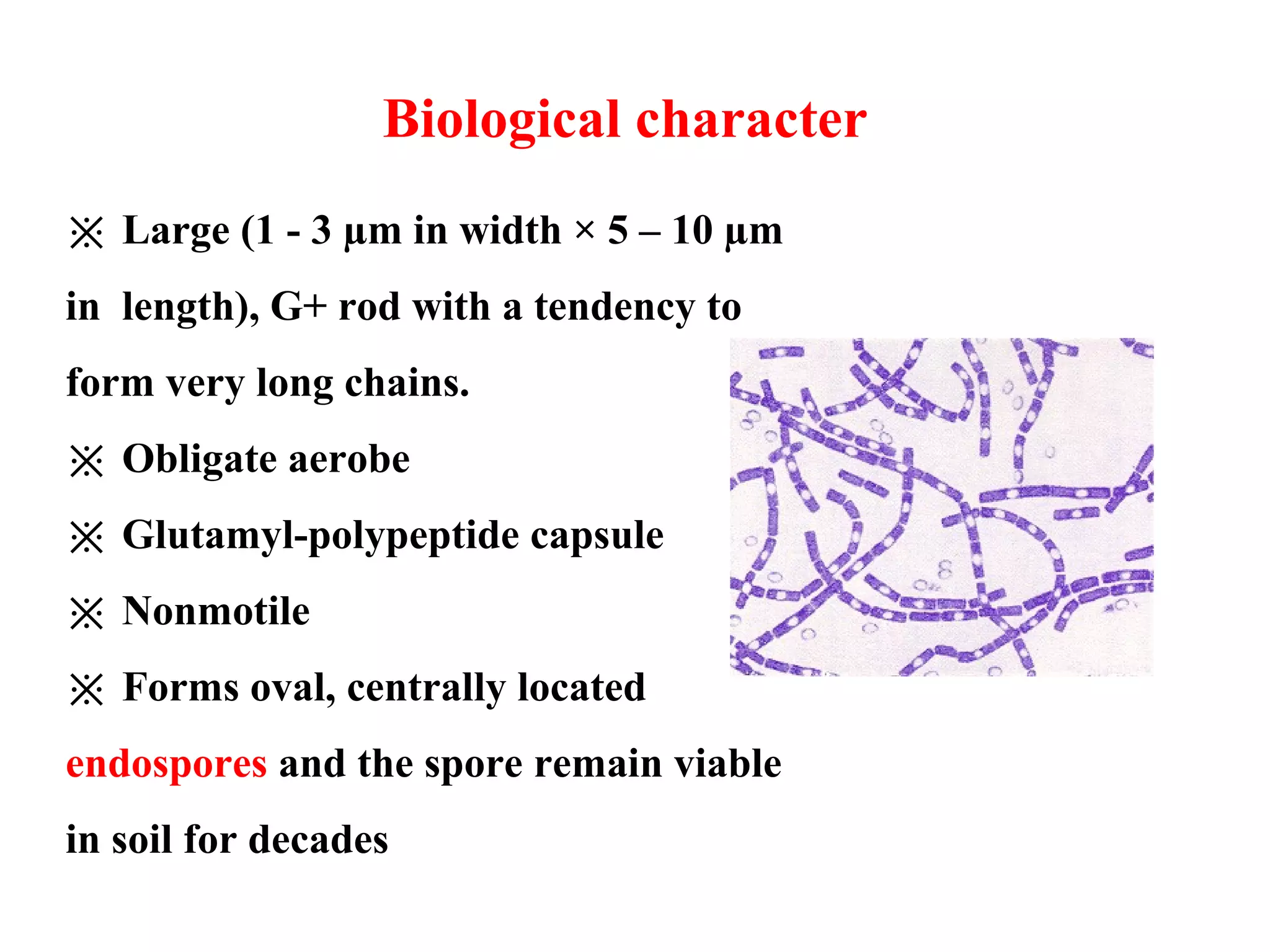
※ Large (1 - 3 µm in width × 5 – 10 µm
in length), G+ rod with a tendency to
form very long chains.
※ Obligate aerobe
※ Glutamyl-polypeptide capsule
※ Nonmotile
※ Forms oval, centrally located
endospores and the spore remain viable
in soil for decades
Biological character
2. Cultural character
On blood agar, nonhemolytic colonies characterized
by a rough, uneven surface with multiple curled extensions
at the edge resembling a “Medusahead”
Colonies of Bacillus anthracis on blood agar.
Mucoid colonies of Bacillus anthracis. This
culture was probably incubated at an
increased CO2 tension (5% CO2) which
greatly enhances production of the poly-D-
glutamyl capsule and accounts for the
mucoid colony type.
2. cultural character
PathogenesisPathogenesis
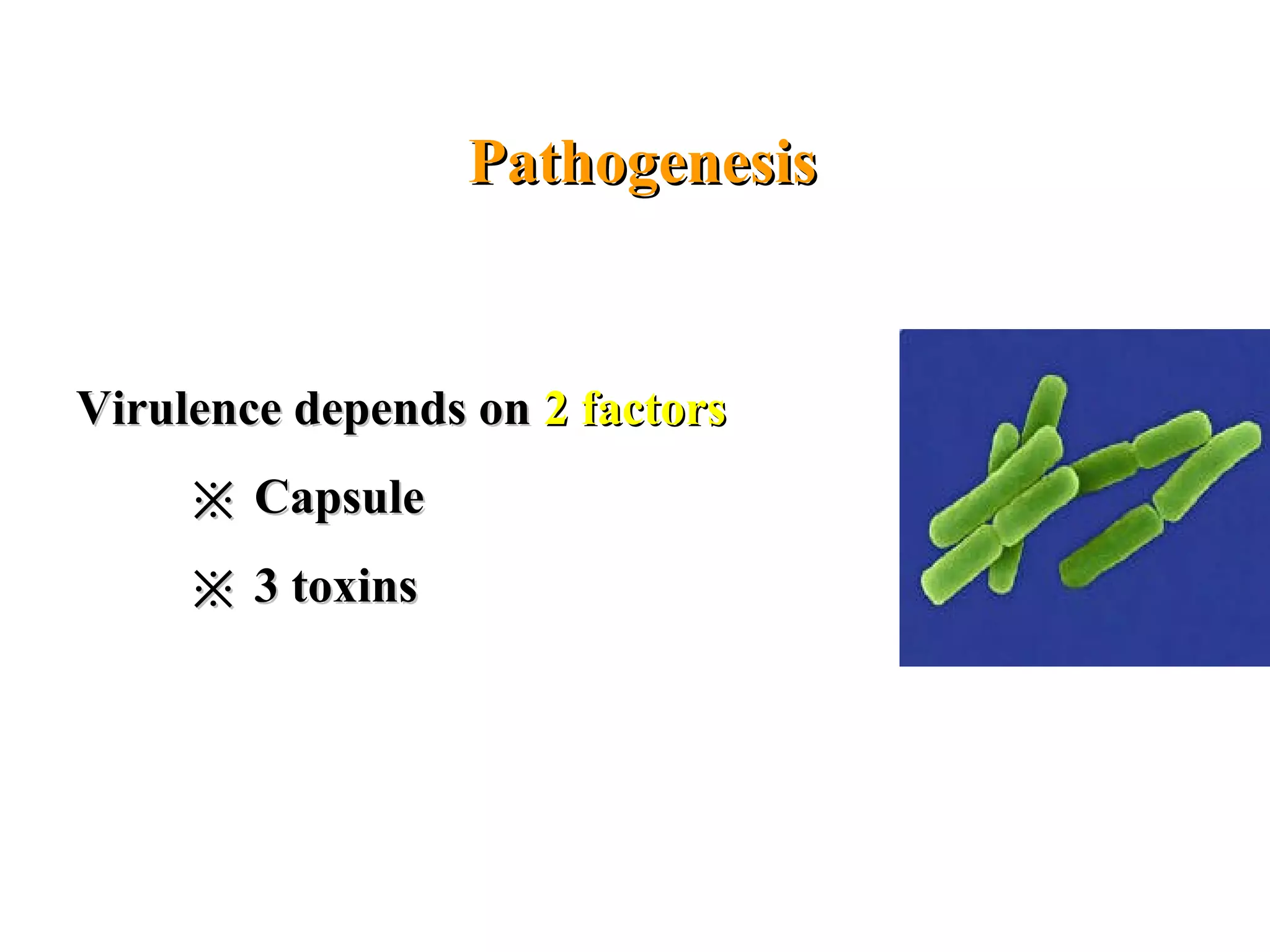
Virulence depends onVirulence depends on 2 factors2 factors
※※ CapsuleCapsule
※※ 3 toxins3 toxins
CapsuleCapsule
C=Capsule; S=S-layer; P=Peptidoglycan
※※ Coded by pX02 plasmidCoded by pX02 plasmid
※※ Made up ofMade up of D-glutamic acidD-glutamic acid
※※ Non-toxic on its ownNon-toxic on its own
※※ Only encapsulatedOnly encapsulated B. anthracisB. anthracis
virulentvirulent
※※ Most important role duringMost important role during
establishment of diseaseestablishment of disease
△△ Protects against phagocytosis & lysisProtects against phagocytosis & lysis
during vegetative stateduring vegetative state
ToxinsToxins
※ Coded by pX01 plasmid
※ AB model
△ Binding
△ Activating
※ Protective antigen (PA), edema factor (EF) & lethal
factor (LF)
△ Make up 50% of proteins in the organism
※ Heterogeneous protein complex made up of 3
components
ToxinsToxins
△ Individually non-toxic
△ PA+LF  lethal activity
△ EF+PA  edema activity
△ EF+LF  inactive
△ PA+LF+EF  edema & necrosis; lethal
※※ Protective antigen (PA, 83kDa)Protective antigen (PA, 83kDa)
△△ PagPag genegene
△△ Binds to receptor & helps internalize other 2 proteinsBinds to receptor & helps internalize other 2 proteins
※※ Edema factor (EF, 89 kDa)Edema factor (EF, 89 kDa)
△△ CyaCya genegene
△△ Adenylate cyclaseAdenylate cyclase
△△ Affects all cellsAffects all cells
※※ Lethal factor (LF, 87 kDa)Lethal factor (LF, 87 kDa)
△△ LefLef genegene
△△ More important virulence factorMore important virulence factor
△△ MetalloproteaseMetalloprotease
△△ Cleaves mitogen activated protein kinase kinase(MAPKK)Cleaves mitogen activated protein kinase kinase(MAPKK)
△△ Affects only macrophagesAffects only macrophages
ToxinsToxins
OutcomeOutcome
※※ Do not understand exactly how symptoms occurDo not understand exactly how symptoms occur
※※ EF convertsEF converts ATP to cAMPATP to cAMP
△△ Increases cAMP levels over 1,000 foldIncreases cAMP levels over 1,000 fold
△△ Impairs neutrophil functionImpairs neutrophil function
△△ Alters water homeostasisAlters water homeostasis
■■ EdemaEdema
OutcomeOutcome
※※ LF cleaves MAPKKLF cleaves MAPKK at its N terminusat its N terminus
△△ Disrupts pathways involved in cell growth & maturationDisrupts pathways involved in cell growth & maturation
△△ Increased synthesis of tumor necrosis factor-Increased synthesis of tumor necrosis factor-αα &&
interleukin-1interleukin-1ββ
△△ Macrophage lysisMacrophage lysis
■■ Septic shock & deathSeptic shock & death
※※ Death probably results from high levels of bacteria secretingDeath probably results from high levels of bacteria secreting
LF toxins in bloodLF toxins in blood
△△ At death, blood contains as many asAt death, blood contains as many as 101099
bacilli/mlbacilli/ml
(depending on the species)(depending on the species)
Anthrax: transmissionAnthrax: transmission
※※ Anthrax is a major disease threat to herbivorous animals.Anthrax is a major disease threat to herbivorous animals.
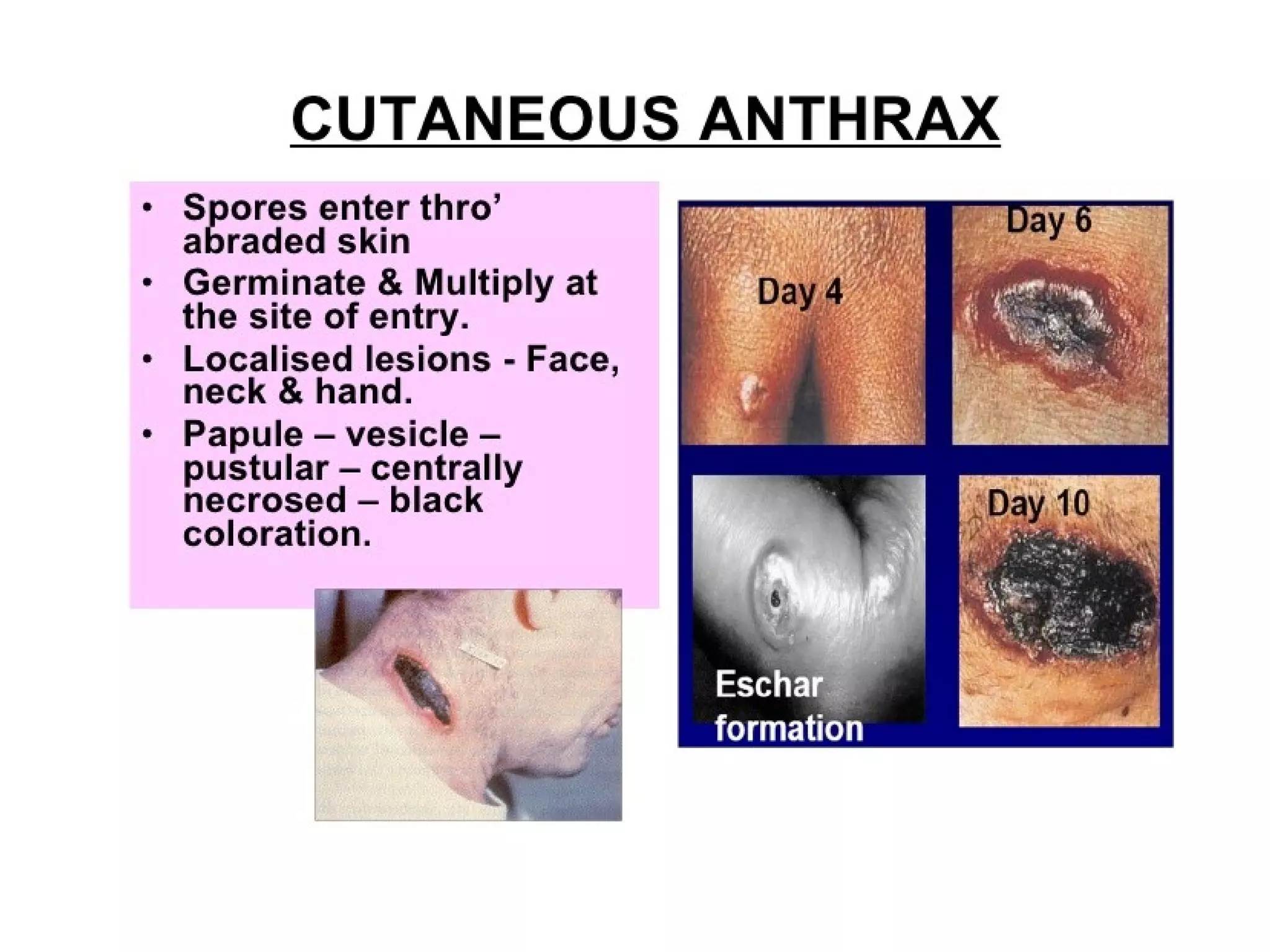
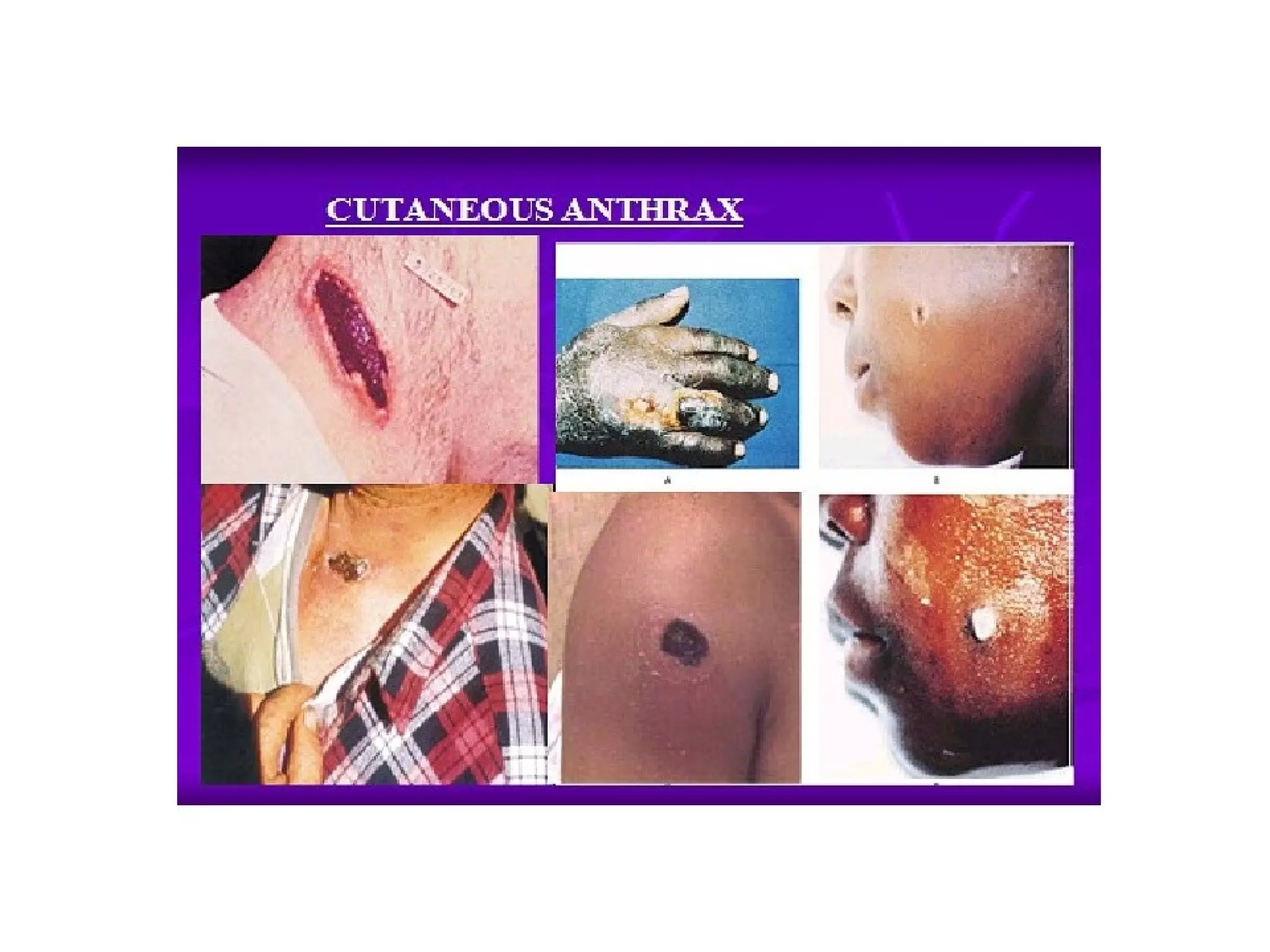
※※ People become infected by thePeople become infected by the cutaneouscutaneous route (directroute (direct
contact with diseased animals, industrial work with hides,contact with diseased animals, industrial work with hides,
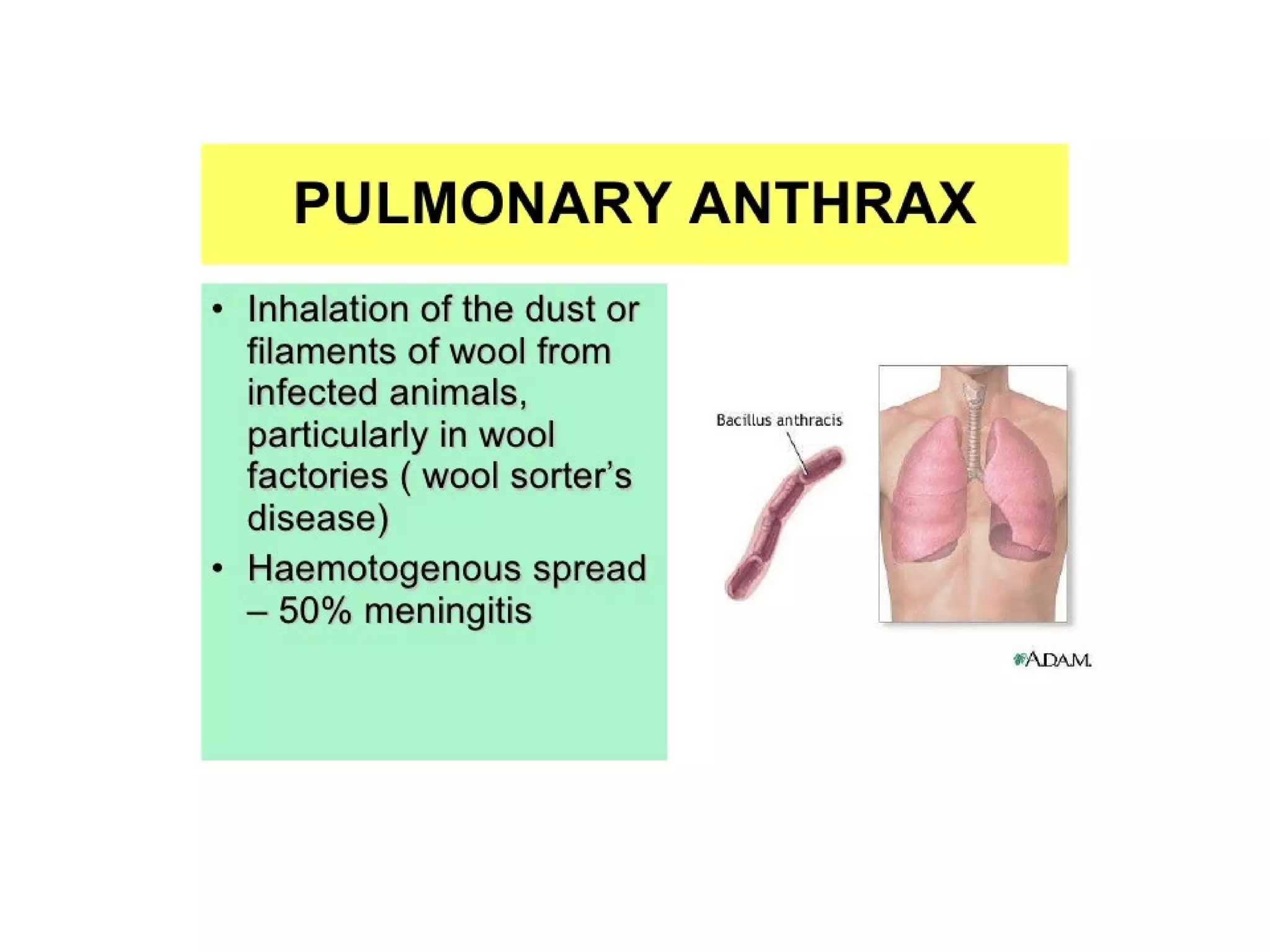
wool, brushes, or bone meal), bywool, brushes, or bone meal), by inhalationinhalation (Woolsorter's(Woolsorter's
disease), or bydisease), or by ingestioningestion (meat from diseased(meat from diseased
animals).animals).
Clinical InformationClinical Information
Three forms of AnthraxThree forms of Anthrax
※※ CutaneousCutaneous anthraxanthrax
△△ SkinSkin
△△ Most commonMost common
△△ Spores enter to skin through small lesionsSpores enter to skin through small lesions
※※ InhalationInhalation anthraxanthrax
△△ Spores are inhaledSpores are inhaled
※※ GastrointestinalGastrointestinal (GI)(GI) anthraxanthrax
△△ Spores are ingestedSpores are ingested
△△ Oral-pharyngeal and abdominalOral-pharyngeal and abdominal
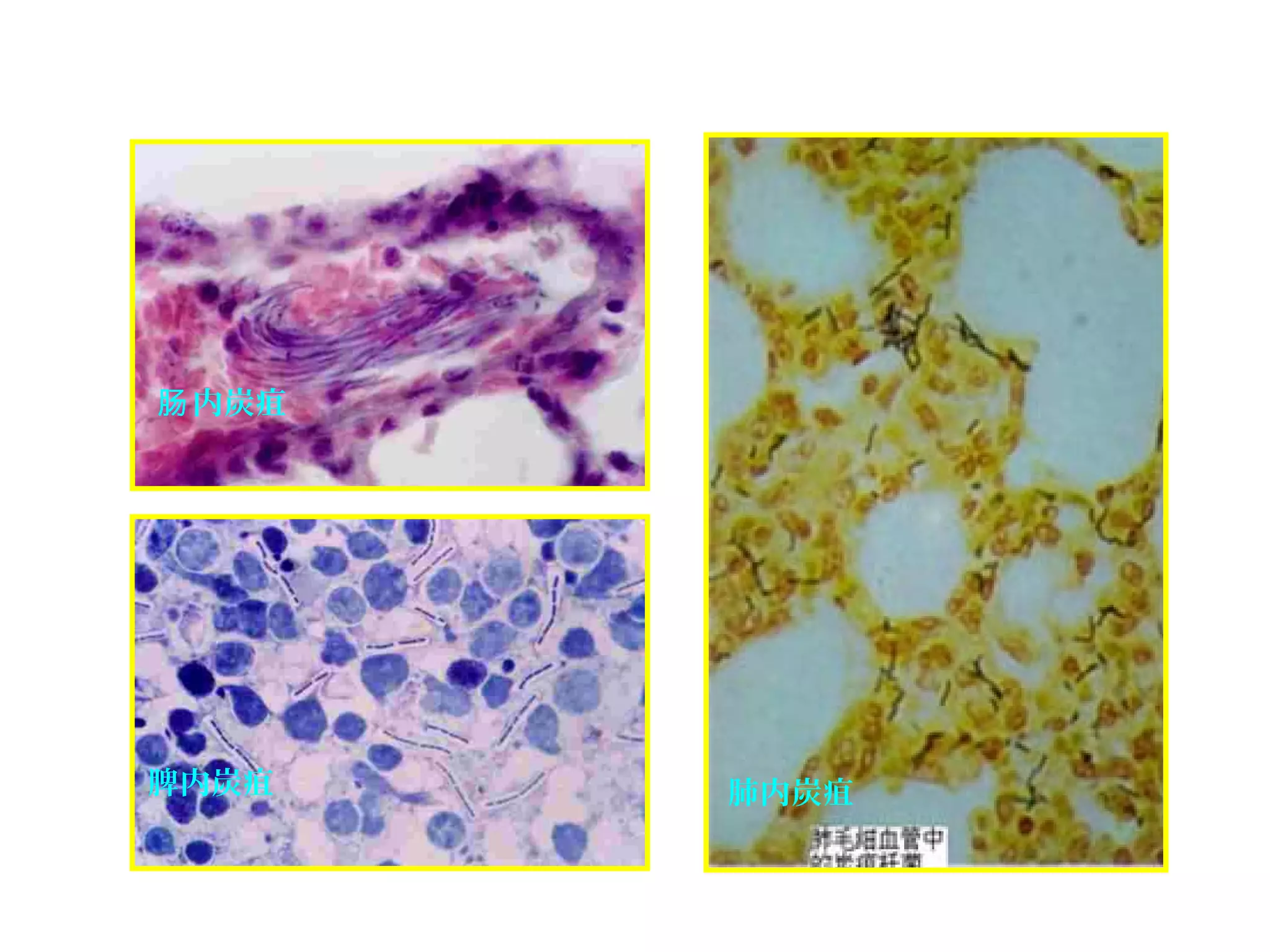
肺内炭疽
内炭疽肠
脾内炭疽
Laboratory diagnosis of anthraxLaboratory diagnosis of anthrax
※※ Gram stainGram stain
※※ Culture ofCulture of B. anthracisB. anthracis from the blood, skin lesions,from the blood, skin lesions,
vesicular fluid, or respiratory secretionsvesicular fluid, or respiratory secretions
※※ Rapid detection methodsRapid detection methods
△△ PCR for detection of nucleic acidPCR for detection of nucleic acid
△△ ELISA assay for antigen detectionELISA assay for antigen detection
△△ Other immunohistochemical and immunoflourescenceOther immunohistochemical and immunoflourescence
examinationsexaminations
Bacillus anthracisBacillus anthracis in Gram stainin Gram stain
Gram Stain AnalysisGram Stain Analysis
△△ Useful for cutaneous and inhalationUseful for cutaneous and inhalation
anthrax.anthrax.
△△ A blood sample or skin lesion isA blood sample or skin lesion is
taken from the patient and culturedtaken from the patient and cultured
forfor 6 to 24 hours6 to 24 hours..
△△ Identify whether the bacteria comeIdentify whether the bacteria come
from the anthrax category.from the anthrax category.
Treatment of anthraxTreatment of anthrax
※※ antibioticsantibiotics
※※ Antibody to the toxin complex is neutralizing andAntibody to the toxin complex is neutralizing and
protectiveprotective
Binding of a Neutralizing Antibody to the Protective
Antigen Subunit of the B. anthracis toxin
Neutralizing Antibodies to B. anthrax toxin
Defense: Protection Against AnthraxDefense: Protection Against Anthrax
※※ VaccinationVaccination
Very Effective: 2 dose efficacy against monkeysVery Effective: 2 dose efficacy against monkeys
(human response believed to be very similar)(human response believed to be very similar)
※※ Early DetectionEarly Detection
Extremely important: eliminate much of danger.Extremely important: eliminate much of danger.
Time lag between exposure and symptoms is primaryTime lag between exposure and symptoms is primary
reason for the high mortality rate experienced withreason for the high mortality rate experienced with
anthrax infectionsanthrax infections
※※ Contaminated animal, carcass or hide should be burned.Contaminated animal, carcass or hide should be burned.
※※ Pre/Post Exposure Antibiotic TreatmentPre/Post Exposure Antibiotic Treatment
※※ Decontamination of Exposed AreasDecontamination of Exposed Areas
※※ Use of Protective Clothing & EquipmentUse of Protective Clothing & Equipment
Defense: Protection Against AnthraxDefense: Protection Against Anthrax
Exercises:
1.Briefly describle the three forms of Anthrax?1.Briefly describle the three forms of Anthrax?
2.Briefly describle the mechanism of anthrax2.Briefly describle the mechanism of anthrax
toxintoxin

16 zoonoses pathogens

  • 1.
  • 2.
    A zoonosis orzoonose is any infectious disease that can be transmitted between species (in some instances, by a vector) from animals to humans or from humans to animals (the latter is sometimes called reverse zoonosis or anthroponosis). In a study of 1415 pathogens known to affect humans, 61% were zoonotic . Overview Zoonosis
  • 3.
    History Interactions between animalsand humans have occurred since the beginning of time. As animals became domesticated and a close bonds developed between animals and humans, the occurrence of zoonotic diseases increased.
  • 4.
    Significant Zoonitic Pandemics 1700s,Mongols invaded Europe Mongols carried plague with them This lead to “black death” or plague pandemic Killed 1/3 of European population
  • 5.
    Significant Zoonitic Pandemics Early1900’s “Spanish flu” transmitted from pigs to humans Decimated 20 million people worldwide Continues to pose a threat to humans
  • 6.
    Today’s threat involvingzoonotic diseases is considered to be partly due to human involvement in which the artificial multiplication of these pathogens can be used as biological terrorism. Contemporary Threats
  • 7.
    Prevalence Largely Unknown Both serologicalstudies and anecdotal discussion have been used to generate estimates 1997 a study trying to assess the prevalence of antibodies against Bartonella henselae and B. quintana was done at a veterinary conference. The results indicated that 7.1% of the veterinary population had antibodies which was no different from the general population studies at an earlier time.
  • 8.
    Types of Pathogens Viruses  Bacteria  Fungi  Others  Rickettsia  Protozoa  Parasites Always assume every animal is shedding pathogens
  • 9.
    How Diseases Spread Fecal-oral Fecalcontamination is not always obvious Many pathogens may survive for long periods of time in the environment. Parvovirus ringworm and some worm eggs can survive for years
  • 10.
    How Diseases Spread Byair (aerosol) Upper respiratory infection (URI- cats) Kennel ( Ken nel ) cough (dogs)
  • 11.
    How Diseases Spread Animalbites or saliva Feline leukemia FIV ( Feline Immunodeficiency Virus ) Rabies Bacteria that can cause bite wound abscesses
  • 12.
    How Diseases Spread Throughdirect contact Ringworm Scabies Ear mites Hookworm larvae
  • 13.
    How Diseases Spread By insect “vectors”  Mosquitoes spread heartworms and encephalitis  Fleas spread tapeworms, cat scratch fever, plague, typhus, etc.  Ticks spread Lyme disease, Rocky Mountain Spotted Fever, and more  Vectors must be controlled in the shelter  Eliminate standing water (mosquitos)  Treat fleas on animals and in environment  Keep grass cut to limit ticks
  • 14.
    How Diseases Spread Byinfected objects (fomites) Ringworm spread by spores on pet hair Cage walls, toys, and bedding Peoples’ hands – including staff!
  • 15.
    12 Tips toHelp You Avoid Zoonotic Diseases  Stay current on appropriate vaccinations (tetanus, rabies)  Wash hands frequently with antibacterial soap  before eating or smoking  After handling each animal or cage  Wear long pants and sturdy shoes or boots  Use gloves  Wear safety glasses and mask when spray cleaning  Disinfect scratches and bite wounds thoroughly, then cover them.
  • 16.
    12 Tips toHelp You Avoid Zoonotic Diseases  Don’t allow animals to lick your face or any open wounds  Learn safe & humane animal-handling techniques, and user proper equipment  Seek assistance when handling questionable animals  Report any bites or injuries to supervisor  Tell your physician where you work  Consider other work if you are immunosuppressed.
  • 17.
    ※ Bacillus anthracis( 炭疽芽孢杆菌 ) ※ Yersinia pestis ( 鼠疫耶尔森氏杆菌 ) ※ Brucella ( 布鲁氏菌 ) ※ Francisella ( 弗朗西斯氏菌属 ) ※ Coxiella ( 考克斯氏体属 ) ※ Bartonella ( 巴尔通氏体属 ) ……※ Common zoonoses pathogens
  • 18.
    Bacillus anthracisBacillus anthracis RobertKoch’s original micrograhps of the anthrax bacillus
  • 19.
    ※ Large (1- 3 µm in width × 5 – 10 µm in length), G+ rod with a tendency to form very long chains. ※ Obligate aerobe ※ Glutamyl-polypeptide capsule ※ Nonmotile ※ Forms oval, centrally located endospores and the spore remain viable in soil for decades Biological character
  • 20.
    2. Cultural character Onblood agar, nonhemolytic colonies characterized by a rough, uneven surface with multiple curled extensions at the edge resembling a “Medusahead” Colonies of Bacillus anthracis on blood agar.
  • 21.
    Mucoid colonies ofBacillus anthracis. This culture was probably incubated at an increased CO2 tension (5% CO2) which greatly enhances production of the poly-D- glutamyl capsule and accounts for the mucoid colony type. 2. cultural character
  • 22.
    PathogenesisPathogenesis Virulence depends onVirulencedepends on 2 factors2 factors ※※ CapsuleCapsule ※※ 3 toxins3 toxins
  • 23.
    CapsuleCapsule C=Capsule; S=S-layer; P=Peptidoglycan ※※Coded by pX02 plasmidCoded by pX02 plasmid ※※ Made up ofMade up of D-glutamic acidD-glutamic acid ※※ Non-toxic on its ownNon-toxic on its own ※※ Only encapsulatedOnly encapsulated B. anthracisB. anthracis virulentvirulent ※※ Most important role duringMost important role during establishment of diseaseestablishment of disease △△ Protects against phagocytosis & lysisProtects against phagocytosis & lysis during vegetative stateduring vegetative state
  • 24.
    ToxinsToxins ※ Coded bypX01 plasmid ※ AB model △ Binding △ Activating ※ Protective antigen (PA), edema factor (EF) & lethal factor (LF) △ Make up 50% of proteins in the organism ※ Heterogeneous protein complex made up of 3 components
  • 25.
    ToxinsToxins △ Individually non-toxic △PA+LF  lethal activity △ EF+PA  edema activity △ EF+LF  inactive △ PA+LF+EF  edema & necrosis; lethal
  • 26.
    ※※ Protective antigen(PA, 83kDa)Protective antigen (PA, 83kDa) △△ PagPag genegene △△ Binds to receptor & helps internalize other 2 proteinsBinds to receptor & helps internalize other 2 proteins ※※ Edema factor (EF, 89 kDa)Edema factor (EF, 89 kDa) △△ CyaCya genegene △△ Adenylate cyclaseAdenylate cyclase △△ Affects all cellsAffects all cells ※※ Lethal factor (LF, 87 kDa)Lethal factor (LF, 87 kDa) △△ LefLef genegene △△ More important virulence factorMore important virulence factor △△ MetalloproteaseMetalloprotease △△ Cleaves mitogen activated protein kinase kinase(MAPKK)Cleaves mitogen activated protein kinase kinase(MAPKK) △△ Affects only macrophagesAffects only macrophages ToxinsToxins
  • 27.
    OutcomeOutcome ※※ Do notunderstand exactly how symptoms occurDo not understand exactly how symptoms occur ※※ EF convertsEF converts ATP to cAMPATP to cAMP △△ Increases cAMP levels over 1,000 foldIncreases cAMP levels over 1,000 fold △△ Impairs neutrophil functionImpairs neutrophil function △△ Alters water homeostasisAlters water homeostasis ■■ EdemaEdema
  • 28.
    OutcomeOutcome ※※ LF cleavesMAPKKLF cleaves MAPKK at its N terminusat its N terminus △△ Disrupts pathways involved in cell growth & maturationDisrupts pathways involved in cell growth & maturation △△ Increased synthesis of tumor necrosis factor-Increased synthesis of tumor necrosis factor-αα && interleukin-1interleukin-1ββ △△ Macrophage lysisMacrophage lysis ■■ Septic shock & deathSeptic shock & death ※※ Death probably results from high levels of bacteria secretingDeath probably results from high levels of bacteria secreting LF toxins in bloodLF toxins in blood △△ At death, blood contains as many asAt death, blood contains as many as 101099 bacilli/mlbacilli/ml (depending on the species)(depending on the species)
  • 29.
    Anthrax: transmissionAnthrax: transmission ※※Anthrax is a major disease threat to herbivorous animals.Anthrax is a major disease threat to herbivorous animals. ※※ People become infected by thePeople become infected by the cutaneouscutaneous route (directroute (direct contact with diseased animals, industrial work with hides,contact with diseased animals, industrial work with hides, wool, brushes, or bone meal), bywool, brushes, or bone meal), by inhalationinhalation (Woolsorter's(Woolsorter's disease), or bydisease), or by ingestioningestion (meat from diseased(meat from diseased animals).animals). Clinical InformationClinical Information
  • 30.
    Three forms ofAnthraxThree forms of Anthrax ※※ CutaneousCutaneous anthraxanthrax △△ SkinSkin △△ Most commonMost common △△ Spores enter to skin through small lesionsSpores enter to skin through small lesions ※※ InhalationInhalation anthraxanthrax △△ Spores are inhaledSpores are inhaled ※※ GastrointestinalGastrointestinal (GI)(GI) anthraxanthrax △△ Spores are ingestedSpores are ingested △△ Oral-pharyngeal and abdominalOral-pharyngeal and abdominal
  • 35.
  • 36.
    Laboratory diagnosis ofanthraxLaboratory diagnosis of anthrax ※※ Gram stainGram stain ※※ Culture ofCulture of B. anthracisB. anthracis from the blood, skin lesions,from the blood, skin lesions, vesicular fluid, or respiratory secretionsvesicular fluid, or respiratory secretions ※※ Rapid detection methodsRapid detection methods △△ PCR for detection of nucleic acidPCR for detection of nucleic acid △△ ELISA assay for antigen detectionELISA assay for antigen detection △△ Other immunohistochemical and immunoflourescenceOther immunohistochemical and immunoflourescence examinationsexaminations
  • 37.
    Bacillus anthracisBacillus anthracisin Gram stainin Gram stain Gram Stain AnalysisGram Stain Analysis △△ Useful for cutaneous and inhalationUseful for cutaneous and inhalation anthrax.anthrax. △△ A blood sample or skin lesion isA blood sample or skin lesion is taken from the patient and culturedtaken from the patient and cultured forfor 6 to 24 hours6 to 24 hours.. △△ Identify whether the bacteria comeIdentify whether the bacteria come from the anthrax category.from the anthrax category.
  • 38.
    Treatment of anthraxTreatmentof anthrax ※※ antibioticsantibiotics ※※ Antibody to the toxin complex is neutralizing andAntibody to the toxin complex is neutralizing and protectiveprotective
  • 39.
    Binding of aNeutralizing Antibody to the Protective Antigen Subunit of the B. anthracis toxin Neutralizing Antibodies to B. anthrax toxin
  • 40.
    Defense: Protection AgainstAnthraxDefense: Protection Against Anthrax ※※ VaccinationVaccination Very Effective: 2 dose efficacy against monkeysVery Effective: 2 dose efficacy against monkeys (human response believed to be very similar)(human response believed to be very similar) ※※ Early DetectionEarly Detection Extremely important: eliminate much of danger.Extremely important: eliminate much of danger. Time lag between exposure and symptoms is primaryTime lag between exposure and symptoms is primary reason for the high mortality rate experienced withreason for the high mortality rate experienced with anthrax infectionsanthrax infections
  • 41.
    ※※ Contaminated animal,carcass or hide should be burned.Contaminated animal, carcass or hide should be burned. ※※ Pre/Post Exposure Antibiotic TreatmentPre/Post Exposure Antibiotic Treatment ※※ Decontamination of Exposed AreasDecontamination of Exposed Areas ※※ Use of Protective Clothing & EquipmentUse of Protective Clothing & Equipment Defense: Protection Against AnthraxDefense: Protection Against Anthrax
  • 42.
    Exercises: 1.Briefly describle thethree forms of Anthrax?1.Briefly describle the three forms of Anthrax? 2.Briefly describle the mechanism of anthrax2.Briefly describle the mechanism of anthrax toxintoxin