SYPHILIS
Contents
• Introduction
• Etiology
• Pathogensis
• Clinical
• Diagnosis
• Treatment
2
Introduction
• Treponema pallidum subspecies pallidum is a spiral-
shaped, Gram positive , highly mobile bacterium.
• Syphilis is transmitted primarily by sexual contact or during
pregnancy from a mother to her baby; the spirochete is able to
pass through intact mucous membranes or compromised skin
Introduction
• Syphilis is caused by T. pallidum, a spirochete that
cannot survive for long outside the human body. T.
pallidum enters through the mucous membranes or
skin, reaches the regional lymph nodes within
hours, and rapidly spreads throughout the body
• Infection is usually transmitted by sexual contact
(including genital, orogenital, and anogenital) but
may be transmitted nonsexually by skin contact or
transplacentally, causing congenital syphilis
PRESENTATION TITLE 4
Stages of Syphilis
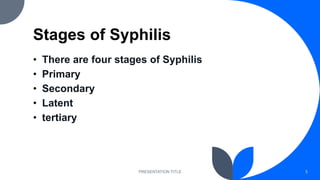
• There are four stages of Syphilis
• Primary
• Secondary
• Latent
• tertiary
PRESENTATION TITLE 5
PRESENTATION TITLE 6
Types of lessions
7
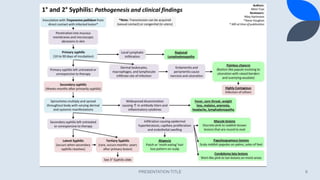
Primary stage
• During the primary stage of syphilis, one or
more sores (chancres) form at the site where
the bacteria entered the body. This often
occurs within 3 weeks of exposure but can
range from 10 to 90 days. A person is highly
contagious during the primary stage and can
easily pass the infection to others.
• A chancre often appears in the genital area. But sores may also
occur in or near the anus or in or nkear the mouth. The sores are
usually painless, so they may go unnoticed if they're inside the
vagina or the rectum.
Types of lessions
• The chancre usually lasts for 3 to 6 weeks. It heals without
treatment and may leave a thin scar. But even though the chancre
has healed, the person still has syphilis. They can still pass the
infection to others.
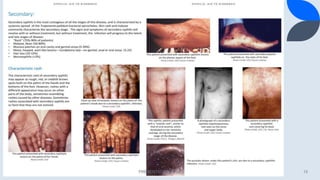
• Secondary stage
During secondary syphilis, a person is highly
contagious. A rash appears 2 to 12 weeks after
the chancre develops and sometimes before it
heals. The rash often forms over the body,
often on the palms of the hands and the soles
of the feet.
PRESENTATION TITLE 8
PRESENTATION TITLE 9
Types of lessions
• The rash usually consists of reddish brown, small, solid, flat or
raised skin sores that are less than 2 cm (0.8 in.) across. But the
rash may look like other more common skin problems.
• There may be small, open sores on mucous membranes. The
sores may contain pus. Or there may be moist sores that look like
warts (called condyloma lata).
• In people who have dark skin, the sores may be a lighter colour
than the skin around them.
Type of lessions
• Latent (hidden) stage
• Without treatment, an infected person will
progress to the latent (hidden) stage. During
this stage, the bacteria that cause syphilis
stay in the body without causing symptoms.
This time with no symptoms usually happens
after the secondary-stage rash goes away.
PRESENTATION TITLE 10
Types of lessions
• Tertiary (late) stage
• In gummatous syphilis, granulomatous lesions called gummas
develop in the skin, bones, and organs. These lesions are a result
of inflammation and contain different types of immune cells
surrounded by fibrous tissue.
PRESENTATION TITLE 11
PRESENTATION TITLE 12
PRESENTATION TITLE 13
PRESENTATION TITLE 14
Diagnosis
• Microscopic observation
• Since T. pallidum cannot be grown in culture, the direct
diagnosis is obtained by the detection with darkfield
microscopy of the spirochaetes in fluid or smears procured
from a lesion. Indeed, the T. pallidum is a corkscrew, spiral-
shaped organism that is 6–15 µm long and 0.1–0.2 µm wide,
thus it cannot be visualised by direct microscopy and
requires darkfield microscopy.
PRESENTATION TITLE 15
Diagnosis
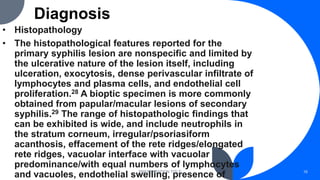
• Histopathology
• The histopathological features reported for the
primary syphilis lesion are nonspecific and limited by
the ulcerative nature of the lesion itself, including
ulceration, exocytosis, dense perivascular infiltrate of
lymphocytes and plasma cells, and endothelial cell
proliferation.28 A bioptic specimen is more commonly
obtained from papular/macular lesions of secondary
syphilis.29 The range of histopathologic findings that
can be exhibited is wide, and include neutrophils in
the stratum corneum, irregular/psoriasiform
acanthosis, effacement of the rete ridges/elongated
rete ridges, vacuolar interface with vacuolar
predominance/with equal numbers of lymphocytes
and vacuoles, endothelial swelling, presence of
PRESENTATION TITLE 16
Diagnosis
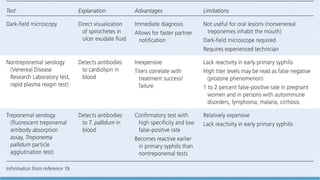
Serologic tests
There are 2 different types of serologic tests classified
based on the type of antigen the antibodies are directed
against. Treponemal tests detect antibody to T
pallidumproteins. Nontreponemal tests detect antibodies
directed against lipoidal antigens, damaged host cells, and
possibly from treponemes. Both tests are used to confirm
the infection and determine whether the disease is active.
PRESENTATION TITLE 17
Nontreponemal tests
Syphilitic infection leads to the production of
nonspecific antibodies that react to cardiolipin. This
reaction is the foundation of “nontreponemal” assays
such as the VDRL (Venereal Disease Research
Laboratory) test and Rapid Plasma Reagin (RPR) test.
Both these test are flocculation type tests that use
an antigen-antibody interaction. The complexes remain
suspended in solution and therefore visible due to
the lipid based antigens.[3][4]
All nontreponemal tests measure immunoglobulins G
(IgG) and M (IgM) anti-lipid antibodies formed by the
host in response both to lipoidal material released from
damaged host cells early in infection and to lipid from
the cell surfaces of the treponeme itself.
PRESENTATION TITLE 18
Treponemal tests
, also called confirmatory tests (FTA, TP-PA, EIA), detect
antibodies specific to syphilis. Treponemal antibodies will
appear earlier after acute infection than non-treponemal
antibodies. The antibodies detected in these tests usually
remain detectable for life even after successful treatment.
Thus, a reactive treponemal test can indicate current or past
syphilis infection.
PRESENTATION TITLE 19
Dermoscopic findings
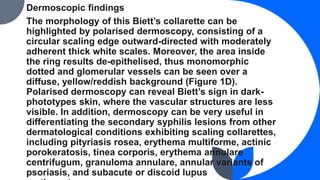
The morphology of this Biett’s collarette can be
highlighted by polarised dermoscopy, consisting of a
circular scaling edge outward-directed with moderately
adherent thick white scales. Moreover, the area inside
the ring results de-epithelised, thus monomorphic
dotted and glomerular vessels can be seen over a
diffuse, yellow/reddish background (Figure 1D).
Polarised dermoscopy can reveal Biett’s sign in dark-
phototypes skin, where the vascular structures are less
visible. In addition, dermoscopy can be very useful in
differentiating the secondary syphilis lesions from other
dermatological conditions exhibiting scaling collarettes,
including pityriasis rosea, erythema multiforme, actinic
porokeratosis, tinea corporis, erythema annulare
centrifugum, granuloma annulare, annular variants of
psoriasis, and subacute or discoid lupus
PRESENTATION TITLE 21
Treatment
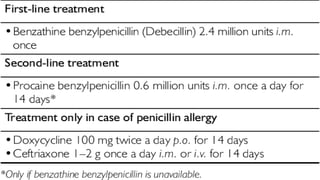
• Antibiotics
Primary, Secondary, and Early
Latent Syphilis
o Treatment for both primary, secondary, and early
latent syphilis consist of one administration of
benzathine penicillin G 2.4 million units
intramuscularly.
Late Latent Syphilis
o The treatment consists of benzathine penicillin G 2.4
million units intramuscularly once a week for 3
consecutive weeks.
PRESENTATION TITLE 25
Tertiary Syphilis
Neurosyphilis, otic syphilis, and ocular syphilis require
treatment with intravenous aqueous crystalline
penicillin G for 10–14 days.
PRESENTATION TITLE 26
Thank you

Syphilis

  • 1.
  • 2.
    Contents • Introduction • Etiology •Pathogensis • Clinical • Diagnosis • Treatment 2
  • 3.
    Introduction • Treponema pallidumsubspecies pallidum is a spiral- shaped, Gram positive , highly mobile bacterium. • Syphilis is transmitted primarily by sexual contact or during pregnancy from a mother to her baby; the spirochete is able to pass through intact mucous membranes or compromised skin
  • 4.
    Introduction • Syphilis iscaused by T. pallidum, a spirochete that cannot survive for long outside the human body. T. pallidum enters through the mucous membranes or skin, reaches the regional lymph nodes within hours, and rapidly spreads throughout the body • Infection is usually transmitted by sexual contact (including genital, orogenital, and anogenital) but may be transmitted nonsexually by skin contact or transplacentally, causing congenital syphilis PRESENTATION TITLE 4
  • 5.
    Stages of Syphilis •There are four stages of Syphilis • Primary • Secondary • Latent • tertiary PRESENTATION TITLE 5
  • 6.
  • 7.
    Types of lessions 7 Primarystage • During the primary stage of syphilis, one or more sores (chancres) form at the site where the bacteria entered the body. This often occurs within 3 weeks of exposure but can range from 10 to 90 days. A person is highly contagious during the primary stage and can easily pass the infection to others. • A chancre often appears in the genital area. But sores may also occur in or near the anus or in or nkear the mouth. The sores are usually painless, so they may go unnoticed if they're inside the vagina or the rectum.
  • 8.
    Types of lessions •The chancre usually lasts for 3 to 6 weeks. It heals without treatment and may leave a thin scar. But even though the chancre has healed, the person still has syphilis. They can still pass the infection to others. • Secondary stage During secondary syphilis, a person is highly contagious. A rash appears 2 to 12 weeks after the chancre develops and sometimes before it heals. The rash often forms over the body, often on the palms of the hands and the soles of the feet. PRESENTATION TITLE 8
  • 9.
    PRESENTATION TITLE 9 Typesof lessions • The rash usually consists of reddish brown, small, solid, flat or raised skin sores that are less than 2 cm (0.8 in.) across. But the rash may look like other more common skin problems. • There may be small, open sores on mucous membranes. The sores may contain pus. Or there may be moist sores that look like warts (called condyloma lata). • In people who have dark skin, the sores may be a lighter colour than the skin around them.
  • 10.
    Type of lessions •Latent (hidden) stage • Without treatment, an infected person will progress to the latent (hidden) stage. During this stage, the bacteria that cause syphilis stay in the body without causing symptoms. This time with no symptoms usually happens after the secondary-stage rash goes away. PRESENTATION TITLE 10
  • 11.
    Types of lessions •Tertiary (late) stage • In gummatous syphilis, granulomatous lesions called gummas develop in the skin, bones, and organs. These lesions are a result of inflammation and contain different types of immune cells surrounded by fibrous tissue. PRESENTATION TITLE 11
  • 12.
  • 13.
  • 14.
  • 15.
    Diagnosis • Microscopic observation •Since T. pallidum cannot be grown in culture, the direct diagnosis is obtained by the detection with darkfield microscopy of the spirochaetes in fluid or smears procured from a lesion. Indeed, the T. pallidum is a corkscrew, spiral- shaped organism that is 6–15 µm long and 0.1–0.2 µm wide, thus it cannot be visualised by direct microscopy and requires darkfield microscopy. PRESENTATION TITLE 15
  • 16.
    Diagnosis • Histopathology • Thehistopathological features reported for the primary syphilis lesion are nonspecific and limited by the ulcerative nature of the lesion itself, including ulceration, exocytosis, dense perivascular infiltrate of lymphocytes and plasma cells, and endothelial cell proliferation.28 A bioptic specimen is more commonly obtained from papular/macular lesions of secondary syphilis.29 The range of histopathologic findings that can be exhibited is wide, and include neutrophils in the stratum corneum, irregular/psoriasiform acanthosis, effacement of the rete ridges/elongated rete ridges, vacuolar interface with vacuolar predominance/with equal numbers of lymphocytes and vacuoles, endothelial swelling, presence of PRESENTATION TITLE 16
  • 17.
    Diagnosis Serologic tests There are2 different types of serologic tests classified based on the type of antigen the antibodies are directed against. Treponemal tests detect antibody to T pallidumproteins. Nontreponemal tests detect antibodies directed against lipoidal antigens, damaged host cells, and possibly from treponemes. Both tests are used to confirm the infection and determine whether the disease is active. PRESENTATION TITLE 17
  • 18.
    Nontreponemal tests Syphilitic infectionleads to the production of nonspecific antibodies that react to cardiolipin. This reaction is the foundation of “nontreponemal” assays such as the VDRL (Venereal Disease Research Laboratory) test and Rapid Plasma Reagin (RPR) test. Both these test are flocculation type tests that use an antigen-antibody interaction. The complexes remain suspended in solution and therefore visible due to the lipid based antigens.[3][4] All nontreponemal tests measure immunoglobulins G (IgG) and M (IgM) anti-lipid antibodies formed by the host in response both to lipoidal material released from damaged host cells early in infection and to lipid from the cell surfaces of the treponeme itself. PRESENTATION TITLE 18
  • 19.
    Treponemal tests , alsocalled confirmatory tests (FTA, TP-PA, EIA), detect antibodies specific to syphilis. Treponemal antibodies will appear earlier after acute infection than non-treponemal antibodies. The antibodies detected in these tests usually remain detectable for life even after successful treatment. Thus, a reactive treponemal test can indicate current or past syphilis infection. PRESENTATION TITLE 19
  • 20.
    Dermoscopic findings The morphologyof this Biett’s collarette can be highlighted by polarised dermoscopy, consisting of a circular scaling edge outward-directed with moderately adherent thick white scales. Moreover, the area inside the ring results de-epithelised, thus monomorphic dotted and glomerular vessels can be seen over a diffuse, yellow/reddish background (Figure 1D). Polarised dermoscopy can reveal Biett’s sign in dark- phototypes skin, where the vascular structures are less visible. In addition, dermoscopy can be very useful in differentiating the secondary syphilis lesions from other dermatological conditions exhibiting scaling collarettes, including pityriasis rosea, erythema multiforme, actinic porokeratosis, tinea corporis, erythema annulare centrifugum, granuloma annulare, annular variants of psoriasis, and subacute or discoid lupus
  • 21.
  • 22.
  • 24.
    Primary, Secondary, andEarly Latent Syphilis o Treatment for both primary, secondary, and early latent syphilis consist of one administration of benzathine penicillin G 2.4 million units intramuscularly.
  • 25.
    Late Latent Syphilis oThe treatment consists of benzathine penicillin G 2.4 million units intramuscularly once a week for 3 consecutive weeks. PRESENTATION TITLE 25
  • 26.
    Tertiary Syphilis Neurosyphilis, oticsyphilis, and ocular syphilis require treatment with intravenous aqueous crystalline penicillin G for 10–14 days. PRESENTATION TITLE 26
  • 27.