PRESENTED BY:
MEENTU PRAKASH
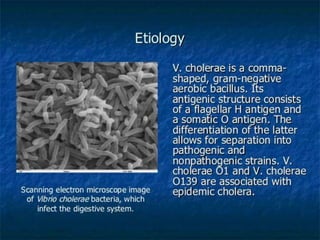
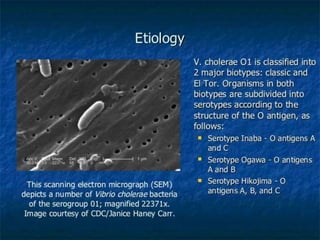
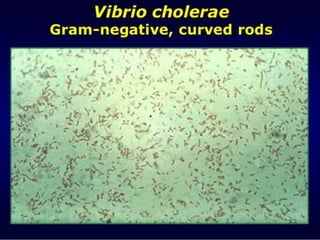
• Gram-negative, rigid
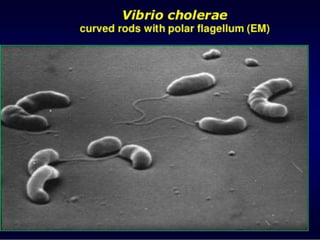
• Curved rods or comma shaped
• Highly motile-single polar flagella
• They are asporogenous & noncapsulated
• Vibrios are present in marine environments &
surface waters worlwide.
• The most important member of the genus is Vibrio
cholerae
Discovery
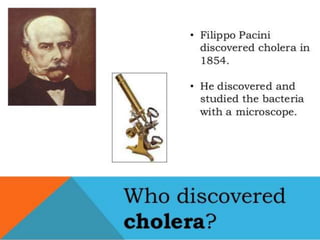
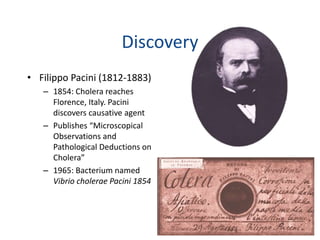
• Filippo Pacini (1812-1883)
– 1854: Cholera reaches
Florence, Italy. Pacini
discovers causative agent
– Publishes “Microscopical
Observations and
Pathological Deductions on
Cholera”
– 1965: Bacterium named
Vibrio cholerae Pacini 1854
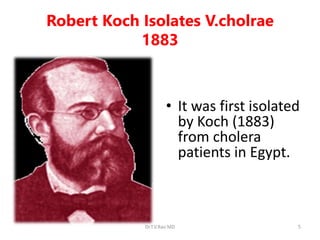
Robert Koch Isolates V.cholrae
1883
• It was first isolated
by Koch (1883)
from cholera
patients in Egypt.
Dr.T.V.Rao MD 5
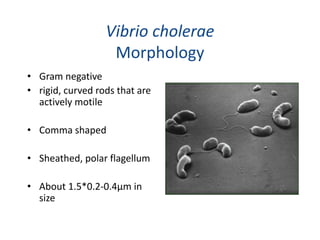
Vibrio cholerae
Morphology
• Gram negative
• rigid, curved rods that are
actively motile
• Comma shaped
• Sheathed, polar flagellum
• About 1.5*0.2-0.4µm in
size
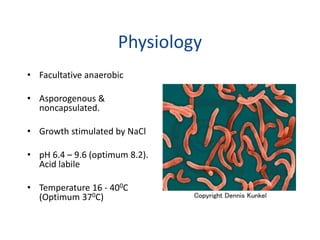
Physiology
• Facultative anaerobic
• Asporogenous &
noncapsulated.
• Growth stimulated by NaCl
• pH 6.4 – 9.6 (optimum 8.2).
Acid labile
• Temperature 16 - 400C
(Optimum 370C)
Morphology
• The V. cholerae is a
short, curved,
cylindrical, rod, about
1.5 * 0.2-0.4 µm in
size, with rounded or
slightly pointed ends.
• It is actively motile,
with a single sheated
polar flagellum.
Cultural characteristics
• V. cholerae is a facultative anaerobic organism.
• It grows within a temperature range of 16-
400c (optimum 370c )
• Growth is better in an alkaline medium, the
range of pH being 6.4 – 9.6(optimum 8.2).
• It grows well on ordinary media.
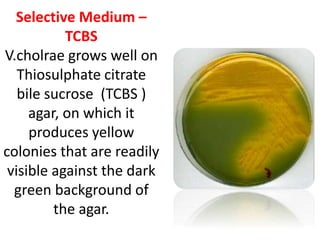
Selective Medium –
TCBS
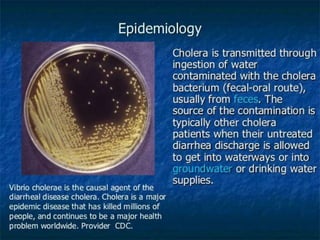
V.cholrae grows well on
Thiosulphate citrate
bile sucrose (TCBS )
agar, on which it
produces yellow
colonies that are readily
visible against the dark
green background of
the agar.
Biochemical reactions
• Carohydrates metabolism is fermentive,
producing acid, but no gas.
• Cholera vibrio ferment glucose, mannitol,
maltose, mannose, & sucrose but not inositol,
arabinose or lactose.
• Indole is formed & nitrates are reduced to
nitrites. These to properties contribute to the
‘ cholera red reaction’
• Catalase & oxidase tests are +ive.
• Methyl red & urease tests are -ive
Resistance
• C. vibrio are susceptible to heat, drying &
acids, but resit high alkanity.
• They are destroyed at 55 degree C in 15
minutes.
• They survive in clean water for 30 days.
• On fruits, they survive for 1-5 days at roomm
temperature & for a week in the refrigerator.
Cholera
• Cholera is an infection of the small intestine
caused by the bacterium Vibrio cholerae.
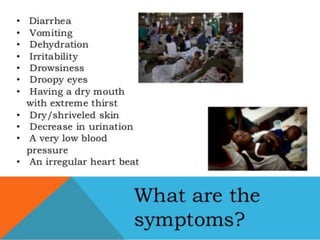
• The main symptoms are watery diarrhea and
vomiting. This may result in dehydration and in
severe cases grayish-bluish skin.
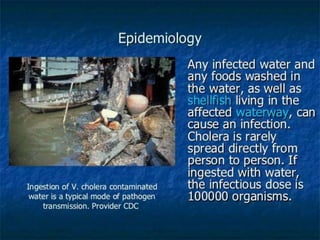
• Transmission occurs primarily by drinking water
or eating food that has been contaminated by the
feces (waste product) of an infected person,
including one with no apparent symptoms.
• The severity of the diarrhea and vomiting can
lead to rapid dehydration and electrolyte
imbalance, and death in some cases.
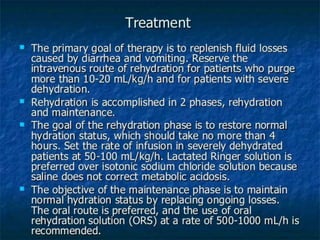
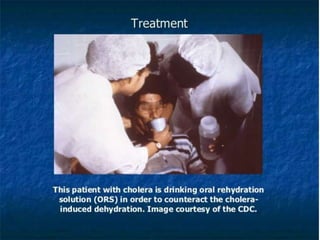
• The primary treatment is oral rehydration
therapy, typically with oral rehydration
solution, to replace water and electrolytes.
• Worldwide, it affects 3–5 million people and
causes 100,000–130,000 deaths a year as of
2010.
Pathogenesis
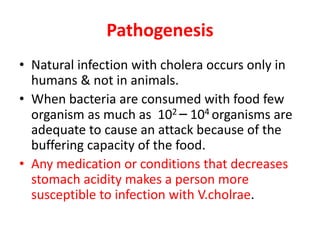
• Natural infection with cholera occurs only in
humans & not in animals.
• When bacteria are consumed with food few
organism as much as 102 – 104 organisms are
adequate to cause an attack because of the
buffering capacity of the food.
• Any medication or conditions that decreases
stomach acidity makes a person more
susceptible to infection with V.cholrae.
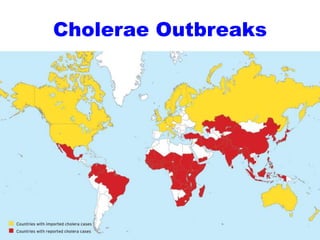
Cholerae Outbreaks
Diagnosis
• Stool culture: Toxigenic Vibrio cholerae O1
• Use Cary Blair Transport media if available
– Viable for many days at room temperature
• Use TCBS media for culture
• Use V. cholerae serogroup O1 antisera
• Confirm presence of cholera toxin
• Cholera Rapid Test Dipsticks
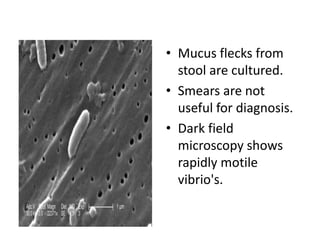
• Mucus flecks from
stool are cultured.
• Smears are not
useful for diagnosis.
• Dark field
microscopy shows
rapidly motile
vibrio's.
Laboratory Diagnosis
• Stools collected in the acute stage of the
diseases,
• Growth is rapid on Blood agar,
• On TCBS medium typical colonies can be picked
in 18 hours.
• The stool specimens can be transported in
Venkataraman Ramakrishnan medium
• Alkaline peptone water is ideal enrichment
medium
Vibrio
Vibrio
Vibrio
Vibrio

Vibrio

  • 1.
  • 2.
    • Gram-negative, rigid •Curved rods or comma shaped • Highly motile-single polar flagella • They are asporogenous & noncapsulated • Vibrios are present in marine environments & surface waters worlwide. • The most important member of the genus is Vibrio cholerae
  • 4.
    Discovery • Filippo Pacini(1812-1883) – 1854: Cholera reaches Florence, Italy. Pacini discovers causative agent – Publishes “Microscopical Observations and Pathological Deductions on Cholera” – 1965: Bacterium named Vibrio cholerae Pacini 1854
  • 5.
    Robert Koch IsolatesV.cholrae 1883 • It was first isolated by Koch (1883) from cholera patients in Egypt. Dr.T.V.Rao MD 5
  • 7.
    Vibrio cholerae Morphology • Gramnegative • rigid, curved rods that are actively motile • Comma shaped • Sheathed, polar flagellum • About 1.5*0.2-0.4µm in size
  • 8.
    Physiology • Facultative anaerobic •Asporogenous & noncapsulated. • Growth stimulated by NaCl • pH 6.4 – 9.6 (optimum 8.2). Acid labile • Temperature 16 - 400C (Optimum 370C)
  • 13.
    Morphology • The V.cholerae is a short, curved, cylindrical, rod, about 1.5 * 0.2-0.4 µm in size, with rounded or slightly pointed ends. • It is actively motile, with a single sheated polar flagellum.
  • 14.
    Cultural characteristics • V.cholerae is a facultative anaerobic organism. • It grows within a temperature range of 16- 400c (optimum 370c ) • Growth is better in an alkaline medium, the range of pH being 6.4 – 9.6(optimum 8.2). • It grows well on ordinary media.
  • 15.
    Selective Medium – TCBS V.cholraegrows well on Thiosulphate citrate bile sucrose (TCBS ) agar, on which it produces yellow colonies that are readily visible against the dark green background of the agar.
  • 16.
    Biochemical reactions • Carohydratesmetabolism is fermentive, producing acid, but no gas. • Cholera vibrio ferment glucose, mannitol, maltose, mannose, & sucrose but not inositol, arabinose or lactose. • Indole is formed & nitrates are reduced to nitrites. These to properties contribute to the ‘ cholera red reaction’ • Catalase & oxidase tests are +ive. • Methyl red & urease tests are -ive
  • 17.
    Resistance • C. vibrioare susceptible to heat, drying & acids, but resit high alkanity. • They are destroyed at 55 degree C in 15 minutes. • They survive in clean water for 30 days. • On fruits, they survive for 1-5 days at roomm temperature & for a week in the refrigerator.
  • 18.
    Cholera • Cholera isan infection of the small intestine caused by the bacterium Vibrio cholerae. • The main symptoms are watery diarrhea and vomiting. This may result in dehydration and in severe cases grayish-bluish skin. • Transmission occurs primarily by drinking water or eating food that has been contaminated by the feces (waste product) of an infected person, including one with no apparent symptoms.
  • 19.
    • The severityof the diarrhea and vomiting can lead to rapid dehydration and electrolyte imbalance, and death in some cases. • The primary treatment is oral rehydration therapy, typically with oral rehydration solution, to replace water and electrolytes. • Worldwide, it affects 3–5 million people and causes 100,000–130,000 deaths a year as of 2010.
  • 21.
    Pathogenesis • Natural infectionwith cholera occurs only in humans & not in animals. • When bacteria are consumed with food few organism as much as 102 – 104 organisms are adequate to cause an attack because of the buffering capacity of the food. • Any medication or conditions that decreases stomach acidity makes a person more susceptible to infection with V.cholrae.
  • 26.
  • 28.
    Diagnosis • Stool culture:Toxigenic Vibrio cholerae O1 • Use Cary Blair Transport media if available – Viable for many days at room temperature • Use TCBS media for culture • Use V. cholerae serogroup O1 antisera • Confirm presence of cholera toxin • Cholera Rapid Test Dipsticks
  • 29.
    • Mucus flecksfrom stool are cultured. • Smears are not useful for diagnosis. • Dark field microscopy shows rapidly motile vibrio's.
  • 30.
    Laboratory Diagnosis • Stoolscollected in the acute stage of the diseases, • Growth is rapid on Blood agar, • On TCBS medium typical colonies can be picked in 18 hours. • The stool specimens can be transported in Venkataraman Ramakrishnan medium • Alkaline peptone water is ideal enrichment medium