Spirochetes
Dr. Jyotsna Agarwal
Dept. Microbiology
KGMU
Classification of spirochetes
• Spirochetes are thin, elongated,
spirally twisted, Gram negative
bacteria
• There are 11 genera in this group
• Some are pathogens, but most are
free-living, and are actually pretty
common in the environment.
3 genera have human pathogens
Treponema, Borrelia, leptospira
Treponema (25 species)-
Relatively short, slender, fine spirals.
Associated with venereal and non venereal
diseases, some are non pathogenic
Treponema pallidum causes syphilis- venereal
disease- STD.
Syphilis - T. pallidum
• History- ancient disease, Columbus crew
• Reservoir- humans only known natural
host.
• Name syphilis from a poem describing a
shepherd boy
• Transmission- sexual route- venereal
• Syphilis is not very contagious; a person
has 1/10 chance of becoming infected
after contact with an infected person
• In some stages, it is less contagious
• Syphilis is conventionally divided into
following stages:
Primary, Secondary, Latent, Tertiary
–Staging has prognostic and
therapeutic implications.
Primary syphilis
• 5 to 80 days after contact (sexual), a
chancre develops at point of contact-
external genitalia
• Chancre is an inflammatory lesion
containing spirochetes & lymphocytes.
• It is painless, well circumscribed,
indurated, heals spontaneously after
~10 – 40 days leaving a thin scar.(also
called hard chancre)
• Regional lymph nodes are enlarged and
non tender
• Even before appearance of chancre,
treponema spread from site of entry via
blood/lymph.
• Multiple chancre may be seen in
immunodefficient patients.
• Once this heals patient remains
asymptomatic till secondary stage
Secondary syphilis
• 2 - 12 weeks after primary lesion
heals, generalized symptoms of
disseminated infection occur due to
multiplication and dissemination of
treponemes
• Fever, headache, sore throat and
enlarged lymph nodes develop
• Papular skin rash develops on body
and lesions appear on palms and
soles of feet also
• Abundant spirochetes in skin lesions-
most infectious stage
• Intensity of lesions in secondary syphilis
varies
• Can Heal spontaneously in months to
years
• Variable course
spontaneous cure
latent stage
go to 3rd stage
Latent Syphilis
• Absence of clinical symptoms
• 3 possible outcomes
Persist for life
Tertiary syphilis
Cure
Tertiary syphilis
• 2-20 years later
• Steady tissue destruction- Chronic
granulomata formation- Gumma,
lesions contain very few treponema
• Cardiovascular system/CNS
• ~1/3 die
Late tertiary or quaternary syphilis-
• Tabes dorsalis- dorsal column of spinal
cord
• GPI- dementia
Congenital Syphilis
• Fetus susceptible after 4th month IU life
• 40% fetal death
• Hutchinson's Triad
peg teeth
interstitial keratitis
8th nerve destruction- deafness
Treponema pallidum bacteria
• It is slender and tightly coiled,
measuring 5 to 15 µm long by 0.09
to 0.18µm wide
• They have a characteristic motility
on dark field microscopy- cork
screw
• This is due to axial fibrils, similar
to flagella, varying numbers
• T. pallidum has not been cultured in
vivo.
• It is rapidly inactivated by:
Drying, Heat, Cold
• Transmission is by direct contact or
congenitally
Diagnosis
Clinical- based on symptoms, history
Laboratory
• Darkfield examination
Wear gloves, Clean the lesion with
saline gauze, press it gently and
collect exudate on a slide and examine
in darkground microscope.
Serologic tests
Non Specific/Non treponemal
• A reactive material from beef heart
called cardiolipin is used as antigen
• It reacts with “reagin” antibodies that
develop in syphilis
• Also called Standard test for Syphilis
(STS)
VDRL
• This is a slide flocculation test to
detect antibodies in patients serum
using cardiolipin as antigen
1o 1/3 +
2o 95% +
latent +/-
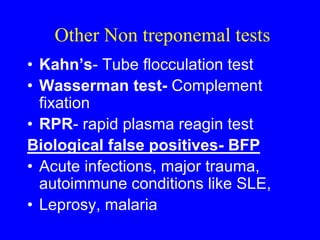
Other Non treponemal tests
• Kahn’s- Tube flocculation test
• Wasserman test- Complement
fixation
• RPR- rapid plasma reagin test
Biological false positives- BFP
• Acute infections, major trauma,
autoimmune conditions like SLE,
• Leprosy, malaria
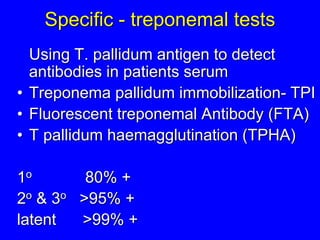
Specific - treponemal tests
Using T. pallidum antigen to detect
antibodies in patients serum
• Treponema pallidum immobilization- TPI
• Fluorescent treponemal Antibody (FTA)
• T pallidum haemagglutination (TPHA)
1o 80% +
2o & 3o >95% +
latent >99% +
Treatment
• Penicillin is drug of choice
• Duration of tretment varies according
to clinical stage of disease
• If allergic to penicillin- Ceftriaxone
Summary
• Treponema pallidum bacteria: characters
• Syphilis disease: mode of transmissison
• Clinical stages
• Diagnostic tests: STS / Specific tests
• Utility of tests / BFP

Treponema_pallidum.ppt

  • 1.
  • 2.
    Classification of spirochetes •Spirochetes are thin, elongated, spirally twisted, Gram negative bacteria • There are 11 genera in this group • Some are pathogens, but most are free-living, and are actually pretty common in the environment.
  • 3.
    3 genera havehuman pathogens Treponema, Borrelia, leptospira Treponema (25 species)- Relatively short, slender, fine spirals. Associated with venereal and non venereal diseases, some are non pathogenic Treponema pallidum causes syphilis- venereal disease- STD.
  • 4.
    Syphilis - T.pallidum • History- ancient disease, Columbus crew • Reservoir- humans only known natural host. • Name syphilis from a poem describing a shepherd boy
  • 5.
    • Transmission- sexualroute- venereal • Syphilis is not very contagious; a person has 1/10 chance of becoming infected after contact with an infected person • In some stages, it is less contagious
  • 6.
    • Syphilis isconventionally divided into following stages: Primary, Secondary, Latent, Tertiary –Staging has prognostic and therapeutic implications.
  • 7.
    Primary syphilis • 5to 80 days after contact (sexual), a chancre develops at point of contact- external genitalia • Chancre is an inflammatory lesion containing spirochetes & lymphocytes. • It is painless, well circumscribed, indurated, heals spontaneously after ~10 – 40 days leaving a thin scar.(also called hard chancre)
  • 8.
    • Regional lymphnodes are enlarged and non tender • Even before appearance of chancre, treponema spread from site of entry via blood/lymph. • Multiple chancre may be seen in immunodefficient patients. • Once this heals patient remains asymptomatic till secondary stage
  • 9.
    Secondary syphilis • 2- 12 weeks after primary lesion heals, generalized symptoms of disseminated infection occur due to multiplication and dissemination of treponemes • Fever, headache, sore throat and enlarged lymph nodes develop • Papular skin rash develops on body and lesions appear on palms and soles of feet also
  • 10.
    • Abundant spirochetesin skin lesions- most infectious stage • Intensity of lesions in secondary syphilis varies • Can Heal spontaneously in months to years • Variable course spontaneous cure latent stage go to 3rd stage
  • 11.
    Latent Syphilis • Absenceof clinical symptoms • 3 possible outcomes Persist for life Tertiary syphilis Cure
  • 12.
    Tertiary syphilis • 2-20years later • Steady tissue destruction- Chronic granulomata formation- Gumma, lesions contain very few treponema • Cardiovascular system/CNS • ~1/3 die
  • 13.
    Late tertiary orquaternary syphilis- • Tabes dorsalis- dorsal column of spinal cord • GPI- dementia
  • 14.
    Congenital Syphilis • Fetussusceptible after 4th month IU life • 40% fetal death • Hutchinson's Triad peg teeth interstitial keratitis 8th nerve destruction- deafness
  • 16.
    Treponema pallidum bacteria •It is slender and tightly coiled, measuring 5 to 15 µm long by 0.09 to 0.18µm wide • They have a characteristic motility on dark field microscopy- cork screw • This is due to axial fibrils, similar to flagella, varying numbers
  • 17.
    • T. pallidumhas not been cultured in vivo. • It is rapidly inactivated by: Drying, Heat, Cold • Transmission is by direct contact or congenitally
  • 20.
    Diagnosis Clinical- based onsymptoms, history Laboratory • Darkfield examination Wear gloves, Clean the lesion with saline gauze, press it gently and collect exudate on a slide and examine in darkground microscope.
  • 21.
    Serologic tests Non Specific/Nontreponemal • A reactive material from beef heart called cardiolipin is used as antigen • It reacts with “reagin” antibodies that develop in syphilis • Also called Standard test for Syphilis (STS)
  • 22.
    VDRL • This isa slide flocculation test to detect antibodies in patients serum using cardiolipin as antigen 1o 1/3 + 2o 95% + latent +/-
  • 23.
    Other Non treponemaltests • Kahn’s- Tube flocculation test • Wasserman test- Complement fixation • RPR- rapid plasma reagin test Biological false positives- BFP • Acute infections, major trauma, autoimmune conditions like SLE, • Leprosy, malaria
  • 24.
    Specific - treponemaltests Using T. pallidum antigen to detect antibodies in patients serum • Treponema pallidum immobilization- TPI • Fluorescent treponemal Antibody (FTA) • T pallidum haemagglutination (TPHA) 1o 80% + 2o & 3o >95% + latent >99% +
  • 25.
    Treatment • Penicillin isdrug of choice • Duration of tretment varies according to clinical stage of disease • If allergic to penicillin- Ceftriaxone
  • 26.
    Summary • Treponema pallidumbacteria: characters • Syphilis disease: mode of transmissison • Clinical stages • Diagnostic tests: STS / Specific tests • Utility of tests / BFP