syphilis
DONE BY,
Sri sharika kumar
German
zoologist ( born
in east Prussia)
and a German
dermatologist
(born in Poland)
About the causative agent
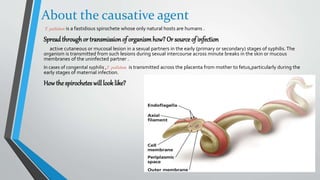
T. pallidum is a fastidious spirochete whose only natural hosts are humans .
Spreadthroughor transmission of organismhow?Or source of infection
active cutaneous or mucosal lesion in a sexual partners in the early (primary or secondary) stages of syphilis.The
organism is transmitted from such lesions during sexual intercourse across minute breaks in the skin or mucous
membranes of the uninfected partner .
In cases of congenital syphilis ,T. pallidum is transmitted across the placenta from mother to fetus,particularly during the
early stages of maternal infection.
Howthe spirochetes will look like?
Dark field microscopical view of T.pallidum ,spichaetes
Lues
oSyphilis or lues,is a chronic venereal infection caused by the spirochete
treponema pallidum.
EPIDEMIOLOGY :
oFirst recognized in epidemic form in 16th century Europe as the pox.
oSyphilis endemic infection all parts of the world.
o In the united states ,approximately 6000 cases are reported every year ,and
this number has been on an upward trajectory since 2000.
oThere is a strong racial disparity,with African American affected 30 times more
often than whites.
what about India ?
Prevalence statistics in India
• According to the council of medical research (ICMR) ,5 to 6 % of sexually active adults
are suffering from sexually transmitted infection (STI) or reproductive tract
infection (RTI).
 Disease statistics : India is on the verge of eliminating syphilis ,one of the most common sexually
transmitted diseases (STD) in the country.
According to the National Aids control organization (NACO),syphilis,which earlier used to affect
about 8%of the pregnant women ,has been reduced to less than 1% .
 Chancroid infections: Till a decade ago ,india recorded 1.2 lakh cases of chancroid infections that
have come down to less than 3000.
• Chancroid causes high numbers of genital ulcers.Around 14%of all genital ulcers were caused by chancroid,
which has since come down to less than 0.1%.
howthe declining rate occurred in India?
 May be due to improved facilities of treatment in the peripheral centers that obviates the need
of many patients in attending the STD clinics in the tertiary centers.
 Improved pharmacotherapy of many of the bacterial STIs may result in partial clearance.
 Awareness about HIV and fear of contracting the STDs are likely to have influenced the risk
taking behavior of people ,thereby reducing the likelihood of being infected with STDs.
 Another factor to be considered is the widespread use of antibacterials , including quinolones and
the new macrolides ,thereby apparent reduction in total number of cases of STDs.
Primary stage of syphilis
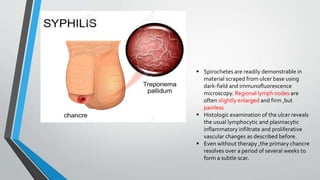
Presence of chancreat the site of initial inoculation .
SITE :
In males –on the penis.
In females –in the vagina or on the uterine cervix.
The chancre begins as a small ,firm papule,which gradually
enlarges to produce a painless ulcer with well defined
,indurated margins and a “clean,” moist base .
 Spirochetes are readily demonstrable in
material scraped from ulcer base using
dark-field and immunofluorescence
microscopy. Regional lymph nodes are
often slightly enlarged and firm ,but
painless
 Histologic examination of the ulcer reveals
the usual lymphocytic and plasmacytic
inflammatory infiltrate and proliferative
vascular changes as described before.
 Even without therapy ,the primary chancre
resolves over a period of several weeks to
form a subtle scar.
Serologic tests for syphilis
are often negative during
the earlystages of primary
syphilis and therefore should be
complemented by dark field
microscopy or direct fluorescent
antibody testing if primary syphilis
is suspected .
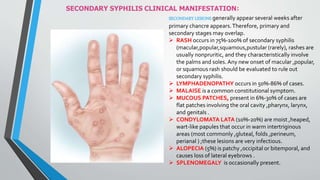
SECONDARY SYPHILIS CLINICAL MANIFESTATION:
SECONDARY LESIONS generally appear several weeks after
primary chancre appears.Therefore, primary and
secondary stages may overlap.
 RASH occurs in 75%-100% of secondary syphilis
(macular,popular,squamous,pustular (rarely), rashes are
usually nonpruritic, and they characteristically involve
the palms and soles. Any new onset of macular ,popular,
or squamous rash should be evaluated to rule out
secondary syphilis.
 LYMPHADENOPATHY occurs in 50%-86% of cases.
 MALAISE is a common constitutional symptom.
 MUCOUS PATCHES, present in 6%-30% of cases are
flat patches involving the oral cavity ,pharynx, larynx,
and genitals .
 CONDYLOMATA LATA (10%-20%) are moist ,heaped,
wart-like papules that occur in warm intertriginous
areas (most commonly ,gluteal, folds ,perineum,
perianal ) ;these lesions are very infectious.
 ALOPECIA (5%) is patchy ,occipital or bitemporal, and
causes loss of lateral eyebrows .
 SPLENOMEGALY is occasionally present.
Serologic tests for syphilis usually highest in
the titer during secondary syphilis relapses of
secondary symptoms may occur in up to 25%
of untreated patients ,usually within the first
year of infection .
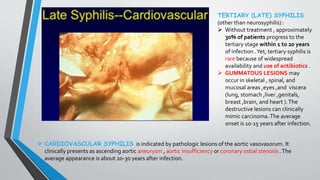
TERTIARY (LATE) SYPHILIS
(other than neurosyphilis) :
 Without treatment , approximately
30% of patients progress to the
tertiary stage within 1 to 20 years
of infection .Yet, tertiary syphilis is
rare because of widespread
availability and use of antibiotics .
 GUMMATOUS LESIONS may
occur in skeletal , spinal, and
mucosal areas ,eyes ,and viscera
(lung, stomach ,liver ,genitals,
breast ,brain, and heart ).The
destructive lesions can clinically
mimic carcinoma.The average
onset is 10-15 years after infection.
 CARDIOVASCULAR SYPHILIS is indicated by pathologic lesions of the aortic vasovasorum. It
clinically presents as ascending aortic aneurysm , aortic insufficiency or coronary ostial stenosis .The
average appearance is about 20-30 years after infection.
CONGENITAL SYPHILIS
• CONGENITAL SYPHILIS occurs whenT.pallidum is transmitted from pregnant with syphilis
to her fetus .
• Untreated syphilis during pregnancy may lead to stillbirth ,neonatal death ,and infant
disorders such as deafness, neurological impairment, and bone deformities.
• Transmission can occur in any stage of syphilis, but the risk is much higher when the
pregnant women is in the primary or secondary stages .
• This syphilis classified as
early
late disease
• EARLY LESIONS (in infants <2 years old):
are usually inflammatory;
may involve skin (bullous or exudative )or mucous membranes ;
can result in alopecia, generalised lymphadenopathy, meningitis, osteitis or
osteochondritis, and hepatosplenomegaly; and
may include hematologic abnormalities such as thrombocytopenia and anemia.
LATE LESIONS (IN children >2 years old)
tend to be immunological and destructive;
most commonly appear as interstitial keratitis ; and
less commonly result in eighth nerve deafness ,bone and
teeth involvement(saber shins, mulberry molars,
Hutchinson incisors).
Your text hereYour text here
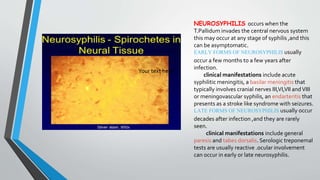
NEUROSYPHILIS occurs when the
T.Pallidum invades the central nervous system
this may occur at any stage of syphilis ,and this
can be asymptomatic.
EARLY FORMS OF NEUROSYPHILIS usually
occur a few months to a few years after
infection.
clinical manifestations include acute
syphilitic meningitis, a basilar meningitis that
typically involves cranial nerves III,VI,VII andVIII
or meningovascular syphilis, an endarteritis that
presents as a stroke like syndrome with seizures.
LATE FORMS OF NEUROSYPHILIS usually occur
decades after infection ,and they are rarely
seen.
clinical manifestations include general
paresis and tabes dorsalis. Serologic treponemal
tests are usually reactive .ocular involvement
can occur in early or late neurosyphilis.
DIAGNOSTICTESTS FOR SYPHILIS
• SEROLOGICAL TESTS:
1) Nontreponemal.
2) Treponemal.
• LESION-BASED TEST:
1) Direct fluorescent antibody test(DFA).
2) Darkfield microscopy.
3) Silver stain.
4) Polymerase chain reaction.(PCR).
NONTREPONEMAL
• Rapid plasma regain(RPR).
• Venereal disease research laboratory(VDRL)
DESCRIPTION ABOUT SEROLOGICAL TEST RESULTS OF NON TREPONEMAL
Nonspecific quantitative tests.
May be negative in 15% to 25% of cases presenting with primary chancre.
Near 100% sensitivity during secondary syphilis.
TREPONEMAL
• Fluorescent treponemal antibody absorbed (FTA-Abs).
• Pallidum particle agglutination (TP-PA).
• Pallidum IgG+IgM Enzyme –linked immunosorbent assay(ELISA).
• Treponemal enzyme immunoassay(EIA)/chemiluminescence immunoassay
(CIA)
DESCRIPTION ABOUT SEROLOGICALTEST RESULTS OFTREPONEMAL
Measure antibody to surface protein of pallidum(antibodies will persist ;they
do not afford protective immunity and cannot be used to diagnose subsequent
episodes or to monitor response to therapy)
More specific than non treponemal tests.
Become reactive approximately 7 to 10 days after the appearance of the
chancre
Rarely produce false-positive results.
LESION BASED TESTS
• Direct fluorescent antibody test(DFA)
• Darkfield microscopy
• Silver stain
• Polymerase chain reaction(PCR)
DESCRIPTION ABOUTTHE LESION BASEDTESTS FOR SYPHILIS
Performed on lesion exudate or tissue specimen.
performed on exudate from an ulcer base or a mucocutaneous lesion.
performed on biopsy specimens of suspicious lesions, such as palmar macular
rash or gummatous lesions.
performed on specimens of lesions.
BICCILIN L—A(penicillinG
benzathine injectable suspension)
2,400,000 units per 4 ml(deep
intramuscular route use only). Made
in Australia.
PENICILLIN G PROCAINE
INJECTABLE SUSPENSION , USP
600,000units per 1ml syringe
IM USE ONLY
WARNING:FATAL if given other
routes.
PATIENT COUNSELLING AND EDUCATION
• NATURE OFTHE DISEASE:
symptomatic or asymptomatic
systemic infection ,extragenital symptoms may occur (such as rash and alopecia)
untreated syphilis in pregnancy can lead to death or severe disability in the fetus.
sequelae of untreated syphilis include neurologic and cardiovascular disorders.
• TRANSMISSION:
sexually or vertically (from pregnant mother to fetus).
most infectious during primary &secondary stages(when lesions or rashes are
present). All at risk sexpartners need to be evaluated and possibly treated.
increased susceptibility to HIV acquisition.
• TREATMENT AND FOLLOW UP:
If treated with penicillin ,the jarisch-herxheimer reaction may occur.
return for follow-up serology at six and 12months for primary and secondary
syphilis for 24months(every three months, if HIV positive).
RISK REDUCTION:
The clinician should
Assess the patients potential for behavior change
Discuss prevention strategies such as abstinence ,
mutual monogamy with an uninfected partner, use of
condoms, and limiting the number of sex partners;
Also discuss about genital ulcer diseases .
CASE STUDY
• Stan carter is a 19 year old male who presents to the STD clinic
because he had a sore on his penis for one week.
1. What are the possible etiologic agents that should be considered in the
differential diagnosis?
Herpes simplex virus (HSV)
Neisseria gonorrhoeae
Treponema pallidum
Haemophilus ducreyi
Lymphogranuloma venereum(LGV)
All the above except N.gonnorrhoeae
All of the above.
CORRECT ANSWER?
ALLTHE ABOVE EXCEPT
N.gonnorrhoeae,because this is
characterized by ulcers and should be
included in differential diagnosis.
2. what is the most likely diagnosis?
o herpes simplex virus
oPrimary syphilis
oChancroid
oLymphogranuloma venereum(LGV)
CORRECT ANSWER ?
PRIMARY SYPHILIS ,because of the lesion
called chancre presence in the penis of this
patient.
3. Who is responsible for reporting this case to the local health department?
oThe patient
oThe laboratory
oThe health care provider
oNone of the above because syphilis is not an public health priority and
therefore it is not reportable.
oDepending on the state ,the laboratory and/or the health care provider.
CORRECT ANSWER?
DEPENDING ONTHE STATE the lab or the
healthcare provider,because laws and
regulations in all states require that persons
diagnosed with syphilis be reported to public
authorities .
A small quite interesting
article By the times of india
on the valentine day (feb 14)
about bacterial STDs.
Syphilis -community pharmacy

Syphilis -community pharmacy

  • 1.
  • 3.
    German zoologist ( born ineast Prussia) and a German dermatologist (born in Poland)
  • 5.
    About the causativeagent T. pallidum is a fastidious spirochete whose only natural hosts are humans . Spreadthroughor transmission of organismhow?Or source of infection active cutaneous or mucosal lesion in a sexual partners in the early (primary or secondary) stages of syphilis.The organism is transmitted from such lesions during sexual intercourse across minute breaks in the skin or mucous membranes of the uninfected partner . In cases of congenital syphilis ,T. pallidum is transmitted across the placenta from mother to fetus,particularly during the early stages of maternal infection. Howthe spirochetes will look like?
  • 6.
    Dark field microscopicalview of T.pallidum ,spichaetes
  • 7.
    Lues oSyphilis or lues,isa chronic venereal infection caused by the spirochete treponema pallidum. EPIDEMIOLOGY : oFirst recognized in epidemic form in 16th century Europe as the pox. oSyphilis endemic infection all parts of the world. o In the united states ,approximately 6000 cases are reported every year ,and this number has been on an upward trajectory since 2000. oThere is a strong racial disparity,with African American affected 30 times more often than whites. what about India ?
  • 8.
    Prevalence statistics inIndia • According to the council of medical research (ICMR) ,5 to 6 % of sexually active adults are suffering from sexually transmitted infection (STI) or reproductive tract infection (RTI).
  • 11.
     Disease statistics: India is on the verge of eliminating syphilis ,one of the most common sexually transmitted diseases (STD) in the country. According to the National Aids control organization (NACO),syphilis,which earlier used to affect about 8%of the pregnant women ,has been reduced to less than 1% .  Chancroid infections: Till a decade ago ,india recorded 1.2 lakh cases of chancroid infections that have come down to less than 3000. • Chancroid causes high numbers of genital ulcers.Around 14%of all genital ulcers were caused by chancroid, which has since come down to less than 0.1%. howthe declining rate occurred in India?  May be due to improved facilities of treatment in the peripheral centers that obviates the need of many patients in attending the STD clinics in the tertiary centers.  Improved pharmacotherapy of many of the bacterial STIs may result in partial clearance.  Awareness about HIV and fear of contracting the STDs are likely to have influenced the risk taking behavior of people ,thereby reducing the likelihood of being infected with STDs.  Another factor to be considered is the widespread use of antibacterials , including quinolones and the new macrolides ,thereby apparent reduction in total number of cases of STDs.
  • 13.
    Primary stage ofsyphilis Presence of chancreat the site of initial inoculation . SITE : In males –on the penis. In females –in the vagina or on the uterine cervix. The chancre begins as a small ,firm papule,which gradually enlarges to produce a painless ulcer with well defined ,indurated margins and a “clean,” moist base .
  • 14.
     Spirochetes arereadily demonstrable in material scraped from ulcer base using dark-field and immunofluorescence microscopy. Regional lymph nodes are often slightly enlarged and firm ,but painless  Histologic examination of the ulcer reveals the usual lymphocytic and plasmacytic inflammatory infiltrate and proliferative vascular changes as described before.  Even without therapy ,the primary chancre resolves over a period of several weeks to form a subtle scar.
  • 15.
    Serologic tests forsyphilis are often negative during the earlystages of primary syphilis and therefore should be complemented by dark field microscopy or direct fluorescent antibody testing if primary syphilis is suspected .
  • 17.
    SECONDARY SYPHILIS CLINICALMANIFESTATION: SECONDARY LESIONS generally appear several weeks after primary chancre appears.Therefore, primary and secondary stages may overlap.  RASH occurs in 75%-100% of secondary syphilis (macular,popular,squamous,pustular (rarely), rashes are usually nonpruritic, and they characteristically involve the palms and soles. Any new onset of macular ,popular, or squamous rash should be evaluated to rule out secondary syphilis.  LYMPHADENOPATHY occurs in 50%-86% of cases.  MALAISE is a common constitutional symptom.  MUCOUS PATCHES, present in 6%-30% of cases are flat patches involving the oral cavity ,pharynx, larynx, and genitals .  CONDYLOMATA LATA (10%-20%) are moist ,heaped, wart-like papules that occur in warm intertriginous areas (most commonly ,gluteal, folds ,perineum, perianal ) ;these lesions are very infectious.  ALOPECIA (5%) is patchy ,occipital or bitemporal, and causes loss of lateral eyebrows .  SPLENOMEGALY is occasionally present.
  • 18.
    Serologic tests forsyphilis usually highest in the titer during secondary syphilis relapses of secondary symptoms may occur in up to 25% of untreated patients ,usually within the first year of infection .
  • 21.
    TERTIARY (LATE) SYPHILIS (otherthan neurosyphilis) :  Without treatment , approximately 30% of patients progress to the tertiary stage within 1 to 20 years of infection .Yet, tertiary syphilis is rare because of widespread availability and use of antibiotics .  GUMMATOUS LESIONS may occur in skeletal , spinal, and mucosal areas ,eyes ,and viscera (lung, stomach ,liver ,genitals, breast ,brain, and heart ).The destructive lesions can clinically mimic carcinoma.The average onset is 10-15 years after infection.  CARDIOVASCULAR SYPHILIS is indicated by pathologic lesions of the aortic vasovasorum. It clinically presents as ascending aortic aneurysm , aortic insufficiency or coronary ostial stenosis .The average appearance is about 20-30 years after infection.
  • 23.
    CONGENITAL SYPHILIS • CONGENITALSYPHILIS occurs whenT.pallidum is transmitted from pregnant with syphilis to her fetus . • Untreated syphilis during pregnancy may lead to stillbirth ,neonatal death ,and infant disorders such as deafness, neurological impairment, and bone deformities. • Transmission can occur in any stage of syphilis, but the risk is much higher when the pregnant women is in the primary or secondary stages . • This syphilis classified as early late disease • EARLY LESIONS (in infants <2 years old): are usually inflammatory; may involve skin (bullous or exudative )or mucous membranes ; can result in alopecia, generalised lymphadenopathy, meningitis, osteitis or osteochondritis, and hepatosplenomegaly; and may include hematologic abnormalities such as thrombocytopenia and anemia.
  • 24.
    LATE LESIONS (INchildren >2 years old) tend to be immunological and destructive; most commonly appear as interstitial keratitis ; and less commonly result in eighth nerve deafness ,bone and teeth involvement(saber shins, mulberry molars, Hutchinson incisors).
  • 25.
    Your text hereYourtext here NEUROSYPHILIS occurs when the T.Pallidum invades the central nervous system this may occur at any stage of syphilis ,and this can be asymptomatic. EARLY FORMS OF NEUROSYPHILIS usually occur a few months to a few years after infection. clinical manifestations include acute syphilitic meningitis, a basilar meningitis that typically involves cranial nerves III,VI,VII andVIII or meningovascular syphilis, an endarteritis that presents as a stroke like syndrome with seizures. LATE FORMS OF NEUROSYPHILIS usually occur decades after infection ,and they are rarely seen. clinical manifestations include general paresis and tabes dorsalis. Serologic treponemal tests are usually reactive .ocular involvement can occur in early or late neurosyphilis.
  • 26.
    DIAGNOSTICTESTS FOR SYPHILIS •SEROLOGICAL TESTS: 1) Nontreponemal. 2) Treponemal. • LESION-BASED TEST: 1) Direct fluorescent antibody test(DFA). 2) Darkfield microscopy. 3) Silver stain. 4) Polymerase chain reaction.(PCR).
  • 27.
    NONTREPONEMAL • Rapid plasmaregain(RPR). • Venereal disease research laboratory(VDRL) DESCRIPTION ABOUT SEROLOGICAL TEST RESULTS OF NON TREPONEMAL Nonspecific quantitative tests. May be negative in 15% to 25% of cases presenting with primary chancre. Near 100% sensitivity during secondary syphilis.
  • 28.
    TREPONEMAL • Fluorescent treponemalantibody absorbed (FTA-Abs). • Pallidum particle agglutination (TP-PA). • Pallidum IgG+IgM Enzyme –linked immunosorbent assay(ELISA). • Treponemal enzyme immunoassay(EIA)/chemiluminescence immunoassay (CIA) DESCRIPTION ABOUT SEROLOGICALTEST RESULTS OFTREPONEMAL Measure antibody to surface protein of pallidum(antibodies will persist ;they do not afford protective immunity and cannot be used to diagnose subsequent episodes or to monitor response to therapy) More specific than non treponemal tests. Become reactive approximately 7 to 10 days after the appearance of the chancre Rarely produce false-positive results.
  • 29.
    LESION BASED TESTS •Direct fluorescent antibody test(DFA) • Darkfield microscopy • Silver stain • Polymerase chain reaction(PCR) DESCRIPTION ABOUTTHE LESION BASEDTESTS FOR SYPHILIS Performed on lesion exudate or tissue specimen. performed on exudate from an ulcer base or a mucocutaneous lesion. performed on biopsy specimens of suspicious lesions, such as palmar macular rash or gummatous lesions. performed on specimens of lesions.
  • 32.
    BICCILIN L—A(penicillinG benzathine injectablesuspension) 2,400,000 units per 4 ml(deep intramuscular route use only). Made in Australia. PENICILLIN G PROCAINE INJECTABLE SUSPENSION , USP 600,000units per 1ml syringe IM USE ONLY WARNING:FATAL if given other routes.
  • 34.
    PATIENT COUNSELLING ANDEDUCATION • NATURE OFTHE DISEASE: symptomatic or asymptomatic systemic infection ,extragenital symptoms may occur (such as rash and alopecia) untreated syphilis in pregnancy can lead to death or severe disability in the fetus. sequelae of untreated syphilis include neurologic and cardiovascular disorders. • TRANSMISSION: sexually or vertically (from pregnant mother to fetus). most infectious during primary &secondary stages(when lesions or rashes are present). All at risk sexpartners need to be evaluated and possibly treated. increased susceptibility to HIV acquisition. • TREATMENT AND FOLLOW UP: If treated with penicillin ,the jarisch-herxheimer reaction may occur. return for follow-up serology at six and 12months for primary and secondary syphilis for 24months(every three months, if HIV positive).
  • 35.
    RISK REDUCTION: The clinicianshould Assess the patients potential for behavior change Discuss prevention strategies such as abstinence , mutual monogamy with an uninfected partner, use of condoms, and limiting the number of sex partners; Also discuss about genital ulcer diseases .
  • 36.
    CASE STUDY • Stancarter is a 19 year old male who presents to the STD clinic because he had a sore on his penis for one week.
  • 38.
    1. What arethe possible etiologic agents that should be considered in the differential diagnosis? Herpes simplex virus (HSV) Neisseria gonorrhoeae Treponema pallidum Haemophilus ducreyi Lymphogranuloma venereum(LGV) All the above except N.gonnorrhoeae All of the above. CORRECT ANSWER?
  • 39.
    ALLTHE ABOVE EXCEPT N.gonnorrhoeae,becausethis is characterized by ulcers and should be included in differential diagnosis.
  • 40.
    2. what isthe most likely diagnosis? o herpes simplex virus oPrimary syphilis oChancroid oLymphogranuloma venereum(LGV) CORRECT ANSWER ?
  • 41.
    PRIMARY SYPHILIS ,becauseof the lesion called chancre presence in the penis of this patient.
  • 43.
    3. Who isresponsible for reporting this case to the local health department? oThe patient oThe laboratory oThe health care provider oNone of the above because syphilis is not an public health priority and therefore it is not reportable. oDepending on the state ,the laboratory and/or the health care provider. CORRECT ANSWER?
  • 44.
    DEPENDING ONTHE STATEthe lab or the healthcare provider,because laws and regulations in all states require that persons diagnosed with syphilis be reported to public authorities .
  • 45.
    A small quiteinteresting article By the times of india on the valentine day (feb 14) about bacterial STDs.