Immune Defense against
Bacterial Pathogens
Immune Defense against Bacterial
Pathogens: Innate Immunity
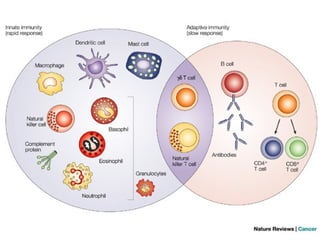
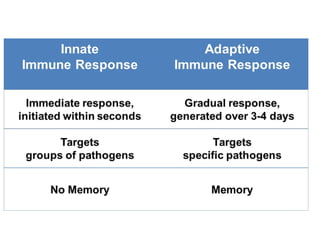
Innate Immunity is a form of non specific host defense
against invading bacteria. It is natural or “innate” to the
host, depending, in part, on genetics. Innate defense
mechanisms are constitutive to the host, meaning they
are continually ready to respond to invasion and do not
require a period of time for induction.
Categories of Innate or Nonspecific Immunity
1. Differences in susceptibility to certain pathogens
2. Anatomical defense
3. Tissue bactericides, including complement
4. Microbial antagonism
5. Inflammation (ability to undergo an inflammatory
response)
6. Phagocytosis
The first four categories are generally considered
non cellular defenses.Inflammation and
Phagocytosis are forms of cellular defense.
1.Differences in Susceptibility of Animal Hosts to Microbial
Pathogens (Natural Immunity)
Natural immunity or resistance is based on the genetics of the
host. There are two aspects:
1) resistance among all members of a species, called species
resistance ;
2) resistance within members of the same animal species,
called individual resistance.
Species resistance
1 ) Absence of specific tissue or cellular receptors for
attachment (colonization) by the pathogen.
2)Temperature of the host and ability of pathogen to
grow.
3)Lack of the exact nutritional requirements to support
the growth of the pathogen.
4)Lack of a target site for a microbial toxin.
Individual resistance
Age. The changes in immunological system and normal flora .
Sex. It could be due to anatomical structure related to sex , and possibly the
effects of sex hormones on infections.
Stress. The best explanation is that in time of stress the output of cortisone from
the adrenal cortex is increased. This suppresses the inflammatory processes .the
overall effect may be harmful. There are also a number of relationships between
stress-related hormones and the functioning of the immune defenses.
Diet, malnutrition. Infections may be linked with vitamin and protein deficiencies.
Also, overfed and obese animals are more susceptible to infection.
Intercurrent disease or trauma. The normal defenses of an animal are impaired by
organic diseases such as leukemia, Hodgkin's disease, diabetes, AIDS, etc.
Therapy against other diseases. Modern therapeutic procedures used in some
diseases can render an individual more susceptible to infection.
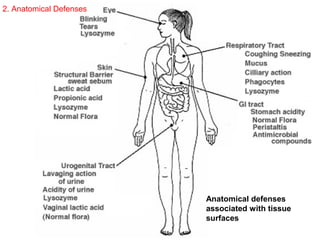
Anatomical defenses
associated with tissue
surfaces
2. Anatomical Defenses
3.Microbial Antagonism
There are three main ways that the normal flora protect
the surfaces where they are colonized:
1) Competition with non-indigenous species for binding
(colonization) sites.
2) Specific antagonism against non-indigenous species.
Members of the normal flora may produce very specific
proteins called bacteriocins which kill or inhibit other
(usually closely-related) species of bacteria.
3) Nonspecific antagonism against non-indigenous
species. The normal flora produce a variety of
metabolites and end products that inhibit other
microorganisms. These include fatty acids (lactate,
propionate, etc.), peroxides and antibiotics.
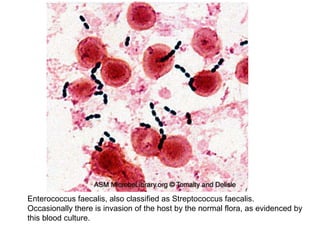
Enterococcus faecalis, also classified as Streptococcus faecalis.
Occasionally there is invasion of the host by the normal flora, as evidenced by
this blood culture.
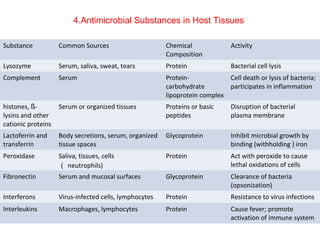
4.Antimicrobial Substances in Host Tissues
Substance Common Sources Chemical
Composition
Activity
Lysozyme Serum, saliva, sweat, tears Protein Bacterial cell lysis
Complement Serum Protein-
carbohydrate
lipoprotein complex
Cell death or lysis of bacteria;
participates in inflammation
histones, ß-
lysins and other
cationic proteins
Serum or organized tissues Proteins or basic
peptides
Disruption of bacterial
plasma membrane
Lactoferrin and
transferrin
Body secretions, serum, organized
tissue spaces
Glycoprotein Inhibit microbial growth by
binding (withholding ) iron
Peroxidase Saliva, tissues, cells
( neutrophils)
Protein Act with peroxide to cause
lethal oxidations of cells
Fibronectin Serum and mucosal surfaces Glycoprotein Clearance of bacteria
(opsonization)
Interferons Virus-infected cells, lymphocytes Protein Resistance to virus infections
Interleukins Macrophages, lymphocytes Protein Cause fever; promote
activation of immune system
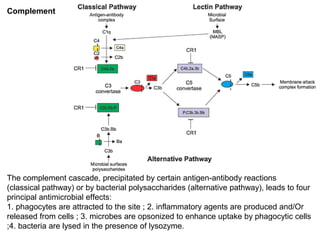
The complement cascade, precipitated by certain antigen-antibody reactions
(classical pathway) or by bacterial polysaccharides (alternative pathway), leads to four
principal antimicrobial effects:
1. phagocytes are attracted to the site ; 2. inflammatory agents are produced and/Or
released from cells ; 3. microbes are opsonized to enhance uptake by phagocytic cells
;4. bacteria are lysed in the presence of lysozyme.
Complement
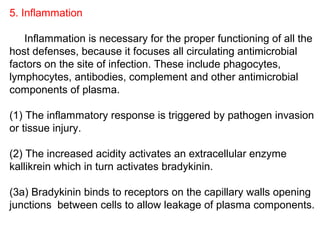
5. Inflammation
Inflammation is necessary for the proper functioning of all the
host defenses, because it focuses all circulating antimicrobial
factors on the site of infection. These include phagocytes,
lymphocytes, antibodies, complement and other antimicrobial
components of plasma.
(1) The inflammatory response is triggered by pathogen invasion
or tissue injury.
(2) The increased acidity activates an extracellular enzyme
kallikrein which in turn activates bradykinin.
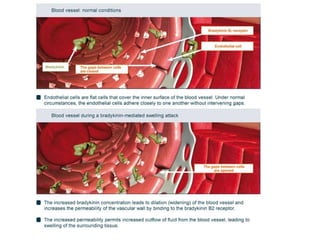
(3a) Bradykinin binds to receptors on the capillary walls opening
junctions between cells to allow leakage of plasma components.
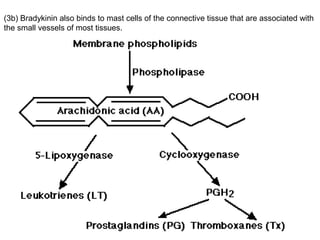
(3b) Bradykinin also binds to mast cells of the connective tissue that are associated with
the small vessels of most tissues.
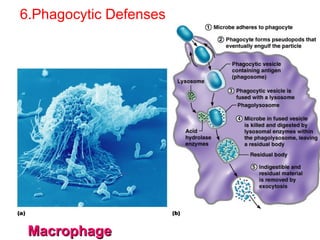
Phagocytosis by a Macrophage.
MacrophageMacrophage
6.Phagocytic Defenses
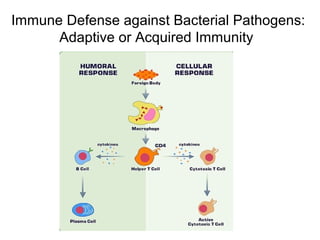
Immune Defense against Bacterial Pathogens:
Adaptive or Acquired Immunity
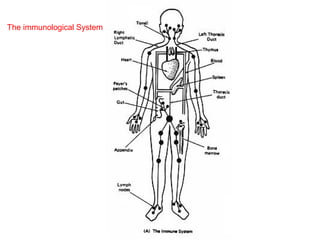
The immunological System
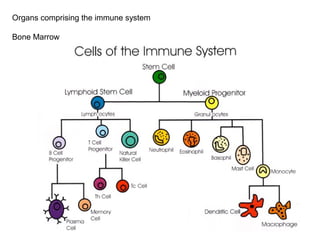
Organs comprising the immune system
Bone Marrow
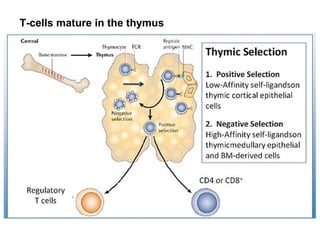
T-cells mature in the thymus
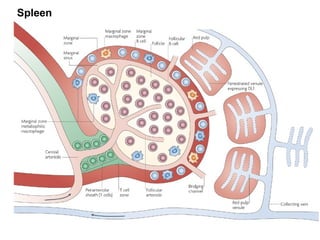
Spleen
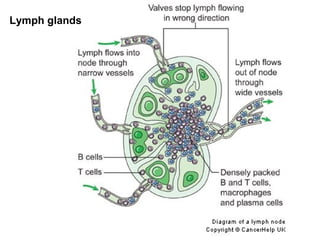
Lymph glands
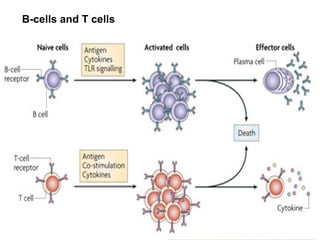
B-cells and T cells
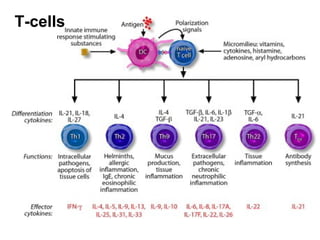
T-cells
Three important features of an immunological response are:
1. Specificity. An antibody or reactive T-cell will react specifically
with the antigen that induced its formation; it will not react with
other antigens.
2. Memory. The immunological system has a "memory". Once
the immunological response has reacted to produce a specific
type of antibody or reactive T-cell, it is capable of producing more
of the antibody or activated T-cells rapidly and in larger amounts.
3. Tolerance. An animal generally does not undergo an
immunological response to its own components. The animal is
said to be tolerant to self-antigens. Tolerance is brought about in
a number of ways, but basically the immunological system is
able to distinguish "self" antigens from "non-self" antigens.
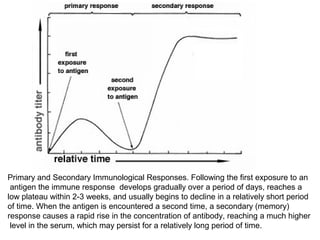
Primary and Secondary Immunological Responses. Following the first exposure to an
antigen the immune response develops gradually over a period of days, reaches a
low plateau within 2-3 weeks, and usually begins to decline in a relatively short period
of time. When the antigen is encountered a second time, a secondary (memory)
response causes a rapid rise in the concentration of antibody, reaching a much higher
level in the serum, which may persist for a relatively long period of time.
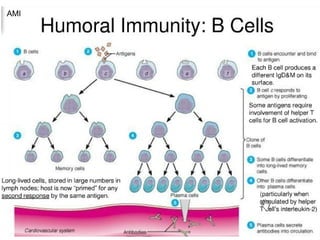
AMI
Exercises:
1. What are the two groups of defense mechanisms of
the body against foreign or harmful agents? What is
the difference between them?
2. What are the categories of innate immunity?
3.What are the important features of an immunological
response?
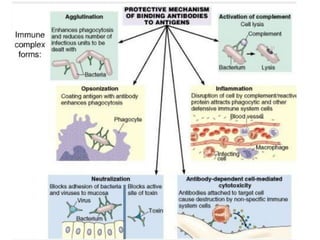
4.How do antibodies work to prevent the infections?
5. What are the categories of adaptive immunity?

5 immune defense against bacterial pathogens

  • 1.
  • 4.
    Immune Defense againstBacterial Pathogens: Innate Immunity Innate Immunity is a form of non specific host defense against invading bacteria. It is natural or “innate” to the host, depending, in part, on genetics. Innate defense mechanisms are constitutive to the host, meaning they are continually ready to respond to invasion and do not require a period of time for induction.
  • 5.
    Categories of Innateor Nonspecific Immunity 1. Differences in susceptibility to certain pathogens 2. Anatomical defense 3. Tissue bactericides, including complement 4. Microbial antagonism 5. Inflammation (ability to undergo an inflammatory response) 6. Phagocytosis The first four categories are generally considered non cellular defenses.Inflammation and Phagocytosis are forms of cellular defense.
  • 6.
    1.Differences in Susceptibilityof Animal Hosts to Microbial Pathogens (Natural Immunity) Natural immunity or resistance is based on the genetics of the host. There are two aspects: 1) resistance among all members of a species, called species resistance ; 2) resistance within members of the same animal species, called individual resistance.
  • 7.
    Species resistance 1 )Absence of specific tissue or cellular receptors for attachment (colonization) by the pathogen. 2)Temperature of the host and ability of pathogen to grow. 3)Lack of the exact nutritional requirements to support the growth of the pathogen. 4)Lack of a target site for a microbial toxin.
  • 8.
    Individual resistance Age. Thechanges in immunological system and normal flora . Sex. It could be due to anatomical structure related to sex , and possibly the effects of sex hormones on infections. Stress. The best explanation is that in time of stress the output of cortisone from the adrenal cortex is increased. This suppresses the inflammatory processes .the overall effect may be harmful. There are also a number of relationships between stress-related hormones and the functioning of the immune defenses. Diet, malnutrition. Infections may be linked with vitamin and protein deficiencies. Also, overfed and obese animals are more susceptible to infection. Intercurrent disease or trauma. The normal defenses of an animal are impaired by organic diseases such as leukemia, Hodgkin's disease, diabetes, AIDS, etc. Therapy against other diseases. Modern therapeutic procedures used in some diseases can render an individual more susceptible to infection.
  • 9.
    Anatomical defenses associated withtissue surfaces 2. Anatomical Defenses
  • 10.
    3.Microbial Antagonism There arethree main ways that the normal flora protect the surfaces where they are colonized: 1) Competition with non-indigenous species for binding (colonization) sites. 2) Specific antagonism against non-indigenous species. Members of the normal flora may produce very specific proteins called bacteriocins which kill or inhibit other (usually closely-related) species of bacteria. 3) Nonspecific antagonism against non-indigenous species. The normal flora produce a variety of metabolites and end products that inhibit other microorganisms. These include fatty acids (lactate, propionate, etc.), peroxides and antibiotics.
  • 11.
    Enterococcus faecalis, alsoclassified as Streptococcus faecalis. Occasionally there is invasion of the host by the normal flora, as evidenced by this blood culture.
  • 12.
    4.Antimicrobial Substances inHost Tissues Substance Common Sources Chemical Composition Activity Lysozyme Serum, saliva, sweat, tears Protein Bacterial cell lysis Complement Serum Protein- carbohydrate lipoprotein complex Cell death or lysis of bacteria; participates in inflammation histones, ß- lysins and other cationic proteins Serum or organized tissues Proteins or basic peptides Disruption of bacterial plasma membrane Lactoferrin and transferrin Body secretions, serum, organized tissue spaces Glycoprotein Inhibit microbial growth by binding (withholding ) iron Peroxidase Saliva, tissues, cells ( neutrophils) Protein Act with peroxide to cause lethal oxidations of cells Fibronectin Serum and mucosal surfaces Glycoprotein Clearance of bacteria (opsonization) Interferons Virus-infected cells, lymphocytes Protein Resistance to virus infections Interleukins Macrophages, lymphocytes Protein Cause fever; promote activation of immune system
  • 13.
    The complement cascade,precipitated by certain antigen-antibody reactions (classical pathway) or by bacterial polysaccharides (alternative pathway), leads to four principal antimicrobial effects: 1. phagocytes are attracted to the site ; 2. inflammatory agents are produced and/Or released from cells ; 3. microbes are opsonized to enhance uptake by phagocytic cells ;4. bacteria are lysed in the presence of lysozyme. Complement
  • 14.
    5. Inflammation Inflammation isnecessary for the proper functioning of all the host defenses, because it focuses all circulating antimicrobial factors on the site of infection. These include phagocytes, lymphocytes, antibodies, complement and other antimicrobial components of plasma. (1) The inflammatory response is triggered by pathogen invasion or tissue injury. (2) The increased acidity activates an extracellular enzyme kallikrein which in turn activates bradykinin. (3a) Bradykinin binds to receptors on the capillary walls opening junctions between cells to allow leakage of plasma components.
  • 16.
    (3b) Bradykinin alsobinds to mast cells of the connective tissue that are associated with the small vessels of most tissues.
  • 17.
    Phagocytosis by aMacrophage. MacrophageMacrophage 6.Phagocytic Defenses
  • 18.
    Immune Defense againstBacterial Pathogens: Adaptive or Acquired Immunity
  • 19.
  • 20.
    Organs comprising theimmune system Bone Marrow
  • 21.
  • 22.
  • 23.
  • 24.
  • 25.
  • 26.
    Three important featuresof an immunological response are: 1. Specificity. An antibody or reactive T-cell will react specifically with the antigen that induced its formation; it will not react with other antigens. 2. Memory. The immunological system has a "memory". Once the immunological response has reacted to produce a specific type of antibody or reactive T-cell, it is capable of producing more of the antibody or activated T-cells rapidly and in larger amounts. 3. Tolerance. An animal generally does not undergo an immunological response to its own components. The animal is said to be tolerant to self-antigens. Tolerance is brought about in a number of ways, but basically the immunological system is able to distinguish "self" antigens from "non-self" antigens.
  • 27.
    Primary and SecondaryImmunological Responses. Following the first exposure to an antigen the immune response develops gradually over a period of days, reaches a low plateau within 2-3 weeks, and usually begins to decline in a relatively short period of time. When the antigen is encountered a second time, a secondary (memory) response causes a rapid rise in the concentration of antibody, reaching a much higher level in the serum, which may persist for a relatively long period of time.
  • 28.
  • 33.
    Exercises: 1. What arethe two groups of defense mechanisms of the body against foreign or harmful agents? What is the difference between them? 2. What are the categories of innate immunity? 3.What are the important features of an immunological response? 4.How do antibodies work to prevent the infections? 5. What are the categories of adaptive immunity?

Editor's Notes

  • #2 Good morning everybody. It’s my pleasure to give you the class. First, let me introduce myself. My name is Yurong Tan. Don't hesitate to contact me if you have any questions. Tel:13272419300 Email: hope7@126.com. I look forward to any suggestions and advice from you. Today, our topics are immune Defense against Bacterial Pathogens, Laboratory Diagnosis of Bacterial Infections and prevention of bacterial infections
  • #3 Humans are in continuous associations with microorganisms. It is relatively rare that these microorganisms cause damage to their host. This is due to the effectiveness of the host defense.The immune system is composed of two major subdivisions, the innate immune system and the adaptive immune system. The innate immune response is a primary defense against invading organisms, while the adaptive immune response acts as a second line of defense. Both immune response have cellular and humoral components by which they carry out their protective functions. There is interplay between these two systems.
  • #4 The innate and adaptive immune responses differ in several ways. the innate immune response are instant and immediate, whereas the adaptive immune response requires some time to react, The adaptive immune response is antigen specific. The innate response is not antigen specific and reacts similarly to a variety of organisms. the adaptive immune response exhibits a memory. It “remembers” that it has encountered an invading organism and reacts more rapidly on subsequent exposure to the same organism. The innate immune response does not exhibit a memory.
  • #5 first let’s come to innate immunity.Innate Immunity is a form of non specific host defense against invading bacteria. It is natural or "innate" to the host, depending, in part, on genetics. Innate defense mechanisms are constitutive [ˌkɑːnstə'tuːtɪv] to the host, meaning they are continually ready to respond to invasion and do not require a period of time for induction. The most important components of innate immunity are anatomical [ˌænə'tɒmɪkl] barriers, intact normal flora, tissue bactericides including complement, and ability to undergo inflammatory and phagocytic [fægə'sɪtɪk]responses.
  • #6 Categories of Innate or Nonspecific Immunity 1) Differences in susceptibility to certain pathogens 2)Anatomical defense 3)Tissue bactericides, including complement 4)Microbial antagonism [æn'tæɡənɪzəm] 5)Inflammation (ability to undergo an inflammatory response) 6) Phagocytosis [ˌfægəsaɪ'toʊsɪs] The first four categories are generally considered non cellular defenses.Inflammation and Phagocytosis are forms of cellular defense.
  • #7 Differences in Susceptibility of Animal Hosts to Microbial Pathogens (Natural Immunity) Natural immunity or resistance is based on the genetics of the host. There are two aspects: 1) resistance among all members of a species, called species resistance; 2) resistance within members of the same animal species, called individual resistance.
  • #8 species resistance Certain pathogens infect only humans, e.g. syphilis['sɪfɪlɪs], gonorrhea, measles['miːzlz], poliomyelitis[ˌpəʊliəʊˌmaɪə'laɪtɪs] . On the other hand, certain pathogens do not infect humans. The reasons could be due to: Absence of specific tissue or cellular receptors for attachment (colonization) by the pathogen. Temperature of the host and ability of pathogen to grow. For example, birds do not normally become infected with mammalian [mæ'meɪliən] strains of Mycobacterium tuberculosis because these strains cannot grow at the high body temperature of birds. Lack of the exact nutritional requirements to support the growth of the pathogen. Naturally-requiring purine[‘pjʊrɪn]-dependent Some strains of Salmonella typhi need purine to grow. So they cannot grow in the environment without purines. Lack of a target site for a microbial toxin. For example, injection of diphtheria toxin fails to kill the rat. The unchanged toxin is excreted in the urine. If a sample of the rat urine (or pure diphtheria toxin) is injected into the guinea pig, it dies of typical lesions['liːʒn] caused by diphtheria[dɪf'θɪriə toxin.
  • #9 Individual resistance There are many reasons why individuals may exhibit different susceptibility to the same pathgen. Age. Usually this relates to The changes in immunological system and normal flora . Sex. It could be due to anatomical structure related to sex , and possibly the effects of sex hormones on infections. Stress.The best explanation is that in time of stress the output of cortisone ['kɔːrtəzoʊn] from the adrenal [æd'riːnəl]cortex is increased. This suppresses the inflammatory processes of the host and the overall effect may be harmful. There are also a number of relationships between stress-related hormones and the functioning of the immune defenses. Diet, malnutrition. Infections may be linked with vitamin and protein deficiencies, and this might explain why many infectious diseases are more prevalent in parts of the world where malnourishment [mæl“nʌrɪʃm(ə)nt] is a problem. Also, overfed and obese animals are more susceptible to infection. Intercurrent [ˌɪntə‘kʌrənt] 并发的disease or trauma. The normal defenses of an animal are impaired by organic [ɔː’ɡænɪk]diseases such as leukemia, Hodgkin‘s disease, diabetes, AIDS, etc. Therapy against other diseases. Modern therapeutic procedures used in some diseases can render an individual more susceptible to infection.
  • #10 The anatomical defenses are associated with all kinds of noncellular immunity, including individual resistance, mechanical resistance, chemical resistance and resistance established by the normal flora Eyes (Conjunctiva [ˌkɒndʒʌŋk‘taɪvə]). Blinking mechanically  [mə'kænɪkli] removes microbes, the lavaging [’lævədʒɪŋ]action of tears washes the surface of the eye, tears contain relatively large amounts of lysozyme['laɪsəˌzaɪm] . Skin. Perspiration contains lysozyme, ['siːbəm]皮脂,[prɒpa'ɪɒnɪk] 丙酸的, and [ˌlæktɪk'æsɪd] 乳酸 The normal flora, which metabolize substances secreted onto the skin, produce end products (e.g. fatty acids) that discourage the colonization of skin by potential pathogens. Respiratory  ['respərətɔːri]tract. Coughing and sneezing eliminate bacteria. bacteria which are inhaled may be swept upward by cillary action. The lower respiratory tract is well protected by mucus, lysozyme, secretory antibody, and phagocytosis. Mouth, stomach and intestinal tract. Most organisms that are swallowed are destroyed by acid and various secretions of the stomach. Microorganisms have to compete with the well-adapted normal flora . The peristaltic [pə‘rɪstæltɪk] 蠕动的action of the intestine ultimately['ʌltɪmətli] flushes out organisms. Bile salts and lysozyme kill or inhibit many types of bacteria. Urogenital [ˌjʊroʊ‘dʒenətəl] Tract. The flushing mechanisms and the acidity [ə‘sɪdəti] of urine maintain the bladder and most of the urethra [jʊ’riːθrə]尿道free of microorganisms. The vaginal epithelium of the female maintains a high population of normal flora prevent colonization by most other types of microorganisms
  • #11 Microbial Antagonism There are three main ways that the normal flora protect the surfaces where they are colonized: Competition with non-indigenous species for binding (colonization) sites. Specific antagonism against non-indigenous [ɪn'dɪdʒənəs] species. Members of the normal flora may produce very specific proteins called bacteriocins which kill or inhibit other (usually closely-related) species of bacteria. Nonspecific antagonism against non-indigenous species. The normal flora produce a variety of metabolites and end products that inhibit other microorganisms. These include fatty acids (lactate, propionate ['proʊpiːəˌneɪt], etc.), peroxides and antibiotics.
  • #12 Occasionally there is invasion of the host by the normal flora, as evidenced by this blood culture which may be related with the maintainance ['meɪntənəns] of the body’s immunity.
  • #13 [sə'laɪvə]唾液['laɪsɪn] 细胞溶解素[ˌkæt'aɪənɪk]adj.阳离子的[læktə'ferɪn] 乳铁传递蛋白 [træns'fɜːɪn] 铁传递蛋白 [ɒp'sɒnaɪzeɪʃən] 调理作用
  • #14 Complement ['kɑːmplɪment] is considered as part of the innate immunity because of its role in inflammation, phagocytosis and bacterial killing. it may play a role in adaptive immunity through activation by reactions between antigens and antibodies. The complement cascade [kæ'skeɪd] , precipitated by certain antigen-antibody reactions (classical['klæsɪkl] pathway) or by bacterial polysaccharides (alternative  [ɔːl'tɜːrnətɪv]pathway), leads to four principal antimicrobial effects: 1. phagocytes are attracted to the site ; 2. inflammatory agents are produced and/Or released from cells ; 3. microbes are opsonized ['ɒpsəˌnaɪz] to enhance uptake by phagocytic cells ;4. bacteria are lysed [laɪs] in the presence of lysozyme.
  • #15 Inflammation is necessary for the proper functioning of all the host defenses, including the immune defenses, because it focuses all circulating antimicrobial factors on the site of infection. These include phagocytes, lymphocytes, antibodies, complement and other antimicrobial components of plasma['plæzmə]. The process of Inflammation includes (1) The inflammatory response is triggered by pathogen invasion or tissue injury. (2) The increased acidity activates an extracellular enzyme kallikrein [ˌkælɪ'krɪən]激肽释放酶which in turn activates bradykinin ['brædɪ'kaɪnɪn] 血管舒缓激肽. (3a) Bradykinin binds to receptors on the capillary walls opening junctions between cells to allow leakage of plasma components .
  • #16 Please look at this picture: the gap between cells are closed under normal conditions. when bradykin binds to its receptor the gap are opened, which allows leukocytes to pass from the vessels into tissues (this process is called diapedisis [ˌdaɪəpɪ'diːsɪs]血球渗出).
  • #17 (3b) Bradykinin also binds to mast cells of the connective tissue that are associated with the small vessels of most tissues. The process activates phospholipase A2 to synthesize a substance called arachidonic acid arachidonate[ɑːrækɪdəʊ‘neɪt]花生四烯酸. This compound can synthesize prostaglandins [prɒs’tæɡlændɪnz], leukotrienes, [ˌljʊkoʊ‘trɪənz]白三烯 [θrɒm’bɒkseɪn]凝血氧烷 by the cyclooxygenase [saɪk‘luːksɪdʒəneɪs]环氧合酶 pathways or lipooxygenase[lɪpɒksɪdʒə’neɪs] 脂加氧酶 pathways.
  • #18 ['laɪsəˌsoʊm]  ['vesɪkl] [rɪ'zɪdʒuəl]  [ˌeksoʊsaɪ'toʊsɪs]  [fægə'sɪtɪk] ['haɪdrəleɪs] [ˌɪndɪ'dʒestəbl]
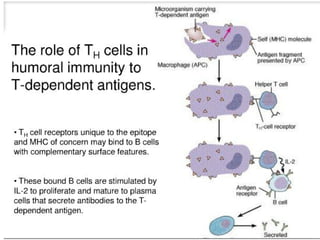
  • #19 Antibody-mediated immunity (AMI) is the type of adaptive immunity that is mediated by antibodies or immunoglobulins.Cell-mediated immunity (CMI) is the type of adaptive immunity that is mediated by specific effector T-cells.
  • #20 Anatomy [ə'nætəmi]of the Immunological System. The major components of the immunological system are lymph nodes connected by lymph ducts, Peyer's patches (masses of lymphocytes in the lower gastrointestinal tract,派尔), thymus, spleen, and bone marrow.
  • #21 All cells of the immune system are initially derived from the bone marrow. The bone marrow produces lymphocytes (B-cells, immature T-cells, and natural killer cells), granulocytes [ɡ'rænjʊləsaɪts](including neutrophils, monocytes and dendritic cells), in addition to red blood cells and platelets['pleɪtlɪts].  ['lɪmfɔɪd] ['maɪəˌlɔɪd] [proʊ'dʒenɪtər]   ['njuːtrəfɪl [ˌiːə'sɪnəfɪl] [bæsə'fɪl]
  • #22 Immature [ˌɪmə'tʃʊr] T-cells leave the bone marrow and migrate into the thymus ['θaɪməs]. In a maturation process sometimes referred to as "thymic education", T cells that are beneficial to the immune system are spared [sper]备用的;多余的;闲置的, while T cells that might evoke a detrimental  [ˌdetrɪ'mentl]autoimmune response are eliminated. The mature T cells are then released into the bloodstream.
  • #23 The spleen  [spliːn]is made up of B cells, T cells, macrophages, dendritic cells, natural killer cells and red blood cells. The spleen filters antigens directly from the blood, and migratory ['maɪɡrətɔːri] macrophages and dendritic cells bring antigens to the spleen via the bloodstream. An immune response is initiated when a macrophage or dendritic cell “presents antigen” to appropriate B or T cells  ['mɑːrdʒɪnl]末端的 ['saɪnəs]  ['fɑːlɪkl]小囊;卵泡;滤泡 [fə'lɪkjələ]  ['venjuːl]  [fɪ'nestreɪtɪd]窗状的;有窗的;有小孔的  [ɑːr'tɪrioʊl]细动脉[metələ'fɪlɪk]嗜金属的 [ɑːˌtɪrɪ'oʊlə]  [ʃiːθ]
  • #24 The lymphatic [lɪm'fætɪk]system parallels [‘pærəlel]the circulatory  ['sɜːrkjələtɔːri] blood system. It is periodically  [ˌpɪəri’ɒdɪkli] guarded by lymph nodes, which are found throughout the body and composed mostly of T cells, B cells, dendritic cells and macrophages.  ['mækrəfeɪdʒ]
  • #25 The major function of B lymphocytes is to develop into antibody-secreting plasma cells following stimulation by foreign antigens of bacteria, viruses and tumor cells.
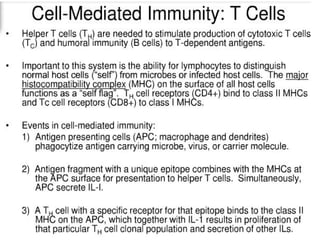
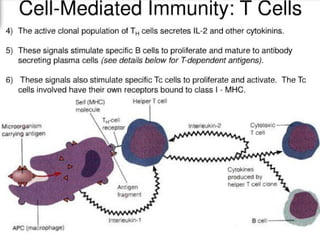
  • #26 T lymphocytes are usually divided into two major subsets that are functionally and phenotypically ['fiːnətaɪp] different. T helper (TH) cells, also called CD4+ T cells, are involved in coordination and regulation of immunological responses. The second subset type of T lymphocytes are cytotoxic T lymphocytes ( Tc cells or CTLs) or CD8+ T cells. These cells are involved in directly killing certain tumor cells, virus-infected cells, transplant ['trænsplænt]cells, and sometimes eucaryotic [juːkeəri'ːɒtɪk]parasites.
  • #27 Three important features of an immunological response are: 1. Specificity[ˌspesɪ'fɪsəti] . An antibody or reactive T-cell will react specifically with the antigen that induced its formation; it will not react with other antigens. 2. Memory. The immunological system has a "memory". Once the immunological response has reacted to produce a specific type of antibody or reactive T-cell, it is capable of producing more of the antibody or activated T-cells rapidly and in larger amounts. 3. Tolerance ['tɒlərəns]. An animal generally does not undergo an immunological response to its own components. The animal is said to be tolerant to self-antigens. Tolerance is brought about in a number of ways, but basically the immunological system is able to distinguish [dɪ'stɪŋɡwɪʃ]"self" antigens from "non-self" (foreign) antigens.
  • #28 primary and Secondary Immunological Responses. Following the first exposure to an antigen the immune response develops gradually over a period of days, reaches a low plateau [plæ‘toʊ]within 2-3 weeks, and usually begins to decline in a relatively short period of time. When the antigen is encountered a second time, a secondary (memory) response causes a rapid rise in the concentration of antibody, reaching a much higher level in the serum, which may persist for a relatively long period of time.
  • #30  [sɪtəʊtɒk'sɪsɪtɪ] ['miːdieɪt] ['mekənɪzəm]
  • #31  ['fægəsɪˌsaɪˌtaɪz]  吞噬(异物或细菌)  ['epɪˌtoʊp]抗原决定基
  • #32  ['saɪtoʊ'kɪnɪn]细胞分裂素