DIGITAL MODULATION TECHNIQUES
Presented By:
NIDHI BARANWAL
MCA 3rd SEMESTER
University of Allahabad
WHAT IS MODULATION
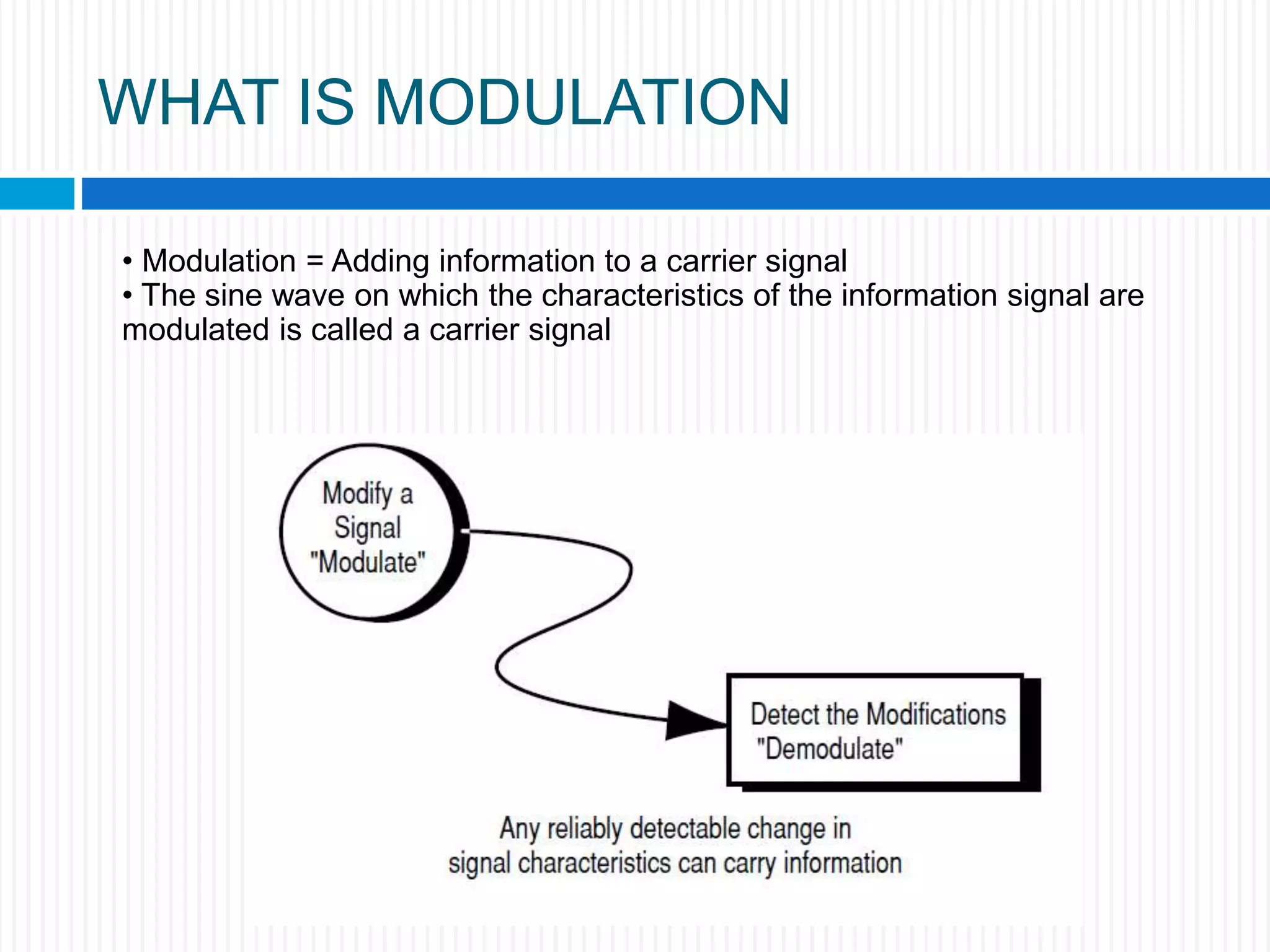
• Modulation = Adding information to a carrier signal
• The sine wave on which the characteristics of the information signal are
modulated is called a carrier signal
CONTD.
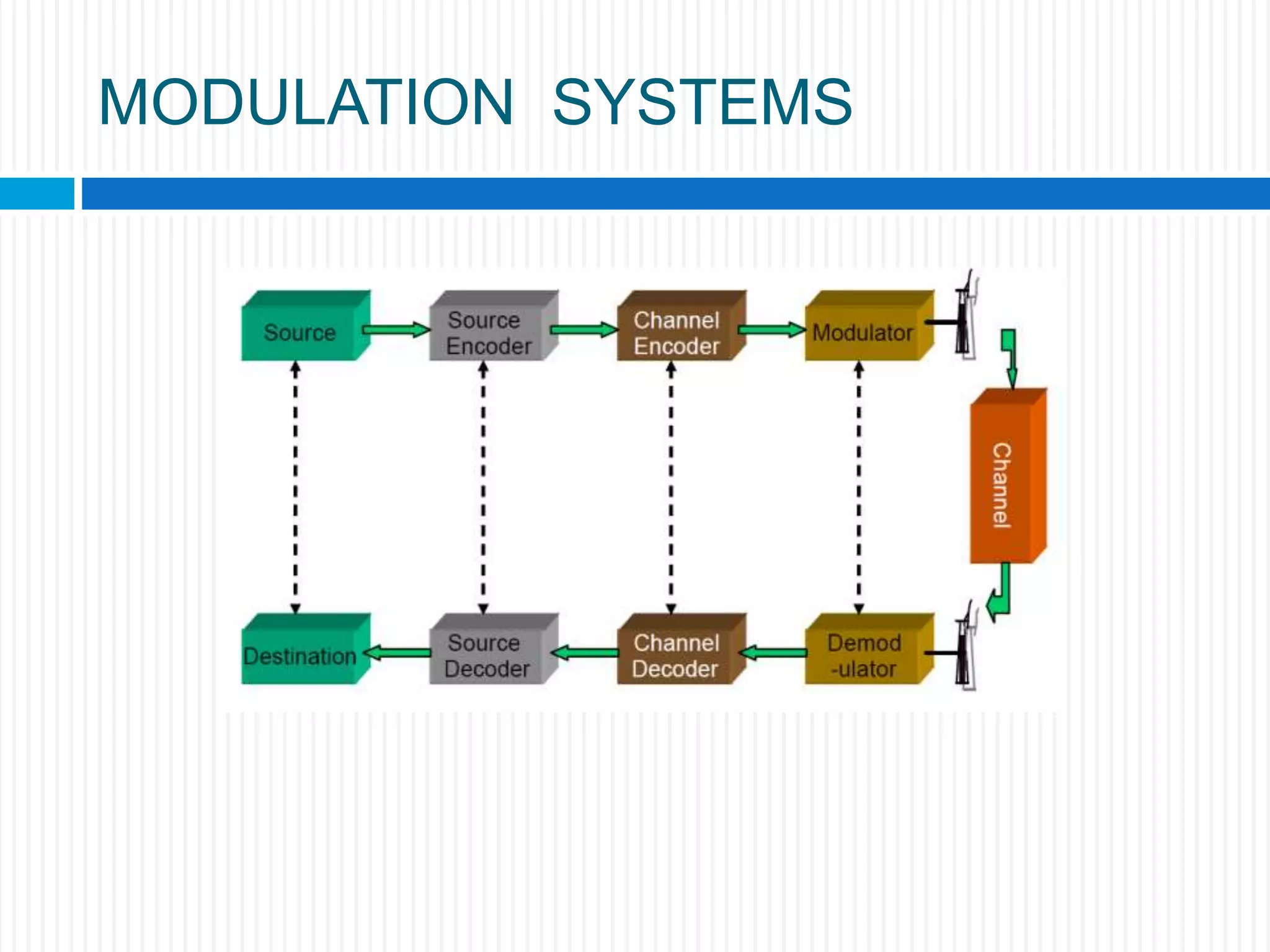
MODULATION SYSTEMS
TYPES OF MODULATION
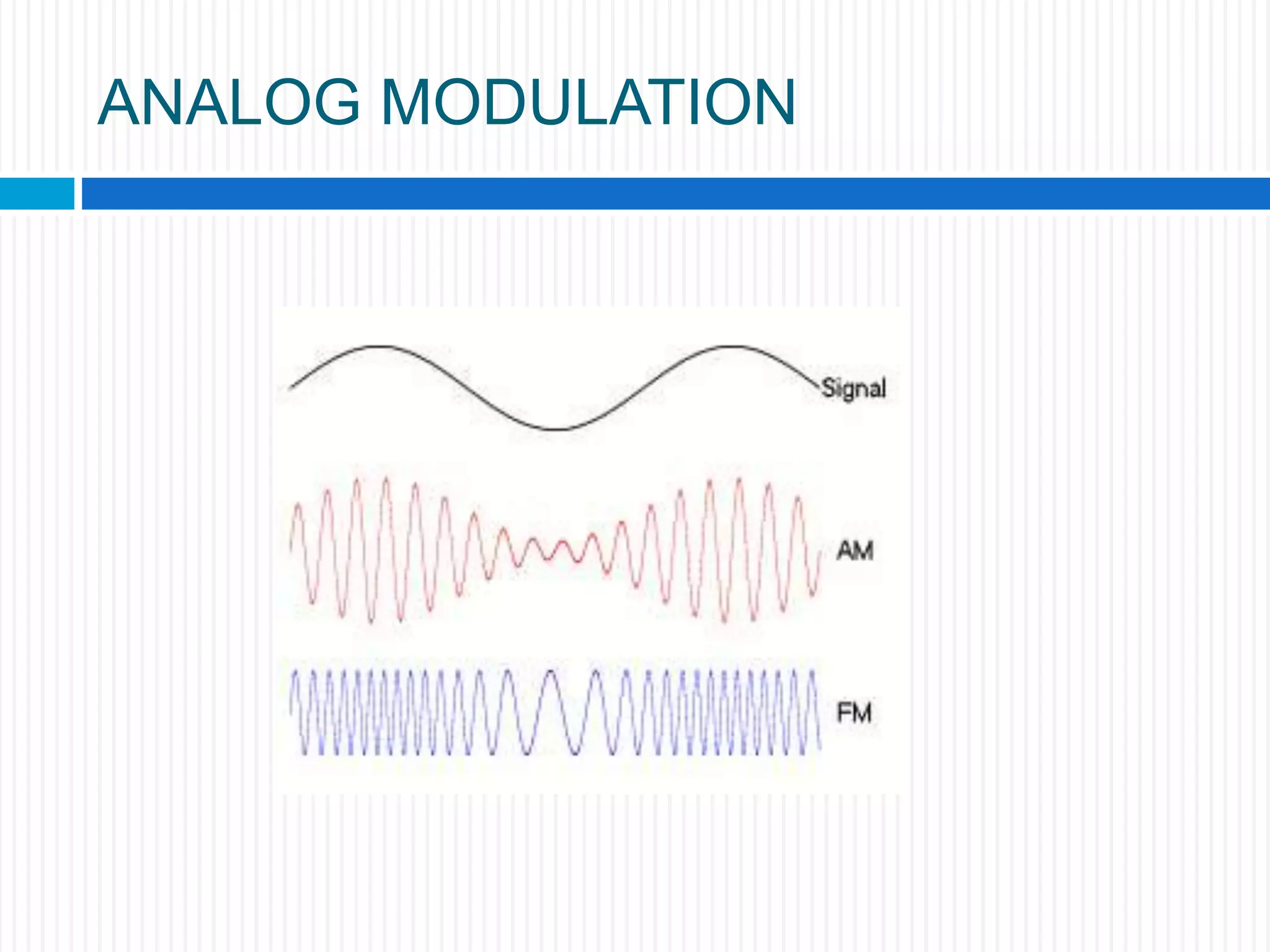
 ANALOG MODULATION: If the variation in
the parameter of the carrier is continuous in
accordance to the input analog signal the
modulation technique is termed as analog
modulation scheme
 DIGITAL MODULATION: If the variation in the
parameter of the carrier is discrete then it is
termed as digital modulation technique
ANALOG MODULATION
DIGITAL MODULATION
• In digital modulation , an analog carrier signal is
modulated by a discrete signal
• Digital modulation can be considered as digital-
to-analog and the corresponding demodulation
as analog-to-digital conversion
• In digital communications, the modulating wave
consists of binary data and the carrier is
sinusoidal wave
DIGITAL MODULATION TECHNIQUES
AMPLITUDE SHIFT KEYING
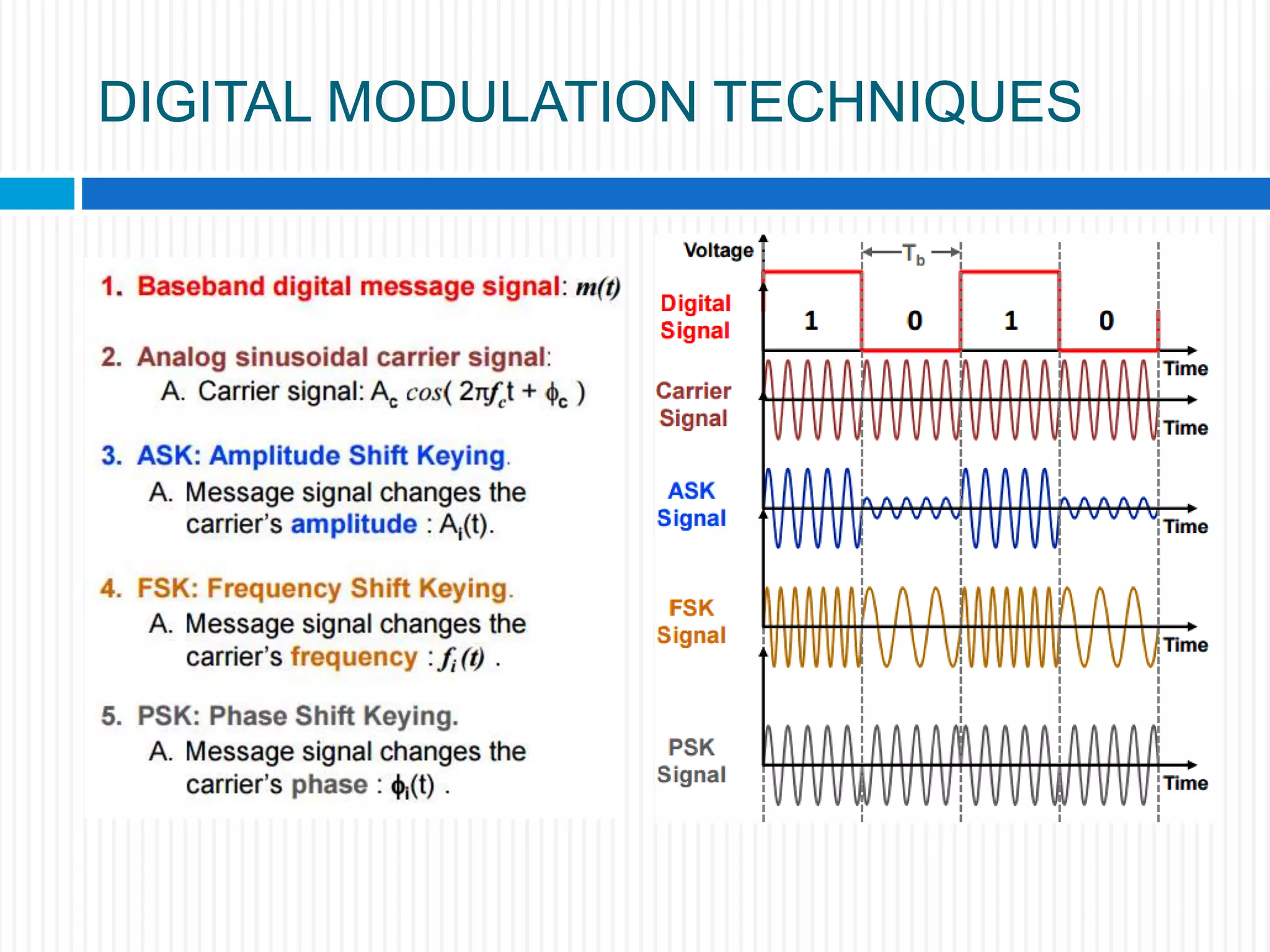
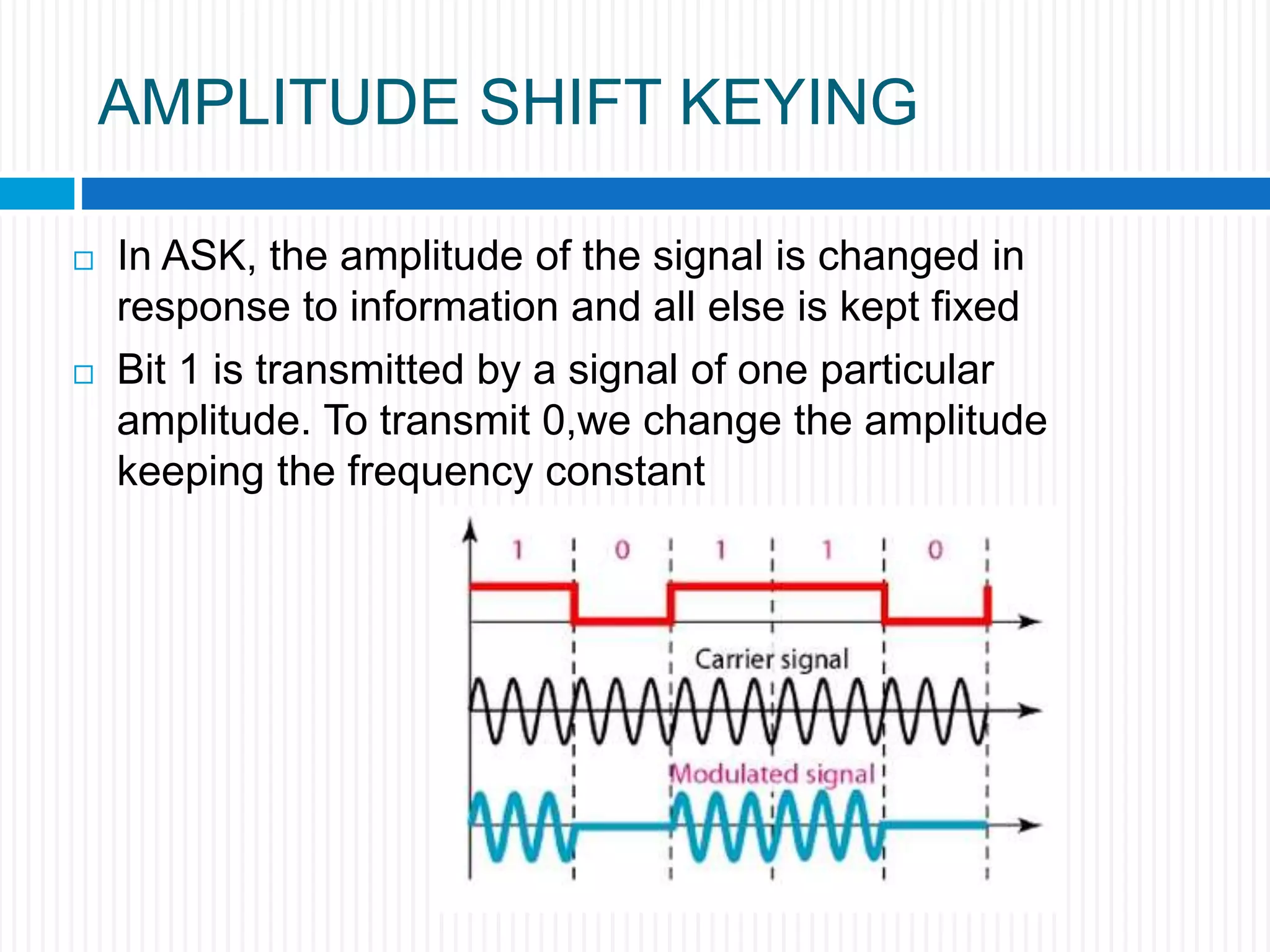
 In ASK, the amplitude of the signal is changed in
response to information and all else is kept fixed
 Bit 1 is transmitted by a signal of one particular
amplitude. To transmit 0,we change the amplitude
keeping the frequency constant
FREQUENCY SHIFT KEYING
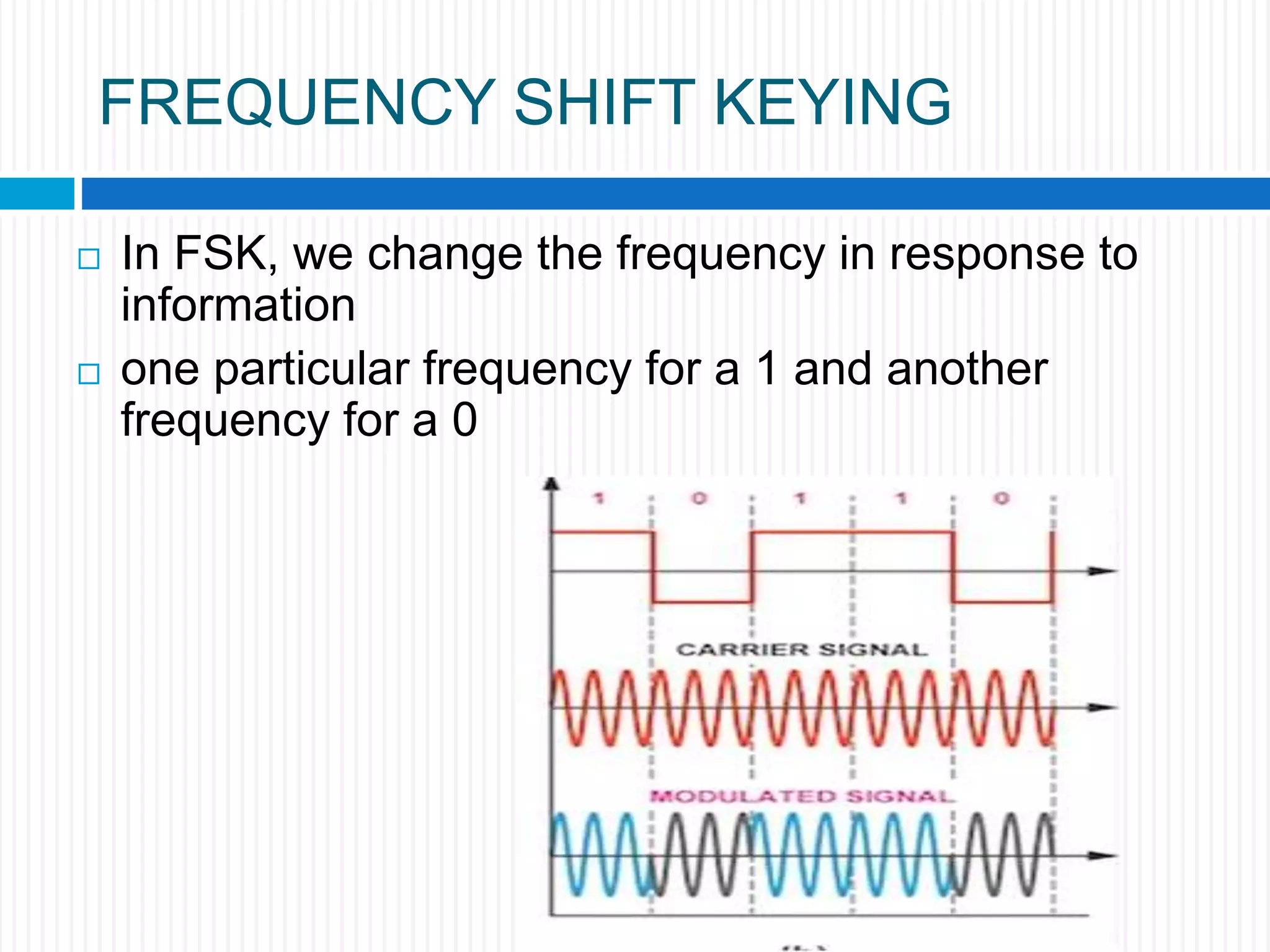
 In FSK, we change the frequency in response to
information
 one particular frequency for a 1 and another
frequency for a 0
PHASE SHIFT KEYING
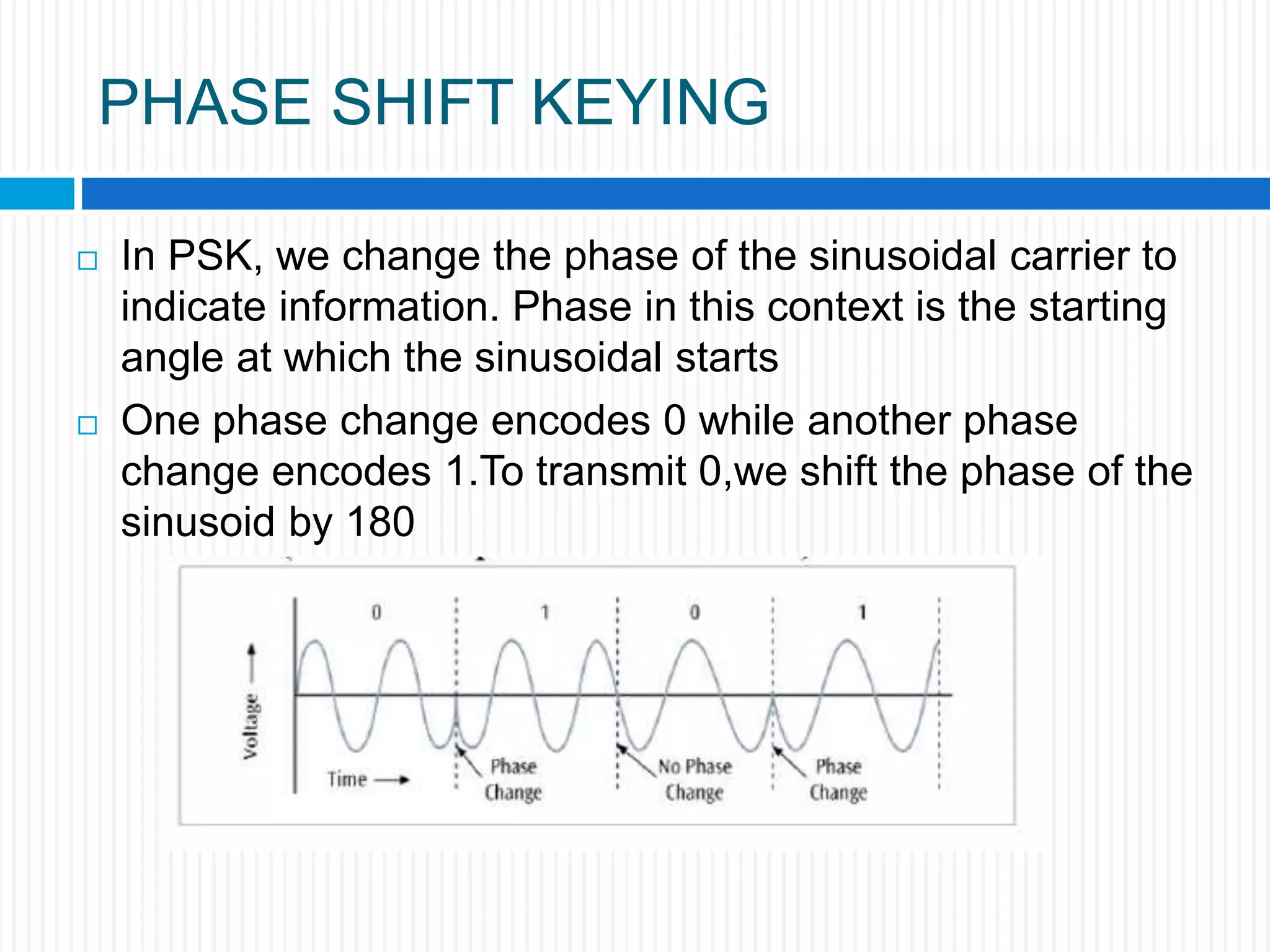
 In PSK, we change the phase of the sinusoidal carrier to
indicate information. Phase in this context is the starting
angle at which the sinusoidal starts
 One phase change encodes 0 while another phase
change encodes 1.To transmit 0,we shift the phase of the
sinusoid by 180
M-ARY MODULATION TECHNIQUE
 In binary data transmission, send only one of two
possible signals during each bit interval Tb
 In M-ary data transmission, send one of M
possible signals during each signaling interval T
 In almost all applications, M = 2n and T = nTb,
where n is an integer
 Each of the M signals is called a symbol
 These signals are generated by changing the
amplitude, phase, frequency, or combined forms
of a carrier.
 Thus, we have: MASK MPSK MFSK MQAM
QUADRATURE PHASE SHIFT KEYING
 Quadrature Phase Shift Keying can be
interpreted as two independent BPSK systems
, and thus the same performance but twice the
bandwidth efficiency
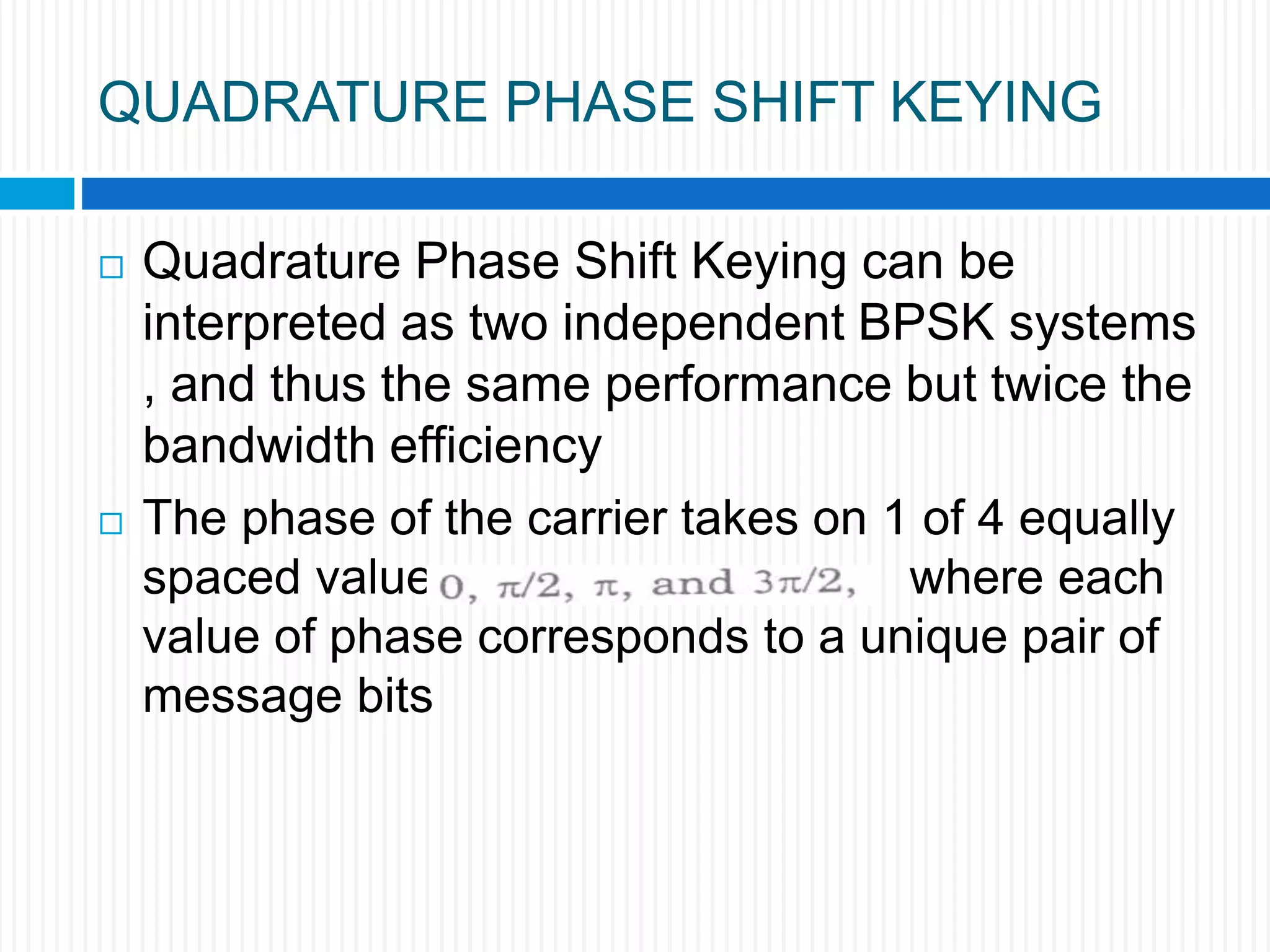
 The phase of the carrier takes on 1 of 4 equally
spaced values where each
value of phase corresponds to a unique pair of
message bits
QUADRATURE AMPLITUDE MODULATION
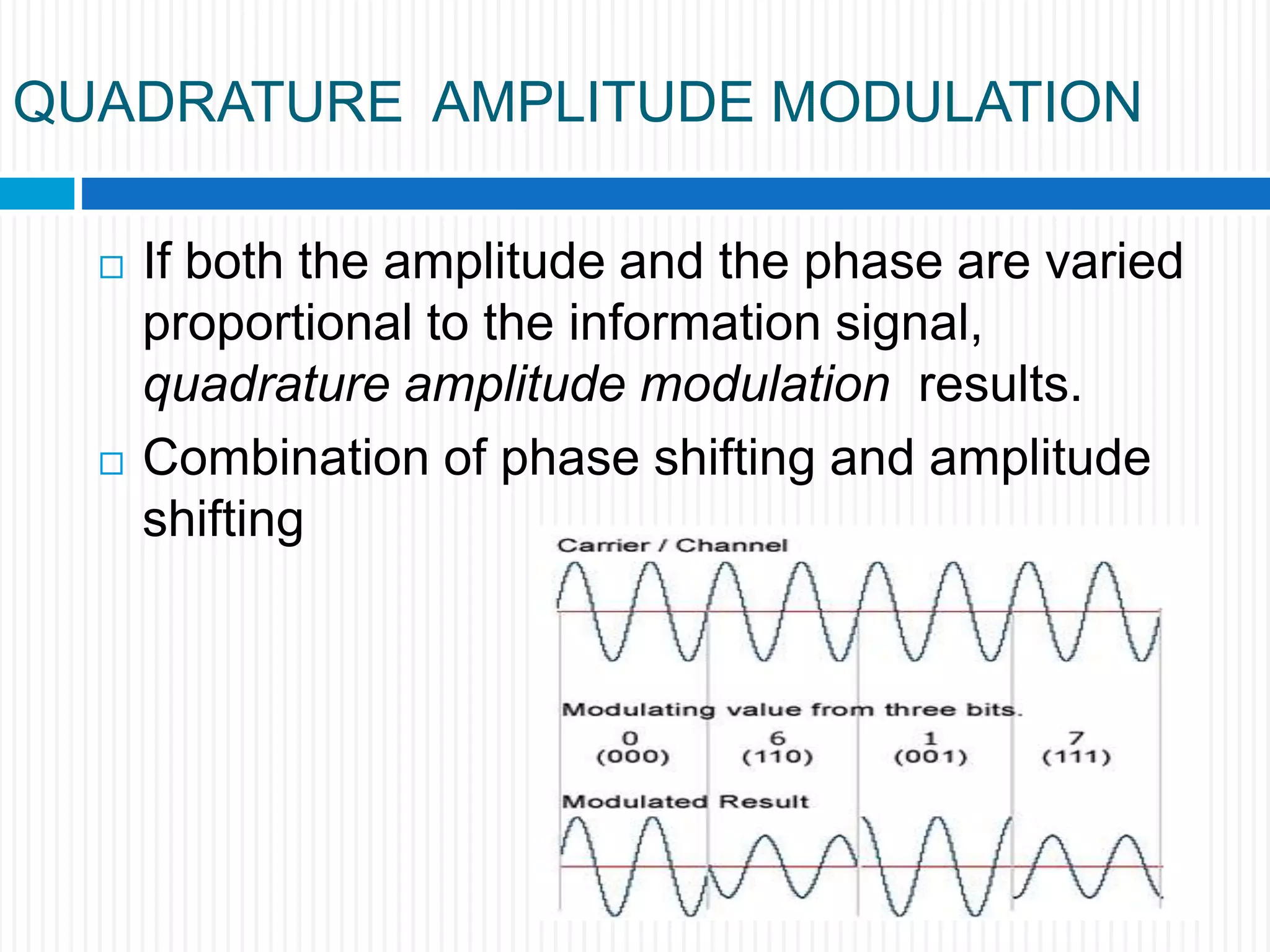
 If both the amplitude and the phase are varied
proportional to the information signal,
quadrature amplitude modulation results.
 Combination of phase shifting and amplitude
shifting
DIFFERENTIAL PHASE SHIFT KEYING
 For the perfect detection of a phase modulated
signal, the receiver needs a reference signal
but if differential encoding and phase shift
keying are made together at the transmitter
the technique is called as Differential Phase
Shift Keying
 For the transmission of a symbol 1, the phase
is unchanged whereas for transmission of
symbol 0, the phase of the signal is changed
by 180
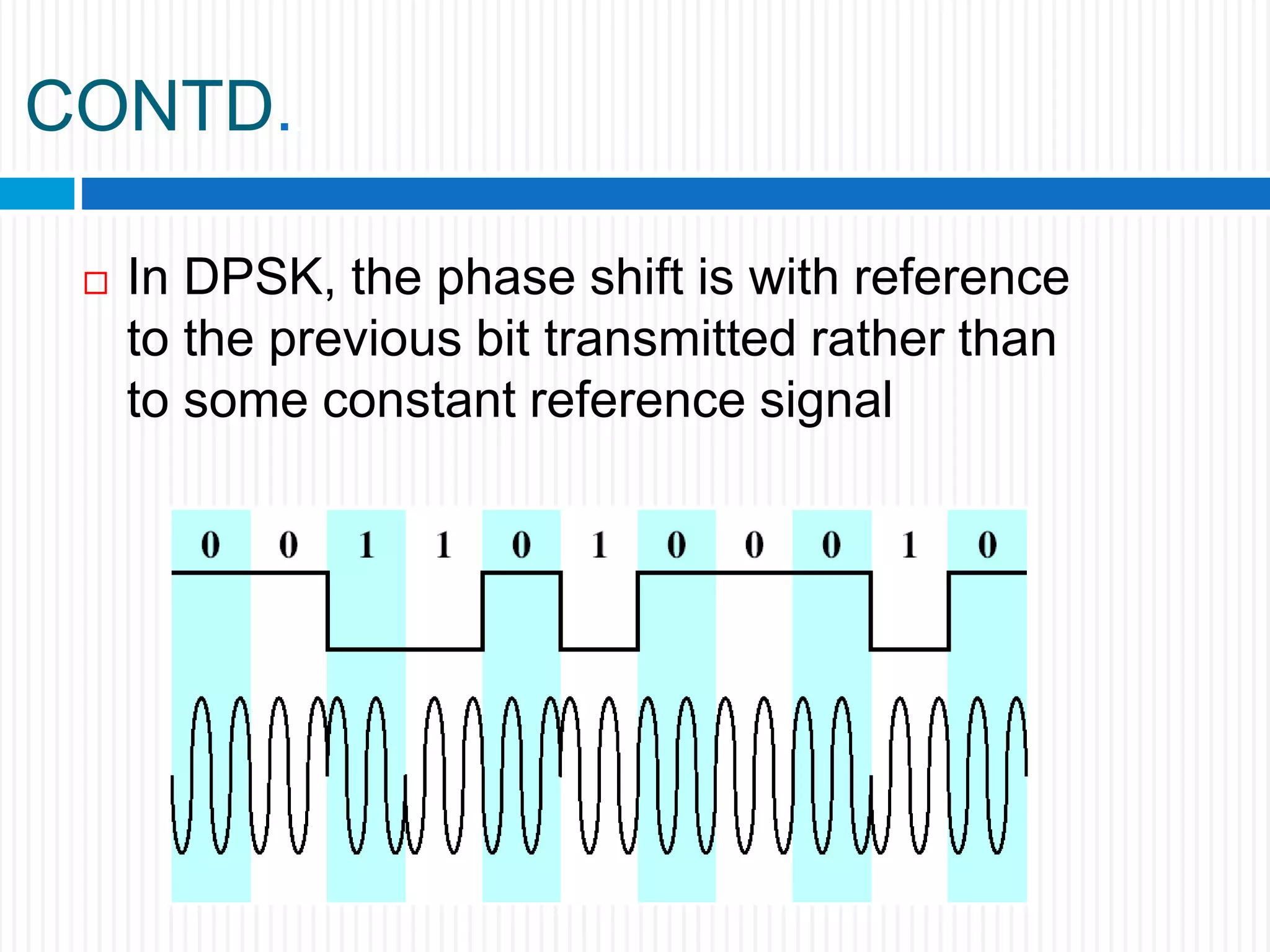
 In DPSK, the phase shift is with reference
to the previous bit transmitted rather than
to some constant reference signal
CONTD..
METRICS FOR DIGITAL MODULATION
 POWER EFFICIENCY
 Power efficiency is a measure of how much signal
power should be increased to achieve a particular bit error
rate (BER) for a given modulation scheme
 Ability of a modulation technique to preserve the fidelity of
the digital message at low power
 Designer can increase noise immunity by increasing
signal
power
 BANDWIDTH EFFICIENCY
 Ability to accomodate data within a limited bandwidth
 Tradeoff between data rate and pulse width
 Easy to implement and cost-effective to operate.
THANKS

Digital modulation techniques...

  • 1.
    DIGITAL MODULATION TECHNIQUES PresentedBy: NIDHI BARANWAL MCA 3rd SEMESTER University of Allahabad
  • 2.
    WHAT IS MODULATION •Modulation = Adding information to a carrier signal • The sine wave on which the characteristics of the information signal are modulated is called a carrier signal
  • 3.
  • 4.
  • 5.
    TYPES OF MODULATION ANALOG MODULATION: If the variation in the parameter of the carrier is continuous in accordance to the input analog signal the modulation technique is termed as analog modulation scheme  DIGITAL MODULATION: If the variation in the parameter of the carrier is discrete then it is termed as digital modulation technique
  • 6.
  • 7.
    DIGITAL MODULATION • Indigital modulation , an analog carrier signal is modulated by a discrete signal • Digital modulation can be considered as digital- to-analog and the corresponding demodulation as analog-to-digital conversion • In digital communications, the modulating wave consists of binary data and the carrier is sinusoidal wave
  • 8.
  • 9.
    AMPLITUDE SHIFT KEYING In ASK, the amplitude of the signal is changed in response to information and all else is kept fixed  Bit 1 is transmitted by a signal of one particular amplitude. To transmit 0,we change the amplitude keeping the frequency constant
  • 10.
    FREQUENCY SHIFT KEYING In FSK, we change the frequency in response to information  one particular frequency for a 1 and another frequency for a 0
  • 11.
    PHASE SHIFT KEYING In PSK, we change the phase of the sinusoidal carrier to indicate information. Phase in this context is the starting angle at which the sinusoidal starts  One phase change encodes 0 while another phase change encodes 1.To transmit 0,we shift the phase of the sinusoid by 180
  • 12.
    M-ARY MODULATION TECHNIQUE In binary data transmission, send only one of two possible signals during each bit interval Tb  In M-ary data transmission, send one of M possible signals during each signaling interval T  In almost all applications, M = 2n and T = nTb, where n is an integer  Each of the M signals is called a symbol  These signals are generated by changing the amplitude, phase, frequency, or combined forms of a carrier.  Thus, we have: MASK MPSK MFSK MQAM
  • 13.
    QUADRATURE PHASE SHIFTKEYING  Quadrature Phase Shift Keying can be interpreted as two independent BPSK systems , and thus the same performance but twice the bandwidth efficiency  The phase of the carrier takes on 1 of 4 equally spaced values where each value of phase corresponds to a unique pair of message bits
  • 14.
    QUADRATURE AMPLITUDE MODULATION If both the amplitude and the phase are varied proportional to the information signal, quadrature amplitude modulation results.  Combination of phase shifting and amplitude shifting
  • 15.
    DIFFERENTIAL PHASE SHIFTKEYING  For the perfect detection of a phase modulated signal, the receiver needs a reference signal but if differential encoding and phase shift keying are made together at the transmitter the technique is called as Differential Phase Shift Keying  For the transmission of a symbol 1, the phase is unchanged whereas for transmission of symbol 0, the phase of the signal is changed by 180
  • 16.
     In DPSK,the phase shift is with reference to the previous bit transmitted rather than to some constant reference signal CONTD..
  • 17.
    METRICS FOR DIGITALMODULATION  POWER EFFICIENCY  Power efficiency is a measure of how much signal power should be increased to achieve a particular bit error rate (BER) for a given modulation scheme  Ability of a modulation technique to preserve the fidelity of the digital message at low power  Designer can increase noise immunity by increasing signal power  BANDWIDTH EFFICIENCY  Ability to accomodate data within a limited bandwidth  Tradeoff between data rate and pulse width  Easy to implement and cost-effective to operate.
  • 18.