Use of MIMO in 802.11n

By
Chaitanya T K
Email:tkchaitanya@tataelxsi.co.in
When you are in light,
Everything will follow you......
But when you enter dark,
Even your shadow will not follow you......
This is LIFE!!!
Enjoy!!!
Objectives
This presentation will give an overview of MIMO
technology and its future in Wireless LAN:
 History of MIMO
 Understanding the Key words
 What is MIMO?
 Different Techniques used in MIMO
 MIMO-OFDM
 MIMO Applications
 How it is useful in 802.11n?
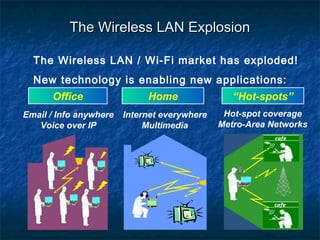
The Wireless LAN Explosion
The Wireless LAN / Wi-Fi market has exploded!
New technology is enabling new applications:
Office

Home

“Hot-spots”

Email / Info anywhere
Voice over IP

Internet everywhere
Multimedia

Hot-spot coverage
Metro-Area Networks
Wireless LAN Technology Advances
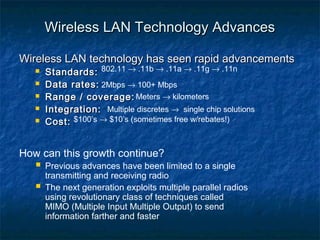
Wireless LAN technology has seen rapid advancements






Standards: 802.11 → .11b → .11a → .11g → .11n
Data rates: 2Mbps → 100+ Mbps
Range / coverage: Meters → kilometers
Integration: Multiple discretes → single chip solutions
Cost: $100’s → $10’s (sometimes free w/rebates!)
How can this growth continue?

 Previous advances have been limited to a single


transmitting and receiving radio
The next generation exploits multiple parallel radios
using revolutionary class of techniques called
MIMO (Multiple Input Multiple Output) to send
information farther and faster
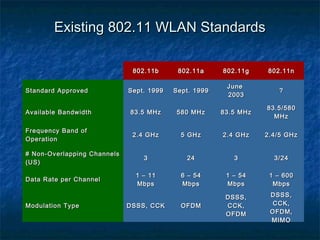
Existing 802.11 WLAN Standards
802.11b

802.11a

802.11g

802.11n

Standard Approved

Sept. 1999

Sept. 1999

June
2003

?

Available Bandwidth

83.5 MHz

580 MHz

83.5 MHz

83.5/580
MHz

2.4 GHz

5 GHz

2.4 GHz

2.4/5 GHz

3

24

3

3/24

1 – 11
Mbps

6 – 54
Mbps

1 – 54
Mbps

1 – 600
Mbps

OFDM

DSSS,
CCK,
OFDM

DSSS,
CCK,
OFDM,
MIMO

Frequency Band of
Operation
# Non-Overlapping Channels
(US)
Data Rate per Channel

Modulation Type

DSSS, CCK
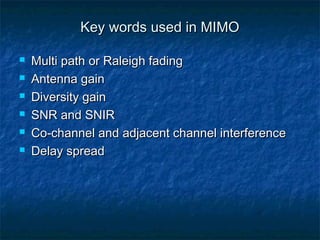
Key words used in MIMO







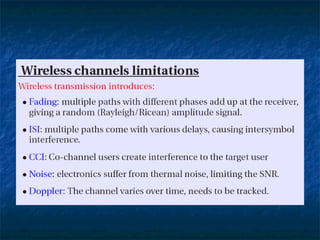
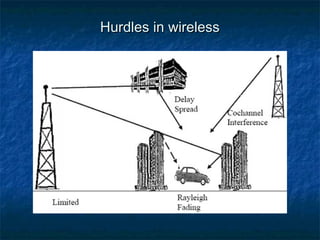
Multi path or Raleigh fading
Antenna gain
Diversity gain
SNR and SNIR
Co-channel and adjacent channel interference
Delay spread
Hurdles in wireless
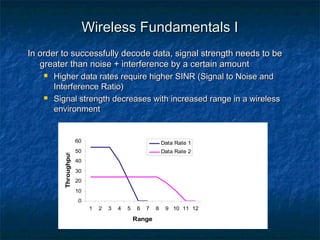
Wireless Fundamentals I
In order to successfully decode data, signal strength needs to be
greater than noise + interference by a certain amount



Higher data rates require higher SINR (Signal to Noise and
Interference Ratio)
Signal strength decreases with increased range in a wireless
environment

60

Throughput



Data Rate 1

50

Data Rate 2

40
30
20
10
0
1

2

3

4

5

6

7

Range

8

9 10 11 12
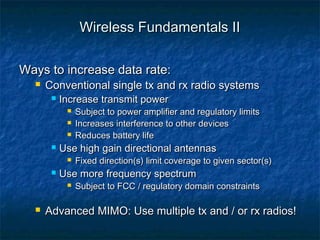
Wireless Fundamentals II
Ways to increase data rate:


Conventional single tx and rx radio systems


Increase transmit power






Use high gain directional antennas




Fixed direction(s) limit coverage to given sector(s)

Use more frequency spectrum




Subject to power amplifier and regulatory limits
Increases interference to other devices
Reduces battery life

Subject to FCC / regulatory domain constraints

Advanced MIMO: Use multiple tx and / or rx radios!
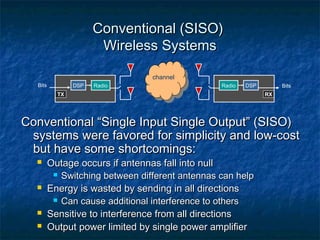
Conventional (SISO)
Wireless Systems
channel
Bits

DSP

Radio

Radio

DSP

TX

Bits
RX

Conventional “Single Input Single Output” (SISO)
systems were favored for simplicity and low-cost
but have some shortcomings:







Outage occurs if antennas fall into null
 Switching between different antennas can help
Energy is wasted by sending in all directions
 Can cause additional interference to others
Sensitive to interference from all directions
Output power limited by single power amplifier
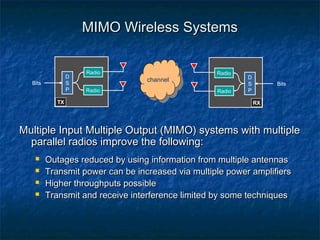
MIMO Wireless Systems

D
S
P

Bits
TX

Radio
Radio

channel

Radio
Radio

D
S
P

Bits
RX

Multiple Input Multiple Output (MIMO) systems with multiple
parallel radios improve the following:





Outages reduced by using information from multiple antennas
Transmit power can be increased via multiple power amplifiers
Higher throughputs possible
Transmit and receive interference limited by some techniques
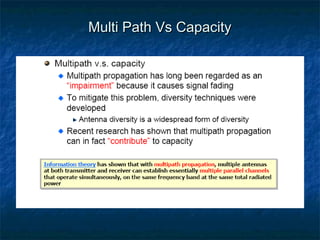
Multi Path Vs Capacity
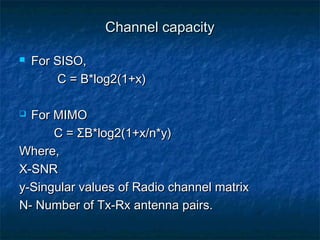
Channel capacity


For SISO,
C = B*log2(1+x)

For MIMO
C = ΣB*log2(1+x/n*y)
Where,
X-SNR
y-Singular values of Radio channel matrix
N- Number of Tx-Rx antenna pairs.

MIMO Techniques
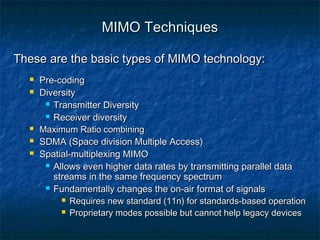
These are the basic types of MIMO technology:








Pre-coding
Diversity
 Transmitter Diversity
 Receiver diversity
Maximum Ratio combining
SDMA (Space division Multiple Access)
Spatial-multiplexing MIMO
 Allows even higher data rates by transmitting parallel data
streams in the same frequency spectrum
 Fundamentally changes the on-air format of signals
 Requires new standard (11n) for standards-based operation
 Proprietary modes possible but cannot help legacy devices
PRE-CODING






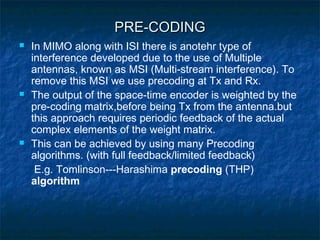
In MIMO along with ISI there is anotehr type of
interference developed due to the use of Multiple
antennas, known as MSI (Multi-stream interference). To
remove this MSI we use precoding at Tx and Rx.
The output of the space-time encoder is weighted by the
pre-coding matrix,before being Tx from the antenna.but
this approach requires periodic feedback of the actual
complex elements of the weight matrix.
This can be achieved by using many Precoding
algorithms. (with full feedback/limited feedback)
E.g. Tomlinson---Harashima precoding (THP)
algorithm
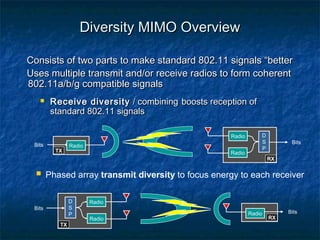
Diversity MIMO Overview
Consists of two parts to make standard 802.11 signals “better
Uses multiple transmit and/or receive radios to form coherent
802.11a/b/g compatible signals


Receive diversity / combining boosts reception of
standard 802.11 signals
Radio

Bits

TX

Radio
Radio

D
S
P

Bits
RX

 Phased array transmit diversity to focus energy to each receiver
D
S
P

Bits
TX

Radio
Radio

Radio

RX

Bits
Diversity in Detail









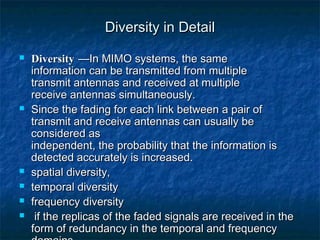
Diversity —In MIMO systems, the same
information can be transmitted from multiple
transmit antennas and received at multiple
receive antennas simultaneously.
Since the fading for each link between a pair of
transmit and receive antennas can usually be
considered as
independent, the probability that the information is
detected accurately is increased.
spatial diversity,
temporal diversity
frequency diversity
if the replicas of the faded signals are received in the
form of redundancy in the temporal and frequency




The simplest way of achieving the diversity in MIMO
systems is through repetition coding that sends the same
information symbol at different time slots from different
Tx antennas.
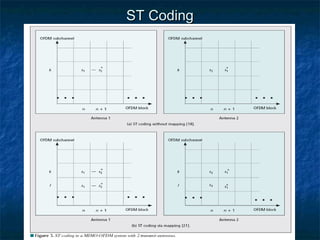
A more BW Efficient coding is ST coding, where a block
of different symbols are Tx in a different order from each
antenna.
Spatial Multiplexing




It is widely recognized that the capacity of a MIMO
system is much higher than a single-antenna system.
For a rich scattering environment , in a MIMO system
with Mt transmit antennas and Mr receive antennas, the
capacity will grow proportionally with min(Mt,Mr).MIMO
systems provide more spatial freedoms or spatial
multiplexing, so that different information can be Tx
simultaneously over multiple antennas, thereby boosting
the system throughput.
SM needs a dedicated algorithm at the Rx to sort out the
Rx signals. E.g. V-BLAST.
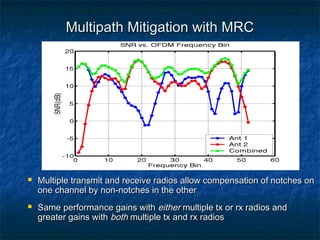
Multipath Mitigation with MRC





Multiple transmit and receive radios allow compensation of notches on
one channel by non-notches in the other
Same performance gains with either multiple tx or rx radios and
greater gains with both multiple tx and rx radios
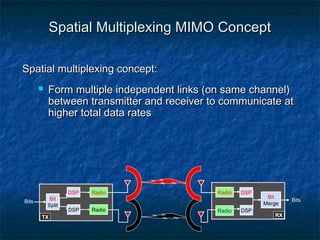
Spatial Multiplexing MIMO Concept
Spatial multiplexing concept:


Form multiple independent links (on same channel)
between transmitter and receiver to communicate at
higher total data rates

DSP
Bits

Bit
Split
TX

DSP

Radio
Radio

Radio
Radio

DSP
DSP

Bit
Merge
RX

Bits
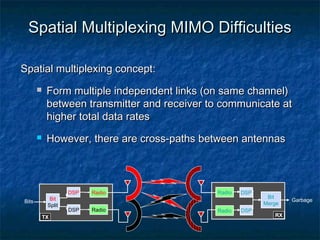
Spatial Multiplexing MIMO Difficulties
Spatial multiplexing concept:




Form multiple independent links (on same channel)
between transmitter and receiver to communicate at
higher total data rates
However, there are cross-paths between antennas

DSP
Bits

Bit
Split
TX

DSP

Radio
Radio

Radio
Radio

DSP
DSP

Bit
Merge
RX

Garbage
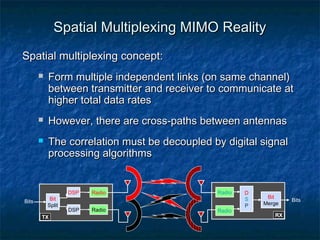
Spatial Multiplexing MIMO Reality
Spatial multiplexing concept:





Form multiple independent links (on same channel)
between transmitter and receiver to communicate at
higher total data rates
However, there are cross-paths between antennas
The correlation must be decoupled by digital signal
processing algorithms

DSP
Bits

Bit
Split
TX

DSP

Radio
Radio

Radio
Radio

D
S
P

Bit
Merge
RX

Bits
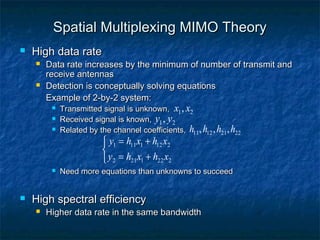
Spatial Multiplexing MIMO Theory


High data rate




Data rate increases by the minimum of number of transmit and
receive antennas
Detection is conceptually solving equations
Example of 2-by-2 system:




Transmitted signal is unknown, x1 , x2
Received signal is known, y1 , y2
Related by the channel coefficients, h11 , h12 , h21 , h22

 y1 = h11x1 + h12 x2

 y2 = h21x1 + h22 x2





Need more equations than unknowns to succeed

High spectral efficiency


Higher data rate in the same bandwidth
Trade-off b/w Diversity and spatial
Multiplexing




Depending on the channel conditions and type
of clients you have u can go for either
diversity/SM.
But there are some grouping techniques at the
Rx using which we achieve optimal diversitymultiplexing trade off. E.g. GZF (ZF+ML) and
,GSIC (Interference Cancellation+ML) and LAST
(Lattice space-time coding/decoding).
Different Implementations of spatial
Multiplexing




Vertical encoding
Horizontal encoding
Vertical Bell Labs Layered Space time
architecture (V-BLAST)
Space Time Coding in MIMO





A space–time code (STC) is a method employed to
improve the reliability of data transmission in wireless
communication systems using multiple transmit
antennas. STCs rely on transmitting multiple,
redundant copies of a data stream to the receiver in
the hope that at least some of them may survive the
physical path between transmission and reception in a
good enough state to allow reliable decoding.
Space time codes may be split into two main types:
Space–time trellis codes (STTCs) distribute a trellis
code over multiple antennas and multiple time-slots
and provide both coding gain and diversity gain.








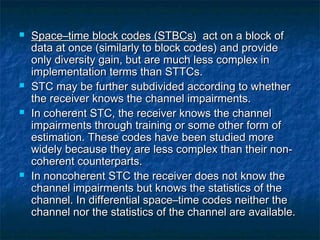
Space–time block codes (STBCs) act on a block of
data at once (similarly to block codes) and provide
only diversity gain, but are much less complex in
implementation terms than STTCs.
STC may be further subdivided according to whether
the receiver knows the channel impairments.
In coherent STC, the receiver knows the channel
impairments through training or some other form of
estimation. These codes have been studied more
widely because they are less complex than their noncoherent counterparts.
In noncoherent STC the receiver does not know the
channel impairments but knows the statistics of the
channel. In differential space–time codes neither the
channel nor the statistics of the channel are available.
ST Coding
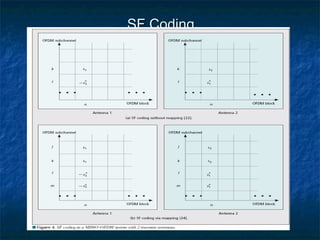
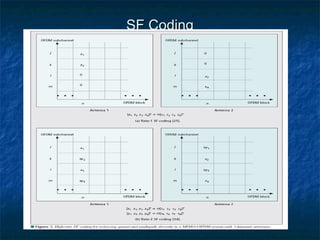
SF Coding
SF Coding
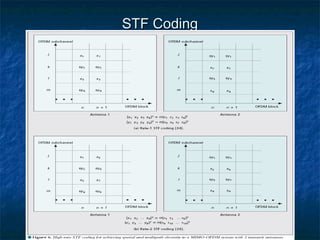
STF Coding
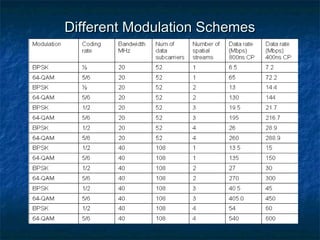
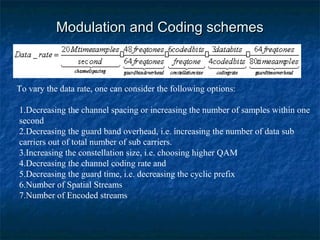
Modulation and Coding schemes

To vary the data rate, one can consider the following options:
1.Decreasing the channel spacing or increasing the number of samples within one
second
2.Decreasing the guard band overhead, i.e. increasing the number of data sub
carriers out of total number of sub carriers.
3.Increasing the constellation size, i.e. choosing higher QAM
4.Decreasing the channel coding rate and
5.Decreasing the guard time, i.e. decreasing the cyclic prefix
6.Number of Spatial Streams
7.Number of Encoded streams
Different Modulation Schemes
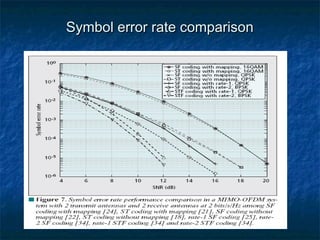
Symbol error rate comparison
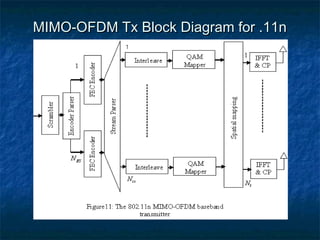
MIMO-OFDM Tx Block Diagram for .11n
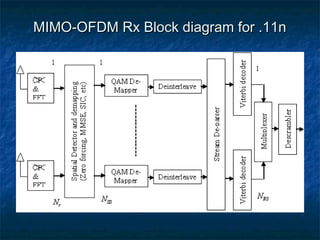
MIMO-OFDM Rx Block diagram for .11n
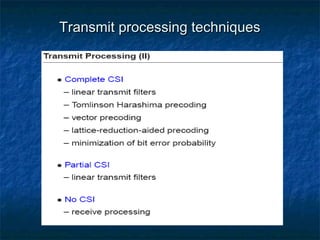
Transmit processing techniques
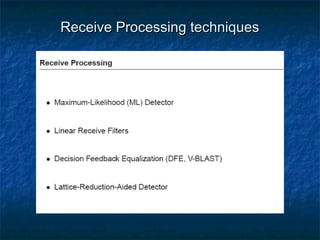
Receive Processing techniques
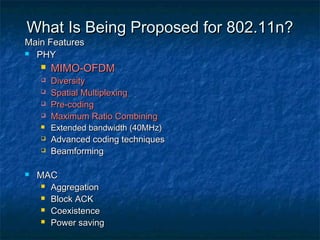
What Is Being Proposed for 802.11n?

Main Features
 PHY












MIMO-OFDM

Diversity
Spatial Multiplexing
Pre-coding
Maximum Ratio Combining

Extended bandwidth (40MHz)

Advanced coding techniques
Beamforming

MAC
 Aggregation
 Block ACK
 Coexistence
 Power saving
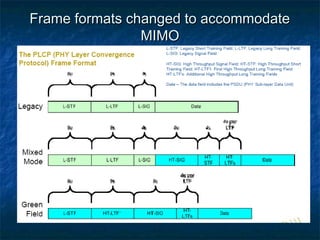
Frame formats changed to accommodate
MIMO
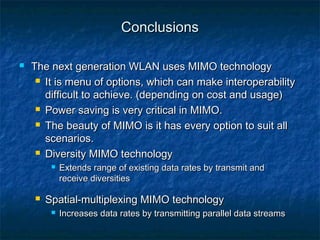
Conclusions


The next generation WLAN uses MIMO technology
 It is menu of options, which can make interoperability
difficult to achieve. (depending on cost and usage)
 Power saving is very critical in MIMO.
 The beauty of MIMO is it has every option to suit all
scenarios.
 Diversity MIMO technology




Extends range of existing data rates by transmit and
receive diversities

Spatial-multiplexing MIMO technology


Increases data rates by transmitting parallel data streams
Destiny is no matter of chance, it is a matter of
choice. It is not a thing to be waited for, it is a
thing to be achieved
Queries?

MIMO in 15 minutes

  • 1.
    Use of MIMOin 802.11n By Chaitanya T K Email:tkchaitanya@tataelxsi.co.in
  • 2.
    When you arein light, Everything will follow you...... But when you enter dark, Even your shadow will not follow you...... This is LIFE!!! Enjoy!!!
  • 3.
    Objectives This presentation willgive an overview of MIMO technology and its future in Wireless LAN:  History of MIMO  Understanding the Key words  What is MIMO?  Different Techniques used in MIMO  MIMO-OFDM  MIMO Applications  How it is useful in 802.11n?
  • 4.
    The Wireless LANExplosion The Wireless LAN / Wi-Fi market has exploded! New technology is enabling new applications: Office Home “Hot-spots” Email / Info anywhere Voice over IP Internet everywhere Multimedia Hot-spot coverage Metro-Area Networks
  • 5.
    Wireless LAN TechnologyAdvances Wireless LAN technology has seen rapid advancements      Standards: 802.11 → .11b → .11a → .11g → .11n Data rates: 2Mbps → 100+ Mbps Range / coverage: Meters → kilometers Integration: Multiple discretes → single chip solutions Cost: $100’s → $10’s (sometimes free w/rebates!) How can this growth continue?  Previous advances have been limited to a single  transmitting and receiving radio The next generation exploits multiple parallel radios using revolutionary class of techniques called MIMO (Multiple Input Multiple Output) to send information farther and faster
  • 6.
    Existing 802.11 WLANStandards 802.11b 802.11a 802.11g 802.11n Standard Approved Sept. 1999 Sept. 1999 June 2003 ? Available Bandwidth 83.5 MHz 580 MHz 83.5 MHz 83.5/580 MHz 2.4 GHz 5 GHz 2.4 GHz 2.4/5 GHz 3 24 3 3/24 1 – 11 Mbps 6 – 54 Mbps 1 – 54 Mbps 1 – 600 Mbps OFDM DSSS, CCK, OFDM DSSS, CCK, OFDM, MIMO Frequency Band of Operation # Non-Overlapping Channels (US) Data Rate per Channel Modulation Type DSSS, CCK
  • 7.
    Key words usedin MIMO       Multi path or Raleigh fading Antenna gain Diversity gain SNR and SNIR Co-channel and adjacent channel interference Delay spread
  • 10.
  • 11.
    Wireless Fundamentals I Inorder to successfully decode data, signal strength needs to be greater than noise + interference by a certain amount  Higher data rates require higher SINR (Signal to Noise and Interference Ratio) Signal strength decreases with increased range in a wireless environment 60 Throughput  Data Rate 1 50 Data Rate 2 40 30 20 10 0 1 2 3 4 5 6 7 Range 8 9 10 11 12
  • 12.
    Wireless Fundamentals II Waysto increase data rate:  Conventional single tx and rx radio systems  Increase transmit power     Use high gain directional antennas   Fixed direction(s) limit coverage to given sector(s) Use more frequency spectrum   Subject to power amplifier and regulatory limits Increases interference to other devices Reduces battery life Subject to FCC / regulatory domain constraints Advanced MIMO: Use multiple tx and / or rx radios!
  • 13.
    Conventional (SISO) Wireless Systems channel Bits DSP Radio Radio DSP TX Bits RX Conventional“Single Input Single Output” (SISO) systems were favored for simplicity and low-cost but have some shortcomings:     Outage occurs if antennas fall into null  Switching between different antennas can help Energy is wasted by sending in all directions  Can cause additional interference to others Sensitive to interference from all directions Output power limited by single power amplifier
  • 14.
    MIMO Wireless Systems D S P Bits TX Radio Radio channel Radio Radio D S P Bits RX MultipleInput Multiple Output (MIMO) systems with multiple parallel radios improve the following:     Outages reduced by using information from multiple antennas Transmit power can be increased via multiple power amplifiers Higher throughputs possible Transmit and receive interference limited by some techniques
  • 15.
    Multi Path VsCapacity
  • 17.
    Channel capacity  For SISO, C= B*log2(1+x) For MIMO C = ΣB*log2(1+x/n*y) Where, X-SNR y-Singular values of Radio channel matrix N- Number of Tx-Rx antenna pairs. 
  • 18.
    MIMO Techniques These arethe basic types of MIMO technology:      Pre-coding Diversity  Transmitter Diversity  Receiver diversity Maximum Ratio combining SDMA (Space division Multiple Access) Spatial-multiplexing MIMO  Allows even higher data rates by transmitting parallel data streams in the same frequency spectrum  Fundamentally changes the on-air format of signals  Requires new standard (11n) for standards-based operation  Proprietary modes possible but cannot help legacy devices
  • 20.
    PRE-CODING    In MIMO alongwith ISI there is anotehr type of interference developed due to the use of Multiple antennas, known as MSI (Multi-stream interference). To remove this MSI we use precoding at Tx and Rx. The output of the space-time encoder is weighted by the pre-coding matrix,before being Tx from the antenna.but this approach requires periodic feedback of the actual complex elements of the weight matrix. This can be achieved by using many Precoding algorithms. (with full feedback/limited feedback) E.g. Tomlinson---Harashima precoding (THP) algorithm
  • 21.
    Diversity MIMO Overview Consistsof two parts to make standard 802.11 signals “better Uses multiple transmit and/or receive radios to form coherent 802.11a/b/g compatible signals  Receive diversity / combining boosts reception of standard 802.11 signals Radio Bits TX Radio Radio D S P Bits RX  Phased array transmit diversity to focus energy to each receiver D S P Bits TX Radio Radio Radio RX Bits
  • 22.
    Diversity in Detail       Diversity—In MIMO systems, the same information can be transmitted from multiple transmit antennas and received at multiple receive antennas simultaneously. Since the fading for each link between a pair of transmit and receive antennas can usually be considered as independent, the probability that the information is detected accurately is increased. spatial diversity, temporal diversity frequency diversity if the replicas of the faded signals are received in the form of redundancy in the temporal and frequency
  • 23.
      The simplest wayof achieving the diversity in MIMO systems is through repetition coding that sends the same information symbol at different time slots from different Tx antennas. A more BW Efficient coding is ST coding, where a block of different symbols are Tx in a different order from each antenna.
  • 24.
    Spatial Multiplexing   It iswidely recognized that the capacity of a MIMO system is much higher than a single-antenna system. For a rich scattering environment , in a MIMO system with Mt transmit antennas and Mr receive antennas, the capacity will grow proportionally with min(Mt,Mr).MIMO systems provide more spatial freedoms or spatial multiplexing, so that different information can be Tx simultaneously over multiple antennas, thereby boosting the system throughput. SM needs a dedicated algorithm at the Rx to sort out the Rx signals. E.g. V-BLAST.
  • 25.
    Multipath Mitigation withMRC   Multiple transmit and receive radios allow compensation of notches on one channel by non-notches in the other Same performance gains with either multiple tx or rx radios and greater gains with both multiple tx and rx radios
  • 26.
    Spatial Multiplexing MIMOConcept Spatial multiplexing concept:  Form multiple independent links (on same channel) between transmitter and receiver to communicate at higher total data rates DSP Bits Bit Split TX DSP Radio Radio Radio Radio DSP DSP Bit Merge RX Bits
  • 27.
    Spatial Multiplexing MIMODifficulties Spatial multiplexing concept:   Form multiple independent links (on same channel) between transmitter and receiver to communicate at higher total data rates However, there are cross-paths between antennas DSP Bits Bit Split TX DSP Radio Radio Radio Radio DSP DSP Bit Merge RX Garbage
  • 28.
    Spatial Multiplexing MIMOReality Spatial multiplexing concept:    Form multiple independent links (on same channel) between transmitter and receiver to communicate at higher total data rates However, there are cross-paths between antennas The correlation must be decoupled by digital signal processing algorithms DSP Bits Bit Split TX DSP Radio Radio Radio Radio D S P Bit Merge RX Bits
  • 29.
    Spatial Multiplexing MIMOTheory  High data rate   Data rate increases by the minimum of number of transmit and receive antennas Detection is conceptually solving equations Example of 2-by-2 system:    Transmitted signal is unknown, x1 , x2 Received signal is known, y1 , y2 Related by the channel coefficients, h11 , h12 , h21 , h22  y1 = h11x1 + h12 x2   y2 = h21x1 + h22 x2   Need more equations than unknowns to succeed High spectral efficiency  Higher data rate in the same bandwidth
  • 30.
    Trade-off b/w Diversityand spatial Multiplexing   Depending on the channel conditions and type of clients you have u can go for either diversity/SM. But there are some grouping techniques at the Rx using which we achieve optimal diversitymultiplexing trade off. E.g. GZF (ZF+ML) and ,GSIC (Interference Cancellation+ML) and LAST (Lattice space-time coding/decoding).
  • 31.
    Different Implementations ofspatial Multiplexing    Vertical encoding Horizontal encoding Vertical Bell Labs Layered Space time architecture (V-BLAST)
  • 32.
    Space Time Codingin MIMO    A space–time code (STC) is a method employed to improve the reliability of data transmission in wireless communication systems using multiple transmit antennas. STCs rely on transmitting multiple, redundant copies of a data stream to the receiver in the hope that at least some of them may survive the physical path between transmission and reception in a good enough state to allow reliable decoding. Space time codes may be split into two main types: Space–time trellis codes (STTCs) distribute a trellis code over multiple antennas and multiple time-slots and provide both coding gain and diversity gain.
  • 33.
        Space–time block codes(STBCs) act on a block of data at once (similarly to block codes) and provide only diversity gain, but are much less complex in implementation terms than STTCs. STC may be further subdivided according to whether the receiver knows the channel impairments. In coherent STC, the receiver knows the channel impairments through training or some other form of estimation. These codes have been studied more widely because they are less complex than their noncoherent counterparts. In noncoherent STC the receiver does not know the channel impairments but knows the statistics of the channel. In differential space–time codes neither the channel nor the statistics of the channel are available.
  • 34.
  • 35.
  • 36.
  • 37.
  • 38.
    Modulation and Codingschemes To vary the data rate, one can consider the following options: 1.Decreasing the channel spacing or increasing the number of samples within one second 2.Decreasing the guard band overhead, i.e. increasing the number of data sub carriers out of total number of sub carriers. 3.Increasing the constellation size, i.e. choosing higher QAM 4.Decreasing the channel coding rate and 5.Decreasing the guard time, i.e. decreasing the cyclic prefix 6.Number of Spatial Streams 7.Number of Encoded streams
  • 39.
  • 40.
  • 41.
    MIMO-OFDM Tx BlockDiagram for .11n
  • 42.
    MIMO-OFDM Rx Blockdiagram for .11n
  • 43.
  • 44.
  • 45.
    What Is BeingProposed for 802.11n? Main Features  PHY          MIMO-OFDM Diversity Spatial Multiplexing Pre-coding Maximum Ratio Combining Extended bandwidth (40MHz) Advanced coding techniques Beamforming MAC  Aggregation  Block ACK  Coexistence  Power saving
  • 46.
    Frame formats changedto accommodate MIMO
  • 47.
    Conclusions  The next generationWLAN uses MIMO technology  It is menu of options, which can make interoperability difficult to achieve. (depending on cost and usage)  Power saving is very critical in MIMO.  The beauty of MIMO is it has every option to suit all scenarios.  Diversity MIMO technology   Extends range of existing data rates by transmit and receive diversities Spatial-multiplexing MIMO technology  Increases data rates by transmitting parallel data streams
  • 48.
    Destiny is nomatter of chance, it is a matter of choice. It is not a thing to be waited for, it is a thing to be achieved
  • 49.