1
AJAL.A.J
Assistant Professor –Dept of ECE,
Federal Institute of Science And Technology (FISAT) TM  
MAIL: ec2reach@gmail.com
08/01/14 2
Spread Spectrum
Spread spectrum is a communication technique that
spreads a narrowband communication signal over a wide range
of frequencies for transmission then de-spreads it into the
original data bandwidth at the receive.
 Spread spectrum is characterized by:
wide bandwidth and
low power
Jamming and interference have less effect on Spread
spectrum because it is:
Resembles noise
Hard to detect
Hard to intercept
08/01/14 3
4
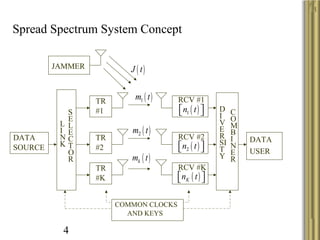
Spread Spectrum System Concept
DATA
SOURCE
JAMMER
L
I
N
K
S
E
L
E
C
T
O
R
TR
#1
TR
#2
TR
#K
COMMON CLOCKS
AND KEYS
RCV #1
RCV #2
RCV #K
D
I
V
E
R
SI
T
Y
C
O
M
B
I
N
E
R
DATA
USER
( )1n t  
( )2n t  
( )Kn t  
( )km t
( )2m t
( )1m t
( )J t
08/01/14 5
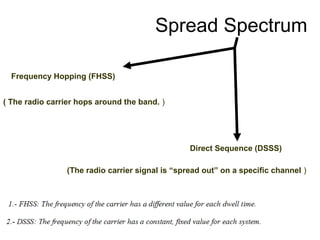
(The radio carrier signal is “spread out” on a specific channel )
Spread Spectrum
Frequency Hopping (FHSS)
( The radio carrier hops around the band. )
Direct Sequence (DSSS)
08/01/14 6
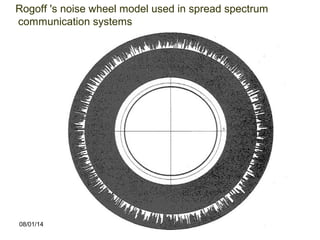
Rogoff 's noise wheel model used in spread spectrum
communication systems
08/01/14 7
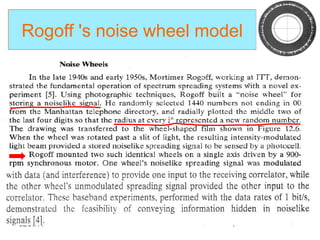
Rogoff 's noise wheel model
8
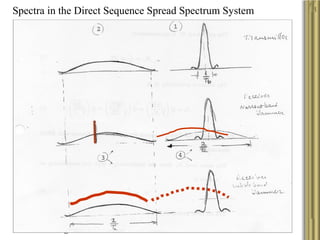
Spectra in the Direct Sequence Spread Spectrum System
08/01/14 9
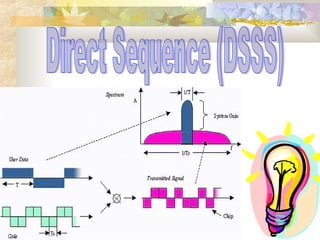
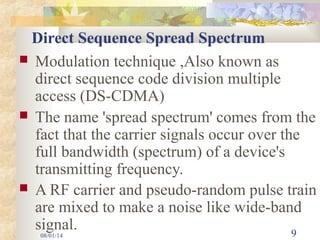
Direct Sequence Spread Spectrum
 Modulation technique ,Also known as
direct sequence code division multiple
access (DS-CDMA)
 The name 'spread spectrum' comes from the
fact that the carrier signals occur over the
full bandwidth (spectrum) of a device's
transmitting frequency.
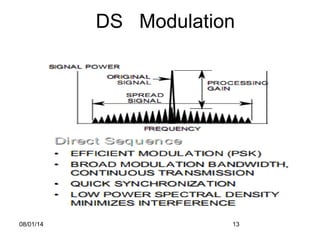
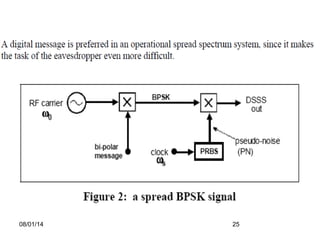
 A RF carrier and pseudo-random pulse train
are mixed to make a noise like wide-band
signal.
08/01/14 10
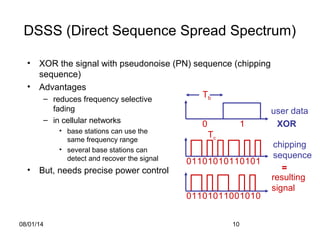
DSSS (Direct Sequence Spread Spectrum)
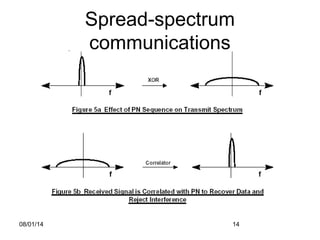
• XOR the signal with pseudonoise (PN) sequence (chipping
sequence)
• Advantages
– reduces frequency selective
fading
– in cellular networks
• base stations can use the
same frequency range
• several base stations can
detect and recover the signal
• But, needs precise power control
user data
chipping
sequence
resulting
signal
0 1
0 1 10 1 0101 0 0 1 11
XOR
0 1 10 0 1011 0 1 0 01
=
Tb
Tc
08/01/14 11
user data
m(t)
chipping
sequence, c(t)
X
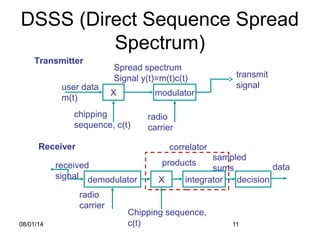
DSSS (Direct Sequence Spread
Spectrum)
modulator
radio
carrier
Spread spectrum
Signal y(t)=m(t)c(t) transmit
signal
Transmitter
demodulator
received
signal
radio
carrier
X
Chipping sequence,
c(t)
Receiver
integrator
products
decision
data
sampled
sums
correlator
12
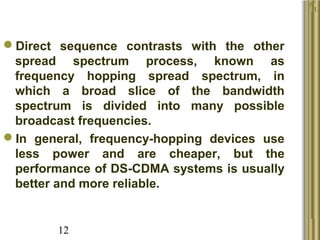
Direct  sequence  contrasts  with  the  other 
spread  spectrum  process,  known  as 
frequency  hopping  spread  spectrum,  in 
which  a  broad  slice  of  the  bandwidth 
spectrum  is  divided  into  many  possible 
broadcast frequencies. 
In  general,  frequency-hopping  devices  use 
less  power  and  are  cheaper,  but  the 
performance of DS-CDMA systems is usually 
better and more reliable. 
08/01/14 13
DS Modulation
08/01/14 14
Spread-spectrum
communications
08/01/14 15
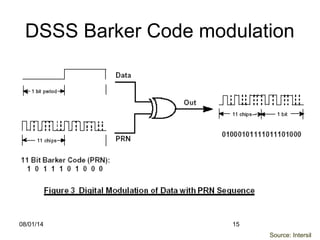
DSSS Barker Code modulation
Source: Intersil
08/01/14 16
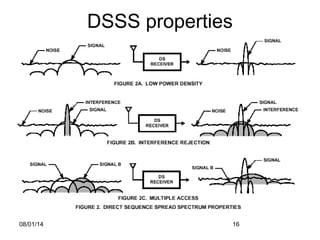
DSSS properties
08/01/14 17
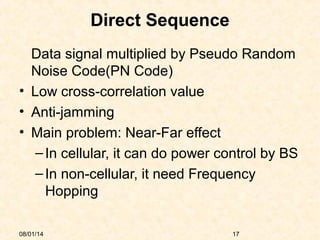
Direct Sequence
Data signal multiplied by Pseudo Random
Noise Code(PN Code)
• Low cross-correlation value
• Anti-jamming
• Main problem: Near-Far effect
–In cellular, it can do power control by BS
–In non-cellular, it need Frequency
Hopping
08/01/14 18
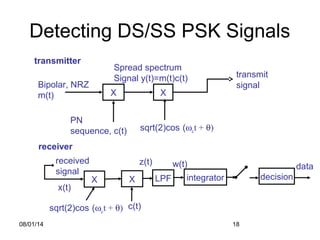
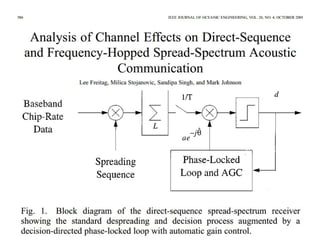
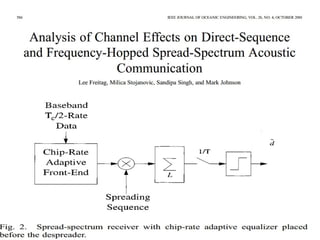
Detecting DS/SS PSK Signals
X
Bipolar, NRZ
m(t)
PN
sequence, c(t)
X
sqrt(2)cos(ωct + θ)
Spread spectrum
Signal y(t)=m(t)c(t) transmit
signal
transmitter
X
received
signal
X
c(t)
receiver
integrator
z(t)
decision
data
sqrt(2)cos(ωct + θ)
LPF
w(t)
x(t)
08/01/14 19
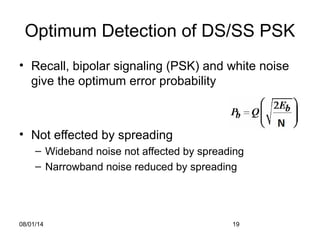
Optimum Detection of DS/SS PSK
• Recall, bipolar signaling (PSK) and white noise
give the optimum error probability
• Not effected by spreading
– Wideband noise not affected by spreading
– Narrowband noise reduced by spreading
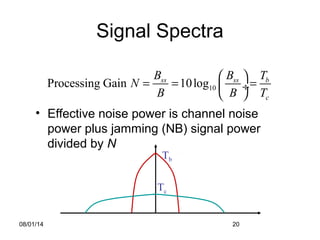
08/01/14 20
Signal Spectra
• Effective noise power is channel noise
power plus jamming (NB) signal power
divided by N
10Processing Gain 10logss ss b
c
B B T
N
B B T
 
= = = ÷
 
Tb
Tc
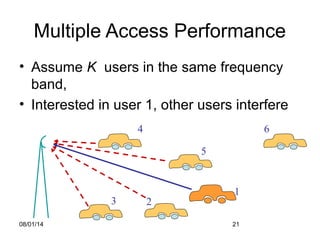
08/01/14 21
Multiple Access Performance
• Assume K users in the same frequency
band,
• Interested in user 1, other users interfere
4
1
3
5
2
6
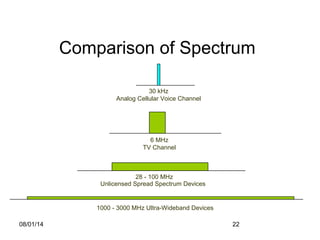
08/01/14 22
Comparison of Spectrum
30 kHz
Analog Cellular Voice Channel
6 MHz
TV Channel
28 - 100 MHz
Unlicensed Spread Spectrum Devices
1000 - 3000 MHz Ultra-Wideband Devices
08/01/14 23
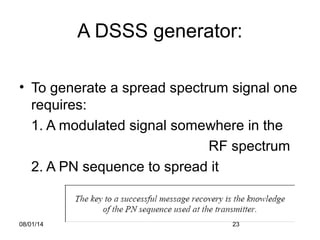
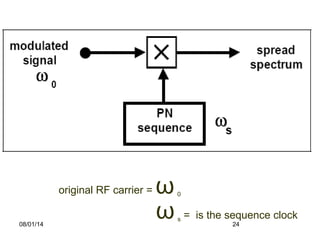
A DSSS generator:
• To generate a spread spectrum signal one
requires:
1. A modulated signal somewhere in the
RF spectrum
2. A PN sequence to spread it
08/01/14 24
original RF carrier = ω0
ωs = is the sequence clock
08/01/14 25
08/01/14 26
08/01/14 27
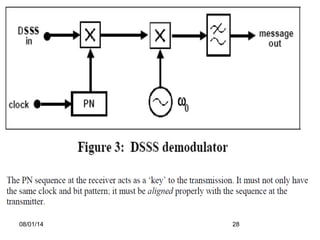
08/01/14 28
08/01/14 29
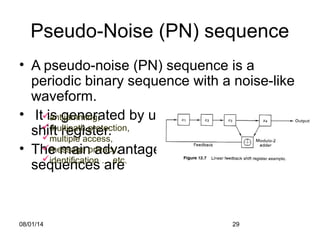
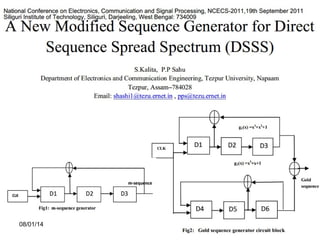
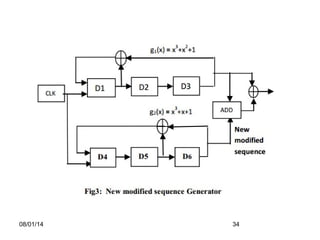
Pseudo-Noise (PN) sequence
• A pseudo-noise (PN) sequence is a
periodic binary sequence with a noise-like
waveform.
• It is generated by using linear feedback
shift register.
• The main advantages of using PN
sequences are
antijamming,
multipath protection,
multiple access,
message privacy,
identification … etc.
08/01/14 30
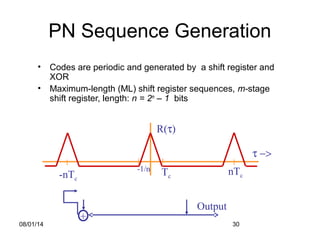
PN Sequence Generation
• Codes are periodic and generated by a shift register and
XOR
• Maximum-length (ML) shift register sequences, m-stage
shift register, length: n = 2m
– 1 bits
R(τ)
-1/n
Tc
τ −>
-nTc
nTc
+
Output
31RF - Cellcom courseDr. Moshe Ran08/01/14
Generating PN Sequences
• Take m=2 =>L=3
• cn=[1,1,0,1,1,0, . . .],
usually written as
bipolar cn=[1,1,-1,1,1,-1,
. . .]
m Stages connected
to modulo-2 adder
2 1,2
3 1,3
4 1,4
5 1,4
6 1,6
8 1,5,6,7
+
Output
( )



−≤≤−
=
=
= ∑=
+
11/1
01
1
1
LmL
m
cc
L
mR
L
n
mnnc
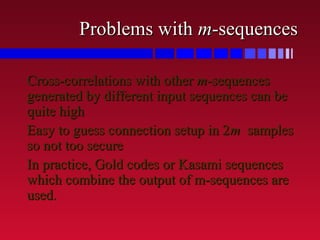
Problems withProblems with mm-sequences-sequences
Cross-correlations with otherCross-correlations with other mm-sequences-sequences
generated by different input sequences can begenerated by different input sequences can be
quite highquite high
Easy to guess connection setup in 2Easy to guess connection setup in 2mm samplessamples
so not too secureso not too secure
In practice, Gold codes or Kasami sequencesIn practice, Gold codes or Kasami sequences
which combine the output of m-sequences arewhich combine the output of m-sequences are
used.used.
08/01/14 33
08/01/14 34
08/01/14 35
08/01/14 36
08/01/14 37
08/01/14 38
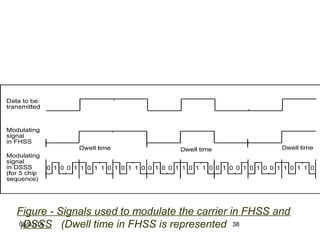
Figure - Signals used to modulate the carrier in FHSS and
DSSS (Dwell time in FHSS is represented)
08/01/14 39
Systems Behavior
• The following issues will be studied in
parallel for FHSS and DSSS systems:
1.- Systems Collocation
2.- Noise and Interference Immunity
3.- The Near / Far problem
4.- Multipath Immunity
5.- Time and frequency diversity
6.- Throughput
7.- Security
8.- Bluetooth interference
08/01/14 40
1.- Systems Collocation
• The issue: How many independent
systems may operate simultaneously
without interference?
In DSSS systems, collocation could be based
on the use of different spreading codes (sequences(
for each active system
08/01/14 41
2.- Noise and Interference
Immunity
• The issue: Capability of the system to operate
without errors when other radio signals are
present in the same band.
• FHSS systems operate with SNR (Signal to
Noise Ratio) of about 18 dB.
• DSSS systems, because of the more
efficient modulation technique used (PSK), can
operate with SNR as low as 12 dB.
08/01/14 42
3.- Near / Far problem
• The issue: The problems generated to a
FH / D SSS receiver by other active
transmitters located in its proximity, are
known as Near / Far problems.
08/01/14 43
4.- Multipath
• The issue: Environments with reflective
surfaces (such as buildings, office walls,
etc.) generate multiple possible paths
between transmitter and receiver and
therefore the receiver receives multiple
copies of the original (transmitted) signal.
08/01/14 44
5.- Time and frequency diversity
• Both DSSS and FHSS retransmit lost
packets, until the receiving part
acknowledges correct reception. A packet
could be lost because of noises
FHSS systems use “frequency diversity" .
)packets are retransmitted on different frequencies /
hops(.
08/01/14 45
6.- Throughput
• The issue: What amount of data is actually
carried by the system (measured in bps).
6.1.- Single system throughput
6.2.-Aggregate throughput of collocated systems
08/01/14 46
7.- Security
• The issue: Protecting the transmission
against eavesdropping
08/01/14 47
8.- Bluetooth interference
• FHSS are significantly less sensitive to
Bluetooth interference.
48
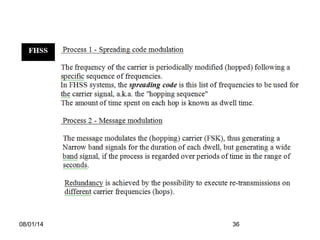
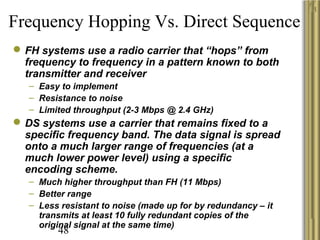
Frequency Hopping Vs. Direct Sequence
FH systems use a radio carrier that “hops” from
frequency to frequency in a pattern known to both
transmitter and receiver
– Easy to implement
– Resistance to noise
– Limited throughput (2-3 Mbps @ 2.4 GHz)
DS systems use a carrier that remains fixed to a
specific frequency band. The data signal is spread
onto a much larger range of frequencies (at a
much lower power level) using a specific
encoding scheme.
– Much higher throughput than FH (11 Mbps)
– Better range
– Less resistant to noise (made up for by redundancy – it
transmits at least 10 fully redundant copies of the
original signal at the same time)
08/01/14 49

Dsss final

  • 1.
    1 AJAL.A.J Assistant Professor –Deptof ECE, Federal Institute of Science And Technology (FISAT) TM   MAIL: ec2reach@gmail.com
  • 2.
    08/01/14 2 Spread Spectrum Spread spectrum isa communication technique that spreads a narrowband communication signal over a wide range of frequencies for transmission then de-spreads it into the original data bandwidth at the receive.  Spread spectrum is characterized by: wide bandwidth and low power Jamming and interference have less effect on Spread spectrum because it is: Resembles noise Hard to detect Hard to intercept
  • 3.
  • 4.
    4 Spread Spectrum SystemConcept DATA SOURCE JAMMER L I N K S E L E C T O R TR #1 TR #2 TR #K COMMON CLOCKS AND KEYS RCV #1 RCV #2 RCV #K D I V E R SI T Y C O M B I N E R DATA USER ( )1n t   ( )2n t   ( )Kn t   ( )km t ( )2m t ( )1m t ( )J t
  • 5.
    08/01/14 5 (The radio carrier signal is “spread out” on a specific channel ) SpreadSpectrum Frequency Hopping (FHSS) ( The radio carrier hops around the band. ) Direct Sequence (DSSS)
  • 6.
    08/01/14 6 Rogoff 'snoise wheel model used in spread spectrum communication systems
  • 7.
    08/01/14 7 Rogoff 'snoise wheel model
  • 8.
    8 Spectra in theDirect Sequence Spread Spectrum System
  • 9.
    08/01/14 9 Direct SequenceSpread Spectrum  Modulation technique ,Also known as direct sequence code division multiple access (DS-CDMA)  The name 'spread spectrum' comes from the fact that the carrier signals occur over the full bandwidth (spectrum) of a device's transmitting frequency.  A RF carrier and pseudo-random pulse train are mixed to make a noise like wide-band signal.
  • 10.
    08/01/14 10 DSSS (DirectSequence Spread Spectrum) • XOR the signal with pseudonoise (PN) sequence (chipping sequence) • Advantages – reduces frequency selective fading – in cellular networks • base stations can use the same frequency range • several base stations can detect and recover the signal • But, needs precise power control user data chipping sequence resulting signal 0 1 0 1 10 1 0101 0 0 1 11 XOR 0 1 10 0 1011 0 1 0 01 = Tb Tc
  • 11.
    08/01/14 11 user data m(t) chipping sequence,c(t) X DSSS (Direct Sequence Spread Spectrum) modulator radio carrier Spread spectrum Signal y(t)=m(t)c(t) transmit signal Transmitter demodulator received signal radio carrier X Chipping sequence, c(t) Receiver integrator products decision data sampled sums correlator
  • 12.
    12 Direct  sequence  contrasts with  the  other  spread  spectrum  process,  known  as  frequency  hopping  spread  spectrum,  in  which  a  broad  slice  of  the  bandwidth  spectrum  is  divided  into  many  possible  broadcast frequencies.  In  general,  frequency-hopping  devices  use  less  power  and  are  cheaper,  but  the  performance of DS-CDMA systems is usually  better and more reliable. 
  • 13.
  • 14.
  • 15.
    08/01/14 15 DSSS BarkerCode modulation Source: Intersil
  • 16.
  • 17.
    08/01/14 17 Direct Sequence Datasignal multiplied by Pseudo Random Noise Code(PN Code) • Low cross-correlation value • Anti-jamming • Main problem: Near-Far effect –In cellular, it can do power control by BS –In non-cellular, it need Frequency Hopping
  • 18.
    08/01/14 18 Detecting DS/SSPSK Signals X Bipolar, NRZ m(t) PN sequence, c(t) X sqrt(2)cos(ωct + θ) Spread spectrum Signal y(t)=m(t)c(t) transmit signal transmitter X received signal X c(t) receiver integrator z(t) decision data sqrt(2)cos(ωct + θ) LPF w(t) x(t)
  • 19.
    08/01/14 19 Optimum Detectionof DS/SS PSK • Recall, bipolar signaling (PSK) and white noise give the optimum error probability • Not effected by spreading – Wideband noise not affected by spreading – Narrowband noise reduced by spreading
  • 20.
    08/01/14 20 Signal Spectra •Effective noise power is channel noise power plus jamming (NB) signal power divided by N 10Processing Gain 10logss ss b c B B T N B B T   = = = ÷   Tb Tc
  • 21.
    08/01/14 21 Multiple AccessPerformance • Assume K users in the same frequency band, • Interested in user 1, other users interfere 4 1 3 5 2 6
  • 22.
    08/01/14 22 Comparison ofSpectrum 30 kHz Analog Cellular Voice Channel 6 MHz TV Channel 28 - 100 MHz Unlicensed Spread Spectrum Devices 1000 - 3000 MHz Ultra-Wideband Devices
  • 23.
    08/01/14 23 A DSSSgenerator: • To generate a spread spectrum signal one requires: 1. A modulated signal somewhere in the RF spectrum 2. A PN sequence to spread it
  • 24.
    08/01/14 24 original RFcarrier = ω0 ωs = is the sequence clock
  • 25.
  • 26.
  • 27.
  • 28.
  • 29.
    08/01/14 29 Pseudo-Noise (PN)sequence • A pseudo-noise (PN) sequence is a periodic binary sequence with a noise-like waveform. • It is generated by using linear feedback shift register. • The main advantages of using PN sequences are antijamming, multipath protection, multiple access, message privacy, identification … etc.
  • 30.
    08/01/14 30 PN SequenceGeneration • Codes are periodic and generated by a shift register and XOR • Maximum-length (ML) shift register sequences, m-stage shift register, length: n = 2m – 1 bits R(τ) -1/n Tc τ −> -nTc nTc + Output
  • 31.
    31RF - CellcomcourseDr. Moshe Ran08/01/14 Generating PN Sequences • Take m=2 =>L=3 • cn=[1,1,0,1,1,0, . . .], usually written as bipolar cn=[1,1,-1,1,1,-1, . . .] m Stages connected to modulo-2 adder 2 1,2 3 1,3 4 1,4 5 1,4 6 1,6 8 1,5,6,7 + Output ( )    −≤≤− = = = ∑= + 11/1 01 1 1 LmL m cc L mR L n mnnc
  • 32.
    Problems withProblems withmm-sequences-sequences Cross-correlations with otherCross-correlations with other mm-sequences-sequences generated by different input sequences can begenerated by different input sequences can be quite highquite high Easy to guess connection setup in 2Easy to guess connection setup in 2mm samplessamples so not too secureso not too secure In practice, Gold codes or Kasami sequencesIn practice, Gold codes or Kasami sequences which combine the output of m-sequences arewhich combine the output of m-sequences are used.used.
  • 33.
  • 34.
  • 35.
  • 36.
  • 37.
  • 38.
    08/01/14 38 Figure -Signals used to modulate the carrier in FHSS and DSSS (Dwell time in FHSS is represented)
  • 39.
    08/01/14 39 Systems Behavior •The following issues will be studied in parallel for FHSS and DSSS systems: 1.- Systems Collocation 2.- Noise and Interference Immunity 3.- The Near / Far problem 4.- Multipath Immunity 5.- Time and frequency diversity 6.- Throughput 7.- Security 8.- Bluetooth interference
  • 40.
    08/01/14 40 1.- SystemsCollocation • The issue: How many independent systems may operate simultaneously without interference? In DSSS systems, collocation could be based on the use of different spreading codes (sequences( for each active system
  • 41.
    08/01/14 41 2.- Noiseand Interference Immunity • The issue: Capability of the system to operate without errors when other radio signals are present in the same band. • FHSS systems operate with SNR (Signal to Noise Ratio) of about 18 dB. • DSSS systems, because of the more efficient modulation technique used (PSK), can operate with SNR as low as 12 dB.
  • 42.
    08/01/14 42 3.- Near/ Far problem • The issue: The problems generated to a FH / D SSS receiver by other active transmitters located in its proximity, are known as Near / Far problems.
  • 43.
    08/01/14 43 4.- Multipath •The issue: Environments with reflective surfaces (such as buildings, office walls, etc.) generate multiple possible paths between transmitter and receiver and therefore the receiver receives multiple copies of the original (transmitted) signal.
  • 44.
    08/01/14 44 5.- Timeand frequency diversity • Both DSSS and FHSS retransmit lost packets, until the receiving part acknowledges correct reception. A packet could be lost because of noises FHSS systems use “frequency diversity" . )packets are retransmitted on different frequencies / hops(.
  • 45.
    08/01/14 45 6.- Throughput •The issue: What amount of data is actually carried by the system (measured in bps). 6.1.- Single system throughput 6.2.-Aggregate throughput of collocated systems
  • 46.
    08/01/14 46 7.- Security •The issue: Protecting the transmission against eavesdropping
  • 47.
    08/01/14 47 8.- Bluetoothinterference • FHSS are significantly less sensitive to Bluetooth interference.
  • 48.
    48 Frequency Hopping Vs.Direct Sequence FH systems use a radio carrier that “hops” from frequency to frequency in a pattern known to both transmitter and receiver – Easy to implement – Resistance to noise – Limited throughput (2-3 Mbps @ 2.4 GHz) DS systems use a carrier that remains fixed to a specific frequency band. The data signal is spread onto a much larger range of frequencies (at a much lower power level) using a specific encoding scheme. – Much higher throughput than FH (11 Mbps) – Better range – Less resistant to noise (made up for by redundancy – it transmits at least 10 fully redundant copies of the original signal at the same time)
  • 49.