Nishita Gogoi
 INTRODUCTION
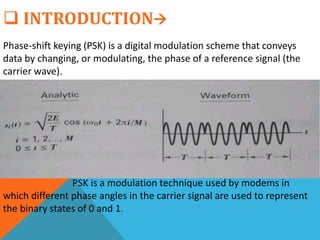
Phase-shift keying (PSK) is a digital modulation scheme that conveys
data by changing, or modulating, the phase of a reference signal (the
carrier wave).
.
PSK is a modulation technique used by modems in
which different phase angles in the carrier signal are used to represent
the binary states of 0 and 1.
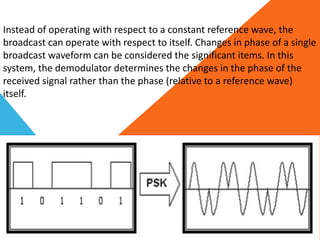
Instead of operating with respect to a constant reference wave, the
broadcast can operate with respect to itself. Changes in phase of a single
broadcast waveform can be considered the significant items. In this
system, the demodulator determines the changes in the phase of the
received signal rather than the phase (relative to a reference wave)
itself.
There are three major classes of digital modulation techniques
used for transmission of digitally represented data: 
Amplitude-shift keying
(ASK)
Frequency-shift keying
(FSK)
Phase-shift keying (PSK)
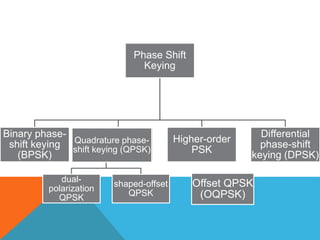
Phase Shift
Keying
Binary phase-
shift keying
(BPSK)
Binary phase-
shift keying
(BPSK)
Higher-order
PSK
Differential
phase-shift
keying (DPSK)
Offset QPSK
(OQPSK)
dual-
polarization
QPSK
shaped-offset
QPSK
Quadrature phase-
shift keying (QPSK)
Offset QPSK
(OQPSK)
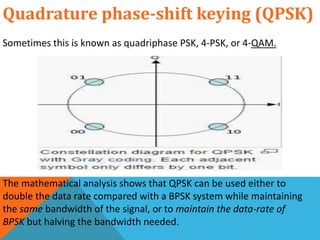
Quadrature phase-shift keying (QPSK)
Sometimes this is known as quadriphase PSK, 4-PSK, or 4-QAM.
The mathematical analysis shows that QPSK can be used either to
double the data rate compared with a BPSK system while maintaining
the same bandwidth of the signal, or to maintain the data-rate of
BPSK but halving the bandwidth needed.
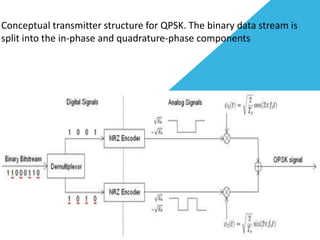
Conceptual transmitter structure for QPSK. The binary data stream is
split into the in-phase and quadrature-phase components
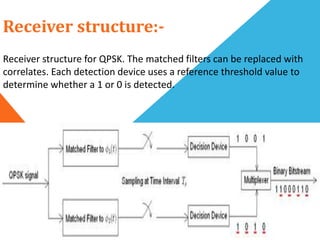
Receiver structure for QPSK. The matched filters can be replaced with
correlates. Each detection device uses a reference threshold value to
determine whether a 1 or 0 is detected.
Receiver structure:-

Phase shift keying Presentation

  • 1.
  • 2.
     INTRODUCTION Phase-shift keying(PSK) is a digital modulation scheme that conveys data by changing, or modulating, the phase of a reference signal (the carrier wave). . PSK is a modulation technique used by modems in which different phase angles in the carrier signal are used to represent the binary states of 0 and 1.
  • 3.
    Instead of operatingwith respect to a constant reference wave, the broadcast can operate with respect to itself. Changes in phase of a single broadcast waveform can be considered the significant items. In this system, the demodulator determines the changes in the phase of the received signal rather than the phase (relative to a reference wave) itself.
  • 4.
    There are threemajor classes of digital modulation techniques used for transmission of digitally represented data:  Amplitude-shift keying (ASK) Frequency-shift keying (FSK) Phase-shift keying (PSK)
  • 5.
    Phase Shift Keying Binary phase- shiftkeying (BPSK) Binary phase- shift keying (BPSK) Higher-order PSK Differential phase-shift keying (DPSK) Offset QPSK (OQPSK) dual- polarization QPSK shaped-offset QPSK Quadrature phase- shift keying (QPSK) Offset QPSK (OQPSK)
  • 6.
    Quadrature phase-shift keying(QPSK) Sometimes this is known as quadriphase PSK, 4-PSK, or 4-QAM. The mathematical analysis shows that QPSK can be used either to double the data rate compared with a BPSK system while maintaining the same bandwidth of the signal, or to maintain the data-rate of BPSK but halving the bandwidth needed.
  • 7.
    Conceptual transmitter structurefor QPSK. The binary data stream is split into the in-phase and quadrature-phase components
  • 8.
    Receiver structure forQPSK. The matched filters can be replaced with correlates. Each detection device uses a reference threshold value to determine whether a 1 or 0 is detected. Receiver structure:-