 ASK is a simple version of amplitude 
modulation used for digital modulation 
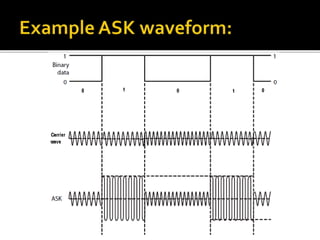
 Two binary values (1 and 0) are represented 
by two different amplitudes of the carrier 
frequency (normally, ‘on’ and ‘off’)
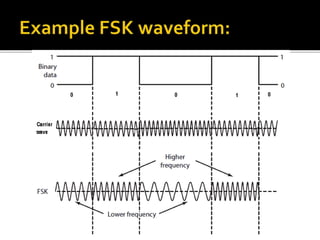
 FSK is the simplest (binary) form of 
frequency modulation used for digital 
modulation 
 The two binary values are represented by 
two different frequencies near the carrier 
frequency 
 Normally, the carrier is shifted high for a 1 
and low for a 0
 PSK is a form of modulation in which the phase of 
the carrier signal is shifted to represent digital data 
 Binary Phase Shift-Keying (BPSK) is PSK between 
two phase states, normally 180° apart 
 Quadrature Phase Shift-Keying (QPSK) is a form of 
PSK using four phase states, normally 90° apart 
 Quadrature Amplitude Modulation (QAM) is a 
modulation technique in which both the phase and 
amplitude of a carrier are varied by the symbols of 
the message
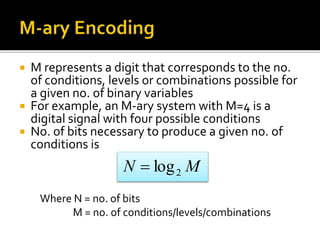
 M represents a digit that corresponds to the no. 
of conditions, levels or combinations possible for 
a given no. of binary variables 
 For example, an M-ary system with M=4 is a 
digital signal with four possible conditions 
 No. of bits necessary to produce a given no. of 
conditions is 
N M 2  log 
Where N = no. of bits 
M = no. of conditions/levels/combinations
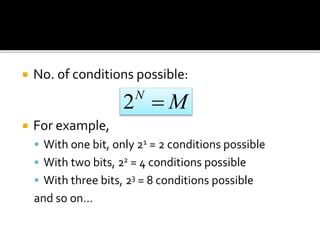
 No. of conditions possible: 
 For example, 
M N  2 
 With one bit, only 21 = 2 conditions possible 
 With two bits, 22 = 4 conditions possible 
 With three bits, 23 = 8 conditions possible 
and so on…
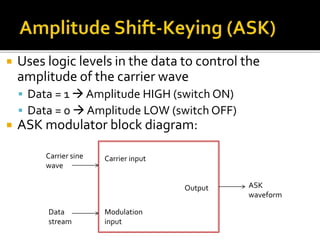
 Uses logic levels in the data to control the 
amplitude of the carrier wave 
 Data = 1 Amplitude HIGH (switch ON) 
 Data = 0  Amplitude LOW (switch OFF) 
 ASK modulator block diagram: 
Carrier input 
Modulation 
input 
Output 
Carrier sine 
wave 
Data 
stream 
ASK 
waveform
Rectifier Low pass 
filter 
Voltage 
comparator 
Voltage 
reference 
Binary 
data 
ASK 
waveform
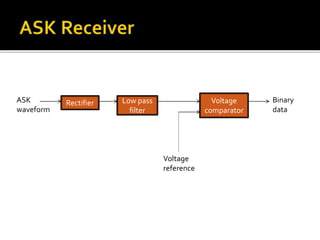
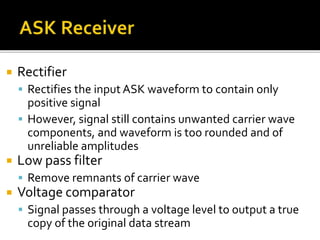
 Rectifier 
 Rectifies the input ASK waveform to contain only 
positive signal 
 However, signal still contains unwanted carrier wave 
components, and waveform is too rounded and of 
unreliable amplitudes 
 Low pass filter 
 Remove remnants of carrier wave 
 Voltage comparator 
 Signal passes through a voltage level to output a true 
copy of the original data stream
 Uses logic levels in data to control the 
frequency of the carrier wave 
 Data = 1  frequency HIGH 
 Data = 0  frequency LOW
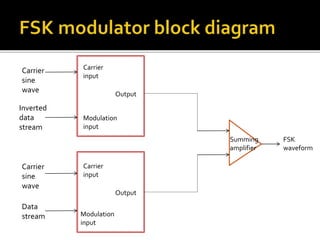
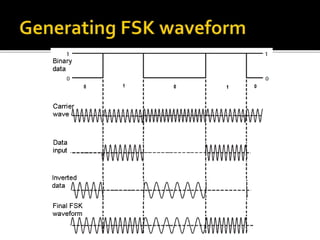
 There are many ways to generate an FSK 
waveform. One way is to treat it as 
combining two different ASK waves
Carrier 
input 
Modulation 
input 
Carrier 
input 
Modulation 
input 
Output 
Output 
Carrier 
sine 
wave 
Inverted 
data 
stream 
Carrier 
sine 
wave 
Data 
stream 
Summing 
amplifier 
FSK 
waveform
 Advantage of FSK over ASK: 
 Higher reliability in terms of data accuracy at the 
receiver 
 Disadvantage of FSK over ASK: 
 FSK uses 2 different frequencies, hence larger 
bandwidth
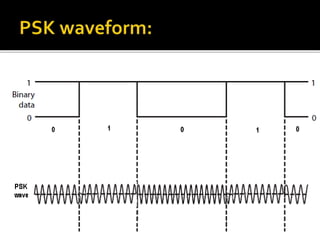
 PSK uses levels in data to control the phase of the 
carrier wave 
 Since sine wave is symmetrical, it is not possible for 
receiver to know whether signal is in inverted form or 
not. So the demodulator will create two different 
possibilities for the received signal, one is the inverse 
of the other 
 NRZ (non return-to-zero) code is used to detect the 
logic levels 
 Data = 1  change in phase 
 Data = 0  no change in phase
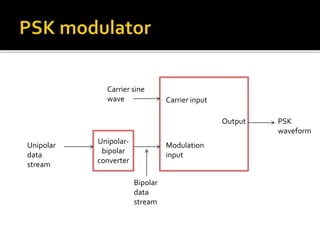
Carrier input 
Modulation 
input 
Output 
Carrier sine 
wave 
Bipolar 
data 
stream 
PSK 
waveform 
Unipolar-bipolar 
converter 
Unipolar 
data 
stream
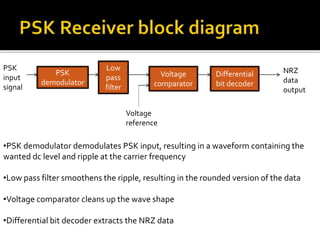
PSK 
demodulator 
Low 
pass 
filter 
Voltage 
comparator 
PSK 
input 
signal 
Differential 
bit decoder 
NRZ 
data 
output 
Voltage 
reference 
•PSK demodulator demodulates PSK input, resulting in a waveform containing the 
wanted dc level and ripple at the carrier frequency 
•Low pass filter smoothens the ripple, resulting in the rounded version of the data 
•Voltage comparator cleans up the wave shape 
•Differential bit decoder extracts the NRZ data
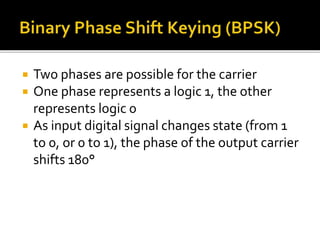
 Two phases are possible for the carrier 
 One phase represents a logic 1, the other 
represents logic 0 
 As input digital signal changes state (from 1 
to 0, or 0 to 1), the phase of the output carrier 
shifts 180°
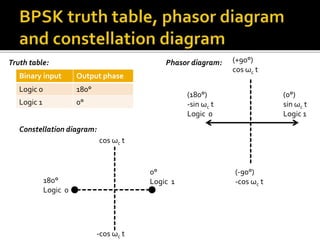
Truth table: (+90°) 
Binary input Output phase 
Logic 0 180° 
Logic 1 0° 
cos ωc t 
(-90°) 
-cos ωc t 
(0°) 
sin ωc t 
Logic 1 
(180°) 
-sin ωc t 
Logic 0 
180° 
Logic 0 
0° 
Logic 1 
cos ωc t 
-cos ωc t 
Phasor diagram: 
Constellation diagram:
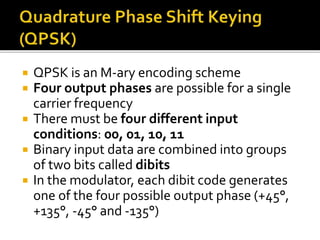
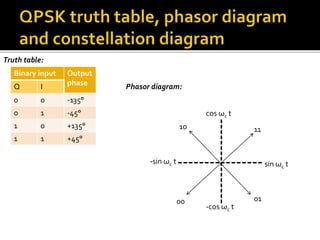
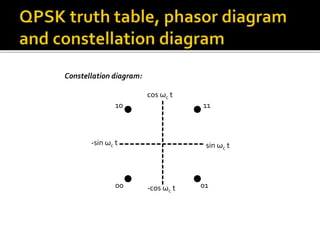
 QPSK is an M-ary encoding scheme 
 Four output phases are possible for a single 
carrier frequency 
 There must be four different input 
conditions: 00, 01, 10, 11 
 Binary input data are combined into groups 
of two bits called dibits 
 In the modulator, each dibit code generates 
one of the four possible output phase (+45°, 
+135°, -45° and -135°)
Truth table: 
Binary input Output 
Q I phase 
0 0 -135° 
0 1 -45° 
1 0 +135° 
1 1 +45° 
cos ωc t 
-sin ωc t sin ωc t 
-cos ωc t 
Phasor diagram: 
10 
00 
11 
01
cos ωc t 
sin ωc -sin ωc t t 
-cos ωc t 
10 
00 
11 
01 
Constellation diagram:
 QAM is a form of digital modulation that is 
similar to PSK, except that the digital 
information is contained in both the 
amplitude and phase of the transmitted 
carrier 
 Amplitude and phase-shift keying are 
combined 
 Reduces probability of error
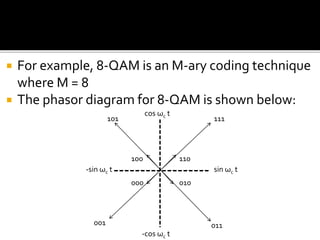
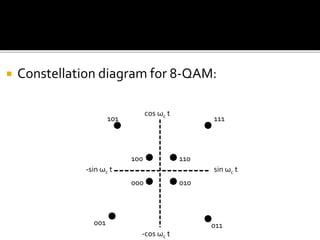
 For example, 8-QAM is an M-ary coding technique 
where M = 8 
 The phasor diagram for 8-QAM is shown below: 
cos ωc t 
-sin ωc t sin ωc t 
-cos ωc t 
101 
000 
011 
100 110 
111 
001 
010
 Constellation diagram for 8-QAM: 
cos ωc t 
-sin ωc t sin ωc t 
-cos ωc t 
101 
000 
011 
100 110 
111 
001 
010

Digital communication methods

  • 2.
     ASK isa simple version of amplitude modulation used for digital modulation  Two binary values (1 and 0) are represented by two different amplitudes of the carrier frequency (normally, ‘on’ and ‘off’)
  • 3.
     FSK isthe simplest (binary) form of frequency modulation used for digital modulation  The two binary values are represented by two different frequencies near the carrier frequency  Normally, the carrier is shifted high for a 1 and low for a 0
  • 4.
     PSK isa form of modulation in which the phase of the carrier signal is shifted to represent digital data  Binary Phase Shift-Keying (BPSK) is PSK between two phase states, normally 180° apart  Quadrature Phase Shift-Keying (QPSK) is a form of PSK using four phase states, normally 90° apart  Quadrature Amplitude Modulation (QAM) is a modulation technique in which both the phase and amplitude of a carrier are varied by the symbols of the message
  • 5.
     M representsa digit that corresponds to the no. of conditions, levels or combinations possible for a given no. of binary variables  For example, an M-ary system with M=4 is a digital signal with four possible conditions  No. of bits necessary to produce a given no. of conditions is N M 2  log Where N = no. of bits M = no. of conditions/levels/combinations
  • 6.
     No. ofconditions possible:  For example, M N  2  With one bit, only 21 = 2 conditions possible  With two bits, 22 = 4 conditions possible  With three bits, 23 = 8 conditions possible and so on…
  • 7.
     Uses logiclevels in the data to control the amplitude of the carrier wave  Data = 1 Amplitude HIGH (switch ON)  Data = 0  Amplitude LOW (switch OFF)  ASK modulator block diagram: Carrier input Modulation input Output Carrier sine wave Data stream ASK waveform
  • 9.
    Rectifier Low pass filter Voltage comparator Voltage reference Binary data ASK waveform
  • 10.
     Rectifier Rectifies the input ASK waveform to contain only positive signal  However, signal still contains unwanted carrier wave components, and waveform is too rounded and of unreliable amplitudes  Low pass filter  Remove remnants of carrier wave  Voltage comparator  Signal passes through a voltage level to output a true copy of the original data stream
  • 11.
     Uses logiclevels in data to control the frequency of the carrier wave  Data = 1  frequency HIGH  Data = 0  frequency LOW
  • 13.
     There aremany ways to generate an FSK waveform. One way is to treat it as combining two different ASK waves
  • 14.
    Carrier input Modulation input Carrier input Modulation input Output Output Carrier sine wave Inverted data stream Carrier sine wave Data stream Summing amplifier FSK waveform
  • 16.
     Advantage ofFSK over ASK:  Higher reliability in terms of data accuracy at the receiver  Disadvantage of FSK over ASK:  FSK uses 2 different frequencies, hence larger bandwidth
  • 17.
     PSK useslevels in data to control the phase of the carrier wave  Since sine wave is symmetrical, it is not possible for receiver to know whether signal is in inverted form or not. So the demodulator will create two different possibilities for the received signal, one is the inverse of the other  NRZ (non return-to-zero) code is used to detect the logic levels  Data = 1  change in phase  Data = 0  no change in phase
  • 19.
    Carrier input Modulation input Output Carrier sine wave Bipolar data stream PSK waveform Unipolar-bipolar converter Unipolar data stream
  • 20.
    PSK demodulator Low pass filter Voltage comparator PSK input signal Differential bit decoder NRZ data output Voltage reference •PSK demodulator demodulates PSK input, resulting in a waveform containing the wanted dc level and ripple at the carrier frequency •Low pass filter smoothens the ripple, resulting in the rounded version of the data •Voltage comparator cleans up the wave shape •Differential bit decoder extracts the NRZ data
  • 21.
     Two phasesare possible for the carrier  One phase represents a logic 1, the other represents logic 0  As input digital signal changes state (from 1 to 0, or 0 to 1), the phase of the output carrier shifts 180°
  • 22.
    Truth table: (+90°) Binary input Output phase Logic 0 180° Logic 1 0° cos ωc t (-90°) -cos ωc t (0°) sin ωc t Logic 1 (180°) -sin ωc t Logic 0 180° Logic 0 0° Logic 1 cos ωc t -cos ωc t Phasor diagram: Constellation diagram:
  • 23.
     QPSK isan M-ary encoding scheme  Four output phases are possible for a single carrier frequency  There must be four different input conditions: 00, 01, 10, 11  Binary input data are combined into groups of two bits called dibits  In the modulator, each dibit code generates one of the four possible output phase (+45°, +135°, -45° and -135°)
  • 24.
    Truth table: Binaryinput Output Q I phase 0 0 -135° 0 1 -45° 1 0 +135° 1 1 +45° cos ωc t -sin ωc t sin ωc t -cos ωc t Phasor diagram: 10 00 11 01
  • 25.
    cos ωc t sin ωc -sin ωc t t -cos ωc t 10 00 11 01 Constellation diagram:
  • 26.
     QAM isa form of digital modulation that is similar to PSK, except that the digital information is contained in both the amplitude and phase of the transmitted carrier  Amplitude and phase-shift keying are combined  Reduces probability of error
  • 27.
     For example,8-QAM is an M-ary coding technique where M = 8  The phasor diagram for 8-QAM is shown below: cos ωc t -sin ωc t sin ωc t -cos ωc t 101 000 011 100 110 111 001 010
  • 28.
     Constellation diagramfor 8-QAM: cos ωc t -sin ωc t sin ωc t -cos ωc t 101 000 011 100 110 111 001 010