Unit - 4
SIGNAL PROCESSING IN WIRELESS
SYSTEMS
Prepared by
JAI GANESH S
Asst.Professor - ECE
Syllabus
• Diversity
– Principles
– Macro Diversity
– Micro Diversity
– Signal Combining Techniques
– Transmit diversity
• Equalizer
– Linear feed back equalizers
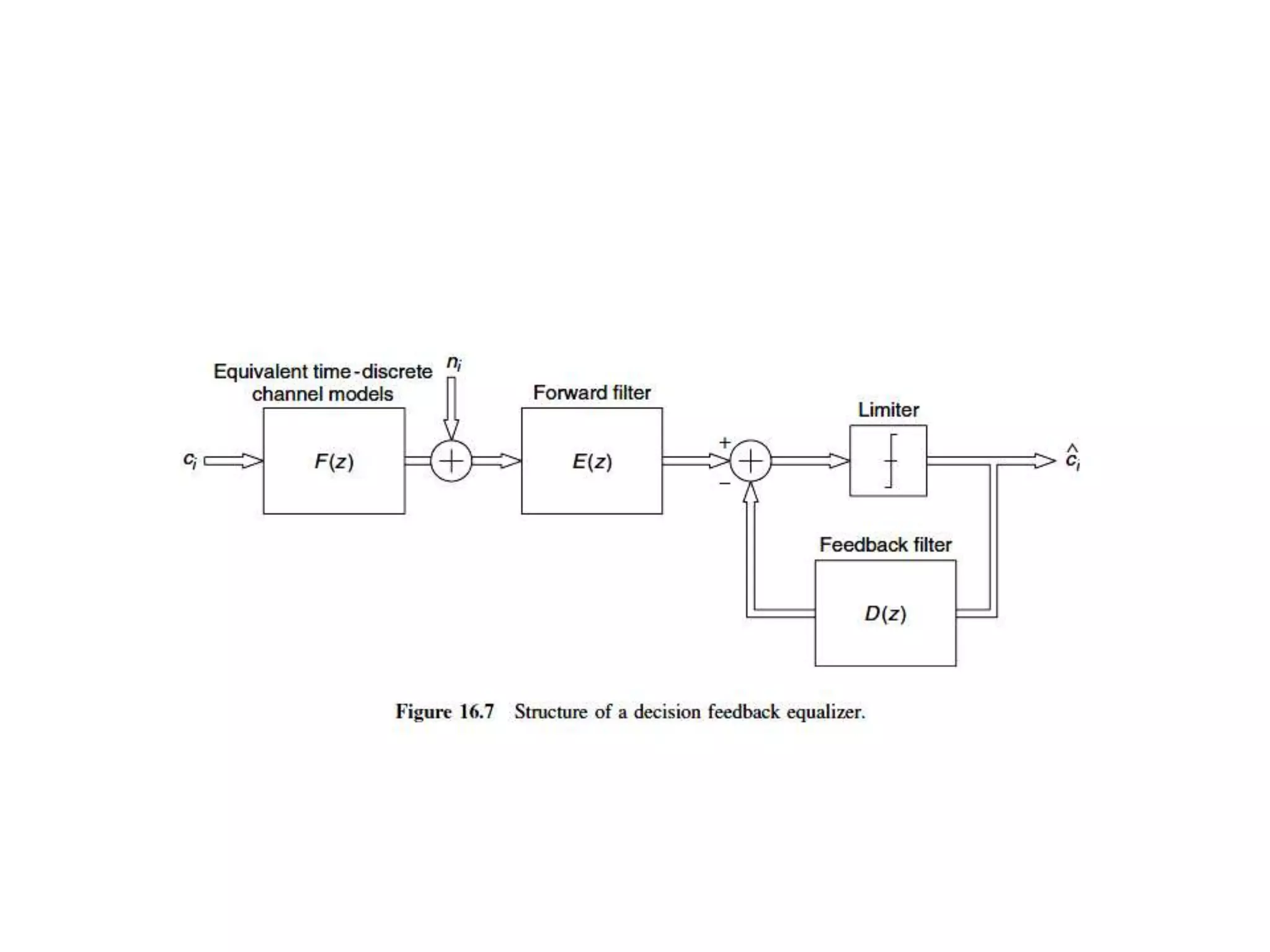
– Decision feed back equalizers
• Coding techniques
– Channel Coding Techniques (Review)
– Speech Coding Techniques (Review)
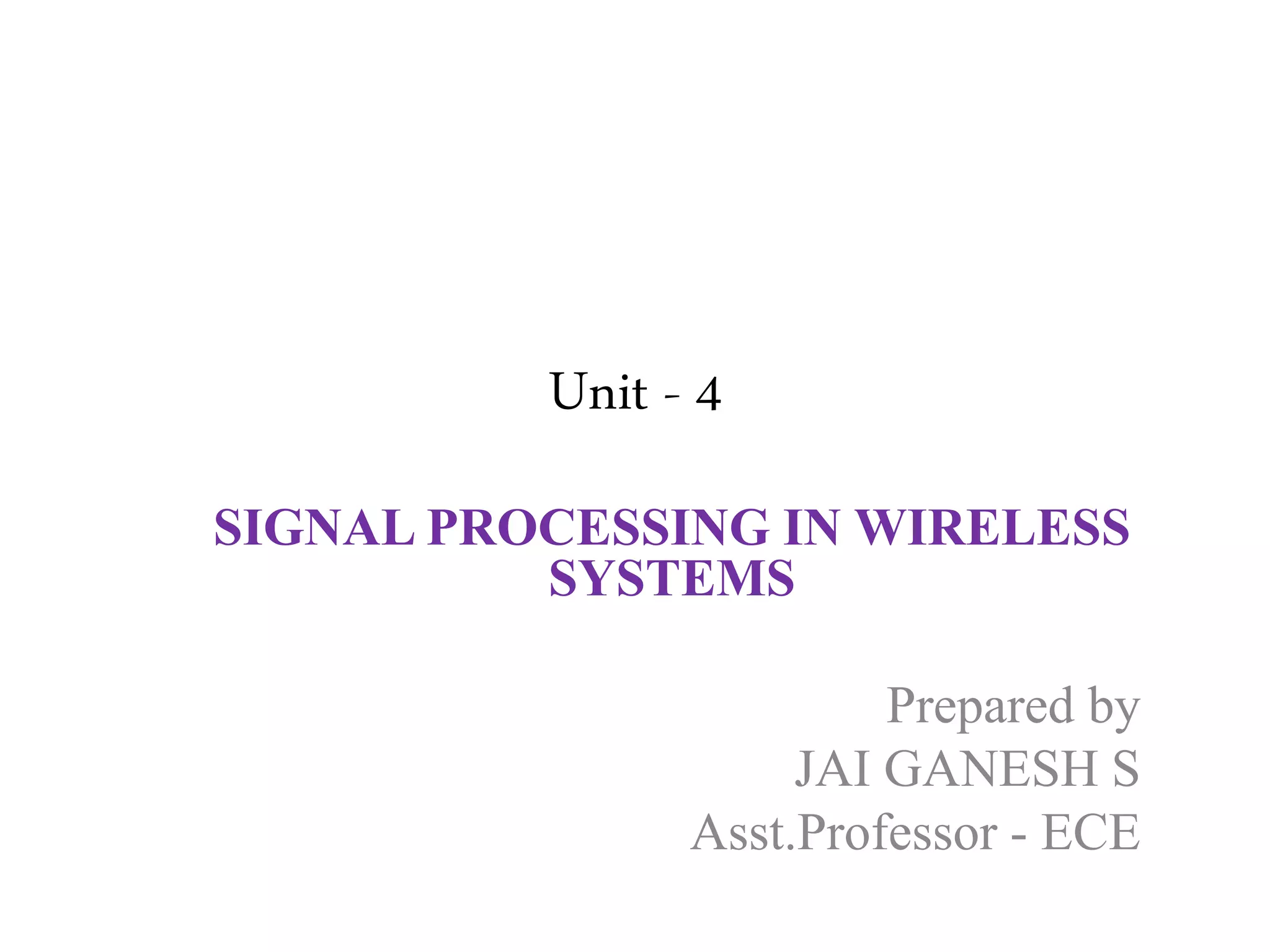
Basic - Understanding
Dispersive
Channels
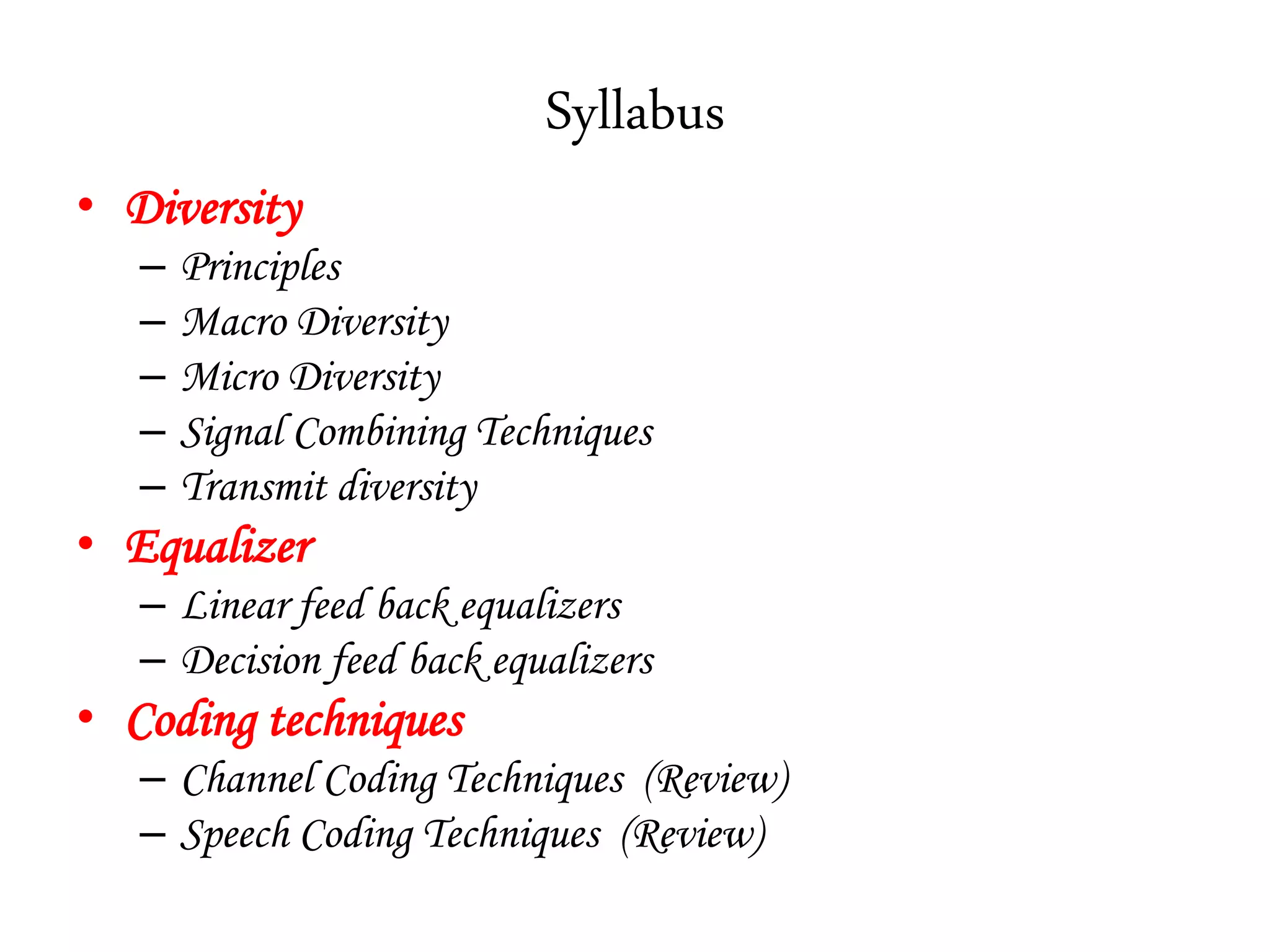
Diversity - Understanding
Dispersive
Channels
Diversity - Principle
• The principle of diversity is to ensure that the same
information reaches the receiver on a statistically
independent channels.
Diversity
• This is a technique implemented to improve the
channel quality and performance.
• This is achieved by placing the Tx signals in a
statistically independent channels.
• This reduces the over all fading of the received signals
at the receiver side.
• This technique mainly addresses the fading problems.
Correlation Coefficient
• Diversity is most efficient when the different
transmission channels carry independently faded copies
of the same signals.
• The correlation coefficient characterises the correlation
between signals on different diversity branches .
• Correlation can be done on different parameters such as
complex part of the signal, phase relations etc,
• Most important one is correlation between the signal
envelopes.
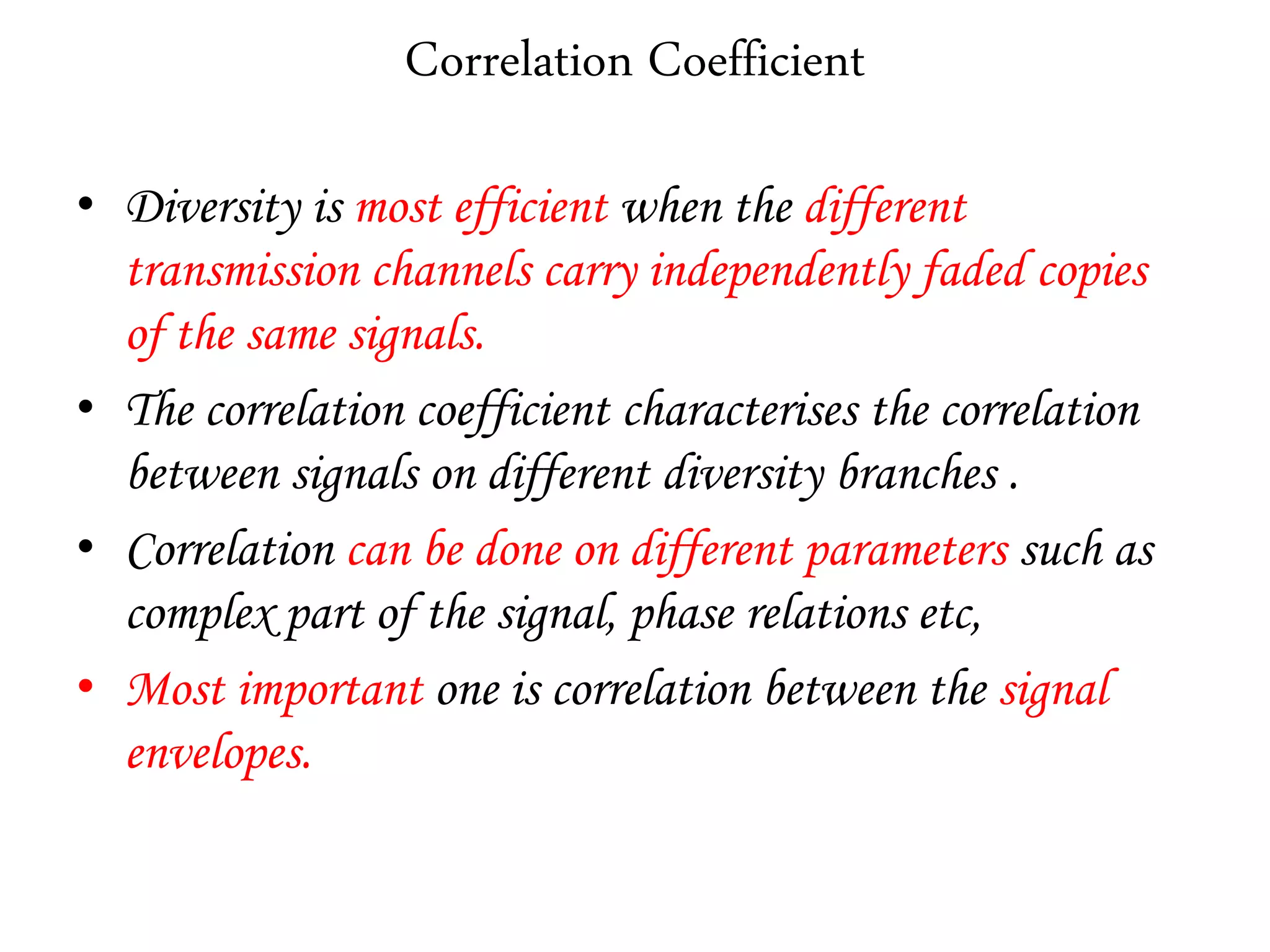
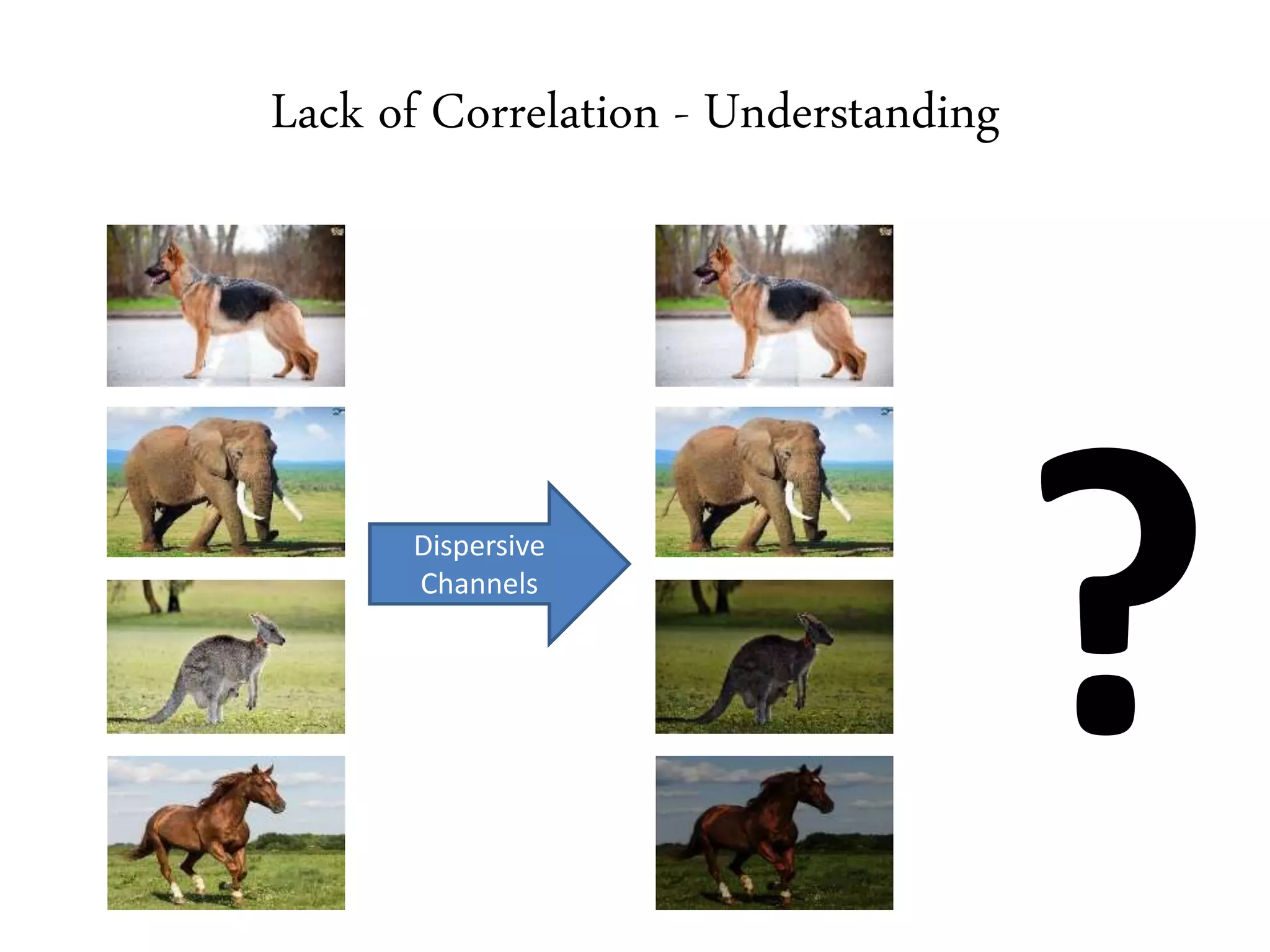
Lack of Correlation - Understanding
Dispersive
Channels
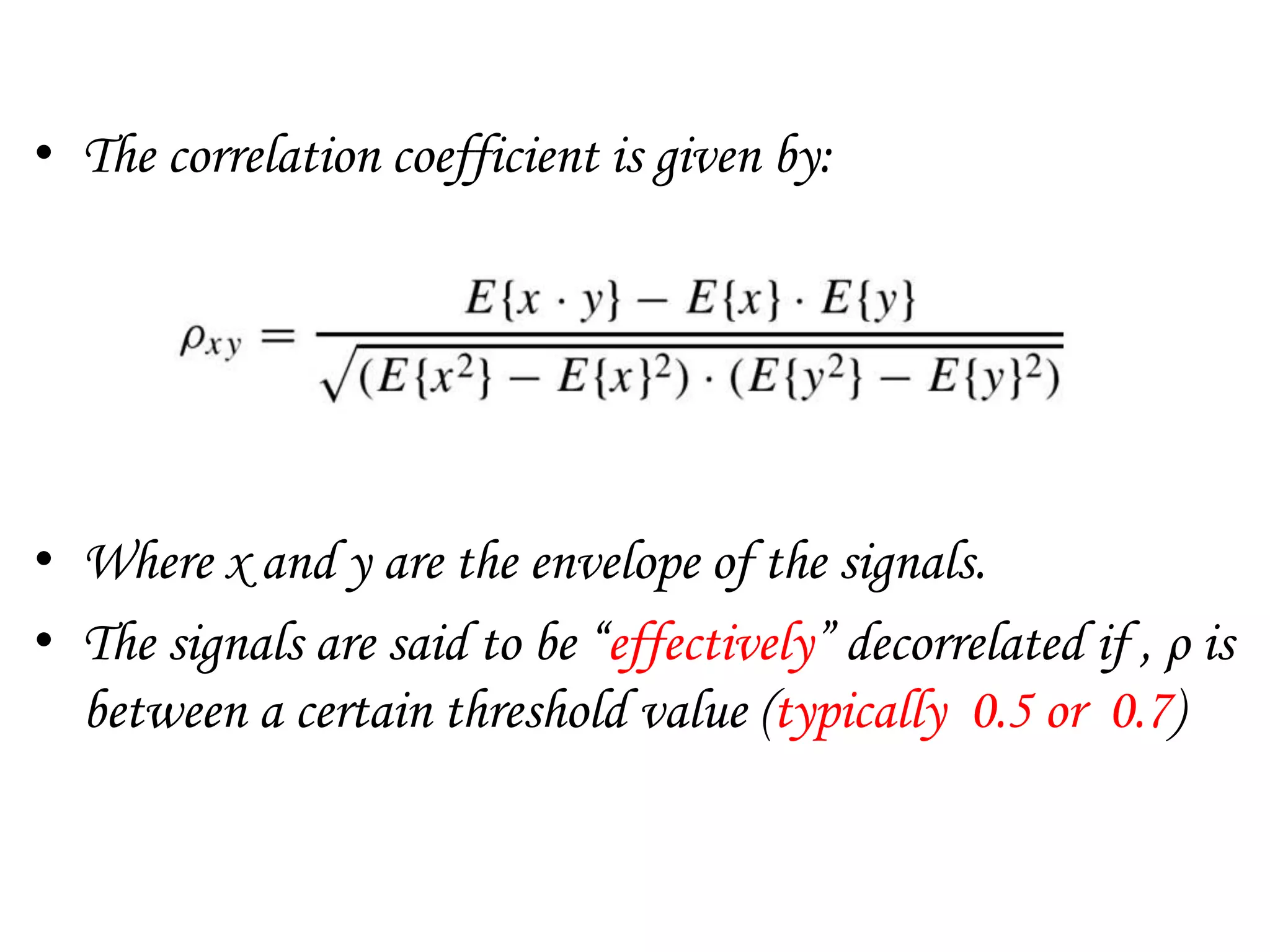
• The correlation coefficient is given by:
• Where x and y are the envelope of the signals.
• The signals are said to be “effectively” decorrelated if , ρ is
between a certain threshold value (typically 0.5 or 0.7)
Types of Diversity
• How to obtain the diversity in the signals ?
• Diversity are classified based on the fading methods.
–Small scale fading
• Microscopic diversity techniques are used.
–Large scale fading
• Macroscopic diversity techniques are used.
Micro diversity Techniques.
• There are 5 methods available.
– Spatial diversity
• Antenna elements separated by space
– Temporal diversity
• Transmission of signals at different time
– Frequency diversity
• Transmission of signals at different frequencies
– Angular diversity
• Multiple antennas with different antenna patterns
– Polarization diversity
• Multiple antenna with different polarizations
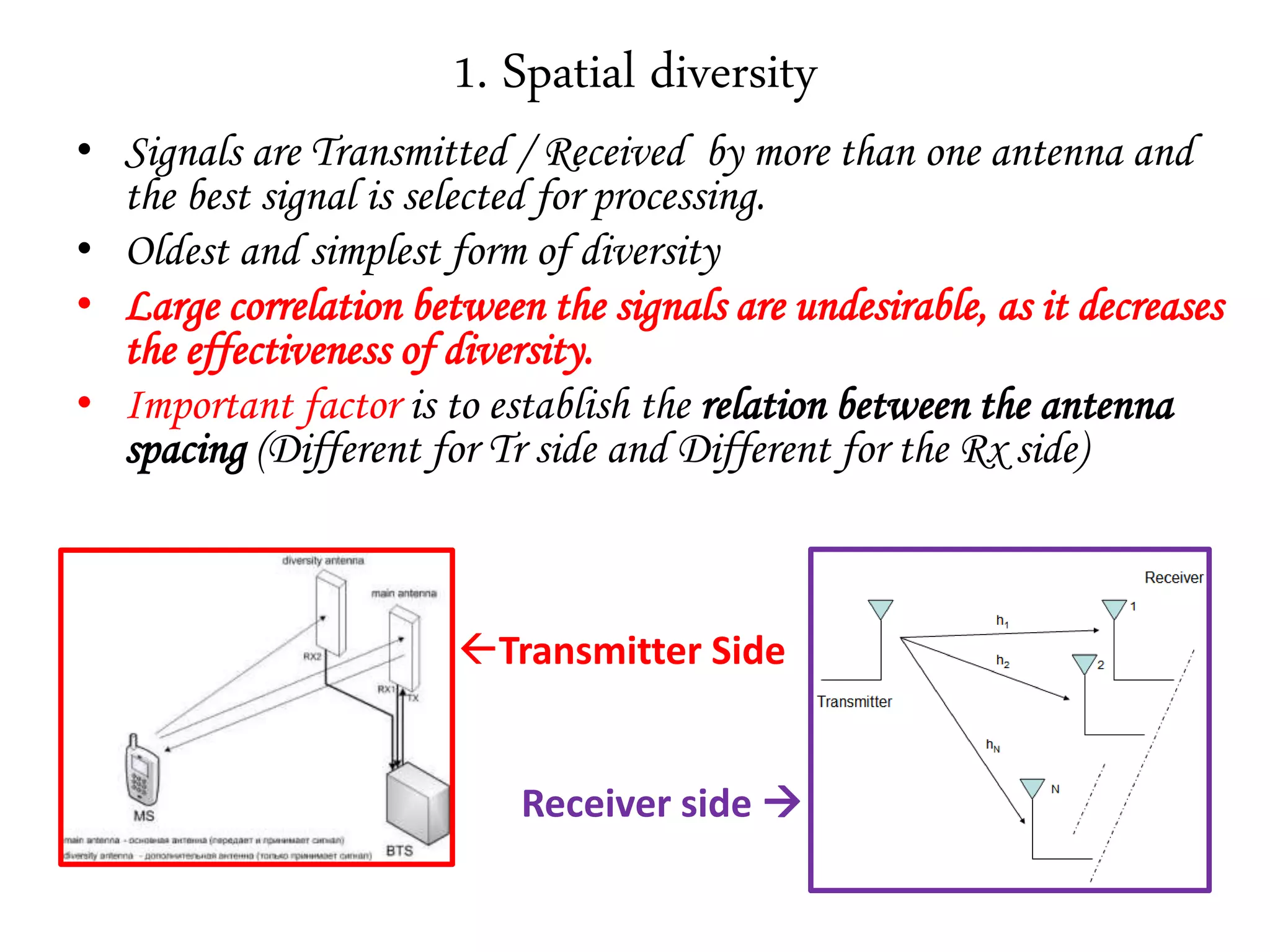
1. Spatial diversity
• Signals are Transmitted / Received by more than one antenna and
the best signal is selected for processing.
• Oldest and simplest form of diversity
• Large correlation between the signals are undesirable, as it decreases
the effectiveness of diversity.
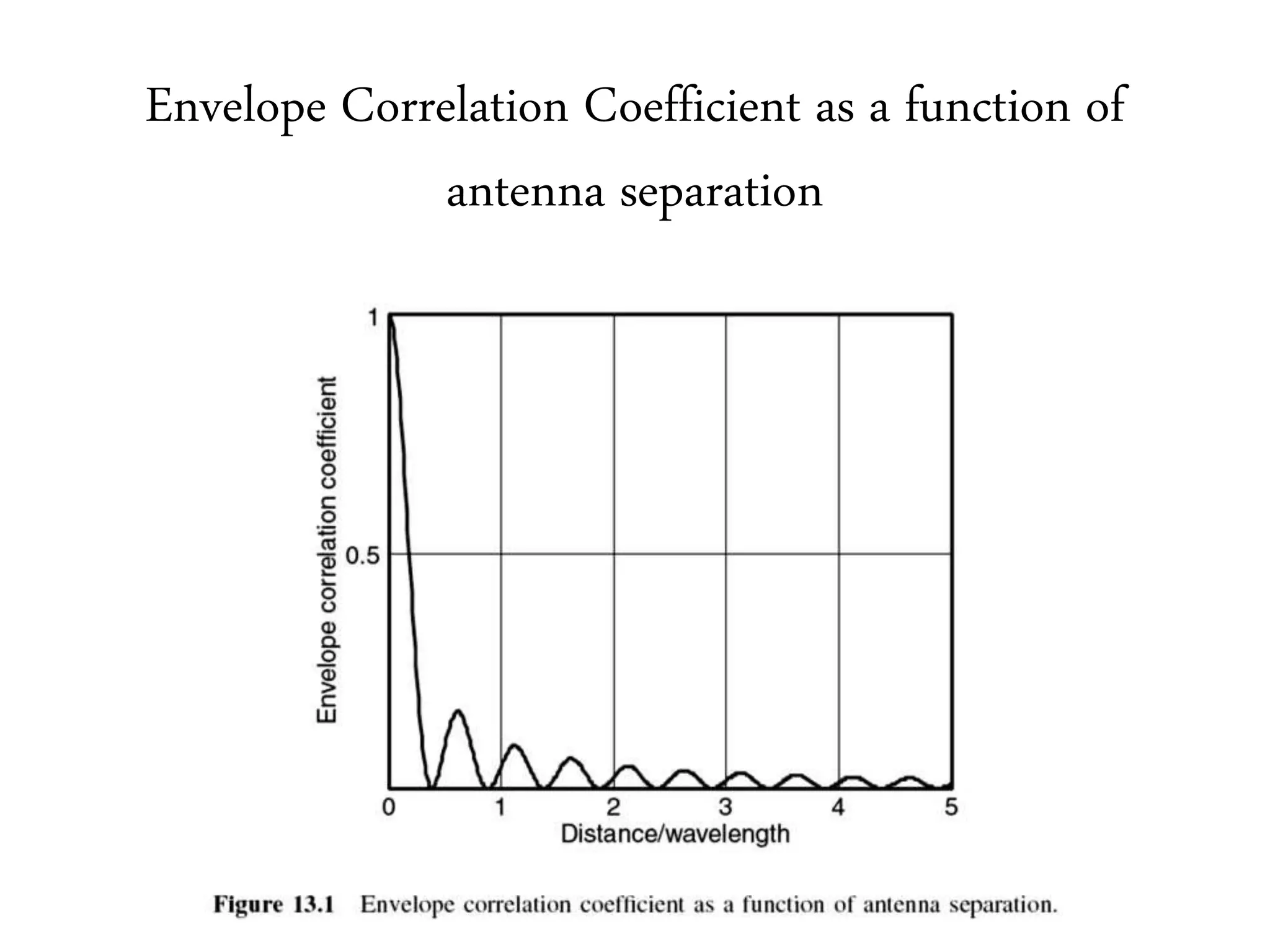
• Important factor is to establish the relation between the antenna
spacing (Different for Tr side and Different for the Rx side)
Transmitter Side
Receiver side 
Envelope Correlation Coefficient as a function of
antenna separation
2.Temporal Diversity
• As the wireless propagation channels are time
variant, signals that are received at different times
are uncorrelated.
• Temporal diversity can be realized in 3 different
ways.
– Repetition coding
– Automatic repeat request
– Combination of interleaving and coding
• Repetition coding:
– The signal is repeated several times, where the repeat intervals
are sufficient for decorrelation of signals.
– This method is highly bandwidth inefficient
• Automatic Repeat ReQuest – (ARQ):
– Rx sends a message to transmitter to indicate weather it
received the data with sufficient quality.
– If not then transmission is repeated again.
– Efficiency is better than repetition coding.
– Retransmission occurs only at certain cases.
• Combination of interleaving and coding:
– The signals are interleaved and coded. Instead of sending the
actual data those code words are sent.
– The transmitted codeword can be reconstructed .
3. Frequency Diversity
• Frequency diversity is implemented by transmitting
information on more than one carrier frequency.
• It does not mean that same messages are transmitted in
two different frequencies.
– When this is done then the signals undergoes different fading
levels.
• Instead, information is spread over a large bandwidth, so
the small parts of the information are conveyed by
different frequency components.
• Then the receiver averages over the different frequencies
to recover the original information.
Frequency Spreading
• The spreading is achieved by different methods:
– Compressing the information in time.(TDMA)
– Code division multiple access.(CDMA)
– Orthogonal frequency division multiplexing(OFDM)
– Frequency hopping in conjunction with coding.
Demerits:
- It requires large band width.
- More number of receivers are required.
- High cost.
4. Angular Diversity
• It enhances the decorrelation of signals at closely
spaced antennas.
• Different antenna patterns can be achieved very
easily.
• This effect is due to Mutual Coupling.
Mutual Coupling
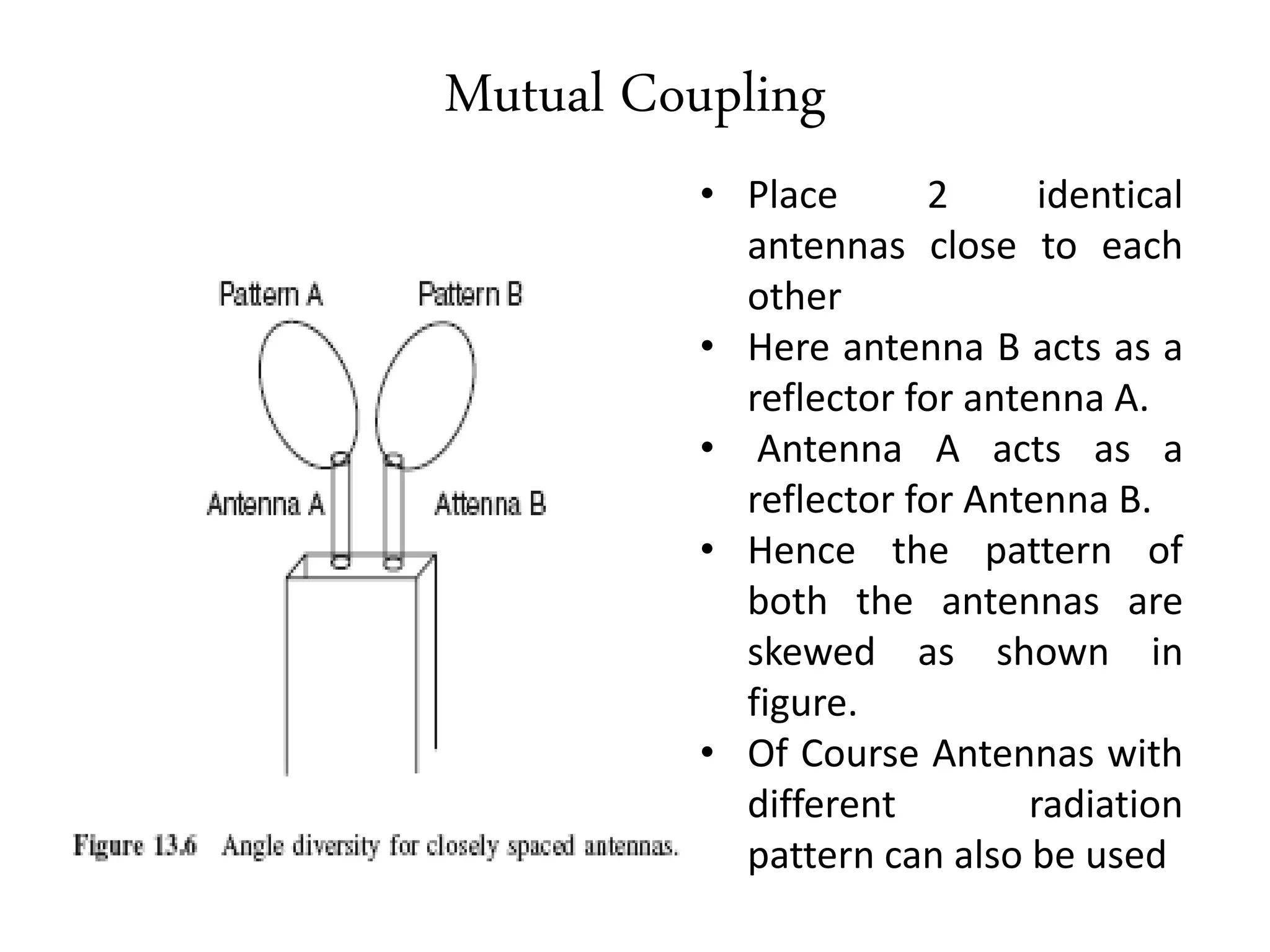
• Place 2 identical
antennas close to each
other
• Here antenna B acts as a
reflector for antenna A.
• Antenna A acts as a
reflector for Antenna B.
• Hence the pattern of
both the antennas are
skewed as shown in
figure.
• Of Course Antennas with
different radiation
pattern can also be used
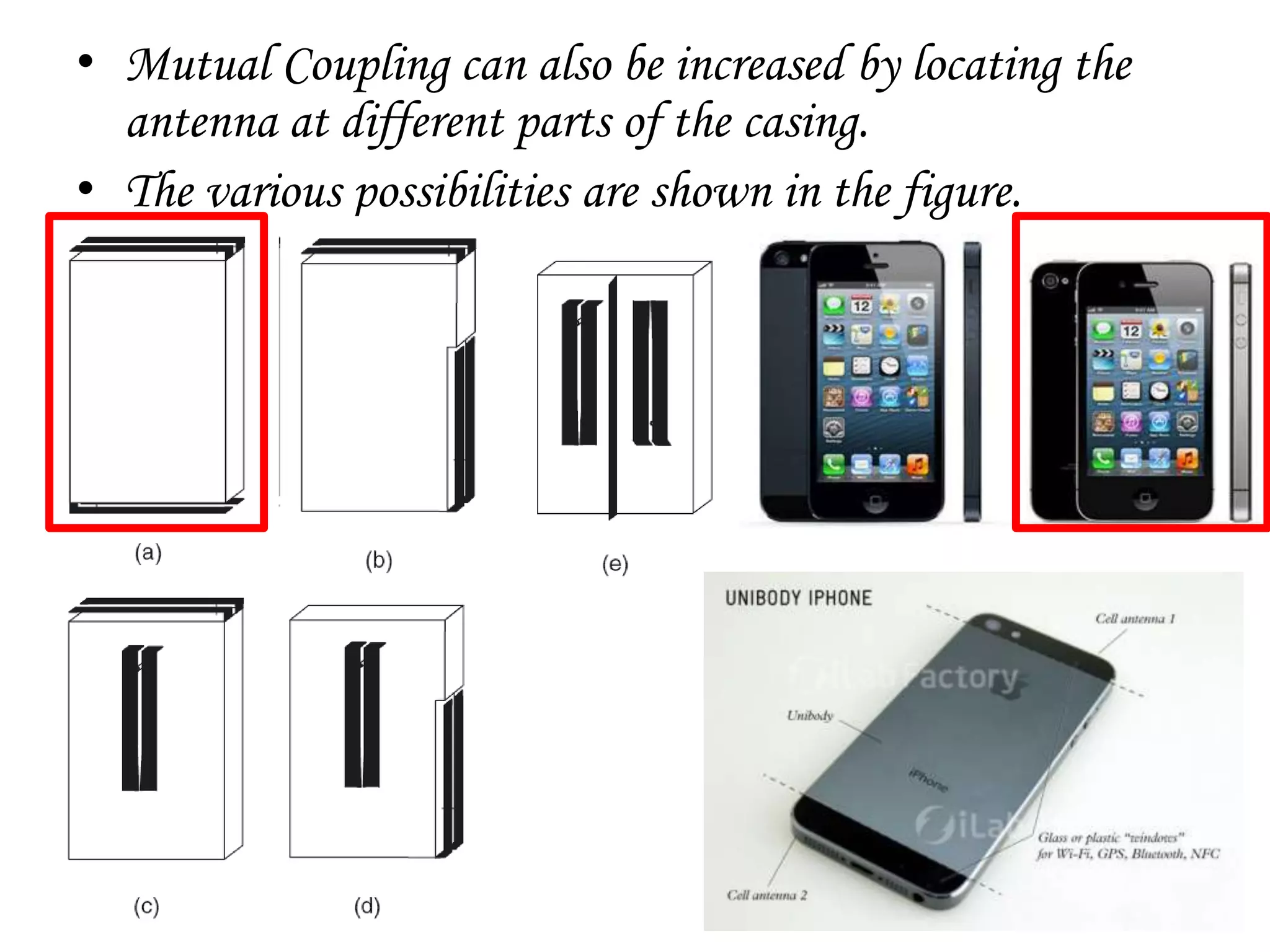
• Mutual Coupling can also be increased by locating the
antenna at different parts of the casing.
• The various possibilities are shown in the figure.
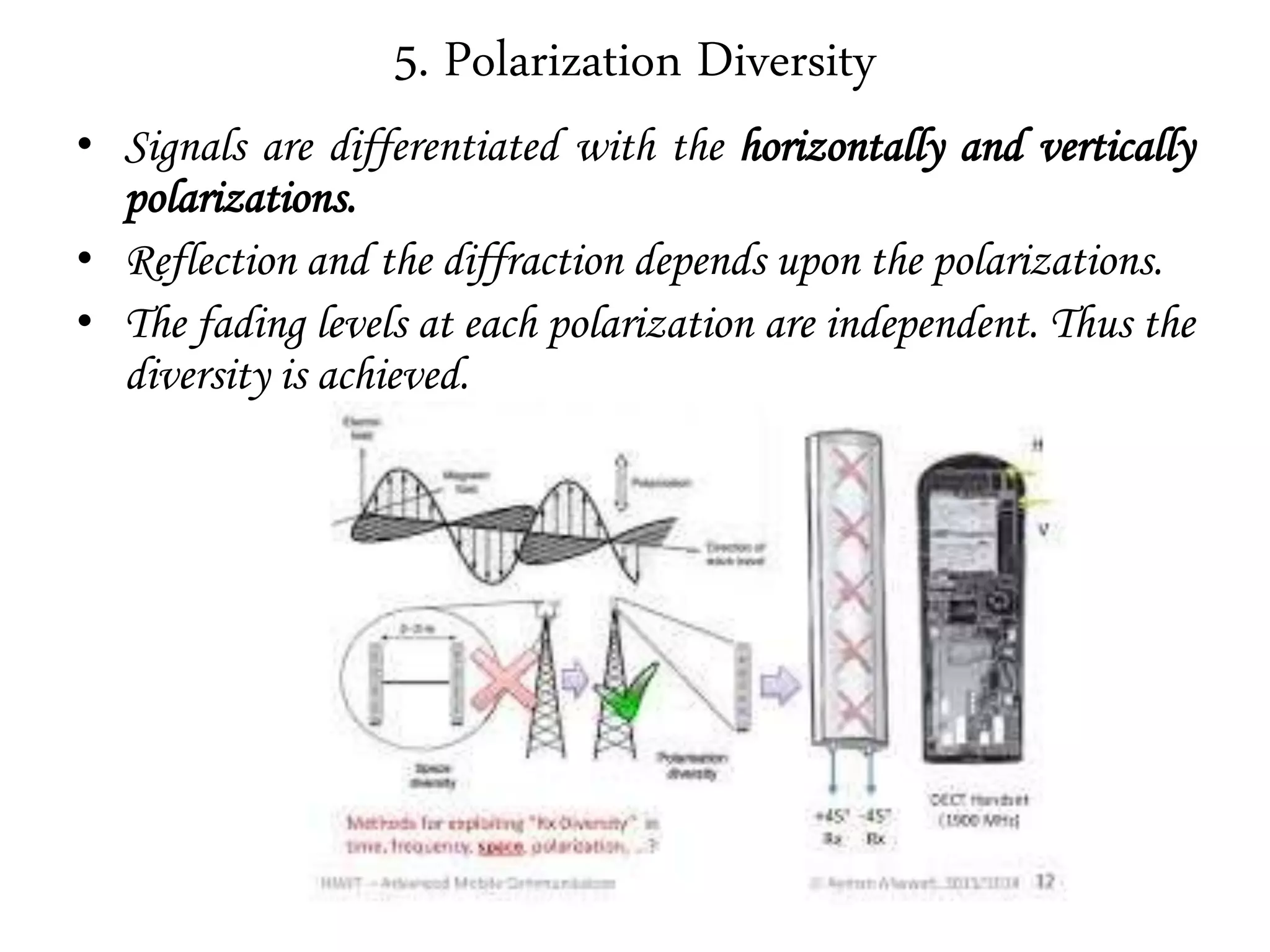
5. Polarization Diversity
• Signals are differentiated with the horizontally and vertically
polarizations.
• Reflection and the diffraction depends upon the polarizations.
• The fading levels at each polarization are independent. Thus the
diversity is achieved.
Macro Diversity
• Macro Diversity:
– To reduce the large scale fading these macro diversity is used.
– Large scale fading are generally caused by shadowing.
– If there is an hill between the BS and the MS then simply
increasing the Tx antenna and Rx antenna doesn’t make any
difference.
– Thus a intermediate BS (BS2) is placed in between the BS and MS
so that the hill does not lie in between the BS and BS2.
–Receive – Amplify – Retransmit.
Merits:
– Distance between BS and MS can be increased.
Demerits:
– It requires large bandwidth.
– frequency repeaters causes delay dispersion.
Diversity Achieved. How to Resolve?
Selection
Diversity
Combining
Diversity
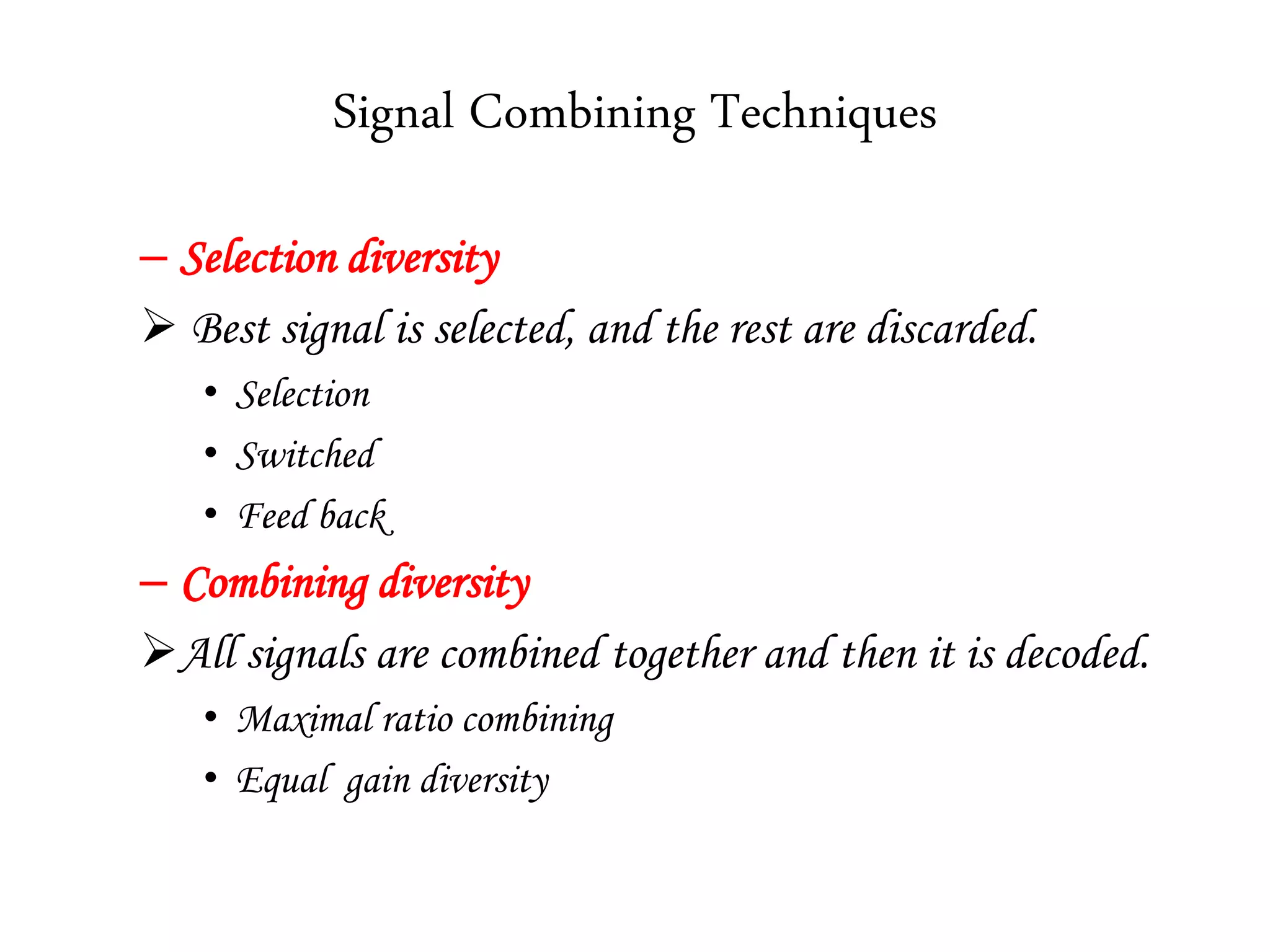
Signal Combining Techniques
– Selection diversity
 Best signal is selected, and the rest are discarded.
• Selection
• Switched
• Feed back
– Combining diversity
All signals are combined together and then it is decoded.
• Maximal ratio combining
• Equal gain diversity
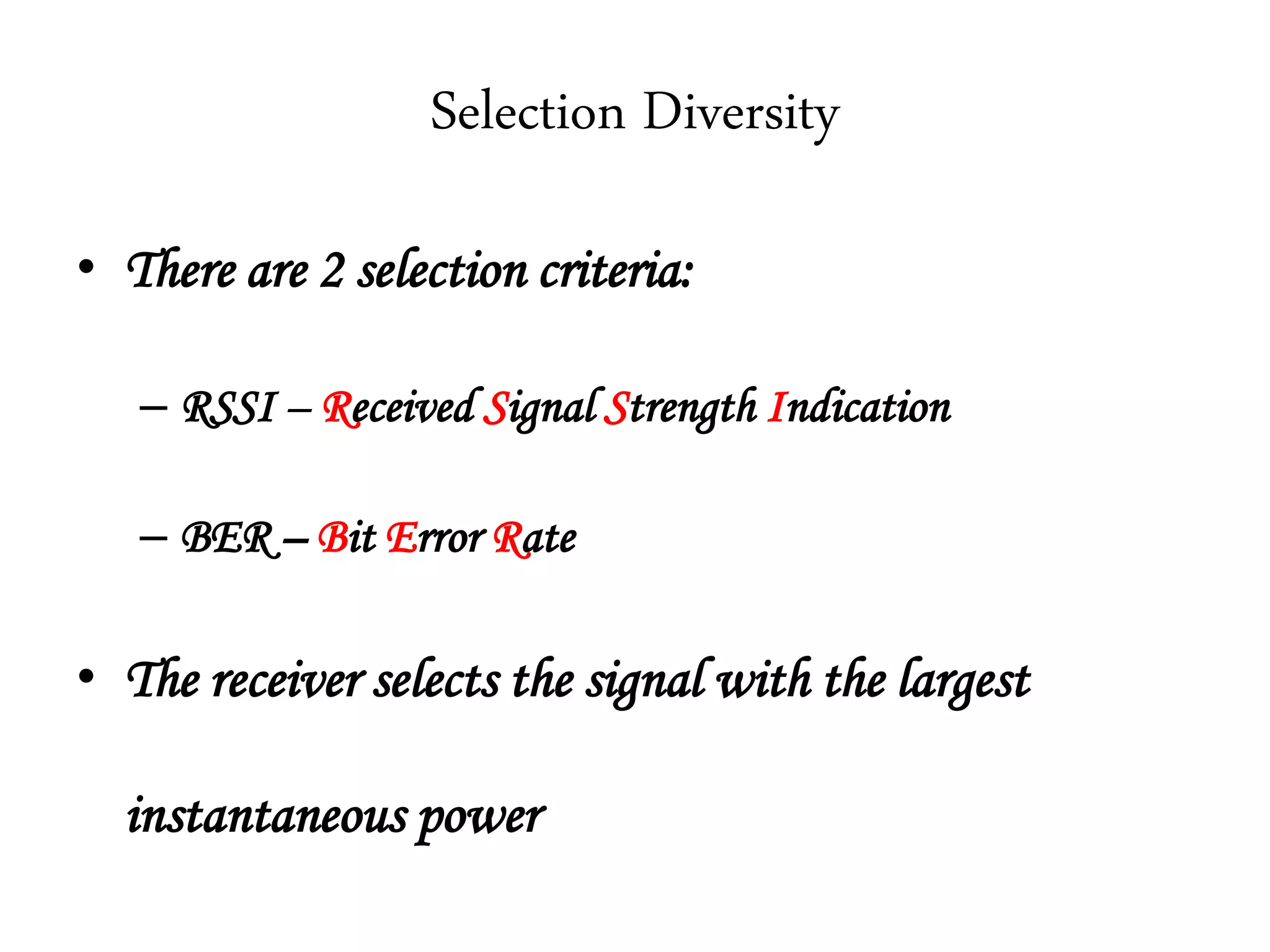
Selection Diversity
• There are 2 selection criteria:
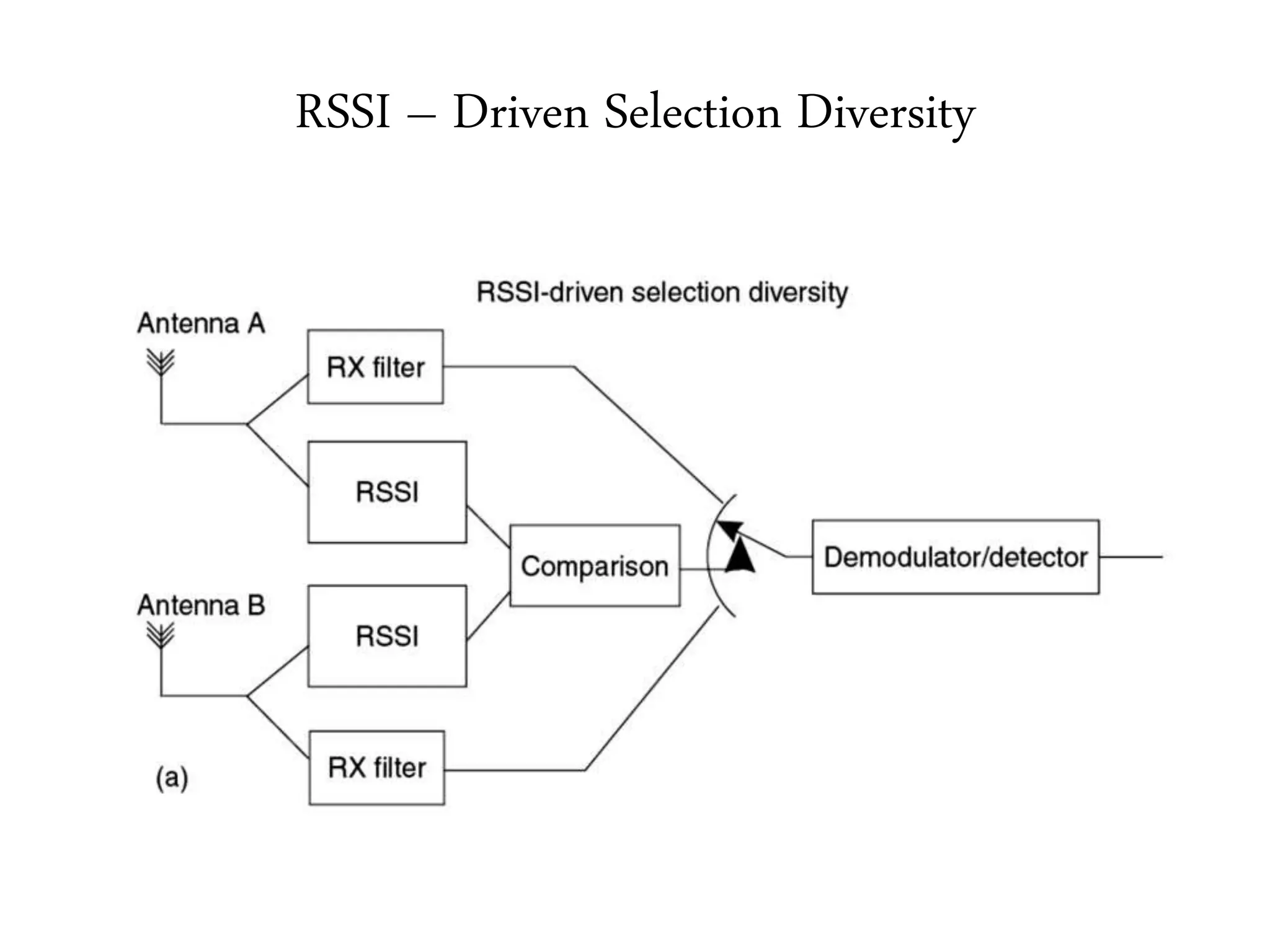
– RSSI – Received Signal Strength Indication
– BER – Bit Error Rate
• The receiver selects the signal with the largest
instantaneous power
RSSI – Driven Selection Diversity
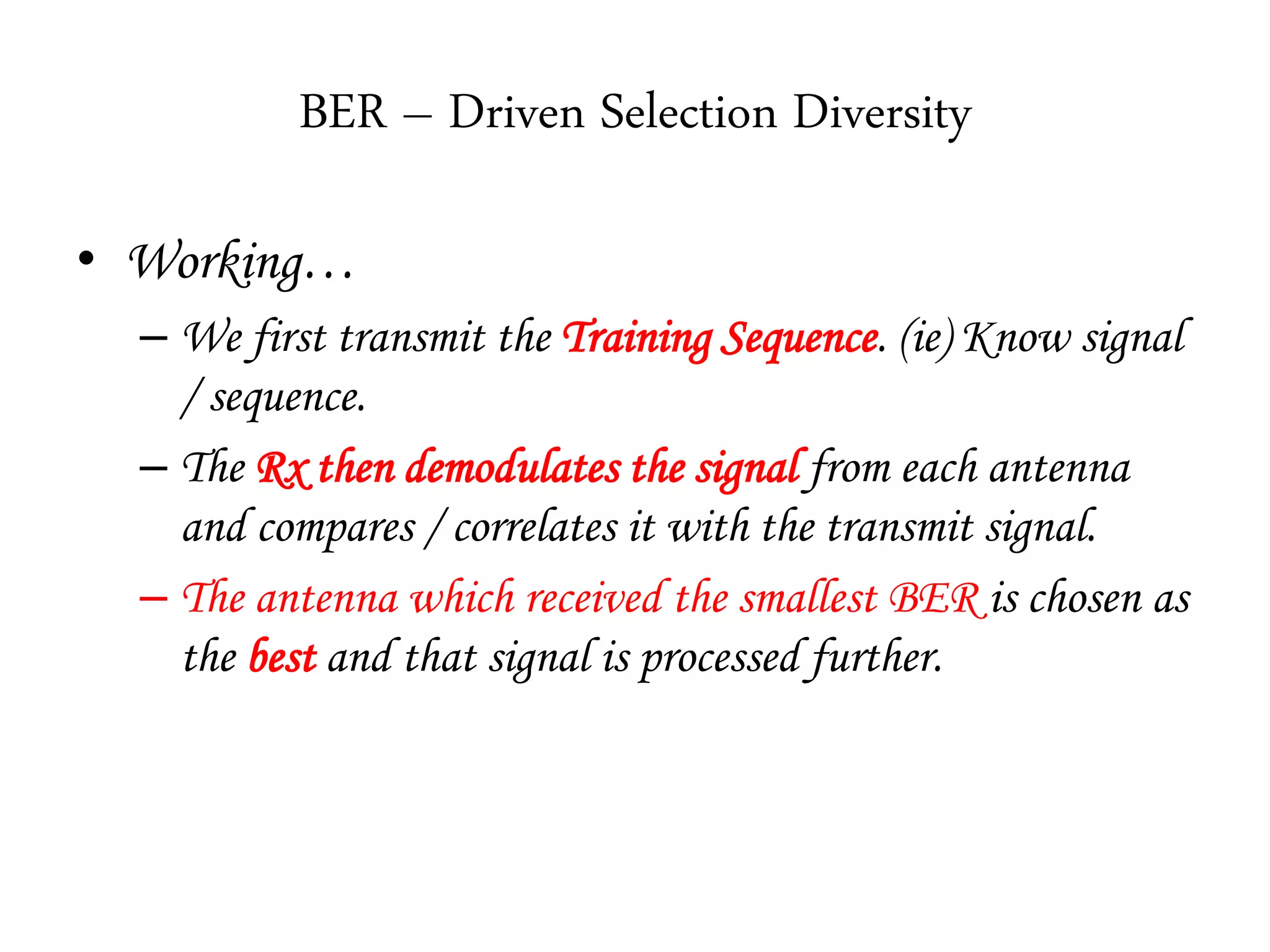
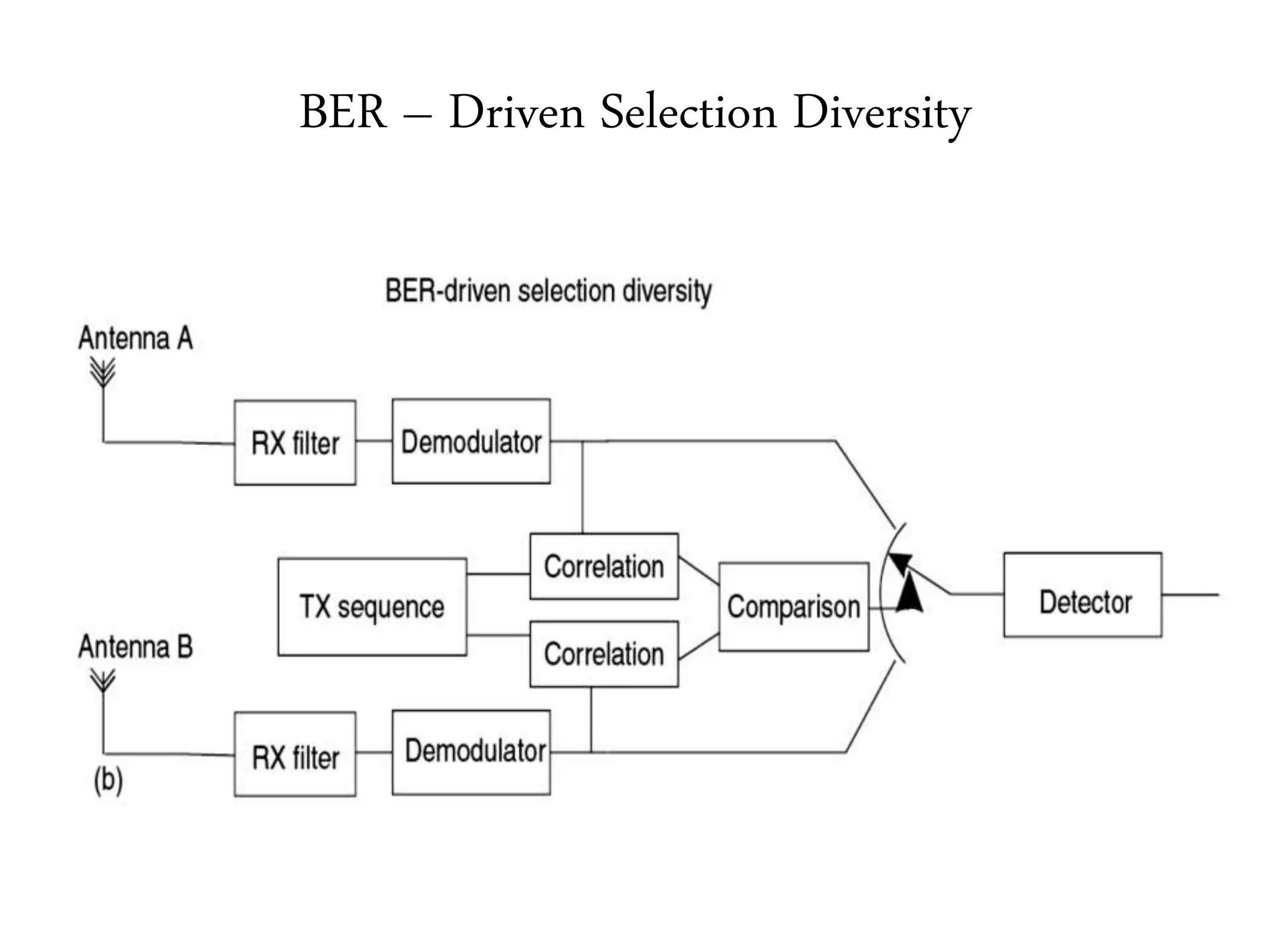
BER – Driven Selection Diversity
• Working…
– We first transmit the Training Sequence. (ie) Know signal
/ sequence.
– The Rx then demodulates the signal from each antenna
and compares / correlates it with the transmit signal.
– The antenna which received the smallest BER is chosen as
the best and that signal is processed further.
BER – Driven Selection Diversity
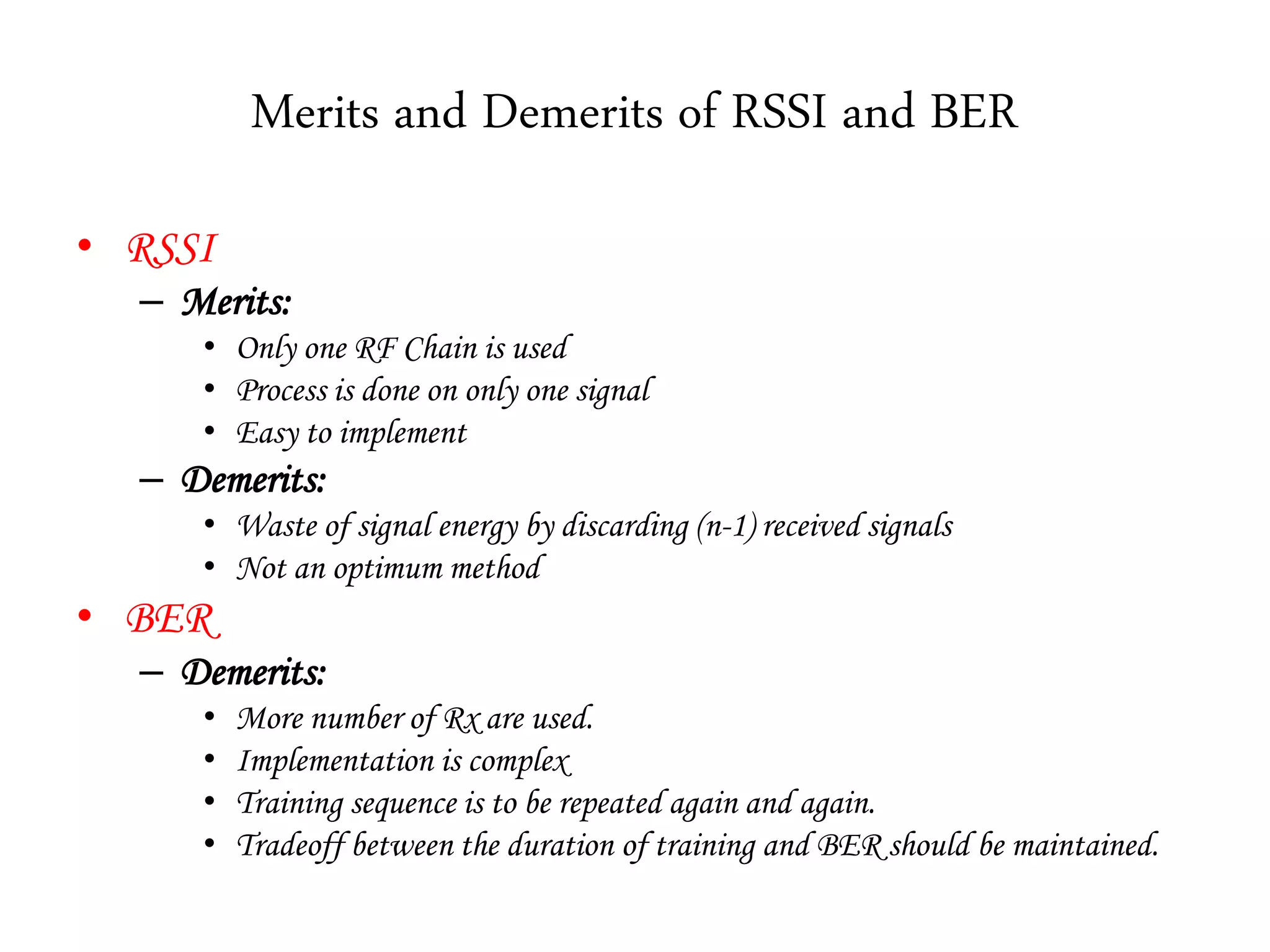
Merits and Demerits of RSSI and BER
• RSSI
– Merits:
• Only one RF Chain is used
• Process is done on only one signal
• Easy to implement
– Demerits:
• Waste of signal energy by discarding (n-1) received signals
• Not an optimum method
• BER
– Demerits:
• More number of Rx are used.
• Implementation is complex
• Training sequence is to be repeated again and again.
• Tradeoff between the duration of training and BER should be maintained.
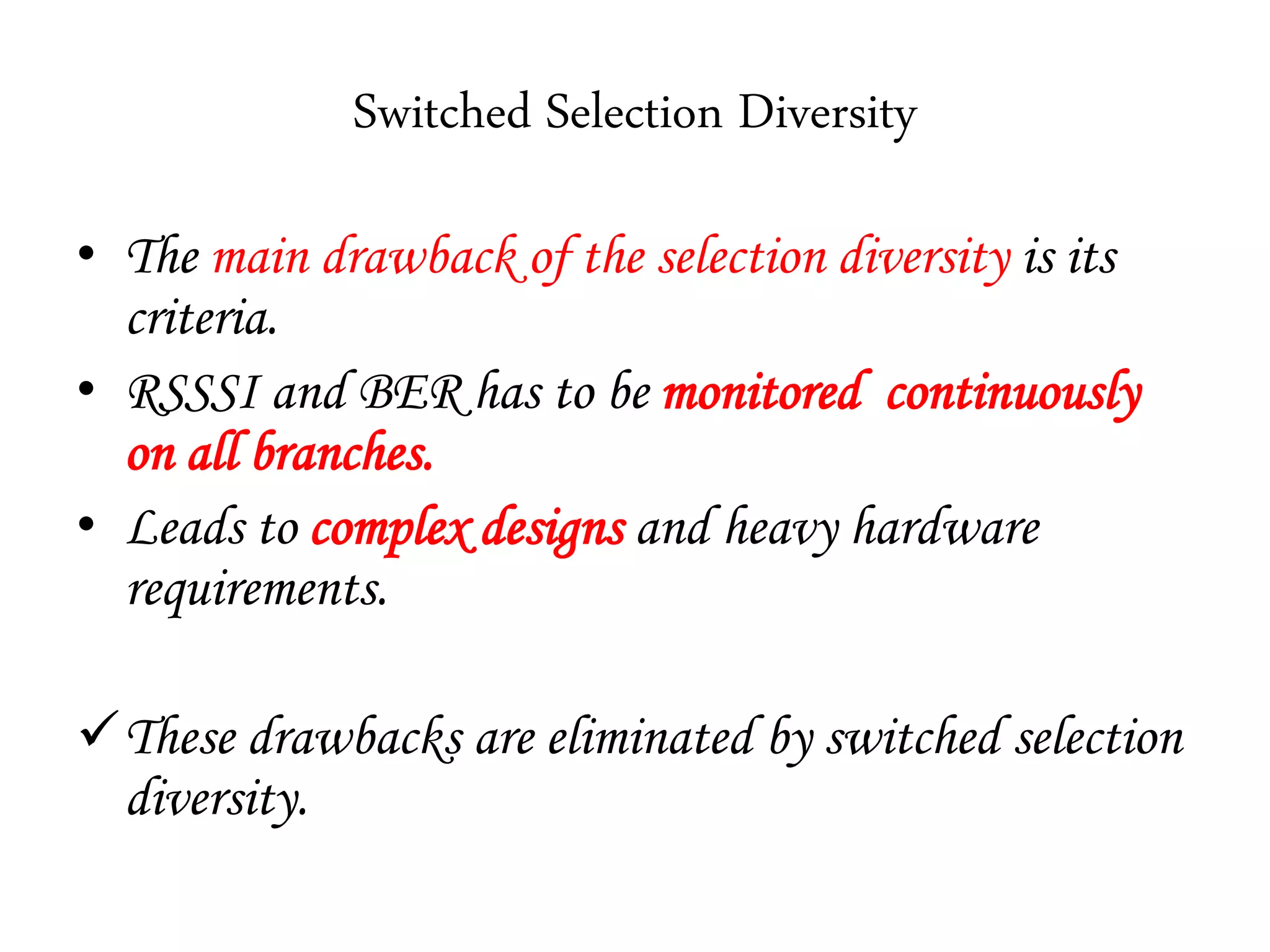
Switched Selection Diversity
• The main drawback of the selection diversity is its
criteria.
• RSSSI and BER has to be monitored continuously
on all branches.
• Leads to complex designs and heavy hardware
requirements.
These drawbacks are eliminated by switched selection
diversity.
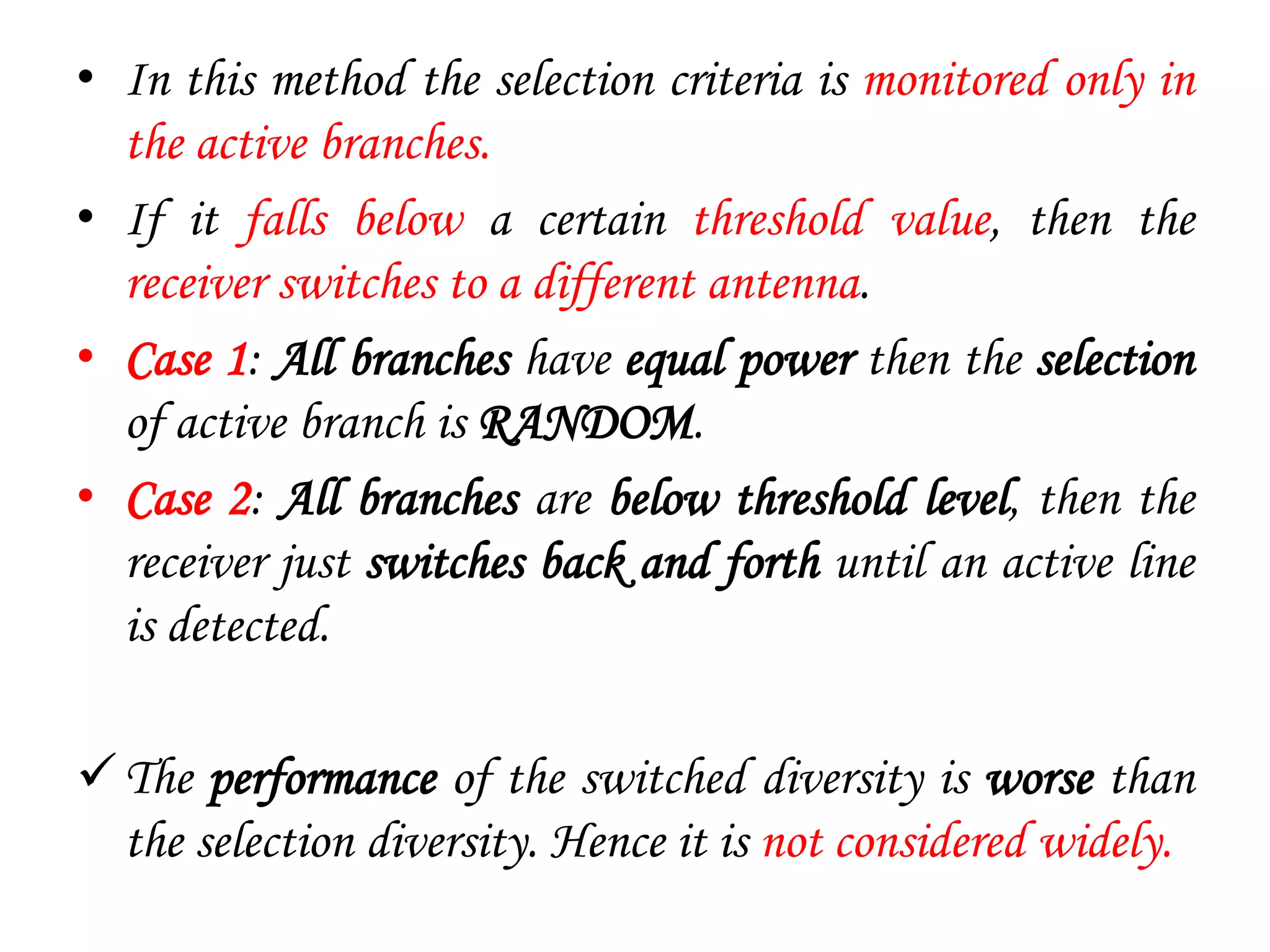
• In this method the selection criteria is monitored only in
the active branches.
• If it falls below a certain threshold value, then the
receiver switches to a different antenna.
• Case 1: All branches have equal power then the selection
of active branch is RANDOM.
• Case 2: All branches are below threshold level, then the
receiver just switches back and forth until an active line
is detected.
The performance of the switched diversity is worse than
the selection diversity. Hence it is not considered widely.
Feed Back Diversity
• Also called scanning diversity.
• This is a combination of selection and switched
diversity.
• All the available channels are scanned first in a fixed
sequence until one is found above the threshold level.
• The signal is received from that antenna until it falls
off the threshold value and scanning process is
initiated again.
2. Combining Diversity
• It exploits all available copies of signals. Each signal
copy is multiplied by a (complex) weight and then
added up.
• Weight = phase correction + weight of amplitude
• Phase correction is done to make the signals coherent.
• Amplitude weighting has 2 methods:
– Maximal ratio combining (MRC).
– Equal gain combining (EGC).
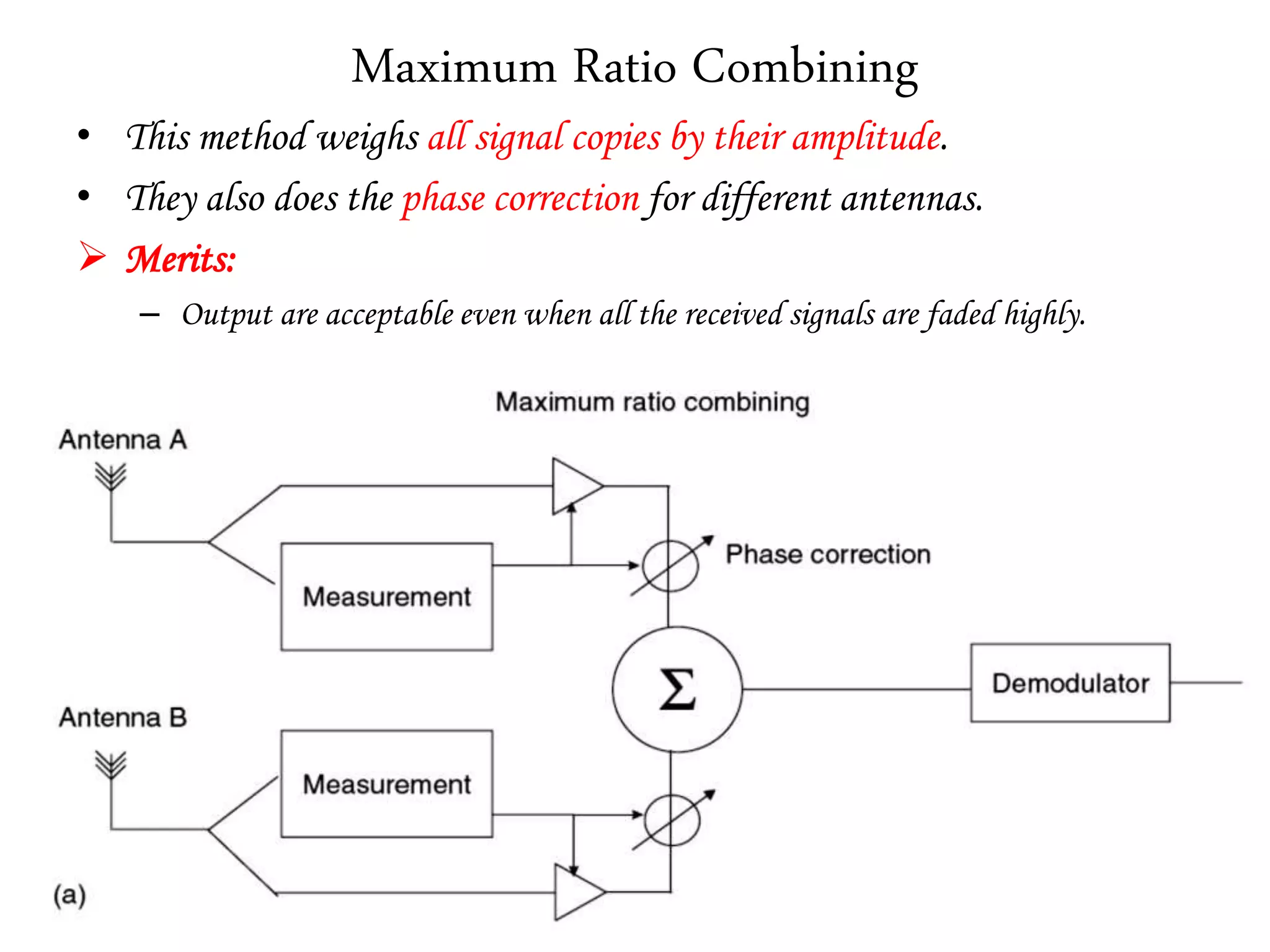
Maximum Ratio Combining
• This method weighs all signal copies by their amplitude.
• They also does the phase correction for different antennas.
 Merits:
– Output are acceptable even when all the received signals are faded highly.
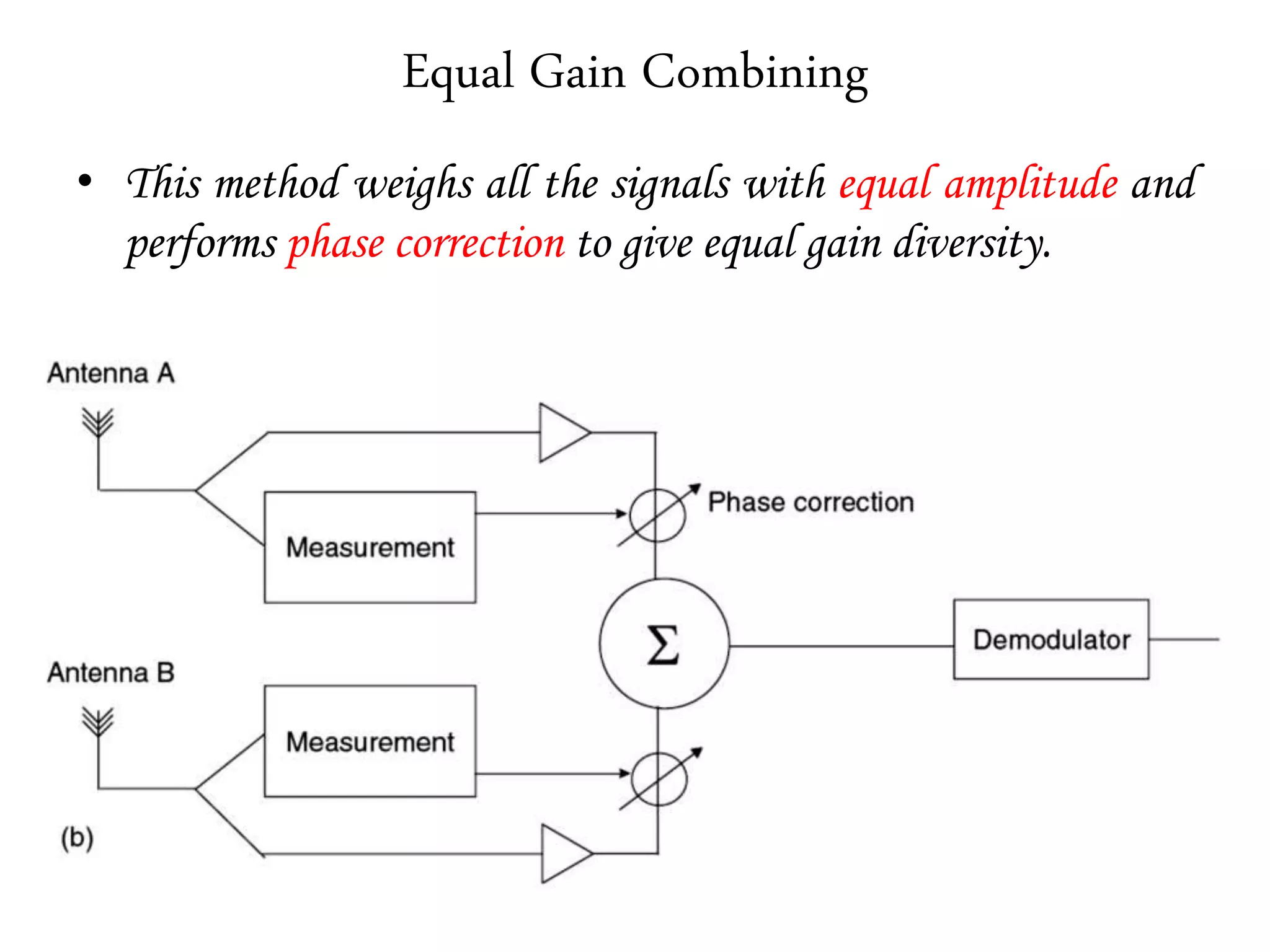
Equal Gain Combining
• This method weighs all the signals with equal amplitude and
performs phase correction to give equal gain diversity.
END
OF
DIVERSITY
EQUALISERS
Introduction
• Inter symbol interference is the major problem in
wireless communication which leads to the BIT
ERRORS at the receiver.
• Equalization is a technique used to reduce the inter
symbol interference.
• This device equalizes the dispersive effect of the
channel. (dispersion due to fading)
• Equalizers are mostly used at the receiver side.
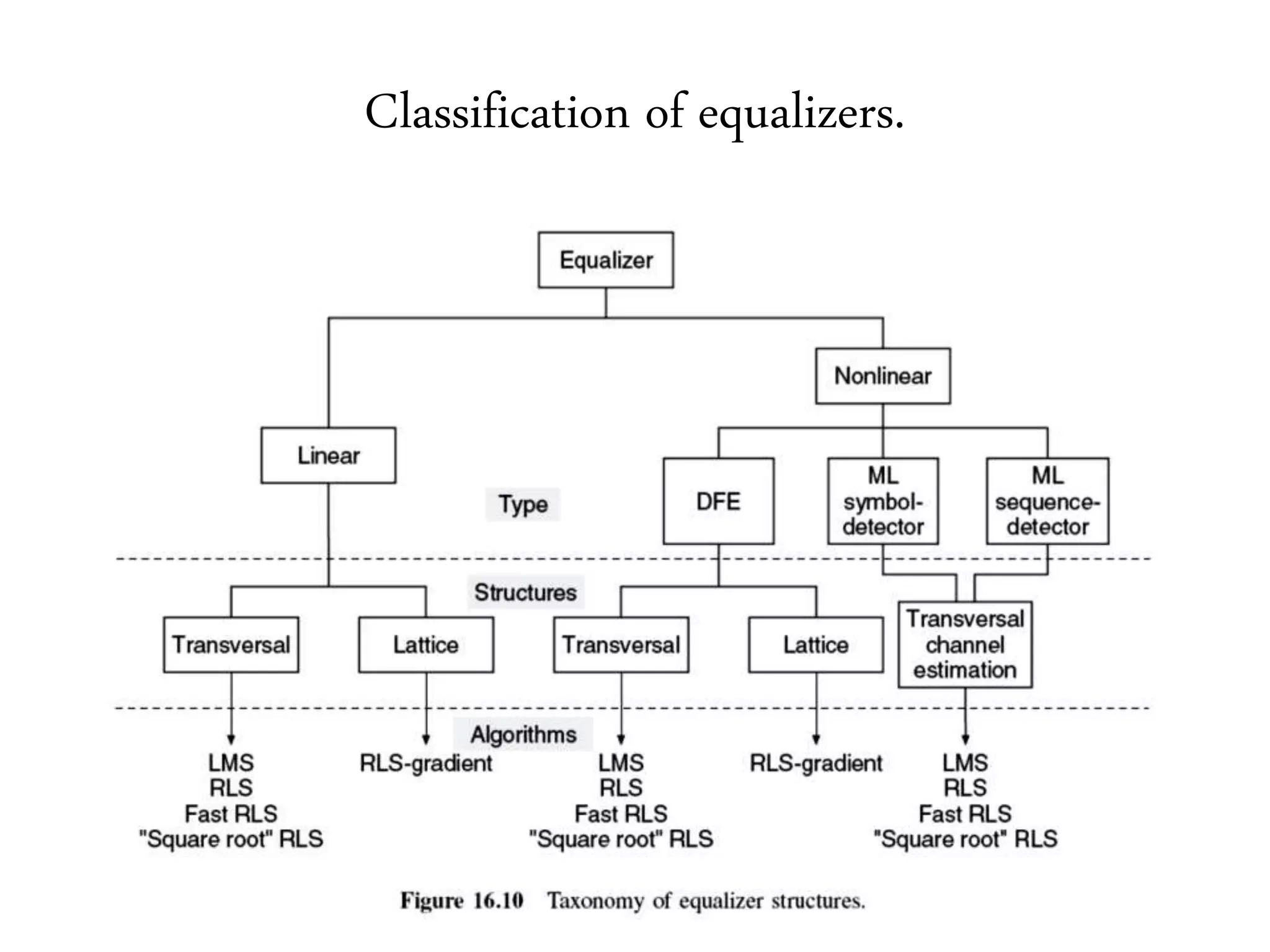
Classification of equalizers.
• Linear equalizers:
– If the output is not used in the feed back path to adapt
the equalizer is called linear equalizer.
• Non linear equalizers:
– If the output is fed back to change the subsequent outputs
of the equalizer is called as non linear equalizers.
LINEAR EQUALIZERS
• They are simple and resembles the filter structures.
• The product of the transfer function of the channel
and equalizer must satisfy certain criteria.
• The criteria can be,
– Either, Achieving a completely flat transfer function of
the channel – filter concatenation.
– Or, Minimizing the mean square error at the filter output.
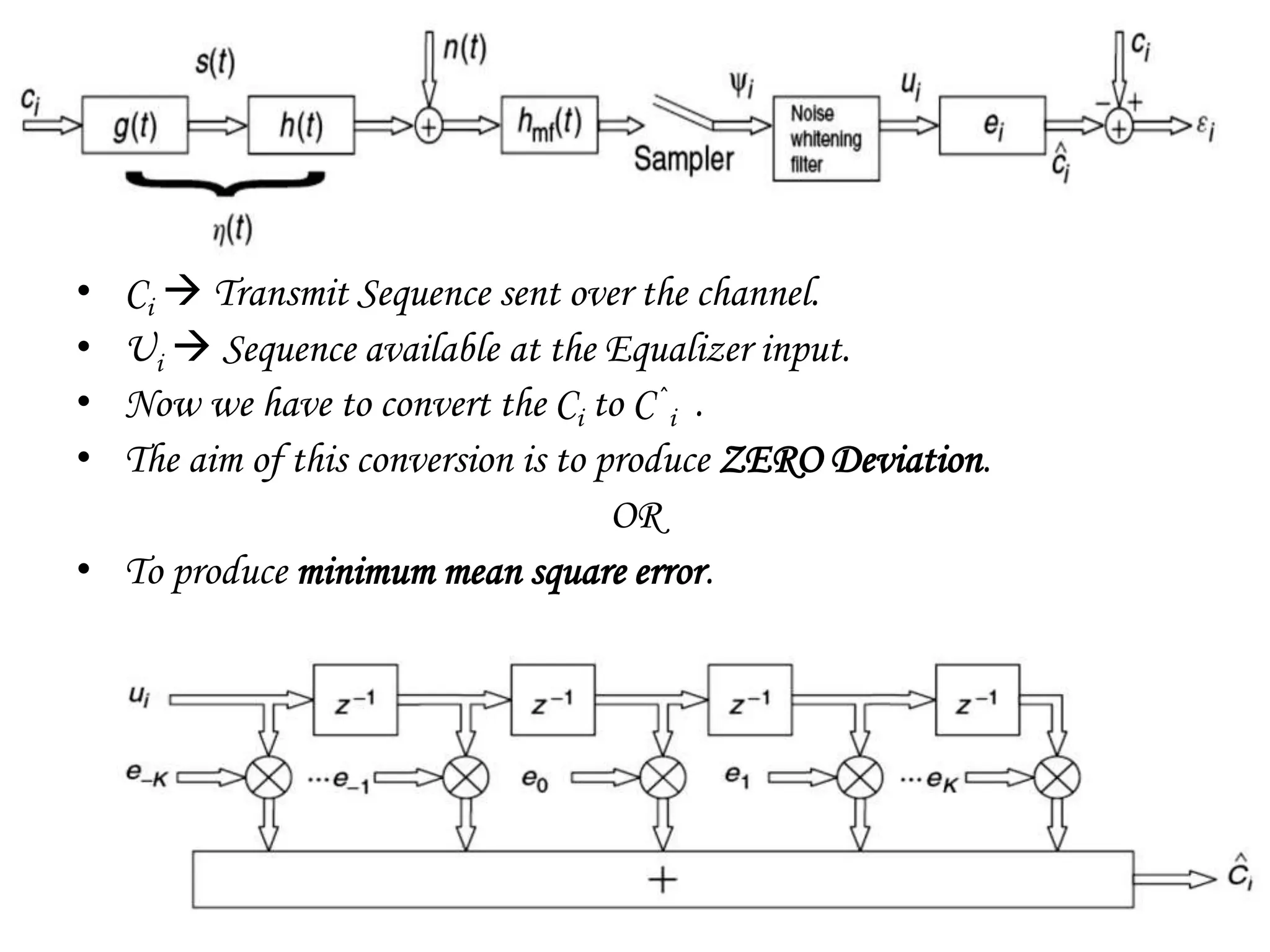
• The basic structure of the linear equalizer is shown in
the figure.
• Ci  Transmit Sequence sent over the channel.
• Ui  Sequence available at the Equalizer input.
• Now we have to convert the Ci to C^
i .
• The aim of this conversion is to produce ZERO Deviation.
OR
• To produce minimum mean square error.
Types of Linear Equalizers
• There are 2 types of linear equalizers, they are:
– Zero Forcing Equalizer (ZF)
– Minimum Mean Square Error Equalizer (MMSE)
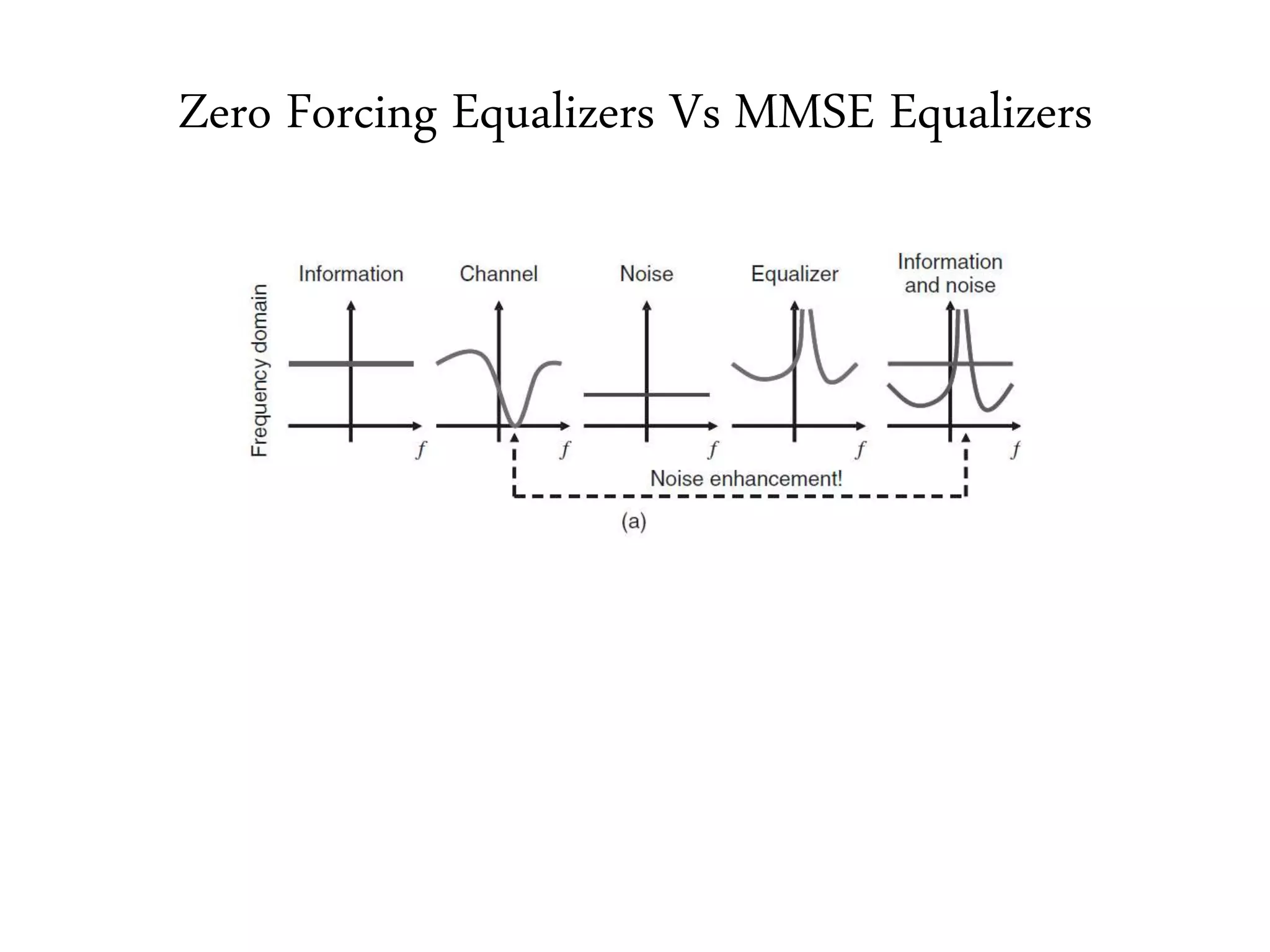
Zero Forcing Equalizers Vs MMSE Equalizers
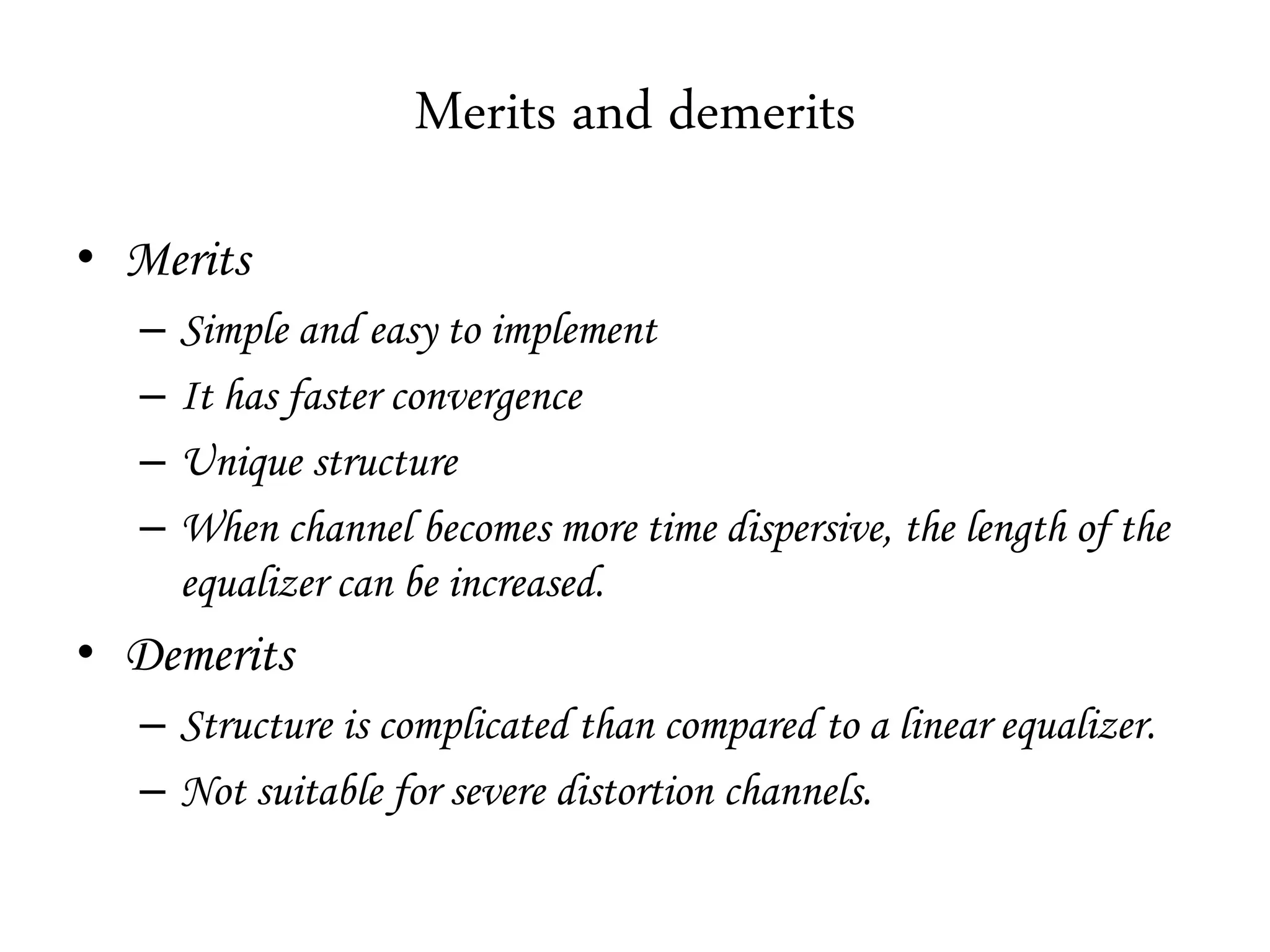
Merits and demerits
• Merits
– Simple and easy to implement
– It has faster convergence
– Unique structure
– When channel becomes more time dispersive, the length of the
equalizer can be increased.
• Demerits
– Structure is complicated than compared to a linear equalizer.
– Not suitable for severe distortion channels.
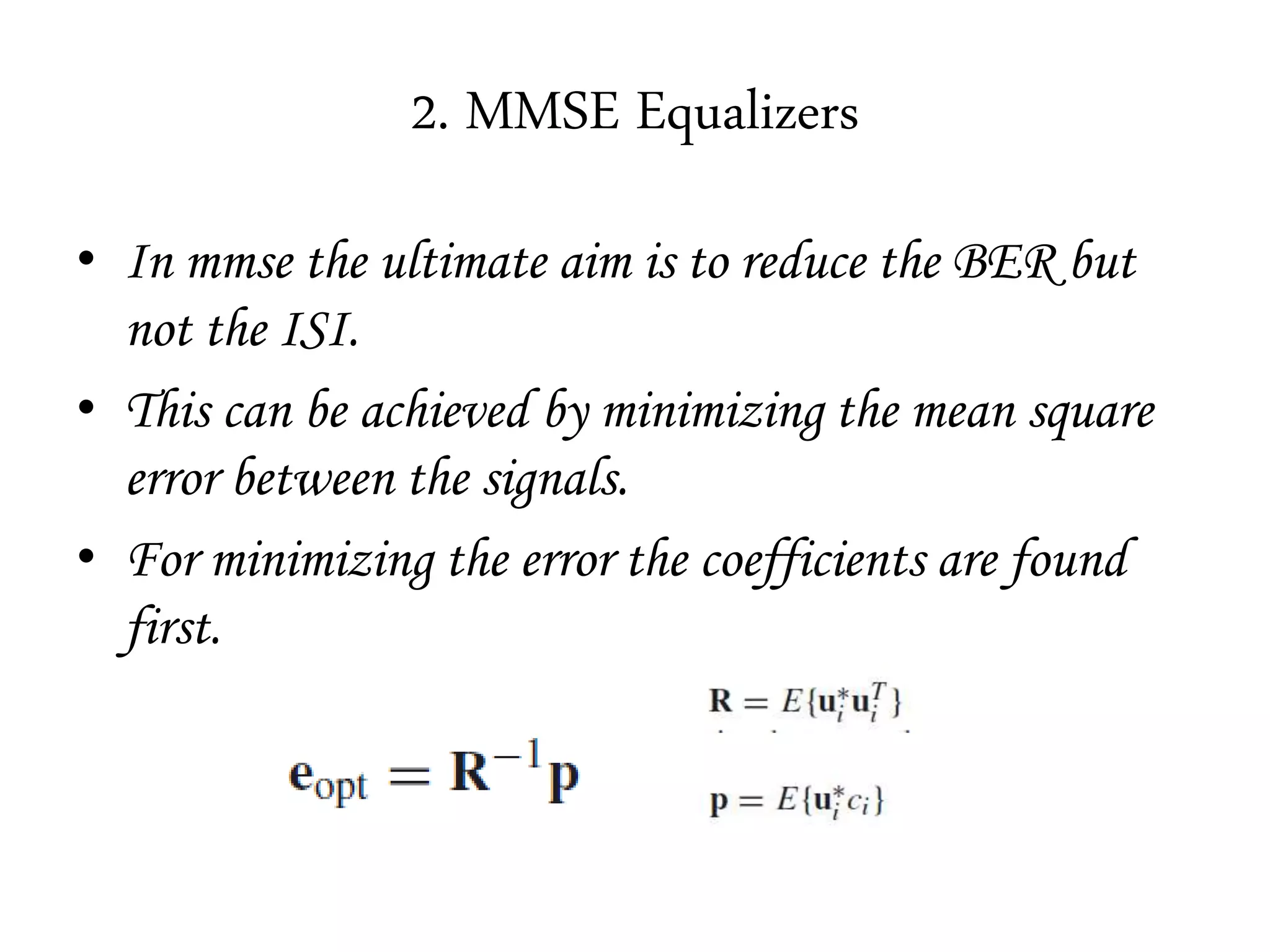
2. MMSE Equalizers
• In mmse the ultimate aim is to reduce the BER but
not the ISI.
• This can be achieved by minimizing the mean square
error between the signals.
• For minimizing the error the coefficients are found
first.
ALGORITHMS FOR MMSE
• Least Mean Square - LMS
• Recursive Least Square - RLS
LMS Algorithm
RLS Algorithms
• No assumptions are made in general
• Each signal is received individually and then they are
analyzed for the type of dispersion.
• This is more advantageous than the LMS alg.
NON LINEAR EQUALISERS
Ec 2401 wireless communication   unit 4

Ec 2401 wireless communication unit 4

  • 1.
    Unit - 4 SIGNALPROCESSING IN WIRELESS SYSTEMS Prepared by JAI GANESH S Asst.Professor - ECE
  • 2.
    Syllabus • Diversity – Principles –Macro Diversity – Micro Diversity – Signal Combining Techniques – Transmit diversity • Equalizer – Linear feed back equalizers – Decision feed back equalizers • Coding techniques – Channel Coding Techniques (Review) – Speech Coding Techniques (Review)
  • 3.
  • 4.
  • 5.
    Diversity - Principle •The principle of diversity is to ensure that the same information reaches the receiver on a statistically independent channels.
  • 6.
    Diversity • This isa technique implemented to improve the channel quality and performance. • This is achieved by placing the Tx signals in a statistically independent channels. • This reduces the over all fading of the received signals at the receiver side. • This technique mainly addresses the fading problems.
  • 7.
    Correlation Coefficient • Diversityis most efficient when the different transmission channels carry independently faded copies of the same signals. • The correlation coefficient characterises the correlation between signals on different diversity branches . • Correlation can be done on different parameters such as complex part of the signal, phase relations etc, • Most important one is correlation between the signal envelopes.
  • 8.
    Lack of Correlation- Understanding Dispersive Channels
  • 9.
    • The correlationcoefficient is given by: • Where x and y are the envelope of the signals. • The signals are said to be “effectively” decorrelated if , ρ is between a certain threshold value (typically 0.5 or 0.7)
  • 10.
    Types of Diversity •How to obtain the diversity in the signals ? • Diversity are classified based on the fading methods. –Small scale fading • Microscopic diversity techniques are used. –Large scale fading • Macroscopic diversity techniques are used.
  • 11.
    Micro diversity Techniques. •There are 5 methods available. – Spatial diversity • Antenna elements separated by space – Temporal diversity • Transmission of signals at different time – Frequency diversity • Transmission of signals at different frequencies – Angular diversity • Multiple antennas with different antenna patterns – Polarization diversity • Multiple antenna with different polarizations
  • 12.
    1. Spatial diversity •Signals are Transmitted / Received by more than one antenna and the best signal is selected for processing. • Oldest and simplest form of diversity • Large correlation between the signals are undesirable, as it decreases the effectiveness of diversity. • Important factor is to establish the relation between the antenna spacing (Different for Tr side and Different for the Rx side) Transmitter Side Receiver side 
  • 13.
    Envelope Correlation Coefficientas a function of antenna separation
  • 14.
    2.Temporal Diversity • Asthe wireless propagation channels are time variant, signals that are received at different times are uncorrelated. • Temporal diversity can be realized in 3 different ways. – Repetition coding – Automatic repeat request – Combination of interleaving and coding
  • 15.
    • Repetition coding: –The signal is repeated several times, where the repeat intervals are sufficient for decorrelation of signals. – This method is highly bandwidth inefficient • Automatic Repeat ReQuest – (ARQ): – Rx sends a message to transmitter to indicate weather it received the data with sufficient quality. – If not then transmission is repeated again. – Efficiency is better than repetition coding. – Retransmission occurs only at certain cases. • Combination of interleaving and coding: – The signals are interleaved and coded. Instead of sending the actual data those code words are sent. – The transmitted codeword can be reconstructed .
  • 16.
    3. Frequency Diversity •Frequency diversity is implemented by transmitting information on more than one carrier frequency. • It does not mean that same messages are transmitted in two different frequencies. – When this is done then the signals undergoes different fading levels. • Instead, information is spread over a large bandwidth, so the small parts of the information are conveyed by different frequency components. • Then the receiver averages over the different frequencies to recover the original information.
  • 17.
  • 18.
    • The spreadingis achieved by different methods: – Compressing the information in time.(TDMA) – Code division multiple access.(CDMA) – Orthogonal frequency division multiplexing(OFDM) – Frequency hopping in conjunction with coding. Demerits: - It requires large band width. - More number of receivers are required. - High cost.
  • 19.
    4. Angular Diversity •It enhances the decorrelation of signals at closely spaced antennas. • Different antenna patterns can be achieved very easily. • This effect is due to Mutual Coupling.
  • 20.
    Mutual Coupling • Place2 identical antennas close to each other • Here antenna B acts as a reflector for antenna A. • Antenna A acts as a reflector for Antenna B. • Hence the pattern of both the antennas are skewed as shown in figure. • Of Course Antennas with different radiation pattern can also be used
  • 21.
    • Mutual Couplingcan also be increased by locating the antenna at different parts of the casing. • The various possibilities are shown in the figure.
  • 22.
    5. Polarization Diversity •Signals are differentiated with the horizontally and vertically polarizations. • Reflection and the diffraction depends upon the polarizations. • The fading levels at each polarization are independent. Thus the diversity is achieved.
  • 23.
    Macro Diversity • MacroDiversity: – To reduce the large scale fading these macro diversity is used. – Large scale fading are generally caused by shadowing. – If there is an hill between the BS and the MS then simply increasing the Tx antenna and Rx antenna doesn’t make any difference. – Thus a intermediate BS (BS2) is placed in between the BS and MS so that the hill does not lie in between the BS and BS2. –Receive – Amplify – Retransmit. Merits: – Distance between BS and MS can be increased. Demerits: – It requires large bandwidth. – frequency repeaters causes delay dispersion.
  • 24.
    Diversity Achieved. Howto Resolve? Selection Diversity Combining Diversity
  • 25.
    Signal Combining Techniques –Selection diversity  Best signal is selected, and the rest are discarded. • Selection • Switched • Feed back – Combining diversity All signals are combined together and then it is decoded. • Maximal ratio combining • Equal gain diversity
  • 26.
    Selection Diversity • Thereare 2 selection criteria: – RSSI – Received Signal Strength Indication – BER – Bit Error Rate • The receiver selects the signal with the largest instantaneous power
  • 27.
    RSSI – DrivenSelection Diversity
  • 28.
    BER – DrivenSelection Diversity • Working… – We first transmit the Training Sequence. (ie) Know signal / sequence. – The Rx then demodulates the signal from each antenna and compares / correlates it with the transmit signal. – The antenna which received the smallest BER is chosen as the best and that signal is processed further.
  • 29.
    BER – DrivenSelection Diversity
  • 30.
    Merits and Demeritsof RSSI and BER • RSSI – Merits: • Only one RF Chain is used • Process is done on only one signal • Easy to implement – Demerits: • Waste of signal energy by discarding (n-1) received signals • Not an optimum method • BER – Demerits: • More number of Rx are used. • Implementation is complex • Training sequence is to be repeated again and again. • Tradeoff between the duration of training and BER should be maintained.
  • 31.
    Switched Selection Diversity •The main drawback of the selection diversity is its criteria. • RSSSI and BER has to be monitored continuously on all branches. • Leads to complex designs and heavy hardware requirements. These drawbacks are eliminated by switched selection diversity.
  • 32.
    • In thismethod the selection criteria is monitored only in the active branches. • If it falls below a certain threshold value, then the receiver switches to a different antenna. • Case 1: All branches have equal power then the selection of active branch is RANDOM. • Case 2: All branches are below threshold level, then the receiver just switches back and forth until an active line is detected. The performance of the switched diversity is worse than the selection diversity. Hence it is not considered widely.
  • 33.
    Feed Back Diversity •Also called scanning diversity. • This is a combination of selection and switched diversity. • All the available channels are scanned first in a fixed sequence until one is found above the threshold level. • The signal is received from that antenna until it falls off the threshold value and scanning process is initiated again.
  • 34.
    2. Combining Diversity •It exploits all available copies of signals. Each signal copy is multiplied by a (complex) weight and then added up. • Weight = phase correction + weight of amplitude • Phase correction is done to make the signals coherent. • Amplitude weighting has 2 methods: – Maximal ratio combining (MRC). – Equal gain combining (EGC).
  • 35.
    Maximum Ratio Combining •This method weighs all signal copies by their amplitude. • They also does the phase correction for different antennas.  Merits: – Output are acceptable even when all the received signals are faded highly.
  • 36.
    Equal Gain Combining •This method weighs all the signals with equal amplitude and performs phase correction to give equal gain diversity.
  • 37.
  • 38.
  • 39.
    Introduction • Inter symbolinterference is the major problem in wireless communication which leads to the BIT ERRORS at the receiver. • Equalization is a technique used to reduce the inter symbol interference. • This device equalizes the dispersive effect of the channel. (dispersion due to fading) • Equalizers are mostly used at the receiver side.
  • 40.
  • 41.
    • Linear equalizers: –If the output is not used in the feed back path to adapt the equalizer is called linear equalizer. • Non linear equalizers: – If the output is fed back to change the subsequent outputs of the equalizer is called as non linear equalizers.
  • 42.
    LINEAR EQUALIZERS • Theyare simple and resembles the filter structures. • The product of the transfer function of the channel and equalizer must satisfy certain criteria. • The criteria can be, – Either, Achieving a completely flat transfer function of the channel – filter concatenation. – Or, Minimizing the mean square error at the filter output. • The basic structure of the linear equalizer is shown in the figure.
  • 43.
    • Ci Transmit Sequence sent over the channel. • Ui  Sequence available at the Equalizer input. • Now we have to convert the Ci to C^ i . • The aim of this conversion is to produce ZERO Deviation. OR • To produce minimum mean square error.
  • 44.
    Types of LinearEqualizers • There are 2 types of linear equalizers, they are: – Zero Forcing Equalizer (ZF) – Minimum Mean Square Error Equalizer (MMSE)
  • 45.
    Zero Forcing EqualizersVs MMSE Equalizers
  • 46.
    Merits and demerits •Merits – Simple and easy to implement – It has faster convergence – Unique structure – When channel becomes more time dispersive, the length of the equalizer can be increased. • Demerits – Structure is complicated than compared to a linear equalizer. – Not suitable for severe distortion channels.
  • 47.
    2. MMSE Equalizers •In mmse the ultimate aim is to reduce the BER but not the ISI. • This can be achieved by minimizing the mean square error between the signals. • For minimizing the error the coefficients are found first.
  • 48.
    ALGORITHMS FOR MMSE •Least Mean Square - LMS • Recursive Least Square - RLS
  • 49.
  • 50.
    RLS Algorithms • Noassumptions are made in general • Each signal is received individually and then they are analyzed for the type of dispersion. • This is more advantageous than the LMS alg.
  • 51.

Editor's Notes

  • #18 NOTE: NOT AN EMPTY SLIDE….Image is hided for better understanding. View in slide show mode..