Highly Accurate 3D Surface Models by
Sparse Surface Adjustment
SUBMITTED BY:
NIDHI BARANWAL
SHUCHI
MCA 3RD SEM
OUTLINES
 Introduction
 Various techniques
 Working algorithm
 Sparse surface adjustment
* Surface model
* Sensor model for RGBD cameras
* Surface correspondence
* Least squares optimization
 Experiments
* Environmental model
*Object model
* Ground truth data
 Conclusions
 References
INTRODUCTION
 Accurate 3D models are essential for the next generation of robotic
applications. The problem of learning models of the environment with a
mobile robot is known as simultaneous localization and mapping
(SLAM).
 Here we propose an approach to obtain highly accurate 3D models
from range data
 a graph-based approach for refining 3D SLAM solutions by considering
it as a joint optimization task that simultaneously estimates the robot
poses and the surfaces in the environment.
 Our approach applies a physical model of the underlying range sensor.
We iteratively refine the graph structure by recomputing the data
association between each individual distance measurement and the
local surface points
CONTD..
 Our approach is a post-processing procedure to be applied to the output
of graph-based SLAM systems and is designed to provide locally more
consistent models.
 In particular RGBD cameras are affected by a quantization error that
leads to noise which grows with the distance.
 By specifically modeling this error, our approach is able to use long
range and noisy measurements, to capture wide regions, and to assess
the structure of the scene.
VARIOUS TECHNIQUES
 The standard technique for the registration of 3D range
scan pairs is the Iterative Closest Point Algorithm
(ICP)proposed by Besl which minimize the error based on a
plane-to-plane metric.
 Fleishman presented Robust Moving Least Squares (MLS),
a smoothing technique based on robust regression.They
assign the points to piecewise smooth surfaces and are able
to obtain accurate models
 Chang proposed model reconstruction approach .This
method estimates the stiffness between surface points and
deforms several scan parts to get a consistent model
WORKING ALGORITHM
 Our method is similar in spirit to traditional bundle adjustment (BA)
problems in computer vision
 A BA algorithm seeks to find the configuration of a set of
distinguishable features and camera poses that minimizes the re-
projection error over the measured sequence of images
 In contrast to BA, our method does not require point features and it
considers the local structure of the model while performing the
optimization.
 We globally minimize a local plane-to-plane error metric
 Furthermore, we refine the data associations after every optimization
run.
 This yields models with highly accurate surfaces and drastically reduces
the impact of noise
SPARSE SURFACE ADJUSTMENT
 We take the regularity assumption by approximating a surface by a set
of small planar patches, characterized by their normals in direction to
the sensor.This is called surfels.
 The main idea is to construct an optimization problem that tries to
adjust the poses of the sensor and the surfels to find a maximally
consistent configuration.This is done in four steps:
1. we assess the surfels structure from each individual measurement
endpoint.Then minimize the distance between nearby surfels
2. We extract locally planar surfels from each range scan. Each
measured distance is then connected to the corresponding surfel by a
constraint depending on the sensor used
3. Nearby surfels arising from different scans are then connected by
“virtual” measurements that are iteratively refined
4. how to construct a sparse optimization problem
1.SURFACE MODEL
It gives an example of the computed local characteristics. Since we update the
poses of the surfels during the optimization procedure we need to recompute the
local characteristics after each optimization run.
2.SENSOR MODEL FOR RGBD CAMERAS
 In case of RGBD the depth value of a point in the scene is obtained
from at least two projections of that point measured in the image
planes of two different observers.
 The displacement between two projections of the same point in the
two image planes is called disparity and is quantized in sub-pixels
 The resulting standard deviation is shown illustrating the
quantization error.
3.SURFACE CORRESPONDENCES
 we will explain how we determine potential
correspondences between regions of surfaces sensed from
different sensor positions.
 For a surfel we search for potential correspondences
between this surfel and all other surfels observed from
different sensor poses carefully within a search radius.
 A too large range might result in stretched surfaces and a
too small range might result in unconnected surfaces,
which might lead to an inconsistent model.
 To ensure the local connectivity we apply nearest neighbor
(NN) in close range and apply “normal-shooting” (NS) with
a larger search range.
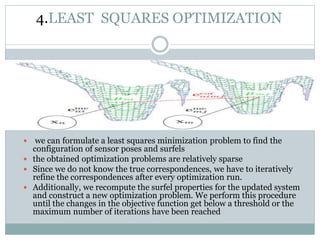
4.LEAST SQUARES OPTIMIZATION
 we can formulate a least squares minimization problem to find the
configuration of sensor poses and surfels
 the obtained optimization problems are relatively sparse
 Since we do not know the true correspondences, we have to iteratively
refine the correspondences after every optimization run.
 Additionally, we recompute the surfel properties for the updated system
and construct a new optimization problem. We perform this procedure
until the changes in the objective function get below a threshold or the
maximum number of iterations have been reached
EXPERIMENTS
 we present experiments on real world data to evaluate the
performance of our approach and to discuss its advantages.
 The main purpose of our approach is to improve the
consistency of models. We evaluate this consistency both
visually and quantitatively.
A. Environmental models
B. Object Models
C. Ground truth data
A.ENVIRONMENTAL MODELS
 In our first experiment we evaluated our method on
three different real world datasets
 The first dataset was recorded with a Kinect sensor in the
corridor of building
 The second dataset was recorded in the same corridor
using a tilting laser range finder.
 As third dataset we choose the publicly available dataset
which was recorded with a spinning laser range finder
 We computed SLAM solutions for both corridor datasets
and used the given SLAM solution of the third dataset as
baseline for our consistency comparison
 Afterwards we applied our method on all three datasets
CONTD..
DATASETS
BEFORE
OPTIMIZATION
AFTER
OPTIMIZATION
B.OBJECT MODELS
 In our second experiment we demonstrate that our
approach can also efficiently build consistent object
models up to a resolution of 1mm
 We applied the method on an object model datasets
 Initially we applied ICP approach; after that MLS
approach and optimized the result. Afterwards , we
applied our newly introduced method.
 Figure shows the input data and the resulting model
for a black cup
CONTD..
INPUT ICP MLS
OUR
APPROACH
C.GROUND TRUTH DATA
 Here we evaluate the accuracy achievable with our
method on a geometrically simple object like a
sphere
 The spherical geometry allowed us to sample a
perfect object model as ground truth
 We recorded a dataset of a metallic sphere on a table
and measured the poses of the camera
 The model using the motion capturing poses is used
as reference for comparison and as input to our
method.
CONTD..
OBJECT INPUT OUR APPROACH COMPARISON
CONCLUSIONS
 We presented a novel approach to improve the
results of pre-aligned 3D point clouds by jointly
optimizing the robot poses and the surface points.
 Our method treats range readings as samples of a
regular surface and is able to improve the
consistency of 3D models efficiently
 Experimental results obtained with an RGBD camera
and a laser range finder in real-world settings and
for known objects demonstrate that our approach
yields substantial improvements compared to a
standard SLAM technique
REFERENCES
[1] “Aass-loop dataset,” http://kos.informatik.uni-
osnabrueck.de/3Dscans.
[2] “Freiburg 2 metallic sphere 2 dataset,”
http://cvpr.in.tum.de/data/datasets/rgbd-dataset/.
[3] V. Andersen, H. Aanæs, and J. Bærentzen, “Surfel
based geometrY resonstruction,” Theory and Practice of
Computer Graphics8.
[4] P. J. Besl and N. D. McKay, “A method for registration
of 3-d shapes,”
IEEE Transactions on Pattern Analysis and Machine
Intelligence,
Graphics

Graphics

  • 1.
    Highly Accurate 3DSurface Models by Sparse Surface Adjustment SUBMITTED BY: NIDHI BARANWAL SHUCHI MCA 3RD SEM
  • 2.
    OUTLINES  Introduction  Varioustechniques  Working algorithm  Sparse surface adjustment * Surface model * Sensor model for RGBD cameras * Surface correspondence * Least squares optimization  Experiments * Environmental model *Object model * Ground truth data  Conclusions  References
  • 3.
    INTRODUCTION  Accurate 3Dmodels are essential for the next generation of robotic applications. The problem of learning models of the environment with a mobile robot is known as simultaneous localization and mapping (SLAM).  Here we propose an approach to obtain highly accurate 3D models from range data  a graph-based approach for refining 3D SLAM solutions by considering it as a joint optimization task that simultaneously estimates the robot poses and the surfaces in the environment.  Our approach applies a physical model of the underlying range sensor. We iteratively refine the graph structure by recomputing the data association between each individual distance measurement and the local surface points
  • 4.
    CONTD..  Our approachis a post-processing procedure to be applied to the output of graph-based SLAM systems and is designed to provide locally more consistent models.  In particular RGBD cameras are affected by a quantization error that leads to noise which grows with the distance.  By specifically modeling this error, our approach is able to use long range and noisy measurements, to capture wide regions, and to assess the structure of the scene.
  • 5.
    VARIOUS TECHNIQUES  Thestandard technique for the registration of 3D range scan pairs is the Iterative Closest Point Algorithm (ICP)proposed by Besl which minimize the error based on a plane-to-plane metric.  Fleishman presented Robust Moving Least Squares (MLS), a smoothing technique based on robust regression.They assign the points to piecewise smooth surfaces and are able to obtain accurate models  Chang proposed model reconstruction approach .This method estimates the stiffness between surface points and deforms several scan parts to get a consistent model
  • 6.
    WORKING ALGORITHM  Ourmethod is similar in spirit to traditional bundle adjustment (BA) problems in computer vision  A BA algorithm seeks to find the configuration of a set of distinguishable features and camera poses that minimizes the re- projection error over the measured sequence of images  In contrast to BA, our method does not require point features and it considers the local structure of the model while performing the optimization.  We globally minimize a local plane-to-plane error metric  Furthermore, we refine the data associations after every optimization run.  This yields models with highly accurate surfaces and drastically reduces the impact of noise
  • 7.
    SPARSE SURFACE ADJUSTMENT We take the regularity assumption by approximating a surface by a set of small planar patches, characterized by their normals in direction to the sensor.This is called surfels.  The main idea is to construct an optimization problem that tries to adjust the poses of the sensor and the surfels to find a maximally consistent configuration.This is done in four steps: 1. we assess the surfels structure from each individual measurement endpoint.Then minimize the distance between nearby surfels 2. We extract locally planar surfels from each range scan. Each measured distance is then connected to the corresponding surfel by a constraint depending on the sensor used 3. Nearby surfels arising from different scans are then connected by “virtual” measurements that are iteratively refined 4. how to construct a sparse optimization problem
  • 8.
    1.SURFACE MODEL It givesan example of the computed local characteristics. Since we update the poses of the surfels during the optimization procedure we need to recompute the local characteristics after each optimization run.
  • 9.
    2.SENSOR MODEL FORRGBD CAMERAS  In case of RGBD the depth value of a point in the scene is obtained from at least two projections of that point measured in the image planes of two different observers.  The displacement between two projections of the same point in the two image planes is called disparity and is quantized in sub-pixels  The resulting standard deviation is shown illustrating the quantization error.
  • 10.
    3.SURFACE CORRESPONDENCES  wewill explain how we determine potential correspondences between regions of surfaces sensed from different sensor positions.  For a surfel we search for potential correspondences between this surfel and all other surfels observed from different sensor poses carefully within a search radius.  A too large range might result in stretched surfaces and a too small range might result in unconnected surfaces, which might lead to an inconsistent model.  To ensure the local connectivity we apply nearest neighbor (NN) in close range and apply “normal-shooting” (NS) with a larger search range.
  • 11.
    4.LEAST SQUARES OPTIMIZATION we can formulate a least squares minimization problem to find the configuration of sensor poses and surfels  the obtained optimization problems are relatively sparse  Since we do not know the true correspondences, we have to iteratively refine the correspondences after every optimization run.  Additionally, we recompute the surfel properties for the updated system and construct a new optimization problem. We perform this procedure until the changes in the objective function get below a threshold or the maximum number of iterations have been reached
  • 12.
    EXPERIMENTS  we presentexperiments on real world data to evaluate the performance of our approach and to discuss its advantages.  The main purpose of our approach is to improve the consistency of models. We evaluate this consistency both visually and quantitatively. A. Environmental models B. Object Models C. Ground truth data
  • 13.
    A.ENVIRONMENTAL MODELS  Inour first experiment we evaluated our method on three different real world datasets  The first dataset was recorded with a Kinect sensor in the corridor of building  The second dataset was recorded in the same corridor using a tilting laser range finder.  As third dataset we choose the publicly available dataset which was recorded with a spinning laser range finder  We computed SLAM solutions for both corridor datasets and used the given SLAM solution of the third dataset as baseline for our consistency comparison  Afterwards we applied our method on all three datasets
  • 14.
  • 15.
    B.OBJECT MODELS  Inour second experiment we demonstrate that our approach can also efficiently build consistent object models up to a resolution of 1mm  We applied the method on an object model datasets  Initially we applied ICP approach; after that MLS approach and optimized the result. Afterwards , we applied our newly introduced method.  Figure shows the input data and the resulting model for a black cup
  • 16.
  • 17.
    C.GROUND TRUTH DATA Here we evaluate the accuracy achievable with our method on a geometrically simple object like a sphere  The spherical geometry allowed us to sample a perfect object model as ground truth  We recorded a dataset of a metallic sphere on a table and measured the poses of the camera  The model using the motion capturing poses is used as reference for comparison and as input to our method.
  • 18.
    CONTD.. OBJECT INPUT OURAPPROACH COMPARISON
  • 19.
    CONCLUSIONS  We presenteda novel approach to improve the results of pre-aligned 3D point clouds by jointly optimizing the robot poses and the surface points.  Our method treats range readings as samples of a regular surface and is able to improve the consistency of 3D models efficiently  Experimental results obtained with an RGBD camera and a laser range finder in real-world settings and for known objects demonstrate that our approach yields substantial improvements compared to a standard SLAM technique
  • 20.
    REFERENCES [1] “Aass-loop dataset,”http://kos.informatik.uni- osnabrueck.de/3Dscans. [2] “Freiburg 2 metallic sphere 2 dataset,” http://cvpr.in.tum.de/data/datasets/rgbd-dataset/. [3] V. Andersen, H. Aanæs, and J. Bærentzen, “Surfel based geometrY resonstruction,” Theory and Practice of Computer Graphics8. [4] P. J. Besl and N. D. McKay, “A method for registration of 3-d shapes,” IEEE Transactions on Pattern Analysis and Machine Intelligence,