PRESENTATION ON “DIGITAL MODULATION TECHNIQUES”
SAM HIGGINBOTTOM INSTITUTE OF
AGRICULTURE, TECHNOLOGY & SCIENCES
PRESENTED BY:-
PANKAJ SINGH
ID- 13BTECE029
PRESENTED TO:-
Er. MANVENDRA YADAV
Er. PRINU C. PHILIP
INTRODUCTION
• In a digital communication system, the source
to be transmitted is discrete both in time and
amplitude
• The source information is normally
represented as a baseband (low-pass) signal
• In digital modulation a high frequency analog
carrier signal is modulated by digital bit
stream
What is modulation ?
• Modulation = Adding information to a carrier signal
• The sine wave on which the characteristics of the
information signal are modulated is called a carrier signal
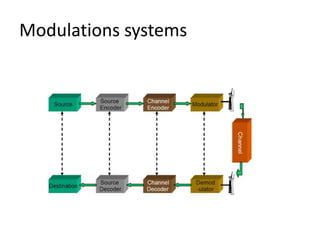
Modulations systems
Types of digital modulation technique
• Coherent
• Non coherent
Coherent; In coherent modulation technique
process received signal with a local carrier of
same frequency and phase.
Non coherent;In Non coherent digital
modulation technique there is no requirment
of reference wave.
Digital modulation technique
• ASK (Amplitude shift keying)
• PSK (Phase shift keying)
• FSK (Frequency shift keying)
Amplitude shift keying
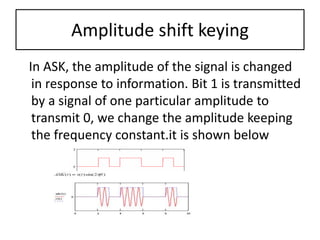
In ASK, the amplitude of the signal is changed
in response to information. Bit 1 is transmitted
by a signal of one particular amplitude to
transmit 0, we change the amplitude keeping
the frequency constant.it is shown below
Phase shift keying
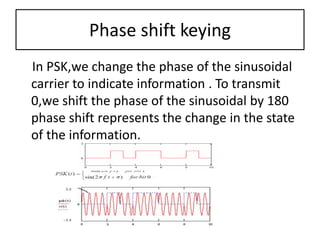
In PSK,we change the phase of the sinusoidal
carrier to indicate information . To transmit
0,we shift the phase of the sinusoidal by 180
phase shift represents the change in the state
of the information.
Frequency shift keying
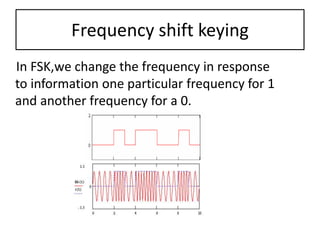
In FSK,we change the frequency in response
to information one particular frequency for 1
and another frequency for a 0.
advantages
• Digital modulation can easily detect and
correct the noise.
• Security is more in digital modulation.
• Digital modulation signal can travels a long
distance.
Thank you..

Digital Modulation Techniques ppt

  • 1.
    PRESENTATION ON “DIGITALMODULATION TECHNIQUES” SAM HIGGINBOTTOM INSTITUTE OF AGRICULTURE, TECHNOLOGY & SCIENCES PRESENTED BY:- PANKAJ SINGH ID- 13BTECE029 PRESENTED TO:- Er. MANVENDRA YADAV Er. PRINU C. PHILIP
  • 2.
    INTRODUCTION • In adigital communication system, the source to be transmitted is discrete both in time and amplitude • The source information is normally represented as a baseband (low-pass) signal • In digital modulation a high frequency analog carrier signal is modulated by digital bit stream
  • 3.
    What is modulation? • Modulation = Adding information to a carrier signal • The sine wave on which the characteristics of the information signal are modulated is called a carrier signal
  • 4.
  • 5.
    Types of digitalmodulation technique • Coherent • Non coherent Coherent; In coherent modulation technique process received signal with a local carrier of same frequency and phase. Non coherent;In Non coherent digital modulation technique there is no requirment of reference wave.
  • 6.
    Digital modulation technique •ASK (Amplitude shift keying) • PSK (Phase shift keying) • FSK (Frequency shift keying)
  • 7.
    Amplitude shift keying InASK, the amplitude of the signal is changed in response to information. Bit 1 is transmitted by a signal of one particular amplitude to transmit 0, we change the amplitude keeping the frequency constant.it is shown below
  • 8.
    Phase shift keying InPSK,we change the phase of the sinusoidal carrier to indicate information . To transmit 0,we shift the phase of the sinusoidal by 180 phase shift represents the change in the state of the information.
  • 9.
    Frequency shift keying InFSK,we change the frequency in response to information one particular frequency for 1 and another frequency for a 0.
  • 10.
    advantages • Digital modulationcan easily detect and correct the noise. • Security is more in digital modulation. • Digital modulation signal can travels a long distance.
  • 11.