FREQUENCY SHIFT-KEYING
ALSO KNOWN AS FSK
• Similar to the analog FM, it is a constant-amplitude angle
modulation
• The modulating signal (fm) is binary.
• Often called binary frequency shift-keying (BPSK).
FREQUENCY SHIFT-KEYING
Digital Data Modulation | Frequency Shift-Keying
2
Digital Data Modulation | Frequency Shift-Keying
3
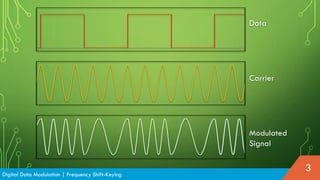
Data
Carrier
Modulated
Signal
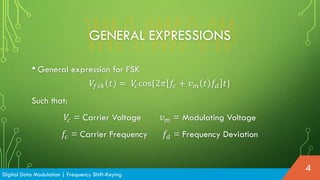
• General expression for FSK
𝑉𝑓𝑠𝑘 𝑡 = 𝑉𝑐cos{2𝜋 𝑓𝑐 + 𝑣 𝑚 𝑡 𝑓𝑑 𝑡}
Such that:
𝑉𝑐 = Carrier Voltage 𝑣 𝑚 = Modulating Voltage
𝑓𝑐 = Carrier Frequency 𝑓𝑑 = Frequency Deviation
GENERAL EXPRESSIONS
Digital Data Modulation | Frequency Shift-Keying
4
• The modulating signal is a normalized binary waveform where:
• For logic 1, 𝑣 𝑚 = +1V
𝑉𝑓𝑠𝑘 𝑡 = 𝑉𝑐cos{2𝜋 𝑓𝑐 + 𝑓𝑑 𝑡}
• For logic 0, 𝑣 𝑚 = -1V
𝑉𝑓𝑠𝑘 𝑡 = 𝑉𝑐cos{2𝜋 𝑓𝑐 − 𝑓𝑑 𝑡}
GENERAL EXPRESSIONS
Digital Data Modulation | Frequency Shift-Keying
5
Digital Data Modulation | Frequency Shift-Keying
6
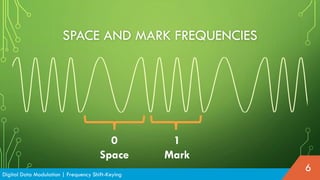
SPACE AND MARK FREQUENCIES
0
Space
1
Mark
SPACE AND MARK FREQUENCIES
Digital Data Modulation | Frequency Shift-Keying
7
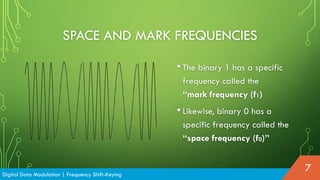
• The binary 1 has a specific
frequency called the
“mark frequency (f1)
• Likewise, binary 0 has a
specific frequency called the
“space frequency (f0)”
SPACE AND MARK FREQUENCIES
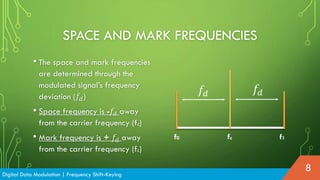
• The space and mark frequencies
are determined through the
modulated signal’s frequency
deviation (𝑓𝑑)
• Space frequency is -𝑓𝑑 away
from the carrier frequency (fc)
• Mark frequency is + 𝑓𝑑 away
from the carrier frequency (fc)
Digital Data Modulation | Frequency Shift-Keying
8
f1f0 fc
𝑓𝑑 𝑓𝑑
BIT RATE, BIT TIME AND BAUD
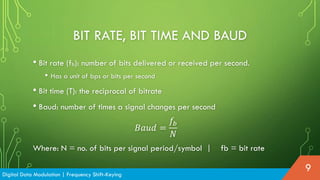
• Bit rate (fb): number of bits delivered or received per second.
• Has a unit of bps or bits per second
• Bit time (T): the reciprocal of bitrate
• Baud: number of times a signal changes per second
𝐵𝑎𝑢𝑑 =
𝑓𝑏
𝑁
Where: N = no. of bits per signal period/symbol | fb = bit rate
Digital Data Modulation | Frequency Shift-Keying
9
Digital Data Modulation | Frequency Shift-Keying
10
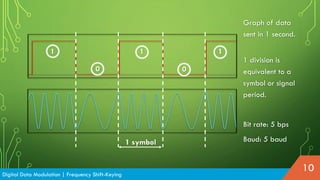
Graph of data
sent in 1 second.
1 division is
equivalent to a
symbol or signal
period.
Bit rate: 5 bps
Baud: 5 baud
1 1 1
0 0
1 symbol
Digital Data Modulation | Frequency Shift-Keying
11
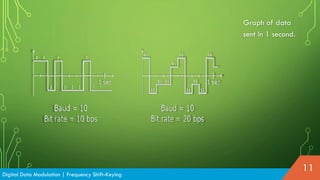
Graph of data
sent in 1 second.
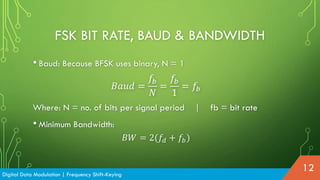
FSK BIT RATE, BAUD & BANDWIDTH
• Baud: Because BFSK uses binary, N = 1
𝐵𝑎𝑢𝑑 =
𝑓𝑏
𝑁
=
𝑓𝑏
1
= 𝑓𝑏
Where: N = no. of bits per signal period | fb = bit rate
• Minimum Bandwidth:
𝐵𝑊 = 2(𝑓𝑑 + 𝑓𝑏)
Digital Data Modulation | Frequency Shift-Keying
12
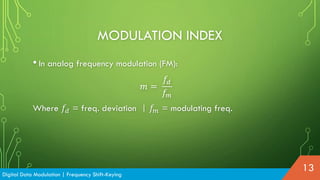
MODULATION INDEX
• In analog frequency modulation (FM):
𝑚 =
𝑓𝑑
𝑓𝑚
Where 𝑓𝑑 = freq. deviation | 𝑓𝑚 = modulating freq.
Digital Data Modulation | Frequency Shift-Keying
13
FSK MODULATION INDEX
• However in FSK:
𝑚 =
∆ 𝑑
𝑓 𝑏
or ∆ 𝑑(T)
Where ∆ 𝑑 = freq. deviation between 𝑓0 and 𝑓1
𝑓𝑏 = bit rate
T = bit time: reciprocal of bitrate
Digital Data Modulation | Frequency Shift-Keying
14
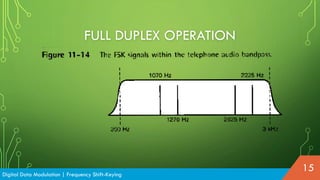
FULL DUPLEX OPERATION
Digital Data Modulation | Frequency Shift-Keying
15
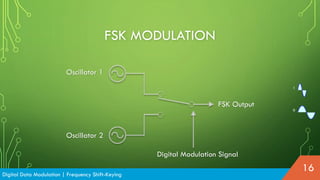
FSK MODULATION
Digital Data Modulation | Frequency Shift-Keying
16
Oscillator 1
Oscillator 2
Digital Modulation Signal
FSK Output
1
0
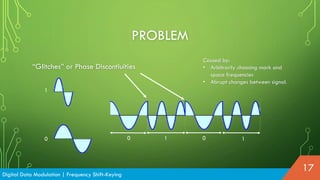
PROBLEM
“Glitches” or Phase Discontiuities
Digital Data Modulation | Frequency Shift-Keying
17
1
0 1 10 0
Caused by:
• Arbitrarily choosing mark and
space frequencies
• Abrupt changes between signal.
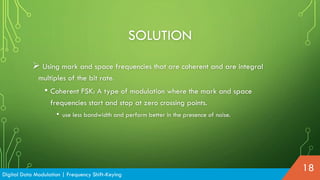
SOLUTION
Digital Data Modulation | Frequency Shift-Keying
18
➢ Using mark and space frequencies that are coherent and are integral
multiples of the bit rate.
• Coherent FSK: A type of modulation where the mark and space
frequencies start and stop at zero crossing points.
• use less bandwidth and perform better in the presence of noise.
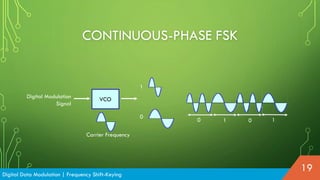
CONTINUOUS-PHASE FSK
Digital Data Modulation | Frequency Shift-Keying
19
1
0
1 10 0
Carrier Frequency
VCODigital Modulation
Signal
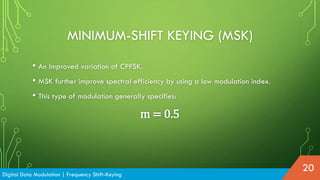
MINIMUM-SHIFT KEYING (MSK)
Digital Data Modulation | Frequency Shift-Keying
20
• An improved variation of CPFSK.
• MSK further improve spectral efficiency by using a low modulation index.
• This type of modulation generally specifies:
m = 0.5
GAUSSIAN FILTERED MSK (GMSK)
Digital Data Modulation | Frequency Shift-Keying
21
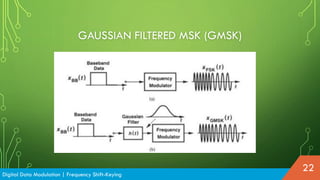
• An improved form of MSK.
• Gaussian low-pass filter
• removes some of the higher-level harmonics that are responsible for the added sidebands
and wider bandwidth.
• Rounds the edges of the signal lengthening the rise and fall times.
• Reduces harmonic content and decreases overall signal bandwidth.
GAUSSIAN FILTERED MSK (GMSK)
Digital Data Modulation | Frequency Shift-Keying
22
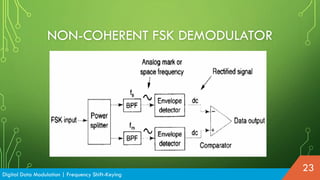
NON-COHERENT FSK DEMODULATOR
Digital Data Modulation | Frequency Shift-Keying
23
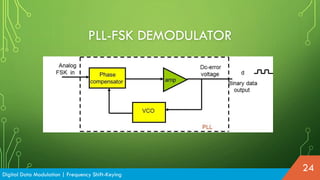
PLL-FSK DEMODULATOR
Digital Data Modulation | Frequency Shift-Keying
24
AUDIO FSK
• a modulation technique by which digital data is represented by changes in
the frequency (pitch) of an audio tone, yielding an encoded signal suitable for
transmission via radio or telephone.
• A higher tone for marks (1)
• A lower tone for space(0)
Digital Data Modulation | Frequency Shift-Keying
25
ADVANTAGES AND DISADVANTAGES
Advantage
• It has lower probability of error (Pe).
• It provides high SNR (Signal to Noise Ratio).
• It has higher immunity to noise due to constant envelope. Hence it is robust
against variation in attenuation through channel.
• FSK transmitter and FSK receiver implementations are simple for low data
rate application.
Digital Data Modulation | Frequency Shift-Keying
26
ADVANTAGES AND DISADVANTAGES
Disadvantage
• It uses larger bandwidth compare to other modulation techniques such as ASK
and PSK. Hence it is not bandwidth efficient.
Digital Data Modulation | Frequency Shift-Keying
27
APPLICATIONS
• Caller ID on Telephone Systems
• Amateur Radio
• Early Telephone-Line Modems.
• Emergency Broadcast Systems
• Modems
Digital Data Modulation | Frequency Shift-Keying
28
BELL 103 AND BELL 202
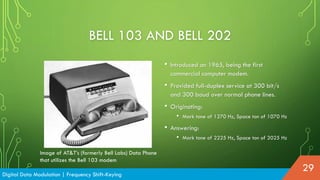
• Introduced on 1965, being the first
commercial computer modem.
• Provided full-duplex service at 300 bit/s
and 300 baud over normal phone lines.
• Originating:
• Mark tone of 1270 Hz, Space ton of 1070 Hz
• Answering:
• Mark tone of 2225 Hz, Space ton of 2025 Hz
Digital Data Modulation | Frequency Shift-Keying
29
Image of AT&T’s (formerly Bell Labs) Data Phone
that utilizes the Bell 103 modem
BELL 202
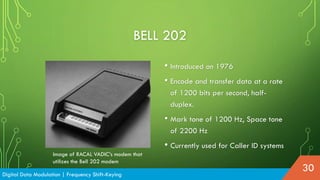
• Introduced on 1976
• Encode and transfer data at a rate
of 1200 bits per second, half-
duplex.
• Mark tone of 1200 Hz, Space tone
of 2200 Hz
• Currently used for Caller ID systems
Digital Data Modulation | Frequency Shift-Keying
30
Image of RACAL VADIC’s modem that
utilizes the Bell 202 modem
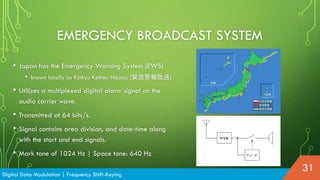
• Japan has the Emergency Warning System (EWS)
• known locally as Kinkyu Keihou Housou (緊急警報放送)
• Utilizes a multiplexed digital alarm signal on the
audio carrier wave.
• Transmitted at 64 bits/s.
• Signal contains area division, and date-time along
with the start and end signals.
• Mark tone of 1024 Hz | Space tone: 640 Hz
EMERGENCY BROADCAST SYSTEM
Digital Data Modulation | Frequency Shift-Keying
31
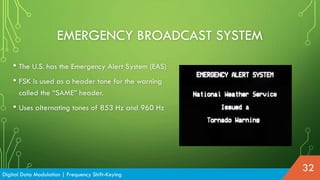
• The U.S. has the Emergency Alert System (EAS)
• FSK is used as a header tone for the warning
called the “SAME” header.
• Uses alternating tones of 853 Hz and 960 Hz
EMERGENCY BROADCAST SYSTEM
Digital Data Modulation | Frequency Shift-Keying
32
THANK YOU!

Frequency-Shift Keying

  • 1.
  • 2.
    • Similar tothe analog FM, it is a constant-amplitude angle modulation • The modulating signal (fm) is binary. • Often called binary frequency shift-keying (BPSK). FREQUENCY SHIFT-KEYING Digital Data Modulation | Frequency Shift-Keying 2
  • 3.
    Digital Data Modulation| Frequency Shift-Keying 3 Data Carrier Modulated Signal
  • 4.
    • General expressionfor FSK 𝑉𝑓𝑠𝑘 𝑡 = 𝑉𝑐cos{2𝜋 𝑓𝑐 + 𝑣 𝑚 𝑡 𝑓𝑑 𝑡} Such that: 𝑉𝑐 = Carrier Voltage 𝑣 𝑚 = Modulating Voltage 𝑓𝑐 = Carrier Frequency 𝑓𝑑 = Frequency Deviation GENERAL EXPRESSIONS Digital Data Modulation | Frequency Shift-Keying 4
  • 5.
    • The modulatingsignal is a normalized binary waveform where: • For logic 1, 𝑣 𝑚 = +1V 𝑉𝑓𝑠𝑘 𝑡 = 𝑉𝑐cos{2𝜋 𝑓𝑐 + 𝑓𝑑 𝑡} • For logic 0, 𝑣 𝑚 = -1V 𝑉𝑓𝑠𝑘 𝑡 = 𝑉𝑐cos{2𝜋 𝑓𝑐 − 𝑓𝑑 𝑡} GENERAL EXPRESSIONS Digital Data Modulation | Frequency Shift-Keying 5
  • 6.
    Digital Data Modulation| Frequency Shift-Keying 6 SPACE AND MARK FREQUENCIES 0 Space 1 Mark
  • 7.
    SPACE AND MARKFREQUENCIES Digital Data Modulation | Frequency Shift-Keying 7 • The binary 1 has a specific frequency called the “mark frequency (f1) • Likewise, binary 0 has a specific frequency called the “space frequency (f0)”
  • 8.
    SPACE AND MARKFREQUENCIES • The space and mark frequencies are determined through the modulated signal’s frequency deviation (𝑓𝑑) • Space frequency is -𝑓𝑑 away from the carrier frequency (fc) • Mark frequency is + 𝑓𝑑 away from the carrier frequency (fc) Digital Data Modulation | Frequency Shift-Keying 8 f1f0 fc 𝑓𝑑 𝑓𝑑
  • 9.
    BIT RATE, BITTIME AND BAUD • Bit rate (fb): number of bits delivered or received per second. • Has a unit of bps or bits per second • Bit time (T): the reciprocal of bitrate • Baud: number of times a signal changes per second 𝐵𝑎𝑢𝑑 = 𝑓𝑏 𝑁 Where: N = no. of bits per signal period/symbol | fb = bit rate Digital Data Modulation | Frequency Shift-Keying 9
  • 10.
    Digital Data Modulation| Frequency Shift-Keying 10 Graph of data sent in 1 second. 1 division is equivalent to a symbol or signal period. Bit rate: 5 bps Baud: 5 baud 1 1 1 0 0 1 symbol
  • 11.
    Digital Data Modulation| Frequency Shift-Keying 11 Graph of data sent in 1 second.
  • 12.
    FSK BIT RATE,BAUD & BANDWIDTH • Baud: Because BFSK uses binary, N = 1 𝐵𝑎𝑢𝑑 = 𝑓𝑏 𝑁 = 𝑓𝑏 1 = 𝑓𝑏 Where: N = no. of bits per signal period | fb = bit rate • Minimum Bandwidth: 𝐵𝑊 = 2(𝑓𝑑 + 𝑓𝑏) Digital Data Modulation | Frequency Shift-Keying 12
  • 13.
    MODULATION INDEX • Inanalog frequency modulation (FM): 𝑚 = 𝑓𝑑 𝑓𝑚 Where 𝑓𝑑 = freq. deviation | 𝑓𝑚 = modulating freq. Digital Data Modulation | Frequency Shift-Keying 13
  • 14.
    FSK MODULATION INDEX •However in FSK: 𝑚 = ∆ 𝑑 𝑓 𝑏 or ∆ 𝑑(T) Where ∆ 𝑑 = freq. deviation between 𝑓0 and 𝑓1 𝑓𝑏 = bit rate T = bit time: reciprocal of bitrate Digital Data Modulation | Frequency Shift-Keying 14
  • 15.
    FULL DUPLEX OPERATION DigitalData Modulation | Frequency Shift-Keying 15
  • 16.
    FSK MODULATION Digital DataModulation | Frequency Shift-Keying 16 Oscillator 1 Oscillator 2 Digital Modulation Signal FSK Output 1 0
  • 17.
    PROBLEM “Glitches” or PhaseDiscontiuities Digital Data Modulation | Frequency Shift-Keying 17 1 0 1 10 0 Caused by: • Arbitrarily choosing mark and space frequencies • Abrupt changes between signal.
  • 18.
    SOLUTION Digital Data Modulation| Frequency Shift-Keying 18 ➢ Using mark and space frequencies that are coherent and are integral multiples of the bit rate. • Coherent FSK: A type of modulation where the mark and space frequencies start and stop at zero crossing points. • use less bandwidth and perform better in the presence of noise.
  • 19.
    CONTINUOUS-PHASE FSK Digital DataModulation | Frequency Shift-Keying 19 1 0 1 10 0 Carrier Frequency VCODigital Modulation Signal
  • 20.
    MINIMUM-SHIFT KEYING (MSK) DigitalData Modulation | Frequency Shift-Keying 20 • An improved variation of CPFSK. • MSK further improve spectral efficiency by using a low modulation index. • This type of modulation generally specifies: m = 0.5
  • 21.
    GAUSSIAN FILTERED MSK(GMSK) Digital Data Modulation | Frequency Shift-Keying 21 • An improved form of MSK. • Gaussian low-pass filter • removes some of the higher-level harmonics that are responsible for the added sidebands and wider bandwidth. • Rounds the edges of the signal lengthening the rise and fall times. • Reduces harmonic content and decreases overall signal bandwidth.
  • 22.
    GAUSSIAN FILTERED MSK(GMSK) Digital Data Modulation | Frequency Shift-Keying 22
  • 23.
    NON-COHERENT FSK DEMODULATOR DigitalData Modulation | Frequency Shift-Keying 23
  • 24.
    PLL-FSK DEMODULATOR Digital DataModulation | Frequency Shift-Keying 24
  • 25.
    AUDIO FSK • amodulation technique by which digital data is represented by changes in the frequency (pitch) of an audio tone, yielding an encoded signal suitable for transmission via radio or telephone. • A higher tone for marks (1) • A lower tone for space(0) Digital Data Modulation | Frequency Shift-Keying 25
  • 26.
    ADVANTAGES AND DISADVANTAGES Advantage •It has lower probability of error (Pe). • It provides high SNR (Signal to Noise Ratio). • It has higher immunity to noise due to constant envelope. Hence it is robust against variation in attenuation through channel. • FSK transmitter and FSK receiver implementations are simple for low data rate application. Digital Data Modulation | Frequency Shift-Keying 26
  • 27.
    ADVANTAGES AND DISADVANTAGES Disadvantage •It uses larger bandwidth compare to other modulation techniques such as ASK and PSK. Hence it is not bandwidth efficient. Digital Data Modulation | Frequency Shift-Keying 27
  • 28.
    APPLICATIONS • Caller IDon Telephone Systems • Amateur Radio • Early Telephone-Line Modems. • Emergency Broadcast Systems • Modems Digital Data Modulation | Frequency Shift-Keying 28
  • 29.
    BELL 103 ANDBELL 202 • Introduced on 1965, being the first commercial computer modem. • Provided full-duplex service at 300 bit/s and 300 baud over normal phone lines. • Originating: • Mark tone of 1270 Hz, Space ton of 1070 Hz • Answering: • Mark tone of 2225 Hz, Space ton of 2025 Hz Digital Data Modulation | Frequency Shift-Keying 29 Image of AT&T’s (formerly Bell Labs) Data Phone that utilizes the Bell 103 modem
  • 30.
    BELL 202 • Introducedon 1976 • Encode and transfer data at a rate of 1200 bits per second, half- duplex. • Mark tone of 1200 Hz, Space tone of 2200 Hz • Currently used for Caller ID systems Digital Data Modulation | Frequency Shift-Keying 30 Image of RACAL VADIC’s modem that utilizes the Bell 202 modem
  • 31.
    • Japan hasthe Emergency Warning System (EWS) • known locally as Kinkyu Keihou Housou (緊急警報放送) • Utilizes a multiplexed digital alarm signal on the audio carrier wave. • Transmitted at 64 bits/s. • Signal contains area division, and date-time along with the start and end signals. • Mark tone of 1024 Hz | Space tone: 640 Hz EMERGENCY BROADCAST SYSTEM Digital Data Modulation | Frequency Shift-Keying 31
  • 32.
    • The U.S.has the Emergency Alert System (EAS) • FSK is used as a header tone for the warning called the “SAME” header. • Uses alternating tones of 853 Hz and 960 Hz EMERGENCY BROADCAST SYSTEM Digital Data Modulation | Frequency Shift-Keying 32
  • 33.