11/15/2024
1
Lecture# 03
Modulation Techniques
Dr. Shahzad Ashraf
Associate Professor
About Modulation
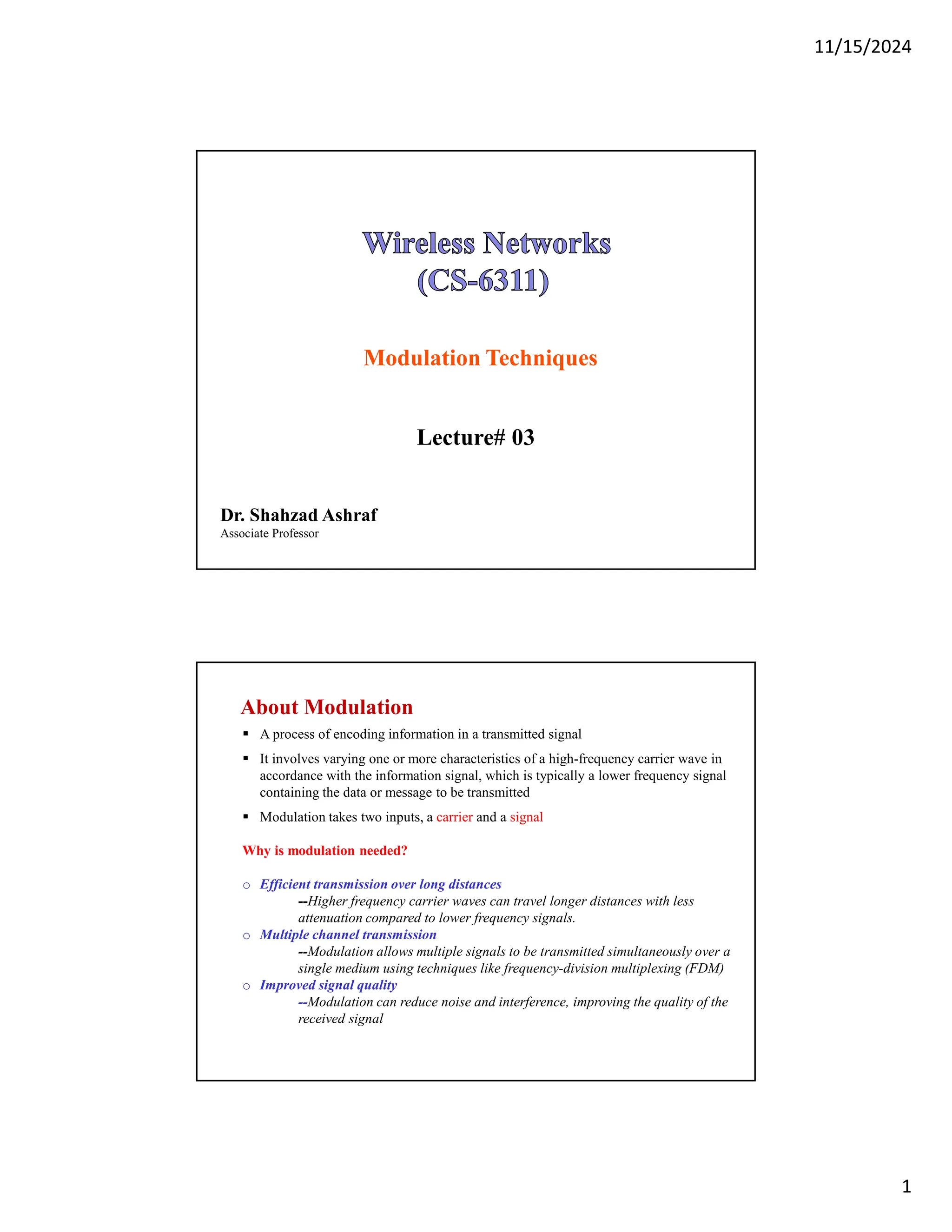
 A process of encoding information in a transmitted signal
 It involves varying one or more characteristics of a high-frequency carrier wave in
accordance with the information signal, which is typically a lower frequency signal
containing the data or message to be transmitted
 Modulation takes two inputs, a carrier and a signal
Why is modulation needed?
o Efficient transmission over long distances
--Higher frequency carrier waves can travel longer distances with less
attenuation compared to lower frequency signals.
o Multiple channel transmission
--Modulation allows multiple signals to be transmitted simultaneously over a
single medium using techniques like frequency-division multiplexing (FDM)
o Improved signal quality
--Modulation can reduce noise and interference, improving the quality of the
received signal
11/15/2024
2
Digital modulation
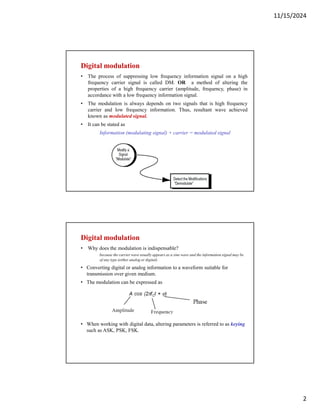
• The process of suppressing low frequency information signal on a high
frequency carrier signal is called DM. OR a method of altering the
properties of a high frequency carrier (amplitude, frequency, phase) in
accordance with a low frequency information signal.
• The modulation is always depends on two signals that is high frequency
carrier and low frequency information. Thus, resultant wave achieved
known as modulated signal.
• It can be stated as
Information (modulating signal) + carrier = modulated signal
Digital modulation
• Why does the modulation is indispensable?
because the carrier wave usually appears as a sine wave and the information signal may be
of any type (either analog or digital)
• Converting digital or analog information to a waveform suitable for
transmission over given medium.
• The modulation can be expressed as
• When working with digital data, altering parameters is referred to as keying
such as ASK, PSK, FSK.
11/15/2024
3
Digital modulation
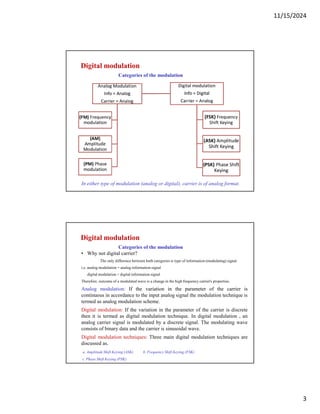
Categories of the modulation
In either type of modulation (analog or digital), carrier is of analog format.
Digital modulation
Categories of the modulation
• Why not digital carrier?
The only difference between both categories is type of information (modulating) signal.
i.e. analog modulation = analog information signal
digital modulation = digital information signal
Therefore. outcome of a modulated wave is a change in the high frequency carrier's properties.
Analog modulation: If the variation in the parameter of the carrier is
continuous in accordance to the input analog signal the modulation technique is
termed as analog modulation scheme.
Digital modulation: If the variation in the parameter of the carrier is discrete
then it is termed as digital modulation technique. In digital modulation , an
analog carrier signal is modulated by a discrete signal. The modulating wave
consists of binary data and the carrier is sinusoidal wave.
Digital modulation techniques: Three main digital modulation techniques are
discussed as.
a. Amplitude Shift Keying (ASK) b. Frequency Shift Keying (FSK)
c. Phase Shift Keying (PSK)
11/15/2024
4
Digital modulation techniques
a. Amplitude Shift Keying (ASK)
o It is a simplest digital modulation technique where digital data is converted into analog signal.
o The amplitude of carrier signal varies with respect to amplitude of message signal.
o Bit 1 is transmitted by a signal of one particular amplitude, to transmit 0,only change the amplitude
while keeping the frequency constant.
Digital modulation techniques
a. Amplitude Shift Keying (ASK)
The outcome:
o The information signal carries the discrete bit, only two voltage levels occur at input (either +1V or -1V)
o Thus, only two voltage levels at output are available (either [Ac cos(ωct)] or OV)
o because of these two output voltage levels, the carrier is either in ON or OFF state.
o Therefore, ASK is also known as ON-OFF Keying (OOK)
Applications
o Broadcasting of signal
o Lazer intensity modulation in optical fiber communication
11/15/2024
5
Digital modulation techniques
b. Frequency Shift Keying (FSK)
o Only change in frequency is occurred in response to the information, a binary information signal
directly modulates frequency of an analog carrier.
o The modulated signal 1, comes up with high frequency while 0 with low frequency
Digital modulation techniques
b. Frequency Shift Keying (FSK)
o Only change in frequency is occurred in response to the information, a binary information signal
11/15/2024
6
Digital modulation techniques
b. Frequency Shift Keying (FSK)
The outcome:
o The carrier wave continuously shifted by an amount specified as Δf.
o when logic 1 input is applied, the carrier wave modulated itself to a frequency known as mark
frequency (fm).
o when logic 0 input is applied, the carrier wave modulated itself to a frequency known as space
frequency (fc).
o The overall spectrum of FSK will be observed as
Digital modulation techniques
c. Phase Shift Keying (PSK)
o In this technique, the phase of the sinusoidal carrier to indicated information is being changed. Phase
in this context is the starting angle at which the sinusoidal starts.
o One phase change encodes 0 while another phase change encodes 1.To transmit 0,we shift the phase
of the sinusoid by 180. Thus, as the input digital signal changes state (i.e. from 1 to 0 or 0 to 1), the
phase of the output carrier shifts between two phases (that are separated by 180o).
o It is one of a simplest form of Binary phase shift keying (BPSK)
11/15/2024
7
The End

Lecture 03-Digital modulation techniques

  • 1.
    11/15/2024 1 Lecture# 03 Modulation Techniques Dr.Shahzad Ashraf Associate Professor About Modulation  A process of encoding information in a transmitted signal  It involves varying one or more characteristics of a high-frequency carrier wave in accordance with the information signal, which is typically a lower frequency signal containing the data or message to be transmitted  Modulation takes two inputs, a carrier and a signal Why is modulation needed? o Efficient transmission over long distances --Higher frequency carrier waves can travel longer distances with less attenuation compared to lower frequency signals. o Multiple channel transmission --Modulation allows multiple signals to be transmitted simultaneously over a single medium using techniques like frequency-division multiplexing (FDM) o Improved signal quality --Modulation can reduce noise and interference, improving the quality of the received signal
  • 2.
    11/15/2024 2 Digital modulation • Theprocess of suppressing low frequency information signal on a high frequency carrier signal is called DM. OR a method of altering the properties of a high frequency carrier (amplitude, frequency, phase) in accordance with a low frequency information signal. • The modulation is always depends on two signals that is high frequency carrier and low frequency information. Thus, resultant wave achieved known as modulated signal. • It can be stated as Information (modulating signal) + carrier = modulated signal Digital modulation • Why does the modulation is indispensable? because the carrier wave usually appears as a sine wave and the information signal may be of any type (either analog or digital) • Converting digital or analog information to a waveform suitable for transmission over given medium. • The modulation can be expressed as • When working with digital data, altering parameters is referred to as keying such as ASK, PSK, FSK.
  • 3.
    11/15/2024 3 Digital modulation Categories ofthe modulation In either type of modulation (analog or digital), carrier is of analog format. Digital modulation Categories of the modulation • Why not digital carrier? The only difference between both categories is type of information (modulating) signal. i.e. analog modulation = analog information signal digital modulation = digital information signal Therefore. outcome of a modulated wave is a change in the high frequency carrier's properties. Analog modulation: If the variation in the parameter of the carrier is continuous in accordance to the input analog signal the modulation technique is termed as analog modulation scheme. Digital modulation: If the variation in the parameter of the carrier is discrete then it is termed as digital modulation technique. In digital modulation , an analog carrier signal is modulated by a discrete signal. The modulating wave consists of binary data and the carrier is sinusoidal wave. Digital modulation techniques: Three main digital modulation techniques are discussed as. a. Amplitude Shift Keying (ASK) b. Frequency Shift Keying (FSK) c. Phase Shift Keying (PSK)
  • 4.
    11/15/2024 4 Digital modulation techniques a.Amplitude Shift Keying (ASK) o It is a simplest digital modulation technique where digital data is converted into analog signal. o The amplitude of carrier signal varies with respect to amplitude of message signal. o Bit 1 is transmitted by a signal of one particular amplitude, to transmit 0,only change the amplitude while keeping the frequency constant. Digital modulation techniques a. Amplitude Shift Keying (ASK) The outcome: o The information signal carries the discrete bit, only two voltage levels occur at input (either +1V or -1V) o Thus, only two voltage levels at output are available (either [Ac cos(ωct)] or OV) o because of these two output voltage levels, the carrier is either in ON or OFF state. o Therefore, ASK is also known as ON-OFF Keying (OOK) Applications o Broadcasting of signal o Lazer intensity modulation in optical fiber communication
  • 5.
    11/15/2024 5 Digital modulation techniques b.Frequency Shift Keying (FSK) o Only change in frequency is occurred in response to the information, a binary information signal directly modulates frequency of an analog carrier. o The modulated signal 1, comes up with high frequency while 0 with low frequency Digital modulation techniques b. Frequency Shift Keying (FSK) o Only change in frequency is occurred in response to the information, a binary information signal
  • 6.
    11/15/2024 6 Digital modulation techniques b.Frequency Shift Keying (FSK) The outcome: o The carrier wave continuously shifted by an amount specified as Δf. o when logic 1 input is applied, the carrier wave modulated itself to a frequency known as mark frequency (fm). o when logic 0 input is applied, the carrier wave modulated itself to a frequency known as space frequency (fc). o The overall spectrum of FSK will be observed as Digital modulation techniques c. Phase Shift Keying (PSK) o In this technique, the phase of the sinusoidal carrier to indicated information is being changed. Phase in this context is the starting angle at which the sinusoidal starts. o One phase change encodes 0 while another phase change encodes 1.To transmit 0,we shift the phase of the sinusoid by 180. Thus, as the input digital signal changes state (i.e. from 1 to 0 or 0 to 1), the phase of the output carrier shifts between two phases (that are separated by 180o). o It is one of a simplest form of Binary phase shift keying (BPSK)
  • 7.