
Some remarks on
distributed depth-first search
SUBMITTED BY: NIDHI BARANWAL
MCA 3RD SEM
University of Allahabad
INTRODUCTION
 Depth-first search (DFS) is a powerful technique that
has been used in designing many efficient graph
algorithms on the computer model.
 DFS is an algorithm for traversing or searching tree or
graph data structures. We start at the root and explores
as far as possible along each branch before backtracking
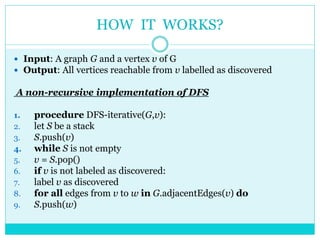
HOW IT WORKS?
 Input: A graph G and a vertex v of G
 Output: All vertices reachable from v labelled as discovered
A non-recursive implementation of DFS
1. procedure DFS-iterative(G,v):
2. let S be a stack
3. S.push(v)
4. while S is not empty
5. v = S.pop()
6. if v is not labeled as discovered:
7. label v as discovered
8. for all edges from v to w in G.adjacentEdges(v) do
9. S.push(w)
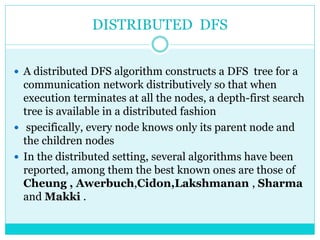
DISTRIBUTED DFS
 A distributed DFS algorithm constructs a DFS tree for a
communication network distributively so that when
execution terminates at all the nodes, a depth-first search
tree is available in a distributed fashion
 specifically, every node knows only its parent node and
the children nodes
 In the distributed setting, several algorithms have been
reported, among them the best known ones are those of
Cheung , Awerbuch,Cidon,Lakshmanan , Sharma
and Makki .
AN OVERVIEW
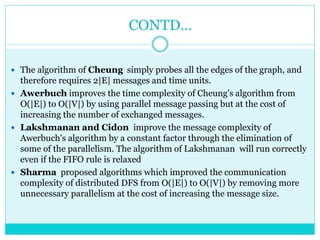
 The time complexity is the maximum time elapsed
from the beginning to the termination of the algorithm,
assuming that delivering a message over a link requires
at most one unit of time.
 The communication complexity is the total number of
messages sent during the execution of the algorithm
CONTD…
 The algorithm of Cheung simply probes all the edges of the graph, and
therefore requires 2|E| messages and time units.
 Awerbuch improves the time complexity of Cheung's algorithm from
O(|E|) to O(|V|) by using parallel message passing but at the cost of
increasing the number of exchanged messages.
 Lakshmanan and Cidon improve the message complexity of
Awerbuch's algorithm by a constant factor through the elimination of
some of the parallelism. The algorithm of Lakshmanan will run correctly
even if the FIFO rule is relaxed
 Sharma proposed algorithms which improved the communication
complexity of distributed DFS from O(|E|) to O(|V|) by removing more
unnecessary parallelism at the cost of increasing the message size.
AN INNOVATIVE IDEA
 The time and message complexity of both Lakshmanan
and the Cidon’s algorithm can be improved by using the
dynamic backtracking technique of Makki .
 The idea is to have each node, except the node source,
keep track of the lowest ancestor node, called split point,
such that no internal node lying on the tree-path
connecting the node and its split point has an ‘unvisited’
link.
 That means when the search backtracks at a node, the
backtracking will continue until it reaches the split point
of that node.
ALGORITHM
 We use Forward and Return messages to explore the
tree. Our key improvement is to reduce the number of
Return messages by using dynamic backtracking.
 Each node has a copy of the procedure Ddfs .We define a
node to be a split point if, when visited, it has two or
more unvisited neighbours or if it is the root node.
 Nodes which are not split points may be bypassed by
Return messages.
 Our messages comprise four components: message
originator; message type; the set visited of visited nodes;
and splitpoint, the previous split point.
CONTD…
 A node which receives a message executes the Ddfs
procedure. Forward messages lead to execution of
initialization code for local variables.
 In each case, a Forward message is issued to a neighbour
, else a Return message is issued to an ancestor, else the
algorithm terminates.
 Our DDFS algorithm constructs the DFS tree for the
distributed system in the order in which nodes are visited
during the execution of the algorithm.
 The DFS tree is stored in a standard way: at termination
the root node is informed. Each node has local variables
parent and childset for storing the DFS-tree, a variable
unvisited for storing its set of unvisited neighbours.
ANALYSIS
 The message and time complexity of this DDFS
algorithm is b/w |V| and 2|V|-2.
 The message complexity is the total number of Forward
and Return messages. The number of Forward messages
is |V|-1, because each non root node has exactly one
Forward message sent to it.
 The number of Return messages is at least one, since a
Return message must be received by the root ; and at
most |V|-1, because each non root node sends at most
one Return message. Thus the total number of messages
is between |V| and 2|V|-2.
 In this algorithm the message and time complexities are
the same.
distributed depth-first search

distributed depth-first search

  • 1.
    Some remarks on distributeddepth-first search SUBMITTED BY: NIDHI BARANWAL MCA 3RD SEM University of Allahabad
  • 2.
    INTRODUCTION  Depth-first search(DFS) is a powerful technique that has been used in designing many efficient graph algorithms on the computer model.  DFS is an algorithm for traversing or searching tree or graph data structures. We start at the root and explores as far as possible along each branch before backtracking
  • 3.
    HOW IT WORKS? Input: A graph G and a vertex v of G  Output: All vertices reachable from v labelled as discovered A non-recursive implementation of DFS 1. procedure DFS-iterative(G,v): 2. let S be a stack 3. S.push(v) 4. while S is not empty 5. v = S.pop() 6. if v is not labeled as discovered: 7. label v as discovered 8. for all edges from v to w in G.adjacentEdges(v) do 9. S.push(w)
  • 4.
    DISTRIBUTED DFS  Adistributed DFS algorithm constructs a DFS tree for a communication network distributively so that when execution terminates at all the nodes, a depth-first search tree is available in a distributed fashion  specifically, every node knows only its parent node and the children nodes  In the distributed setting, several algorithms have been reported, among them the best known ones are those of Cheung , Awerbuch,Cidon,Lakshmanan , Sharma and Makki .
  • 5.
    AN OVERVIEW  Thetime complexity is the maximum time elapsed from the beginning to the termination of the algorithm, assuming that delivering a message over a link requires at most one unit of time.  The communication complexity is the total number of messages sent during the execution of the algorithm
  • 6.
    CONTD…  The algorithmof Cheung simply probes all the edges of the graph, and therefore requires 2|E| messages and time units.  Awerbuch improves the time complexity of Cheung's algorithm from O(|E|) to O(|V|) by using parallel message passing but at the cost of increasing the number of exchanged messages.  Lakshmanan and Cidon improve the message complexity of Awerbuch's algorithm by a constant factor through the elimination of some of the parallelism. The algorithm of Lakshmanan will run correctly even if the FIFO rule is relaxed  Sharma proposed algorithms which improved the communication complexity of distributed DFS from O(|E|) to O(|V|) by removing more unnecessary parallelism at the cost of increasing the message size.
  • 7.
    AN INNOVATIVE IDEA The time and message complexity of both Lakshmanan and the Cidon’s algorithm can be improved by using the dynamic backtracking technique of Makki .  The idea is to have each node, except the node source, keep track of the lowest ancestor node, called split point, such that no internal node lying on the tree-path connecting the node and its split point has an ‘unvisited’ link.  That means when the search backtracks at a node, the backtracking will continue until it reaches the split point of that node.
  • 8.
    ALGORITHM  We useForward and Return messages to explore the tree. Our key improvement is to reduce the number of Return messages by using dynamic backtracking.  Each node has a copy of the procedure Ddfs .We define a node to be a split point if, when visited, it has two or more unvisited neighbours or if it is the root node.  Nodes which are not split points may be bypassed by Return messages.  Our messages comprise four components: message originator; message type; the set visited of visited nodes; and splitpoint, the previous split point.
  • 9.
    CONTD…  A nodewhich receives a message executes the Ddfs procedure. Forward messages lead to execution of initialization code for local variables.  In each case, a Forward message is issued to a neighbour , else a Return message is issued to an ancestor, else the algorithm terminates.  Our DDFS algorithm constructs the DFS tree for the distributed system in the order in which nodes are visited during the execution of the algorithm.  The DFS tree is stored in a standard way: at termination the root node is informed. Each node has local variables parent and childset for storing the DFS-tree, a variable unvisited for storing its set of unvisited neighbours.
  • 10.
    ANALYSIS  The messageand time complexity of this DDFS algorithm is b/w |V| and 2|V|-2.  The message complexity is the total number of Forward and Return messages. The number of Forward messages is |V|-1, because each non root node has exactly one Forward message sent to it.  The number of Return messages is at least one, since a Return message must be received by the root ; and at most |V|-1, because each non root node sends at most one Return message. Thus the total number of messages is between |V| and 2|V|-2.  In this algorithm the message and time complexities are the same.