Embed presentation
Downloaded 241 times
This document discusses different types of analog modulation techniques used in communication systems. It defines key concepts like signals, carriers, modulation and demodulation. There are three main types of analog modulation covered - amplitude modulation, frequency modulation, and phase modulation. Each works by varying a different property of the carrier signal (amplitude, frequency, or phase respectively) according to the information-bearing signal.
Overview of signals, carriers, modulation, and demodulation techniques in analog communication.
Signals are useful information sent between transmitter and receiver; carriers are high-frequency signals used to transmit information.
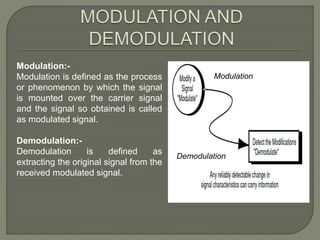
Modulation is the process of embedding information signals onto carrier waves; demodulation is extracting the original signal from the modulated signal.
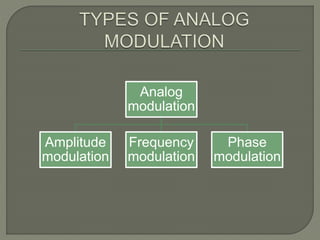
Introduction to different types of analog modulation: Amplitude Modulation, Frequency Modulation, and Phase Modulation.
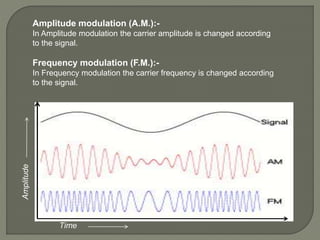
Amplitude Modulation varies the carrier's amplitude with the signal; Frequency Modulation varies the carrier's frequency based on the signal.
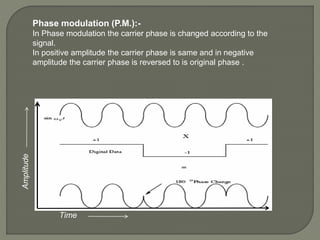
Phase Modulation alters the carrier phase according to the signal, reversing in negative amplitude.


