Home / Tutorials / Modulation
Modulation
Posted on November 24, 2011 by john in Tutorials with 5 Comments
When audio signals are transmitted over thousands of kilometres through radio
transmission, the audio frequencies that lie within the frequency range of 15 Hertz to 20
KiloHertz has very small signal power and thus cannot be transmitted via antenna for
communication purposes. The radiation of electrical energy is only possible at frequencies
above 20 KiloHertz. The main advantage of high frequency signals is that they can be
transmitted over very long distances by dissipating very small power. Thus, the audio signals
must be sent along with the high frequency signals for communication. This can be done by
superimposing electrical audio signals on a high frequency wave called the carrier wave. The
carrier wave is generated from radio-frequency oscillators and is undamped in nature. Thus,
when the audio-frequency signal is superimposed on a carrier wave, the resulting wave gets
all the characteristics of the audio signal. The method of superimposing an audio signal over
the carrier wave is called modulation.
After modulation is done, the resulting wave can be given to the antenna and the signal can
be transmitted over a long distance.
Principle of Transmission and Reception
The speech or music that is to be broadcasted consists of a series of compressions and
rarefractions. A microphone acts as a transducer to convert these parameters into its
corresponding varying current measures. With the difference in the measure of sound, the
corresponding change in the frequency of electrical current is also produced, and they lie in
the audio-frequency range and therefore, it is known as an audio-frequency signal. Since the
signal strength of this low frequency signal is less, it has to be given to an audio-frequency
amplifier to strengthen the signal to a desired level. These low frequency signals cannot be
sent over long distances by radiating it out directly from the aerial. Thus, the audio frequency
signal has to be modulated with a radio-frequency carrier wave. The carrier wave can be
produced using any oscillator. The radio frequency waves have constant amplitude and travel
through space with the velocity of light. This is why you can see and hear live broadcasts with
very little delay.
The resulting modulated wave is radiated out of the transmitter antenna and travels through
space till it reaches the receiver antenna. The receiving aerial consists of a receiver that
separates both the carrier signal and audio-frequency signal. The process of the receiver by
which he audio frequency is separated from the carrier signal is called demodulation. The
demodulated audio signal is sent to the loudspeakers for the user to hear. If there was no
demodulation, the high frequency currents would have reached the loudspeaker and would
have caused signal errors. Radio frequency current also cannot be heard by humans. This
shows why modulation and demodulation is important in a communication system.
What is Modulation?
The best way to define modulation is:
Get Daily Updates via
Email
Enter your email Subscribe
Categories
(24)101-Announcements
(14)555 Timer IC
(16)8051
(12)8051 projects
(39)Amplifier Circuits
(28)Arduino
(104)Audio Circuits
(28)Automotive Circuits
(15)AVR
(1)Basic Electricity
(6)Basic Electronics
Home Buy Project Kits Store Advertise With Us
Search … SearchAbout Privacy Policy
The process of impressing low-frequency information to be transmitted on to a high-
frequency wave, called the carrier wave, by changing the characteristics of either its
amplitude, frequency, or phase angle is called modulation.
Another definition for modulation is:
The process of altering the characteristics of the amplitude, frequency, or phase angle of the
high-frequency signal in accordance with the instantaneous value of the modulating wave is
called modulation.
Functions of the Carrier Wave
The main function of the carrier wave is to carry the audio or video signal from the
transmitter to the receiver. The wave that is resulted due to superimposition of audio signal
and carrier wave is called the modulated wave.
Need for Modulation
The reason why low frequency signals cannot be transmitted over long distances through
space is listed below:
1. Short Operating Range – When a wave has a large frequency, the energy associated with
it will also be large. Thus low frequency signals have less power that does not enable
them to travel over long distances.
2. Poor Radiation Efficiency – The radiation efficiency becomes very poor for low frequency
signals.
3. Mutual Interference – If all audio frequencies are send continuously from different
sources, they would all get mixed up and cause erroneous interference air. If modulation
is done, each signal will occupy different frequency levels and can be transmitted
simultaneously without any error.
4. Huge Antenna Requirement – For a effective signal transmission, the sending and
receiving antenna should be at least 1/4 of the wave length of the signal. Thus, for small
frequencies, the antenna will have kilometres of length. But if the signal has the range of
MegaHertz frequency, then the antenna size would be less. The carrier wave cannot be
used alone for transmission purposes. Since its amplitude, frequency, and phase angle
are constant with respect to some preference.
Types of Modulation
The sinusoidal carrier wave can be given by the equation
v = V Sin(w t + θ) = V Sin(2f t + θ)
V   – Maximum Value
f Frequency
θ  – Phase Relation
Since the three variables are the amplitude, frequency, and phase angle, the modulation can
be done by varying any one of them. Thus there are three modulation types namely:
Amplitude Modulation (AM)
Frequency Modulation (FM)
Phase Modulation (PM)
Click on the links given above to know more.
In India, radio broadcasting is done through amplitude modulation. Television broadcasting is
done with amplitude modulation for video signals and frequency modulation for audio
signals.
Amplitude Modulation (AM)
th
c c c c c
c
c –
(22)Battery Circuits
(7)C plus plus
(14)C Programming
(1)Cable TV Circuits
(5)Camera Technology
(7)Clipping and Clamping Circuits
(2)Clocking & Timer Circuits
(10)Conversion Circuits
(2)Counter Circuits
(2)Counters
(11)Digital Electronics
(6)Education & Training
(30)Electronic Components
(3)Electronic Keys & Locks
(10)Electronics Books
(4)Electronics Jobs
(7)Embedded Systems
(1)Equipment Reviews
(3)Events
(1)Fan Circuits
(16)Filter Circuits
(3)Fire Alarm
(14)Fun & Game Circuits
(3)Gadget Reviews
(2)Ham Radio Circuits
(1)High Voltage Circuits
(26)History
(35)Home Circuits
(15)Industrial Circuits
(12)Instruments
(20)Integrated Circuits
(5)Inverters
(20)Lab Manuals
(3)LED related
(14)Light Related
(43)Lighting Circuits
(3)MATLAB
(7)Microcontrollers
(1)Mobile Phone Related
(14)Motor Related
(14)Nanotechnology
(25)Oscillators
(PIC)(29)Peripheral Interface Controller
(8)Power Controller Circuits
(2)Power Electronics
(72)Power Supplies
(1)Project Ideas
(7)Projects
 Definition
The method of varying amplitude of a high frequency carrier wave in accordance with the
information to be transmitted, keeping the frequency and phase of the carrier wave
unchanged is called Amplitude Modulation. The information is considered as the modulating
signal and it is superimposed on the carrier wave by applying both of them to the modulator.
The detailed diagram showing the amplitude modulation process is given below.
Amplitude Modulation
As shown above, the carrier wave has positive and negative half cycles. Both these cycles are
varied according to the information to be sent. The carrier then consists of sine waves whose
amplitudes follow the amplitude variations of the modulating wave. The carrier is kept in an
envelope formed by the modulating wave. From the figure, you can also see that the
amplitude variation of the high frequency carrier is at the signal frequency and the frequency
of the carrier wave is the same as the frequency of the resulting wave.
Analysis of Amplitude Modulation Carrier Wave
Let v = V Sin w t
v = V Sin w t
v – Instantaneous value of the carrier
V – Peak value of the carrier
W – Angular velocity of the carrier
v – Instantaneous value of the modulating signal
V – Maximum value of the modulating signal
w – Angular velocity  of the modulating signal
f – Modulating signal frequency
It must be noted that the phase angle remains constant in this process. Thus it can be
ignored. The amplitude of the carrier wave varies at  f .
The amplitude modulated wave is given by the equation
A = V + v = V + V Sin w t = V [1+ (V /V Sin w t)]
= V (1 + mSin w t)
m – Modulation Index. The ratio of V /V .
Instantaneous value of amplitude modulated wave is given by the equation
c c c
m m m
c
c
c
m
m
m
m
m
c m c m m c m c m
c m
m c
(3)Proximity Detectors
(30)Radio Circuits
(19)Radio Transmitters
(1)Raspberry Pi
(3)Relays
(12)Remote Circuits
(4)Reviews
(6)Robotics
(2)RTOS
(16)Security & Saftey
(16)Sensor Circuits
(11)Signal Conditioners
(13)Signal Generators
(1)Speed Controller Circuits
(2)State space analysis
(6)Switching Circuits
(87)Tech News
(9)Telephone Related
(4)Television Related
(3)Temperature Related
(38)Test & Measurement Circuits
(9)Testing Components
(1)Three phase circuits
(3)Timer Circuits
(20)Tone generator circuits
(5)Tools and Softwares
(7)Transmitters
(158)Tutorials
(2)UPS
(3)USB Circuits
(5)Videos
(36)VLSI
(15)Voltage Regulators
Latest Articles
GSM based SMS Alert Fire Alarm System
using Arduino
Simple RFID based Door Lock using Arduino
Interfacing RFID with Arduino – How to Read
RFID Cards using Arduino
How to Interface GSM Module and Arduino-
Send and Receive SMS
Frequency counter using arduino
IPCA Electronics Expo 2015 – Revolutionizing
the Make in India campaign
Interfacing pressure sensor to arduino
We Are Launching An Online Store to Shop
v = A Sin w t = Vc (1 + m Sin w t) Sin wct
= V Sin w t + mVc (Sin w t Sin w t)
v = V Sin wct + [mV /2 Cos (wc-wm)t – mVc/2 Cos (wc + wm)t]
The above equation represents the sum of three sine waves. One with amplitude of Vc and a
frequency of w /2 , the second one with an amplitude of mV /2 and frequency of (w – w )/2
and the third one with an amplitude of mV /2 and a frequency of (w + w )/2 .
In practice the angular velocity of the carrier is known to be greater than the angular velocity
of the modulating signal (w >> w ). Thus, the second and third cosine equations are more
close to the carrier frequency. The equation is represented graphically as shown below.
Amplitude Modulation Frequency Spectrum
Frequency Spectrum of AM Wave
Lower side frequency – (w – w )/2
Upper side frequency – (w +w )/2
The frequency components present in the AM wave are represented by vertical lines
approximately located along the frequency axis. The height of each vertical line is drawn in
proportion to its amplitude. Since the angular velocity of the carrier is greater than the
angular velocity of the modulating signal, the amplitude of side band frequencies can never
exceed half of the carrier amplitude.
Thus there will not be any change in the original frequency, but the side band frequencies (w
– w )/2  and (w +w )/2  will be changed. The former is called the upper side band (USB)
frequency and the later is known as lower side band (LSB) frequency.
Since the signal frequency w /2  is present in the side bands, it is clear that the carrier
voltage component does not transmit any information.
Two side banded frequencies will be produced when a carrier is amplitude modulated by a
single frequency. That is, an AM wave has a band width from (w – w )/2  to (w +w )/2 , that
is, 2w /2  or twice the signal frequency is produced. When a modulating signal has more
than one frequency, two side band frequencies are produced by every frequency. Similarly
for two frequencies of the modulating signal 2 LSB’s and 2 USB’s frequencies will be
c m
c c m c
c c
c c c m
c c m
c m
c m
c m
c
m c m
m
c m c m
m
Electronic Kits,Boards and Components
Digital Code Lock using Arduino with LCD
Display and User Defined Password
The Big List of Arduino Projects and Circuits
Like Us on Facebook
Circuitstoday.com
27,022 people like Circuitstoday.com.
Facebook social plugin
Like
Recent Comments
jojo on Simple RFID based Door Lock using
Arduino
jojo on Digital code lock using arduino
ijaz on Interfacing 16×2 LCD with 8051
Srihari Rao M on Line Follower Robot using
Arduino
Yashas on Digital code lock using arduino
prabhakar reddy on Embedded Systems
Career-An Outline
Mandar Kholgade on Interfacing Seven
segment display to 8051
hamid on Heart rate monitor using 8051
pathik on Simple Lamp Dimmer/ Fan
Regulator
Atharva.muraskar on Electronic mosquito
repeller
miraat on Temperature controlled DC fan
Raymond Tan on Heart rate monitor using
8051
Raymond Tan on Heart rate monitor using
8051
Rohith N on Water Level Controller using
8051
Pages
About
Advertise With Us
Authors
produced.
The side bands of frequencies present above the carrier frequency will be same as the ones
present below. The side band frequencies present above the carrier frequency is known to be
the upper side band and all those below the carrier frequency belong to the lower side band.
The USB frequencies represent the some of the individual modulating frequencies and the
LSB frequencies represent the difference between the modulating frequency and the carrier
frequency.  The total bandwidth is represented in terms of the higher modulating frequency
and is equal to twice this frequency.
Modulation Index (m)
The ratio between the amplitude change of carrier wave to the amplitude of the normal
carrier wave is called modulation index. It is represented by the letter ‘m’.
It can also be defined as the range in which the amplitude of the carrier wave is varied by the
modulating signal.
m = V /V
Percentage modulation, %m = m*100 = V /V * 100
The percentage modulation lies between 0 and 80%.
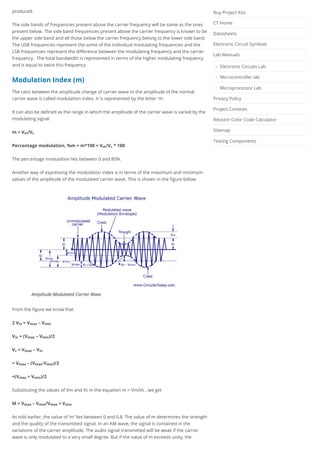
Another way of expressing the modulation index is in terms of the maximum and minimum
values of the amplitude of the modulated carrier wave. This is shown in the figure below.
Amplitude Modulated Carrier Wave
From the figure we know that
2 V = V – V
V = (V – V )/2
V = V – V
= V – (V -V )/2
=(V + V )/2
Substituting the values of Vm and Vc in the equation m = Vm/Vc , we get
M = V – V /V + V
As told earlier, the value of ‘m’ lies between 0 and 0.8. The value of m determines the strength
and the quality of the transmitted signal. In an AM wave, the signal is contained in the
variations of the carrier amplitude. The audio signal transmitted will be weak if the carrier
wave is only modulated to a very small degree. But if the value of m exceeds unity, the
m c
m c
in max min
in max min
c max in
max max min
max min
max min max min
Buy Project Kits
CT Home
Datasheets
Electronic Circuit Symbols
Lab Manuals
Electronic Circuits Lab-
Microcontroller lab-
Microprocessor Lab-
Privacy Policy
Project Contests
Resistor Color Code Calculator
Sitemap
Testing Components
You may also like:
Resistor Color Code Chart – Understanding Resistance Color Coding
How to debug in Keil Microvision
Getting Started with Keil uVision
Bit rate Vs Baud rate – the common misconception
How to recover/reset admin username and password of Vbulletin forum software
Tagged
transmitter output produces erroneous distortion.
Power Relations in an AM wave
A modulated wave has more power than had by the carrier wave before modulating. The
total power components in amplitude modulation can be written as:
P = P + P + P
Considering additional resistance like antenna resistance R.
P = [(V /√2)/R] = V /2R
Each side band has a value of m/2 V and r.m.s value of mV /2√2. Hence power in LSB and
USB can be written as
P = P = (mV /2√2) /R = m /4*V C/2R = m /4 P
P = V /2R + [m /4*V C/2R] + [m /4*V C/2R] = V /2R (1 + m /2) = P (1 + m /2)
In some applications, the carrier is simultaneously modulated by several sinusoidal
modulating signals. In such a case, the total modulation index is given as
Mt = √(m1 + m2 + m3 + m4 + …..)
If Ic and It are the r.m.s values of unmodulated current and total modulated current and R is
the resistance through which these current flow, then
P /P = (It.R/Ic.R) = (It/Ic)
P /P = (1 + m /2)
It/Ic = 1 + m /2
Limitations of Amplitude Modulation
1. Low Efficiency- Since the useful power that lies in the small bands is quite small, so the
efficiency of AM system is low.
2. Limited Operating Range – The range of operation is small due to low efficiency. Thus,
transmission of signals is difficult.
3. Noise in Reception – As the radio receiver finds it difficult to distinguish between the
amplitude variations that represent noise and those with the signals, heavy noise is
prone to occur in its reception.
4. Poor Audio Quality – To obtain high fidelity reception, all audio frequencies till 15
KiloHertz must be reproduced and this necessitates the bandwidth of 10 KiloHertz to
minimise the interference from the adjacent broadcasting stations. Therefore in AM
broadcasting stations audio quality is known to be poor.
total carrier LSB USB
carrier c
2 2
C
c c
LSB USB c
2 2 2
2 carrier
total
2
C
2 2 2 2 2
C
2
carrier
2
2 2 2 2
total carrier
2 2
total carrier
2
2
Tutorials
Electronics In Jaipur
Want To Buy Used Electronic Items? Get TV,Kettles,Inverters
Only@Askme
We recommend:
Arduino (For beginners)
Invention History of Television
Types of Thyristors
150 Watt amplifier circuit
Simple audio circuits
5 thoughts on “Modulation”
Leave a Reply
Ads by Google   ► RF Signal   ► Frequency   ► FM Antenna   ► FM Radio
Louis J. Bruno May 24, 2013 at 12:30 pm
What happened to the FM and PM explanation?
Reply
Safi Khan December 1, 2011 at 3:01 am
it is good to learn but it is good and easy to learn with circuits today.
Reply
Peter November 25, 2011 at 1:48 am
I have gone through this peace and am happy.
Reply
Joseph Vella-Zarb November 24, 2011 at 9:52 pm
Re: Need for Modulation.
<>
Allow me to clarify the above note because it is not quite correct.
Interference will occur if the same CARRIER frequency is transmitted, at the same time, from
different sources.
A carrier frequency on its own has no information and, if you tune in to this frequency on the
receiver, all you will hear is silence.
If, on the other hand, the carrier frequency is modulated with information (for example, speech
or music) and your receiver is tuned to the carrier frequency, this signal is demodulated in the
receiver and you can hear the information. Demodulation, as the name implies, is the extraction
of what was modulated in the transmitter.
Reply
jawid akhtar November 24, 2011 at 6:27 pm
I went through the topic Modulation. It was defined very simply and precisely. I appreciate and
hope the same thing will keep on going.
Reply
Your email address will not be published. Required fields are marked *
Name *
Email *
Website
Comment
You may use these HTML tags and attributes: <a href="" title=""> <abbr title="">
<acronym title=""> <b> <blockquote cite=""> <cite> <code> <del datetime=""> <em> <i>
<q cite=""> <strike> <strong>
Post Comment
© 2015 CircuitsToday. All rights reserved. Latest Electronic Circuits

Modulation types-amplitude,frequency,phase modulation,

Modulation types-amplitude,frequency,phase modulation,

  • 1.
    Home / Tutorials/ Modulation Modulation Posted on November 24, 2011 by john in Tutorials with 5 Comments When audio signals are transmitted over thousands of kilometres through radio transmission, the audio frequencies that lie within the frequency range of 15 Hertz to 20 KiloHertz has very small signal power and thus cannot be transmitted via antenna for communication purposes. The radiation of electrical energy is only possible at frequencies above 20 KiloHertz. The main advantage of high frequency signals is that they can be transmitted over very long distances by dissipating very small power. Thus, the audio signals must be sent along with the high frequency signals for communication. This can be done by superimposing electrical audio signals on a high frequency wave called the carrier wave. The carrier wave is generated from radio-frequency oscillators and is undamped in nature. Thus, when the audio-frequency signal is superimposed on a carrier wave, the resulting wave gets all the characteristics of the audio signal. The method of superimposing an audio signal over the carrier wave is called modulation. After modulation is done, the resulting wave can be given to the antenna and the signal can be transmitted over a long distance. Principle of Transmission and Reception The speech or music that is to be broadcasted consists of a series of compressions and rarefractions. A microphone acts as a transducer to convert these parameters into its corresponding varying current measures. With the difference in the measure of sound, the corresponding change in the frequency of electrical current is also produced, and they lie in the audio-frequency range and therefore, it is known as an audio-frequency signal. Since the signal strength of this low frequency signal is less, it has to be given to an audio-frequency amplifier to strengthen the signal to a desired level. These low frequency signals cannot be sent over long distances by radiating it out directly from the aerial. Thus, the audio frequency signal has to be modulated with a radio-frequency carrier wave. The carrier wave can be produced using any oscillator. The radio frequency waves have constant amplitude and travel through space with the velocity of light. This is why you can see and hear live broadcasts with very little delay. The resulting modulated wave is radiated out of the transmitter antenna and travels through space till it reaches the receiver antenna. The receiving aerial consists of a receiver that separates both the carrier signal and audio-frequency signal. The process of the receiver by which he audio frequency is separated from the carrier signal is called demodulation. The demodulated audio signal is sent to the loudspeakers for the user to hear. If there was no demodulation, the high frequency currents would have reached the loudspeaker and would have caused signal errors. Radio frequency current also cannot be heard by humans. This shows why modulation and demodulation is important in a communication system. What is Modulation? The best way to define modulation is: Get Daily Updates via Email Enter your email Subscribe Categories (24)101-Announcements (14)555 Timer IC (16)8051 (12)8051 projects (39)Amplifier Circuits (28)Arduino (104)Audio Circuits (28)Automotive Circuits (15)AVR (1)Basic Electricity (6)Basic Electronics Home Buy Project Kits Store Advertise With Us Search … SearchAbout Privacy Policy
  • 2.
    The process ofimpressing low-frequency information to be transmitted on to a high- frequency wave, called the carrier wave, by changing the characteristics of either its amplitude, frequency, or phase angle is called modulation. Another definition for modulation is: The process of altering the characteristics of the amplitude, frequency, or phase angle of the high-frequency signal in accordance with the instantaneous value of the modulating wave is called modulation. Functions of the Carrier Wave The main function of the carrier wave is to carry the audio or video signal from the transmitter to the receiver. The wave that is resulted due to superimposition of audio signal and carrier wave is called the modulated wave. Need for Modulation The reason why low frequency signals cannot be transmitted over long distances through space is listed below: 1. Short Operating Range – When a wave has a large frequency, the energy associated with it will also be large. Thus low frequency signals have less power that does not enable them to travel over long distances. 2. Poor Radiation Efficiency – The radiation efficiency becomes very poor for low frequency signals. 3. Mutual Interference – If all audio frequencies are send continuously from different sources, they would all get mixed up and cause erroneous interference air. If modulation is done, each signal will occupy different frequency levels and can be transmitted simultaneously without any error. 4. Huge Antenna Requirement – For a effective signal transmission, the sending and receiving antenna should be at least 1/4 of the wave length of the signal. Thus, for small frequencies, the antenna will have kilometres of length. But if the signal has the range of MegaHertz frequency, then the antenna size would be less. The carrier wave cannot be used alone for transmission purposes. Since its amplitude, frequency, and phase angle are constant with respect to some preference. Types of Modulation The sinusoidal carrier wave can be given by the equation v = V Sin(w t + θ) = V Sin(2f t + θ) V   – Maximum Value f Frequency θ  – Phase Relation Since the three variables are the amplitude, frequency, and phase angle, the modulation can be done by varying any one of them. Thus there are three modulation types namely: Amplitude Modulation (AM) Frequency Modulation (FM) Phase Modulation (PM) Click on the links given above to know more. In India, radio broadcasting is done through amplitude modulation. Television broadcasting is done with amplitude modulation for video signals and frequency modulation for audio signals. Amplitude Modulation (AM) th c c c c c c c – (22)Battery Circuits (7)C plus plus (14)C Programming (1)Cable TV Circuits (5)Camera Technology (7)Clipping and Clamping Circuits (2)Clocking & Timer Circuits (10)Conversion Circuits (2)Counter Circuits (2)Counters (11)Digital Electronics (6)Education & Training (30)Electronic Components (3)Electronic Keys & Locks (10)Electronics Books (4)Electronics Jobs (7)Embedded Systems (1)Equipment Reviews (3)Events (1)Fan Circuits (16)Filter Circuits (3)Fire Alarm (14)Fun & Game Circuits (3)Gadget Reviews (2)Ham Radio Circuits (1)High Voltage Circuits (26)History (35)Home Circuits (15)Industrial Circuits (12)Instruments (20)Integrated Circuits (5)Inverters (20)Lab Manuals (3)LED related (14)Light Related (43)Lighting Circuits (3)MATLAB (7)Microcontrollers (1)Mobile Phone Related (14)Motor Related (14)Nanotechnology (25)Oscillators (PIC)(29)Peripheral Interface Controller (8)Power Controller Circuits (2)Power Electronics (72)Power Supplies (1)Project Ideas (7)Projects
  • 3.
     Definition The method ofvarying amplitude of a high frequency carrier wave in accordance with the information to be transmitted, keeping the frequency and phase of the carrier wave unchanged is called Amplitude Modulation. The information is considered as the modulating signal and it is superimposed on the carrier wave by applying both of them to the modulator. The detailed diagram showing the amplitude modulation process is given below. Amplitude Modulation As shown above, the carrier wave has positive and negative half cycles. Both these cycles are varied according to the information to be sent. The carrier then consists of sine waves whose amplitudes follow the amplitude variations of the modulating wave. The carrier is kept in an envelope formed by the modulating wave. From the figure, you can also see that the amplitude variation of the high frequency carrier is at the signal frequency and the frequency of the carrier wave is the same as the frequency of the resulting wave. Analysis of Amplitude Modulation Carrier Wave Let v = V Sin w t v = V Sin w t v – Instantaneous value of the carrier V – Peak value of the carrier W – Angular velocity of the carrier v – Instantaneous value of the modulating signal V – Maximum value of the modulating signal w – Angular velocity  of the modulating signal f – Modulating signal frequency It must be noted that the phase angle remains constant in this process. Thus it can be ignored. The amplitude of the carrier wave varies at  f . The amplitude modulated wave is given by the equation A = V + v = V + V Sin w t = V [1+ (V /V Sin w t)] = V (1 + mSin w t) m – Modulation Index. The ratio of V /V . Instantaneous value of amplitude modulated wave is given by the equation c c c m m m c c c m m m m m c m c m m c m c m c m m c (3)Proximity Detectors (30)Radio Circuits (19)Radio Transmitters (1)Raspberry Pi (3)Relays (12)Remote Circuits (4)Reviews (6)Robotics (2)RTOS (16)Security & Saftey (16)Sensor Circuits (11)Signal Conditioners (13)Signal Generators (1)Speed Controller Circuits (2)State space analysis (6)Switching Circuits (87)Tech News (9)Telephone Related (4)Television Related (3)Temperature Related (38)Test & Measurement Circuits (9)Testing Components (1)Three phase circuits (3)Timer Circuits (20)Tone generator circuits (5)Tools and Softwares (7)Transmitters (158)Tutorials (2)UPS (3)USB Circuits (5)Videos (36)VLSI (15)Voltage Regulators Latest Articles GSM based SMS Alert Fire Alarm System using Arduino Simple RFID based Door Lock using Arduino Interfacing RFID with Arduino – How to Read RFID Cards using Arduino How to Interface GSM Module and Arduino- Send and Receive SMS Frequency counter using arduino IPCA Electronics Expo 2015 – Revolutionizing the Make in India campaign Interfacing pressure sensor to arduino We Are Launching An Online Store to Shop
  • 4.
    v = ASin w t = Vc (1 + m Sin w t) Sin wct = V Sin w t + mVc (Sin w t Sin w t) v = V Sin wct + [mV /2 Cos (wc-wm)t – mVc/2 Cos (wc + wm)t] The above equation represents the sum of three sine waves. One with amplitude of Vc and a frequency of w /2 , the second one with an amplitude of mV /2 and frequency of (w – w )/2 and the third one with an amplitude of mV /2 and a frequency of (w + w )/2 . In practice the angular velocity of the carrier is known to be greater than the angular velocity of the modulating signal (w >> w ). Thus, the second and third cosine equations are more close to the carrier frequency. The equation is represented graphically as shown below. Amplitude Modulation Frequency Spectrum Frequency Spectrum of AM Wave Lower side frequency – (w – w )/2 Upper side frequency – (w +w )/2 The frequency components present in the AM wave are represented by vertical lines approximately located along the frequency axis. The height of each vertical line is drawn in proportion to its amplitude. Since the angular velocity of the carrier is greater than the angular velocity of the modulating signal, the amplitude of side band frequencies can never exceed half of the carrier amplitude. Thus there will not be any change in the original frequency, but the side band frequencies (w – w )/2  and (w +w )/2  will be changed. The former is called the upper side band (USB) frequency and the later is known as lower side band (LSB) frequency. Since the signal frequency w /2  is present in the side bands, it is clear that the carrier voltage component does not transmit any information. Two side banded frequencies will be produced when a carrier is amplitude modulated by a single frequency. That is, an AM wave has a band width from (w – w )/2  to (w +w )/2 , that is, 2w /2  or twice the signal frequency is produced. When a modulating signal has more than one frequency, two side band frequencies are produced by every frequency. Similarly for two frequencies of the modulating signal 2 LSB’s and 2 USB’s frequencies will be c m c c m c c c c c c m c c m c m c m c m c m c m m c m c m m Electronic Kits,Boards and Components Digital Code Lock using Arduino with LCD Display and User Defined Password The Big List of Arduino Projects and Circuits Like Us on Facebook Circuitstoday.com 27,022 people like Circuitstoday.com. Facebook social plugin Like Recent Comments jojo on Simple RFID based Door Lock using Arduino jojo on Digital code lock using arduino jojo on Digital code lock using arduino ijaz on Interfacing 16×2 LCD with 8051 Srihari Rao M on Line Follower Robot using Arduino Yashas on Digital code lock using arduino prabhakar reddy on Embedded Systems Career-An Outline Mandar Kholgade on Interfacing Seven segment display to 8051 hamid on Heart rate monitor using 8051 pathik on Simple Lamp Dimmer/ Fan Regulator Atharva.muraskar on Electronic mosquito repeller miraat on Temperature controlled DC fan Raymond Tan on Heart rate monitor using 8051 Raymond Tan on Heart rate monitor using 8051 Rohith N on Water Level Controller using 8051 Pages About Advertise With Us Authors
  • 5.
    produced. The side bandsof frequencies present above the carrier frequency will be same as the ones present below. The side band frequencies present above the carrier frequency is known to be the upper side band and all those below the carrier frequency belong to the lower side band. The USB frequencies represent the some of the individual modulating frequencies and the LSB frequencies represent the difference between the modulating frequency and the carrier frequency.  The total bandwidth is represented in terms of the higher modulating frequency and is equal to twice this frequency. Modulation Index (m) The ratio between the amplitude change of carrier wave to the amplitude of the normal carrier wave is called modulation index. It is represented by the letter ‘m’. It can also be defined as the range in which the amplitude of the carrier wave is varied by the modulating signal. m = V /V Percentage modulation, %m = m*100 = V /V * 100 The percentage modulation lies between 0 and 80%. Another way of expressing the modulation index is in terms of the maximum and minimum values of the amplitude of the modulated carrier wave. This is shown in the figure below. Amplitude Modulated Carrier Wave From the figure we know that 2 V = V – V V = (V – V )/2 V = V – V = V – (V -V )/2 =(V + V )/2 Substituting the values of Vm and Vc in the equation m = Vm/Vc , we get M = V – V /V + V As told earlier, the value of ‘m’ lies between 0 and 0.8. The value of m determines the strength and the quality of the transmitted signal. In an AM wave, the signal is contained in the variations of the carrier amplitude. The audio signal transmitted will be weak if the carrier wave is only modulated to a very small degree. But if the value of m exceeds unity, the m c m c in max min in max min c max in max max min max min max min max min Buy Project Kits CT Home Datasheets Electronic Circuit Symbols Lab Manuals Electronic Circuits Lab- Microcontroller lab- Microprocessor Lab- Privacy Policy Project Contests Resistor Color Code Calculator Sitemap Testing Components
  • 6.
    You may alsolike: Resistor Color Code Chart – Understanding Resistance Color Coding How to debug in Keil Microvision Getting Started with Keil uVision Bit rate Vs Baud rate – the common misconception How to recover/reset admin username and password of Vbulletin forum software Tagged transmitter output produces erroneous distortion. Power Relations in an AM wave A modulated wave has more power than had by the carrier wave before modulating. The total power components in amplitude modulation can be written as: P = P + P + P Considering additional resistance like antenna resistance R. P = [(V /√2)/R] = V /2R Each side band has a value of m/2 V and r.m.s value of mV /2√2. Hence power in LSB and USB can be written as P = P = (mV /2√2) /R = m /4*V C/2R = m /4 P P = V /2R + [m /4*V C/2R] + [m /4*V C/2R] = V /2R (1 + m /2) = P (1 + m /2) In some applications, the carrier is simultaneously modulated by several sinusoidal modulating signals. In such a case, the total modulation index is given as Mt = √(m1 + m2 + m3 + m4 + …..) If Ic and It are the r.m.s values of unmodulated current and total modulated current and R is the resistance through which these current flow, then P /P = (It.R/Ic.R) = (It/Ic) P /P = (1 + m /2) It/Ic = 1 + m /2 Limitations of Amplitude Modulation 1. Low Efficiency- Since the useful power that lies in the small bands is quite small, so the efficiency of AM system is low. 2. Limited Operating Range – The range of operation is small due to low efficiency. Thus, transmission of signals is difficult. 3. Noise in Reception – As the radio receiver finds it difficult to distinguish between the amplitude variations that represent noise and those with the signals, heavy noise is prone to occur in its reception. 4. Poor Audio Quality – To obtain high fidelity reception, all audio frequencies till 15 KiloHertz must be reproduced and this necessitates the bandwidth of 10 KiloHertz to minimise the interference from the adjacent broadcasting stations. Therefore in AM broadcasting stations audio quality is known to be poor. total carrier LSB USB carrier c 2 2 C c c LSB USB c 2 2 2 2 carrier total 2 C 2 2 2 2 2 C 2 carrier 2 2 2 2 2 total carrier 2 2 total carrier 2 2 Tutorials Electronics In Jaipur Want To Buy Used Electronic Items? Get TV,Kettles,Inverters Only@Askme
  • 7.
    We recommend: Arduino (Forbeginners) Invention History of Television Types of Thyristors 150 Watt amplifier circuit Simple audio circuits 5 thoughts on “Modulation” Leave a Reply Ads by Google   ► RF Signal   ► Frequency   ► FM Antenna   ► FM Radio Louis J. Bruno May 24, 2013 at 12:30 pm What happened to the FM and PM explanation? Reply Safi Khan December 1, 2011 at 3:01 am it is good to learn but it is good and easy to learn with circuits today. Reply Peter November 25, 2011 at 1:48 am I have gone through this peace and am happy. Reply Joseph Vella-Zarb November 24, 2011 at 9:52 pm Re: Need for Modulation. <> Allow me to clarify the above note because it is not quite correct. Interference will occur if the same CARRIER frequency is transmitted, at the same time, from different sources. A carrier frequency on its own has no information and, if you tune in to this frequency on the receiver, all you will hear is silence. If, on the other hand, the carrier frequency is modulated with information (for example, speech or music) and your receiver is tuned to the carrier frequency, this signal is demodulated in the receiver and you can hear the information. Demodulation, as the name implies, is the extraction of what was modulated in the transmitter. Reply jawid akhtar November 24, 2011 at 6:27 pm I went through the topic Modulation. It was defined very simply and precisely. I appreciate and hope the same thing will keep on going. Reply Your email address will not be published. Required fields are marked * Name * Email *
  • 8.
    Website Comment You may usethese HTML tags and attributes: <a href="" title=""> <abbr title=""> <acronym title=""> <b> <blockquote cite=""> <cite> <code> <del datetime=""> <em> <i> <q cite=""> <strike> <strong> Post Comment © 2015 CircuitsToday. All rights reserved. Latest Electronic Circuits 