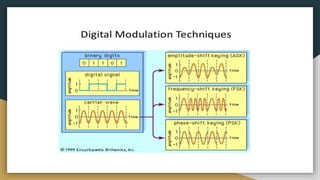
Digital modulation
techniques
Submitted By - KM Sakshi Verma
Roll no.-1705918
Section-CS12
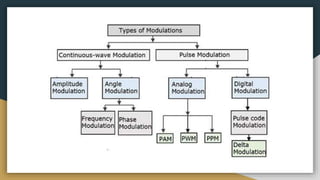
In this presentation, we will study about
• What modulation is ?
• Categories of modulation (Analog and Digital)
• Types of Modulation (Analog and Digital)
1. Modulation
• Modulation is a process of suppressing low frequency information
signal on a high frequency carrier signal.
OR
Modulation is a process of modifying the any of the characteristics
(amplitude, frequency, phase) of
high frequency carrier in accordance with low frequency information
signal.
• Remember, for modulation require two signals, high frequency
carrier and low frequency
information signal (also called modulation signal).
• The resultant wave achieved known as “modulated signal”.
i.e. information (modulating signal) + carrier = modulated signal.
• Why there is need of modulation? • Is there any substitute of
modulation?
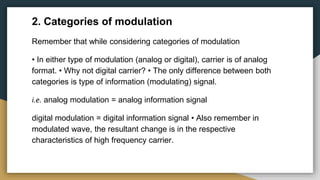
2. Categories of modulation
Remember that while considering categories of modulation
• In either type of modulation (analog or digital), carrier is of analog
format. • Why not digital carrier? • The only difference between both
categories is type of information (modulating) signal.
i.e. analog modulation = analog information signal
digital modulation = digital information signal • Also remember in
modulated wave, the resultant change is in the respective
characteristics of high frequency carrier.
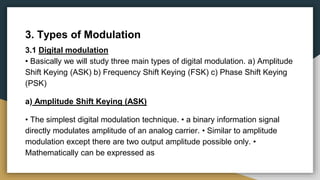
3. Types of Modulation
3.1 Digital modulation
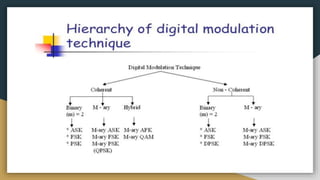
• Basically we will study three main types of digital modulation. a) Amplitude
Shift Keying (ASK) b) Frequency Shift Keying (FSK) c) Phase Shift Keying
(PSK)
a) Amplitude Shift Keying (ASK)
• The simplest digital modulation technique. • a binary information signal
directly modulates amplitude of an analog carrier. • Similar to amplitude
modulation except there are two output amplitude possible only. •
Mathematically can be expressed as
VASK(t) = [ 1 + Vm(t)] [ (Ac/2) cos(ωct) ]
Where • VASK(t) = Amplitude Shift Keying Modulated wave • Vm(t) = Amplitude
of binary modulating (information) signal • (Ac/2) = Amplitude of un-modulated
high frequency carrier • ωc = 2πfc = un-modulated high frequency carrier.
a) Amplitude Shift Keying (ASK)
Vm (t) = logic 1 = +1V Vm (t) = logic 0 = -1V
VASK(t) = [ 1 + Vm(t)] [ (Ac/2) cos(ωct) ] VASK(t) = [ 1 + Vm(t)] [ (Ac/2) cos(ωct)]
= [ 1 +1] [ (Ac/2) cos(ωct) ] = [ 1 - 1] [ (Ac/2) cos(ωct) ]
= [2] [ (Ac/2) cos(ωct) ] = [0] [ (Ac/2) cos(ωct) ]
= [Ac cos(ωct) ] =0
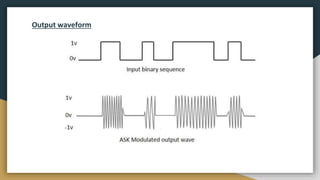
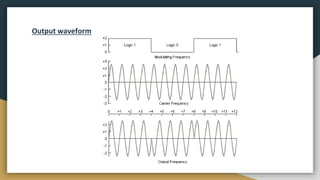
Output waveform
Conclusion:
• As information signal is of binary format, only two voltage levels occur
at input (either +1V or -1V) • As a result, we get only two voltage levels
at output (either [Ac cos(ωct) ] or OV) • because of these two output
voltage levels, the carrier is either in “ON” or “OFF” state. • that’s the
reason why ASK is also known as “ON-OFF Keying (OOK)”
b) Frequency Shift Keying (FSK)
• Simple and low performance type of digital modulation. • a binary information
signal directly modulates frequency of an analog carrier.
• Mathematically can be expressed as
VFSK(t) = Vc cos[ 2π (fc + Vm(t)Δf)t ]
Where • VFSK(t) = Frequency Shift Keying Modulated wave • fc = Analog carrier
central frequency • Vc = peak analog carrier amplitude • Vm(t) = binary input
(modulating) signal • Δf = peak change (shift) in the analog carrier frequency
Vm(t) = logic 1 = +1V Vm(t) = logic 1 = -1V
VFSK(t) = Vc cos[ 2π (fc + Vm(t)Δf)t ] VFSK(t) = Vc cos[ 2π (fc + Vm(t)Δf)t ]
= Vc cos[ 2π (fc + 1.Δf)t ] = Vc cos[ 2π (fc - 1.Δf)t ]
= Vc cos[ 2π (fc + Δf)t ] = Vc cos[ 2π (fc - Δf)t ]
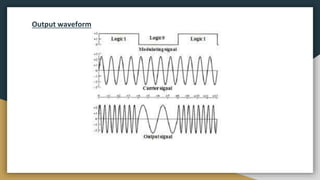
We observed that in FSK
• carrier wave continuously shifted by an amount specified as Δf.
• when logic 1 input is applied, the carrier wave modulated itself to a
frequency known as “mark frequency (fm)”.
• when logic 0 input is applied, the carrier wave modulated itself to a
frequency known as “space frequency (fc)”.
• the overall spectrum of FSK will be observed
Output waveform
c) Phase Shift Keying (PSK)
• PSK is another form of angle modulated (later define in upcoming slides) constant
amplitude digital modulation. • PSK is an M-ary digital modulation scheme
• a binary information signal directly modulates phase of an analog carrier.
• Simplest form is “Binary phase shift keying” (BPSK)
• with BPSK, two phases are possible for carrier wave.
• one phase represents a logic 1 and other a logic 0.
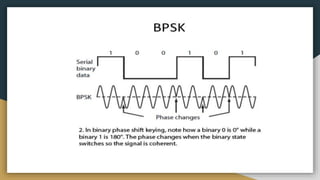
• as the input digital signal changes state (i.e. from 1 to 0 or 0 to 1), the phase of
the output carrier shifts between two phases (that are sepereated by 180) .
Remember in PSK, • When information binary signal (modulating signal)
goes low or 0 state, then output carrier undergoes 180o shift with
reference to original carrier for that particular bit slot.
• When information binary signal (modulating signal) goes high or 1
state, then output carrier undergoes 0o shift with reference to original
carrier for that particular bit slot. • PSK modulated output wave will be
shown here
Output waveform
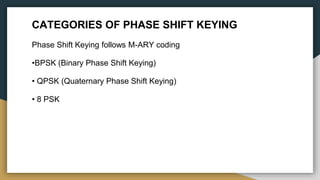
CATEGORIES OF PHASE SHIFT KEYING
Phase Shift Keying follows M-ARY coding
•BPSK (Binary Phase Shift Keying)
• QPSK (Quaternary Phase Shift Keying)
• 8 PSK
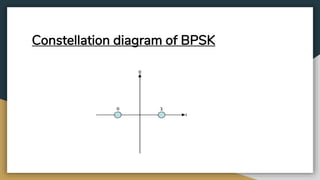
Constellation diagram of BPSK
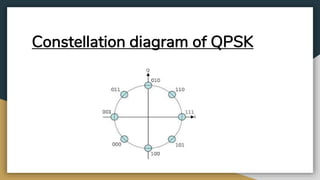
Constellation diagram of QPSK
THANK YOU

Digital modulation techniques

  • 1.
    Digital modulation techniques Submitted By- KM Sakshi Verma Roll no.-1705918 Section-CS12
  • 2.
    In this presentation,we will study about • What modulation is ? • Categories of modulation (Analog and Digital) • Types of Modulation (Analog and Digital)
  • 3.
    1. Modulation • Modulationis a process of suppressing low frequency information signal on a high frequency carrier signal. OR Modulation is a process of modifying the any of the characteristics (amplitude, frequency, phase) of high frequency carrier in accordance with low frequency information signal.
  • 4.
    • Remember, formodulation require two signals, high frequency carrier and low frequency information signal (also called modulation signal). • The resultant wave achieved known as “modulated signal”. i.e. information (modulating signal) + carrier = modulated signal. • Why there is need of modulation? • Is there any substitute of modulation?
  • 6.
    2. Categories ofmodulation Remember that while considering categories of modulation • In either type of modulation (analog or digital), carrier is of analog format. • Why not digital carrier? • The only difference between both categories is type of information (modulating) signal. i.e. analog modulation = analog information signal digital modulation = digital information signal • Also remember in modulated wave, the resultant change is in the respective characteristics of high frequency carrier.
  • 7.
    3. Types ofModulation 3.1 Digital modulation • Basically we will study three main types of digital modulation. a) Amplitude Shift Keying (ASK) b) Frequency Shift Keying (FSK) c) Phase Shift Keying (PSK) a) Amplitude Shift Keying (ASK) • The simplest digital modulation technique. • a binary information signal directly modulates amplitude of an analog carrier. • Similar to amplitude modulation except there are two output amplitude possible only. • Mathematically can be expressed as
  • 8.
    VASK(t) = [1 + Vm(t)] [ (Ac/2) cos(ωct) ] Where • VASK(t) = Amplitude Shift Keying Modulated wave • Vm(t) = Amplitude of binary modulating (information) signal • (Ac/2) = Amplitude of un-modulated high frequency carrier • ωc = 2πfc = un-modulated high frequency carrier. a) Amplitude Shift Keying (ASK) Vm (t) = logic 1 = +1V Vm (t) = logic 0 = -1V VASK(t) = [ 1 + Vm(t)] [ (Ac/2) cos(ωct) ] VASK(t) = [ 1 + Vm(t)] [ (Ac/2) cos(ωct)] = [ 1 +1] [ (Ac/2) cos(ωct) ] = [ 1 - 1] [ (Ac/2) cos(ωct) ] = [2] [ (Ac/2) cos(ωct) ] = [0] [ (Ac/2) cos(ωct) ] = [Ac cos(ωct) ] =0
  • 9.
  • 10.
    Conclusion: • As informationsignal is of binary format, only two voltage levels occur at input (either +1V or -1V) • As a result, we get only two voltage levels at output (either [Ac cos(ωct) ] or OV) • because of these two output voltage levels, the carrier is either in “ON” or “OFF” state. • that’s the reason why ASK is also known as “ON-OFF Keying (OOK)”
  • 11.
    b) Frequency ShiftKeying (FSK) • Simple and low performance type of digital modulation. • a binary information signal directly modulates frequency of an analog carrier. • Mathematically can be expressed as VFSK(t) = Vc cos[ 2π (fc + Vm(t)Δf)t ] Where • VFSK(t) = Frequency Shift Keying Modulated wave • fc = Analog carrier central frequency • Vc = peak analog carrier amplitude • Vm(t) = binary input (modulating) signal • Δf = peak change (shift) in the analog carrier frequency
  • 12.
    Vm(t) = logic1 = +1V Vm(t) = logic 1 = -1V VFSK(t) = Vc cos[ 2π (fc + Vm(t)Δf)t ] VFSK(t) = Vc cos[ 2π (fc + Vm(t)Δf)t ] = Vc cos[ 2π (fc + 1.Δf)t ] = Vc cos[ 2π (fc - 1.Δf)t ] = Vc cos[ 2π (fc + Δf)t ] = Vc cos[ 2π (fc - Δf)t ]
  • 13.
    We observed thatin FSK • carrier wave continuously shifted by an amount specified as Δf. • when logic 1 input is applied, the carrier wave modulated itself to a frequency known as “mark frequency (fm)”. • when logic 0 input is applied, the carrier wave modulated itself to a frequency known as “space frequency (fc)”. • the overall spectrum of FSK will be observed
  • 14.
  • 15.
    c) Phase ShiftKeying (PSK) • PSK is another form of angle modulated (later define in upcoming slides) constant amplitude digital modulation. • PSK is an M-ary digital modulation scheme • a binary information signal directly modulates phase of an analog carrier. • Simplest form is “Binary phase shift keying” (BPSK) • with BPSK, two phases are possible for carrier wave. • one phase represents a logic 1 and other a logic 0. • as the input digital signal changes state (i.e. from 1 to 0 or 0 to 1), the phase of the output carrier shifts between two phases (that are sepereated by 180) .
  • 16.
    Remember in PSK,• When information binary signal (modulating signal) goes low or 0 state, then output carrier undergoes 180o shift with reference to original carrier for that particular bit slot. • When information binary signal (modulating signal) goes high or 1 state, then output carrier undergoes 0o shift with reference to original carrier for that particular bit slot. • PSK modulated output wave will be shown here
  • 17.
  • 18.
    CATEGORIES OF PHASESHIFT KEYING Phase Shift Keying follows M-ARY coding •BPSK (Binary Phase Shift Keying) • QPSK (Quaternary Phase Shift Keying) • 8 PSK
  • 20.
  • 23.
  • 26.