Image Compression: Techniques and Application
By- Nidhi Baranwal
University of Allahabad
What and Why?
• Image compression is the technique of reducing the amount of data
required to represent an image
• It involves:
- reducing the storage required to save an image
-reducing the bandwidth required to transmit it
• Why?
- to handle large amount of information such as multimedia
- to fulfill the goal of representing an image with minimum number of bits
of an acceptable image quality
- for focusing on removal or reduction of several types of redundancy in
data or information
Compression Algorithm
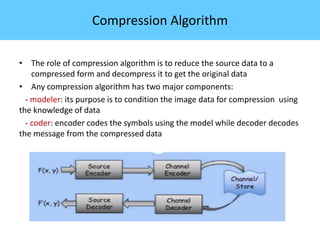
• The role of compression algorithm is to reduce the source data to a
compressed form and decompress it to get the original data
• Any compression algorithm has two major components:
- modeler: its purpose is to condition the image data for compression using
the knowledge of data
- coder: encoder codes the symbols using the model while decoder decodes
the message from the compressed data
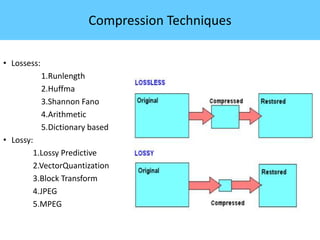
Compression Techniques
• Lossess:
1.Runlength
2.Huffma
3.Shannon Fano
4.Arithmetic
5.Dictionary based
• Lossy:
1.Lossy Predictive
2.VectorQuantization
3.Block Transform
4.JPEG
5.MPEG
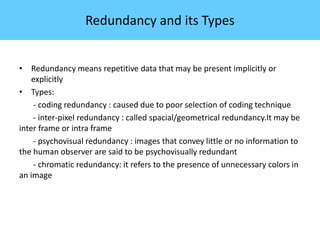
Redundancy and its Types
• Redundancy means repetitive data that may be present implicitly or
explicitly
• Types:
- coding redundancy : caused due to poor selection of coding technique
- inter-pixel redundancy : called spacial/geometrical redundancy.It may be
inter frame or intra frame
- psychovisual redundancy : images that convey little or no information to
the human observer are said to be psychovisually redundant
- chromatic redundancy: it refers to the presence of unnecessary colors in
an image
Arithmetic Coding
Algorithm/Pseudocode
Input symbol is l
Previouslow is the lower bound for the old interval
Previoushigh is the upper bound for the old interval
Range is Previoushigh - Previouslow
Let Previouslow= 0, Previoushigh = 1, Range = Previoushigh – Previouslow =1
WHILE (input symbol != EOF)
get input symbol l
Range = Previoushigh - Previouslow
New Previouslow = Previouslow + Range* intervallow of l
New Previoushigh = Previouslow + Range* intervalhigh of l
END
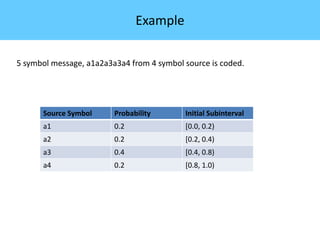
Example
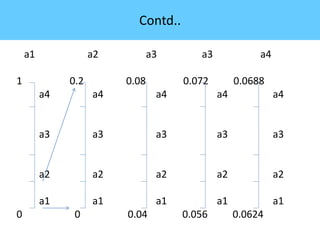
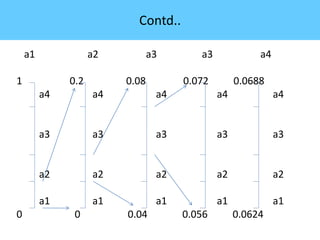
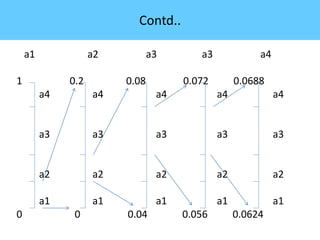
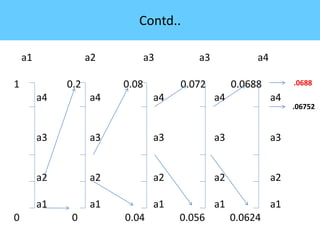
5 symbol message, a1a2a3a3a4 from 4 symbol source is coded.
Source Symbol Probability Initial Subinterval
a1 0.2 [0.0, 0.2)
a2 0.2 [0.2, 0.4)
a3 0.4 [0.4, 0.8)
a4 0.2 [0.8, 1.0)
Contd..
a1 a2 a3 a3 a4
1 0.2 0.08 0.072 0.0688
a4 a4 a4 a4 a4
a3 a3 a3 a3 a3
a2 a2 a2 a2 a2
a1 a1 a1 a1 a1
0 0 0.04 0.056 0.0624
Contd..
a1 a2 a3 a3 a4
1 0.2 0.08 0.072 0.0688
a4 a4 a4 a4 a4
a3 a3 a3 a3 a3
a2 a2 a2 a2 a2
a1 a1 a1 a1 a1
0 0 0.04 0.056 0.0624
Contd..
a1 a2 a3 a3 a4
1 0.2 0.08 0.072 0.0688
a4 a4 a4 a4 a4
a3 a3 a3 a3 a3
a2 a2 a2 a2 a2
a1 a1 a1 a1 a1
0 0 0.04 0.056 0.0624
Contd..
a1 a2 a3 a3 a4
1 0.2 0.08 0.072 0.0688
a4 a4 a4 a4 a4
a3 a3 a3 a3 a3
a2 a2 a2 a2 a2
a1 a1 a1 a1 a1
0 0 0.04 0.056 0.0624
Contd..
a1 a2 a3 a3 a4
1 0.2 0.08 0.072 0.0688
a4 a4 a4 a4 a4
a3 a3 a3 a3 a3
a2 a2 a2 a2 a2
a1 a1 a1 a1 a1
0 0 0.04 0.056 0.0624
Contd..
a1 a2 a3 a3 a4
1 0.2 0.08 0.072 0.0688
a4 a4 a4 a4 a4
a3 a3 a3 a3 a3
a2 a2 a2 a2 a2
a1 a1 a1 a1 a1
0 0 0.04 0.056 0.0624
.06752
.0688
Dictionary based Techniques_1.LZ77
Algorithm/Pseudocode
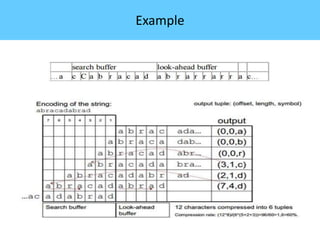
Example
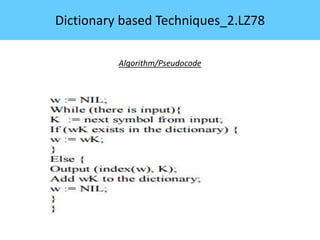
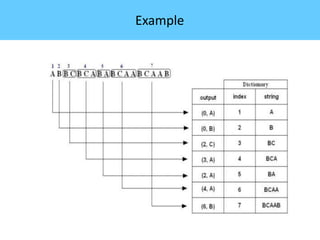
Dictionary based Techniques_2.LZ78
Algorithm/Pseudocode
Example
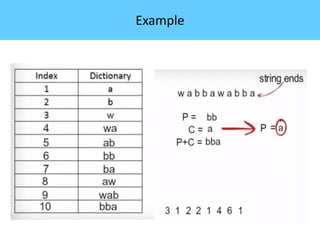
Dictionary based Techniques_3.LZW
Algorithm/Pseudocode
Example
•
Applications of Image Compression
• Broadcast Television
• Remote sensing via satellite
• Military communication via radar, sonar
• Tele conferencing
• Computer communications
• Facsimile transmission
• Medical images : in computer tomography
• Magnetic Resonance Imaging(MRI)
• Satellite images, geological surveys, weather maps

Image compression: Techniques and Application

  • 1.
    Image Compression: Techniquesand Application By- Nidhi Baranwal University of Allahabad
  • 2.
    What and Why? •Image compression is the technique of reducing the amount of data required to represent an image • It involves: - reducing the storage required to save an image -reducing the bandwidth required to transmit it • Why? - to handle large amount of information such as multimedia - to fulfill the goal of representing an image with minimum number of bits of an acceptable image quality - for focusing on removal or reduction of several types of redundancy in data or information
  • 3.
    Compression Algorithm • Therole of compression algorithm is to reduce the source data to a compressed form and decompress it to get the original data • Any compression algorithm has two major components: - modeler: its purpose is to condition the image data for compression using the knowledge of data - coder: encoder codes the symbols using the model while decoder decodes the message from the compressed data
  • 4.
    Compression Techniques • Lossess: 1.Runlength 2.Huffma 3.ShannonFano 4.Arithmetic 5.Dictionary based • Lossy: 1.Lossy Predictive 2.VectorQuantization 3.Block Transform 4.JPEG 5.MPEG
  • 5.
    Redundancy and itsTypes • Redundancy means repetitive data that may be present implicitly or explicitly • Types: - coding redundancy : caused due to poor selection of coding technique - inter-pixel redundancy : called spacial/geometrical redundancy.It may be inter frame or intra frame - psychovisual redundancy : images that convey little or no information to the human observer are said to be psychovisually redundant - chromatic redundancy: it refers to the presence of unnecessary colors in an image
  • 6.
    Arithmetic Coding Algorithm/Pseudocode Input symbolis l Previouslow is the lower bound for the old interval Previoushigh is the upper bound for the old interval Range is Previoushigh - Previouslow Let Previouslow= 0, Previoushigh = 1, Range = Previoushigh – Previouslow =1 WHILE (input symbol != EOF) get input symbol l Range = Previoushigh - Previouslow New Previouslow = Previouslow + Range* intervallow of l New Previoushigh = Previouslow + Range* intervalhigh of l END
  • 7.
    Example 5 symbol message,a1a2a3a3a4 from 4 symbol source is coded. Source Symbol Probability Initial Subinterval a1 0.2 [0.0, 0.2) a2 0.2 [0.2, 0.4) a3 0.4 [0.4, 0.8) a4 0.2 [0.8, 1.0)
  • 8.
    Contd.. a1 a2 a3a3 a4 1 0.2 0.08 0.072 0.0688 a4 a4 a4 a4 a4 a3 a3 a3 a3 a3 a2 a2 a2 a2 a2 a1 a1 a1 a1 a1 0 0 0.04 0.056 0.0624
  • 9.
    Contd.. a1 a2 a3a3 a4 1 0.2 0.08 0.072 0.0688 a4 a4 a4 a4 a4 a3 a3 a3 a3 a3 a2 a2 a2 a2 a2 a1 a1 a1 a1 a1 0 0 0.04 0.056 0.0624
  • 10.
    Contd.. a1 a2 a3a3 a4 1 0.2 0.08 0.072 0.0688 a4 a4 a4 a4 a4 a3 a3 a3 a3 a3 a2 a2 a2 a2 a2 a1 a1 a1 a1 a1 0 0 0.04 0.056 0.0624
  • 11.
    Contd.. a1 a2 a3a3 a4 1 0.2 0.08 0.072 0.0688 a4 a4 a4 a4 a4 a3 a3 a3 a3 a3 a2 a2 a2 a2 a2 a1 a1 a1 a1 a1 0 0 0.04 0.056 0.0624
  • 12.
    Contd.. a1 a2 a3a3 a4 1 0.2 0.08 0.072 0.0688 a4 a4 a4 a4 a4 a3 a3 a3 a3 a3 a2 a2 a2 a2 a2 a1 a1 a1 a1 a1 0 0 0.04 0.056 0.0624
  • 13.
    Contd.. a1 a2 a3a3 a4 1 0.2 0.08 0.072 0.0688 a4 a4 a4 a4 a4 a3 a3 a3 a3 a3 a2 a2 a2 a2 a2 a1 a1 a1 a1 a1 0 0 0.04 0.056 0.0624 .06752 .0688
  • 14.
  • 15.
  • 16.
  • 17.
  • 18.
  • 19.
  • 20.
    Applications of ImageCompression • Broadcast Television • Remote sensing via satellite • Military communication via radar, sonar • Tele conferencing • Computer communications • Facsimile transmission • Medical images : in computer tomography • Magnetic Resonance Imaging(MRI) • Satellite images, geological surveys, weather maps