PONDICHERRY UNIVERSITYPONDICHERRY UNIVERSITY
DEPARTMENT OF ELCTRONICS
ENGINNERING
BY:BY:
VISHNUDHARAN.BVISHNUDHARAN.B
M.TECH 1M.TECH 1STST
YEARYEAR
AGENDAAGENDA
 Introduction
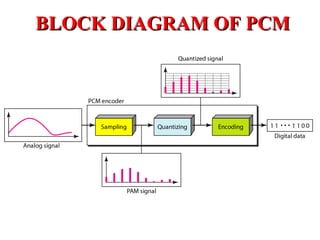
 Block diagram of PCM
 PCM processes
 PCM standards
 Bit rate and bandwidth requirements of PCM
 Advantages
 Disadvantages
 Application
PULSE CODE MODULATIONPULSE CODE MODULATION
 Analog voice data must be translated into a series of
binary digits before they can be transmitted.
 With Pulse Code Modulation (PCM), the amplitude of
the sound wave is sampled at regular intervals and
translated into a binary number.
 The difference between the original analog signal and
the translated digital signal is called quantizing error.
BLOCK DIAGRAM OF PCMBLOCK DIAGRAM OF PCM
PCM PROCESSESPCM PROCESSES
 Filtering
 Sampling
 Quantization
 Encoding
SAMPLINGSAMPLING
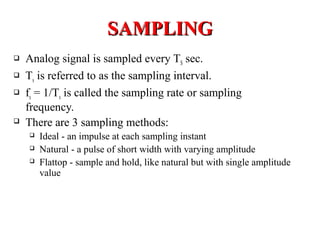
 Analog signal is sampled every TS sec.
 Ts is referred to as the sampling interval.
 fs = 1/Ts is called the sampling rate or sampling
frequency.
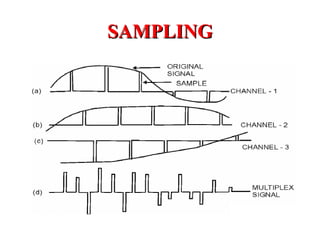
 There are 3 sampling methods:
 Ideal - an impulse at each sampling instant
 Natural - a pulse of short width with varying amplitude
 Flattop - sample and hold, like natural but with single amplitude
value
DIFFERENT TYPES OF SAMPLING METHODSDIFFERENT TYPES OF SAMPLING METHODS
SAMPLINGSAMPLING
QUANTIZINGQUANTIZING
 The process of measuring the numerical values of
the samples and giving them a table value in a
suitable scale
 The finite number of amplitude intervals is called
the ‘quantizing interval’ like quantizing interval
no.1 is 10-20mV; 2 is 20-30mV etc. in a case of
1V signal.
 Linear quantizing is where the quantizing
intervals are of the same size
QUANTIZINGQUANTIZING
 Quantization intervals are coded in binary
form, and so the quantization intervals will be
in powers of 2.
 In PCM, 8 bit code is used and so we have 256
intervals for quantizing (128 levels in the
positive direction and 128 levels in negative
direction)
QUANTIZATION DISTORTIONQUANTIZATION DISTORTION
 The deviation between the amplitude of
samples at the transmitter and receiving ends
 In linear quantization, the distortion is more
and to decrease the distortion, the no. of steps
in the given amplitude range has to be
increased.
 Due to BW limitations, more quantum levels in
small amplitude region are planned results to
Non linear (uniform) quantization
PCM StandardsPCM Standards
 There are two standards of pcm namely
 1) The European Standard
2 ) The American Standard
 They differ slightly in the detail of their working but
the principles are the same.
 European pcm = 30 channels
 North american pcm = 24 channels
 Japanese pcm = 24 channels
 In india we follow the european pcm of 30 channels
system working.
BIT RATE AND BANDWIDTHBIT RATE AND BANDWIDTH
REQUIREMENTS OF PCMREQUIREMENTS OF PCM
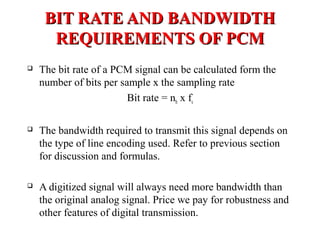
 The bit rate of a PCM signal can be calculated form the
number of bits per sample x the sampling rate
Bit rate = nb x fs
 The bandwidth required to transmit this signal depends on
the type of line encoding used. Refer to previous section
for discussion and formulas.
 A digitized signal will always need more bandwidth than
the original analog signal. Price we pay for robustness and
other features of digital transmission.
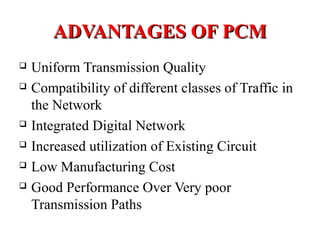
ADVANTAGES OF PCMADVANTAGES OF PCM
 Uniform Transmission Quality
 Compatibility of different classes of Traffic in
the Network
 Integrated Digital Network
 Increased utilization of Existing Circuit
 Low Manufacturing Cost
 Good Performance Over Very poor
Transmission Paths
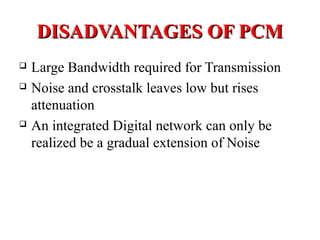
DISADVANTAGES OF PCMDISADVANTAGES OF PCM
 Large Bandwidth required for Transmission
 Noise and crosstalk leaves low but rises
attenuation
 An integrated Digital network can only be
realized be a gradual extension of Noise
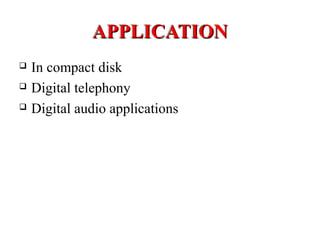
APPLICATIONAPPLICATION
 In compact disk
 Digital telephony
 Digital audio applications
PULSE CODE MODULATION (PCM)

PULSE CODE MODULATION (PCM)

  • 1.
    PONDICHERRY UNIVERSITYPONDICHERRY UNIVERSITY DEPARTMENTOF ELCTRONICS ENGINNERING BY:BY: VISHNUDHARAN.BVISHNUDHARAN.B M.TECH 1M.TECH 1STST YEARYEAR
  • 2.
    AGENDAAGENDA  Introduction  Blockdiagram of PCM  PCM processes  PCM standards  Bit rate and bandwidth requirements of PCM  Advantages  Disadvantages  Application
  • 3.
    PULSE CODE MODULATIONPULSECODE MODULATION  Analog voice data must be translated into a series of binary digits before they can be transmitted.  With Pulse Code Modulation (PCM), the amplitude of the sound wave is sampled at regular intervals and translated into a binary number.  The difference between the original analog signal and the translated digital signal is called quantizing error.
  • 4.
    BLOCK DIAGRAM OFPCMBLOCK DIAGRAM OF PCM
  • 5.
    PCM PROCESSESPCM PROCESSES Filtering  Sampling  Quantization  Encoding
  • 6.
    SAMPLINGSAMPLING  Analog signalis sampled every TS sec.  Ts is referred to as the sampling interval.  fs = 1/Ts is called the sampling rate or sampling frequency.  There are 3 sampling methods:  Ideal - an impulse at each sampling instant  Natural - a pulse of short width with varying amplitude  Flattop - sample and hold, like natural but with single amplitude value
  • 7.
    DIFFERENT TYPES OFSAMPLING METHODSDIFFERENT TYPES OF SAMPLING METHODS
  • 8.
  • 9.
    QUANTIZINGQUANTIZING  The processof measuring the numerical values of the samples and giving them a table value in a suitable scale  The finite number of amplitude intervals is called the ‘quantizing interval’ like quantizing interval no.1 is 10-20mV; 2 is 20-30mV etc. in a case of 1V signal.  Linear quantizing is where the quantizing intervals are of the same size
  • 10.
    QUANTIZINGQUANTIZING  Quantization intervalsare coded in binary form, and so the quantization intervals will be in powers of 2.  In PCM, 8 bit code is used and so we have 256 intervals for quantizing (128 levels in the positive direction and 128 levels in negative direction)
  • 11.
    QUANTIZATION DISTORTIONQUANTIZATION DISTORTION The deviation between the amplitude of samples at the transmitter and receiving ends  In linear quantization, the distortion is more and to decrease the distortion, the no. of steps in the given amplitude range has to be increased.  Due to BW limitations, more quantum levels in small amplitude region are planned results to Non linear (uniform) quantization
  • 12.
    PCM StandardsPCM Standards There are two standards of pcm namely  1) The European Standard 2 ) The American Standard  They differ slightly in the detail of their working but the principles are the same.  European pcm = 30 channels  North american pcm = 24 channels  Japanese pcm = 24 channels  In india we follow the european pcm of 30 channels system working.
  • 13.
    BIT RATE ANDBANDWIDTHBIT RATE AND BANDWIDTH REQUIREMENTS OF PCMREQUIREMENTS OF PCM  The bit rate of a PCM signal can be calculated form the number of bits per sample x the sampling rate Bit rate = nb x fs  The bandwidth required to transmit this signal depends on the type of line encoding used. Refer to previous section for discussion and formulas.  A digitized signal will always need more bandwidth than the original analog signal. Price we pay for robustness and other features of digital transmission.
  • 14.
    ADVANTAGES OF PCMADVANTAGESOF PCM  Uniform Transmission Quality  Compatibility of different classes of Traffic in the Network  Integrated Digital Network  Increased utilization of Existing Circuit  Low Manufacturing Cost  Good Performance Over Very poor Transmission Paths
  • 15.
    DISADVANTAGES OF PCMDISADVANTAGESOF PCM  Large Bandwidth required for Transmission  Noise and crosstalk leaves low but rises attenuation  An integrated Digital network can only be realized be a gradual extension of Noise
  • 16.
    APPLICATIONAPPLICATION  In compactdisk  Digital telephony  Digital audio applications