Apache Spark MLlib 2.0 Preview:
Data Science and Production
Joseph K. Bradley
June 8, 2016
® ™
Who am I?
• ApacheSpark committer & PMC member
• Software Engineer@ Databricks
• Ph.D. in Machine Learning from CarnegieMellonU.
2
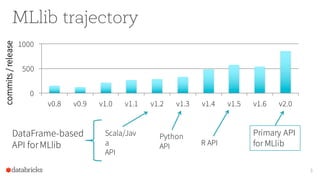
MLlib trajectory
3
0
500
1000
v0.8 v0.9 v1.0 v1.1 v1.2 v1.3 v1.4 v1.5 v1.6 v2.0
commits/release
Scala/Jav
a
API
Primary API
for MLlib
Python
API R API
DataFrame-based
API forMLlib
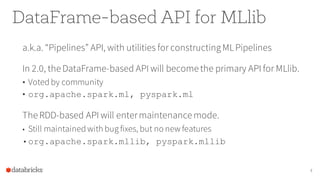
DataFrame-based API for MLlib
a.k.a. “Pipelines” API, with utilities for constructingMLPipelines
In 2.0, the DataFrame-based API will become the primary API for MLlib.
• Voted by community
• org.apache.spark.ml, pyspark.ml
The RDD-based API will entermaintenance mode.
• Still maintained with bug fixes, but no new features
•org.apache.spark.mllib, pyspark.mllib
4
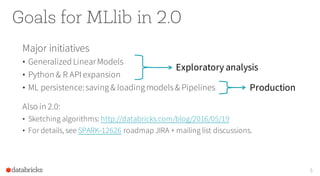
Goals for MLlib in 2.0
Major initiatives
• Generalized LinearModels
• Python & R API expansion
• ML persistence:saving & loading models& Pipelines
Also in 2.0:
• Sketching algorithms: http://databricks.com/blog/2016/05/19
• For details, see SPARK-12626 roadmap JIRA + mailing list discussions.
5
Exploratory analysis
Production
MLlib for exploratory analysis
Generalized Linear Models (GLMs)
Python & R APIs
6
Generalized Linear Models (GLMs)
Arguablythe most important class of models for ML
• Logistic regression
• Linear regression
7
In Spark 1.6 & earlier
• Many othertypes of models
• Model summary statistics +1
+1
+1
+1
-1-1
-1-1
+1
-1
+1
+1 Spam
Ham
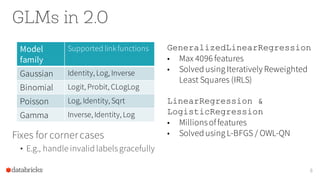
GLMs in 2.0
8
GeneralizedLinearRegression
• Max 4096 features
• Solved using Iteratively Reweighted
Least Squares (IRLS)
LinearRegression &
LogisticRegression
• Millionsoffeatures
• Solved using L-BFGS / OWL-QNFixes for cornercases
• E.g., handle invalid labelsgracefully
Model
family
Supported linkfunctions
Gaussian Identity, Log, Inverse
Binomial Logit, Probit, CLogLog
Poisson Log, Identity, Sqrt
Gamma Inverse, Identity, Log
Python & R APIs for MLlib
Python
• Clustering algorithms: Bisecting K-Means, Gaussian Mixtures, LDA
• Meta-algorithms: OneVsRest, TrainValidationSplit
• GeneralizedLinearRegression
• Feature transformers: ChiSqSelector, MaxAbsScaler, QuantileDiscretizer
• Model inspection: summaries for Logistic Regression, Linear Regression, GLMs
R
• Regression & classification: Generalized Linear Regression, AFT survival regression
• Clustering: K-Means
9
Goal: Expand ML APIs forcritical languagesfor data science
MLlib in production
ML Persistence
Customizing Pipelines
10
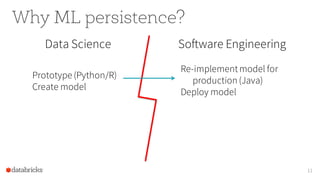
Why ML persistence?
11
Data Science Software Engineering
Prototype (Python/R)
Create model
Re-implementmodel for
production (Java)
Deploy model
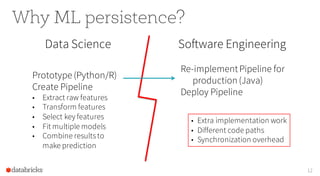
Why ML persistence?
12
Data Science Software Engineering
Prototype (Python/R)
Create Pipeline
• Extract raw features
• Transform features
• Select key features
• Fit multiple models
• Combine results to
make prediction
• Extra implementation work
• Different code paths
• Synchronization overhead
Re-implementPipeline for
production (Java)
Deploy Pipeline
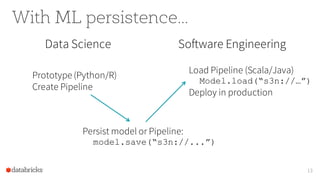
With ML persistence...
13
Data Science Software Engineering
Prototype (Python/R)
Create Pipeline
Persist model or Pipeline:
model.save(“s3n://...”)
Load Pipeline (Scala/Java)
Model.load(“s3n://…”)
Deploy in production
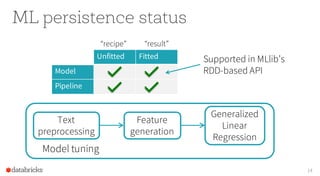
Model tuning
ML persistence status
14
Text
preprocessing
Feature
generation
Generalized
Linear
Regression
Unfitted Fitted
Model
Pipeline
Supported in MLlib’s
RDD-based API
“recipe” “result”
ML persistence status
Near-complete coveragein all Spark languageAPIs
• Scala & Java: complete
• Python:complete exceptfor 2 algorithms
• R: complete for existing APIs
Single underlyingimplementation of models
Exchangeabledata format
• JSON for metadata
• Parquet for model data (coefficients,etc.)
15
Customizing ML Pipelines
MLlib 2.0 will include:
• 29 feature transformers (Tokenizer,Word2Vec, ...)
• 21 models (for classification, regression,clustering, ...)
• Model tuning & evaluation
But some applications requirecustomized
Transformers& Models.
16
Options for customization
Extend abstractions
• Transformer
• Estimator & Model
• Evaluator
17
UnaryTransformer: input à output
E.g.:
• Tokenizer: text à sequence of words
• Normalizer: vector à normalized vector
Simple API which provides:
• DataFrame-based API
• Built-in parametergetters, setters
• Distributed Row-wise transformation
Existing use cases:
• Natural Language Processing
(Snowball, Stanford NLP)
• Featurization libraries
• Many others!
Persistence for customized algorithms
2 traits provide persistence for simple Transformers:
•DefaultParamsWritable
•DefaultParamsReadable
Simply mix in these traits to provide persistence in Scala/Java.
à Saves & loadsalgorithmparameters
val myParam: Param[Double]
à Does notsave member data
val myCoefficients: Vector
For an example, see UnaryTransformerExample.scala
in spark/examples/
18
Recap
Exploratory analysis
• Generalized LinearRegression
• Python & R APIs
Production
• ML persistence
• Customizing Pipelines
19
Many thanksto the community
for contributions& support!
What’s next?
Prioritized items on the 2.1 roadmap JIRA (SPARK-15581):
• Critical feature completenessfor the DataFrame-based API
– Multiclass logistic regression
– Statistics
• Python API parity & R API expansion
• Scaling & speed tuning for key algorithms: trees & ensembles
GraphFrames
• Release for Spark 2.0
• Speed improvements(join elimination,connected components)
20
Get started
• Getinvolved via roadmap JIRA (SPARK-
15581) + mailing lists
• Download notebook for this talk
http://dbricks.co/1UfvAH9
• ML persistenceblog post
http://databricks.com/blog/2016/05/31
21
Try outthe ApacheSpark 2.0
preview release:
http://databricks.com/try
Thank you!
Officehour@2:45pmtoday(ExpoHall)
Twitter:@jkbatcmu

Apache Spark MLlib 2.0 Preview: Data Science and Production

  • 1.
    Apache Spark MLlib2.0 Preview: Data Science and Production Joseph K. Bradley June 8, 2016 ® ™
  • 2.
    Who am I? •ApacheSpark committer & PMC member • Software Engineer@ Databricks • Ph.D. in Machine Learning from CarnegieMellonU. 2
  • 3.
    MLlib trajectory 3 0 500 1000 v0.8 v0.9v1.0 v1.1 v1.2 v1.3 v1.4 v1.5 v1.6 v2.0 commits/release Scala/Jav a API Primary API for MLlib Python API R API DataFrame-based API forMLlib
  • 4.
    DataFrame-based API forMLlib a.k.a. “Pipelines” API, with utilities for constructingMLPipelines In 2.0, the DataFrame-based API will become the primary API for MLlib. • Voted by community • org.apache.spark.ml, pyspark.ml The RDD-based API will entermaintenance mode. • Still maintained with bug fixes, but no new features •org.apache.spark.mllib, pyspark.mllib 4
  • 5.
    Goals for MLlibin 2.0 Major initiatives • Generalized LinearModels • Python & R API expansion • ML persistence:saving & loading models& Pipelines Also in 2.0: • Sketching algorithms: http://databricks.com/blog/2016/05/19 • For details, see SPARK-12626 roadmap JIRA + mailing list discussions. 5 Exploratory analysis Production
  • 6.
    MLlib for exploratoryanalysis Generalized Linear Models (GLMs) Python & R APIs 6
  • 7.
    Generalized Linear Models(GLMs) Arguablythe most important class of models for ML • Logistic regression • Linear regression 7 In Spark 1.6 & earlier • Many othertypes of models • Model summary statistics +1 +1 +1 +1 -1-1 -1-1 +1 -1 +1 +1 Spam Ham
  • 8.
    GLMs in 2.0 8 GeneralizedLinearRegression •Max 4096 features • Solved using Iteratively Reweighted Least Squares (IRLS) LinearRegression & LogisticRegression • Millionsoffeatures • Solved using L-BFGS / OWL-QNFixes for cornercases • E.g., handle invalid labelsgracefully Model family Supported linkfunctions Gaussian Identity, Log, Inverse Binomial Logit, Probit, CLogLog Poisson Log, Identity, Sqrt Gamma Inverse, Identity, Log
  • 9.
    Python & RAPIs for MLlib Python • Clustering algorithms: Bisecting K-Means, Gaussian Mixtures, LDA • Meta-algorithms: OneVsRest, TrainValidationSplit • GeneralizedLinearRegression • Feature transformers: ChiSqSelector, MaxAbsScaler, QuantileDiscretizer • Model inspection: summaries for Logistic Regression, Linear Regression, GLMs R • Regression & classification: Generalized Linear Regression, AFT survival regression • Clustering: K-Means 9 Goal: Expand ML APIs forcritical languagesfor data science
  • 10.
    MLlib in production MLPersistence Customizing Pipelines 10
  • 11.
    Why ML persistence? 11 DataScience Software Engineering Prototype (Python/R) Create model Re-implementmodel for production (Java) Deploy model
  • 12.
    Why ML persistence? 12 DataScience Software Engineering Prototype (Python/R) Create Pipeline • Extract raw features • Transform features • Select key features • Fit multiple models • Combine results to make prediction • Extra implementation work • Different code paths • Synchronization overhead Re-implementPipeline for production (Java) Deploy Pipeline
  • 13.
    With ML persistence... 13 DataScience Software Engineering Prototype (Python/R) Create Pipeline Persist model or Pipeline: model.save(“s3n://...”) Load Pipeline (Scala/Java) Model.load(“s3n://…”) Deploy in production
  • 14.
    Model tuning ML persistencestatus 14 Text preprocessing Feature generation Generalized Linear Regression Unfitted Fitted Model Pipeline Supported in MLlib’s RDD-based API “recipe” “result”
  • 15.
    ML persistence status Near-completecoveragein all Spark languageAPIs • Scala & Java: complete • Python:complete exceptfor 2 algorithms • R: complete for existing APIs Single underlyingimplementation of models Exchangeabledata format • JSON for metadata • Parquet for model data (coefficients,etc.) 15
  • 16.
    Customizing ML Pipelines MLlib2.0 will include: • 29 feature transformers (Tokenizer,Word2Vec, ...) • 21 models (for classification, regression,clustering, ...) • Model tuning & evaluation But some applications requirecustomized Transformers& Models. 16
  • 17.
    Options for customization Extendabstractions • Transformer • Estimator & Model • Evaluator 17 UnaryTransformer: input à output E.g.: • Tokenizer: text à sequence of words • Normalizer: vector à normalized vector Simple API which provides: • DataFrame-based API • Built-in parametergetters, setters • Distributed Row-wise transformation Existing use cases: • Natural Language Processing (Snowball, Stanford NLP) • Featurization libraries • Many others!
  • 18.
    Persistence for customizedalgorithms 2 traits provide persistence for simple Transformers: •DefaultParamsWritable •DefaultParamsReadable Simply mix in these traits to provide persistence in Scala/Java. à Saves & loadsalgorithmparameters val myParam: Param[Double] à Does notsave member data val myCoefficients: Vector For an example, see UnaryTransformerExample.scala in spark/examples/ 18
  • 19.
    Recap Exploratory analysis • GeneralizedLinearRegression • Python & R APIs Production • ML persistence • Customizing Pipelines 19 Many thanksto the community for contributions& support!
  • 20.
    What’s next? Prioritized itemson the 2.1 roadmap JIRA (SPARK-15581): • Critical feature completenessfor the DataFrame-based API – Multiclass logistic regression – Statistics • Python API parity & R API expansion • Scaling & speed tuning for key algorithms: trees & ensembles GraphFrames • Release for Spark 2.0 • Speed improvements(join elimination,connected components) 20
  • 21.
    Get started • Getinvolvedvia roadmap JIRA (SPARK- 15581) + mailing lists • Download notebook for this talk http://dbricks.co/1UfvAH9 • ML persistenceblog post http://databricks.com/blog/2016/05/31 21 Try outthe ApacheSpark 2.0 preview release: http://databricks.com/try
  • 22.