About Me 
• Postdoc in AMPLab 
• Led initial development of MLlib 
• Technical Advisor for Databricks 
• Assistant Professor at UCLA 
• Research interests include scalability and ease-of- 
use issues in statistical machine learning
MLlib: Spark’s Machine 
Learning Library 
Ameet Talwalkar 
AMPCAMP 5 
November 20, 2014
History and Overview 
Example Applications 
Ongoing Development
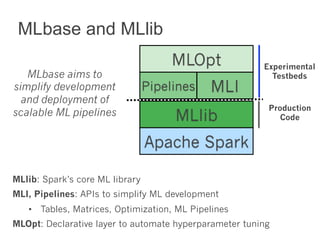
MLbase and MLlib 
MLOpt 
MLI 
MLlib 
Apache Spark 
MLbase aims to 
simplify development 
and deployment of 
scalable ML pipelines 
MLlib: Spark’s core ML library 
MLI, Pipelines: APIs to simplify ML development 
• Tables, Matrices, Optimization, ML Pipelines 
Experimental 
Testbeds 
Production 
MLOpt: Declarative layer to automate hyperparameter tuning 
Code 
Pipelines
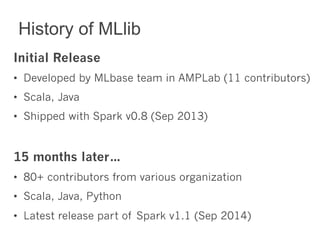
History of MLlib 
Initial Release 
• Developed by MLbase team in AMPLab (11 contributors) 
• Scala, Java 
• Shipped with Spark v0.8 (Sep 2013) 
15 months later… 
• 80+ contributors from various organization 
• Scala, Java, Python 
• Latest release part of Spark v1.1 (Sep 2014)
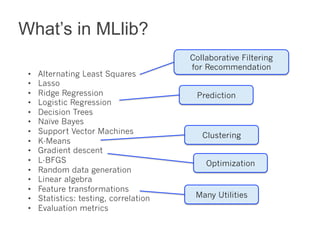
What’s in MLlib? 
• Alternating Least Squares 
• Lasso 
• Ridge Regression 
• Logistic Regression 
• Decision Trees 
• Naïve Bayes 
• Support Vector Machines 
• K-Means 
• Gradient descent 
• L-BFGS 
• Random data generation 
• Linear algebra 
• Feature transformations 
• Statistics: testing, correlation 
• Evaluation metrics 
Collaborative Filtering 
for Recommendation 
Prediction 
Clustering 
Optimization 
Many Utilities
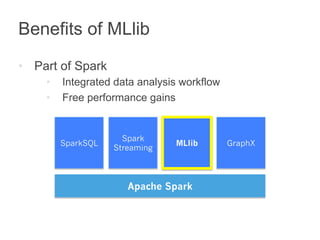
Benefits of MLlib 
• Part of Spark 
• Integrated data analysis workflow 
• Free performance gains 
Apache Spark 
SparkSQL 
Spark 
Streaming MLlib GraphX
Benefits of MLlib 
• Part of Spark 
• Integrated data analysis workflow 
• Free performance gains 
• Scalable 
• Python, Scala, Java APIs 
• Broad coverage of applications & algorithms 
• Rapid improvements in speed & robustness
History and Overview 
Example Applications 
Use Cases 
Distributed ML Challenges 
Code Examples 
Ongoing Development
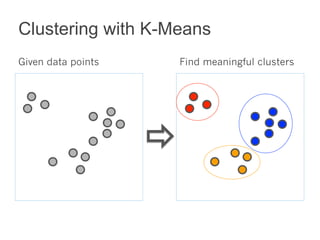
Clustering with K-Means 
Given data points Find meaningful clusters
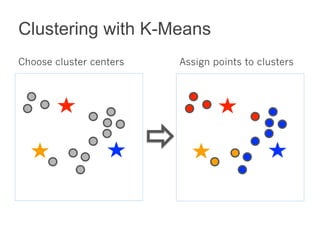
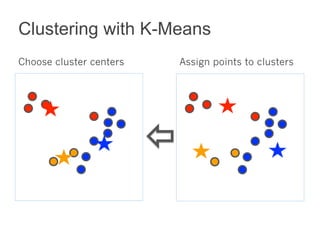
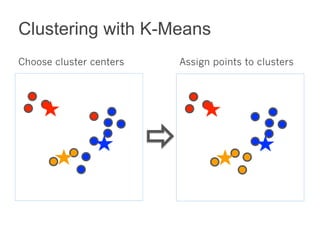
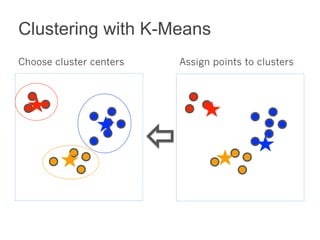
Clustering with K-Means 
Choose cluster centers Assign points to clusters
Clustering with K-Means 
Assign Choose cluster centers points to clusters
Clustering with K-Means 
Choose cluster centers Assign points to clusters
Clustering with K-Means 
Choose cluster centers Assign points to clusters
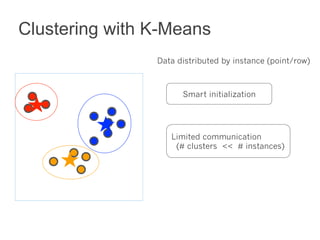
Clustering with K-Means 
Data distributed by instance (point/row) 
Smart initialization 
Limited communication 
(# clusters << # instances)
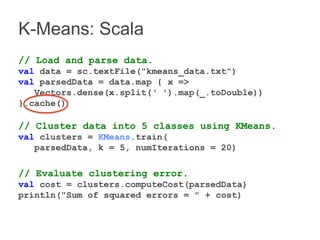
K-Means: Scala 
// Load and parse data. 
val data = sc.textFile("kmeans_data.txt") 
val parsedData = data.map { x => 
Vectors.dense(x.split(‘ ').map(_.toDouble)) 
}.cache() 
// Cluster data into 5 classes using KMeans. 
val clusters = KMeans.train( 
parsedData, k = 5, numIterations = 20) 
// Evaluate clustering error. 
val cost = clusters.computeCost(parsedData) 
println("Sum of squared errors = " + cost)
K-Means: Python 
# Load and parse data. 
data = sc.textFile("kmeans_data.txt") 
parsedData = data.map(lambda line: 
array([float(x) for x in line.split(' ‘)])).cache() 
# Cluster data into 5 classes using KMeans. 
clusters = KMeans.train(parsedData, k = 5, maxIterations = 20) 
# Evaluate clustering error. 
def error(point): 
center = clusters.centers[clusters.predict(point)] 
return sqrt(sum([x**2 for x in (point - center)])) 
cost = parsedData.map(lambda point: error(point))  
.reduce(lambda x, y: x + y) 
print("Sum of squared error = " + str(cost))
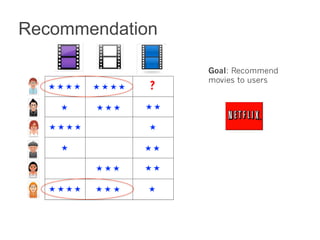
Recommendation 
? 
Goal: Recommend 
movies to users
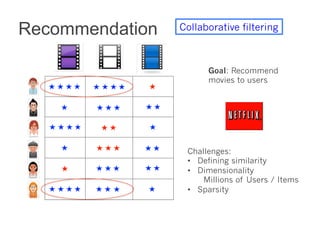
Recommendation 
Collaborative filtering 
Goal: Recommend 
movies to users 
Challenges: 
• Defining similarity 
• Dimensionality 
Millions of Users / Items 
• Sparsity
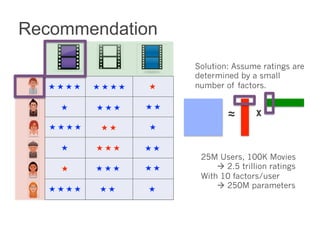
Recommendation 
Solution: Assume ratings are 
determined by a small 
number of factors. 
≈ x 
25M Users, 100K Movies 
! 2.5 trillion ratings 
With 10 factors/user 
! 250M parameters
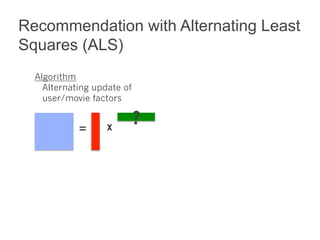
Recommendation with Alternating Least 
Squares (ALS) 
Algorithm 
Alternating update of 
user/movie factors 
= x 
? 
?
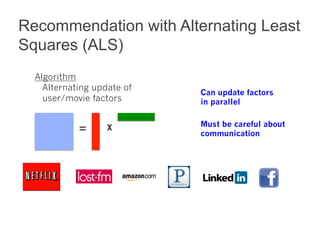
Recommendation with Alternating Least 
Squares (ALS) 
Algorithm 
Alternating update of 
user/movie factors 
= x 
Can update factors 
in parallel 
Must be careful about 
communication
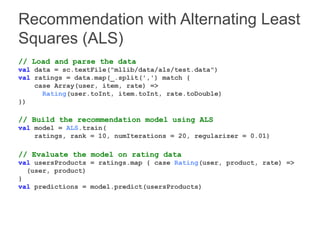
Recommendation with Alternating Least 
Squares (ALS) 
// Load and parse the data 
val data = sc.textFile("mllib/data/als/test.data") 
val ratings = data.map(_.split(',') match { 
case Array(user, item, rate) => 
Rating(user.toInt, item.toInt, rate.toDouble) 
}) 
// Build the recommendation model using ALS 
val model = ALS.train( 
ratings, rank = 10, numIterations = 20, regularizer = 0.01) 
// Evaluate the model on rating data 
val usersProducts = ratings.map { case Rating(user, product, rate) => 
(user, product) 
} 
val predictions = model.predict(usersProducts)
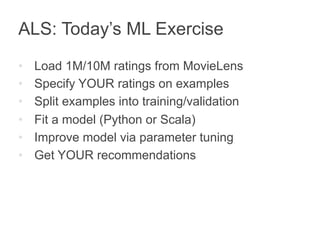
ALS: Today’s ML Exercise 
• Load 1M/10M ratings from MovieLens 
• Specify YOUR ratings on examples 
• Split examples into training/validation 
• Fit a model (Python or Scala) 
• Improve model via parameter tuning 
• Get YOUR recommendations
History and Overview 
Example Applications 
Ongoing Development 
Performance 
New APIs
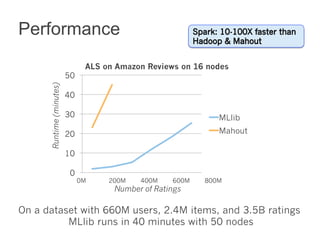
Performance 
50 
ALS on Amazon Reviews on 16 nodes 
minutes) 
40 
(30 
Runtime 20 
10 
0 
0M 200M 400M 600M 800M MLlib 
Mahout 
Number of Ratings 
On a dataset with 660M users, 2.4M items, and 3.5B ratings 
MLlib runs in 40 minutes with 50 nodes
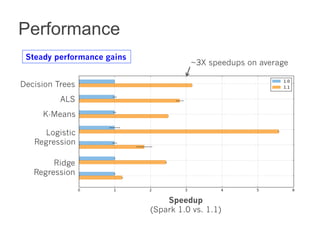
Performance 
Steady performance gains 
Decision Trees 
ALS 
K-Means 
Logistic 
Regression 
Ridge 
Regression 
~3X speedups on average 
Speedup 
(Spark 1.0 vs. 1.1)
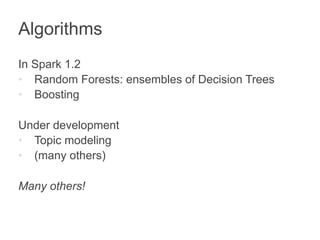
Algorithms 
In Spark 1.2 
• Random Forests: ensembles of Decision Trees 
• Boosting 
Under development 
• Topic modeling 
• (many others) 
Many others!
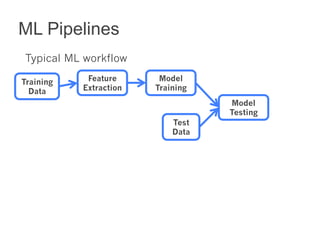
ML Pipelines 
Typical ML workflow 
Training 
Data 
Feature 
Extraction 
Model 
Training 
Model 
Testing 
Test 
Data
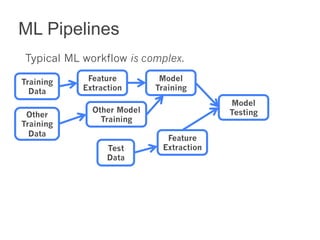
ML Pipelines 
Typical ML workflow is complex. 
Training 
Data 
Feature 
Extraction 
Model 
Training 
Model 
Testing 
Test 
Data 
Feature 
Extraction 
Other 
Training 
Data 
Other Model 
Training
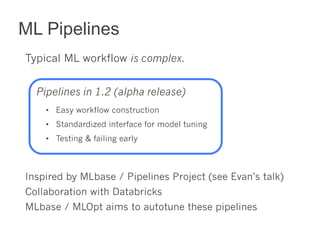
ML Pipelines 
Typical ML workflow is complex. 
Pipelines in 1.2 (alpha release) 
• Easy workflow construction 
• Standardized interface for model tuning 
• Testing & failing early 
Inspired by MLbase / Pipelines Project (see Evan’s talk) 
Collaboration with Databricks 
MLbase / MLOpt aims to autotune these pipelines
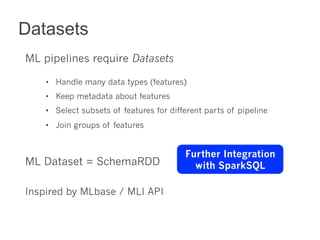
Datasets 
Further Integration 
with SparkSQL 
ML pipelines require Datasets 
• Handle many data types (features) 
• Keep metadata about features 
• Select subsets of features for different parts of pipeline 
• Join groups of features 
ML Dataset = SchemaRDD 
Inspired by MLbase / MLI API
MLlib Programming 
Guide 
spark.apache.org/docs/latest/mllib-guide. 
html 
Databricks training info 
databricks.com/spark-training 
Spark user lists & 
community 
spark.apache.org/community.html 
edX MOOC on Scalable 
Machine Learning 
www.edx.org/course/uc-berkeleyx/uc-berkeleyx- 
cs190-1x-scalable-machine-6066 
4-day BIDS minicourse 
in January 
Resources

MLlib: Spark's Machine Learning Library

  • 1.
    About Me •Postdoc in AMPLab • Led initial development of MLlib • Technical Advisor for Databricks • Assistant Professor at UCLA • Research interests include scalability and ease-of- use issues in statistical machine learning
  • 2.
    MLlib: Spark’s Machine Learning Library Ameet Talwalkar AMPCAMP 5 November 20, 2014
  • 3.
    History and Overview Example Applications Ongoing Development
  • 4.
    MLbase and MLlib MLOpt MLI MLlib Apache Spark MLbase aims to simplify development and deployment of scalable ML pipelines MLlib: Spark’s core ML library MLI, Pipelines: APIs to simplify ML development • Tables, Matrices, Optimization, ML Pipelines Experimental Testbeds Production MLOpt: Declarative layer to automate hyperparameter tuning Code Pipelines
  • 5.
    History of MLlib Initial Release • Developed by MLbase team in AMPLab (11 contributors) • Scala, Java • Shipped with Spark v0.8 (Sep 2013) 15 months later… • 80+ contributors from various organization • Scala, Java, Python • Latest release part of Spark v1.1 (Sep 2014)
  • 6.
    What’s in MLlib? • Alternating Least Squares • Lasso • Ridge Regression • Logistic Regression • Decision Trees • Naïve Bayes • Support Vector Machines • K-Means • Gradient descent • L-BFGS • Random data generation • Linear algebra • Feature transformations • Statistics: testing, correlation • Evaluation metrics Collaborative Filtering for Recommendation Prediction Clustering Optimization Many Utilities
  • 7.
    Benefits of MLlib • Part of Spark • Integrated data analysis workflow • Free performance gains Apache Spark SparkSQL Spark Streaming MLlib GraphX
  • 8.
    Benefits of MLlib • Part of Spark • Integrated data analysis workflow • Free performance gains • Scalable • Python, Scala, Java APIs • Broad coverage of applications & algorithms • Rapid improvements in speed & robustness
  • 9.
    History and Overview Example Applications Use Cases Distributed ML Challenges Code Examples Ongoing Development
  • 10.
    Clustering with K-Means Given data points Find meaningful clusters
  • 11.
    Clustering with K-Means Choose cluster centers Assign points to clusters
  • 12.
    Clustering with K-Means Assign Choose cluster centers points to clusters
  • 13.
    Clustering with K-Means Choose cluster centers Assign points to clusters
  • 14.
    Clustering with K-Means Choose cluster centers Assign points to clusters
  • 15.
    Clustering with K-Means Data distributed by instance (point/row) Smart initialization Limited communication (# clusters << # instances)
  • 16.
    K-Means: Scala //Load and parse data. val data = sc.textFile("kmeans_data.txt") val parsedData = data.map { x => Vectors.dense(x.split(‘ ').map(_.toDouble)) }.cache() // Cluster data into 5 classes using KMeans. val clusters = KMeans.train( parsedData, k = 5, numIterations = 20) // Evaluate clustering error. val cost = clusters.computeCost(parsedData) println("Sum of squared errors = " + cost)
  • 17.
    K-Means: Python #Load and parse data. data = sc.textFile("kmeans_data.txt") parsedData = data.map(lambda line: array([float(x) for x in line.split(' ‘)])).cache() # Cluster data into 5 classes using KMeans. clusters = KMeans.train(parsedData, k = 5, maxIterations = 20) # Evaluate clustering error. def error(point): center = clusters.centers[clusters.predict(point)] return sqrt(sum([x**2 for x in (point - center)])) cost = parsedData.map(lambda point: error(point)) .reduce(lambda x, y: x + y) print("Sum of squared error = " + str(cost))
  • 18.
    Recommendation ? Goal:Recommend movies to users
  • 19.
    Recommendation Collaborative filtering Goal: Recommend movies to users Challenges: • Defining similarity • Dimensionality Millions of Users / Items • Sparsity
  • 20.
    Recommendation Solution: Assumeratings are determined by a small number of factors. ≈ x 25M Users, 100K Movies ! 2.5 trillion ratings With 10 factors/user ! 250M parameters
  • 21.
    Recommendation with AlternatingLeast Squares (ALS) Algorithm Alternating update of user/movie factors = x ? ?
  • 22.
    Recommendation with AlternatingLeast Squares (ALS) Algorithm Alternating update of user/movie factors = x Can update factors in parallel Must be careful about communication
  • 23.
    Recommendation with AlternatingLeast Squares (ALS) // Load and parse the data val data = sc.textFile("mllib/data/als/test.data") val ratings = data.map(_.split(',') match { case Array(user, item, rate) => Rating(user.toInt, item.toInt, rate.toDouble) }) // Build the recommendation model using ALS val model = ALS.train( ratings, rank = 10, numIterations = 20, regularizer = 0.01) // Evaluate the model on rating data val usersProducts = ratings.map { case Rating(user, product, rate) => (user, product) } val predictions = model.predict(usersProducts)
  • 24.
    ALS: Today’s MLExercise • Load 1M/10M ratings from MovieLens • Specify YOUR ratings on examples • Split examples into training/validation • Fit a model (Python or Scala) • Improve model via parameter tuning • Get YOUR recommendations
  • 25.
    History and Overview Example Applications Ongoing Development Performance New APIs
  • 26.
    Performance 50 ALSon Amazon Reviews on 16 nodes minutes) 40 (30 Runtime 20 10 0 0M 200M 400M 600M 800M MLlib Mahout Number of Ratings On a dataset with 660M users, 2.4M items, and 3.5B ratings MLlib runs in 40 minutes with 50 nodes
  • 27.
    Performance Steady performancegains Decision Trees ALS K-Means Logistic Regression Ridge Regression ~3X speedups on average Speedup (Spark 1.0 vs. 1.1)
  • 28.
    Algorithms In Spark1.2 • Random Forests: ensembles of Decision Trees • Boosting Under development • Topic modeling • (many others) Many others!
  • 29.
    ML Pipelines TypicalML workflow Training Data Feature Extraction Model Training Model Testing Test Data
  • 30.
    ML Pipelines TypicalML workflow is complex. Training Data Feature Extraction Model Training Model Testing Test Data Feature Extraction Other Training Data Other Model Training
  • 31.
    ML Pipelines TypicalML workflow is complex. Pipelines in 1.2 (alpha release) • Easy workflow construction • Standardized interface for model tuning • Testing & failing early Inspired by MLbase / Pipelines Project (see Evan’s talk) Collaboration with Databricks MLbase / MLOpt aims to autotune these pipelines
  • 32.
    Datasets Further Integration with SparkSQL ML pipelines require Datasets • Handle many data types (features) • Keep metadata about features • Select subsets of features for different parts of pipeline • Join groups of features ML Dataset = SchemaRDD Inspired by MLbase / MLI API
  • 33.
    MLlib Programming Guide spark.apache.org/docs/latest/mllib-guide. html Databricks training info databricks.com/spark-training Spark user lists & community spark.apache.org/community.html edX MOOC on Scalable Machine Learning www.edx.org/course/uc-berkeleyx/uc-berkeleyx- cs190-1x-scalable-machine-6066 4-day BIDS minicourse in January Resources