Apache Spark 2.0:
Faster, Easier, and Smarter
Reynold Xin
@rxin
2016-05-05 Webinar
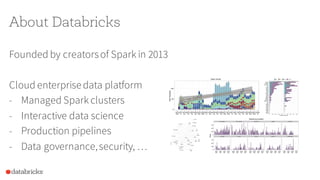
About Databricks
Founded by creatorsof Spark in 2013
Cloud enterprisedata platform
- Managed Spark clusters
- Interactive data science
- Production pipelines
- Data governance,security, …
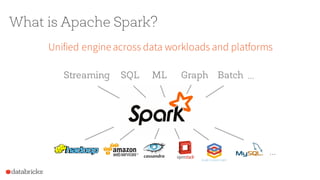
What is Apache Spark?
Unified engineacross data workloads and platforms
…
SQLStreaming ML Graph Batch …
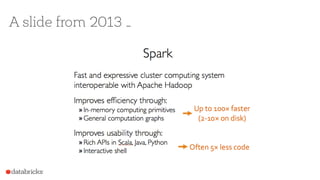
A slide from 2013 …
Spark 2.0
Steps to bigger& better things….
Builds on all we learned in past 2 years
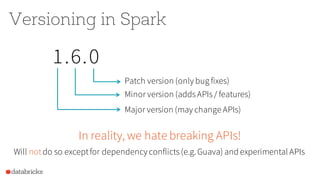
Versioning in Spark
In reality, we hate breaking APIs!
Will notdo so exceptfor dependency conflicts(e.g.Guava) and experimental APIs
1.6.0
Patch version (only bug fixes)
Major version (may change APIs)
Minor version (addsAPIs/ features)
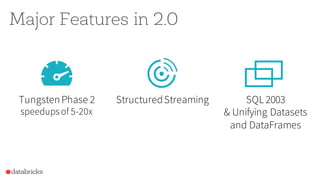
Major Features in 2.0
TungstenPhase 2
speedupsof 5-20x
StructuredStreaming SQL 2003
& Unifying Datasets
and DataFrames
API Foundation for the Future
Dataset, DataFrame, SQL, ML
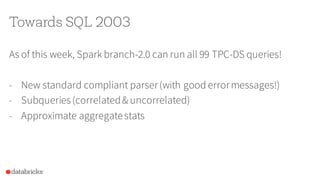
Towards SQL 2003
As of this week, Spark branch-2.0 can run all 99 TPC-DS queries!
- New standard compliant parser(with good errormessages!)
- Subqueries(correlated& uncorrelated)
- Approximate aggregatestats
Datasets and DataFrames
In 2015, we added DataFrames & Datasets as structured data APIs
• DataFrames are collections of rows with a schema
• Datasets add static types,e.g. Dataset[Person]
• Both run on Tungsten
Spark 2.0 will merge these APIs: DataFrame = Dataset[Row]
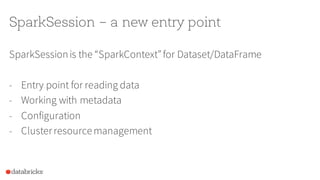
SparkSession – a new entry point
SparkSessionis the “SparkContext”for Dataset/DataFrame
- Entry point for reading data
- Working with metadata
- Configuration
- Clusterresourcemanagement
Notebook demo
http://bit.ly/1SMPEzQ
and
http://bit.ly/1OeqdSn
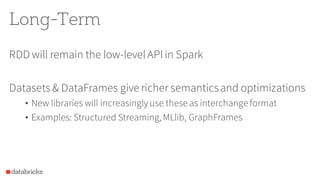
Long-Term
RDD will remain the low-levelAPIin Spark
Datasets & DataFrames give richer semanticsand optimizations
• New libraries will increasingly use these as interchange format
• Examples: Structured Streaming,MLlib, GraphFrames
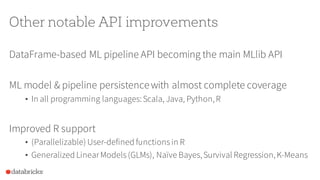
Other notable API improvements
DataFrame-based ML pipeline API becoming the main MLlib API
ML model & pipeline persistencewith almost complete coverage
• In all programming languages:Scala, Java, Python,R
Improved R support
• (Parallelizable) User-defined functionsin R
• Generalized LinearModels(GLMs), Naïve Bayes,Survival Regression,K-Means
Structured Streaming
How do we simplify streaming?
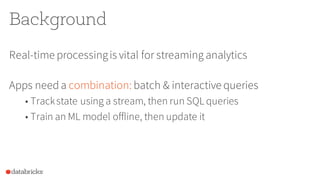
Background
Real-time processingis vital for streaming analytics
Apps needa combination: batch & interactive queries
• Trackstate using a stream, then run SQL queries
• Train an ML model offline, then update it
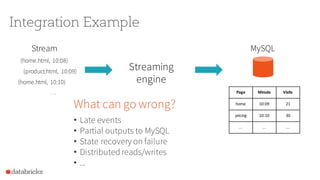
Integration Example
Streaming
engine
Stream
(home.html, 10:08)
(product.html, 10:09)
(home.html, 10:10)
. . .
What can go wrong?
• Late events
• Partial outputs to MySQL
• State recovery on failure
• Distributed reads/writes
• ...
MySQL
Page Minute Visits
home 10:09 21
pricing 10:10 30
... ... ...
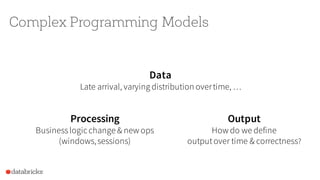
Processing
Businesslogic change & new ops
(windows,sessions)
Complex Programming Models
Output
How do we define
outputover time & correctness?
Data
Late arrival, varying distribution overtime, …
The simplest way to perform streaming analytics
is not having to reason about streaming.
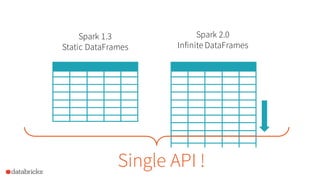
Spark 2.0
Infinite DataFrames
Spark 1.3
Static DataFrames
Single API !
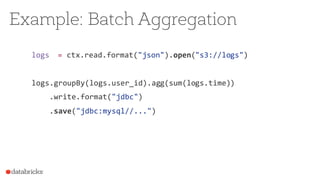
logs = ctx.read.format("json").open("s3://logs")
logs.groupBy(logs.user_id).agg(sum(logs.time))
.write.format("jdbc")
.save("jdbc:mysql//...")
Example: Batch Aggregation
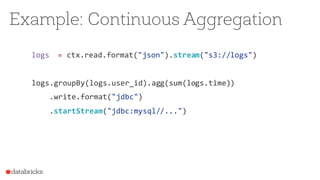
logs = ctx.read.format("json").stream("s3://logs")
logs.groupBy(logs.user_id).agg(sum(logs.time))
.write.format("jdbc")
.startStream("jdbc:mysql//...")
Example: Continuous Aggregation
Structured Streaming
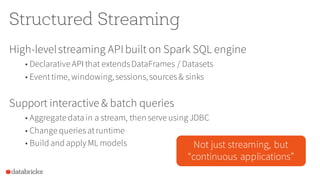
High-levelstreaming APIbuilt on Spark SQL engine
• Declarative API that extendsDataFrames / Datasets
• Eventtime, windowing,sessions,sources& sinks
Support interactive & batch queries
• Aggregate data in a stream, then serve using JDBC
• Change queriesatruntime
• Build and apply ML models Not just streaming, but
“continuous applications”
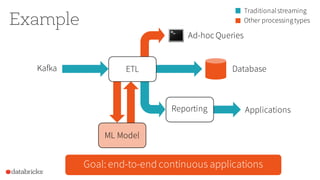
Goal: end-to-end continuous applications
Example
Reporting Applications
ML Model
Ad-hoc Queries
Traditionalstreaming
Other processingtypes
Kafka DatabaseETL
Tungsten Phase 2
Can we speed up Spark by 10X?
Demo
http://bit.ly/1X8LKmH
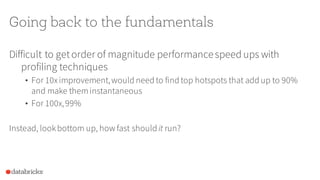
Going back to the fundamentals
Difficult to getorder of magnitude performancespeed ups with
profiling techniques
• For 10ximprovement,would need to find top hotspots that add up to 90%
and make theminstantaneous
• For 100x,99%
Instead, lookbottom up, how fast should it run?
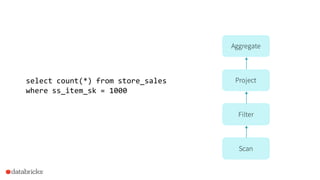
Scan
Filter
Project
Aggregate
select count(*) from store_sales
where ss_item_sk = 1000
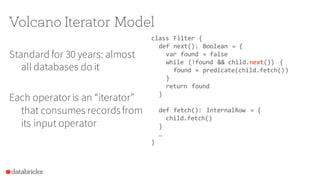
Volcano Iterator Model
Standard for 30 years: almost
all databases do it
Each operatoris an “iterator”
that consumes recordsfrom
its input operator
class Filter {
def next(): Boolean = {
var found = false
while (!found && child.next()) {
found = predicate(child.fetch())
}
return found
}
def fetch(): InternalRow = {
child.fetch()
}
…
}
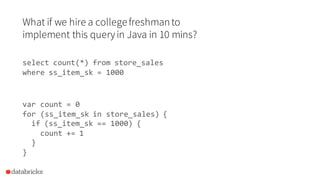
What if we hire a collegefreshmanto
implement this queryin Java in 10 mins?
select count(*) from store_sales
where ss_item_sk = 1000
var count = 0
for (ss_item_sk in store_sales) {
if (ss_item_sk == 1000) {
count += 1
}
}
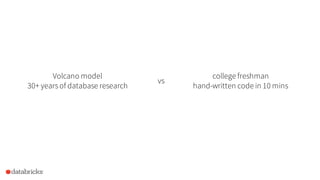
Volcano model
30+ years of database research
college freshman
hand-written code in 10 mins
vs
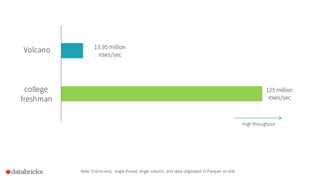
Volcano 13.95 million
rows/sec
college
freshman
125 million
rows/sec
Note: End-to-end, single thread, single column, and data originated in Parquet on disk
High throughput
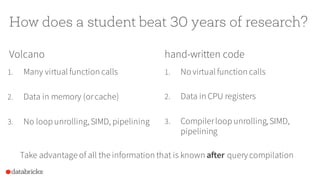
How does a student beat 30 years of research?
Volcano
1. Many virtual function calls
2. Data in memory (orcache)
3. No loop unrolling,SIMD, pipelining
hand-written code
1. No virtual function calls
2. Data in CPU registers
3. Compilerloop unrolling,SIMD,
pipelining
Take advantage of all the information that is known after query compilation
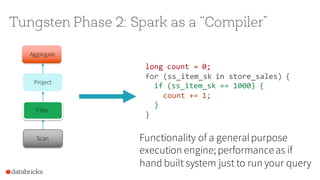
Scan
Filter
Project
Aggregate
long count = 0;
for (ss_item_sk in store_sales) {
if (ss_item_sk == 1000) {
count += 1;
}
}
Tungsten Phase 2: Spark as a “Compiler”
Functionality of a generalpurpose
execution engine; performanceas if
hand built system just to run your query
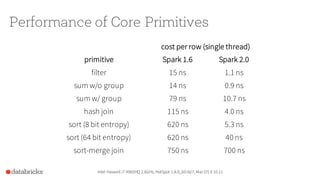
Performance of Core Primitives
cost per row (single thread)
primitive Spark 1.6 Spark 2.0
filter 15 ns 1.1 ns
sum w/o group 14 ns 0.9 ns
sum w/ group 79 ns 10.7 ns
hash join 115 ns 4.0 ns
sort (8 bit entropy) 620 ns 5.3 ns
sort (64 bit entropy) 620 ns 40 ns
sort-merge join 750 ns 700 ns
Intel Haswell i7 4960HQ 2.6GHz, HotSpot 1.8.0_60-b27, Mac OS X 10.11
0
100
200
300
400
500
600
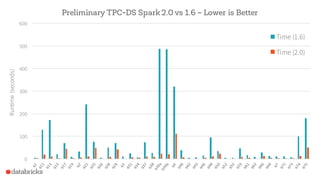
Runtime(seconds) Preliminary TPC-DS Spark2.0 vs 1.6 – Lower is Better
Time (1.6)
Time (2.0)
Databricks
Community Edition
Best place to try & learn Spark.
Release Schedule
Today: work-in-progresssource code available on GitHub
Next week: preview of Spark 2.0 in Databricks Community Edition
Early June: Apache Spark 2.0 GA
Today’s talk
Spark 2.0 doubles down on what made Spark attractive:
• Faster: Project Tungsten Phase 2, i.e. “Spark as a compiler”
• Easier: unified APIs& SQL 2003
• Smarter: Structured Streaming
• Only scratched the surface here, as Spark 2.0 will resolve ~ 2000 tickets.
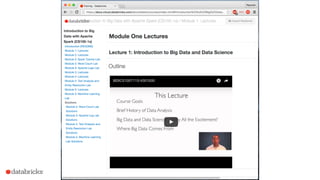
Learn Spark on Databricks Community Edition
• join beta waitlist https://databricks.com/ce/
Discount code: Meetup16SF
Thank you.
Don’tforgettoregisterforSparkSummitSF!

Apache Spark 2.0: Faster, Easier, and Smarter