Get rid of traditional ETL,
Move to Spark!
Bas Geerdink
ING
Bas Geerdink
• Chapter Lead in Analytics area at ING
• Master degree in Artificial Intelligence and
Informatics
• Spark Certified Developer
• @bgeerdink
• https://www.linkedin.com/in/geerdink
Who am I?
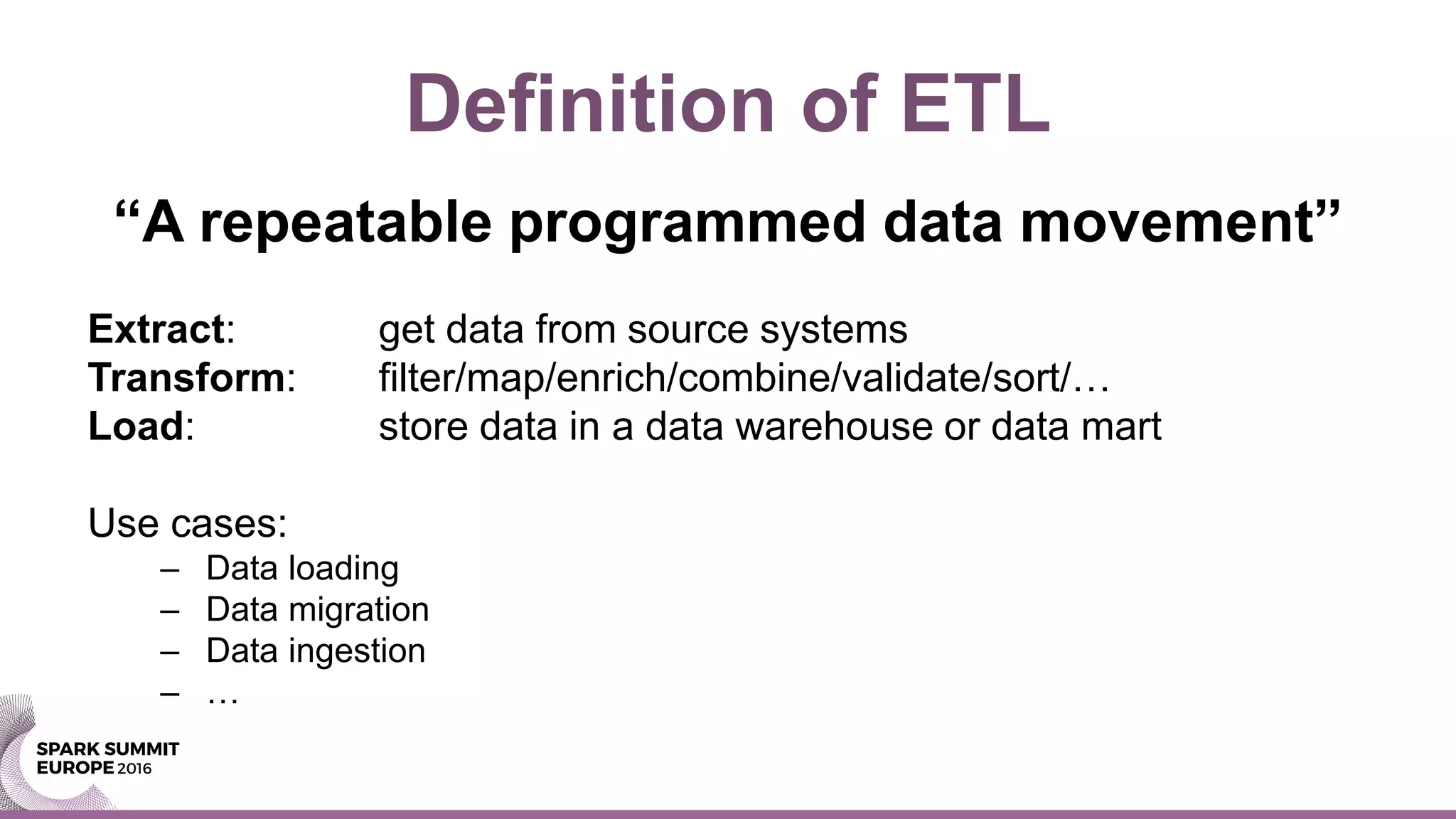
Definition of ETL
“A repeatable programmed data movement”
Extract: get data from source systems
Transform: filter/map/enrich/combine/validate/sort/…
Load: store data in a data warehouse or data mart
Use cases:
– Data loading
– Data migration
– Data ingestion
– …
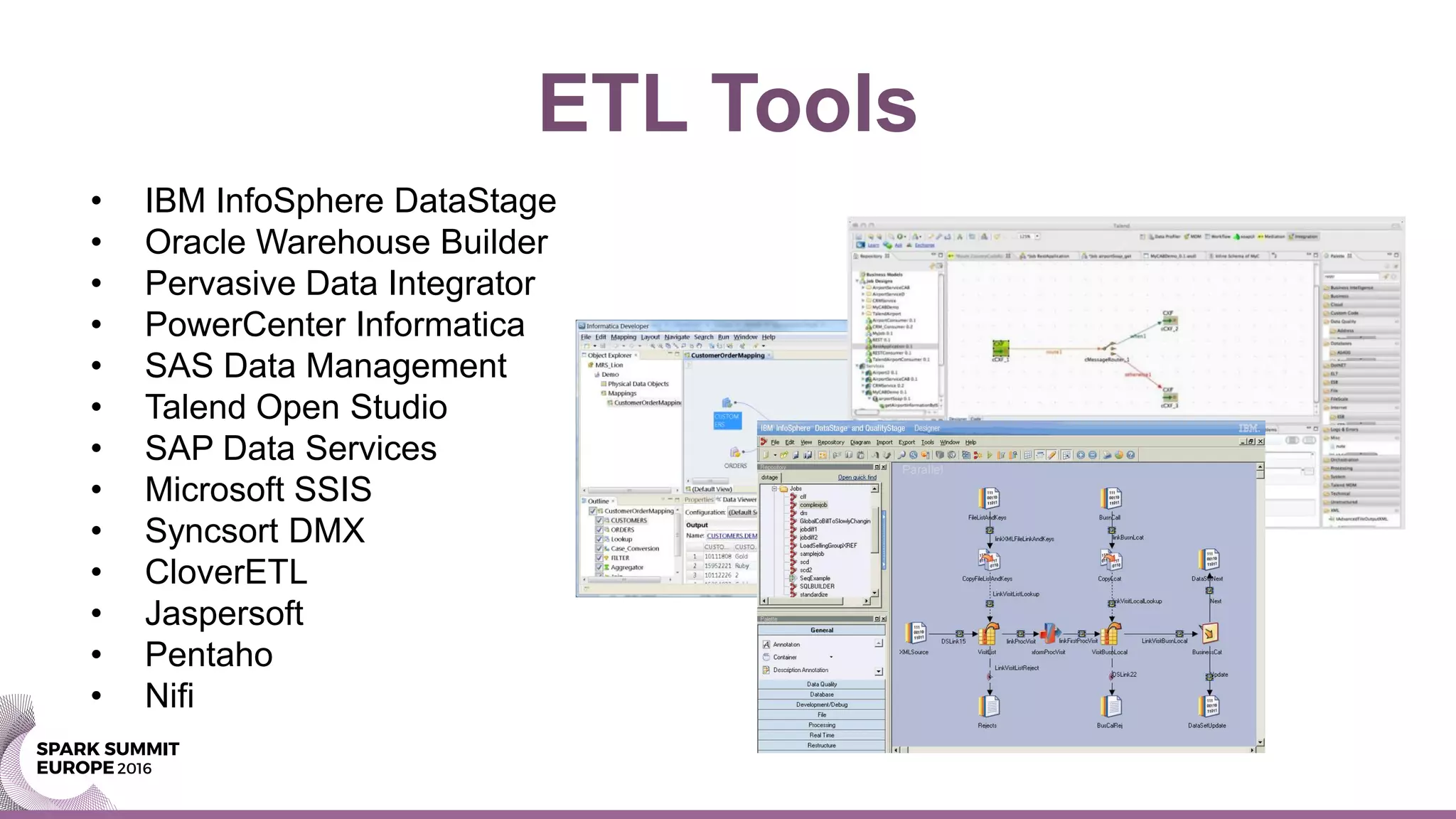
ETL Tools
• IBM InfoSphere DataStage
• Oracle Warehouse Builder
• Pervasive Data Integrator
• PowerCenter Informatica
• SAS Data Management
• Talend Open Studio
• SAP Data Services
• Microsoft SSIS
• Syncsort DMX
• CloverETL
• Jaspersoft
• Pentaho
• Nifi
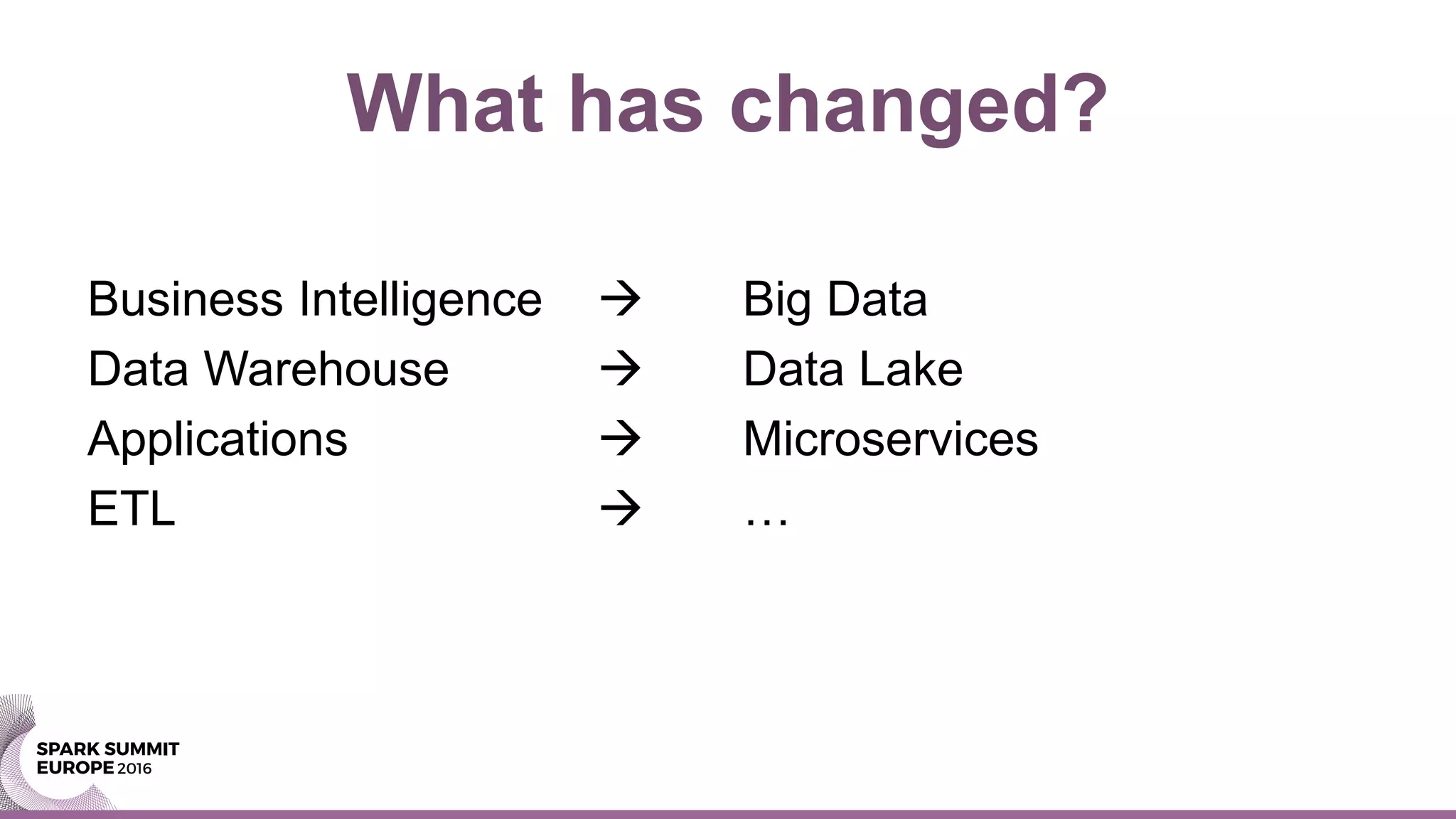
What has changed?
Business Intelligence  Big Data
Data Warehouse  Data Lake
Applications  Microservices
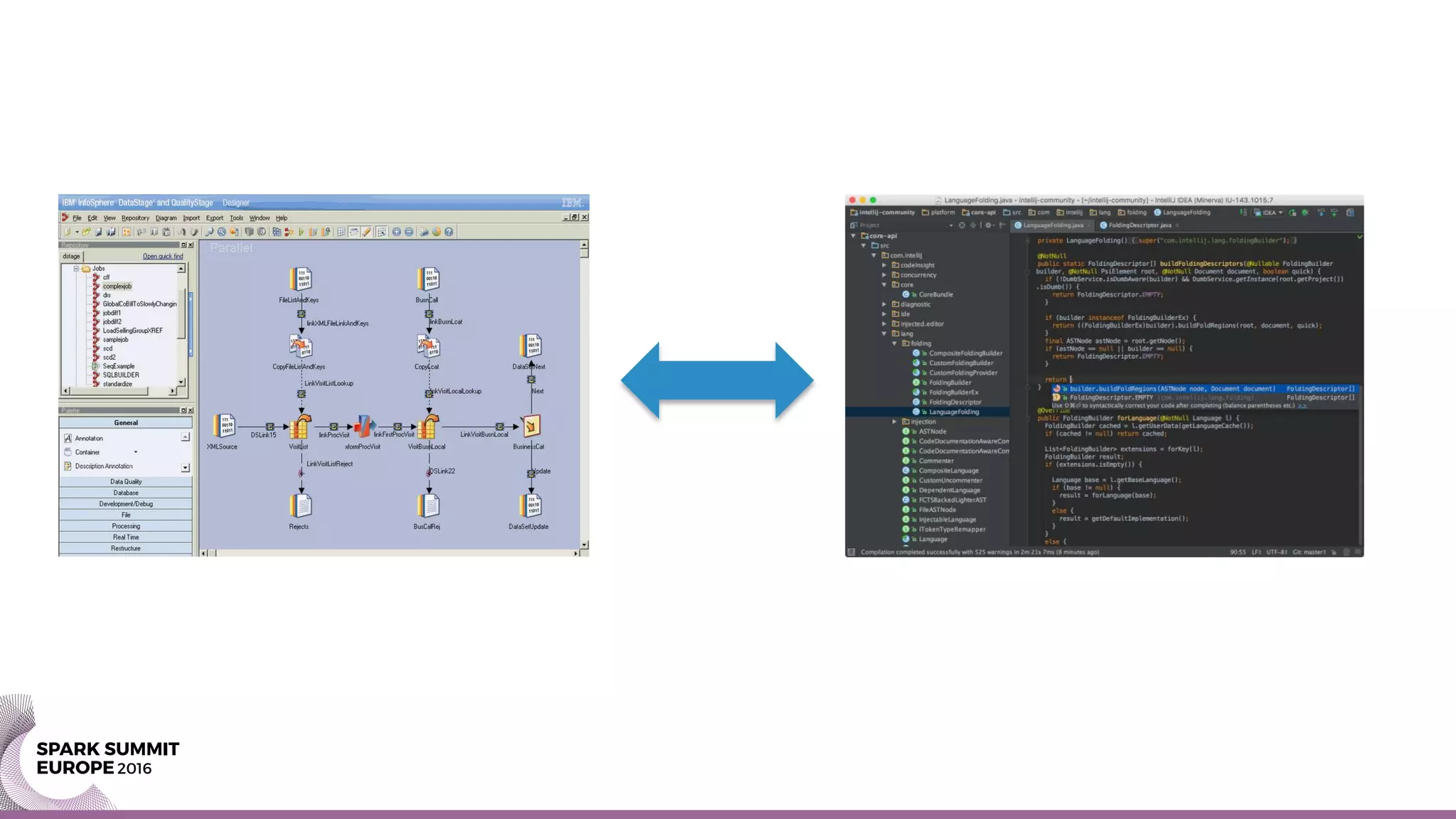
ETL  …
The Future of ETL Tools
• Only develop connectors for integration?
• Rebuild entire back-end to Hadoop/Spark/Flink?
• Provide a GUI with code generation?
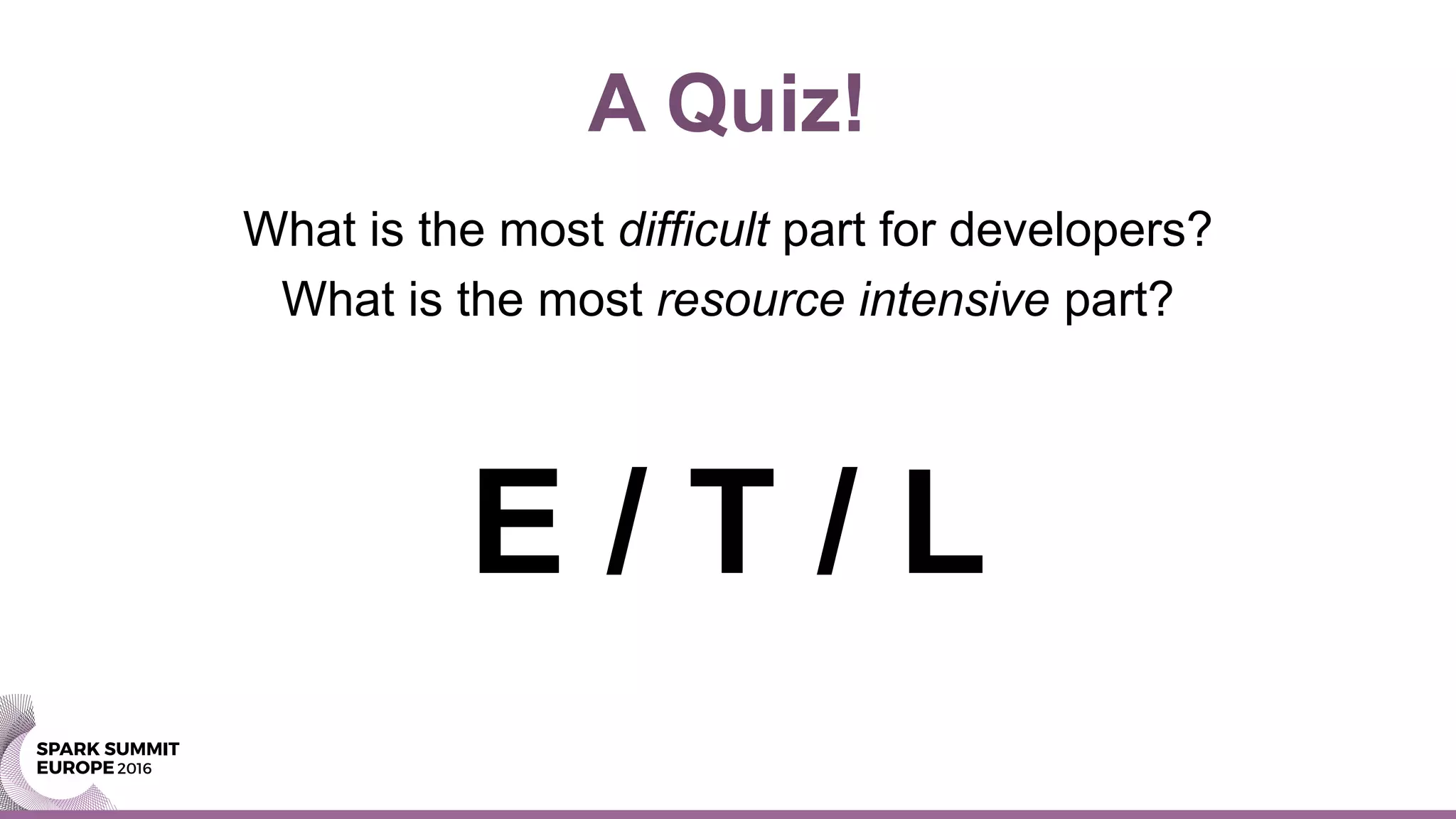
A Quiz!
What is the most difficult part for developers?
What is the most resource intensive part?
E / T / L
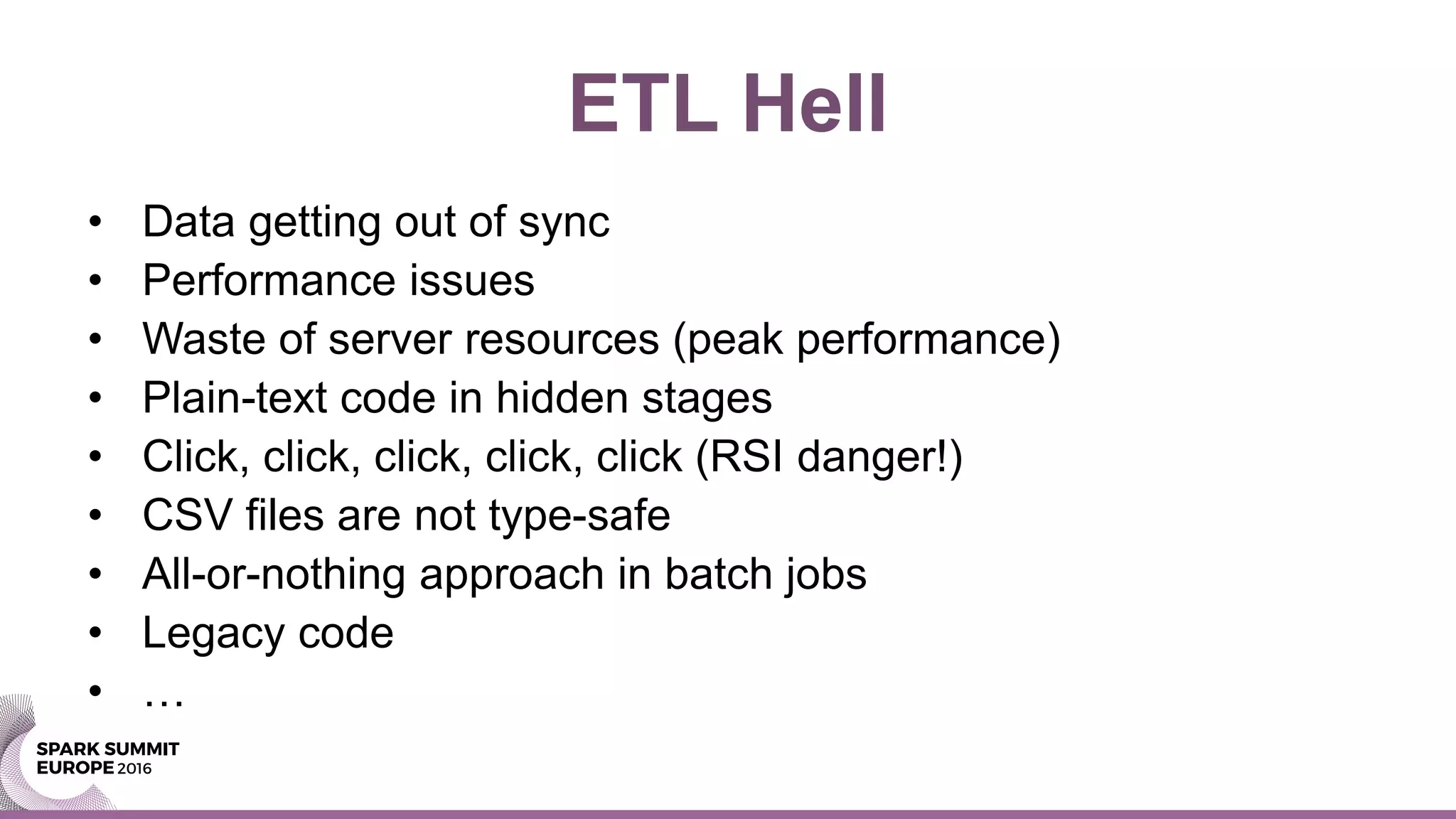
ETL Hell
• Data getting out of sync
• Performance issues
• Waste of server resources (peak performance)
• Plain-text code in hidden stages
• Click, click, click, click, click (RSI danger!)
• CSV files are not type-safe
• All-or-nothing approach in batch jobs
• Legacy code
• …
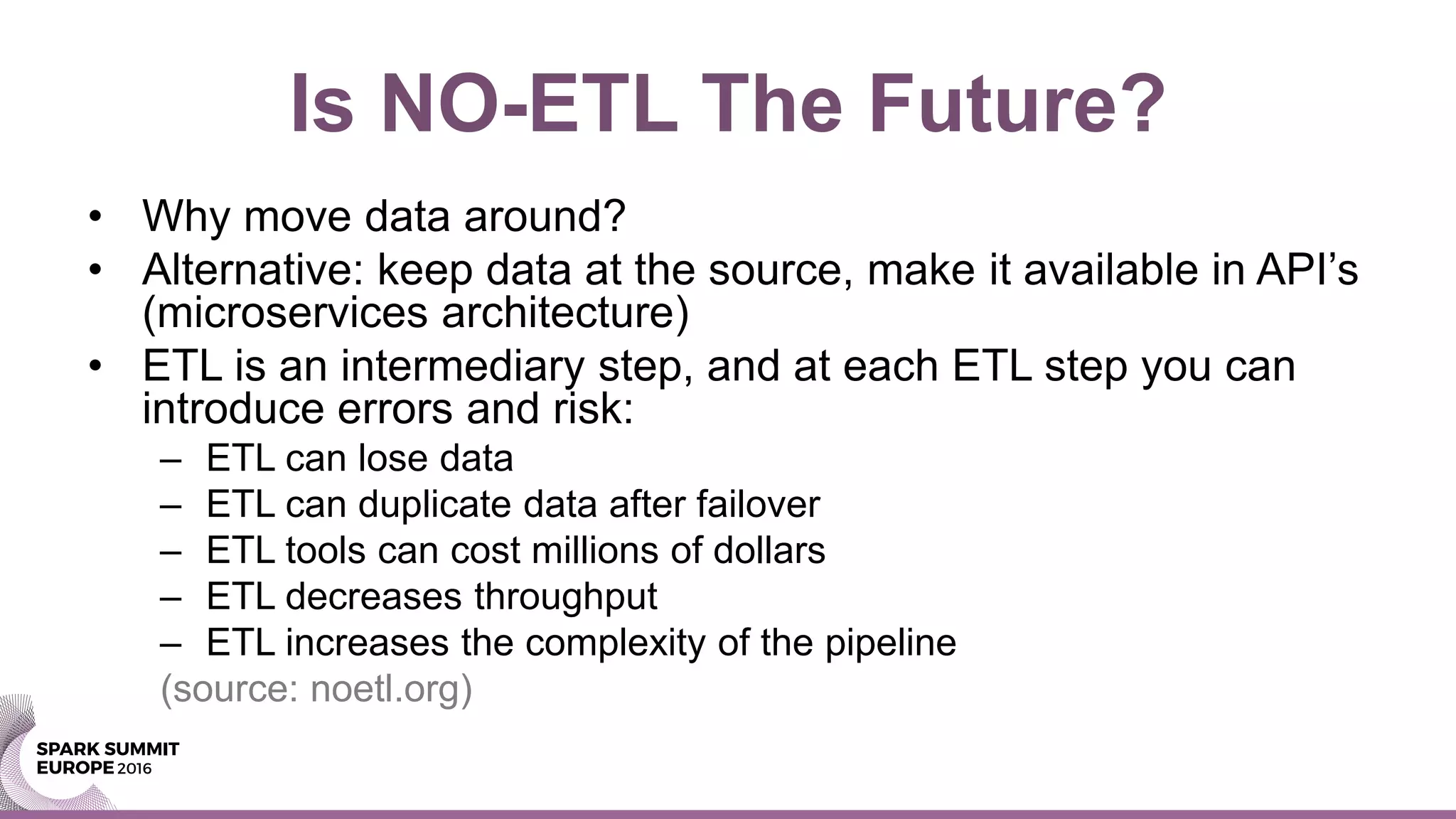
Is NO-ETL The Future?
• Why move data around?
• Alternative: keep data at the source, make it available in API’s
(microservices architecture)
• ETL is an intermediary step, and at each ETL step you can
introduce errors and risk:
– ETL can lose data
– ETL can duplicate data after failover
– ETL tools can cost millions of dollars
– ETL decreases throughput
– ETL increases the complexity of the pipeline
(source: noetl.org)
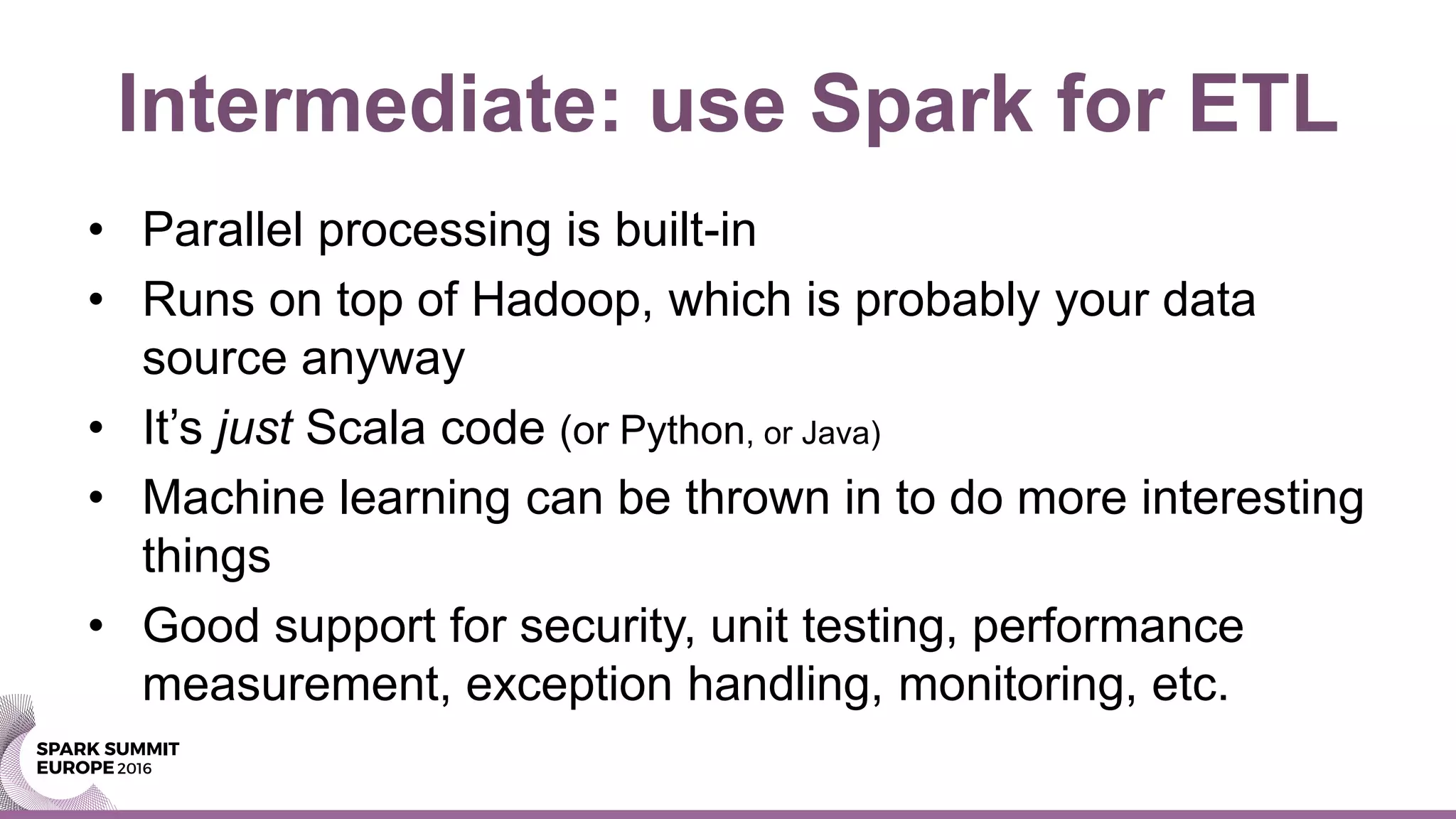
Intermediate: use Spark for ETL
• Parallel processing is built-in
• Runs on top of Hadoop, which is probably your data
source anyway
• It’s just Scala code (or Python, or Java)
• Machine learning can be thrown in to do more interesting
things
• Good support for security, unit testing, performance
measurement, exception handling, monitoring, etc.
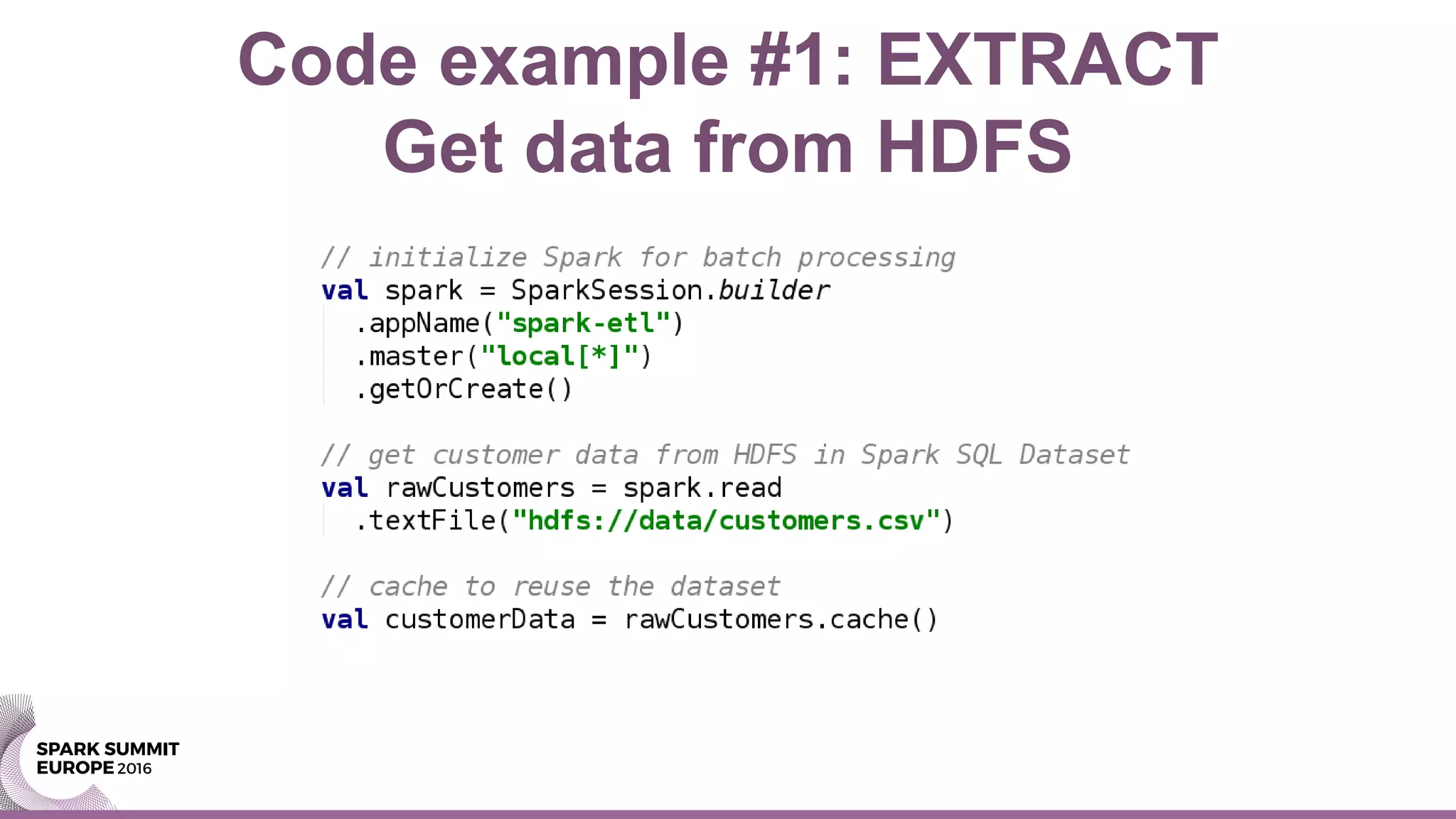
Code example #1: EXTRACT
Get data from HDFS
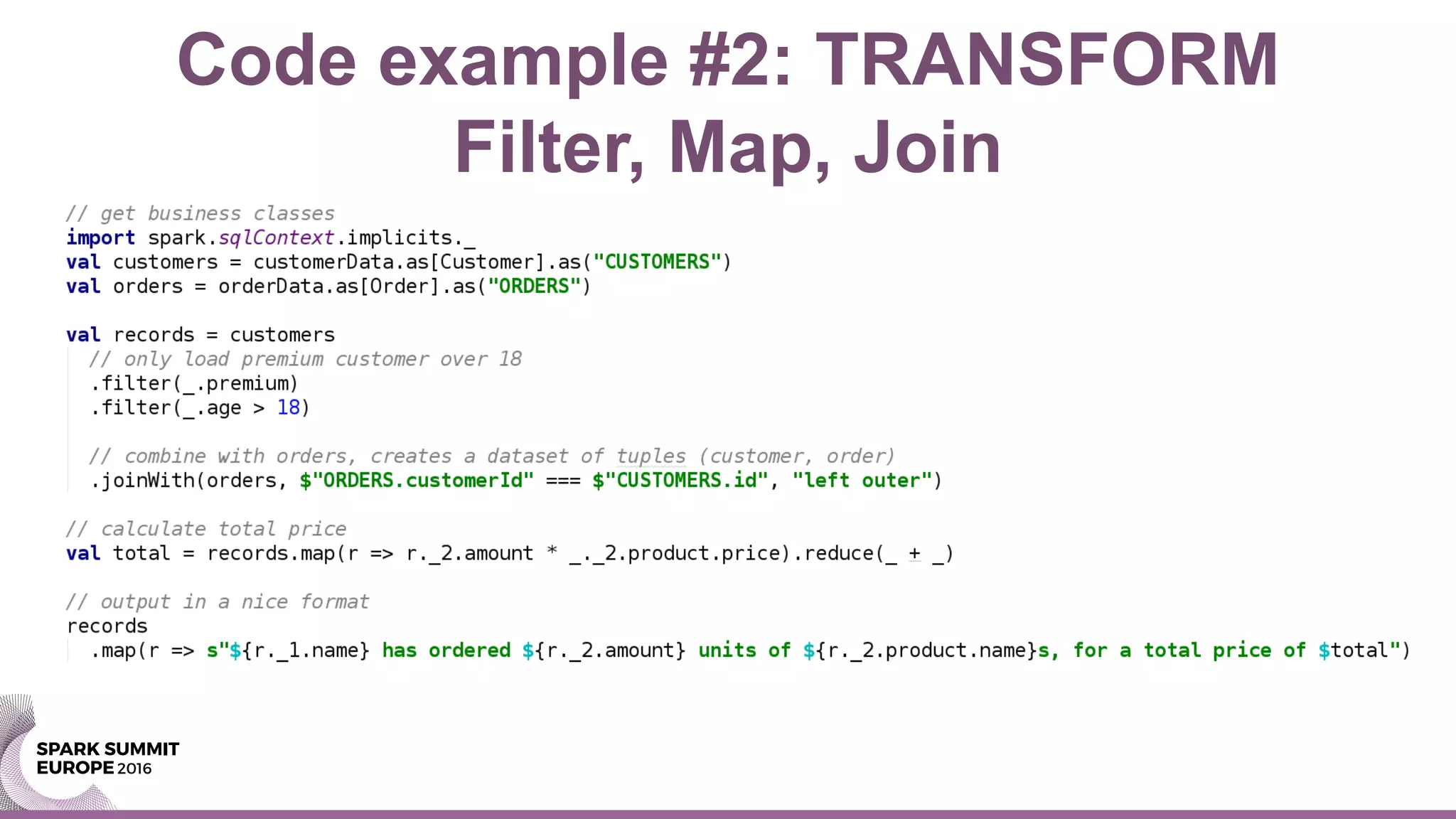
Code example #2: TRANSFORM
Filter, Map, Join
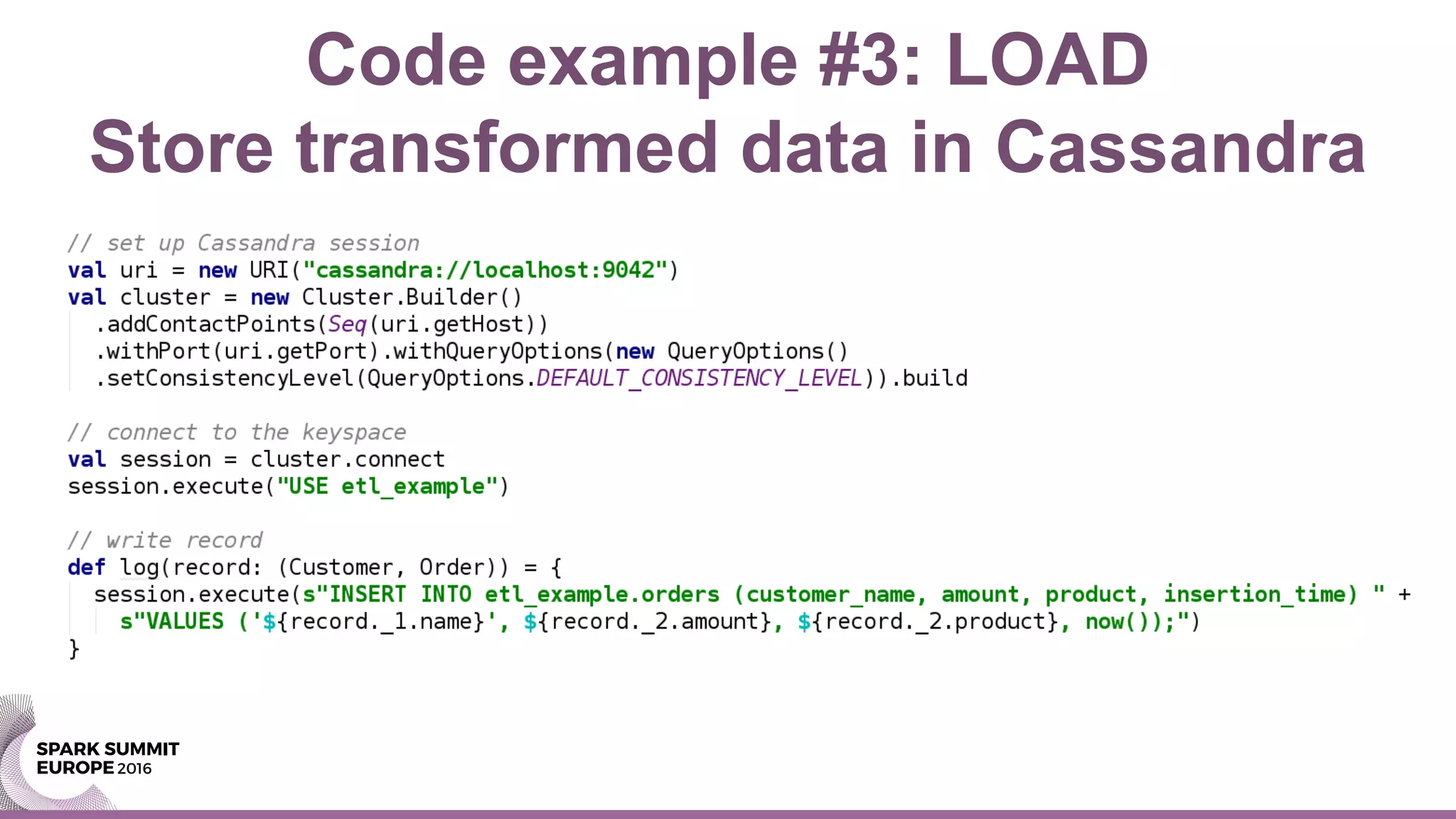
Code example #3: LOAD
Store transformed data in Cassandra
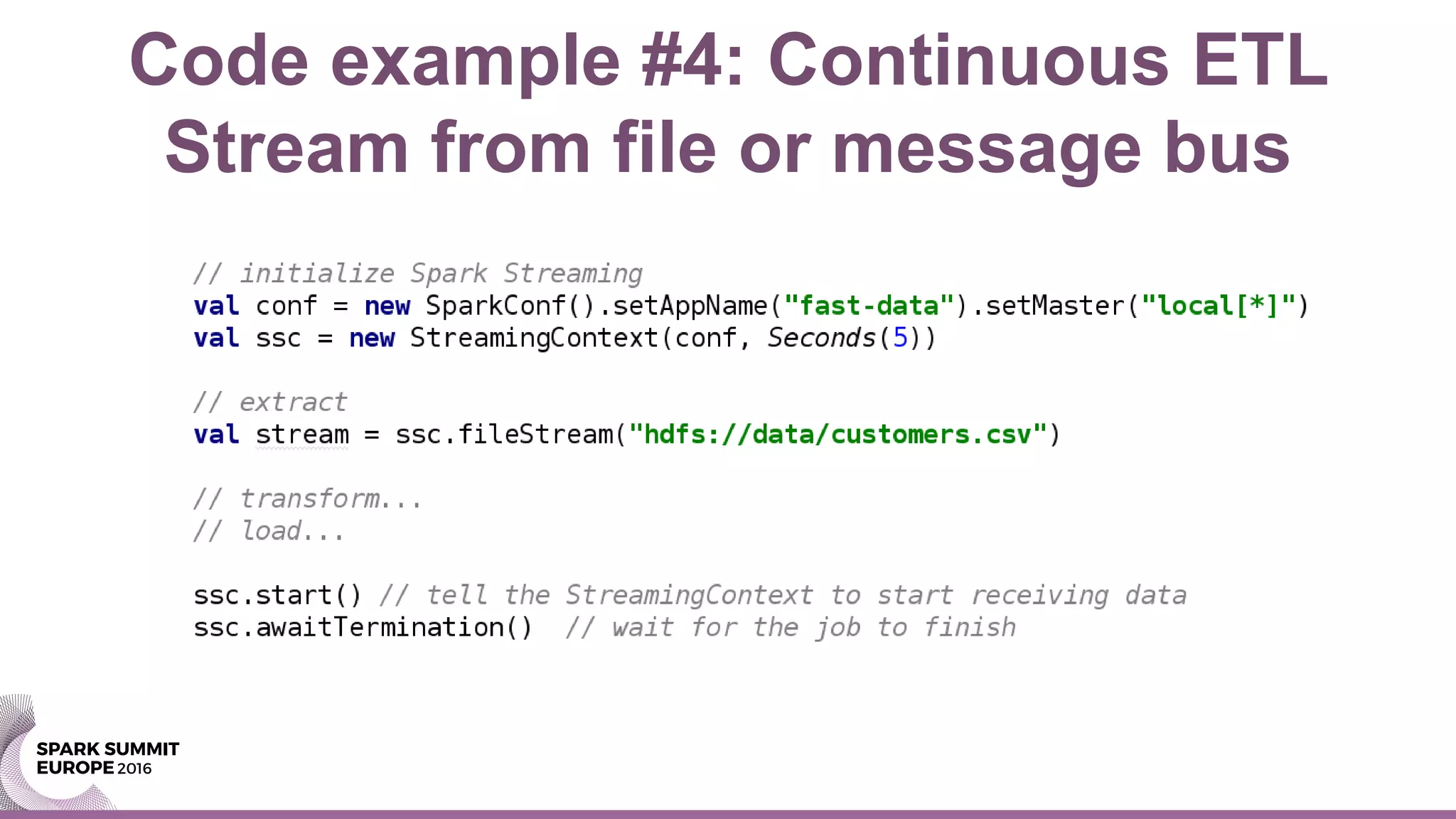
Code example #4: Continuous ETL
Stream from file or message bus
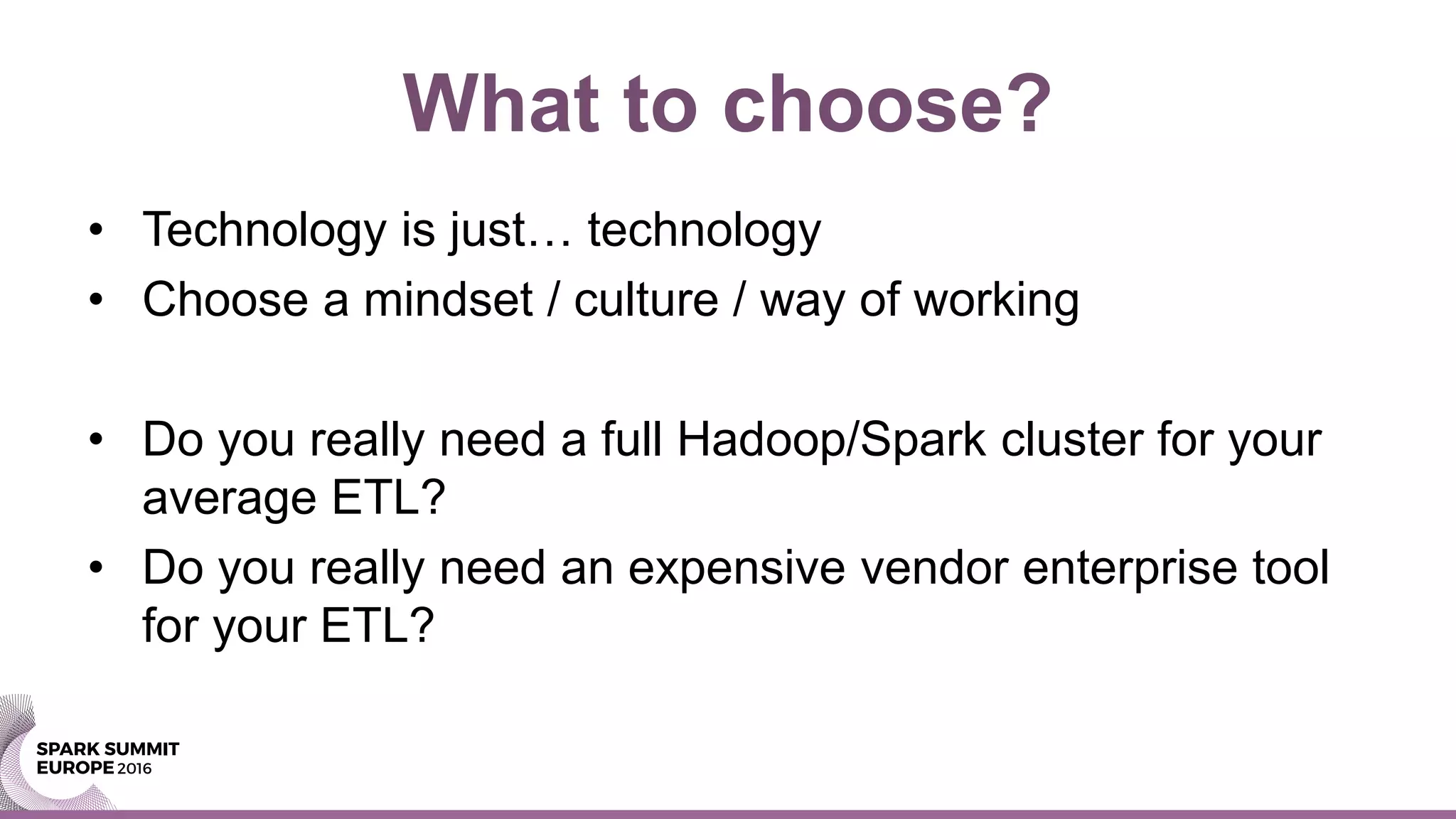
What to choose?
• Technology is just… technology
• Choose a mindset / culture / way of working
• Do you really need a full Hadoop/Spark cluster for your
average ETL?
• Do you really need an expensive vendor enterprise tool
for your ETL?
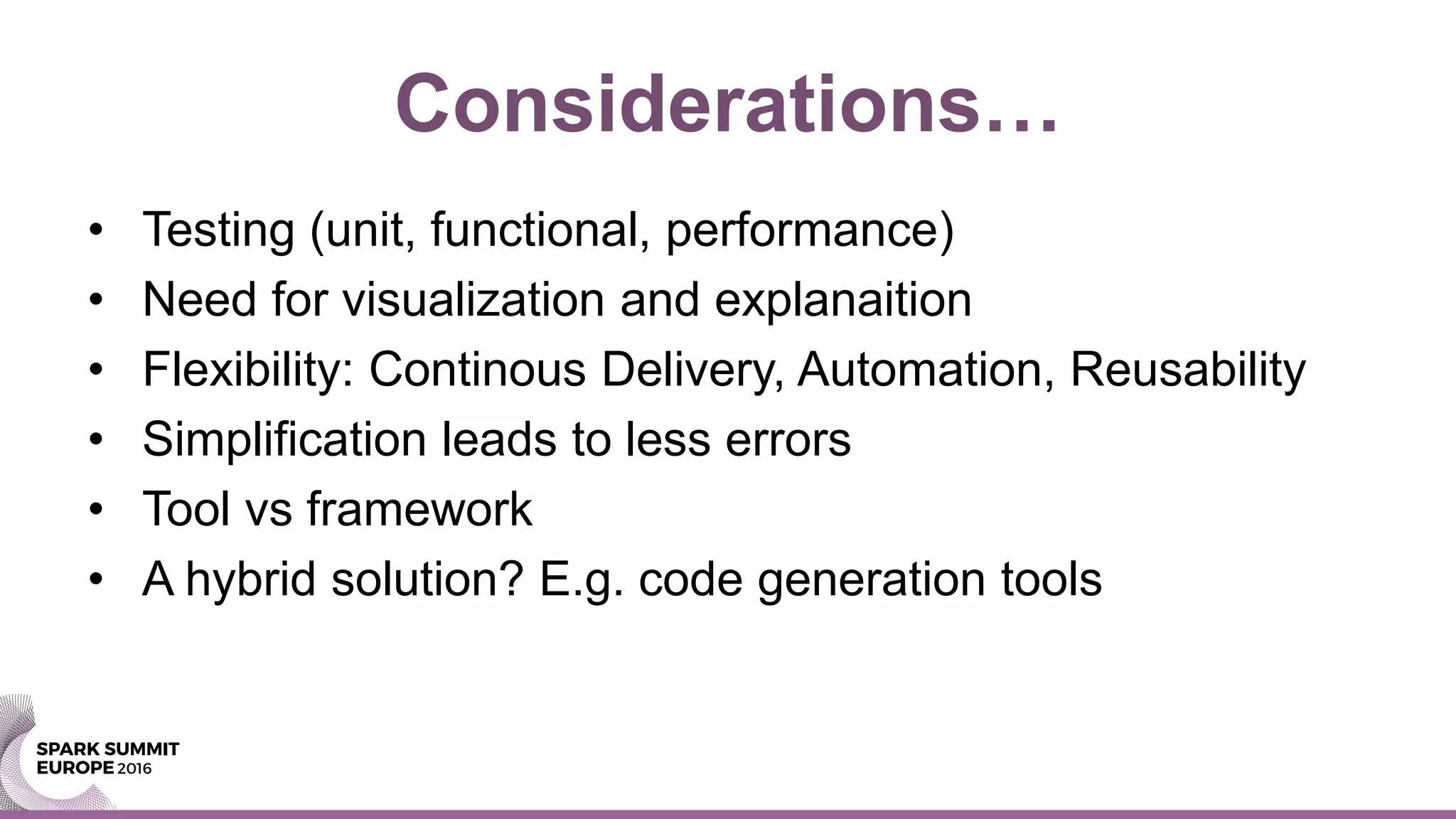
Considerations…
• Testing (unit, functional, performance)
• Need for visualization and explanaition
• Flexibility: Continous Delivery, Automation, Reusability
• Simplification leads to less errors
• Tool vs framework
• A hybrid solution? E.g. code generation tools
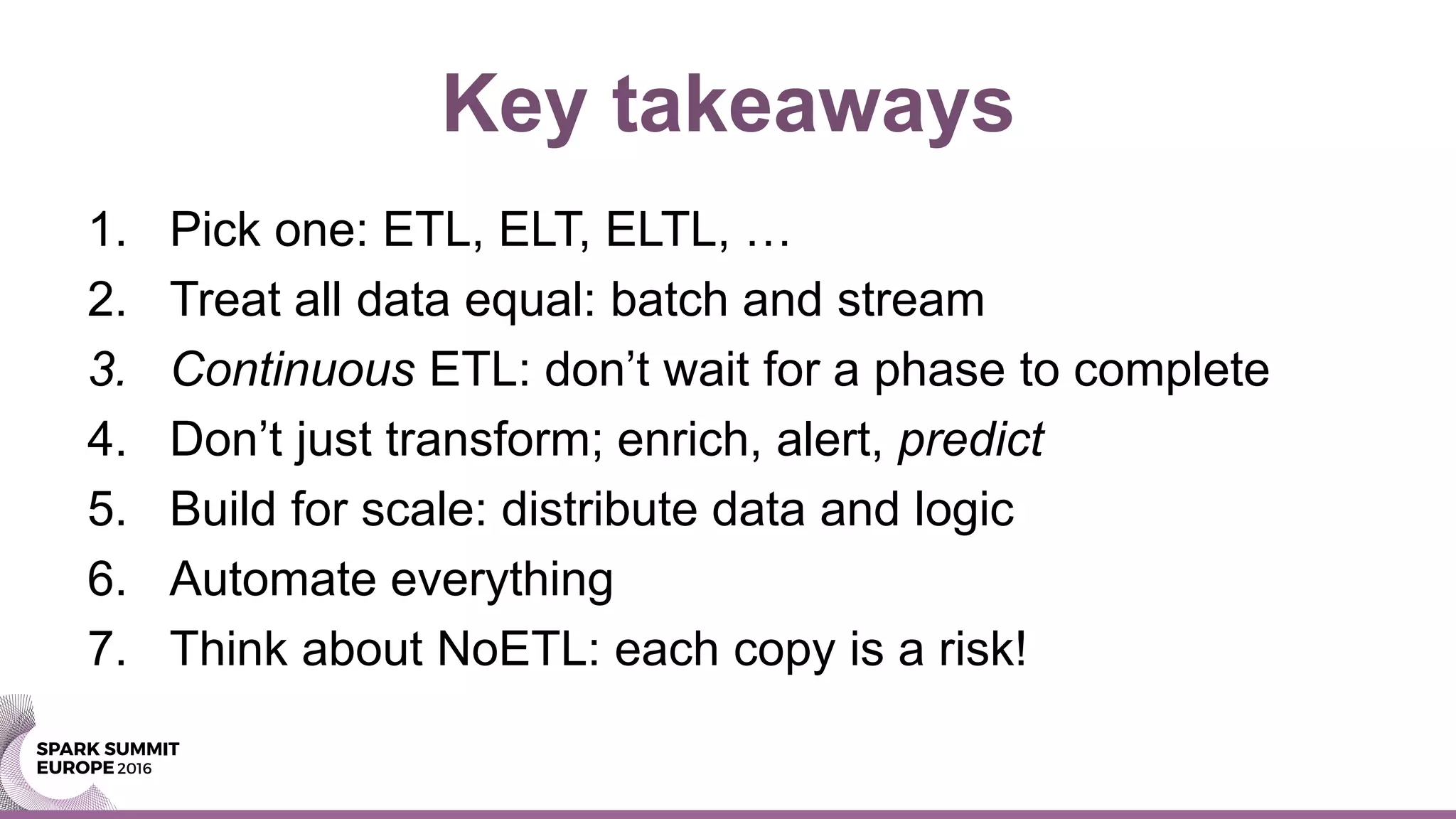
Key takeaways
1. Pick one: ETL, ELT, ELTL, …
2. Treat all data equal: batch and stream
3. Continuous ETL: don’t wait for a phase to complete
4. Don’t just transform; enrich, alert, predict
5. Build for scale: distribute data and logic
6. Automate everything
7. Think about NoETL: each copy is a risk!
THANK YOU!
ING is hiring 
#SparkSummit

Spark Summit EU talk by Bas Geerdink

  • 1.
    Get rid oftraditional ETL, Move to Spark! Bas Geerdink ING
  • 2.
    Bas Geerdink • ChapterLead in Analytics area at ING • Master degree in Artificial Intelligence and Informatics • Spark Certified Developer • @bgeerdink • https://www.linkedin.com/in/geerdink Who am I?
  • 5.
    Definition of ETL “Arepeatable programmed data movement” Extract: get data from source systems Transform: filter/map/enrich/combine/validate/sort/… Load: store data in a data warehouse or data mart Use cases: – Data loading – Data migration – Data ingestion – …
  • 6.
    ETL Tools • IBMInfoSphere DataStage • Oracle Warehouse Builder • Pervasive Data Integrator • PowerCenter Informatica • SAS Data Management • Talend Open Studio • SAP Data Services • Microsoft SSIS • Syncsort DMX • CloverETL • Jaspersoft • Pentaho • Nifi
  • 7.
    What has changed? BusinessIntelligence  Big Data Data Warehouse  Data Lake Applications  Microservices ETL  …
  • 8.
    The Future ofETL Tools • Only develop connectors for integration? • Rebuild entire back-end to Hadoop/Spark/Flink? • Provide a GUI with code generation?
  • 9.
    A Quiz! What isthe most difficult part for developers? What is the most resource intensive part? E / T / L
  • 10.
    ETL Hell • Datagetting out of sync • Performance issues • Waste of server resources (peak performance) • Plain-text code in hidden stages • Click, click, click, click, click (RSI danger!) • CSV files are not type-safe • All-or-nothing approach in batch jobs • Legacy code • …
  • 11.
    Is NO-ETL TheFuture? • Why move data around? • Alternative: keep data at the source, make it available in API’s (microservices architecture) • ETL is an intermediary step, and at each ETL step you can introduce errors and risk: – ETL can lose data – ETL can duplicate data after failover – ETL tools can cost millions of dollars – ETL decreases throughput – ETL increases the complexity of the pipeline (source: noetl.org)
  • 12.
    Intermediate: use Sparkfor ETL • Parallel processing is built-in • Runs on top of Hadoop, which is probably your data source anyway • It’s just Scala code (or Python, or Java) • Machine learning can be thrown in to do more interesting things • Good support for security, unit testing, performance measurement, exception handling, monitoring, etc.
  • 13.
    Code example #1:EXTRACT Get data from HDFS
  • 14.
    Code example #2:TRANSFORM Filter, Map, Join
  • 15.
    Code example #3:LOAD Store transformed data in Cassandra
  • 16.
    Code example #4:Continuous ETL Stream from file or message bus
  • 17.
    What to choose? •Technology is just… technology • Choose a mindset / culture / way of working • Do you really need a full Hadoop/Spark cluster for your average ETL? • Do you really need an expensive vendor enterprise tool for your ETL?
  • 18.
    Considerations… • Testing (unit,functional, performance) • Need for visualization and explanaition • Flexibility: Continous Delivery, Automation, Reusability • Simplification leads to less errors • Tool vs framework • A hybrid solution? E.g. code generation tools
  • 19.
    Key takeaways 1. Pickone: ETL, ELT, ELTL, … 2. Treat all data equal: batch and stream 3. Continuous ETL: don’t wait for a phase to complete 4. Don’t just transform; enrich, alert, predict 5. Build for scale: distribute data and logic 6. Automate everything 7. Think about NoETL: each copy is a risk!
  • 20.
    THANK YOU! ING ishiring  #SparkSummit