Hive to Spark – Journey and
Lessons Learned
William Lau, Kent Buenaventura
Unity Technologies
Agenda
• Our journey moving our data pipeline to use Spark
• Key factors that made the migration successful
• Walkthrough of how we use Spark in our data pipeline
Analytics @ Unity
• The leading game development platform
– 3D Engine, Tools, and Services (Analytics, Ads)
– 34% of top 1000 games are made with Unity
• Analytics for game developers
• We are hiring!
Made with Unity
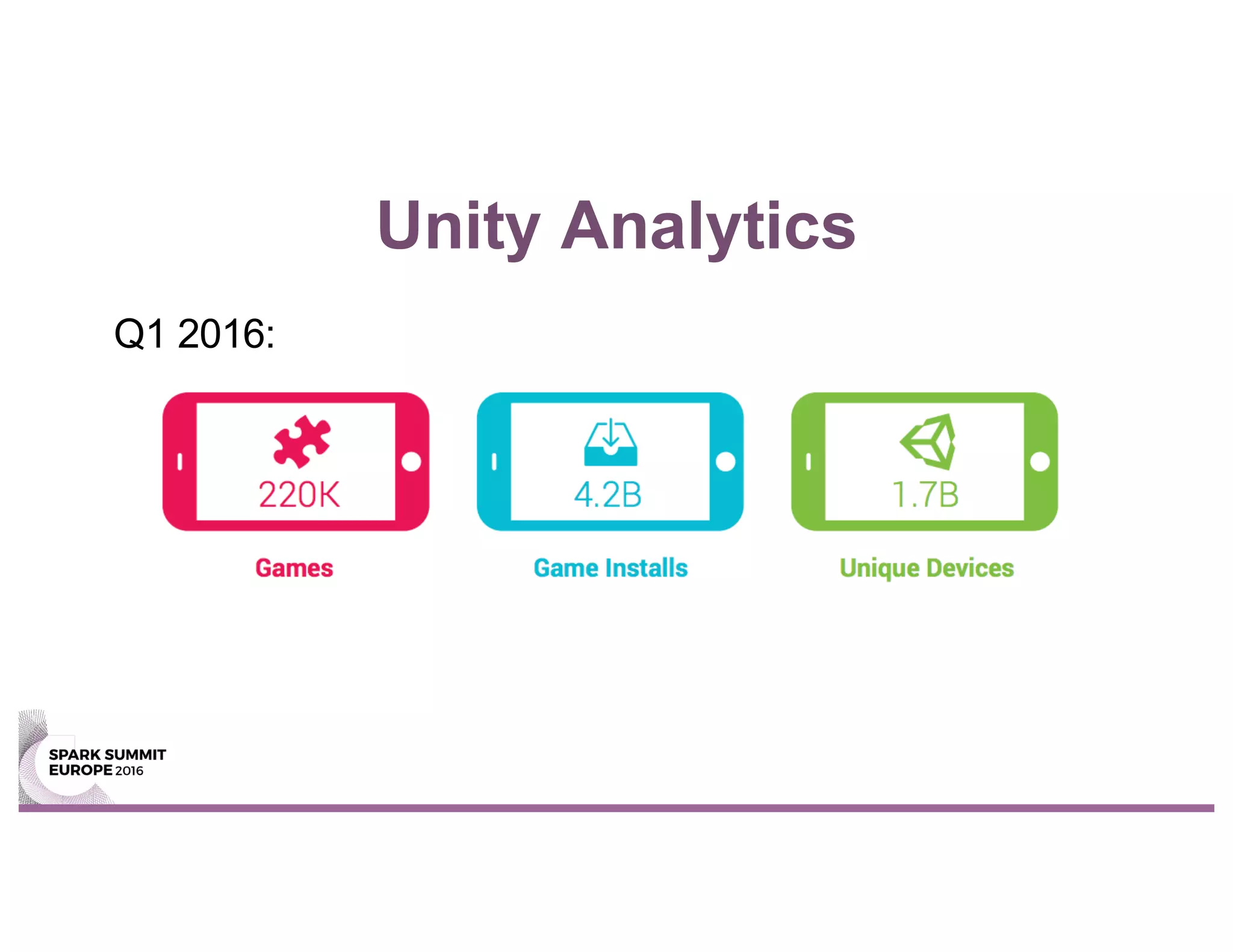
Unity Analytics
Q1 2016:
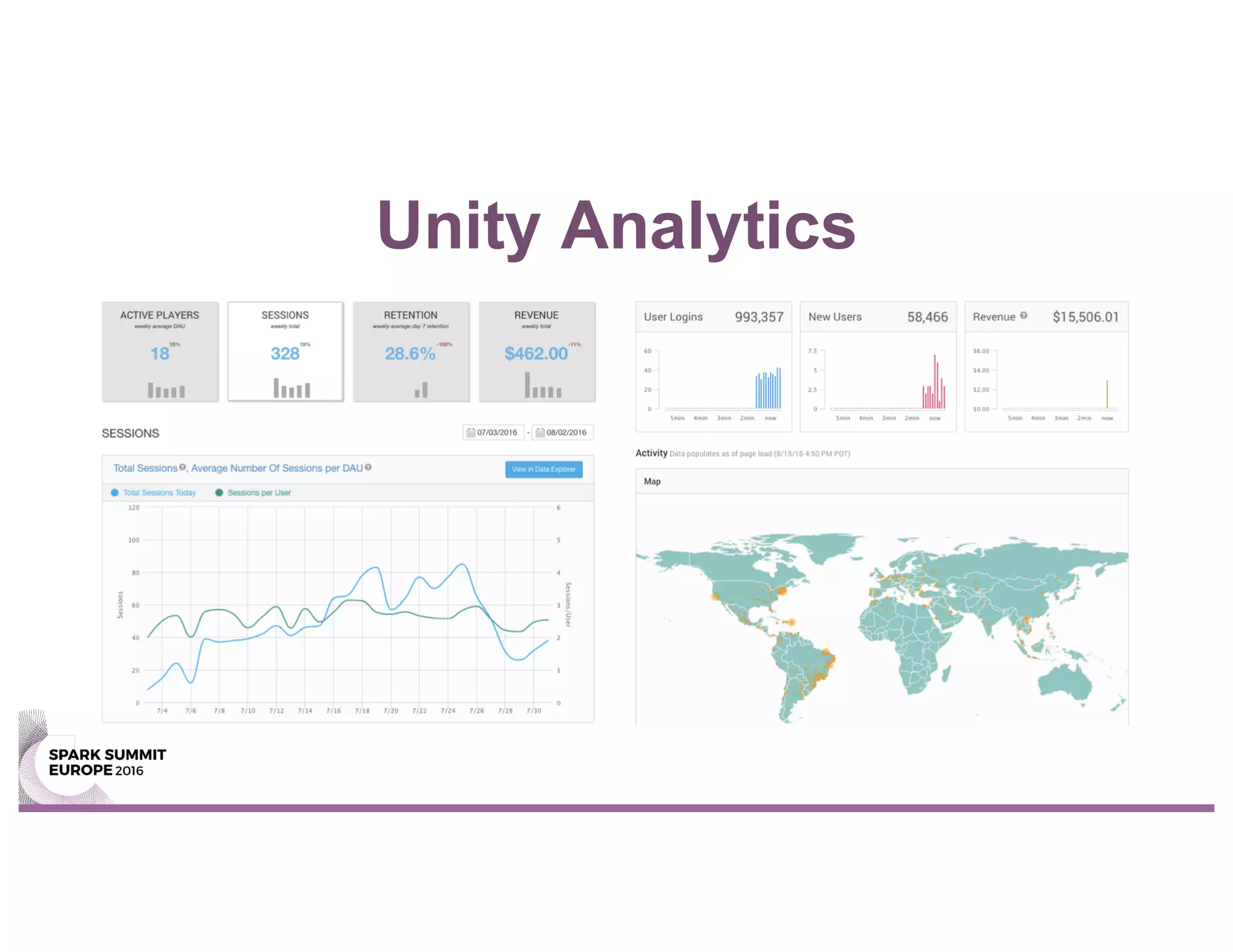
Unity Analytics
Background
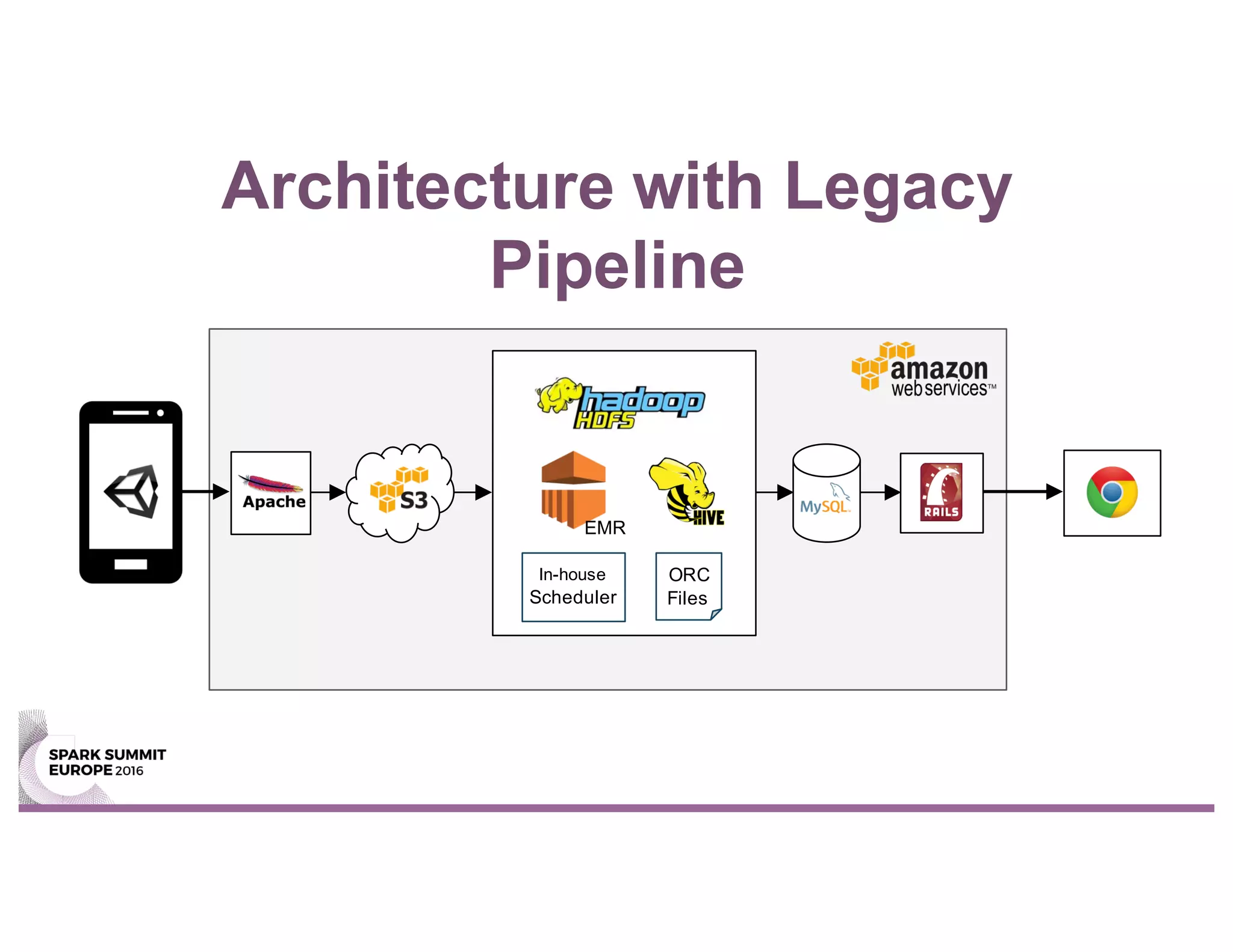
Legacy Data Pipeline (Hive based)
• Scaling and Performance issues
• Operational challenges
• Overly complex
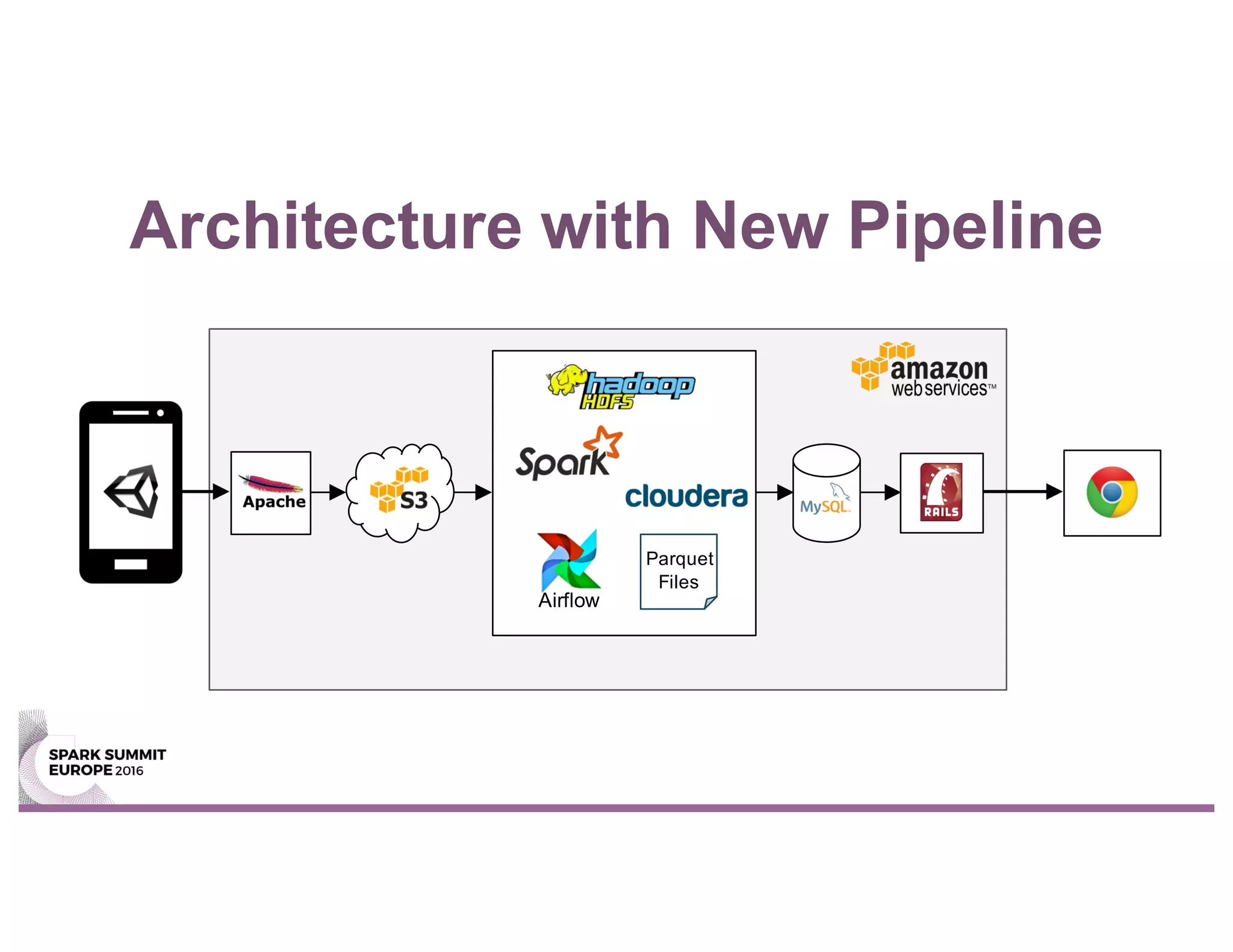
Migrating to Spark
Key decision points:
• Invest in next generation technology stack
• Spark’s ecosystem - community, libraries, tools
• Case studies show solid scaling/performance
• Single stack for batch and streaming
Architecture with Legacy
Pipeline
In-house
Scheduler
ORC
Files
EMR
Architecture with New Pipeline
Parquet
Files
Airflow
Spark Development
• Spark 1.6.0 on Cloudera 5.7.x
• Directly on RDDs with Scala/Java
–control with lower level operators
–easy for unit testing
–strongly typed case classes
• Why not DataSet/SparkSQL?
–interested, waiting for stable Spark 2.0
Development Approach
• What?
– Fast Iterations
• Why?
– Catch bugs and integration issues early
– Scaling and Performance tuning
– Feedback
Development Approach
• How?
– Unit and Parity Tests
– E2E pipeline in Dev environment
– Staging environment
• realistic cluster size and workload
• use production data early
• run repeatable tests - consistent and stable
environment
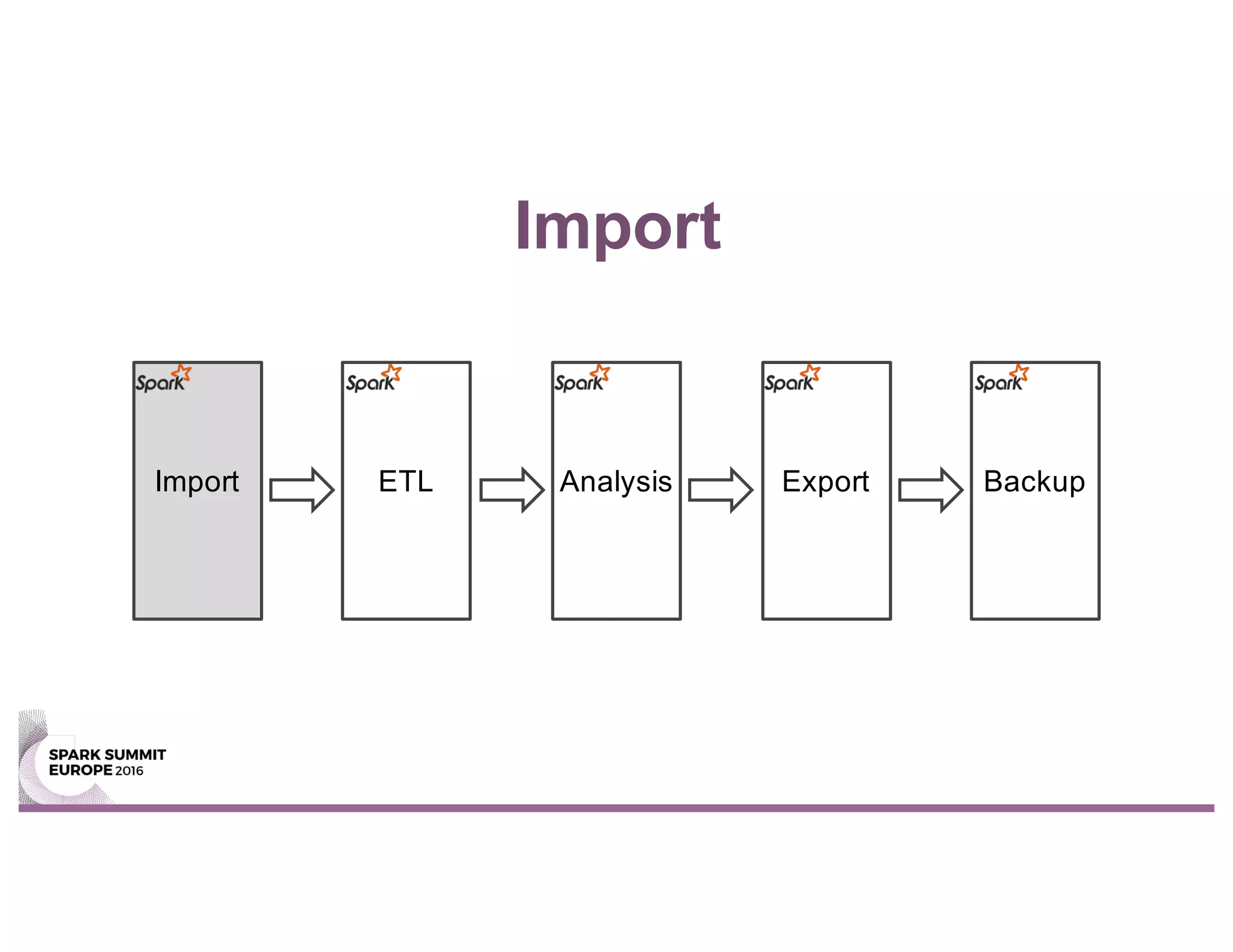
Analytics Data Pipeline
Import ETL Analysis Export Backup
Parquet
Files
Pipeline Principle
• What?
– Idempotent
• Why?
– Fault Tolerance - retry at run and stage level
– Backtrack and start from older run
• How?
– Immutable input and output
– Parquet for persistent read-only data
Import
Import ETL Analysis Export Backup
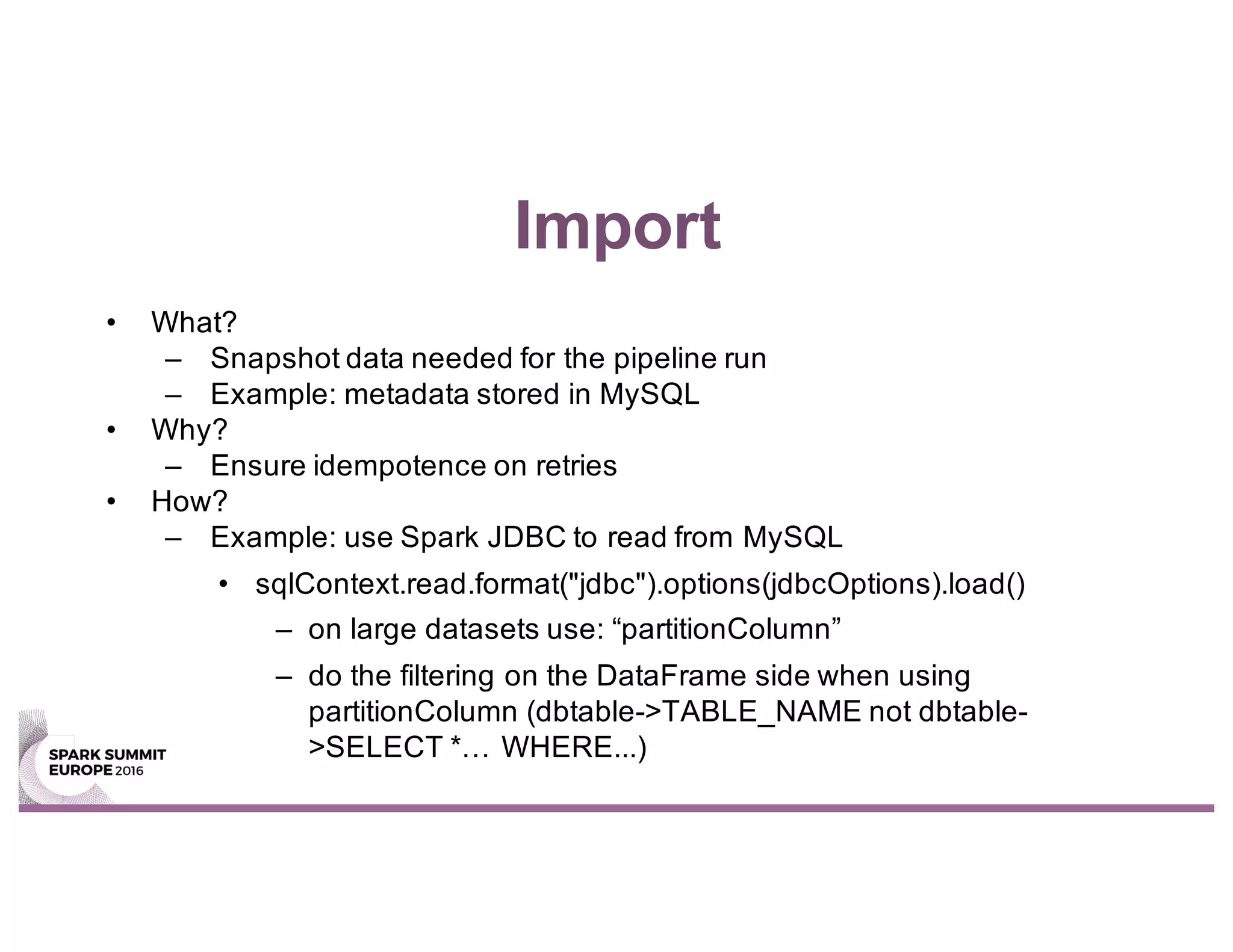
Import
• What?
– Snapshot data needed for the pipeline run
– Example: metadata stored in MySQL
• Why?
– Ensure idempotence on retries
• How?
– Example: use Spark JDBC to read from MySQL
• sqlContext.read.format("jdbc").options(jdbcOptions).load()
– on large datasets use: “partitionColumn”
– do the filtering on the DataFrame side when using
partitionColumn (dbtable->TABLE_NAME not dbtable-
>SELECT *… WHERE...)
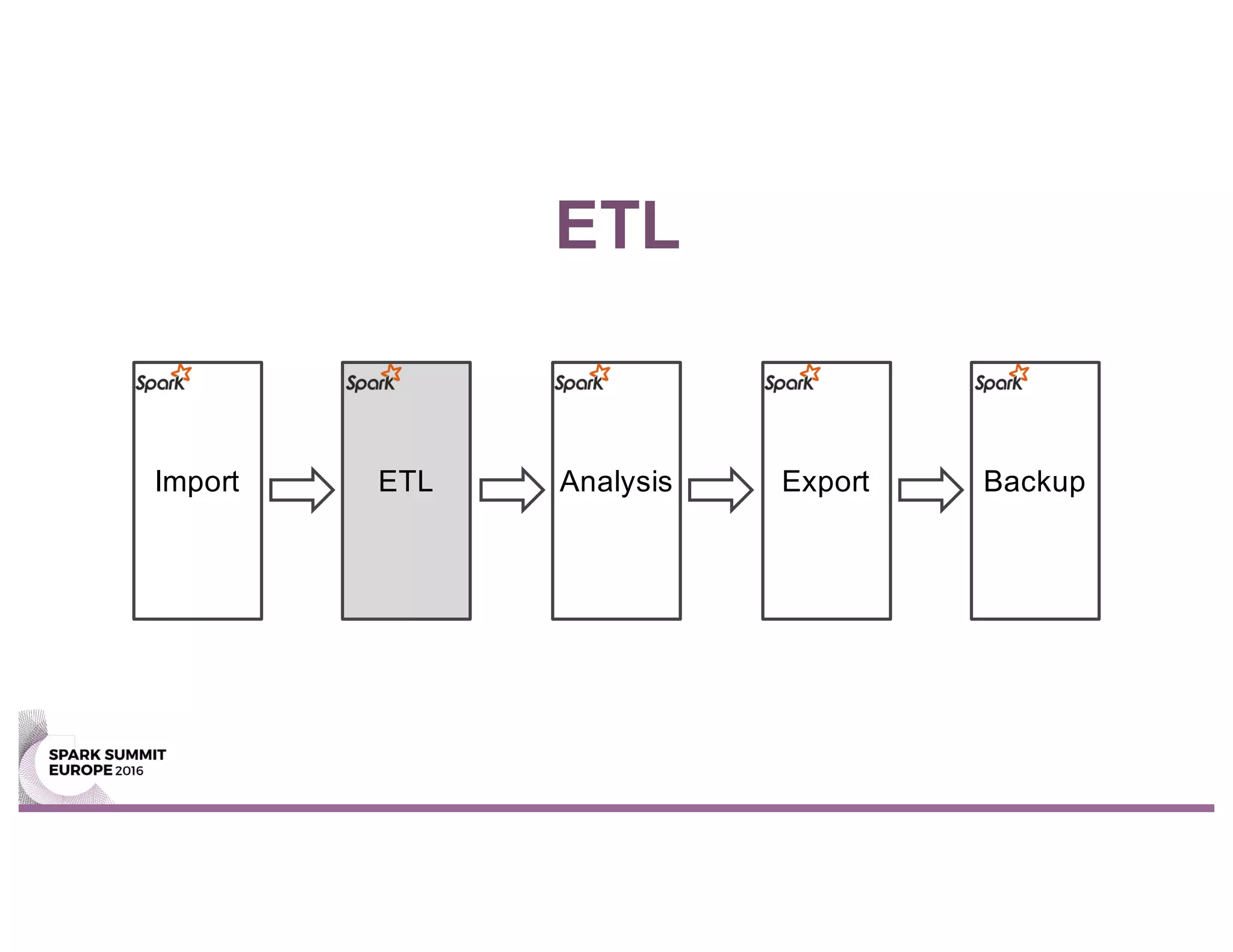
ETL
Import ETL Analysis Export Backup
ETL
• What?
–Sanitize, transforming, grouping of data
• Why?
–Consistency and quality of data for subsequentstages
• How?
–Converting input JSON (json4s) to Case Classes
–Transformations (RDD)
–Save to Parquet (SparkSQL)
• Tips:
–Avoid Nulls
–Repartition output RDDs to remove skews
Analysis
Import ETL Analysis Export Backup
Analysis
• What?
– Computing user level and aggregate metrics
• Why?
– Metrics consume by front-end or internally
• How?
– Single Spark job
• Advantage: reuse of cached RDDs
• Disadvantage:complex DAGs, recompute tree on failure, cached
RDDs spill to disks
Analysis
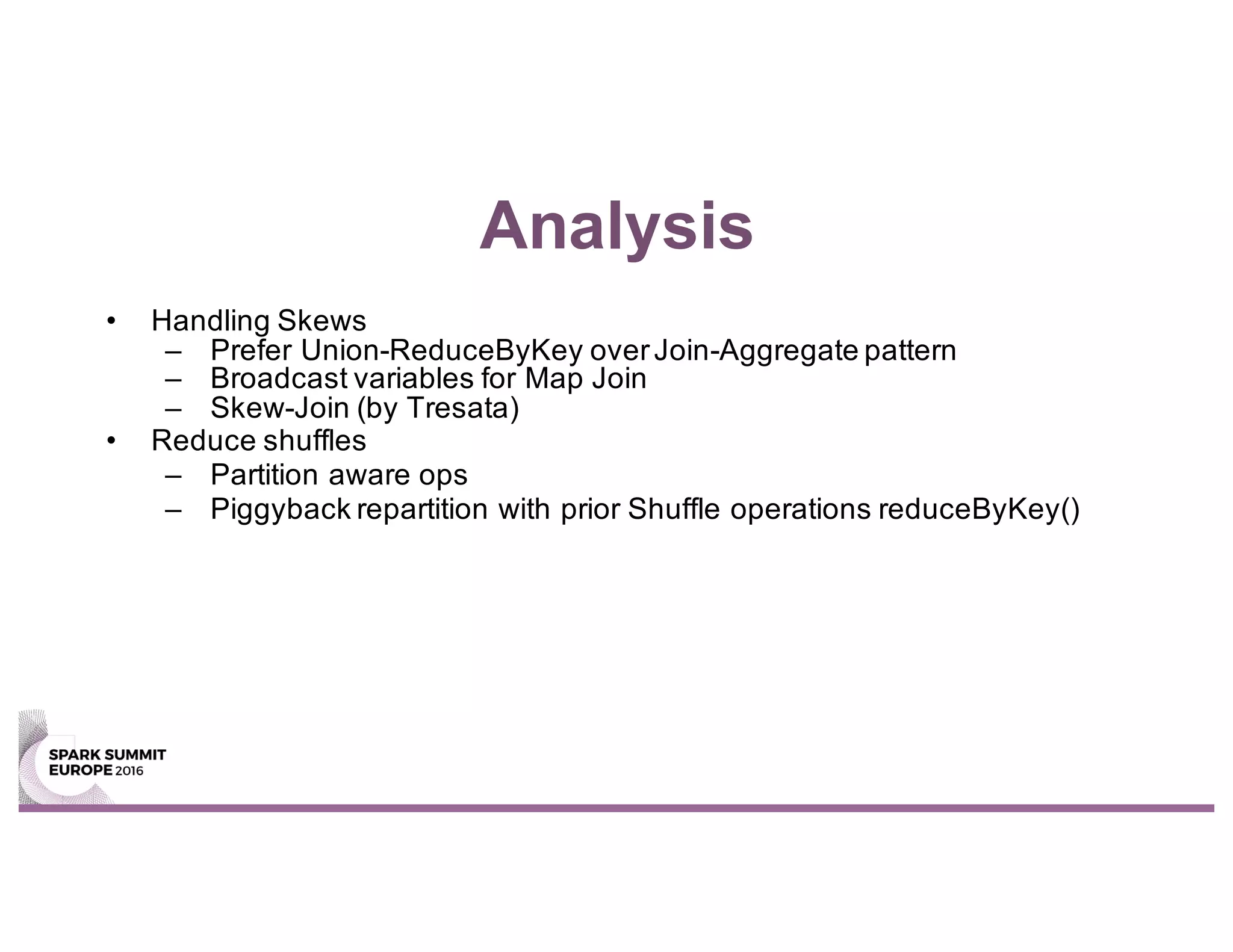
• Handling Skews
– Prefer Union-ReduceByKey overJoin-Aggregate pattern
– Broadcast variables for Map Join
– Skew-Join (by Tresata)
• Reduce shuffles
– Partition aware ops
– Piggyback repartition with prior Shuffle operations reduceByKey()
Analysis
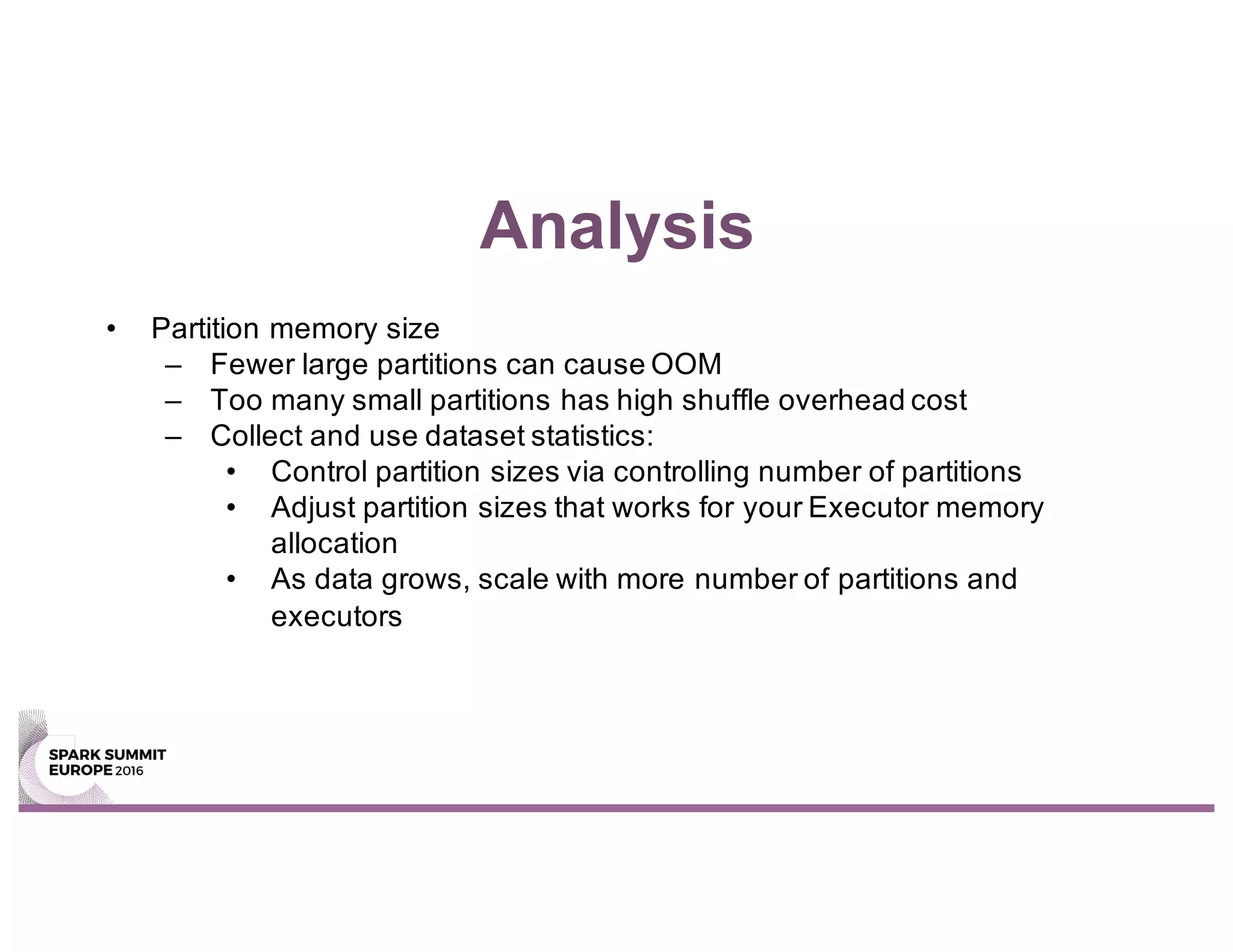
• Partition memory size
– Fewer large partitions can cause OOM
– Too many small partitions has high shuffle overhead cost
– Collect and use dataset statistics:
• Control partition sizes via controlling number of partitions
• Adjust partition sizes that works for your Executor memory
allocation
• As data grows, scale with more number of partitions and
executors
• Partitioner matters
– Resulting number of partitions on Joins depends on input RDD’s
partitioners
• Joins mostly use the DefaultPartitioner Logic
– Takes partitioner with largest number
– if no partitioner, takes the largest RDD partitioner number
– RDD has partitions but not necessarily a partitioner
• Reading from parquet does not give a partitioner
• Some operations remove the partitioner e.g map, keyBy
Analysis
Hive Differences
• Memory:
–Spark RDD operations are sensitive to partition size and often hit OOM
–Hive/MapReduce can run with larger reducer dataset but will be slow
• Skew Handling Joins
– Spark has Broadcast Join
– Hive has bucket map join and other special skew handling Joins
Export
Import ETL Analysis Export Backup
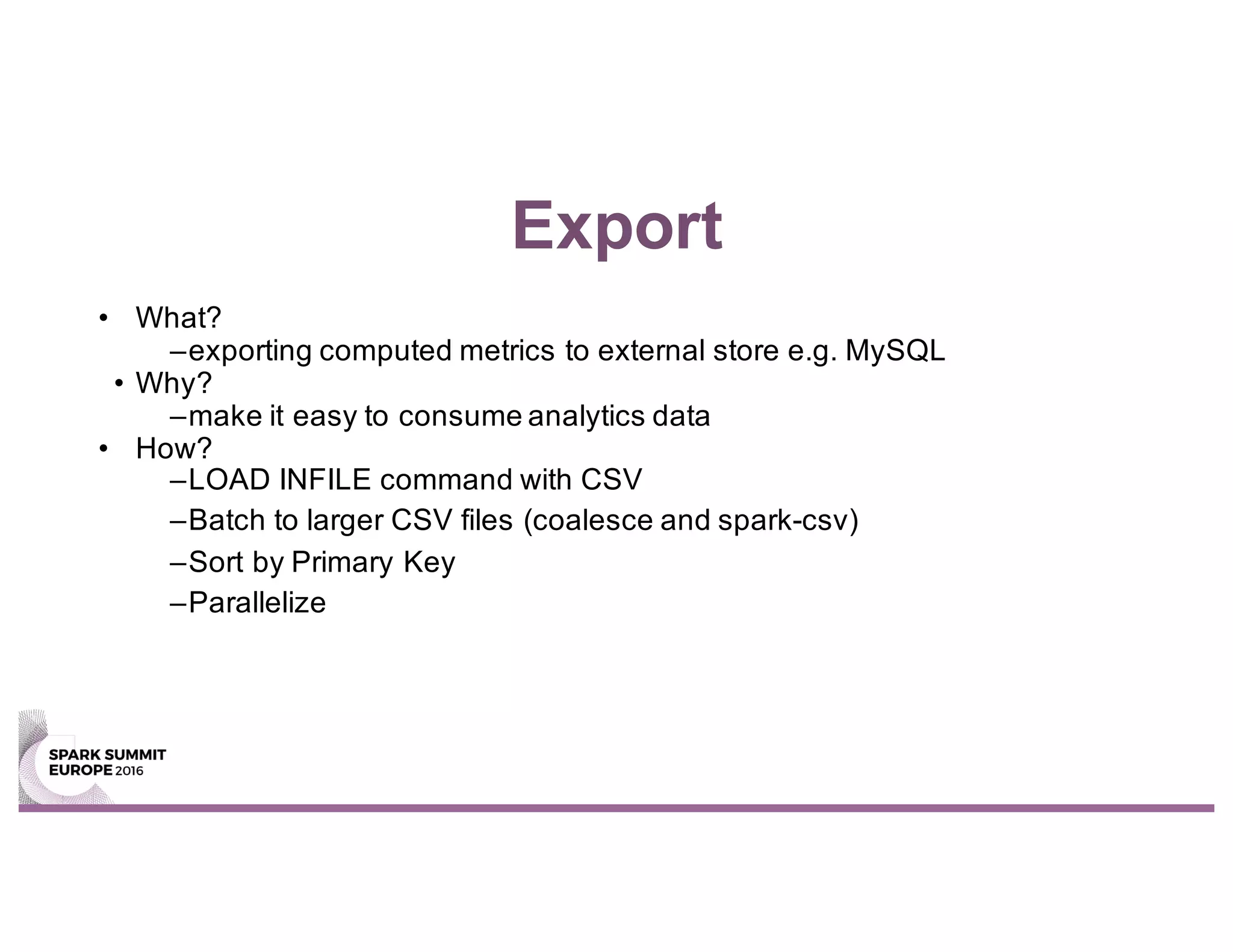
Export
• What?
–exporting computed metrics to external store e.g. MySQL
• Why?
–make it easy to consume analytics data
• How?
–LOAD INFILE command with CSV
–Batch to larger CSV files (coalesce and spark-csv)
–Sort by Primary Key
–Parallelize
Backup
Import ETL Analysis Export Backup
Backup
• What?
–Backing up processed data to S3 (Parquet-S3-Backup)
• Why?
–HDFS for co-located working dataset
–S3 for long term backup
• How?
–Coalesce parquet files locally before saving
–Use s3a:// uri
–Use DirectParquetOutputCommitter to skip writing to temp folder
•Default requires a S3 copy and delete (SLOW)
•Set “spark.speculation=false” to prevent data loss
•Deprecated* in Spark 2.0, use “mapreduce.fileoutputcommitter.
algorithm.version, 2” instead for Spark 2.0+
Airflow
• What?
– Pipeline workflow management
– Schedule and backfill
• Why?
– Simple to setup and easy to use
– Fits our short/mid term needs
• How?
– BashOperators, PythonOperators, MySqlOperators
– spark-submit
Hive Data Migration
• One-off Spark Job
• Read Legacy Hive tables in S3 using ORC format
• Spark can load hive table directly
hiveContext.sql("CREATE EXTERNAL TABLE …
LOCATION ‘s3a://…’")
val dataframe = hiveContext.sql(“select * from
TABLE_NAME”)
• Validate, Sanitize, Transform (like ETL)
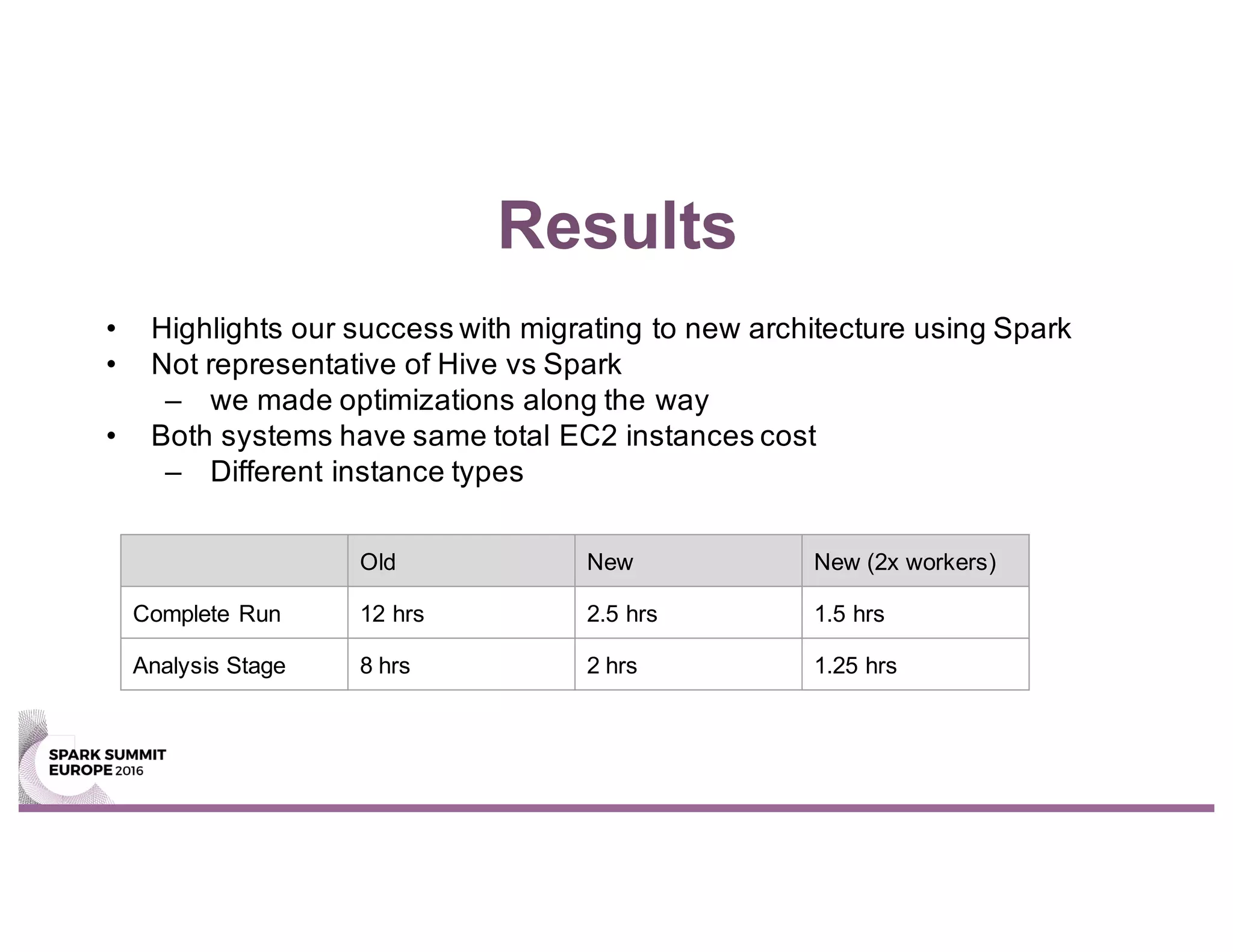
• Highlights our success with migrating to new architecture using Spark
• Not representative of Hive vs Spark
– we made optimizations along the way
• Both systems have same total EC2 instances cost
– Different instance types
Results
Old New New (2x workers)
Complete Run 12 hrs 2.5 hrs 1.5 hrs
Analysis Stage 8 hrs 2 hrs 1.25 hrs
Links
• Block/Skew Join
–https://github.com/tresata/spark-skewjoin
• Parquet S3 Backup
–https://github.com/UnityTech/parquet-s3-backup
• MySQL Uploader
–https://github.com/UnityTech/mysql-uploader
THANK YOU.
williaml@unity3d.com
kentb@unity3d.com

Spark Summit EU talk by Kent Buenaventura and Willaim Lau

  • 1.
    Hive to Spark– Journey and Lessons Learned William Lau, Kent Buenaventura Unity Technologies
  • 2.
    Agenda • Our journeymoving our data pipeline to use Spark • Key factors that made the migration successful • Walkthrough of how we use Spark in our data pipeline
  • 3.
    Analytics @ Unity •The leading game development platform – 3D Engine, Tools, and Services (Analytics, Ads) – 34% of top 1000 games are made with Unity • Analytics for game developers • We are hiring!
  • 4.
  • 5.
  • 6.
  • 7.
    Background Legacy Data Pipeline(Hive based) • Scaling and Performance issues • Operational challenges • Overly complex
  • 8.
    Migrating to Spark Keydecision points: • Invest in next generation technology stack • Spark’s ecosystem - community, libraries, tools • Case studies show solid scaling/performance • Single stack for batch and streaming
  • 9.
  • 10.
    Architecture with NewPipeline Parquet Files Airflow
  • 11.
    Spark Development • Spark1.6.0 on Cloudera 5.7.x • Directly on RDDs with Scala/Java –control with lower level operators –easy for unit testing –strongly typed case classes • Why not DataSet/SparkSQL? –interested, waiting for stable Spark 2.0
  • 12.
    Development Approach • What? –Fast Iterations • Why? – Catch bugs and integration issues early – Scaling and Performance tuning – Feedback
  • 13.
    Development Approach • How? –Unit and Parity Tests – E2E pipeline in Dev environment – Staging environment • realistic cluster size and workload • use production data early • run repeatable tests - consistent and stable environment
  • 14.
    Analytics Data Pipeline ImportETL Analysis Export Backup Parquet Files
  • 15.
    Pipeline Principle • What? –Idempotent • Why? – Fault Tolerance - retry at run and stage level – Backtrack and start from older run • How? – Immutable input and output – Parquet for persistent read-only data
  • 16.
  • 17.
    Import • What? – Snapshotdata needed for the pipeline run – Example: metadata stored in MySQL • Why? – Ensure idempotence on retries • How? – Example: use Spark JDBC to read from MySQL • sqlContext.read.format("jdbc").options(jdbcOptions).load() – on large datasets use: “partitionColumn” – do the filtering on the DataFrame side when using partitionColumn (dbtable->TABLE_NAME not dbtable- >SELECT *… WHERE...)
  • 18.
  • 19.
    ETL • What? –Sanitize, transforming,grouping of data • Why? –Consistency and quality of data for subsequentstages • How? –Converting input JSON (json4s) to Case Classes –Transformations (RDD) –Save to Parquet (SparkSQL) • Tips: –Avoid Nulls –Repartition output RDDs to remove skews
  • 20.
  • 21.
    Analysis • What? – Computinguser level and aggregate metrics • Why? – Metrics consume by front-end or internally • How? – Single Spark job • Advantage: reuse of cached RDDs • Disadvantage:complex DAGs, recompute tree on failure, cached RDDs spill to disks
  • 22.
    Analysis • Handling Skews –Prefer Union-ReduceByKey overJoin-Aggregate pattern – Broadcast variables for Map Join – Skew-Join (by Tresata) • Reduce shuffles – Partition aware ops – Piggyback repartition with prior Shuffle operations reduceByKey()
  • 23.
    Analysis • Partition memorysize – Fewer large partitions can cause OOM – Too many small partitions has high shuffle overhead cost – Collect and use dataset statistics: • Control partition sizes via controlling number of partitions • Adjust partition sizes that works for your Executor memory allocation • As data grows, scale with more number of partitions and executors
  • 24.
    • Partitioner matters –Resulting number of partitions on Joins depends on input RDD’s partitioners • Joins mostly use the DefaultPartitioner Logic – Takes partitioner with largest number – if no partitioner, takes the largest RDD partitioner number – RDD has partitions but not necessarily a partitioner • Reading from parquet does not give a partitioner • Some operations remove the partitioner e.g map, keyBy Analysis
  • 25.
    Hive Differences • Memory: –SparkRDD operations are sensitive to partition size and often hit OOM –Hive/MapReduce can run with larger reducer dataset but will be slow • Skew Handling Joins – Spark has Broadcast Join – Hive has bucket map join and other special skew handling Joins
  • 26.
  • 27.
    Export • What? –exporting computedmetrics to external store e.g. MySQL • Why? –make it easy to consume analytics data • How? –LOAD INFILE command with CSV –Batch to larger CSV files (coalesce and spark-csv) –Sort by Primary Key –Parallelize
  • 28.
  • 29.
    Backup • What? –Backing upprocessed data to S3 (Parquet-S3-Backup) • Why? –HDFS for co-located working dataset –S3 for long term backup • How? –Coalesce parquet files locally before saving –Use s3a:// uri –Use DirectParquetOutputCommitter to skip writing to temp folder •Default requires a S3 copy and delete (SLOW) •Set “spark.speculation=false” to prevent data loss •Deprecated* in Spark 2.0, use “mapreduce.fileoutputcommitter. algorithm.version, 2” instead for Spark 2.0+
  • 30.
    Airflow • What? – Pipelineworkflow management – Schedule and backfill • Why? – Simple to setup and easy to use – Fits our short/mid term needs • How? – BashOperators, PythonOperators, MySqlOperators – spark-submit
  • 31.
    Hive Data Migration •One-off Spark Job • Read Legacy Hive tables in S3 using ORC format • Spark can load hive table directly hiveContext.sql("CREATE EXTERNAL TABLE … LOCATION ‘s3a://…’") val dataframe = hiveContext.sql(“select * from TABLE_NAME”) • Validate, Sanitize, Transform (like ETL)
  • 32.
    • Highlights oursuccess with migrating to new architecture using Spark • Not representative of Hive vs Spark – we made optimizations along the way • Both systems have same total EC2 instances cost – Different instance types Results Old New New (2x workers) Complete Run 12 hrs 2.5 hrs 1.5 hrs Analysis Stage 8 hrs 2 hrs 1.25 hrs
  • 33.
    Links • Block/Skew Join –https://github.com/tresata/spark-skewjoin •Parquet S3 Backup –https://github.com/UnityTech/parquet-s3-backup • MySQL Uploader –https://github.com/UnityTech/mysql-uploader
  • 34.