Apache Spark™ MLlib 2.x:
How to Productionize your
Machine Learning Models
Richard Garris (Principal Solutions Architect)
Jules S. Damji (Spark Community Evangelist)
March 9 , 2017
About Me
• Jules Damji
• Twitter: @2twitme; LinkedIn
• Spark Community Evangelist @ Databricks
• Worked in various software engineering roles building
distributed systems and applications at Sun, Netscape,
LoudCloud/Opsware, VeriSign, Scalix, Ebrary & Hortonworks
Webinar Logistics
3
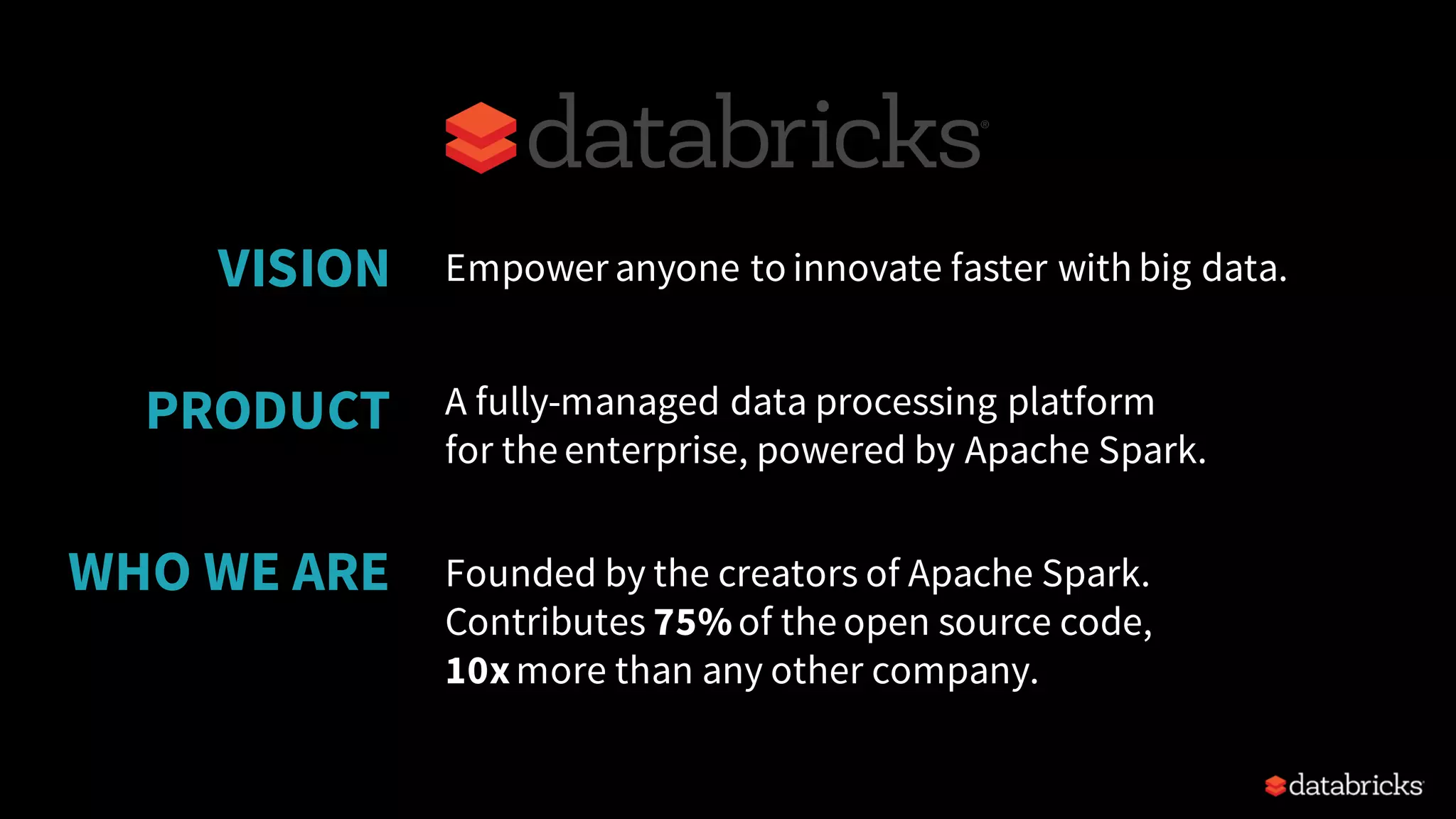
Empower anyone to innovate faster with big data.
Founded by the creators of Apache Spark.
Contributes 75%of the open source code,
10xmore than any other company.
VISION
WHO WE ARE
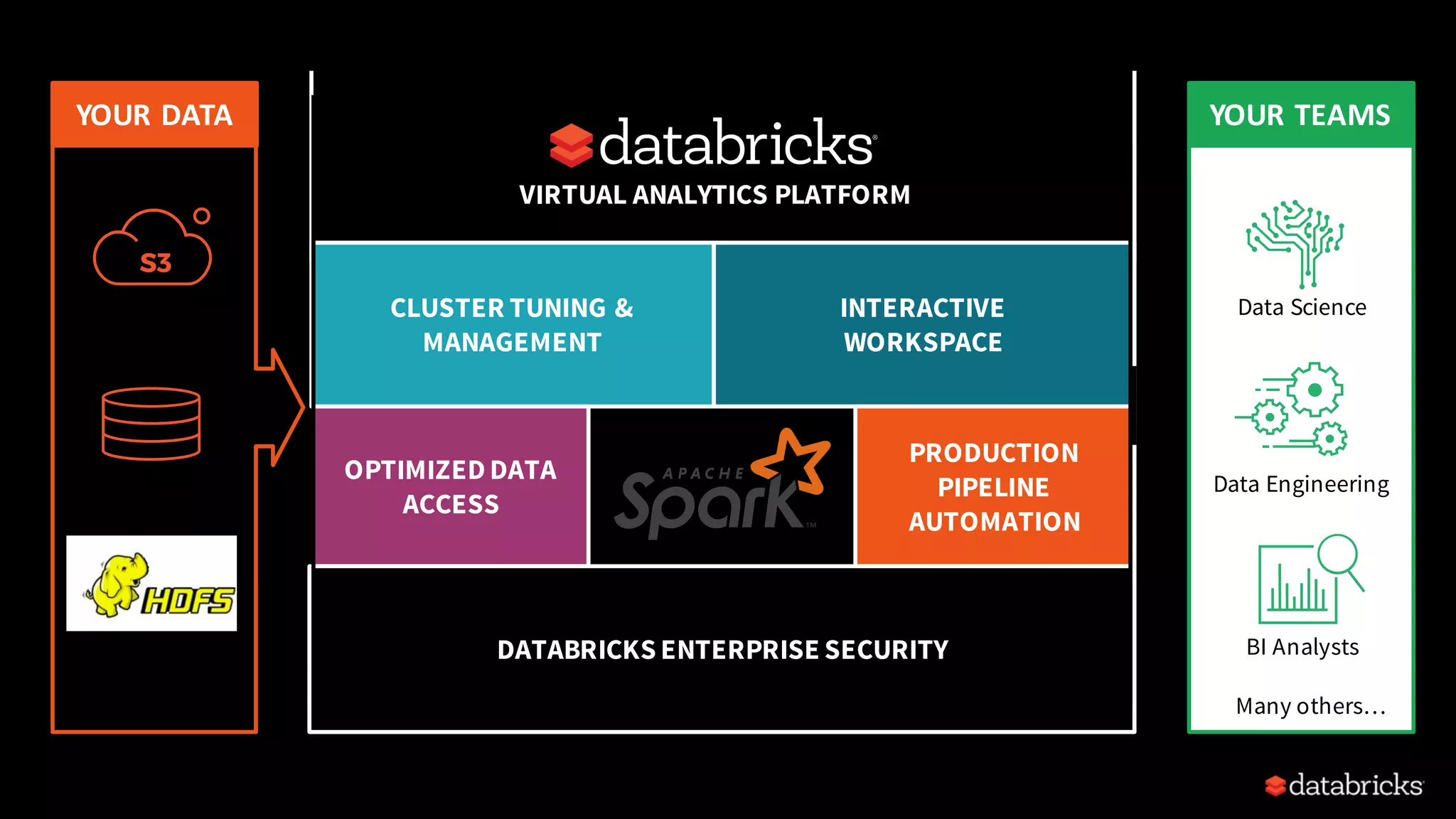
A fully-managed data processing platform
for the enterprise, powered by Apache Spark.
PRODUCT
CLUSTER TUNING &
MANAGEMENT
INTERACTIVE
WORKSPACE
PRODUCTION
PIPELINE
AUTOMATION
OPTIMIZED DATA
ACCESS
DATABRICKS ENTERPRISE SECURITY
YOUR	TEAMS
Data Science
Data Engineering
Many others…
BI Analysts
YOUR	DATA
Cloud Storage
Data Warehouses
Data Lake
VIRTUAL ANALYTICS PLATFORM
Apache Spark™ MLlib 2.x:
How to Productionize your
Machine Learning Models
Richard Garris (Principal Solutions Architect)
March 9 , 2017
About Me
• Richard L Garris
• rlgarris@databricks.com
• Twitter @rlgarris
• Principal Data Solutions Architect @ Databricks
• 12+ years designing Enterprise Data Solutions for everyone from
startups to Global 2000
• Prior Work Experience PwC, Google and Skytree – the Machine
Learning Company
• Ohio State Buckeye and Masters from CMU
Outline
• Spark MLlib 2.X
• Model Serialization
• Model Scoring System Requirements
• Model Scoring Architectures
• Databricks Model Scoring
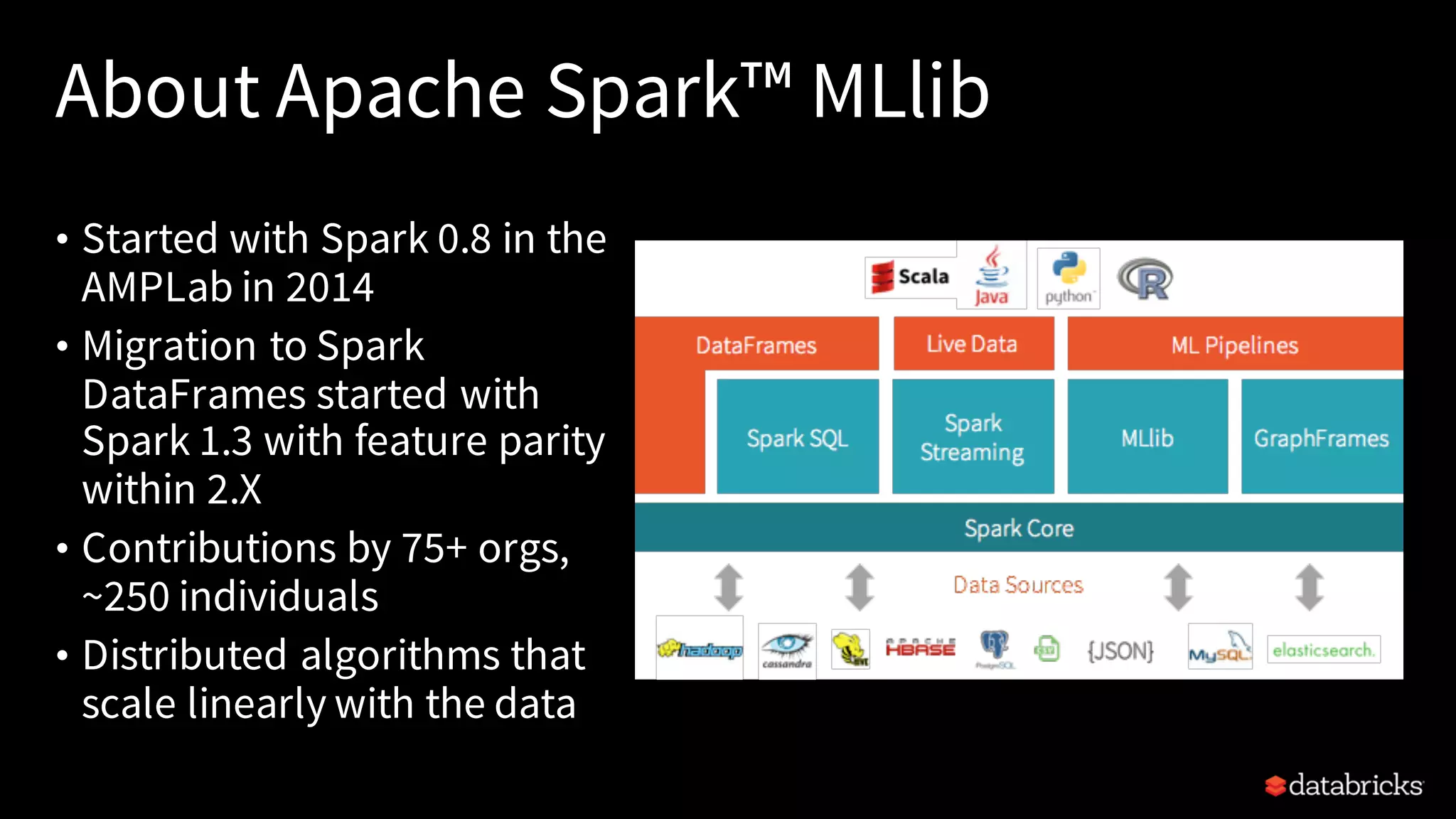
About Apache Spark™ MLlib
• Started with Spark 0.8 in the
AMPLab in 2014
• Migration to Spark
DataFrames started with
Spark 1.3 with feature parity
within 2.X
• Contributions by 75+ orgs,
~250 individuals
• Distributed algorithms that
scale linearly with the data
MLlib’s Goals
• General purpose machine learning library optimized for big data
• Linearly scalable = 2x more machines , runtime theoretically cut in half
• Fault tolerant = resilient to the failure of nodes
• Covers the most common algorithms with distributed implementations
• Built around the concept of a Data Science Pipeline (scikit-learn)
• Written entirely using Apache Spark™
• Integrates well with the Agile Modeling Process
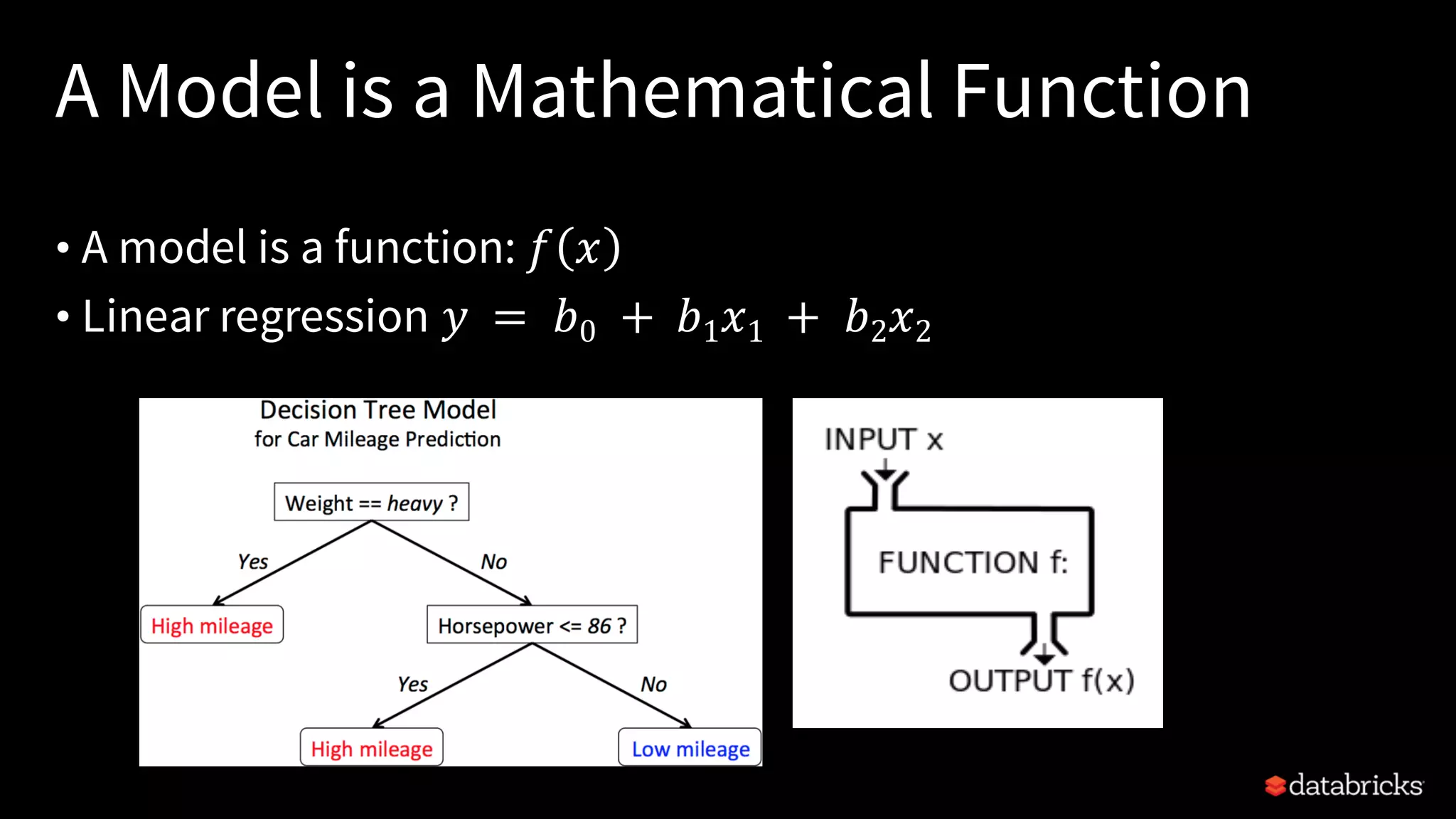
A Model is a Mathematical Function
• A model is a function: 𝑓 𝑥
• Linear regression 𝑦	 = 	𝑏0	 + 	𝑏1 𝑥1	 + 	𝑏2 𝑥2
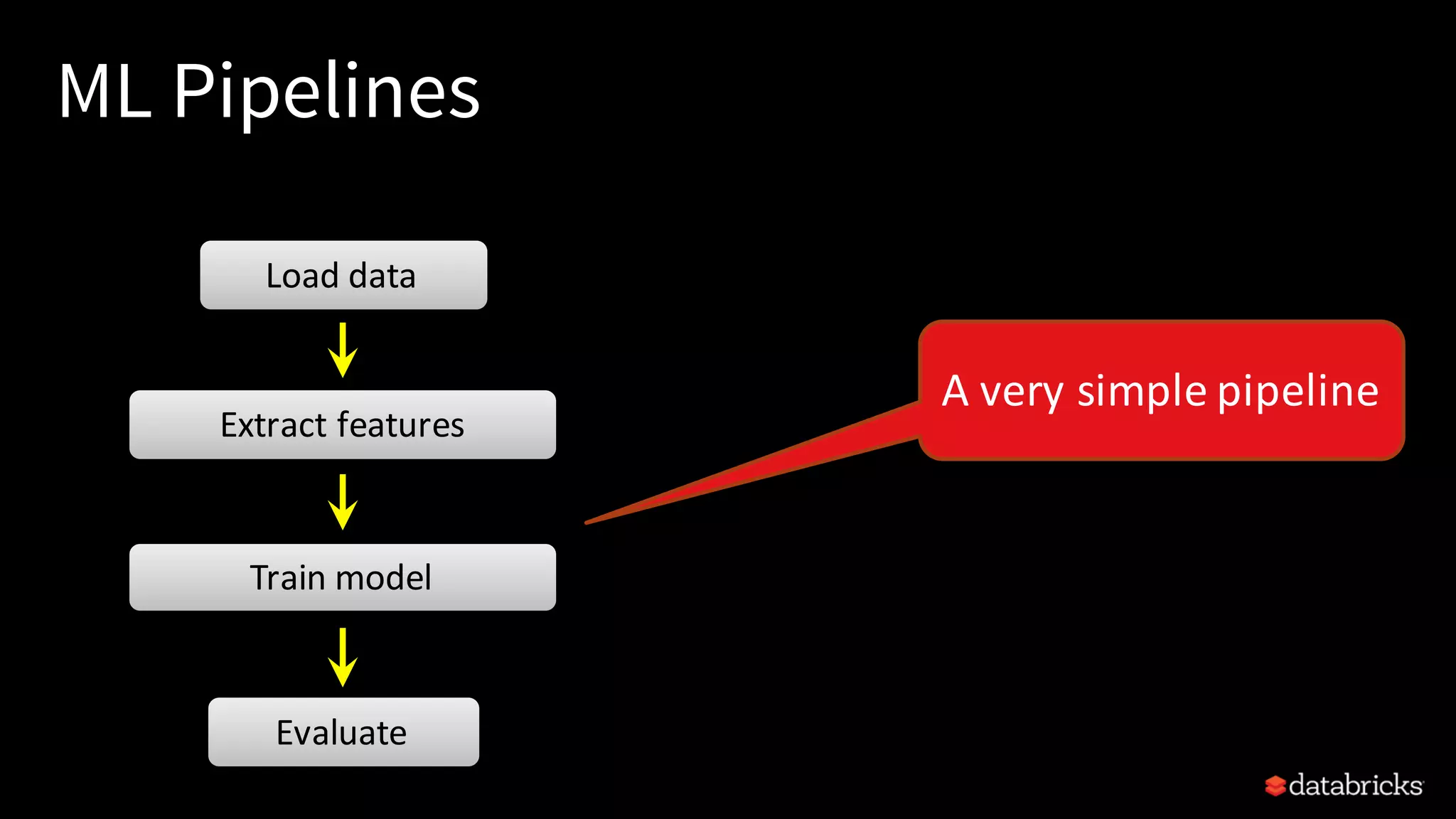
ML Pipelines
Train	model
Evaluate
Load	data
Extract	features
A	very	simple	pipeline
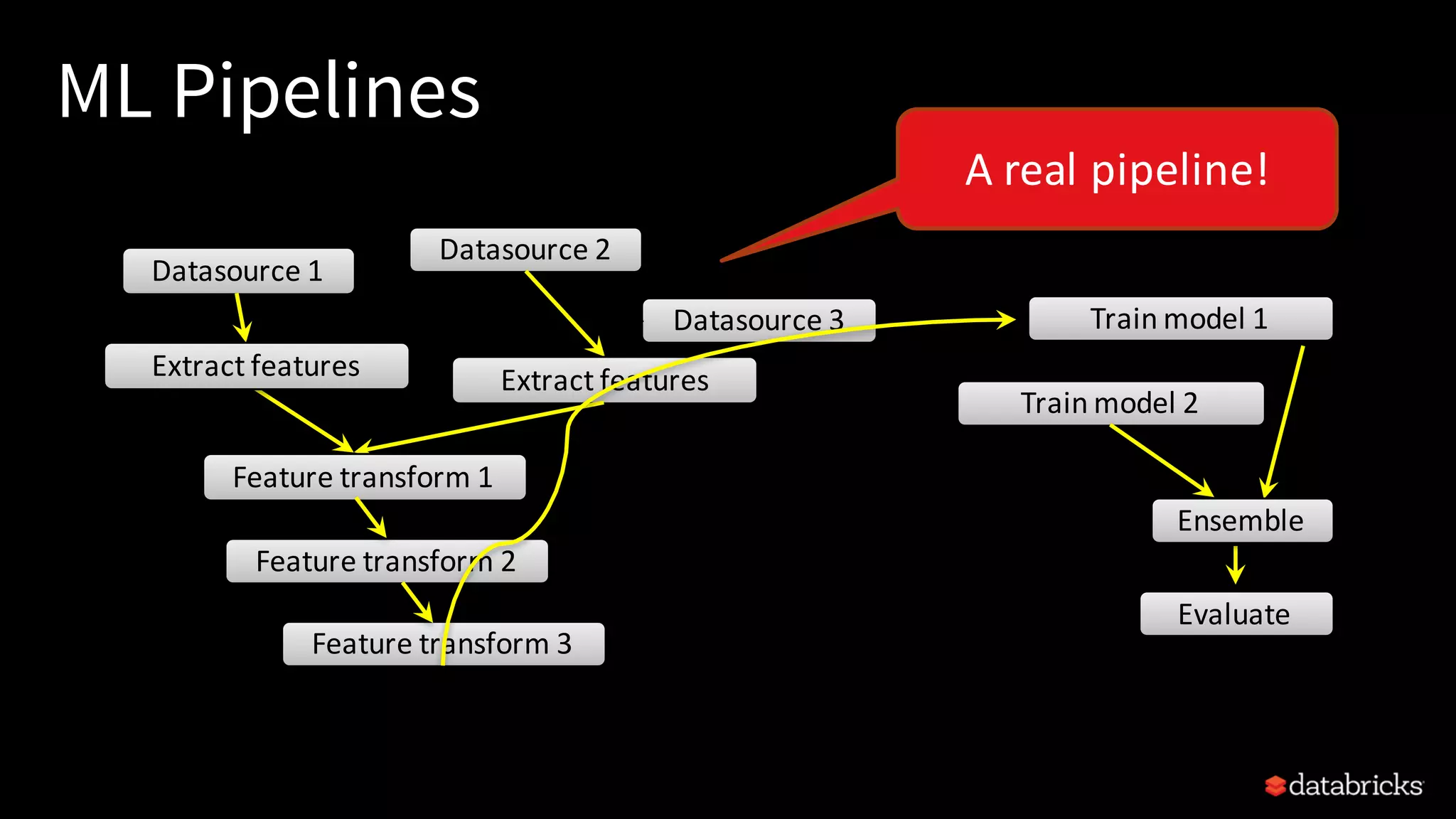
ML Pipelines
Train	model	1
Evaluate
Datasource	1
Datasource	2
Datasource	3
Extract	featuresExtract	features
Feature	transform	1
Feature	transform	2
Feature	transform	3
Train	model	2
Ensemble
A	real	pipeline!
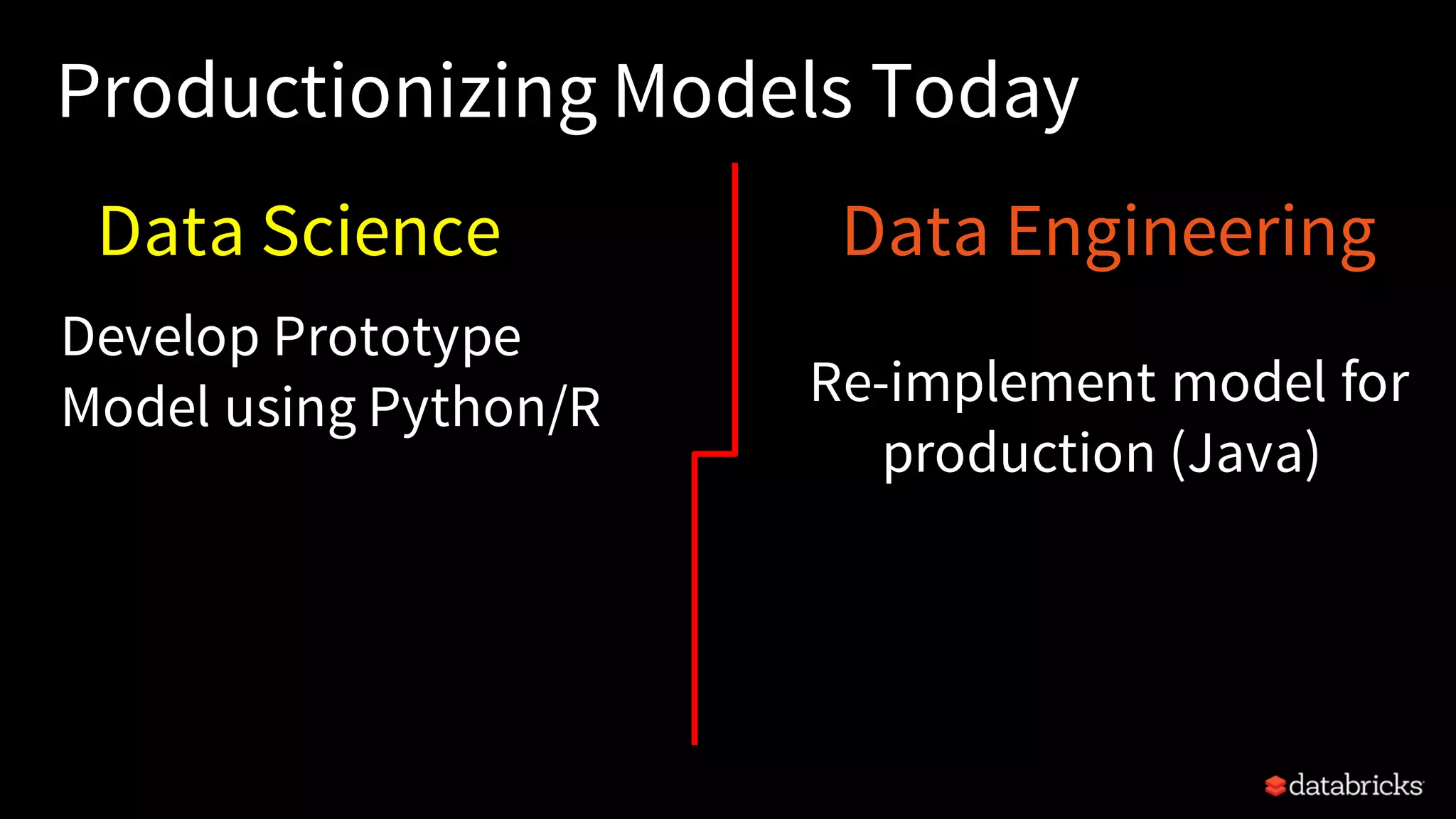
Productionizing Models Today
Data Science Data Engineering
Develop Prototype
Model using Python/R Re-implement model for
production (Java)
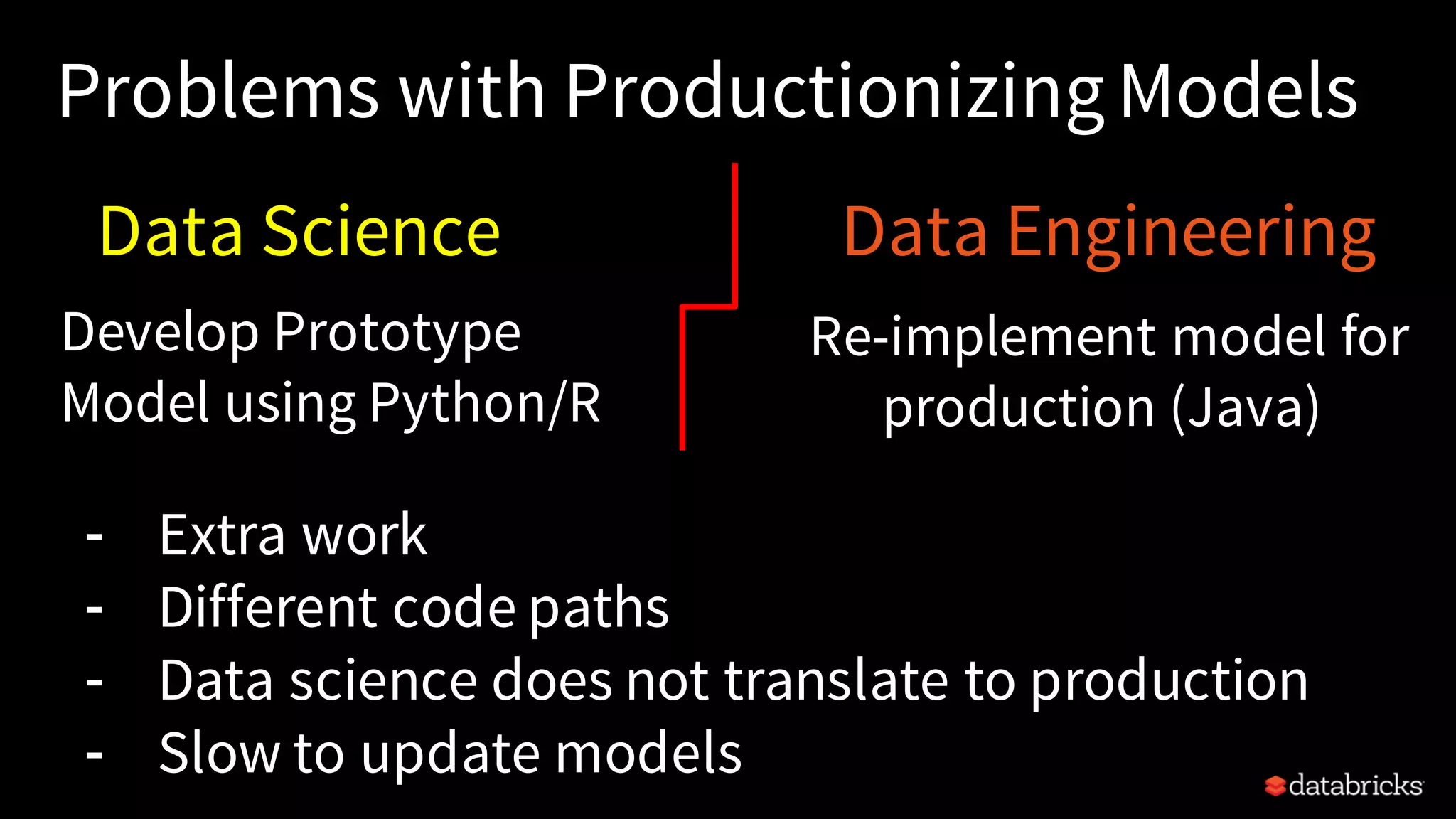
Problems with ProductionizingModels
Develop Prototype
Model using Python/R
Re-implement model for
production (Java)
- Extra work
- Different code paths
- Data science does not translate to production
- Slow to update models
Data Science Data Engineering
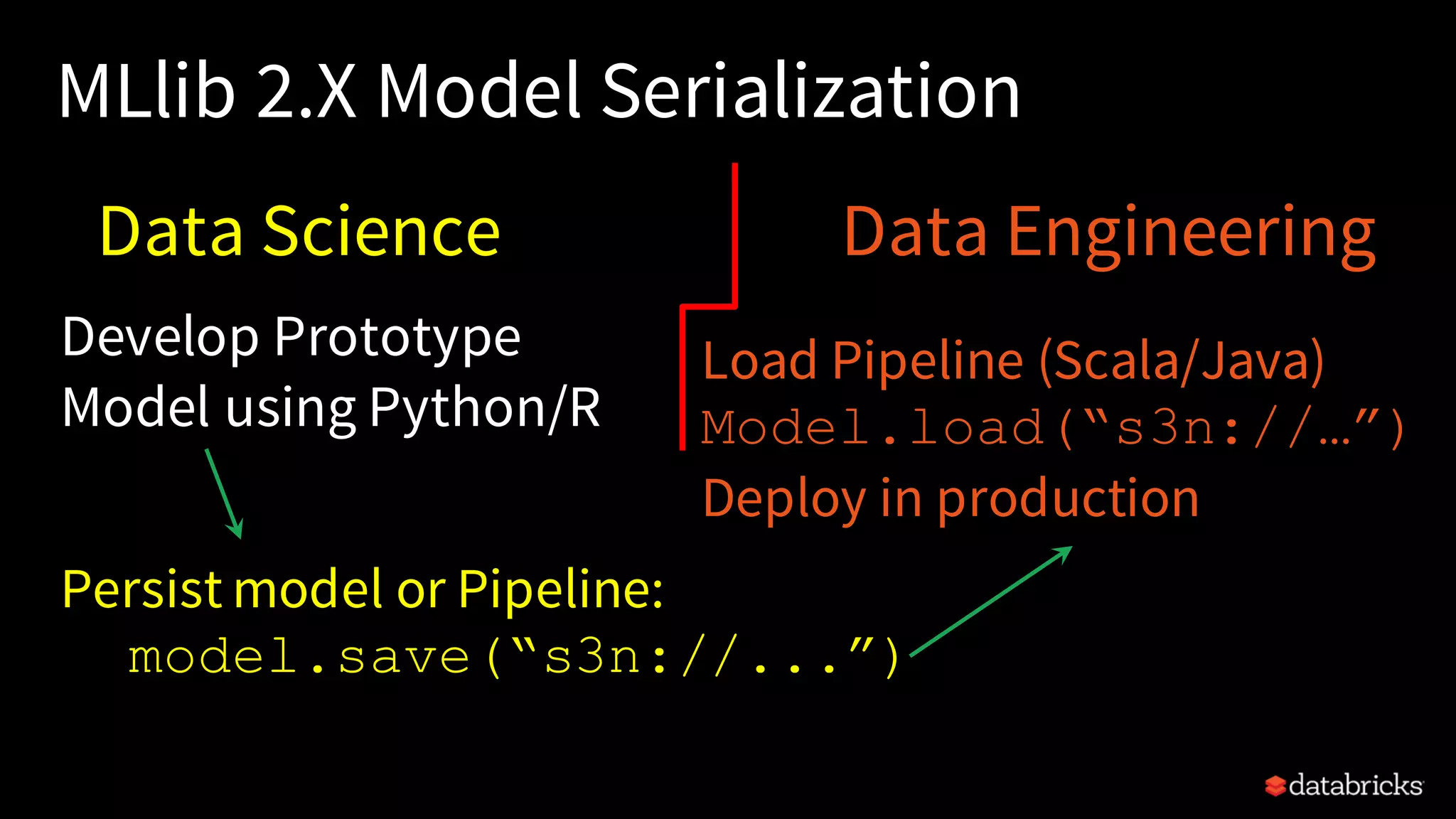
MLlib 2.X Model Serialization
Data Science Data Engineering
Develop Prototype
Model using Python/R
Persist model or Pipeline:
model.save(“s3n://...”)
Load Pipeline (Scala/Java)
Model.load(“s3n://…”)
Deploy in production
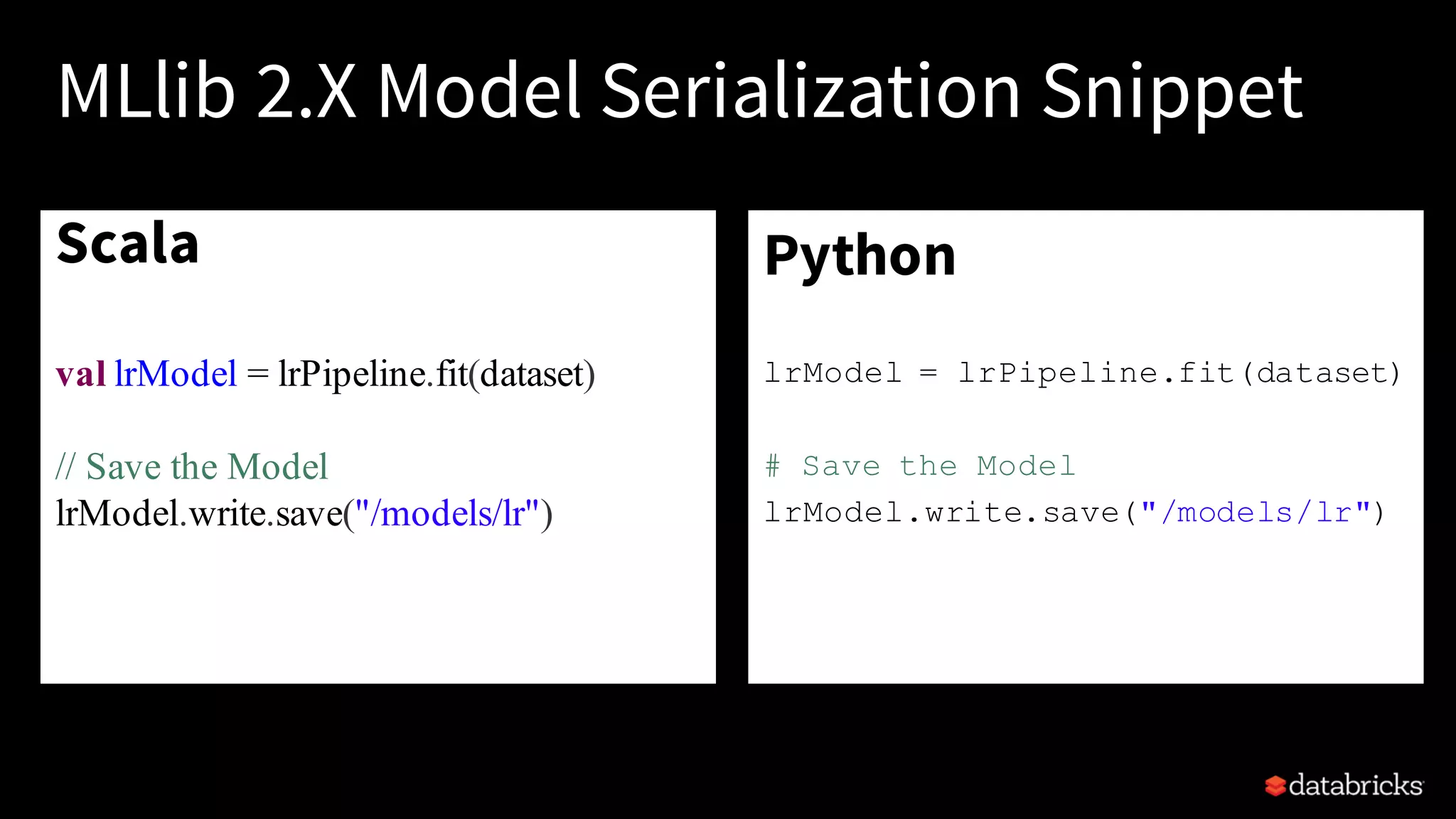
Scala
val lrModel = lrPipeline.fit(dataset)
// Save the Model
lrModel.write.save("/models/lr")
•
MLlib 2.X Model Serialization Snippet
Python
lrModel = lrPipeline.fit(dataset)
# Save the Model
lrModel.write.save("/models/lr")
•
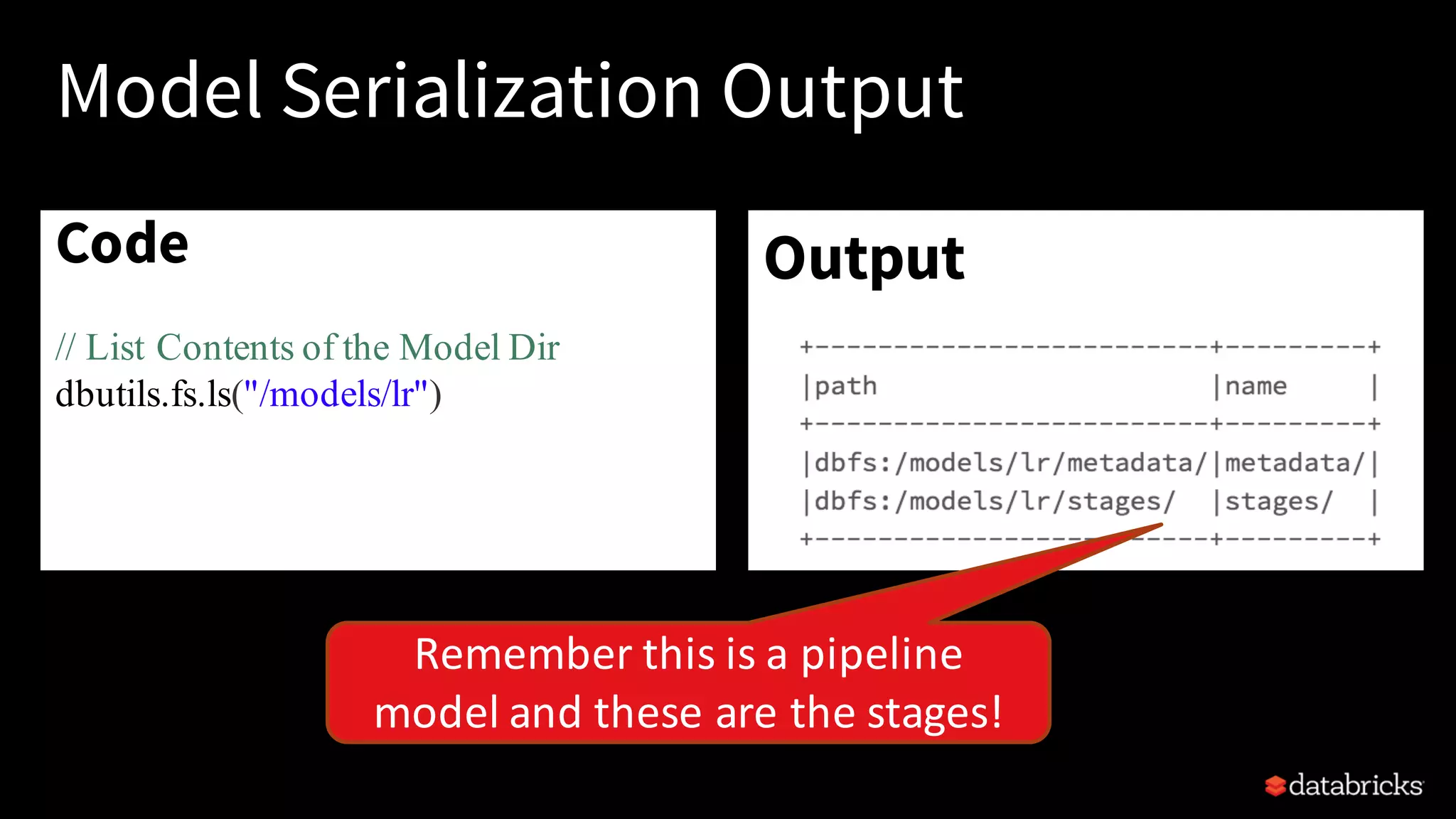
Model Serialization Output
Code
// List Contents of the Model Dir
dbutils.fs.ls("/models/lr")
•
Output
Remember	this	is	a	pipeline	
model	and	these	are	the	stages!
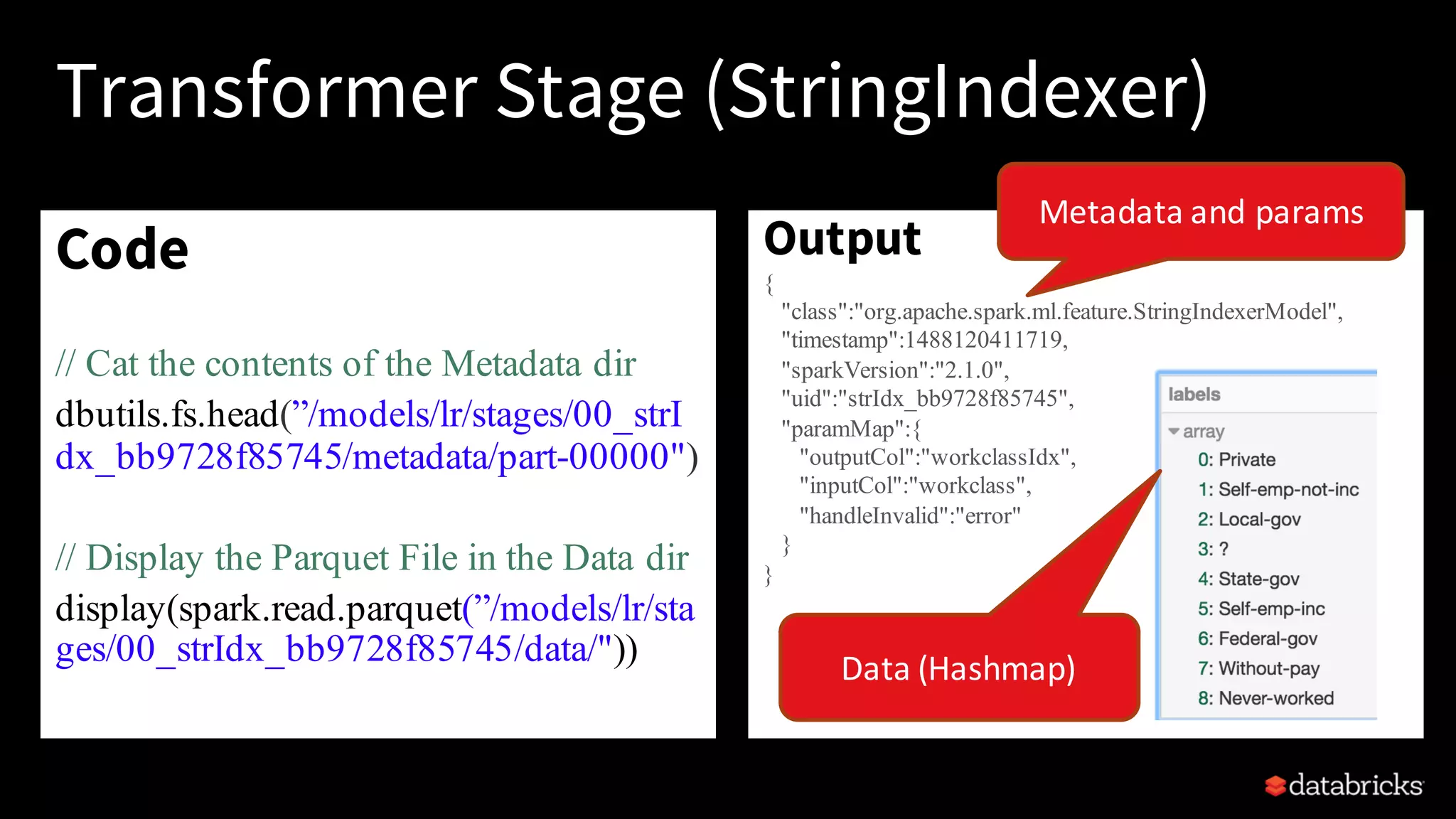
Transformer Stage (StringIndexer)
Code
// Cat the contents of the Metadata dir
dbutils.fs.head(”/models/lr/stages/00_strI
dx_bb9728f85745/metadata/part-00000")
// Display the Parquet File in the Data dir
display(spark.read.parquet(”/models/lr/sta
ges/00_strIdx_bb9728f85745/data/"))
Output
{
"class":"org.apache.spark.ml.feature.StringIndexerModel",
"timestamp":1488120411719,
"sparkVersion":"2.1.0",
"uid":"strIdx_bb9728f85745",
"paramMap":{
"outputCol":"workclassIdx",
"inputCol":"workclass",
"handleInvalid":"error"
}
}
Metadata	and	params
Data	(Hashmap)
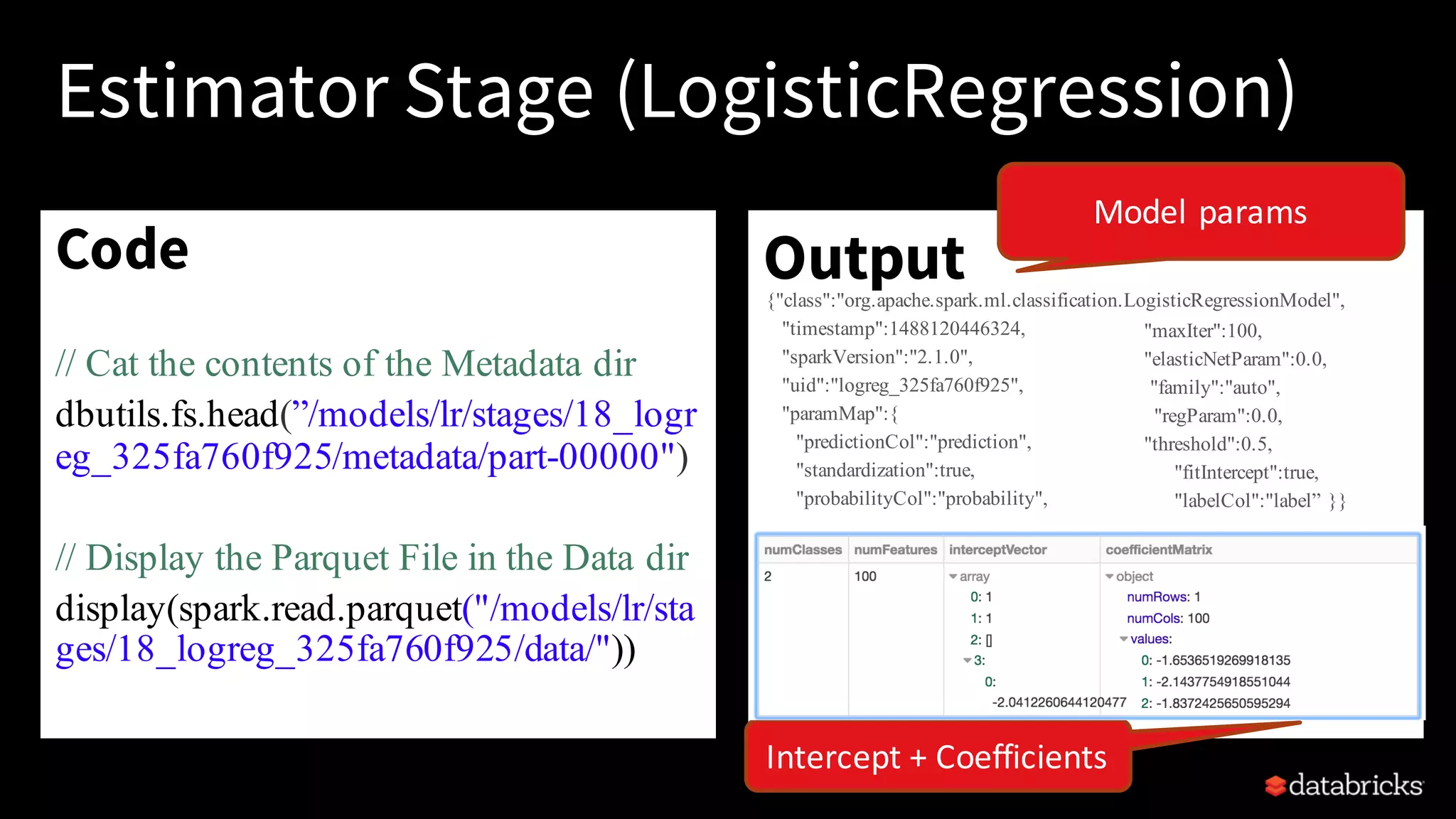
Estimator Stage (LogisticRegression)
Code
// Cat the contents of the Metadata dir
dbutils.fs.head(”/models/lr/stages/18_logr
eg_325fa760f925/metadata/part-00000")
// Display the Parquet File in the Data dir
display(spark.read.parquet("/models/lr/sta
ges/18_logreg_325fa760f925/data/"))
Output
Model	params
Intercept	+	Coefficients
{"class":"org.apache.spark.ml.classification.LogisticRegressionModel",
"timestamp":1488120446324,
"sparkVersion":"2.1.0",
"uid":"logreg_325fa760f925",
"paramMap":{
"predictionCol":"prediction",
"standardization":true,
"probabilityCol":"probability",
"maxIter":100,
"elasticNetParam":0.0,
"family":"auto",
"regParam":0.0,
"threshold":0.5,
"fitIntercept":true,
"labelCol":"label” }}
Output
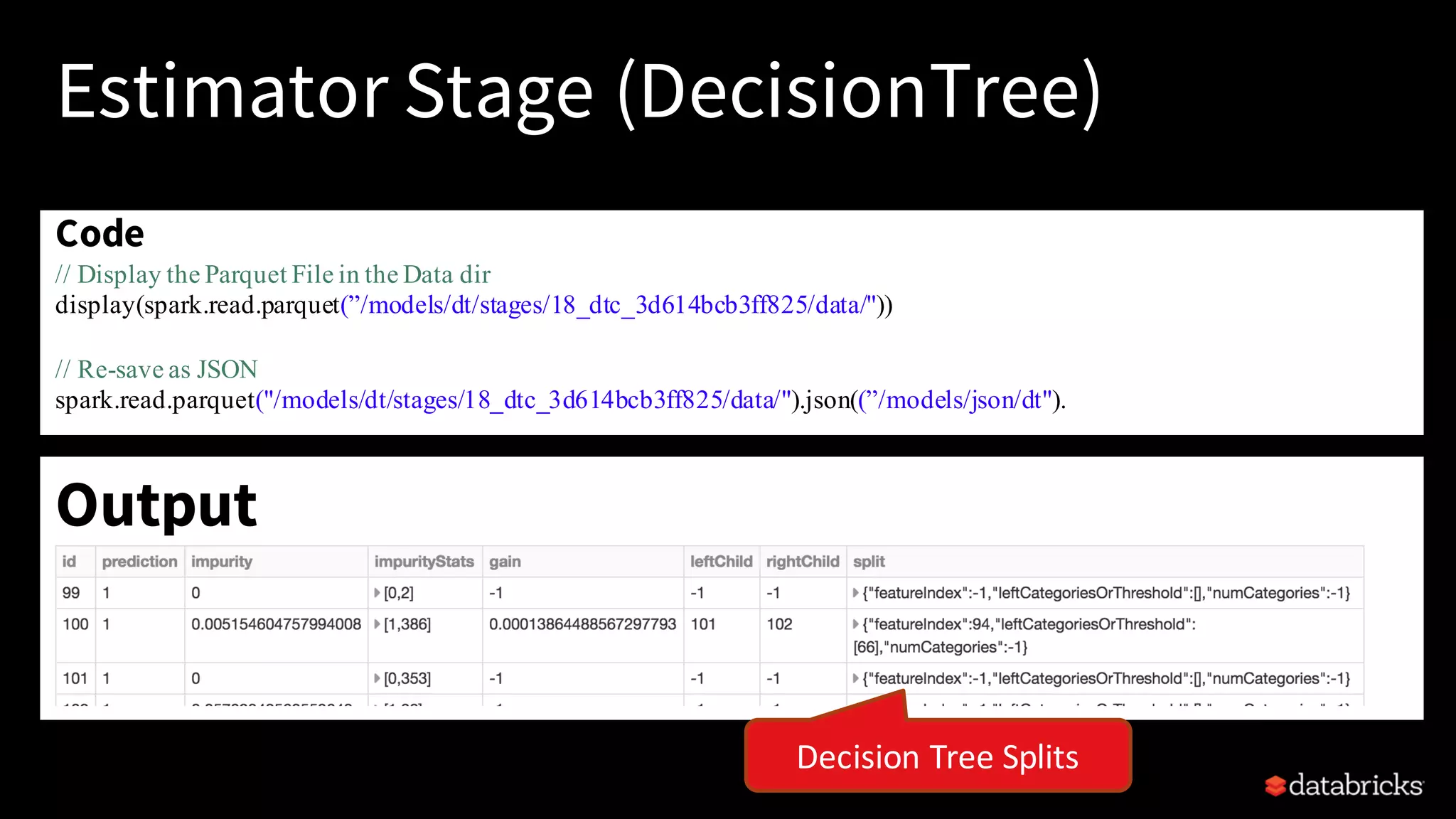
Decision	Tree	Splits
Estimator Stage (DecisionTree)
Code
// Display the Parquet File in the Data dir
display(spark.read.parquet(”/models/dt/stages/18_dtc_3d614bcb3ff825/data/"))
// Re-save as JSON
spark.read.parquet("/models/dt/stages/18_dtc_3d614bcb3ff825/data/").json((”/models/json/dt").
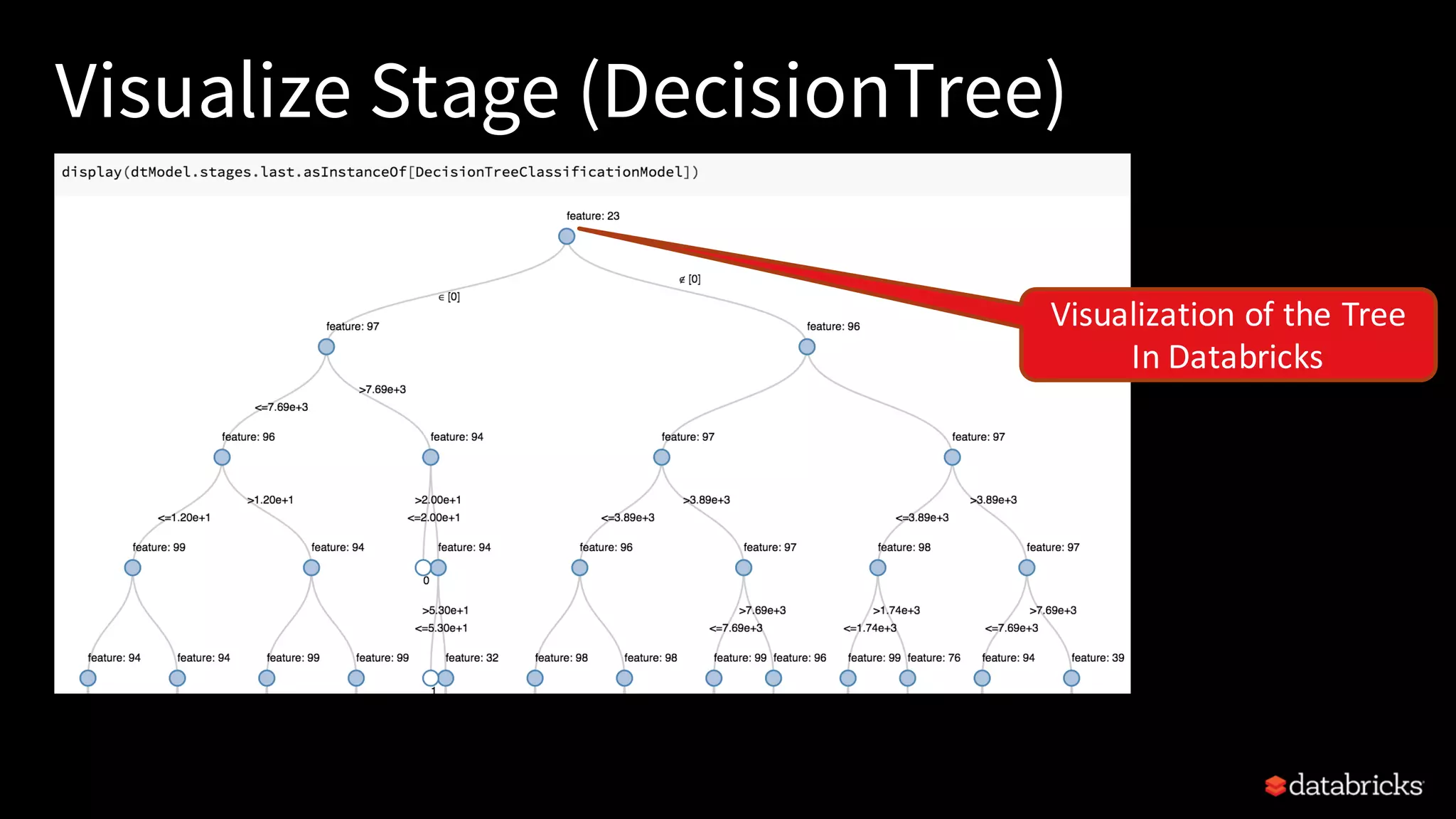
Visualize Stage (DecisionTree)
Visualization	of	the	Tree	
In	Databricks
What are the Requirements for
a Robust Model Deployment
System?
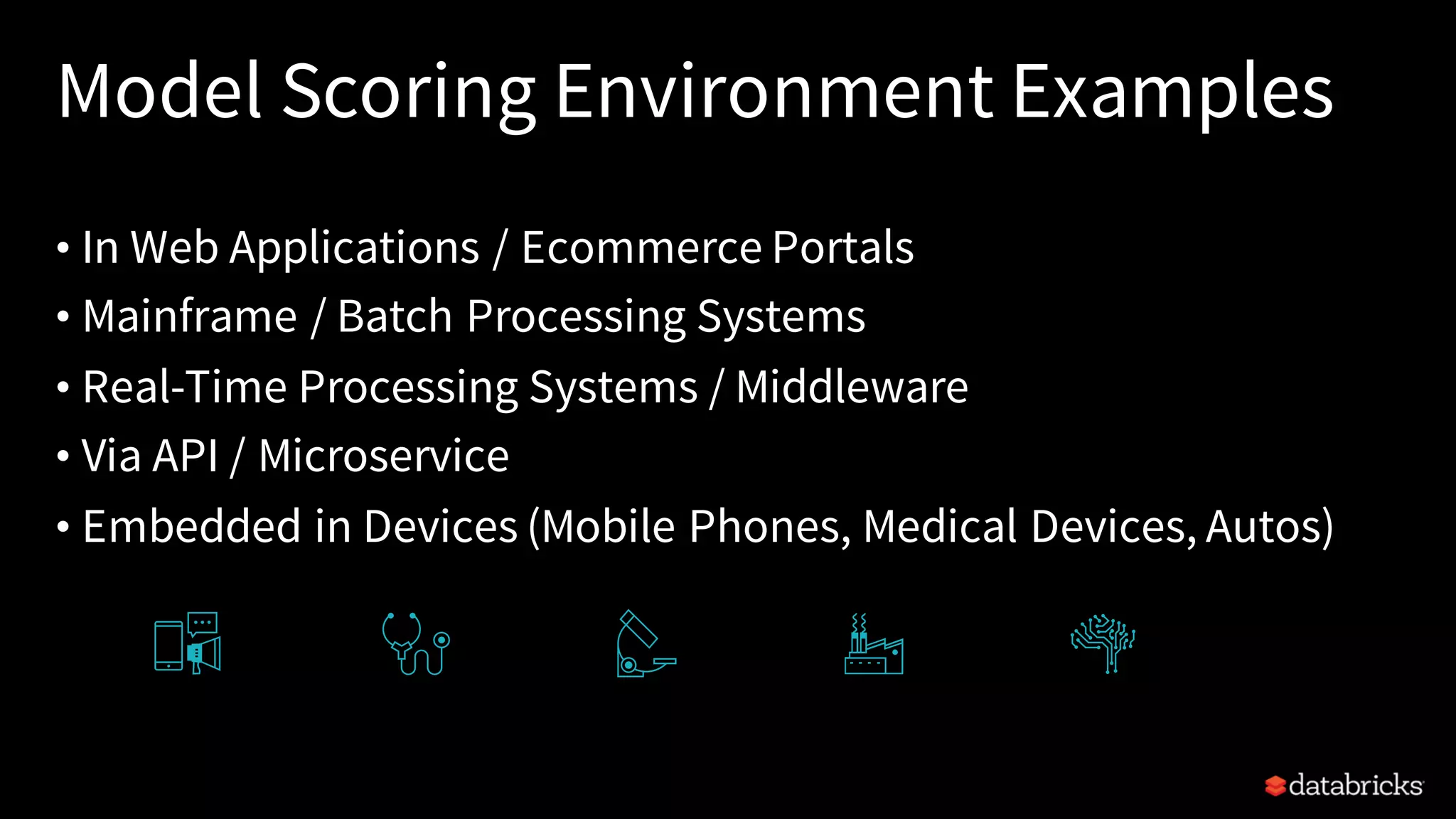
Model Scoring Environment Examples
• In Web Applications / Ecommerce Portals
• Mainframe / Batch Processing Systems
• Real-Time Processing Systems / Middleware
• Via API / Microservice
• Embedded in Devices (Mobile Phones, Medical Devices, Autos)
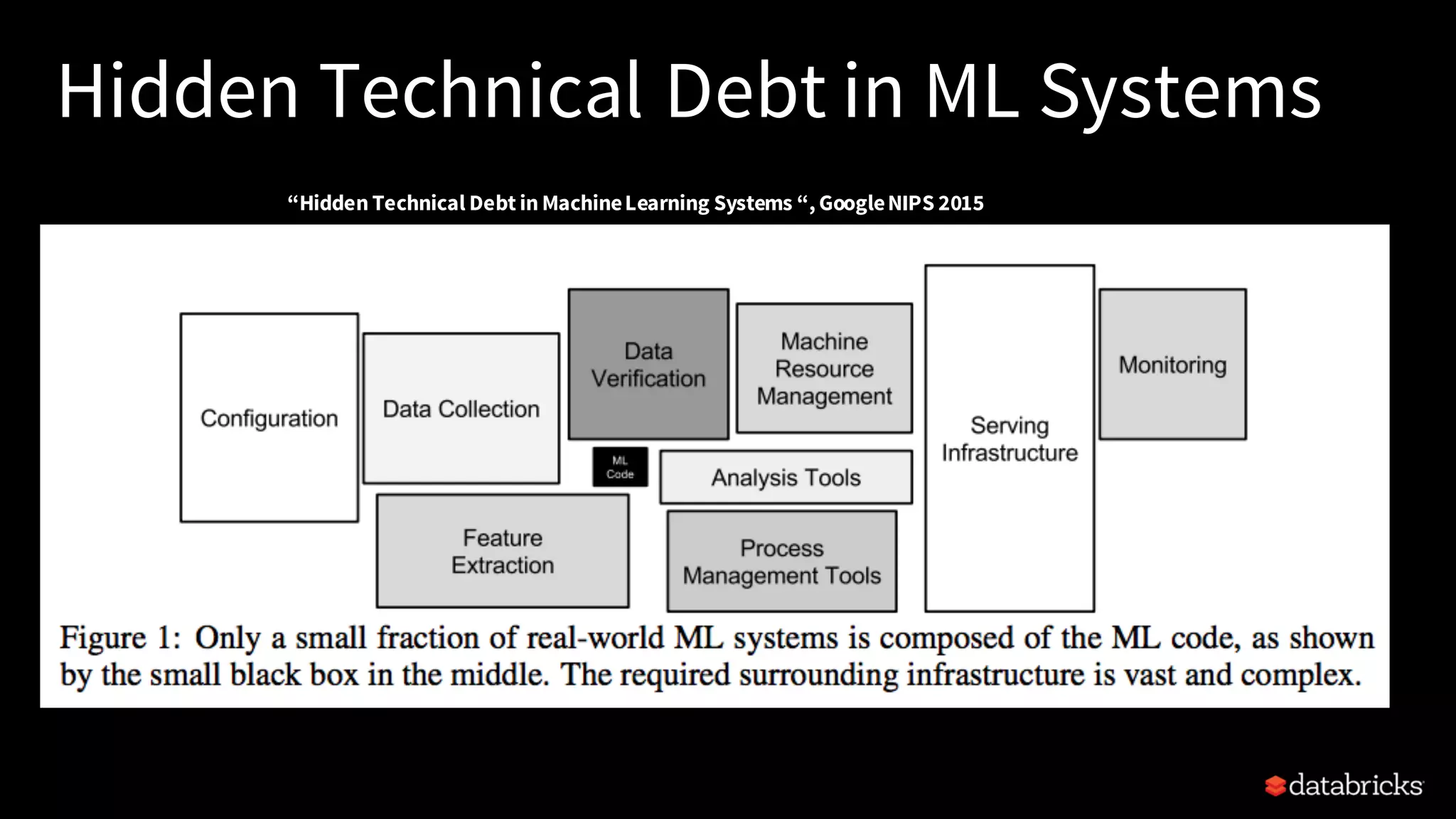
Hidden Technical Debt in ML Systems
“Hidden Technical Debt in Machine
Learning Systems “, Google NIPS 2015
“Hidden Technical Debt in MachineLearning Systems “, GoogleNIPS 2015
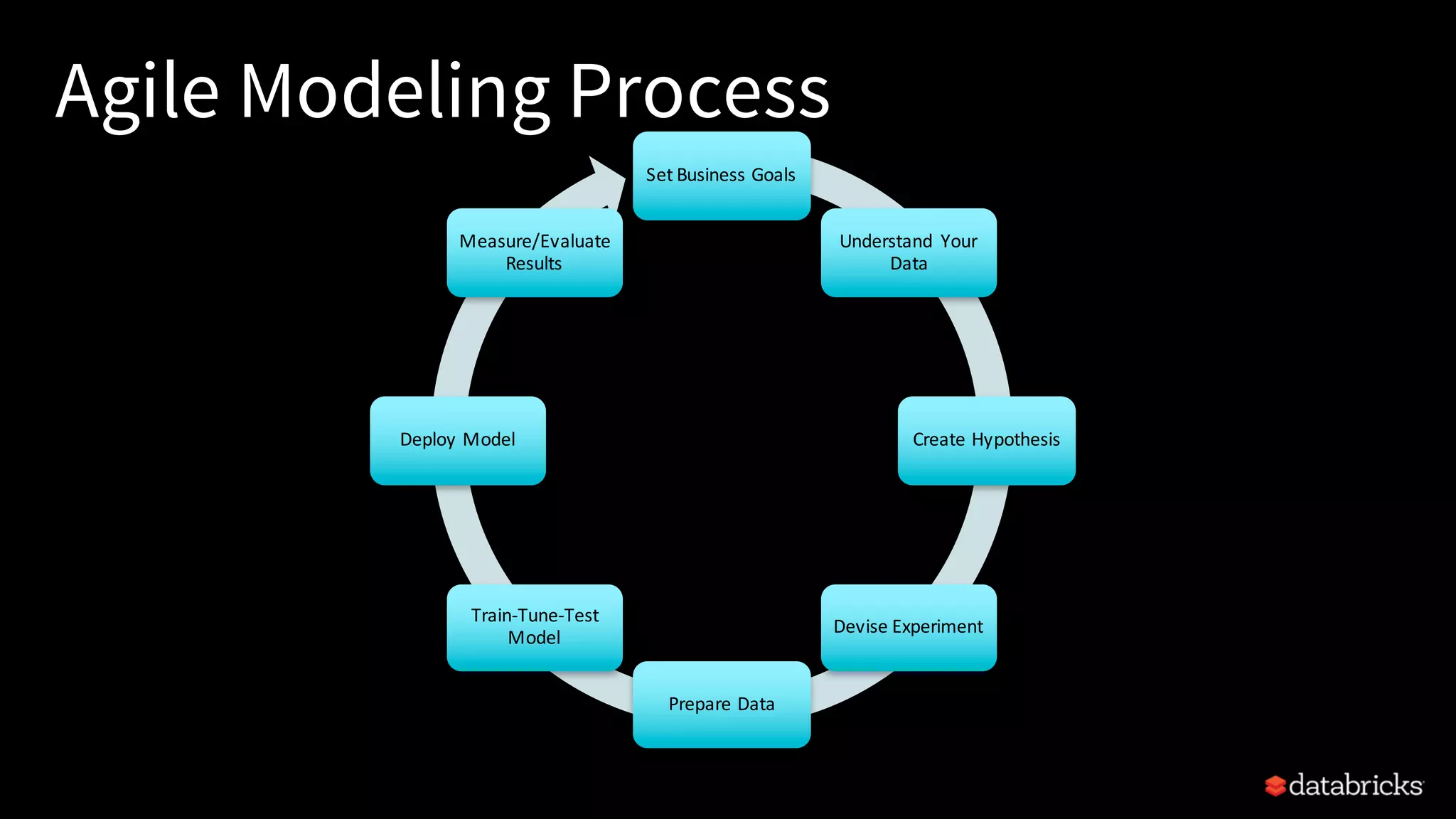
Agile Modeling Process
Set	Business	Goals
Understand	 Your	
Data
Create	Hypothesis
Devise	Experiment
Prepare	Data
Train-Tune-Test	
Model
Deploy	Model
Measure/Evaluate	
Results
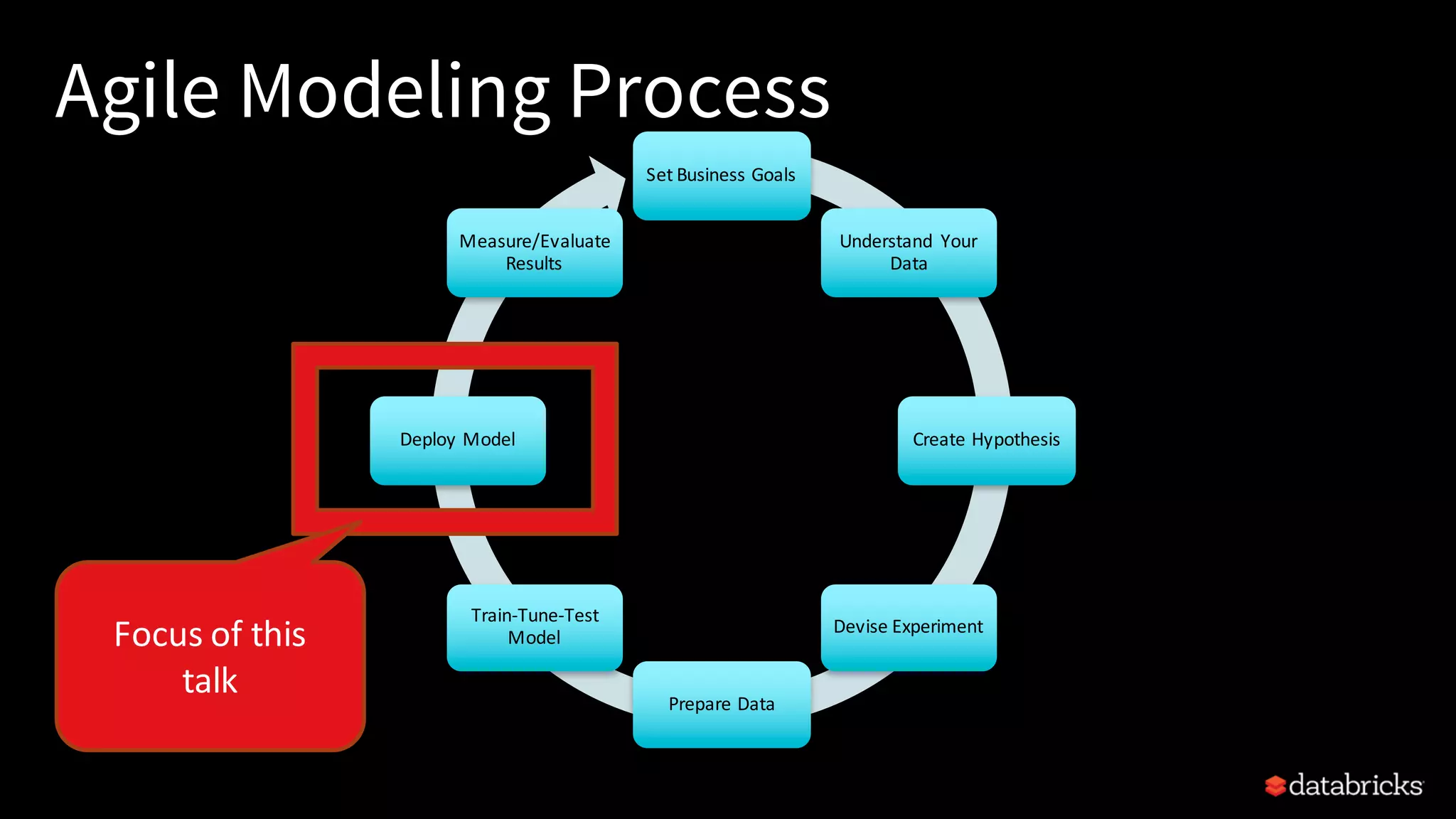
Agile Modeling Process
Set	Business	Goals
Understand	 Your	
Data
Create	Hypothesis
Devise	Experiment
Prepare	Data
Train-Tune-Test	
Model
Deploy	Model
Measure/Evaluate	
Results
Focus	of	this	
talk
Set	Business	Goals
Understand	 Your	
Data
Create	Hypothesis
Devise	Experiment
Prepare	Data
Train-Tune-Test	
Model
Deploy	Model
Measure/Evaluate	
Results
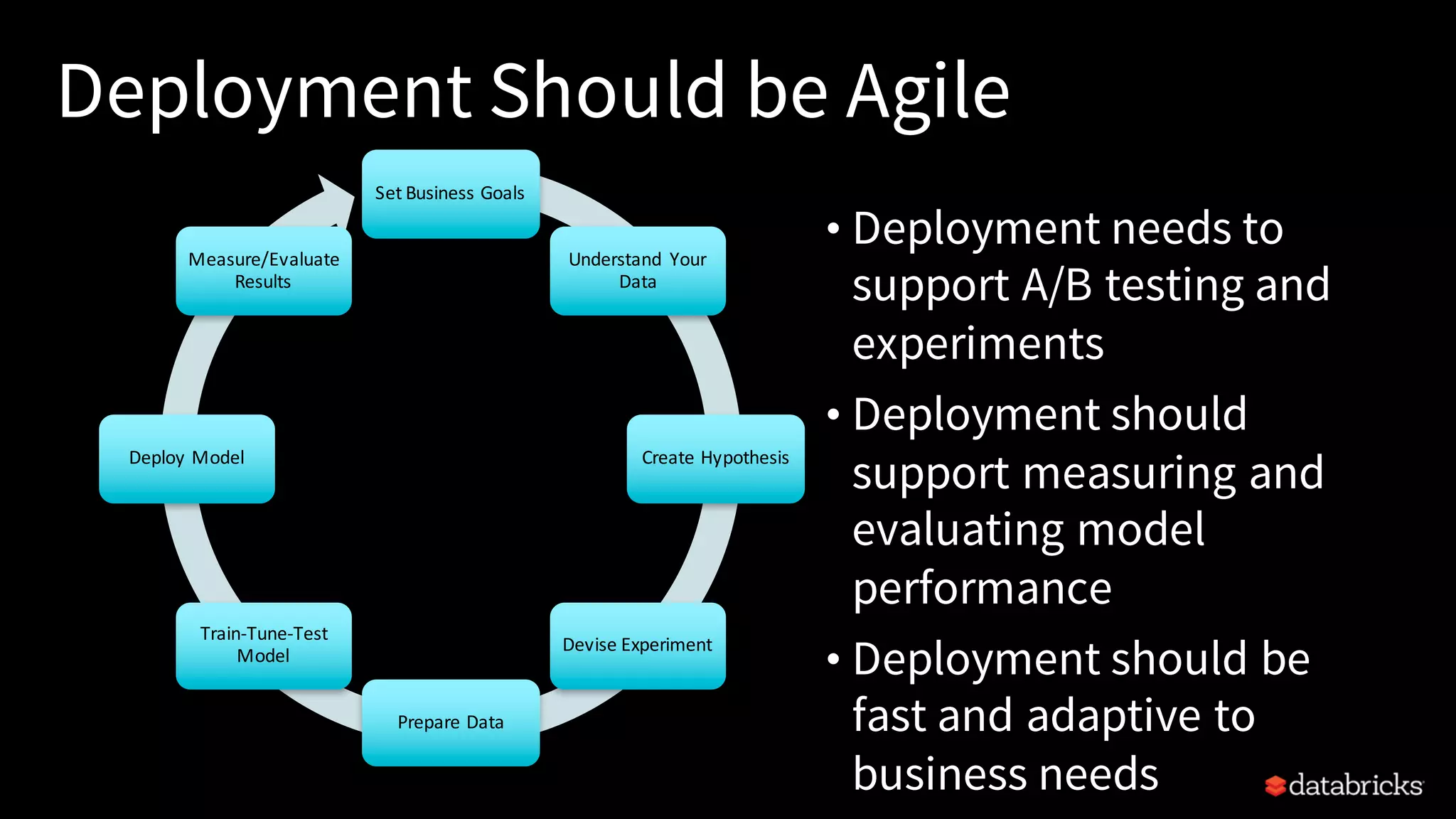
Deployment Should be Agile
• Deployment needs to
support A/B testing and
experiments
• Deployment should
support measuring and
evaluating model
performance
• Deployment should be
fast and adaptive to
business needs
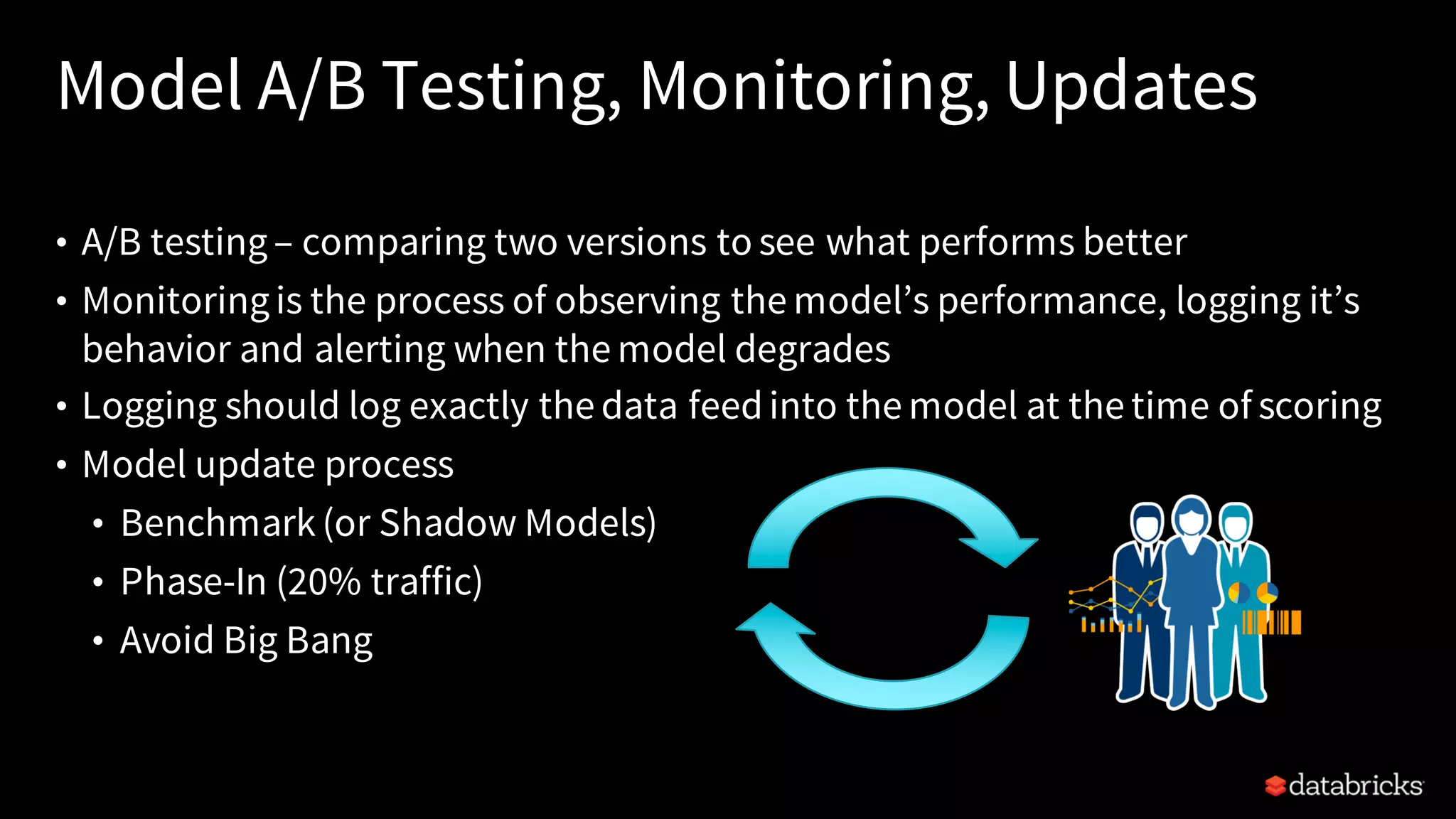
Model A/B Testing, Monitoring, Updates
• A/B testing– comparing two versions to see what performs better
• Monitoringis the process of observing the model’s performance, logging it’s
behavior and alerting when the model degrades
• Logging should log exactly the data feedinto the model at the time of scoring
• Model update process
• Benchmark (or Shadow Models)
• Phase-In (20% traffic)
• Avoid Big Bang
Consider the Scoring Environment
Customer SLAs
•Response time
•Throughput
(predictionsper
second)
•Uptime / Reliability
Tech Stack
–C / C++
–Legacy (mainframe)
–Java
Batch Real-Time
Scoring in Batch vs Real-Time
• Synchronous
• Could be Seconds:
– Customer is waiting
(human real-time)
• Subsecond:
– High FrequencyTrading
– Fraud Detection on the Swipe
• Asynchronous
• Internal Use
• Triggers can be event based on time
based
• Used for EmailCampaigns,
Notifications
Open Loop – human being involved
Closed Loop– no human involved
• Model Scoring– almost always
closed loop, some open loop e.g.
alert agents or customer service
• Model Training– usually open loop
with a data scientist in the loop to
update the model
Online Learning and Open / Closed Loop
• Online is closed loop, entirely
machine driven but modelingis
risky
• need to have proper model
monitoringand safeguards to
prevent abuse / sensitivity to noise
• MLlibsupports online through
streaming models (k-means, logistic
regression support online)
• Alternative – use a more complex
model to better fit new data rather
than using online learning
Open / Closed Loop Online Learning
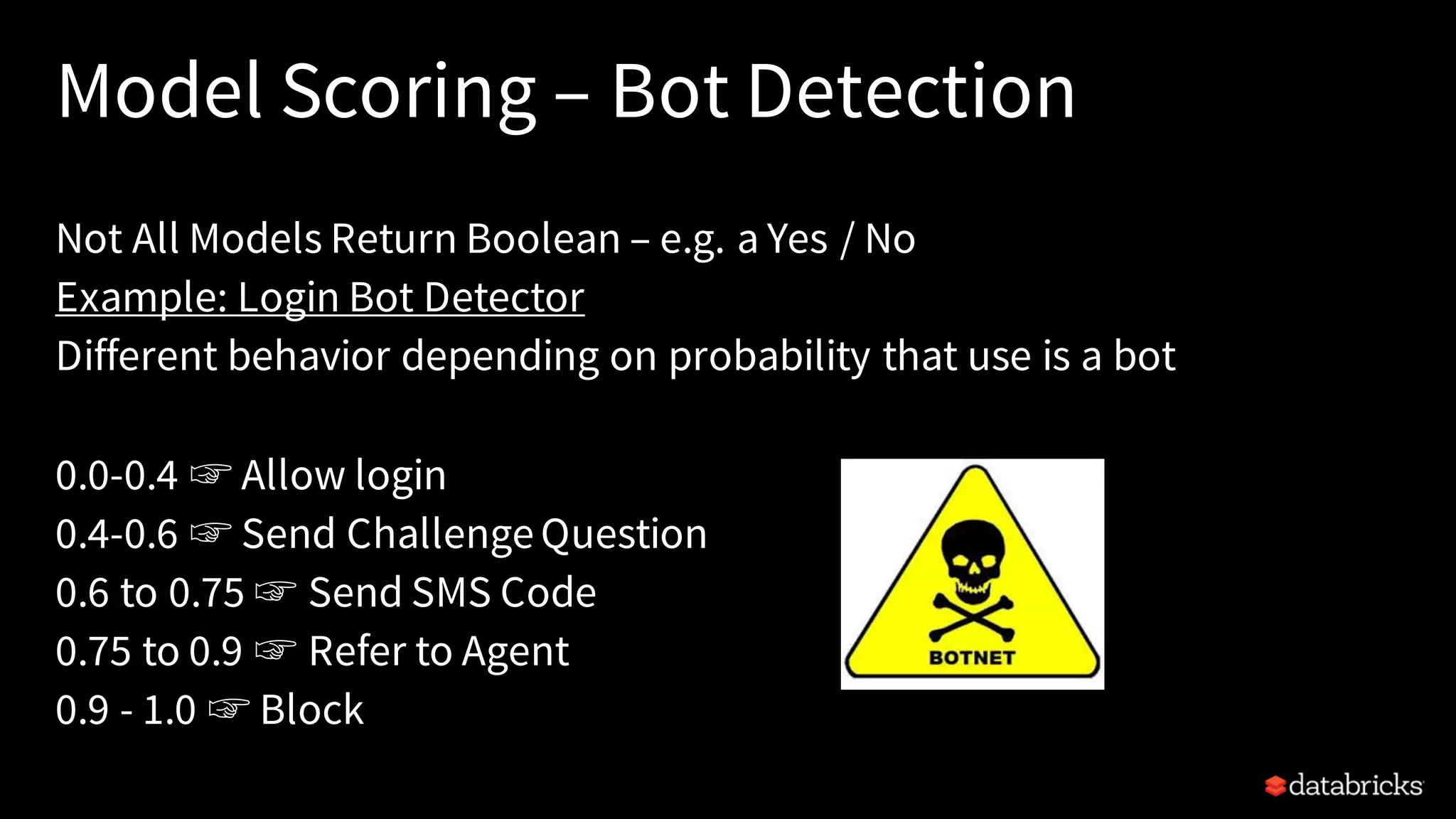
Model Scoring – Bot Detection
Not All Models Return Boolean – e.g. a Yes / No
Example: Login Bot Detector
Different behavior depending on probability that use is a bot
0.0-0.4 ☞ Allow login
0.4-0.6 ☞ Send ChallengeQuestion
0.6 to 0.75 ☞ Send SMS Code
0.75 to 0.9 ☞ Refer to Agent
0.9 - 1.0 ☞ Block
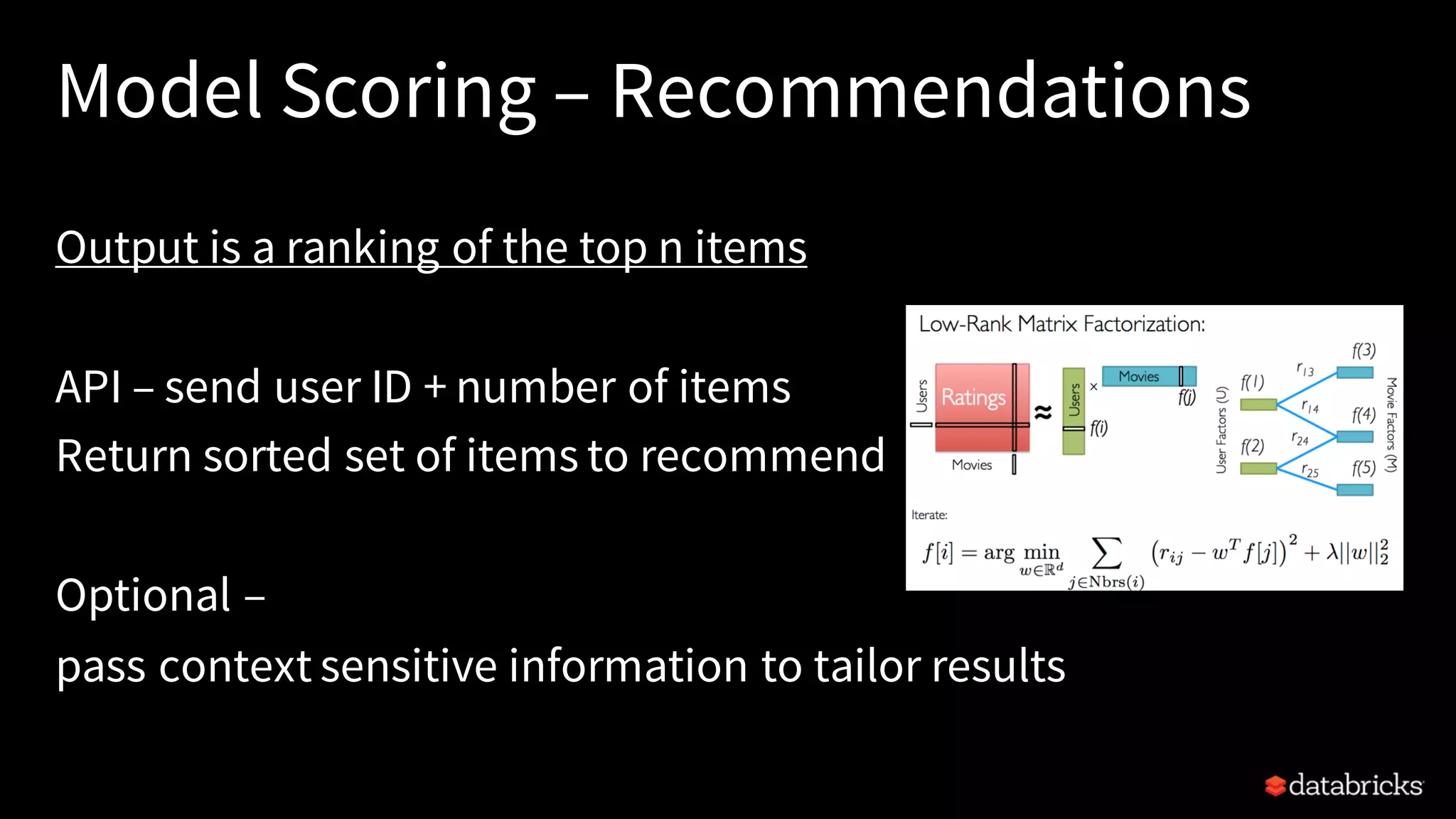
Model Scoring – Recommendations
Output is a ranking of the top n items
API – send user ID + number of items
Return sorted set of items to recommend
Optional –
pass context sensitive information to tailor results
Model Scoring Architectures
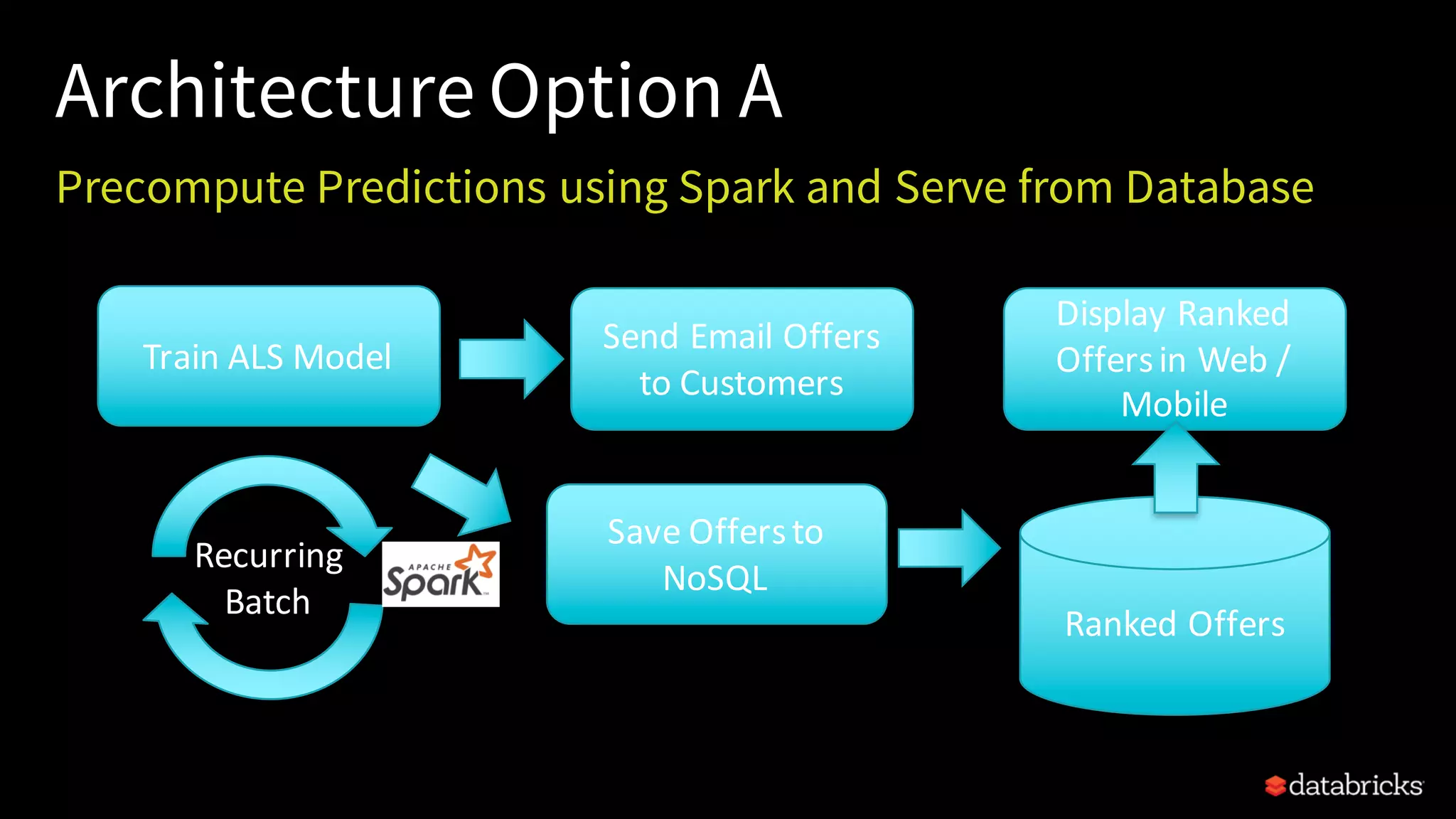
Architecture Option A
Precompute Predictions using Spark and Serve from Database
Train	ALS	Model
Send	Email	Offers	
to	Customers
Save	Offers	to	
NoSQL
Ranked	Offers
Display	Ranked	
Offers	in	Web	/	
Mobile
Recurring	
Batch
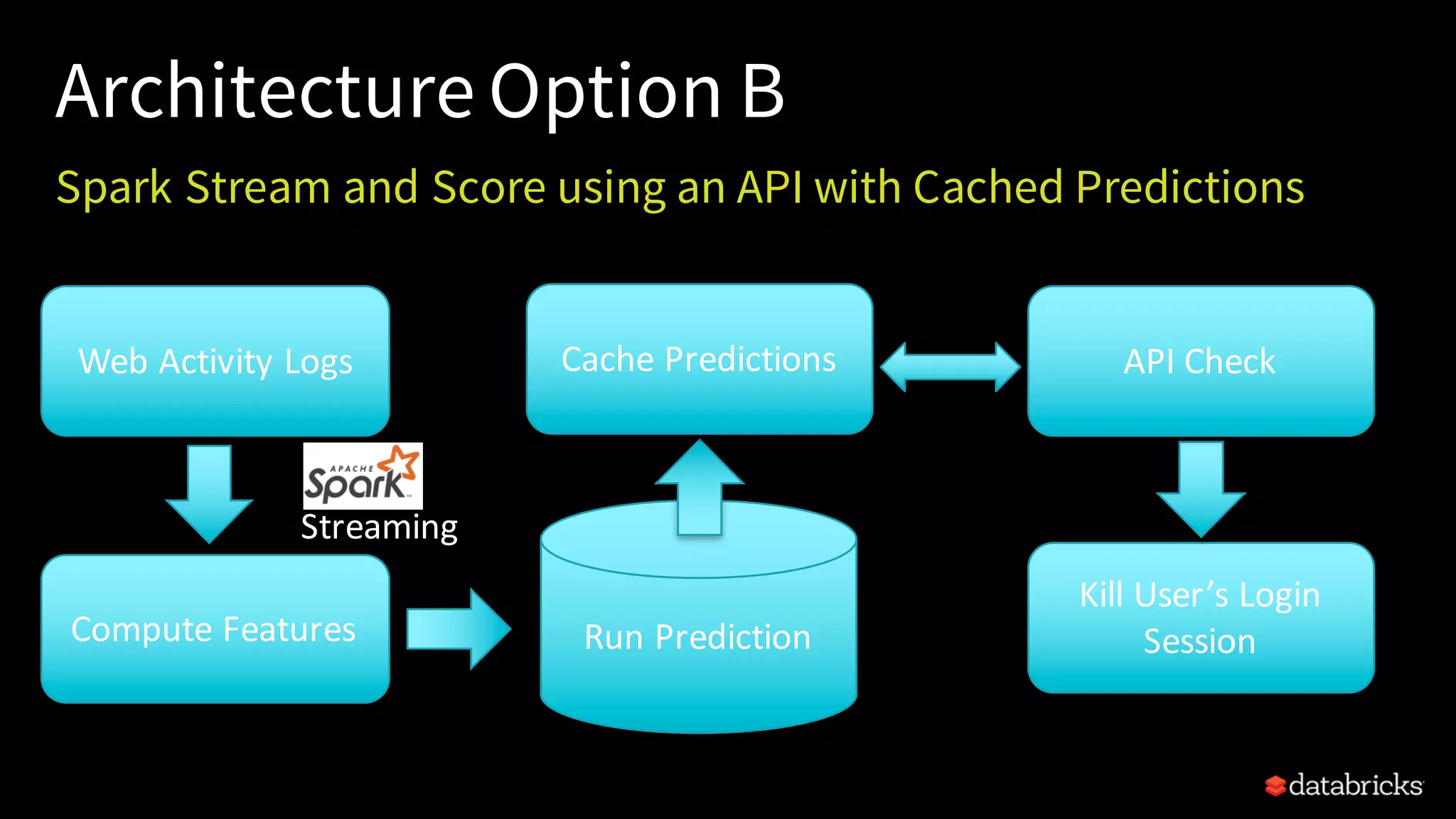
Architecture Option B
Spark Stream and Score using an API with Cached Predictions
Web	Activity	Logs
Kill	User’s	Login	
SessionCompute	Features Run	Prediction
Streaming
Cache	Predictions API	Check
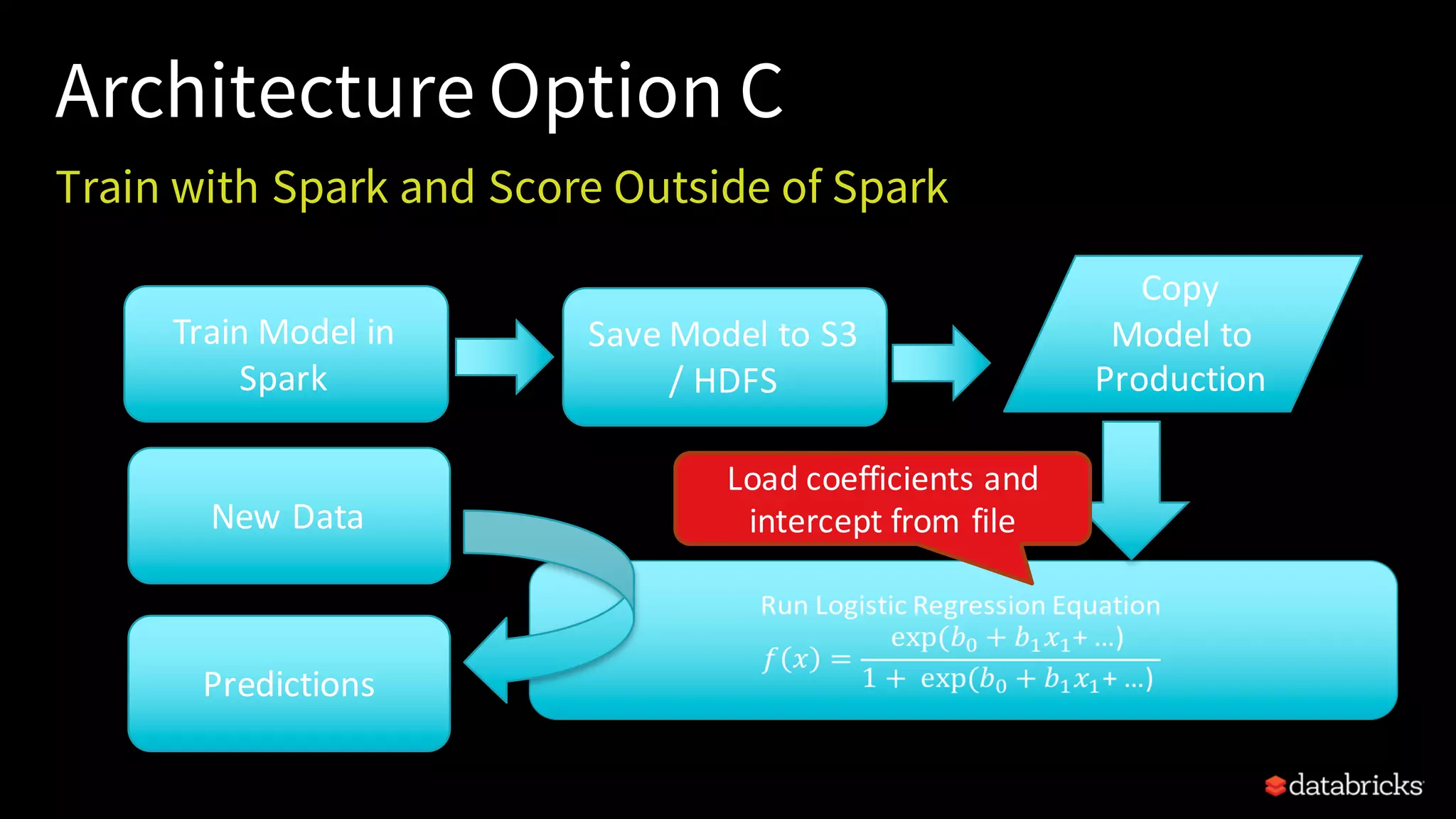
Architecture Option C
Train with Spark and Score Outside of Spark
Train	Model	in	
Spark
Save	Model	to	S3	
/	HDFS
New	Data
Copy	
Model	to	
Production
Predictions
Load	coefficients	and	
intercept	from	file
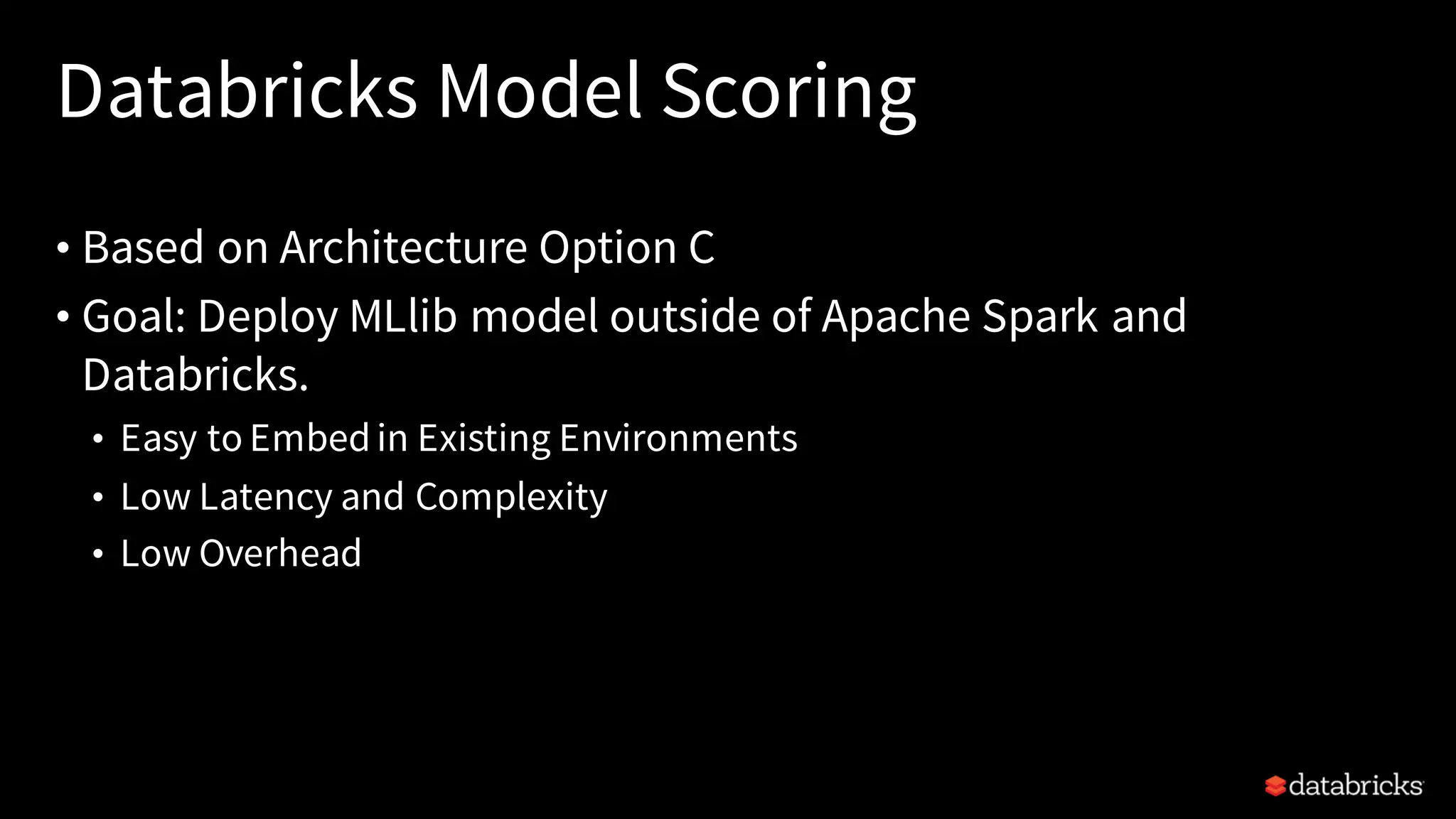
Databricks Model Scoring
• Based on Architecture Option C
• Goal: Deploy MLlib model outside of Apache Spark and
Databricks.
• Easy to Embedin Existing Environments
• Low Latency and Complexity
• Low Overhead
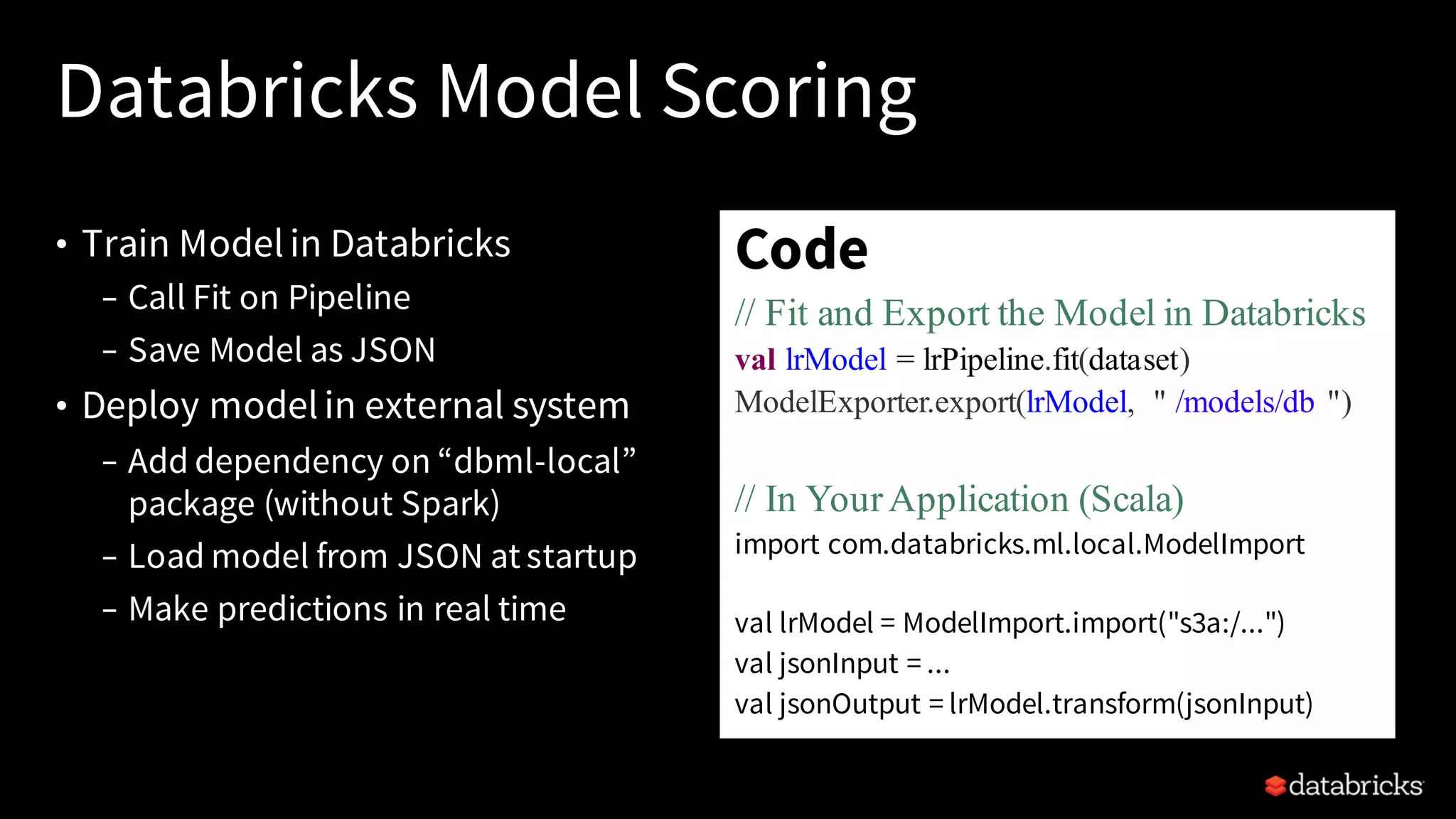
• Train Modelin Databricks
– Call Fit on Pipeline
– Save Model as JSON
• Deploy modelin external system
– Add dependency on “dbml-local”
package (without Spark)
– Load model from JSON at startup
– Make predictions in real time
Databricks Model Scoring
Code
// Fit and Export the Model in Databricks
val lrModel = lrPipeline.fit(dataset)
ModelExporter.export(lrModel, " /models/db ")
// In YourApplication (Scala)
import com.databricks.ml.local.ModelImport
val lrModel = ModelImport.import("s3a:/...")
val jsonInput = ...
val jsonOutput = lrModel.transform(jsonInput)
Databricks Model Scoring Private Beta
• Private Beta Available for Databricks Customers
• Available on Databricks using Apache Spark 2.1
• Only logistic regression available now
• Additional Estimators and Transformers in Progress
Demo Model Serialization
https://databricks-prod-
cloudfront.cloud.databricks.com/public/4027ec902e239c93eaaa8
714f173bcfc/1526931011080774/1904316851197504/63204405618
00420/latest.html
Thank You!
Questions?
Happy Sparking

Apache ® Spark™ MLlib 2.x: How to Productionize your Machine Learning Models

  • 1.
    Apache Spark™ MLlib2.x: How to Productionize your Machine Learning Models Richard Garris (Principal Solutions Architect) Jules S. Damji (Spark Community Evangelist) March 9 , 2017
  • 2.
    About Me • JulesDamji • Twitter: @2twitme; LinkedIn • Spark Community Evangelist @ Databricks • Worked in various software engineering roles building distributed systems and applications at Sun, Netscape, LoudCloud/Opsware, VeriSign, Scalix, Ebrary & Hortonworks
  • 3.
  • 4.
    Empower anyone toinnovate faster with big data. Founded by the creators of Apache Spark. Contributes 75%of the open source code, 10xmore than any other company. VISION WHO WE ARE A fully-managed data processing platform for the enterprise, powered by Apache Spark. PRODUCT
  • 5.
    CLUSTER TUNING & MANAGEMENT INTERACTIVE WORKSPACE PRODUCTION PIPELINE AUTOMATION OPTIMIZEDDATA ACCESS DATABRICKS ENTERPRISE SECURITY YOUR TEAMS Data Science Data Engineering Many others… BI Analysts YOUR DATA Cloud Storage Data Warehouses Data Lake VIRTUAL ANALYTICS PLATFORM
  • 6.
    Apache Spark™ MLlib2.x: How to Productionize your Machine Learning Models Richard Garris (Principal Solutions Architect) March 9 , 2017
  • 7.
    About Me • RichardL Garris • rlgarris@databricks.com • Twitter @rlgarris • Principal Data Solutions Architect @ Databricks • 12+ years designing Enterprise Data Solutions for everyone from startups to Global 2000 • Prior Work Experience PwC, Google and Skytree – the Machine Learning Company • Ohio State Buckeye and Masters from CMU
  • 8.
    Outline • Spark MLlib2.X • Model Serialization • Model Scoring System Requirements • Model Scoring Architectures • Databricks Model Scoring
  • 9.
    About Apache Spark™MLlib • Started with Spark 0.8 in the AMPLab in 2014 • Migration to Spark DataFrames started with Spark 1.3 with feature parity within 2.X • Contributions by 75+ orgs, ~250 individuals • Distributed algorithms that scale linearly with the data
  • 10.
    MLlib’s Goals • Generalpurpose machine learning library optimized for big data • Linearly scalable = 2x more machines , runtime theoretically cut in half • Fault tolerant = resilient to the failure of nodes • Covers the most common algorithms with distributed implementations • Built around the concept of a Data Science Pipeline (scikit-learn) • Written entirely using Apache Spark™ • Integrates well with the Agile Modeling Process
  • 11.
    A Model isa Mathematical Function • A model is a function: 𝑓 𝑥 • Linear regression 𝑦 = 𝑏0 + 𝑏1 𝑥1 + 𝑏2 𝑥2
  • 12.
  • 13.
  • 14.
    Productionizing Models Today DataScience Data Engineering Develop Prototype Model using Python/R Re-implement model for production (Java)
  • 15.
    Problems with ProductionizingModels DevelopPrototype Model using Python/R Re-implement model for production (Java) - Extra work - Different code paths - Data science does not translate to production - Slow to update models Data Science Data Engineering
  • 16.
    MLlib 2.X ModelSerialization Data Science Data Engineering Develop Prototype Model using Python/R Persist model or Pipeline: model.save(“s3n://...”) Load Pipeline (Scala/Java) Model.load(“s3n://…”) Deploy in production
  • 17.
    Scala val lrModel =lrPipeline.fit(dataset) // Save the Model lrModel.write.save("/models/lr") • MLlib 2.X Model Serialization Snippet Python lrModel = lrPipeline.fit(dataset) # Save the Model lrModel.write.save("/models/lr") •
  • 18.
    Model Serialization Output Code //List Contents of the Model Dir dbutils.fs.ls("/models/lr") • Output Remember this is a pipeline model and these are the stages!
  • 19.
    Transformer Stage (StringIndexer) Code //Cat the contents of the Metadata dir dbutils.fs.head(”/models/lr/stages/00_strI dx_bb9728f85745/metadata/part-00000") // Display the Parquet File in the Data dir display(spark.read.parquet(”/models/lr/sta ges/00_strIdx_bb9728f85745/data/")) Output { "class":"org.apache.spark.ml.feature.StringIndexerModel", "timestamp":1488120411719, "sparkVersion":"2.1.0", "uid":"strIdx_bb9728f85745", "paramMap":{ "outputCol":"workclassIdx", "inputCol":"workclass", "handleInvalid":"error" } } Metadata and params Data (Hashmap)
  • 20.
    Estimator Stage (LogisticRegression) Code //Cat the contents of the Metadata dir dbutils.fs.head(”/models/lr/stages/18_logr eg_325fa760f925/metadata/part-00000") // Display the Parquet File in the Data dir display(spark.read.parquet("/models/lr/sta ges/18_logreg_325fa760f925/data/")) Output Model params Intercept + Coefficients {"class":"org.apache.spark.ml.classification.LogisticRegressionModel", "timestamp":1488120446324, "sparkVersion":"2.1.0", "uid":"logreg_325fa760f925", "paramMap":{ "predictionCol":"prediction", "standardization":true, "probabilityCol":"probability", "maxIter":100, "elasticNetParam":0.0, "family":"auto", "regParam":0.0, "threshold":0.5, "fitIntercept":true, "labelCol":"label” }}
  • 21.
    Output Decision Tree Splits Estimator Stage (DecisionTree) Code //Display the Parquet File in the Data dir display(spark.read.parquet(”/models/dt/stages/18_dtc_3d614bcb3ff825/data/")) // Re-save as JSON spark.read.parquet("/models/dt/stages/18_dtc_3d614bcb3ff825/data/").json((”/models/json/dt").
  • 22.
  • 23.
    What are theRequirements for a Robust Model Deployment System?
  • 24.
    Model Scoring EnvironmentExamples • In Web Applications / Ecommerce Portals • Mainframe / Batch Processing Systems • Real-Time Processing Systems / Middleware • Via API / Microservice • Embedded in Devices (Mobile Phones, Medical Devices, Autos)
  • 25.
    Hidden Technical Debtin ML Systems “Hidden Technical Debt in Machine Learning Systems “, Google NIPS 2015 “Hidden Technical Debt in MachineLearning Systems “, GoogleNIPS 2015
  • 26.
    Agile Modeling Process Set Business Goals Understand Your Data Create Hypothesis Devise Experiment Prepare Data Train-Tune-Test Model Deploy Model Measure/Evaluate Results
  • 27.
    Agile Modeling Process Set Business Goals Understand Your Data Create Hypothesis Devise Experiment Prepare Data Train-Tune-Test Model Deploy Model Measure/Evaluate Results Focus of this talk
  • 28.
    Set Business Goals Understand Your Data Create Hypothesis Devise Experiment Prepare Data Train-Tune-Test Model Deploy Model Measure/Evaluate Results Deployment Shouldbe Agile • Deployment needs to support A/B testing and experiments • Deployment should support measuring and evaluating model performance • Deployment should be fast and adaptive to business needs
  • 29.
    Model A/B Testing,Monitoring, Updates • A/B testing– comparing two versions to see what performs better • Monitoringis the process of observing the model’s performance, logging it’s behavior and alerting when the model degrades • Logging should log exactly the data feedinto the model at the time of scoring • Model update process • Benchmark (or Shadow Models) • Phase-In (20% traffic) • Avoid Big Bang
  • 30.
    Consider the ScoringEnvironment Customer SLAs •Response time •Throughput (predictionsper second) •Uptime / Reliability Tech Stack –C / C++ –Legacy (mainframe) –Java
  • 31.
    Batch Real-Time Scoring inBatch vs Real-Time • Synchronous • Could be Seconds: – Customer is waiting (human real-time) • Subsecond: – High FrequencyTrading – Fraud Detection on the Swipe • Asynchronous • Internal Use • Triggers can be event based on time based • Used for EmailCampaigns, Notifications
  • 32.
    Open Loop –human being involved Closed Loop– no human involved • Model Scoring– almost always closed loop, some open loop e.g. alert agents or customer service • Model Training– usually open loop with a data scientist in the loop to update the model Online Learning and Open / Closed Loop • Online is closed loop, entirely machine driven but modelingis risky • need to have proper model monitoringand safeguards to prevent abuse / sensitivity to noise • MLlibsupports online through streaming models (k-means, logistic regression support online) • Alternative – use a more complex model to better fit new data rather than using online learning Open / Closed Loop Online Learning
  • 33.
    Model Scoring –Bot Detection Not All Models Return Boolean – e.g. a Yes / No Example: Login Bot Detector Different behavior depending on probability that use is a bot 0.0-0.4 ☞ Allow login 0.4-0.6 ☞ Send ChallengeQuestion 0.6 to 0.75 ☞ Send SMS Code 0.75 to 0.9 ☞ Refer to Agent 0.9 - 1.0 ☞ Block
  • 34.
    Model Scoring –Recommendations Output is a ranking of the top n items API – send user ID + number of items Return sorted set of items to recommend Optional – pass context sensitive information to tailor results
  • 35.
  • 36.
    Architecture Option A PrecomputePredictions using Spark and Serve from Database Train ALS Model Send Email Offers to Customers Save Offers to NoSQL Ranked Offers Display Ranked Offers in Web / Mobile Recurring Batch
  • 37.
    Architecture Option B SparkStream and Score using an API with Cached Predictions Web Activity Logs Kill User’s Login SessionCompute Features Run Prediction Streaming Cache Predictions API Check
  • 38.
    Architecture Option C Trainwith Spark and Score Outside of Spark Train Model in Spark Save Model to S3 / HDFS New Data Copy Model to Production Predictions Load coefficients and intercept from file
  • 39.
  • 40.
    Databricks Model Scoring •Based on Architecture Option C • Goal: Deploy MLlib model outside of Apache Spark and Databricks. • Easy to Embedin Existing Environments • Low Latency and Complexity • Low Overhead
  • 41.
    • Train ModelinDatabricks – Call Fit on Pipeline – Save Model as JSON • Deploy modelin external system – Add dependency on “dbml-local” package (without Spark) – Load model from JSON at startup – Make predictions in real time Databricks Model Scoring Code // Fit and Export the Model in Databricks val lrModel = lrPipeline.fit(dataset) ModelExporter.export(lrModel, " /models/db ") // In YourApplication (Scala) import com.databricks.ml.local.ModelImport val lrModel = ModelImport.import("s3a:/...") val jsonInput = ... val jsonOutput = lrModel.transform(jsonInput)
  • 42.
    Databricks Model ScoringPrivate Beta • Private Beta Available for Databricks Customers • Available on Databricks using Apache Spark 2.1 • Only logistic regression available now • Additional Estimators and Transformers in Progress
  • 43.
  • 44.