Apache® Spark™ MLlib:
From Quick Start to Scikit-Learn
Joseph K. Bradley
February 24th, 2016
About the speaker: Joseph Bradley
Joseph Bradley is a Software Engineerand Apache
Spark Committer working on MLlib at Databricks.
Previously,he was a postdoc at UC Berkeley after
receiving hisPh.D. in Machine Learning from
Carnegie Mellon U. in 2013.Hisresearch included
probabilistic graphical models,parallel sparse
regression,and aggregation mechanismsfor peer
grading in MOOCs.
2
About the moderator: Denny Lee
Denny Lee is a Technology Evangelistwith
Databricks; he is a hands-on data sciencesengineer
with more than 15 years of experience developing
internet-scale infrastructure, data platforms, and
distributed systems for both on-premisesand cloud.
Prior to joining Databricks, Denny worked as a
SeniorDirector of Data SciencesEngineering at
Concur and was part of the incubation teamthat
builtHadoop on Windowsand Azure (currently
known as HDInsight).
3
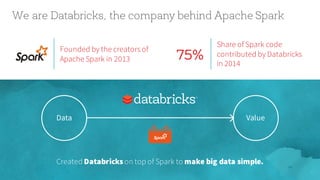
We are Databricks, the company behind Apache Spark
Founded by the creators of
Apache Spark in 2013
Share of Spark code
contributed by Databricks
in 2014
75%
4
Data Value
Created Databricks on top of Spark to make big data simple.
…
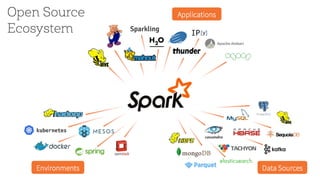
Apache Spark Engine
Spark Core
Spark
Streaming
Spark SQL MLlib GraphX
Unified engineacross diverse workloads & environments
Scale out, fault tolerant
Python, Java, Scala, and R
APIs
Standard libraries
NOTABL E USERS THAT PRESENTED AT SPARK SUMMIT
2 0 1 5 SAN F RANCISCO
Source: Slide5ofSparkCommunityUpdate
Machine Learning: What and Why?
What: ML usesdata to identify patterns and make decisions.
Why: Thecore value of ML is automated decision making.
• Especially important when dealing with TB or PB of data
Many use cases, including:
• Marketing and advertising optimization
• Security monitoring /fraud detection
• Operational optimizations
Why Spark MLlib
Provide generalpurposeML algorithms on top of Spark
• Hide complexity of distributing data & queries,and scaling
• Leverage Spark improvements(DataFrames, Tungsten, Datasets)
Advantages of MLlib’s design:
• Simplicity
• Scalability
• Streamlined end-to-end
• Compatibility
Spark scales well
Largest cluster:
8000 Nodes (Tencent)
Largest single job:
1 PB (Alibaba, Databricks)
Top Streaming Intake:
1 TB/hour (HHMI
Janelia Farm)
2014 On-Disk Sort Record
Fastest Open Source Engine
for sorting a PB
Machine Learning highlights
Source: Why you should use Sparkfor Machine Learning
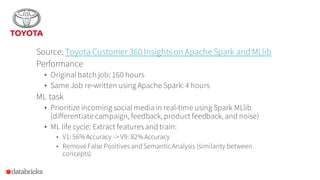
Source: Toyota Customer 360 Insightson Apache Spark and MLlib
Performance
• Original batch job: 160 hours
• Same Job re-written using Apache Spark: 4 hours
ML task
• Prioritize incoming social media in real-time using Spark MLlib
(differentiate campaign, feedback, product feedback, and noise)
• ML life cycle: Extract features and train:
• V1: 56%Accuracy ->V9: 82%Accuracy
• RemoveFalse Positives andSemanticAnalysis (similarity between
concepts)
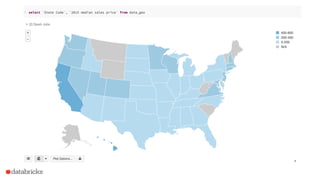
Example analysis:
Population vs. housing price
Links
Simplifying Machine Learning with Databricks Blog Post
Population vs. Price Multi-chart SparkSQL Notebook
Population vs. Price Linear Regression Python Notebook
Scatterplot
import numpy as np
import matplotlib.pyplot as plt
x = data.map(lambda p:
(p.features[0])).collect()
y = data.map(lambda p:
(p.label)).collect()
from pandas import *
from ggplot import *
pydf = DataFrame({'pop':x,'price':y})
p = ggplot(pydf, aes('pop','price')) + 
geom_point(color='blue')
display(p)
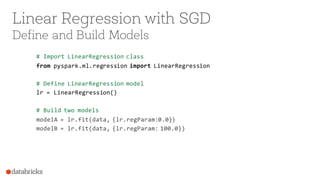
Linear Regression with SGD
Define and Build Models
# Import LinearRegression class
from pyspark.ml.regression import LinearRegression
# Define LinearRegression model
lr = LinearRegression()
# Build two models
modelA = lr.fit(data, {lr.regParam:0.0})
modelB = lr.fit(data, {lr.regParam: 100.0})
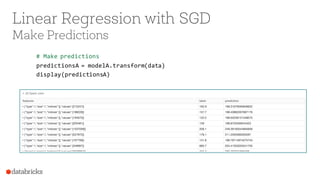
Linear Regression with SGD
Make Predictions
# Make predictions
predictionsA = modelA.transform(data)
display(predictionsA)
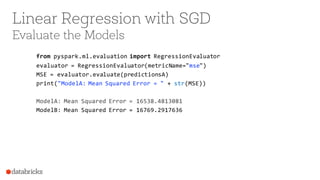
Linear Regression with SGD
Evaluate the Models
from pyspark.ml.evaluation import RegressionEvaluator
evaluator = RegressionEvaluator(metricName="mse")
MSE = evaluator.evaluate(predictionsA)
print("ModelA: Mean Squared Error = " + str(MSE))
ModelA: Mean Squared Error = 16538.4813081
ModelB: Mean Squared Error = 16769.2917636
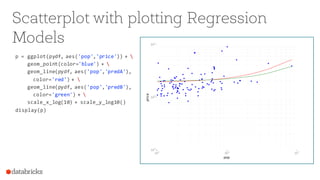
Scatterplot with plotting Regression
Models
p = ggplot(pydf, aes('pop','price')) + 
geom_point(color='blue') + 
geom_line(pydf, aes('pop','predA'),
color='red') + 
geom_line(pydf, aes('pop','predB'),
color='green') + 
scale_x_log(10) + scale_y_log10()
display(p)
Learning more about MLlib
Guides & examples
• Example workflow using ML Pipelines (Python)
• Power plant data analysis workflow (Scala)
• The above 2 links are part of the Databricks Guide, which contains
many more examples and references.
References
• Apache Spark MLlib User Guide
• The MLlib User Guide containscodesnippetsfor almost all algorithms, as wellas
links to API documentation.
• Meng et al. “MLlib: Machine Learning in Apache Spark.” 2015.
http://arxiv.org/abs/1505.06807 (academic paper)
21
Combining the Strengths
of MLlib, scikit-learn, & R
23
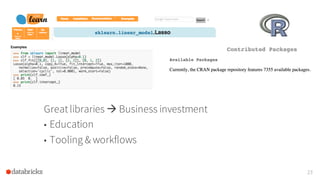
Greatlibraries à Business investment
• Education
• Tooling & workflows
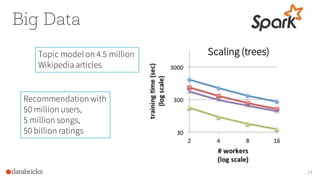
Big Data
24
Scaling (trees)Topic model on 4.5 million
Wikipedia articles
Recommendation with
50 million users,
5 million songs,
50 billion ratings
Big Data & MLlib
• More data à higher accuracy
• Scalewith business (# users,available data)
• Integrate with production systems
25
Bridging the gap
How do you get from a single-machine workload
to a distributed one?
26
At school: Machine Learning with R on my laptop
The Goal: Machine Learning on a huge computing cluster
Wish list
• Run original code on a production environment
• Use distributed data sources
• Distribute ML workload piece by piece
• Use familiar algorithms & APIs
27
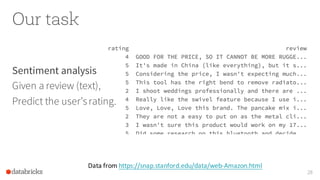
Our task
28
Sentiment analysis
Given a review (text),
Predict the user’srating.
Data	from	https://snap.stanford.edu/data/web-Amazon.html
Our ML workflow
29
Text
This scarf I
bought is
very strange.
When I ...
Label
Rating = 3.0
Tokenizer
Words
[This,
scarf,
I,
bought,
...]
Hashing
Term-Freq
Features
[2.0,
0.0,
3.0,
...]
Linear
Regression
Prediction
Rating = 2.7
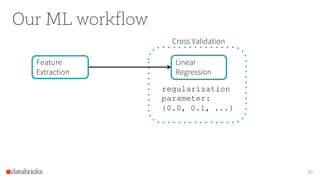
Our ML workflow
30
Cross Validation
Linear
Regression
Feature
Extraction
regularization
parameter:
{0.0, 0.1, ...}
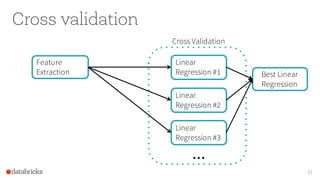
Cross validation
31
Cross Validation
...
Best Linear
Regression
Linear
Regression #1
Linear
Regression #2
Feature
Extraction
Linear
Regression #3
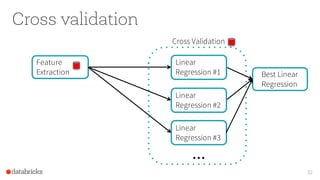
Cross validation
32
Cross Validation
...
Best Linear
Regression
Linear
Regression #1
Linear
Regression #2
Feature
Extraction
Linear
Regression #3
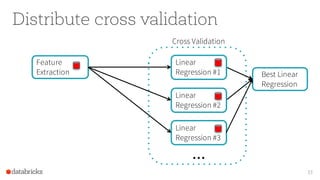
Distribute cross validation
33
Cross Validation
...
Best Linear
Regression
Linear
Regression #1
Linear
Regression #2
Feature
Extraction
Linear
Regression #3
Repeating this at home
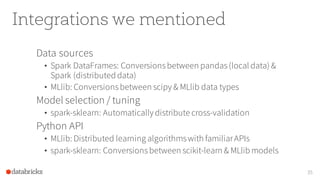
This demo used:
• Spark 1.6
• spark-sklearn (on Spark Packages) (on PyPi)
The notebookfrom the demo is available here:
• sklearn integration
• MLlib + sklearn: Distribute Everything!
The Amazon Reviews data20K and test4K datasets were created and can be used within the
databricks-datasets with permission from Professor Julian McAuley @ UCSD.
Source: Image-based recommendations onstyles and substitutes.J.McAuley,C. Targett, J. Shi,
A. van den Hengel.SIGIR, 2015.
34
Integrations we mentioned
Data sources
• Spark DataFrames: Conversionsbetween pandas(local data) &
Spark (distributed data)
• MLlib: Conversionsbetween scipy & MLlib data types
Model selection / tuning
• spark-sklearn: Automatically distribute cross-validation
Python API
• MLlib: Distributed learning algorithmswith familiarAPIs
• spark-sklearn: Conversionsbetween scikit-learn & MLlib models
35
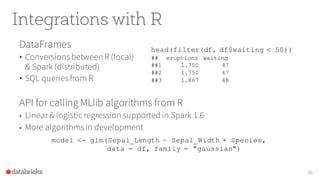
Integrations with R
DataFrames
• Conversionsbetween R(local)
& Spark (distributed)
• SQL queriesfrom R
36
model <- glm(Sepal_Length ~ Sepal_Width + Species,
data = df, family = "gaussian")
head(filter(df, df$waiting < 50))
## eruptions waiting
##1 1.750 47
##2 1.750 47
##3 1.867 48
API for calling MLlib algorithms from R
• Linear & logistic regression supported in Spark 1.6
• More algorithmsin development
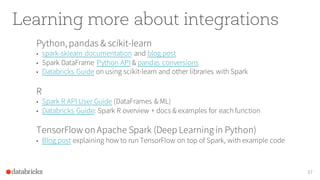
Learning more about integrations
Python,pandas & scikit-learn
• spark-sklearn documentation and blog post
• Spark DataFrame Python API & pandas conversions
• Databricks Guide on using scikit-learn and other libraries with Spark
R
• Spark R API User Guide (DataFrames & ML)
• Databricks Guide: Spark R overview + docs & examples for each function
TensorFlow onApache Spark (Deep Learningin Python)
• Blog post explaining how to run TensorFlow on top of Spark, with example code
37
MLlib roadmap highlights
Workflow
• Simplify building and customizing ML Pipelines.
Key models
• Improve inspection for generalized linear models (linear & logistic
regression).
Language APIs
• Support Pipeline persistence (saving & loading Pipelines and Models)
in the Python API.
Spark 2.0RoadmapJIRA: https://issues.apache.org/jira/browse/SPARK-12626
More resources
• Databricks Guide
• ApacheSpark User Guide
• Databricks Community Forum
• Training courses:public classes,MOOCs, & private training
• Databricks Community Edition: Free hosted Apache Spark.
Join the waitlist for the beta release!
39
Thanks!

Apache® Spark™ MLlib: From Quick Start to Scikit-Learn

  • 1.
    Apache® Spark™ MLlib: FromQuick Start to Scikit-Learn Joseph K. Bradley February 24th, 2016
  • 2.
    About the speaker:Joseph Bradley Joseph Bradley is a Software Engineerand Apache Spark Committer working on MLlib at Databricks. Previously,he was a postdoc at UC Berkeley after receiving hisPh.D. in Machine Learning from Carnegie Mellon U. in 2013.Hisresearch included probabilistic graphical models,parallel sparse regression,and aggregation mechanismsfor peer grading in MOOCs. 2
  • 3.
    About the moderator:Denny Lee Denny Lee is a Technology Evangelistwith Databricks; he is a hands-on data sciencesengineer with more than 15 years of experience developing internet-scale infrastructure, data platforms, and distributed systems for both on-premisesand cloud. Prior to joining Databricks, Denny worked as a SeniorDirector of Data SciencesEngineering at Concur and was part of the incubation teamthat builtHadoop on Windowsand Azure (currently known as HDInsight). 3
  • 4.
    We are Databricks,the company behind Apache Spark Founded by the creators of Apache Spark in 2013 Share of Spark code contributed by Databricks in 2014 75% 4 Data Value Created Databricks on top of Spark to make big data simple.
  • 5.
    … Apache Spark Engine SparkCore Spark Streaming Spark SQL MLlib GraphX Unified engineacross diverse workloads & environments Scale out, fault tolerant Python, Java, Scala, and R APIs Standard libraries
  • 7.
    NOTABL E USERSTHAT PRESENTED AT SPARK SUMMIT 2 0 1 5 SAN F RANCISCO Source: Slide5ofSparkCommunityUpdate
  • 8.
    Machine Learning: Whatand Why? What: ML usesdata to identify patterns and make decisions. Why: Thecore value of ML is automated decision making. • Especially important when dealing with TB or PB of data Many use cases, including: • Marketing and advertising optimization • Security monitoring /fraud detection • Operational optimizations
  • 9.
    Why Spark MLlib ProvidegeneralpurposeML algorithms on top of Spark • Hide complexity of distributing data & queries,and scaling • Leverage Spark improvements(DataFrames, Tungsten, Datasets) Advantages of MLlib’s design: • Simplicity • Scalability • Streamlined end-to-end • Compatibility
  • 10.
    Spark scales well Largestcluster: 8000 Nodes (Tencent) Largest single job: 1 PB (Alibaba, Databricks) Top Streaming Intake: 1 TB/hour (HHMI Janelia Farm) 2014 On-Disk Sort Record Fastest Open Source Engine for sorting a PB
  • 11.
    Machine Learning highlights Source:Why you should use Sparkfor Machine Learning
  • 12.
    Source: Toyota Customer360 Insightson Apache Spark and MLlib Performance • Original batch job: 160 hours • Same Job re-written using Apache Spark: 4 hours ML task • Prioritize incoming social media in real-time using Spark MLlib (differentiate campaign, feedback, product feedback, and noise) • ML life cycle: Extract features and train: • V1: 56%Accuracy ->V9: 82%Accuracy • RemoveFalse Positives andSemanticAnalysis (similarity between concepts)
  • 13.
    Example analysis: Population vs.housing price Links Simplifying Machine Learning with Databricks Blog Post Population vs. Price Multi-chart SparkSQL Notebook Population vs. Price Linear Regression Python Notebook
  • 16.
    Scatterplot import numpy asnp import matplotlib.pyplot as plt x = data.map(lambda p: (p.features[0])).collect() y = data.map(lambda p: (p.label)).collect() from pandas import * from ggplot import * pydf = DataFrame({'pop':x,'price':y}) p = ggplot(pydf, aes('pop','price')) + geom_point(color='blue') display(p)
  • 17.
    Linear Regression withSGD Define and Build Models # Import LinearRegression class from pyspark.ml.regression import LinearRegression # Define LinearRegression model lr = LinearRegression() # Build two models modelA = lr.fit(data, {lr.regParam:0.0}) modelB = lr.fit(data, {lr.regParam: 100.0})
  • 18.
    Linear Regression withSGD Make Predictions # Make predictions predictionsA = modelA.transform(data) display(predictionsA)
  • 19.
    Linear Regression withSGD Evaluate the Models from pyspark.ml.evaluation import RegressionEvaluator evaluator = RegressionEvaluator(metricName="mse") MSE = evaluator.evaluate(predictionsA) print("ModelA: Mean Squared Error = " + str(MSE)) ModelA: Mean Squared Error = 16538.4813081 ModelB: Mean Squared Error = 16769.2917636
  • 20.
    Scatterplot with plottingRegression Models p = ggplot(pydf, aes('pop','price')) + geom_point(color='blue') + geom_line(pydf, aes('pop','predA'), color='red') + geom_line(pydf, aes('pop','predB'), color='green') + scale_x_log(10) + scale_y_log10() display(p)
  • 21.
    Learning more aboutMLlib Guides & examples • Example workflow using ML Pipelines (Python) • Power plant data analysis workflow (Scala) • The above 2 links are part of the Databricks Guide, which contains many more examples and references. References • Apache Spark MLlib User Guide • The MLlib User Guide containscodesnippetsfor almost all algorithms, as wellas links to API documentation. • Meng et al. “MLlib: Machine Learning in Apache Spark.” 2015. http://arxiv.org/abs/1505.06807 (academic paper) 21
  • 22.
    Combining the Strengths ofMLlib, scikit-learn, & R
  • 23.
    23 Greatlibraries à Businessinvestment • Education • Tooling & workflows
  • 24.
    Big Data 24 Scaling (trees)Topicmodel on 4.5 million Wikipedia articles Recommendation with 50 million users, 5 million songs, 50 billion ratings
  • 25.
    Big Data &MLlib • More data à higher accuracy • Scalewith business (# users,available data) • Integrate with production systems 25
  • 26.
    Bridging the gap Howdo you get from a single-machine workload to a distributed one? 26 At school: Machine Learning with R on my laptop The Goal: Machine Learning on a huge computing cluster
  • 27.
    Wish list • Runoriginal code on a production environment • Use distributed data sources • Distribute ML workload piece by piece • Use familiar algorithms & APIs 27
  • 28.
    Our task 28 Sentiment analysis Givena review (text), Predict the user’srating. Data from https://snap.stanford.edu/data/web-Amazon.html
  • 29.
    Our ML workflow 29 Text Thisscarf I bought is very strange. When I ... Label Rating = 3.0 Tokenizer Words [This, scarf, I, bought, ...] Hashing Term-Freq Features [2.0, 0.0, 3.0, ...] Linear Regression Prediction Rating = 2.7
  • 30.
    Our ML workflow 30 CrossValidation Linear Regression Feature Extraction regularization parameter: {0.0, 0.1, ...}
  • 31.
    Cross validation 31 Cross Validation ... BestLinear Regression Linear Regression #1 Linear Regression #2 Feature Extraction Linear Regression #3
  • 32.
    Cross validation 32 Cross Validation ... BestLinear Regression Linear Regression #1 Linear Regression #2 Feature Extraction Linear Regression #3
  • 33.
    Distribute cross validation 33 CrossValidation ... Best Linear Regression Linear Regression #1 Linear Regression #2 Feature Extraction Linear Regression #3
  • 34.
    Repeating this athome This demo used: • Spark 1.6 • spark-sklearn (on Spark Packages) (on PyPi) The notebookfrom the demo is available here: • sklearn integration • MLlib + sklearn: Distribute Everything! The Amazon Reviews data20K and test4K datasets were created and can be used within the databricks-datasets with permission from Professor Julian McAuley @ UCSD. Source: Image-based recommendations onstyles and substitutes.J.McAuley,C. Targett, J. Shi, A. van den Hengel.SIGIR, 2015. 34
  • 35.
    Integrations we mentioned Datasources • Spark DataFrames: Conversionsbetween pandas(local data) & Spark (distributed data) • MLlib: Conversionsbetween scipy & MLlib data types Model selection / tuning • spark-sklearn: Automatically distribute cross-validation Python API • MLlib: Distributed learning algorithmswith familiarAPIs • spark-sklearn: Conversionsbetween scikit-learn & MLlib models 35
  • 36.
    Integrations with R DataFrames •Conversionsbetween R(local) & Spark (distributed) • SQL queriesfrom R 36 model <- glm(Sepal_Length ~ Sepal_Width + Species, data = df, family = "gaussian") head(filter(df, df$waiting < 50)) ## eruptions waiting ##1 1.750 47 ##2 1.750 47 ##3 1.867 48 API for calling MLlib algorithms from R • Linear & logistic regression supported in Spark 1.6 • More algorithmsin development
  • 37.
    Learning more aboutintegrations Python,pandas & scikit-learn • spark-sklearn documentation and blog post • Spark DataFrame Python API & pandas conversions • Databricks Guide on using scikit-learn and other libraries with Spark R • Spark R API User Guide (DataFrames & ML) • Databricks Guide: Spark R overview + docs & examples for each function TensorFlow onApache Spark (Deep Learningin Python) • Blog post explaining how to run TensorFlow on top of Spark, with example code 37
  • 38.
    MLlib roadmap highlights Workflow •Simplify building and customizing ML Pipelines. Key models • Improve inspection for generalized linear models (linear & logistic regression). Language APIs • Support Pipeline persistence (saving & loading Pipelines and Models) in the Python API. Spark 2.0RoadmapJIRA: https://issues.apache.org/jira/browse/SPARK-12626
  • 39.
    More resources • DatabricksGuide • ApacheSpark User Guide • Databricks Community Forum • Training courses:public classes,MOOCs, & private training • Databricks Community Edition: Free hosted Apache Spark. Join the waitlist for the beta release! 39
  • 40.