

The Data Lakehouse Symposium – February, 2022
Hosted by - Bill Inmon and DataBricks – Feb 1- 4, 2022
The Data Lakehouse Symposium – February, 2022
Text in the Data Lakehouse
David Rapien
Partner in ForestRim Technology
Associate Professor – Lindner College of Business
University of Cincinnati
Let’s Look at the Major Historical Changes in Data Collection, Storage, and Usage
• 1980’s - The Data Warehouse allowed us to hold a single version of the truth and make
enterprise wide decisions.
• 2010 - The Data Lake allowed us to collect all of our “data” in one place.
• 2020- The Data Lakehouse marries the two by adding governance and metadata to data
going into the Data Lake so that it can be separately transitioned into a Data Warehouse
AND consumed by decision makers and analysts.
Text in the
Data Lakehouse
Where is your company’s data focus?
• Data collection for “future use”?
• Business decisions?
• Analysis and research?
• We have none!
Text in the
Data Lakehouse
What types of data does your company collect and store?
• Transactional Data from customer interactions?
• Machine generated data?
• Emails, blogs, customer reviews, medical records, contracts?
• Images, videos, scans, audio files?
Text in the
Data Lakehouse
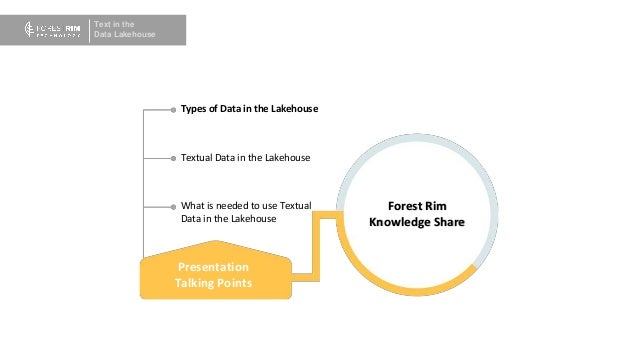
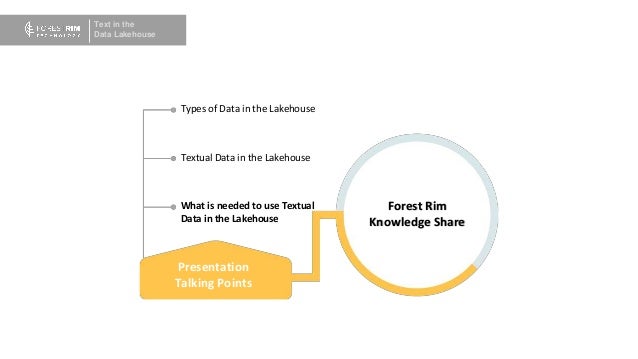
Presentation
Talking Points
Types of Data in the Lakehouse
Textual Data in the Lakehouse
What is needed to use Textual
Data in the Lakehouse
Forest Rim
Knowledge Share
Text in the
Data Lakehouse
What We will Discuss in Today’s Presentation
Presentation
Talking Points
Types of Data in the Lakehouse
Textual Data in the Lakehouse
What is needed to use Textual
Data in the Lakehouse
Forest Rim
Knowledge Share
Text in the
Data Lakehouse
Text in the
Data Lakehouse
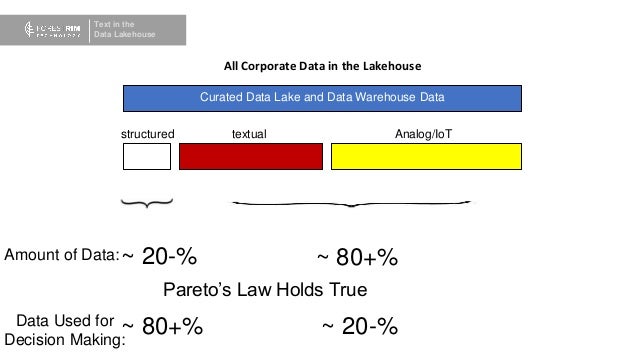
structured textual Analog/IoT
Curated Data Lake and Data Warehouse Data
All Corporate Data in the Lakehouse
~ 20-%
~ 80+%
Pareto’s Law Holds True
~ 80+%
Amount of Data:
Data Used for
Decision Making:
~ 20-%
Text in the
Data Lakehouse
All Corporate Data in the Lakehouse
structured textual Analog/IoT
~ 80-90% of business decisions are
made on less than 20% of the data.
Is there something wrong here?
Curated Data Lake and Data Warehouse Data
Text in the
Data Lakehouse
All Corporate Data in the Lakehouse
structured textual Analog/IoT
Data Warehouse Data
• Physical models
• Tables
• Aggregated
• Scrubbed
• Additional Metadata
• Additional Data Governance
Curated Data Lake and Data Warehouse Data
Text in the
Data Lakehouse
All Corporate Data in the Lakehouse
structured textual Analog/IoT
• Documents
• Emails
• Contracts
• Medical Records
• Voice of the Customer
• Insurance Claims
• Call Center …
• Other???
Curated Data Lake and Data Warehouse Data
Text in the
Data Lakehouse
All Corporate Data in the Lakehouse
structured textual Analog/IoT
• Status Data
• Automation Data
• Location Data
• Clickstreams
• Sensor Data
• Images
• Audio / Video files
Curated Data Lake and Data Warehouse Data
Text in the
Data Lakehouse
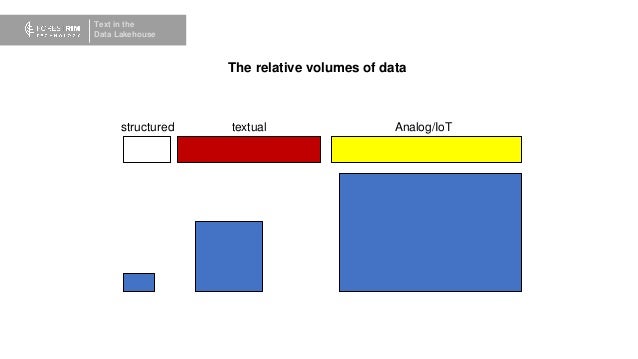
structured textual Analog/IoT
The relative volumes of data
Text in the
Data Lakehouse
structured textual Analog/IoT
The relative amount of business value to be found in the different sectors
Business value
Text in the
Data Lakehouse
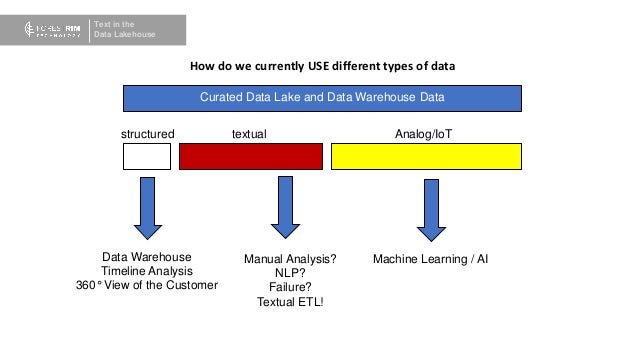
How do we currently USE different types of data
structured textual Analog/IoT
Data Warehouse
Timeline Analysis
360° View of the Customer
Curated Data Lake and Data Warehouse Data
Machine Learning / AI
Manual Analysis?
NLP?
Failure?
Textual ETL!
Presentation
Talking Points
Types of Data in the Lakehouse
Textual Data in the Lakehouse
What is needed to use Textual
Data in the Lakehouse
Forest Rim
Knowledge Share
Text in the
Data Lakehouse
Text in the
Data Lakehouse
What data you are missing in your analysis?
textual
Voice mails
Dictations
Transcriptions
PDFs
Word documents CSVs
Yelp Reviews
Parquet Files
Document scans
The voice of the customer
Real estate deeds/sales Internet
Insurance claims
Warranties
Emails Call center
Contracts
Medical records
Text in the
Data Lakehouse
What is similar about most of this textual data?
textual
It is stream of thought
It is different document by document
It does not have Primary Keys or Foreign Keys
It has little format
It is DIRTY DATA!
Text in the
Data Lakehouse
textual
structured
Why?
Because people do not write or talk the same way that
is found in the structured world
Keys
Attributes
Indexes
Physical models
“I was looking at the nice colored
sweater in the window. I wonder if
I could try it on….but
I don’t like the sleeve length…”
These worlds are incompatible.
In order to address text you need a completely different approach
The Issue: The modelling and design techniques that worked in the
Structured world do not work in the world of Text.
Think
About it:
Presentation
Talking Points
Types of Data in the Lakehouse
Textual Data in the Lakehouse
What is needed to use Textual
Data in the Lakehouse
Forest Rim
Knowledge Share
Text in the
Data Lakehouse
Text in the
Data Lakehouse
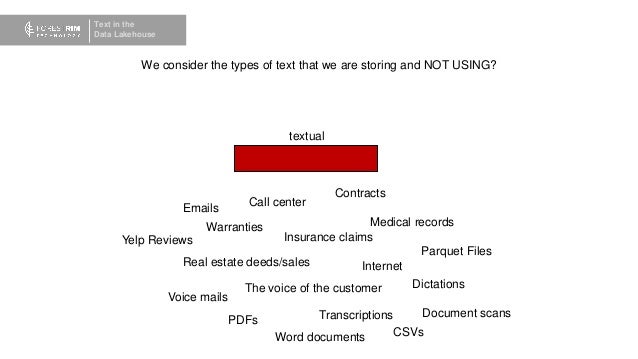
We consider the types of text that we are storing and NOT USING?
textual
Voice mails
Dictations
Transcriptions
PDFs
Word documents CSVs
Yelp Reviews
Parquet Files
Document scans
The voice of the customer
Real estate deeds/sales Internet
Insurance claims
Warranties
Emails Call center
Contracts
Medical records
Text in the
Data Lakehouse
You need to organize everything and convert each into a standard text format
textual
Voice mails
Dictations
Transcriptions
Audio Data
PDFs
Document scans
Mixed
CSVs
Yelp Reviews
Parquet files
The voice of the customer
Tabular Data
Word documents
Internet
Emails
Call center
General Documents
Real estate deeds/sales
Insurance claims
Warranties
Contracts
Medical records
“Some Format”
Transcription
(Dragon)
OCR and
Converters
Set “Textual”
Columns
Converters
and Formatters
Inline
Contextualization
USE:
Text in the
Data Lakehouse
textual
Transcription
(Dragon)
OCR and
Converters
Set “Textual”
Columns
Converters
and Formatters
Inline
Contextualization
Convert to a Common Textual Format
Now WHAT do we do with this data?
Text in the
Data Lakehouse
textual
Transcription
(Dragon)
OCR and
Converters
Set “Textual”
Columns
Converters
and Formatters
Inline
Contextualization
Common Textual Format
Deidentify – Redact Personal Data
Apply Context!
Text in the
Data Lakehouse
If you are going to address text you MUST have a handle on
both text AND context.
It is not sufficient to merely address text.
Text is relatively simple. Context is 90% of the battle.
textual
Furthermore, most of the context that is needed lies OUTSIDE of the text.
You can analyze the text until you are blue in the face
and never find the relevant context of the text
Text in the
Data Lakehouse
By Properly Applying Context
You can convert your Unstructured Textual Data into Structured Data!
textual
This allows you to use your Textual Data for Structured Analysis!
So what is the purpose of all of this?
Text in the
Data Lakehouse
What is Meant by “the Context” of Textual Data?
It has different meanings in different areas
Consider the word “Trust”
In Friendship – It is the ability to believe in the word and actions of another
In Finance – It is a legal vehicle used to pass and allocate assets to another
In Networking – It allows one computer to communicate and share with another
Text in the
Data Lakehouse
What is Meant by “the Context” of Textual Data?
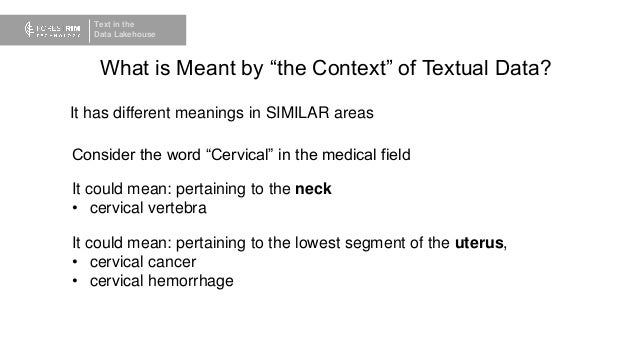
It has different meanings in SIMILAR areas
Consider the word “Cervical” in the medical field
It could mean: pertaining to the neck
• cervical vertebra
It could mean: pertaining to the lowest segment of the uterus,
• cervical cancer
• cervical hemorrhage
Text in the
Data Lakehouse
What is Meant by “the Context” of Textual Data?
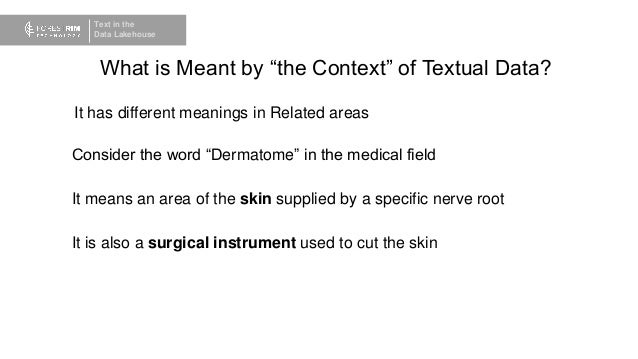
It has different meanings in Related areas
Consider the word “Dermatome” in the medical field
It means an area of the skin supplied by a specific nerve root
It is also a surgical instrument used to cut the skin
Text in the
Data Lakehouse
What is Meant by “Adding Context” to Textual Data?
It has different meanings in different areas
1. Extraction of key elements and phrases for categorization
2. Aggregation of terms into layered categories
3. Similar to Data Governance with Data Warehouse Data
• Requires subject matter experts
• Requires understanding of what dimensions you want for analysis
• Can be Highly Political between Departments
• It is controlled by BUSINESS, not IT or Data Analysts!
Text in the
Data Lakehouse
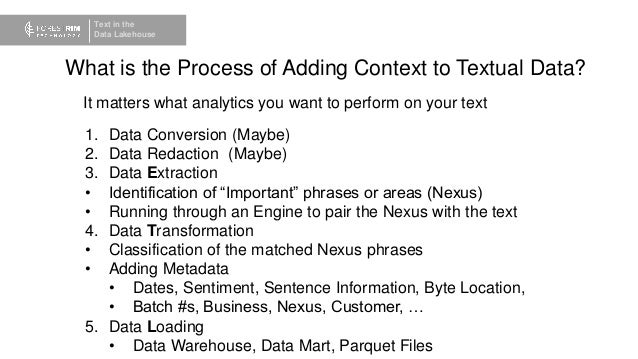
What is the Process of Adding Context to Textual Data?
It matters what analytics you want to perform on your text
1. Data Conversion (Maybe)
2. Data Redaction (Maybe)
3. Data Extraction
• Identification of “Important” phrases or areas (Nexus)
• Running through an Engine to pair the Nexus with the text
4. Data Transformation
• Classification of the matched Nexus phrases
• Adding Metadata
• Dates, Sentiment, Sentence Information, Byte Location,
• Batch #s, Business, Nexus, Customer, …
5. Data Loading
• Data Warehouse, Data Mart, Parquet Files
Text in the
Data Lakehouse
What Can Be Done with Contextualized Data?
We can do Structured Data Analysis
1. Document Markup
• Visually identifies parts of the document
2. Sentiment Analysis
• Gives feeling and degrees of feeling to parts of document
3. Inline Contextualization
• Reverse Mail Merge – Pull out set of terms that have value
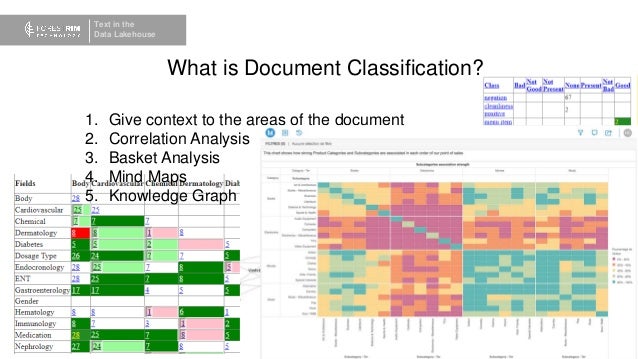
4. Document Classification
• Give context to the areas of the document for
correlation or basket analysis
Text in the
Data Lakehouse
What is Document Markup?
1. Data Visualization
• Color coded
• Draws the eyes
2. Used document by document
3. Great for “spot” review
4. Irrelevant and impractical for
analyzing Big Data
Text in the
Data Lakehouse
What is Sentiment Analysis?
1. Assigns Feeling to words
• Color coded
• Draws the eyes
2. Tries to identify and categorize
opinions stated in some text
3. Great for Comments
4. A BASIC requirement for
Voice of the Customer Analytics
Text in the
Data Lakehouse
What is Inline Contextualization?
1. Reverse Mail Merge
2. Pull out set of terms that have value
• Names
• Contract Dates
• Ratings
3. Useful for Contracts
4. Needed for Redaction
5. Needed for Document Separation
• Medical Visits
• Combined repeat visits
6. Needed for retrieval of grouped data
from blocks of text
Text in the
Data Lakehouse
What is Document Classification?
1. Give context to the areas of the document
2. Correlation Analysis
3. Basket Analysis
4. Mind Maps
5. Knowledge Graph
Text in the
Data Lakehouse
structured textual Analog/IoT
Data Warehouse
Curated Data Lake and Data Warehouse Data
Parquet Files
Review
There are many types of data in a Data Lakehouse
Textual ETL
Text in the
Data Lakehouse
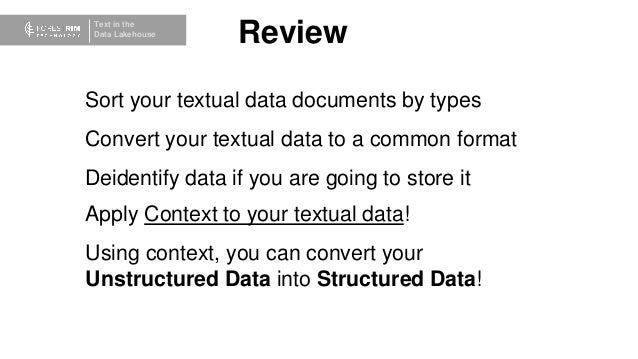
Using context, you can convert your
Unstructured Data into Structured Data!
Deidentify data if you are going to store it
Apply Context to your textual data!
Sort your textual data documents by types
Convert your textual data to a common format
Review
Text in the
Data Lakehouse
1. Document Markup
2. Sentiment Analysis
3. Inline Contextualization
4. Document Classification
5. Plus many others…
This conversion allows for Structured Data Analysis
Review
Text in the
Data Lakehouse
Questions
https://www.forestrimtech.com/
info@forestrimtech.com
Text in the
Data Lakehouse
• Bill Inmon – Slides and Conversations
• Inmon, B. (2021). Building The Data Lakehouse. Technics Publications LLC.
• https://www.snowflake.com/guides/what-iot
• https://medicalterminologyblog.com/homonyms-medical-language-2/
• Andrea and Amanda Rapien – Format and Additional Clarifying Material
References and Sources

Data Lakehouse Symposium | Day 2

  • 1.
    The Data LakehouseSymposium – February, 2022 Hosted by - Bill Inmon and DataBricks – Feb 1- 4, 2022
  • 2.
    The Data LakehouseSymposium – February, 2022 Text in the Data Lakehouse David Rapien Partner in ForestRim Technology Associate Professor – Lindner College of Business University of Cincinnati
  • 3.
    Let’s Look atthe Major Historical Changes in Data Collection, Storage, and Usage • 1980’s - The Data Warehouse allowed us to hold a single version of the truth and make enterprise wide decisions. • 2010 - The Data Lake allowed us to collect all of our “data” in one place. • 2020- The Data Lakehouse marries the two by adding governance and metadata to data going into the Data Lake so that it can be separately transitioned into a Data Warehouse AND consumed by decision makers and analysts. Text in the Data Lakehouse
  • 4.
    Where is yourcompany’s data focus? • Data collection for “future use”? • Business decisions? • Analysis and research? • We have none! Text in the Data Lakehouse
  • 5.
    What types ofdata does your company collect and store? • Transactional Data from customer interactions? • Machine generated data? • Emails, blogs, customer reviews, medical records, contracts? • Images, videos, scans, audio files? Text in the Data Lakehouse
  • 6.
    Presentation Talking Points Types ofData in the Lakehouse Textual Data in the Lakehouse What is needed to use Textual Data in the Lakehouse Forest Rim Knowledge Share Text in the Data Lakehouse What We will Discuss in Today’s Presentation
  • 7.
    Presentation Talking Points Types ofData in the Lakehouse Textual Data in the Lakehouse What is needed to use Textual Data in the Lakehouse Forest Rim Knowledge Share Text in the Data Lakehouse
  • 8.
    Text in the DataLakehouse structured textual Analog/IoT Curated Data Lake and Data Warehouse Data All Corporate Data in the Lakehouse ~ 20-% ~ 80+% Pareto’s Law Holds True ~ 80+% Amount of Data: Data Used for Decision Making: ~ 20-%
  • 9.
    Text in the DataLakehouse All Corporate Data in the Lakehouse structured textual Analog/IoT ~ 80-90% of business decisions are made on less than 20% of the data. Is there something wrong here? Curated Data Lake and Data Warehouse Data
  • 10.
    Text in the DataLakehouse All Corporate Data in the Lakehouse structured textual Analog/IoT Data Warehouse Data • Physical models • Tables • Aggregated • Scrubbed • Additional Metadata • Additional Data Governance Curated Data Lake and Data Warehouse Data
  • 11.
    Text in the DataLakehouse All Corporate Data in the Lakehouse structured textual Analog/IoT • Documents • Emails • Contracts • Medical Records • Voice of the Customer • Insurance Claims • Call Center … • Other??? Curated Data Lake and Data Warehouse Data
  • 12.
    Text in the DataLakehouse All Corporate Data in the Lakehouse structured textual Analog/IoT • Status Data • Automation Data • Location Data • Clickstreams • Sensor Data • Images • Audio / Video files Curated Data Lake and Data Warehouse Data
  • 13.
    Text in the DataLakehouse structured textual Analog/IoT The relative volumes of data
  • 14.
    Text in the DataLakehouse structured textual Analog/IoT The relative amount of business value to be found in the different sectors Business value
  • 15.
    Text in the DataLakehouse How do we currently USE different types of data structured textual Analog/IoT Data Warehouse Timeline Analysis 360° View of the Customer Curated Data Lake and Data Warehouse Data Machine Learning / AI Manual Analysis? NLP? Failure? Textual ETL!
  • 16.
    Presentation Talking Points Types ofData in the Lakehouse Textual Data in the Lakehouse What is needed to use Textual Data in the Lakehouse Forest Rim Knowledge Share Text in the Data Lakehouse
  • 17.
    Text in the DataLakehouse What data you are missing in your analysis? textual Voice mails Dictations Transcriptions PDFs Word documents CSVs Yelp Reviews Parquet Files Document scans The voice of the customer Real estate deeds/sales Internet Insurance claims Warranties Emails Call center Contracts Medical records
  • 18.
    Text in the DataLakehouse What is similar about most of this textual data? textual It is stream of thought It is different document by document It does not have Primary Keys or Foreign Keys It has little format It is DIRTY DATA!
  • 19.
    Text in the DataLakehouse textual structured Why? Because people do not write or talk the same way that is found in the structured world Keys Attributes Indexes Physical models “I was looking at the nice colored sweater in the window. I wonder if I could try it on….but I don’t like the sleeve length…” These worlds are incompatible. In order to address text you need a completely different approach The Issue: The modelling and design techniques that worked in the Structured world do not work in the world of Text. Think About it:
  • 20.
    Presentation Talking Points Types ofData in the Lakehouse Textual Data in the Lakehouse What is needed to use Textual Data in the Lakehouse Forest Rim Knowledge Share Text in the Data Lakehouse
  • 21.
    Text in the DataLakehouse We consider the types of text that we are storing and NOT USING? textual Voice mails Dictations Transcriptions PDFs Word documents CSVs Yelp Reviews Parquet Files Document scans The voice of the customer Real estate deeds/sales Internet Insurance claims Warranties Emails Call center Contracts Medical records
  • 22.
    Text in the DataLakehouse You need to organize everything and convert each into a standard text format textual Voice mails Dictations Transcriptions Audio Data PDFs Document scans Mixed CSVs Yelp Reviews Parquet files The voice of the customer Tabular Data Word documents Internet Emails Call center General Documents Real estate deeds/sales Insurance claims Warranties Contracts Medical records “Some Format” Transcription (Dragon) OCR and Converters Set “Textual” Columns Converters and Formatters Inline Contextualization USE:
  • 23.
    Text in the DataLakehouse textual Transcription (Dragon) OCR and Converters Set “Textual” Columns Converters and Formatters Inline Contextualization Convert to a Common Textual Format Now WHAT do we do with this data?
  • 24.
    Text in the DataLakehouse textual Transcription (Dragon) OCR and Converters Set “Textual” Columns Converters and Formatters Inline Contextualization Common Textual Format Deidentify – Redact Personal Data Apply Context!
  • 25.
    Text in the DataLakehouse If you are going to address text you MUST have a handle on both text AND context. It is not sufficient to merely address text. Text is relatively simple. Context is 90% of the battle. textual Furthermore, most of the context that is needed lies OUTSIDE of the text. You can analyze the text until you are blue in the face and never find the relevant context of the text
  • 26.
    Text in the DataLakehouse By Properly Applying Context You can convert your Unstructured Textual Data into Structured Data! textual This allows you to use your Textual Data for Structured Analysis! So what is the purpose of all of this?
  • 27.
    Text in the DataLakehouse What is Meant by “the Context” of Textual Data? It has different meanings in different areas Consider the word “Trust” In Friendship – It is the ability to believe in the word and actions of another In Finance – It is a legal vehicle used to pass and allocate assets to another In Networking – It allows one computer to communicate and share with another
  • 28.
    Text in the DataLakehouse What is Meant by “the Context” of Textual Data? It has different meanings in SIMILAR areas Consider the word “Cervical” in the medical field It could mean: pertaining to the neck • cervical vertebra It could mean: pertaining to the lowest segment of the uterus, • cervical cancer • cervical hemorrhage
  • 29.
    Text in the DataLakehouse What is Meant by “the Context” of Textual Data? It has different meanings in Related areas Consider the word “Dermatome” in the medical field It means an area of the skin supplied by a specific nerve root It is also a surgical instrument used to cut the skin
  • 30.
    Text in the DataLakehouse What is Meant by “Adding Context” to Textual Data? It has different meanings in different areas 1. Extraction of key elements and phrases for categorization 2. Aggregation of terms into layered categories 3. Similar to Data Governance with Data Warehouse Data • Requires subject matter experts • Requires understanding of what dimensions you want for analysis • Can be Highly Political between Departments • It is controlled by BUSINESS, not IT or Data Analysts!
  • 31.
    Text in the DataLakehouse What is the Process of Adding Context to Textual Data? It matters what analytics you want to perform on your text 1. Data Conversion (Maybe) 2. Data Redaction (Maybe) 3. Data Extraction • Identification of “Important” phrases or areas (Nexus) • Running through an Engine to pair the Nexus with the text 4. Data Transformation • Classification of the matched Nexus phrases • Adding Metadata • Dates, Sentiment, Sentence Information, Byte Location, • Batch #s, Business, Nexus, Customer, … 5. Data Loading • Data Warehouse, Data Mart, Parquet Files
  • 32.
    Text in the DataLakehouse What Can Be Done with Contextualized Data? We can do Structured Data Analysis 1. Document Markup • Visually identifies parts of the document 2. Sentiment Analysis • Gives feeling and degrees of feeling to parts of document 3. Inline Contextualization • Reverse Mail Merge – Pull out set of terms that have value 4. Document Classification • Give context to the areas of the document for correlation or basket analysis
  • 33.
    Text in the DataLakehouse What is Document Markup? 1. Data Visualization • Color coded • Draws the eyes 2. Used document by document 3. Great for “spot” review 4. Irrelevant and impractical for analyzing Big Data
  • 34.
    Text in the DataLakehouse What is Sentiment Analysis? 1. Assigns Feeling to words • Color coded • Draws the eyes 2. Tries to identify and categorize opinions stated in some text 3. Great for Comments 4. A BASIC requirement for Voice of the Customer Analytics
  • 35.
    Text in the DataLakehouse What is Inline Contextualization? 1. Reverse Mail Merge 2. Pull out set of terms that have value • Names • Contract Dates • Ratings 3. Useful for Contracts 4. Needed for Redaction 5. Needed for Document Separation • Medical Visits • Combined repeat visits 6. Needed for retrieval of grouped data from blocks of text
  • 36.
    Text in the DataLakehouse What is Document Classification? 1. Give context to the areas of the document 2. Correlation Analysis 3. Basket Analysis 4. Mind Maps 5. Knowledge Graph
  • 37.
    Text in the DataLakehouse structured textual Analog/IoT Data Warehouse Curated Data Lake and Data Warehouse Data Parquet Files Review There are many types of data in a Data Lakehouse Textual ETL
  • 38.
    Text in the DataLakehouse Using context, you can convert your Unstructured Data into Structured Data! Deidentify data if you are going to store it Apply Context to your textual data! Sort your textual data documents by types Convert your textual data to a common format Review
  • 39.
    Text in the DataLakehouse 1. Document Markup 2. Sentiment Analysis 3. Inline Contextualization 4. Document Classification 5. Plus many others… This conversion allows for Structured Data Analysis Review
  • 40.
    Text in the DataLakehouse Questions
  • 41.
  • 42.
    Text in the DataLakehouse • Bill Inmon – Slides and Conversations • Inmon, B. (2021). Building The Data Lakehouse. Technics Publications LLC. • https://www.snowflake.com/guides/what-iot • https://medicalterminologyblog.com/homonyms-medical-language-2/ • Andrea and Amanda Rapien – Format and Additional Clarifying Material References and Sources