

1.Kheni Jenil V.
2.Chaudhari Bhavin R.
3.Navadiya Dharmik V.
4.Patel Kevin U.
5.Mangukiya Hardik B.
Guided By : Prof. Raval Khushbu
Prof. Falguni Soneri
Angular Measurement
Compass
Bearing
Meridian
 Basic field operation performed by a surveyor
involve linear and angular measurements.
 Points on the ground or on map are related to
each other through a horizontal distance and a
horizontal angle (or direction).
 Horizontal angular measurement are made
between survey lines to determine the angle
between the lines.
 A horizontal angle is the difference between two
measured directions.
 Measurement of horizontal angle is required in
traverse surveying and other types of surveying.
 A survey line can only be plotted if its length and
direction both are known. So, it is necessary to
measure linear measurement (length) and angular
measurement (direction or horizontal angle) of a
survey line.
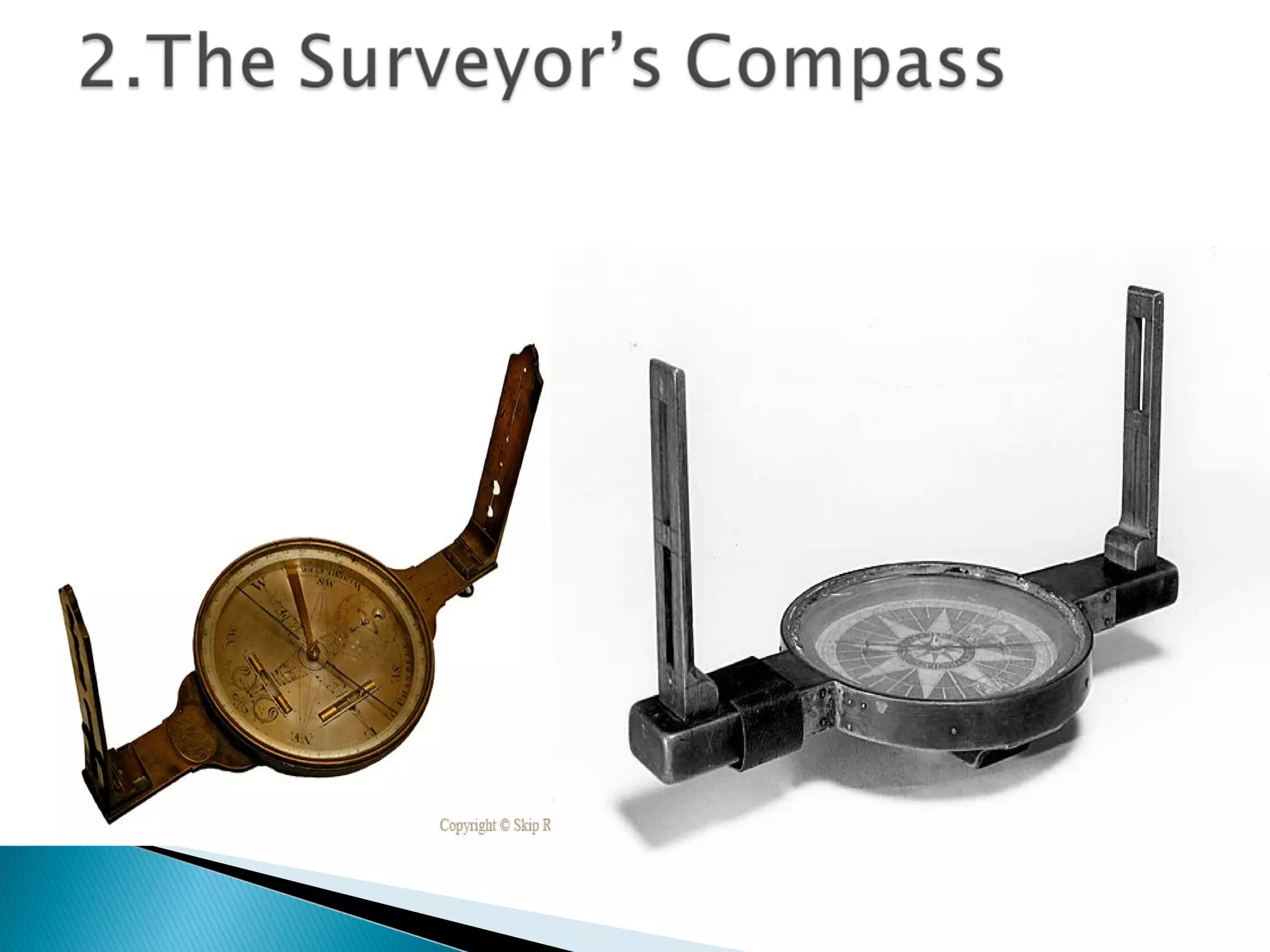
There are two types of compass.
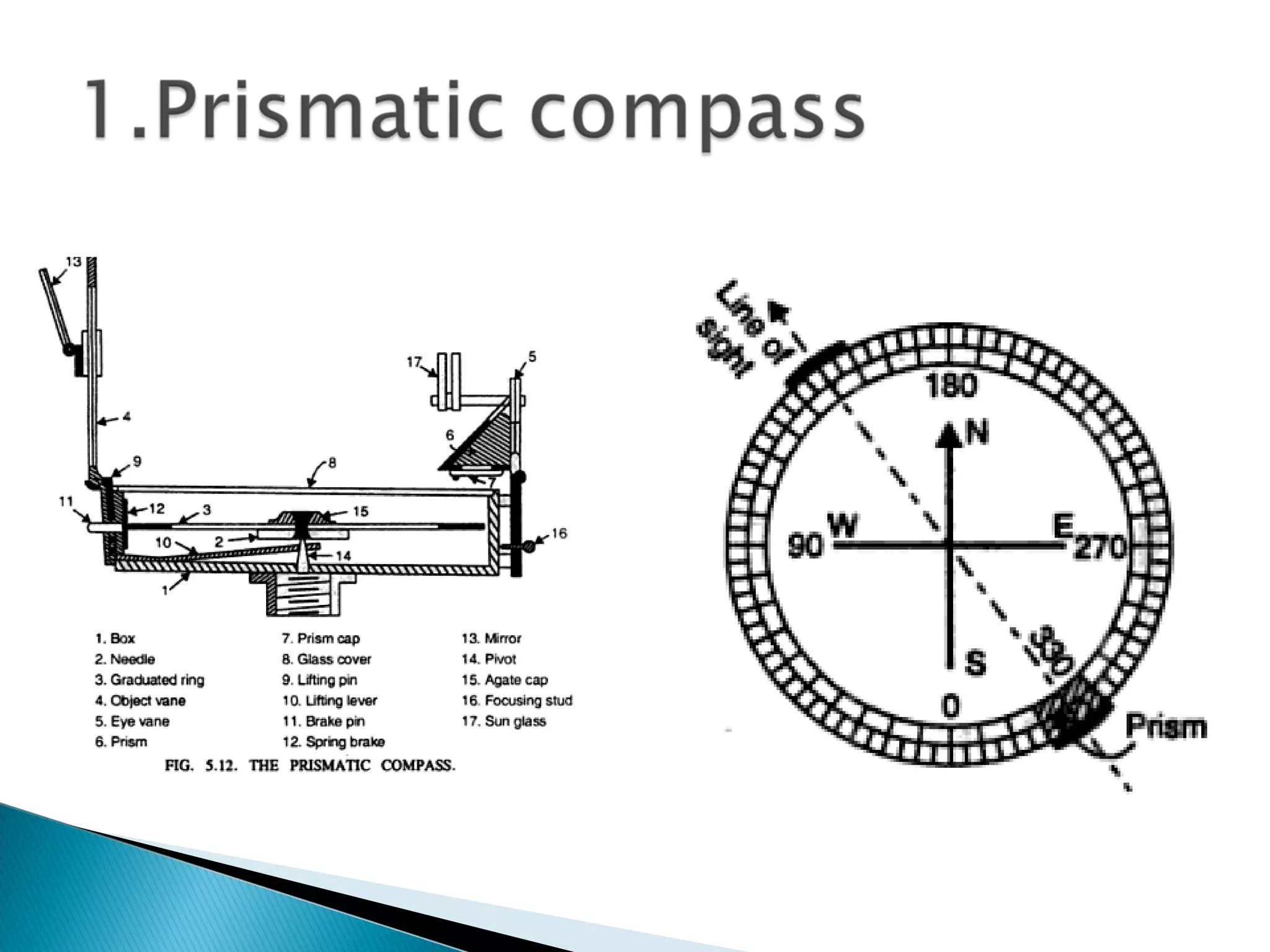
1. The Prismatic Compass
2. The Surveyor’s Compass
1. Cylindrical Metal Box
2. Pivot
3. Lifting Pin and Lifting Lever
4. Magnetic Needle
5. Graduated Circle or Ring
6. Prism
7. Object Vane
8. Eye Vane
9. Glass Cover
10. Sun Glasses
11. Reflecting Mirror
12. Spring Brake Pin
 When the needle of the compass is suspended freely, It
always points towards the north. Therefore, all the angles
measured with prismatic compass are with respect to north.
 While using the compass, it is usually mounted on a light
tripod which is having vertical spindle in the ball and socket
arrangement to which the compass is screwed. Its working
involves following three steps
 1.Centering
 2.Levelling
 3.Focusing
1. Circular Brass box
2. Pivot
3. Agate Cap
4. Magnetic Needle
5. Rider
6. Glass Cover
7. Sight Vane
8. Object Vane
9. Sliding Piece
10. Graduated Circle
11. Lifting Lever
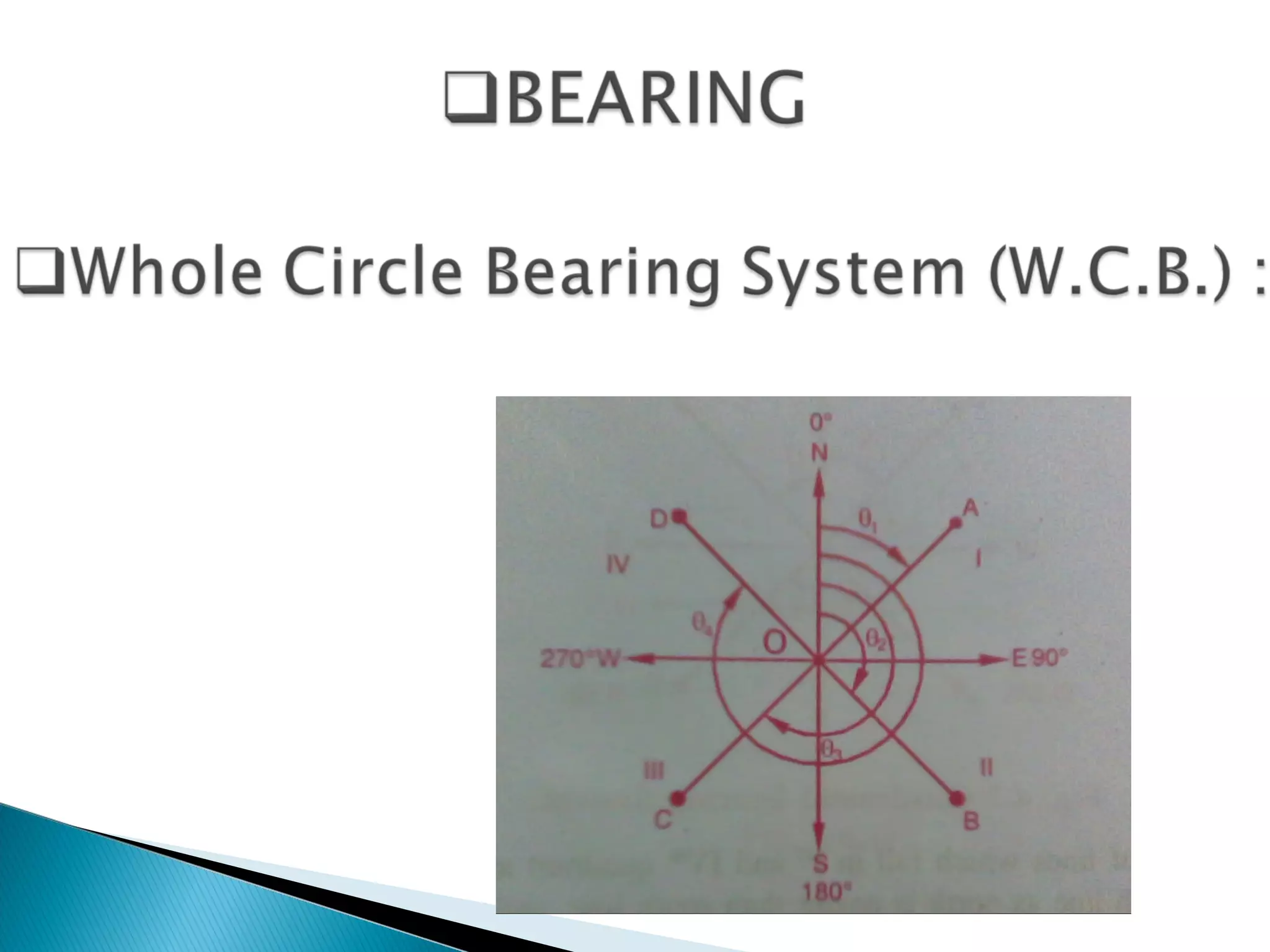
 When the bearing of a line is measured
with respect to magnetic north in
clockwise direction it is called magnetic
bearing or whole circle bearing.
 The value of W.C.B. varies from 0º to
360º.
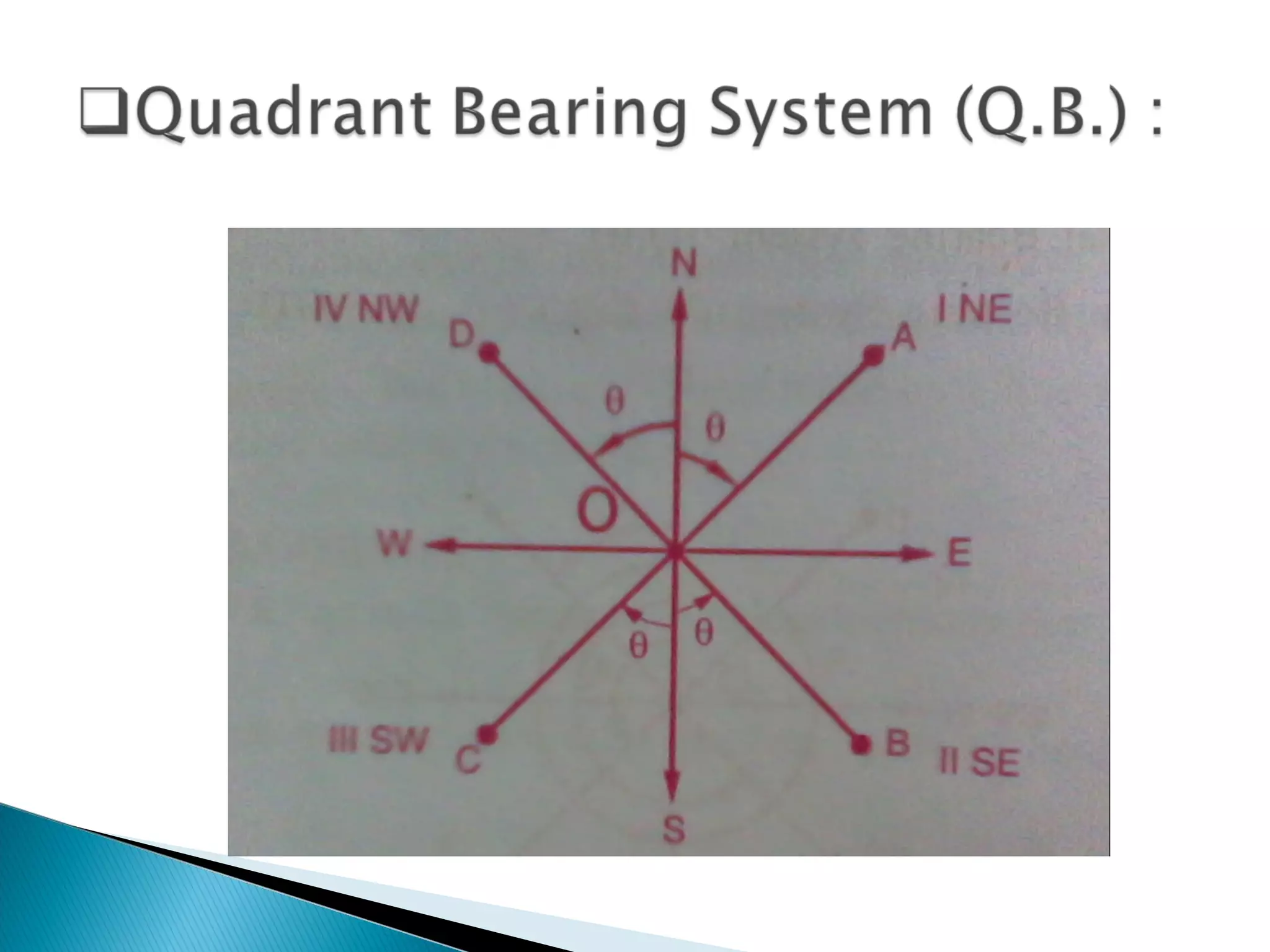
 In this system, the bearing of a survey
line is measured with respect to north or
south, in clockwise or anticlockwise
direction towards east or west.
 The value of Q.B. varies from 0º to 90º.
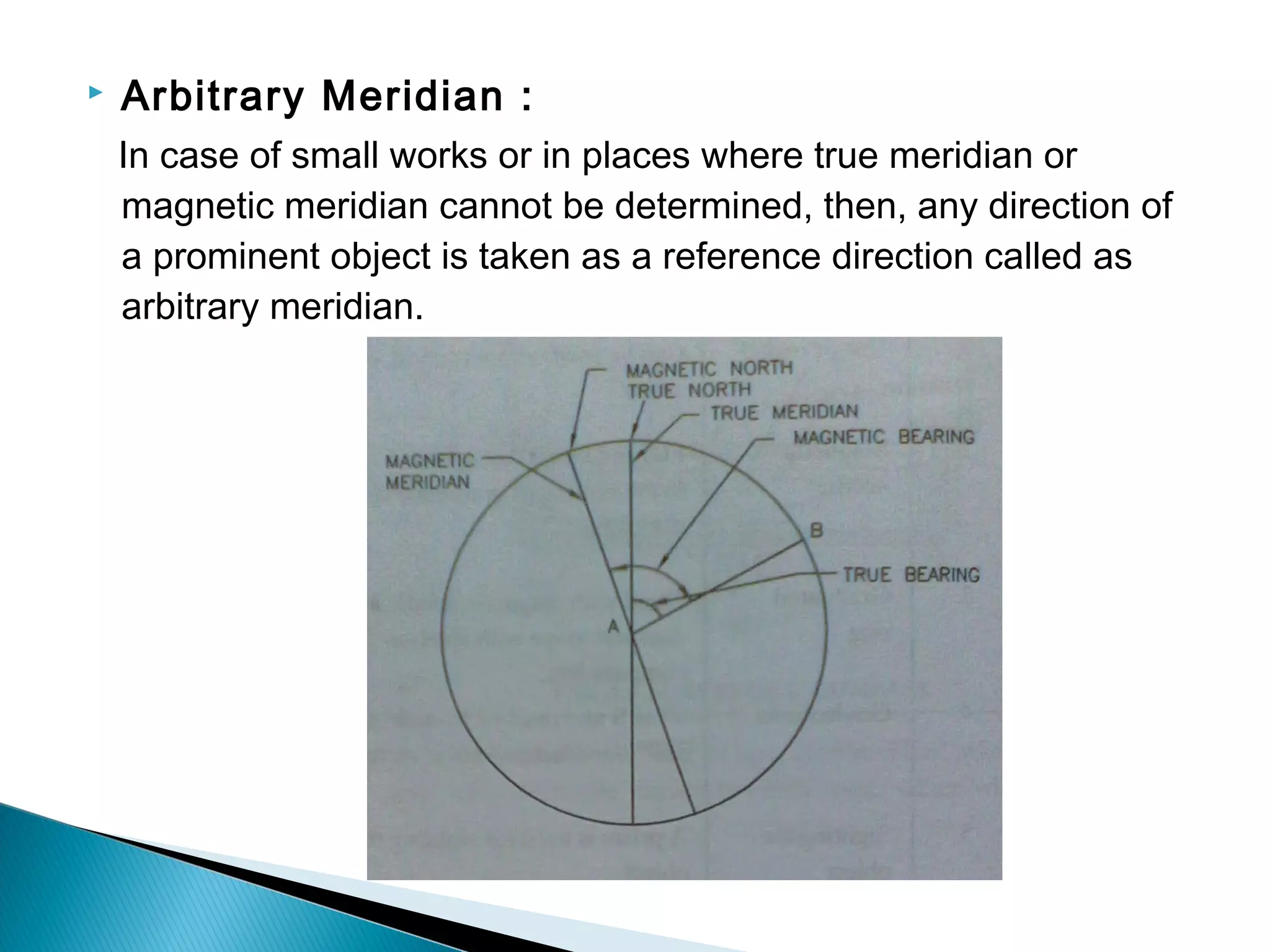
 True Bearing :
The true bearing of a line is the
horizontal angle between the true
meridian and the survey line. The true
bearing is measured from the true north in
the clockwise direction.
 Magnetic Bearing :
The magnetic bearing of a line is the
horizontal angle which the line makes with
the magnetic north.
 Grid Bearing :
The grid bearing of a line is the
horizontal angle which the line makes with
the grid meridian.
 Arbitrary Bearing :
The arbitrary bearing of a line is the
horizontal angle which the line makes with
the arbitrary meridian.
 Magnetic Meridian :
The direction shown by a freely suspended needle which is
magnetized and balanced properly without influenced by
any other factors is known as magnetic meridian.
 True Meridian :
True meridian is the which passes through the true north
and south. The direction of true meridian at any point can
be determined by either observing the bearing of the sun at
12 noon or by sun’s shadow.
 Arbitrary Meridian :
In case of small works or in places where true meridian or
magnetic meridian cannot be determined, then, any direction of
a prominent object is taken as a reference direction called as
arbitrary meridian.
Angular measurement for surveying

Angular measurement for surveying

  • 1.
    1.Kheni Jenil V. 2.ChaudhariBhavin R. 3.Navadiya Dharmik V. 4.Patel Kevin U. 5.Mangukiya Hardik B. Guided By : Prof. Raval Khushbu Prof. Falguni Soneri
  • 2.
  • 3.
     Basic fieldoperation performed by a surveyor involve linear and angular measurements.  Points on the ground or on map are related to each other through a horizontal distance and a horizontal angle (or direction).  Horizontal angular measurement are made between survey lines to determine the angle between the lines.
  • 4.
     A horizontalangle is the difference between two measured directions.  Measurement of horizontal angle is required in traverse surveying and other types of surveying.  A survey line can only be plotted if its length and direction both are known. So, it is necessary to measure linear measurement (length) and angular measurement (direction or horizontal angle) of a survey line.
  • 5.
    There are twotypes of compass. 1. The Prismatic Compass 2. The Surveyor’s Compass
  • 8.
    1. Cylindrical MetalBox 2. Pivot 3. Lifting Pin and Lifting Lever 4. Magnetic Needle 5. Graduated Circle or Ring 6. Prism 7. Object Vane 8. Eye Vane 9. Glass Cover 10. Sun Glasses 11. Reflecting Mirror 12. Spring Brake Pin
  • 9.
     When theneedle of the compass is suspended freely, It always points towards the north. Therefore, all the angles measured with prismatic compass are with respect to north.  While using the compass, it is usually mounted on a light tripod which is having vertical spindle in the ball and socket arrangement to which the compass is screwed. Its working involves following three steps  1.Centering  2.Levelling  3.Focusing
  • 11.
    1. Circular Brassbox 2. Pivot 3. Agate Cap 4. Magnetic Needle 5. Rider 6. Glass Cover 7. Sight Vane 8. Object Vane 9. Sliding Piece 10. Graduated Circle 11. Lifting Lever
  • 13.
     When thebearing of a line is measured with respect to magnetic north in clockwise direction it is called magnetic bearing or whole circle bearing.  The value of W.C.B. varies from 0º to 360º.
  • 15.
     In thissystem, the bearing of a survey line is measured with respect to north or south, in clockwise or anticlockwise direction towards east or west.  The value of Q.B. varies from 0º to 90º.
  • 16.
     True Bearing: The true bearing of a line is the horizontal angle between the true meridian and the survey line. The true bearing is measured from the true north in the clockwise direction.  Magnetic Bearing : The magnetic bearing of a line is the horizontal angle which the line makes with the magnetic north.
  • 17.
     Grid Bearing: The grid bearing of a line is the horizontal angle which the line makes with the grid meridian.  Arbitrary Bearing : The arbitrary bearing of a line is the horizontal angle which the line makes with the arbitrary meridian.
  • 18.
     Magnetic Meridian: The direction shown by a freely suspended needle which is magnetized and balanced properly without influenced by any other factors is known as magnetic meridian.  True Meridian : True meridian is the which passes through the true north and south. The direction of true meridian at any point can be determined by either observing the bearing of the sun at 12 noon or by sun’s shadow.
  • 19.
     Arbitrary Meridian: In case of small works or in places where true meridian or magnetic meridian cannot be determined, then, any direction of a prominent object is taken as a reference direction called as arbitrary meridian.