

2
CONTENTS
3
4
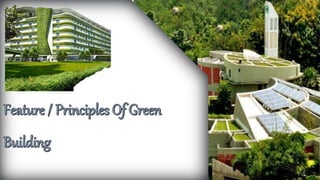
Sustainable Green Building
 Green building (also known as green construction, sustainable building)
expands & complements the building design concerns of economy,
utility, durability, & comfort.
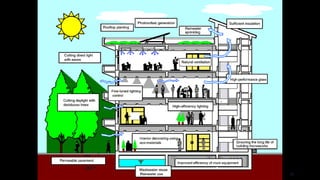
 A Green Building is one which uses less water, optimize energy
efficiency, conserves natural resources, generate less waste & provide
healthy environment to its users compare to conventional building.
5
Concept of Green Building
The design ideas coming from…...
 ...of our homes is fundamental to our quality of life, comfort & how
affordable they are to run,
 ...of our schools leaves a life-long imprint on those who learn within
them, influencing people concentration and how environmentally aware
the next generation.
6
Objective of Green Building
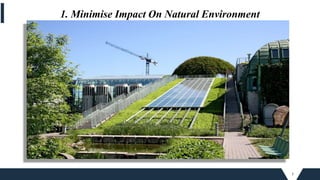
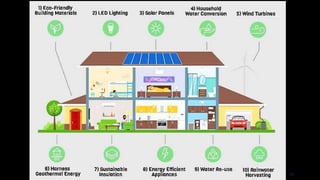
 Low Impact:- Minimize impact on natural environment
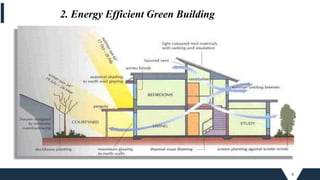
 Energy Efficient:- Reduced Energy usage and Water usage
 Healthy:- protect occupant health & increases productivity
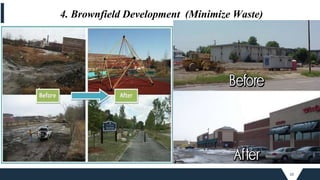
 Minimize waste:- Designed & constructed in a manner that minimize
waste, pollution, & environmental degradation.
7
1. Minimise Impact On Natural Environment
8
2. Energy Efficient Green Building
9
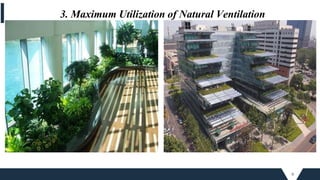
3. Maximum Utilization of Natural Ventilation
10
4. Brownfield Development (Minimize Waste)
12
Feature / Principles Of Green Building
Material efficiency
Sustainable Site Selection
Design efficiency
Occupant health & safety
Structural efficiency
Energy efficiency
Water efficiency
Waste efficiency
13
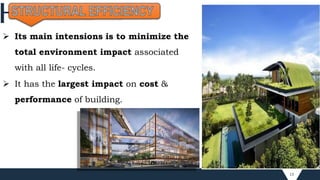
 Its main intensions is to minimize the
total environment impact associated
with all life- cycles.
 It has the largest impact on cost &
performance of building.
14
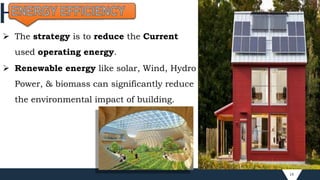
 The strategy is to reduce the Current
used operating energy.
 Renewable energy like solar, Wind, Hydro
Power, & biomass can significantly reduce
the environmental impact of building.
15
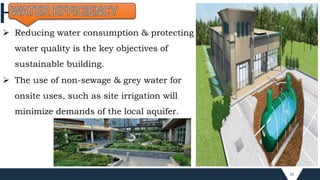
 Reducing water consumption & protecting
water quality is the key objectives of
sustainable building.
 The use of non-sewage & grey water for
onsite uses, such as site irrigation will
minimize demands of the local aquifer.
16
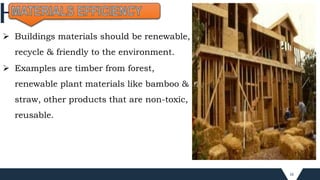
 Buildings materials should be renewable,
recycle & friendly to the environment.
 Examples are timber from forest,
renewable plant materials like bamboo &
straw, other products that are non-toxic,
reusable.
18
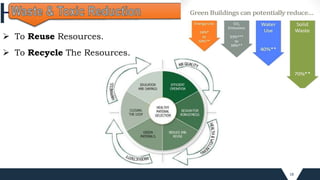
 To Reuse Resources.
 To Recycle The Resources.
20
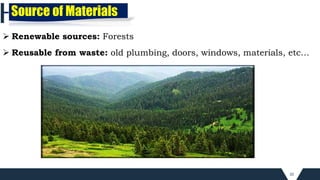
Source of Materials
 Renewable sources: Forests
 Reusable from waste: old plumbing, doors, windows, materials, etc…
21
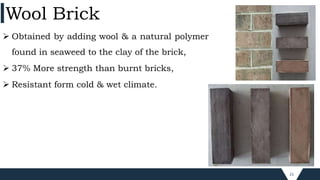
 Obtained by adding wool & a natural polymer
found in seaweed to the clay of the brick,
 37% More strength than burnt bricks,
 Resistant form cold & wet climate.
Wool Brick
22
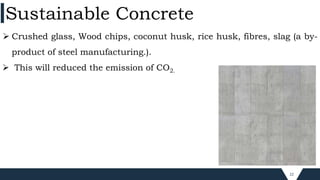
 Crushed glass, Wood chips, coconut husk, rice husk, fibres, slag (a by-
product of steel manufacturing.).
 This will reduced the emission of CO2.
Sustainable Concrete
23
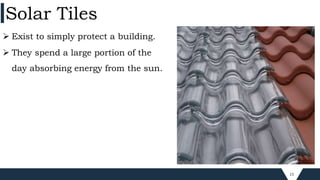
 Exist to simply protect a building.
 They spend a large portion of the
day absorbing energy from the sun.
Solar Tiles
24
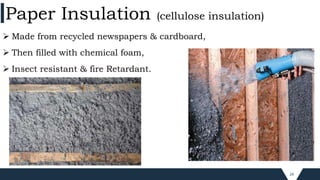
 Made from recycled newspapers & cardboard,
 Then filled with chemical foam,
 Insect resistant & fire Retardant.
Paper Insulation (cellulose insulation)
25
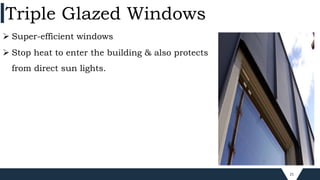
 Super-efficient windows
 Stop heat to enter the building & also protects
from direct sun lights.
Triple Glazed Windows
26
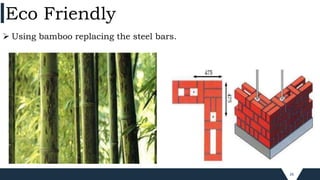
 Using bamboo replacing the steel bars.
Eco Friendly
28
29
31
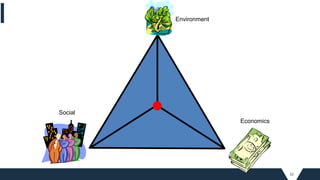
 Buildings have a large effect on the environment, human health & the
economy.
 The successful adoption of GREEN BUILDING development can
maximize the economic & environmental performance of the buildings.
 Protect biodiversity & ecosystems
 Improve air & water quality
 Conserve natural resources
 Reduce operating costs
 Create, expand, shape markets for green product & services.
 Improve occupant productivity
32
Environment
Social
Economics
34
• LEED [Leadership in Energy and Environmental Design]
• GRIHA [Green Rating for Integrated Habitat Assessment]
• TERI [The Energy and Resources Institute]
• ADaRSH [Association for Develop. & Research of Sustainable Habitats]
• MNRE [Ministry of New and Renewable Energy]
Government Agencies
35
 NATIONAL BUILDING CODE (NBC)
 THE BUREAU OF INDIAN STANDARDS (BIS)
 ENERGY CONSERVATION BUILDING CODE (ECBC)
 THE BUREAU OF ENERGY EFFICIENCY (BEE)
 ENVIRONMENTAL IMPACT ASSESSMENT (EIA)
 THE MINISTRY OF ENVIRONMENTAL &FORESTS (MoFE)
Green Building Policy & codes
37
 The objective of green building rating systems is to evaluate the
performance of green buildings.
 The performance of building evaluated based on following parameters
 Site planning
 Building envelope design
 Building system design (HVAC)
 Integration of renewable energy sources to generate energy @ site.
 Planning designing, construction and operation.
Green Building Rating Systems
38
39
 LEED INDIA: An Indian adaptation of LEED USA, by Indian green
building council [IGBC]
 TERI- GRIHA
 A National Rating System for Green Buildings developed by MNRE in
association with TERI.
Green Building Rating Systems in INDIA
40
 Indian Green Building Council (IGBC) provides LEED ratings to
structures in India.
 Each rating system divide in different level of certification as….
 ‘Certified’ to recognise best practices.
 ‘Silver’ to recognise outstanding performances.
 ‘Gold’ to recognise national excellence.
 ‘Platinum’ to recognise global leadership.
IGBC GREEN Buildings
41
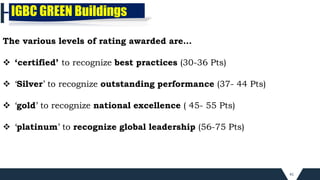
The various levels of rating awarded are…
 ‘certified’ to recognize best practices (30-36 Pts)
 ‘Silver’ to recognize outstanding performance (37- 44 Pts)
 ‘gold’ to recognize national excellence ( 45- 55 Pts)
 ‘platinum’ to recognize global leadership (56-75 Pts)
IGBC GREEN Buildings
42
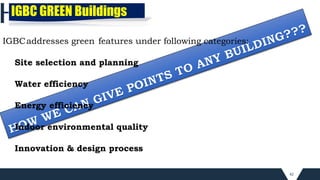
IGBCaddresses green features under following categories:
Site selection and planning
Water efficiency
Energy efficiency
Indoor environmental quality
Innovation & design process
IGBC GREEN Buildings
43
44
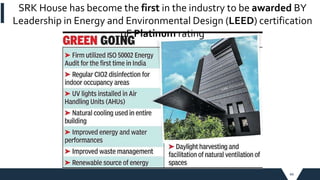
SRK House has become the first in the industry to be awarded BY
Leadership in Energy and Environmental Design (LEED) certification
oF Platinum rating
45
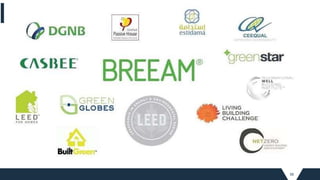
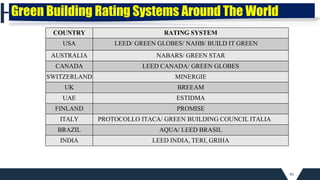
Green Building Rating Systems Around The World
COUNTRY RATING SYSTEM
USA LEED/ GREEN GLOBES/ NAHB/ BUILD IT GREEN
AUSTRALIA NABARS/ GREEN STAR
CANADA LEED CANADA/ GREEN GLOBES
SWITZERLAND MINERGIE
UK BREEAM
UAE ESTIDMA
FINLAND PROMISE
ITALY PROTOCOLLO ITACA/ GREEN BUILDING COUNCIL ITALIA
BRAZIL AQUA/ LEED BRASIL
INDIA LEED INDIA, TERI, GRIHA
46
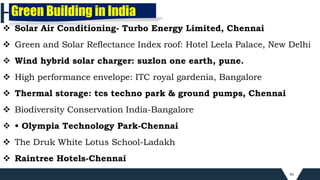
 Solar Air Conditioning- Turbo Energy Limited, Chennai
 Green and Solar Reflectance Index roof: Hotel Leela Palace, New Delhi
 Wind hybrid solar charger: suzlon one earth, pune.
 High performance envelope: ITC royal gardenia, Bangalore
 Thermal storage: tcs techno park & ground pumps, Chennai
 Biodiversity Conservation India-Bangalore
 • Olympia Technology Park-Chennai
 The Druk White Lotus School-Ladakh
 Raintree Hotels-Chennai
Green Building in India
47
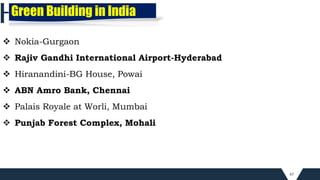
 Nokia-Gurgaon
 Rajiv Gandhi International Airport-Hyderabad
 Hiranandini-BG House, Powai
 ABN Amro Bank, Chennai
 Palais Royale at Worli, Mumbai
 Punjab Forest Complex, Mohali
Green Building in India
48
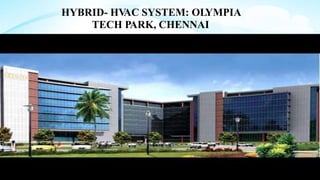
HYBRID- HV
AC SYSTEM: OLYMPIA
TECH PARK, CHENNAI
49
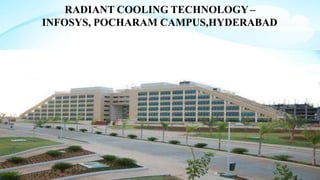
RADIANT COOLING TECHNOLOGY–
INFOSYS, POCHARAM CAMPUS,HYDERABAD
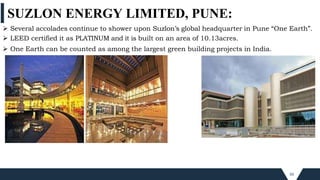
SUZLON ENERGY LIMITED, PUNE:
50
 Several accolades continue to shower upon Suzlon’s global headquarter in Pune “One Earth”.
 LEED certified it as PLATINUM and it is built on an area of 10.13acres.
 One Earth can be counted as among the largest green building projects in India.
51
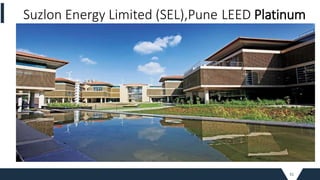
Suzlon Energy Limited (SEL),Pune LEED Platinum
52
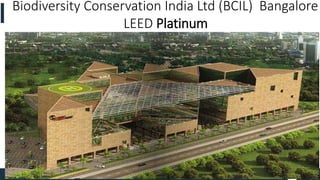
Biodiversity Conservation India Ltd (BCIL) Bangalore
LEED Platinum
53
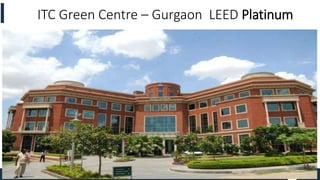
ITC Green Centre – Gurgaon LEED Platinum
54
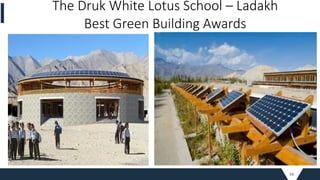
The Druk White Lotus School – Ladakh
Best Green Building Awards
55
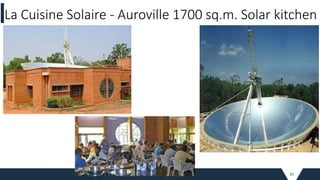
La Cuisine Solaire - Auroville 1700 sq.m. Solar kitchen
56
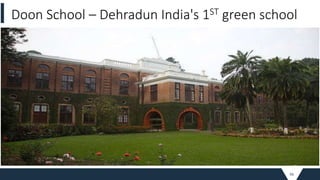
Doon School – Dehradun India's 1ST green school
57
Raintree Hotels – Chennai 1st Eco-sensitive Hotel In
India. [The entire chain]
58
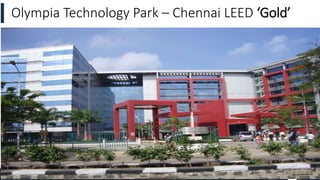
Olympia Technology Park – Chennai LEED ‘Gold’
59
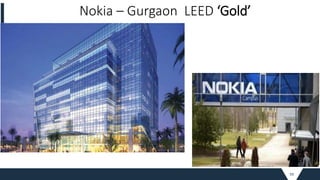
Nokia – Gurgaon LEED ‘Gold’
60
Rajiv Gandhi International Airport – ‘Silver’
61
Your mind is a garden. your thoughts are the seeds.
You can grow flowers or you can grow weeds..
62
63
DISASTER MANAGEMENT
64
DISASTER MANAGEMENT
65
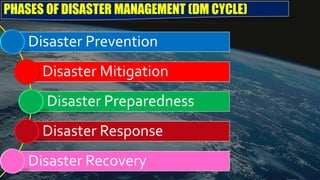
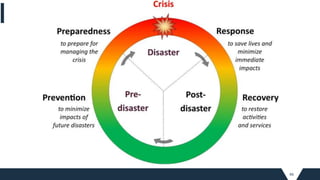
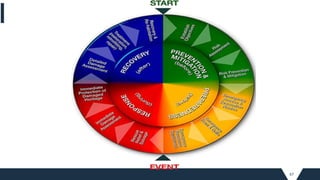
PHASES OF DISASTER MANAGEMENT (DM CYCLE)
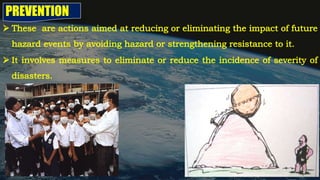
Disaster Prevention
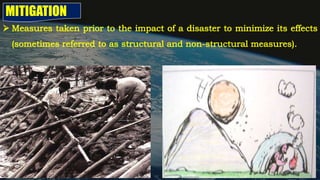
Disaster Mitigation
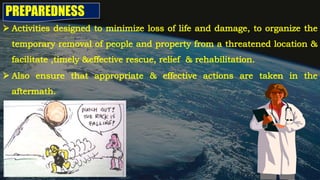
Disaster Preparedness
Disaster Response
Disaster Recovery
66
67
68
PREVENTION
69
MITIGATION
70
PREPAREDNESS
71
PREPAREDNESS [examples]
72
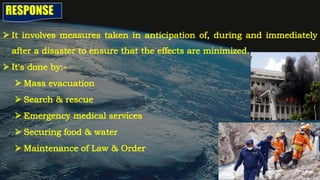
RESPONSE
73
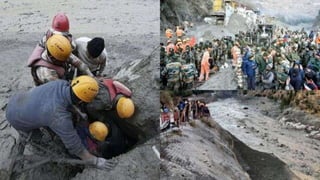
RESPONSE [examples]
75
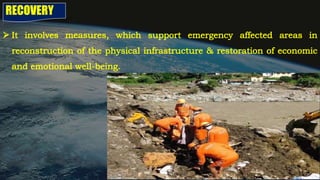
RECOVERY
76
RECOVERY [examples]
78
 Ministry of Water Resources [Central Water Commission] :- Floods, Drought
 Indian Meteorological Department :- Cyclones, heat waves, cold waves
 Indian Meteorological Department :- Earthquakes
 Ministry of Health and Family Welfare :- Epidemics
 Indian national center for oceanic information services :- Tsunami
 Ministry of Environment and Forests :- Chemical Disasters
 Ministry of Labor :- Industrial Disasters
 Ministry of Railways :- Rail Accidents
 Ministry of Civil Aviation :- Air Accidents
 Department of Atomic Energy :- Nuclear Incidents
[Ews]
80
EARLY WARNING SYSTEM
 a set of capacities needed to generate & disseminate timely &
meaningful warning information of the possible extreme events or
disasters (e.g. floods, drought, fire, earthquake and tsunamis) that
threatens people’s lives.
 The purpose of this information is to enable individuals, communities
and organizations threatened to prepare and
 Act appropriately and in sufficient time to reduce the possibility of
harm, loss or risk.
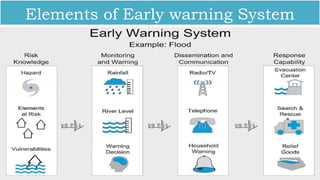
 Risk Knowledge: Risk assessment provides essential information to set priorities for
mitigation & prevention strategies & designing early warning systems.
 Monitoring & Predicting: its provide timely estimates of the potential risk faced by
communities, economies & the environment.
 Disseminating Information: Communication systems are needed for delivering warning
messages to the potentially affected locations to alert the regional governmental agencies.
The messages need to be reliable, simple to be understood by authorities & public.
 Response: Coordination, good governance & action plans are a key point in effective early
warning. Likewise, public awareness & education are critical aspects of disaster mitigation.
Elements of Early warning System
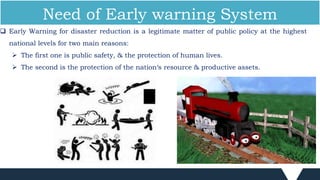
 Early Warning for disaster reduction is a legitimate matter of public policy at the highest
national levels for two main reasons:
 The first one is public safety, & the protection of human lives.
 The second is the protection of the nation‘s resource & productive assets.
Need of Early warning System
84
CYBER SECURITY
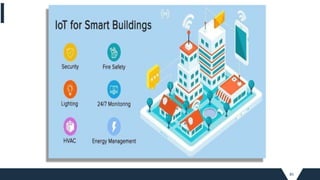
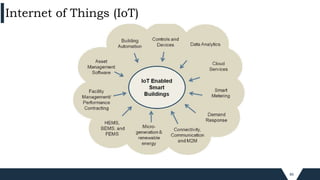
 Today’s smart buildings are increasingly enabled by Internet of Things
(IoT) and made functional by the ongoing convergence of Operational
Technology (OT) systems and Information Technology (IT) systems in
buildings.
 A host of new elements such as the cloud, remote access, data sharing
and analytics, and connected and shared networks has fundamentally
changed how built environments are being used and operated.
85
86
Internet of Things (IoT)
87
CYBER SECURITY
 However, buildings are exposed to a new threat that has been
downplayed and undervalued for a long time.
 After witnessing a recent slew of security breaches, stake holders of the
smart buildings industry are recognizing the potential damaging impact
cyber threats pose for the industry and its related businesses.
 Smart Building can be defined as one that uses both technology &
processes to create an environment that is safe, healthy, & comfortable
and enables productivity and well-being for its occupants.
88
Black Hat Hackers
89
90
Sustainable Green Building
Business Template
Minimal Template for PowerPoint
Insert your title here
• Click to edit Master text styles
• Second level
• Third level
• Fourth level
• Fifth level
92
Insert your title here
• Click to edit Master text styles
• Second level
• Third level
• Fourth level
• Fifth level
93
Business Template
Minimal Template for PowerPoint
Insert your title here
• Click to edit Master text styles
• Second level
• Third level
• Fourth level
• Fifth level
95
Insert your title here
• Click to edit Master text styles
• Second level
• Third level
• Fourth level
• Fifth level
96
Section Divider
Insert some subtitle here
01
Section Divider
Insert some subtitle here
02
Section Divider
Insert some subtitle here
03
Coffee Break!
Let’s start again in 20 minutes
Thank You!

INFRASTRUCTURE FOR SMART CITIES_MOD 2_planning for smart cities

  • 2.
  • 3.
  • 4.
    4 Sustainable Green Building Green building (also known as green construction, sustainable building) expands & complements the building design concerns of economy, utility, durability, & comfort.  A Green Building is one which uses less water, optimize energy efficiency, conserves natural resources, generate less waste & provide healthy environment to its users compare to conventional building.
  • 5.
    5 Concept of GreenBuilding The design ideas coming from…...  ...of our homes is fundamental to our quality of life, comfort & how affordable they are to run,  ...of our schools leaves a life-long imprint on those who learn within them, influencing people concentration and how environmentally aware the next generation.
  • 6.
    6 Objective of GreenBuilding  Low Impact:- Minimize impact on natural environment  Energy Efficient:- Reduced Energy usage and Water usage  Healthy:- protect occupant health & increases productivity  Minimize waste:- Designed & constructed in a manner that minimize waste, pollution, & environmental degradation.
  • 7.
    7 1. Minimise ImpactOn Natural Environment
  • 8.
    8 2. Energy EfficientGreen Building
  • 9.
    9 3. Maximum Utilizationof Natural Ventilation
  • 10.
  • 12.
    12 Feature / PrinciplesOf Green Building Material efficiency Sustainable Site Selection Design efficiency Occupant health & safety Structural efficiency Energy efficiency Water efficiency Waste efficiency
  • 13.
    13  Its mainintensions is to minimize the total environment impact associated with all life- cycles.  It has the largest impact on cost & performance of building.
  • 14.
    14  The strategyis to reduce the Current used operating energy.  Renewable energy like solar, Wind, Hydro Power, & biomass can significantly reduce the environmental impact of building.
  • 15.
    15  Reducing waterconsumption & protecting water quality is the key objectives of sustainable building.  The use of non-sewage & grey water for onsite uses, such as site irrigation will minimize demands of the local aquifer.
  • 16.
    16  Buildings materialsshould be renewable, recycle & friendly to the environment.  Examples are timber from forest, renewable plant materials like bamboo & straw, other products that are non-toxic, reusable.
  • 18.
    18  To ReuseResources.  To Recycle The Resources.
  • 20.
    20 Source of Materials Renewable sources: Forests  Reusable from waste: old plumbing, doors, windows, materials, etc…
  • 21.
    21  Obtained byadding wool & a natural polymer found in seaweed to the clay of the brick,  37% More strength than burnt bricks,  Resistant form cold & wet climate. Wool Brick
  • 22.
    22  Crushed glass,Wood chips, coconut husk, rice husk, fibres, slag (a by- product of steel manufacturing.).  This will reduced the emission of CO2. Sustainable Concrete
  • 23.
    23  Exist tosimply protect a building.  They spend a large portion of the day absorbing energy from the sun. Solar Tiles
  • 24.
    24  Made fromrecycled newspapers & cardboard,  Then filled with chemical foam,  Insect resistant & fire Retardant. Paper Insulation (cellulose insulation)
  • 25.
    25  Super-efficient windows Stop heat to enter the building & also protects from direct sun lights. Triple Glazed Windows
  • 26.
    26  Using bambooreplacing the steel bars. Eco Friendly
  • 28.
  • 29.
  • 31.
    31  Buildings havea large effect on the environment, human health & the economy.  The successful adoption of GREEN BUILDING development can maximize the economic & environmental performance of the buildings.  Protect biodiversity & ecosystems  Improve air & water quality  Conserve natural resources  Reduce operating costs  Create, expand, shape markets for green product & services.  Improve occupant productivity
  • 32.
  • 34.
    34 • LEED [Leadershipin Energy and Environmental Design] • GRIHA [Green Rating for Integrated Habitat Assessment] • TERI [The Energy and Resources Institute] • ADaRSH [Association for Develop. & Research of Sustainable Habitats] • MNRE [Ministry of New and Renewable Energy] Government Agencies
  • 35.
    35  NATIONAL BUILDINGCODE (NBC)  THE BUREAU OF INDIAN STANDARDS (BIS)  ENERGY CONSERVATION BUILDING CODE (ECBC)  THE BUREAU OF ENERGY EFFICIENCY (BEE)  ENVIRONMENTAL IMPACT ASSESSMENT (EIA)  THE MINISTRY OF ENVIRONMENTAL &FORESTS (MoFE) Green Building Policy & codes
  • 37.
    37  The objectiveof green building rating systems is to evaluate the performance of green buildings.  The performance of building evaluated based on following parameters  Site planning  Building envelope design  Building system design (HVAC)  Integration of renewable energy sources to generate energy @ site.  Planning designing, construction and operation. Green Building Rating Systems
  • 38.
  • 39.
    39  LEED INDIA:An Indian adaptation of LEED USA, by Indian green building council [IGBC]  TERI- GRIHA  A National Rating System for Green Buildings developed by MNRE in association with TERI. Green Building Rating Systems in INDIA
  • 40.
    40  Indian GreenBuilding Council (IGBC) provides LEED ratings to structures in India.  Each rating system divide in different level of certification as….  ‘Certified’ to recognise best practices.  ‘Silver’ to recognise outstanding performances.  ‘Gold’ to recognise national excellence.  ‘Platinum’ to recognise global leadership. IGBC GREEN Buildings
  • 41.
    41 The various levelsof rating awarded are…  ‘certified’ to recognize best practices (30-36 Pts)  ‘Silver’ to recognize outstanding performance (37- 44 Pts)  ‘gold’ to recognize national excellence ( 45- 55 Pts)  ‘platinum’ to recognize global leadership (56-75 Pts) IGBC GREEN Buildings
  • 42.
    42 IGBCaddresses green featuresunder following categories: Site selection and planning Water efficiency Energy efficiency Indoor environmental quality Innovation & design process IGBC GREEN Buildings
  • 43.
  • 44.
    44 SRK House hasbecome the first in the industry to be awarded BY Leadership in Energy and Environmental Design (LEED) certification oF Platinum rating
  • 45.
    45 Green Building RatingSystems Around The World COUNTRY RATING SYSTEM USA LEED/ GREEN GLOBES/ NAHB/ BUILD IT GREEN AUSTRALIA NABARS/ GREEN STAR CANADA LEED CANADA/ GREEN GLOBES SWITZERLAND MINERGIE UK BREEAM UAE ESTIDMA FINLAND PROMISE ITALY PROTOCOLLO ITACA/ GREEN BUILDING COUNCIL ITALIA BRAZIL AQUA/ LEED BRASIL INDIA LEED INDIA, TERI, GRIHA
  • 46.
    46  Solar AirConditioning- Turbo Energy Limited, Chennai  Green and Solar Reflectance Index roof: Hotel Leela Palace, New Delhi  Wind hybrid solar charger: suzlon one earth, pune.  High performance envelope: ITC royal gardenia, Bangalore  Thermal storage: tcs techno park & ground pumps, Chennai  Biodiversity Conservation India-Bangalore  • Olympia Technology Park-Chennai  The Druk White Lotus School-Ladakh  Raintree Hotels-Chennai Green Building in India
  • 47.
    47  Nokia-Gurgaon  RajivGandhi International Airport-Hyderabad  Hiranandini-BG House, Powai  ABN Amro Bank, Chennai  Palais Royale at Worli, Mumbai  Punjab Forest Complex, Mohali Green Building in India
  • 48.
    48 HYBRID- HV AC SYSTEM:OLYMPIA TECH PARK, CHENNAI
  • 49.
  • 50.
    SUZLON ENERGY LIMITED,PUNE: 50  Several accolades continue to shower upon Suzlon’s global headquarter in Pune “One Earth”.  LEED certified it as PLATINUM and it is built on an area of 10.13acres.  One Earth can be counted as among the largest green building projects in India.
  • 51.
    51 Suzlon Energy Limited(SEL),Pune LEED Platinum
  • 52.
    52 Biodiversity Conservation IndiaLtd (BCIL) Bangalore LEED Platinum
  • 53.
    53 ITC Green Centre– Gurgaon LEED Platinum
  • 54.
    54 The Druk WhiteLotus School – Ladakh Best Green Building Awards
  • 55.
    55 La Cuisine Solaire- Auroville 1700 sq.m. Solar kitchen
  • 56.
    56 Doon School –Dehradun India's 1ST green school
  • 57.
    57 Raintree Hotels –Chennai 1st Eco-sensitive Hotel In India. [The entire chain]
  • 58.
    58 Olympia Technology Park– Chennai LEED ‘Gold’
  • 59.
    59 Nokia – GurgaonLEED ‘Gold’
  • 60.
    60 Rajiv Gandhi InternationalAirport – ‘Silver’
  • 61.
  • 62.
    Your mind isa garden. your thoughts are the seeds. You can grow flowers or you can grow weeds.. 62
  • 63.
  • 64.
  • 65.
    65 PHASES OF DISASTERMANAGEMENT (DM CYCLE) Disaster Prevention Disaster Mitigation Disaster Preparedness Disaster Response Disaster Recovery
  • 66.
  • 67.
  • 68.
  • 69.
  • 70.
  • 71.
  • 72.
  • 73.
  • 75.
  • 76.
  • 78.
    78  Ministry ofWater Resources [Central Water Commission] :- Floods, Drought  Indian Meteorological Department :- Cyclones, heat waves, cold waves  Indian Meteorological Department :- Earthquakes  Ministry of Health and Family Welfare :- Epidemics  Indian national center for oceanic information services :- Tsunami  Ministry of Environment and Forests :- Chemical Disasters  Ministry of Labor :- Industrial Disasters  Ministry of Railways :- Rail Accidents  Ministry of Civil Aviation :- Air Accidents  Department of Atomic Energy :- Nuclear Incidents
  • 79.
  • 80.
    80 EARLY WARNING SYSTEM a set of capacities needed to generate & disseminate timely & meaningful warning information of the possible extreme events or disasters (e.g. floods, drought, fire, earthquake and tsunamis) that threatens people’s lives.  The purpose of this information is to enable individuals, communities and organizations threatened to prepare and  Act appropriately and in sufficient time to reduce the possibility of harm, loss or risk.
  • 81.
     Risk Knowledge:Risk assessment provides essential information to set priorities for mitigation & prevention strategies & designing early warning systems.  Monitoring & Predicting: its provide timely estimates of the potential risk faced by communities, economies & the environment.  Disseminating Information: Communication systems are needed for delivering warning messages to the potentially affected locations to alert the regional governmental agencies. The messages need to be reliable, simple to be understood by authorities & public.  Response: Coordination, good governance & action plans are a key point in effective early warning. Likewise, public awareness & education are critical aspects of disaster mitigation. Elements of Early warning System
  • 82.
     Early Warningfor disaster reduction is a legitimate matter of public policy at the highest national levels for two main reasons:  The first one is public safety, & the protection of human lives.  The second is the protection of the nation‘s resource & productive assets. Need of Early warning System
  • 84.
    84 CYBER SECURITY  Today’ssmart buildings are increasingly enabled by Internet of Things (IoT) and made functional by the ongoing convergence of Operational Technology (OT) systems and Information Technology (IT) systems in buildings.  A host of new elements such as the cloud, remote access, data sharing and analytics, and connected and shared networks has fundamentally changed how built environments are being used and operated.
  • 85.
  • 86.
  • 87.
    87 CYBER SECURITY  However,buildings are exposed to a new threat that has been downplayed and undervalued for a long time.  After witnessing a recent slew of security breaches, stake holders of the smart buildings industry are recognizing the potential damaging impact cyber threats pose for the industry and its related businesses.  Smart Building can be defined as one that uses both technology & processes to create an environment that is safe, healthy, & comfortable and enables productivity and well-being for its occupants.
  • 88.
  • 89.
  • 90.
  • 91.
  • 92.
    Insert your titlehere • Click to edit Master text styles • Second level • Third level • Fourth level • Fifth level 92
  • 93.
    Insert your titlehere • Click to edit Master text styles • Second level • Third level • Fourth level • Fifth level 93
  • 94.
  • 95.
    Insert your titlehere • Click to edit Master text styles • Second level • Third level • Fourth level • Fifth level 95
  • 96.
    Insert your titlehere • Click to edit Master text styles • Second level • Third level • Fourth level • Fifth level 96
  • 97.
  • 98.
  • 99.
  • 100.
    Coffee Break! Let’s startagain in 20 minutes
  • 102.

Editor's Notes

  • #5 © Copyright Showeet.com
  • #6 © Copyright Showeet.com
  • #7 © Copyright Showeet.com
  • #8 © Copyright Showeet.com
  • #9 © Copyright Showeet.com
  • #10 © Copyright Showeet.com
  • #11 © Copyright Showeet.com
  • #12 © Copyright Showeet.com
  • #13 © Copyright Showeet.com
  • #14 © Copyright Showeet.com
  • #15 © Copyright Showeet.com
  • #16 © Copyright Showeet.com
  • #17 © Copyright Showeet.com
  • #18 © Copyright Showeet.com
  • #19 © Copyright Showeet.com
  • #20 © Copyright Showeet.com
  • #21 © Copyright Showeet.com
  • #22 © Copyright Showeet.com
  • #23 © Copyright Showeet.com
  • #24 © Copyright Showeet.com
  • #25 © Copyright Showeet.com
  • #26 © Copyright Showeet.com
  • #27 © Copyright Showeet.com
  • #28 © Copyright Showeet.com
  • #31 © Copyright Showeet.com
  • #34 © Copyright Showeet.com
  • #37 © Copyright Showeet.com
  • #64 © Copyright Showeet.com
  • #65 © Copyright Showeet.com
  • #66 © Copyright Showeet.com
  • #69 © Copyright Showeet.com
  • #70 Those disaster who has the potential to happen in any condition for that…..
  • #71 Those disaster who has the potential to happen in any condition for that…..
  • #72 Those disaster who has the potential to happen in any condition for that…..
  • #73 Those disaster who has the potential to happen in any condition for that…..
  • #74 Those disaster who has the potential to happen in any condition for that…..
  • #75 Those disaster who has the potential to happen in any condition for that…..
  • #76 Those disaster who has the potential to happen in any condition for that…..
  • #77 Those disaster who has the potential to happen in any condition for that…..
  • #78 © Copyright Showeet.com
  • #81 Those disaster who has the potential to happen in any condition for that…..
  • #85 © Copyright Showeet.com
  • #88 © Copyright Showeet.com
  • #89 © Copyright Showeet.com
  • #91 © Copyright Showeet.com
  • #92 © Copyright Showeet.com
  • #93 © Copyright Showeet.com
  • #94 © Copyright Showeet.com
  • #95 © Copyright Showeet.com
  • #96 © Copyright Showeet.com
  • #97 © Copyright Showeet.com
  • #98 © Copyright Showeet.com
  • #99 © Copyright Showeet.com
  • #100 © Copyright Showeet.com
  • #101 © Copyright Showeet.com
  • #103 © Copyright Showeet.com