PREPARED BY:-
Karm Balar
ASST. Prof.
S.S.A.S.I.T.
S.S.A.S.I.T G.T.U
SHREE SWAMI ATMANAND SARASWATI
INSTITUTE OF TECHNOLOGY, SURAT
Construction management
Project
Stakeholders
PM
Project Life
Cycle
Phases of
CP
Phases of
CM
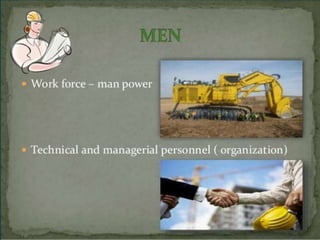
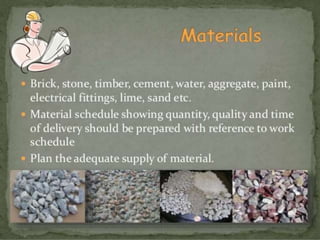
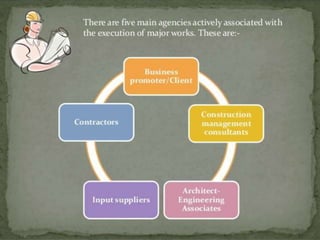
Resources
participate
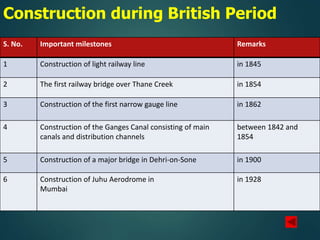
Construction during British Period
S. No. Important milestones Remarks
1 Construction of light railway line in 1845
2 The first railway bridge over Thane Creek in 1854
3 Construction of the first narrow gauge line in 1862
4 Construction of the Ganges Canal consisting of main
canals and distribution channels
between 1842 and
1854
5 Construction of a major bridge in Dehri-on-Sone in 1900
6 Construction of Juhu Aerodrome in
Mumbai
in 1928
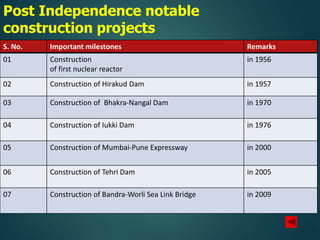
Post Independence notable
construction projects
S. No. Important milestones Remarks
01 Construction
of first nuclear reactor
in 1956
02 Construction of Hirakud Dam in 1957
03 Construction of Bhakra-Nangal Dam in 1970
04 Construction of Iukki Dam in 1976
05 Construction of Mumbai-Pune Expressway in 2000
06 Construction of Tehri Dam in 2005
07 Construction of Bandra-Worli Sea Link Bridge in 2009
What Is a Project?
A project is “a temporary endeavor undertaken to accomplish a unique
product or service” (PMBOK® Guide 2000, p. 4)
OR
A project is an assignment/task/job that has to be undertaken and
completed within a set time, budget, resources and performance
specifications designed to meet the needs of stakeholders.
Characteristics of projects
 unique purpose
 temporary
 require resources, often from various areas
 should have a primary sponsor and/or customer
 involve uncertainty
For example
 The XYZ Agency has donated 7.5 crore to provide 3 BHK homes to 50 families living
in the VARACHHA informal settlement. On 6 February 2004, the agency signed a
contract with the ABC DEVLOPERS to implement the project. The following
requirements, set in the contract:
 The 3 bedroomed houses must meet specifications in line with government policy.
 50 families must be given skills development training in small business development
and small business start-up. This is to ensure that the families will be able to afford
rentals, maintenance of the homes and to expand their homes to accommodate the
growth of the families in the future.
 The project must be completed within three years and the handover of the homes to
the 50 families must be a high profile public event.
From the example we see:
 a clear task - build 3 BHK homes for 50 families;
 a set time – within 3 years;
 a budget – 7.5 crore;
 performance specifications – houses meet specifications in line with
government policy.
 beneficiaries – 50 families;
 stakeholders – donor agency, Department of Housing.
Project stakeholders
Project stakeholders are individuals and organizations who are actively
involved in the project, or whose interests may be positively or negatively
affected by the project.
Key stakeholders in the example above include:
 Project Manager - the individual responsible for managing the project;
 Project beneficiaries – 50 families who are going to receive the houses;
 Performing organization – the ABC DEVLOPERS whose employees are
most directly involved in doing the work of the project.
 Sponsor – XYZ Agency.
In addition to these different typical stakeholders:
 Suppliers and contractors
 Project team members and their families
 Government agencies
 Community representatives and organizations.
Typical Stakeholders
 Sponsor
 Funding Body
 Customer
 Suppliers
 End User
 Environmental Agency
 Maintenance Team
 Neighbours/Community/Shareholders
What is Project Management?
Project management is “the application of knowledge, skills, tools, and
techniques of project activities in order to meet project requirements”
(PMI*, Project Management Body of Knowledge (PMBOK® Guide), 2000, p. 6)
OR
Project Management is the use of knowledge, skills, tools, and techniques to
plan and implement activities to meet or exceed stakeholder needs and
expectations from a project.
*The Project Management Institute (PMI) is an international professional society. Their web
site is www.pmi.org.
The starting point begins the moment the project is given the go- ahead (when a
contract agreement is signed). Project effort starts slowly, builds to a peak, and then
declines to delivery of the project to the customer.
specifications of the project are defined, project objectives are established,
project teams are formed and major responsibilities are assigned.
plans are developed to determine the project steps, beneficiaries,
timeframes, quality standards and budget.
delivering the project
product to the customer
the major portion of the project work takes place
PHASES OF A CONSTRUCTION PROJECT
Initiating Phase
 Select Project
 Collect Historical Information
 Determine Project Objectives
 Determine High-Level Deliverables, Estimates
 Determine High-Level Assumptions
 Determine Business Need
 Develop Product Description
 Define Responsibilities of the Project Manager
 Determine High-Level Resources Requirements
 Finalize the Project Charter
Planning Phase
 Determine Project Team
 Create WBS (Work Breakdown Structure)
 Finalize the Team
 Create WBS dictionary
 Create Network Diagram
 Estimate Time & Cost
 Determine Critical Path
 Create Risk Management Plan
 Develop Schedule
 Develop Budget
 Determine Communication Requirements
 Determine Quality Standards
 Risk Identification, Qualification, Quantification and Resource Planning
 Create Other Management Plans – Scope, Schedule, Cost, Quality,
Staffing, Communications, Procurement
Executing Phase
 Execute the Project Plan
 Manage Project Progress
 Complete Work Packages
 Distribute Information
 Quality Assurance
 Team Development
 Identify Changes
 Use Work Authorization System
Controlling Phase
 Integrated Change Control
 Project Performance Measuring
 Performance Reporting
 Scope Change Control
 Quality Control
 Risk monitoring and Control
 Schedule Control
 Cost Control
 Project Plan Updates
Closing Phase
 Procurement Audits
 Product Verification
 Financial Closure
 Lessons Learned
 Update Records
 End of Project Performance Reporting
 Formal Acceptance
 Project Archives
 Release Resources
Phasesofconstructionmanagement
Planning
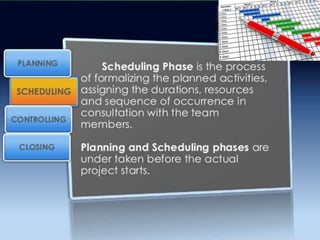
scheduling
Controlling & monitoring
communicating
organizing
Directing
coordinating
Phases of construction management
 Inadequate planning leads to frustration towards the
end of the project & poor project performance
Project Start Project End
Machines
The Project Management Profession
• The job of IT Project Manager is in the list of the top
ten most in demand IT skills
• Professional societies like the Project Management
Institute (PMI) have grown tremendously
• Project management research and certification
programs continue to grow.
Project Management Certification
• PMI provides certification as a Project
Management Professional (PMP)
• A PMP has documented sufficient project
experience, agreed to follow a code of ethics, and
passed the PMP exam
• The number of people earning PMP certification is
increasing quickly
• PMI and other organizations are offering new
certification programs.
Growth in PMP Certification 1993-2015
Sources: PMI’s PMP Salary Survey Report 9th edition
Project Management Statistics
 The world as a whole spends nearly $10 trillion on projects of
all kinds.
 More than sixteen million people regard project management
as their profession; on average, a project manager earns more
than $82,000 per year.*
 The Project Management Institute estimates demand for 15.7
million project management jobs from 2010 to 2020, with
6.2 million of those jobs in the United States.
*PMI, The PMI Project Management Fact Book, Second Edition, 2001
PMI (Project Management Institute )
Copyright 2016
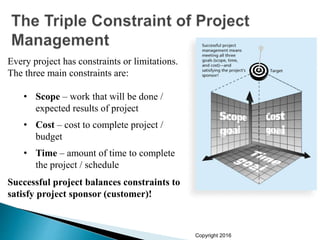
Every project has constraints or limitations.
The three main constraints are:
• Scope – work that will be done /
expected results of project
• Cost – cost to complete project /
budget
• Time – amount of time to complete
the project / schedule
Successful project balances constraints to
satisfy project sponsor (customer)!
MODULE 1 Introduction to Construction Management

MODULE 1 Introduction to Construction Management

  • 1.
    PREPARED BY:- Karm Balar ASST.Prof. S.S.A.S.I.T. S.S.A.S.I.T G.T.U SHREE SWAMI ATMANAND SARASWATI INSTITUTE OF TECHNOLOGY, SURAT Construction management
  • 2.
  • 4.
    Construction during BritishPeriod S. No. Important milestones Remarks 1 Construction of light railway line in 1845 2 The first railway bridge over Thane Creek in 1854 3 Construction of the first narrow gauge line in 1862 4 Construction of the Ganges Canal consisting of main canals and distribution channels between 1842 and 1854 5 Construction of a major bridge in Dehri-on-Sone in 1900 6 Construction of Juhu Aerodrome in Mumbai in 1928
  • 5.
    Post Independence notable constructionprojects S. No. Important milestones Remarks 01 Construction of first nuclear reactor in 1956 02 Construction of Hirakud Dam in 1957 03 Construction of Bhakra-Nangal Dam in 1970 04 Construction of Iukki Dam in 1976 05 Construction of Mumbai-Pune Expressway in 2000 06 Construction of Tehri Dam in 2005 07 Construction of Bandra-Worli Sea Link Bridge in 2009
  • 6.
    What Is aProject? A project is “a temporary endeavor undertaken to accomplish a unique product or service” (PMBOK® Guide 2000, p. 4) OR A project is an assignment/task/job that has to be undertaken and completed within a set time, budget, resources and performance specifications designed to meet the needs of stakeholders. Characteristics of projects  unique purpose  temporary  require resources, often from various areas  should have a primary sponsor and/or customer  involve uncertainty
  • 7.
    For example  TheXYZ Agency has donated 7.5 crore to provide 3 BHK homes to 50 families living in the VARACHHA informal settlement. On 6 February 2004, the agency signed a contract with the ABC DEVLOPERS to implement the project. The following requirements, set in the contract:  The 3 bedroomed houses must meet specifications in line with government policy.  50 families must be given skills development training in small business development and small business start-up. This is to ensure that the families will be able to afford rentals, maintenance of the homes and to expand their homes to accommodate the growth of the families in the future.  The project must be completed within three years and the handover of the homes to the 50 families must be a high profile public event.
  • 8.
    From the examplewe see:  a clear task - build 3 BHK homes for 50 families;  a set time – within 3 years;  a budget – 7.5 crore;  performance specifications – houses meet specifications in line with government policy.  beneficiaries – 50 families;  stakeholders – donor agency, Department of Housing.
  • 9.
    Project stakeholders Project stakeholdersare individuals and organizations who are actively involved in the project, or whose interests may be positively or negatively affected by the project. Key stakeholders in the example above include:  Project Manager - the individual responsible for managing the project;  Project beneficiaries – 50 families who are going to receive the houses;  Performing organization – the ABC DEVLOPERS whose employees are most directly involved in doing the work of the project.  Sponsor – XYZ Agency.
  • 10.
    In addition tothese different typical stakeholders:  Suppliers and contractors  Project team members and their families  Government agencies  Community representatives and organizations.
  • 11.
    Typical Stakeholders  Sponsor Funding Body  Customer  Suppliers  End User  Environmental Agency  Maintenance Team  Neighbours/Community/Shareholders
  • 12.
    What is ProjectManagement? Project management is “the application of knowledge, skills, tools, and techniques of project activities in order to meet project requirements” (PMI*, Project Management Body of Knowledge (PMBOK® Guide), 2000, p. 6) OR Project Management is the use of knowledge, skills, tools, and techniques to plan and implement activities to meet or exceed stakeholder needs and expectations from a project. *The Project Management Institute (PMI) is an international professional society. Their web site is www.pmi.org.
  • 14.
    The starting pointbegins the moment the project is given the go- ahead (when a contract agreement is signed). Project effort starts slowly, builds to a peak, and then declines to delivery of the project to the customer. specifications of the project are defined, project objectives are established, project teams are formed and major responsibilities are assigned. plans are developed to determine the project steps, beneficiaries, timeframes, quality standards and budget. delivering the project product to the customer the major portion of the project work takes place
  • 15.
    PHASES OF ACONSTRUCTION PROJECT
  • 16.
    Initiating Phase  SelectProject  Collect Historical Information  Determine Project Objectives  Determine High-Level Deliverables, Estimates  Determine High-Level Assumptions  Determine Business Need  Develop Product Description  Define Responsibilities of the Project Manager  Determine High-Level Resources Requirements  Finalize the Project Charter
  • 17.
    Planning Phase  DetermineProject Team  Create WBS (Work Breakdown Structure)  Finalize the Team  Create WBS dictionary  Create Network Diagram  Estimate Time & Cost  Determine Critical Path  Create Risk Management Plan  Develop Schedule  Develop Budget  Determine Communication Requirements  Determine Quality Standards  Risk Identification, Qualification, Quantification and Resource Planning  Create Other Management Plans – Scope, Schedule, Cost, Quality, Staffing, Communications, Procurement
  • 18.
    Executing Phase  Executethe Project Plan  Manage Project Progress  Complete Work Packages  Distribute Information  Quality Assurance  Team Development  Identify Changes  Use Work Authorization System
  • 19.
    Controlling Phase  IntegratedChange Control  Project Performance Measuring  Performance Reporting  Scope Change Control  Quality Control  Risk monitoring and Control  Schedule Control  Cost Control  Project Plan Updates
  • 20.
    Closing Phase  ProcurementAudits  Product Verification  Financial Closure  Lessons Learned  Update Records  End of Project Performance Reporting  Formal Acceptance  Project Archives  Release Resources
  • 21.
  • 23.
     Inadequate planningleads to frustration towards the end of the project & poor project performance Project Start Project End
  • 30.
  • 35.
    The Project ManagementProfession • The job of IT Project Manager is in the list of the top ten most in demand IT skills • Professional societies like the Project Management Institute (PMI) have grown tremendously • Project management research and certification programs continue to grow.
  • 36.
    Project Management Certification •PMI provides certification as a Project Management Professional (PMP) • A PMP has documented sufficient project experience, agreed to follow a code of ethics, and passed the PMP exam • The number of people earning PMP certification is increasing quickly • PMI and other organizations are offering new certification programs.
  • 37.
    Growth in PMPCertification 1993-2015
  • 38.
    Sources: PMI’s PMPSalary Survey Report 9th edition
  • 39.
    Project Management Statistics The world as a whole spends nearly $10 trillion on projects of all kinds.  More than sixteen million people regard project management as their profession; on average, a project manager earns more than $82,000 per year.*  The Project Management Institute estimates demand for 15.7 million project management jobs from 2010 to 2020, with 6.2 million of those jobs in the United States. *PMI, The PMI Project Management Fact Book, Second Edition, 2001 PMI (Project Management Institute )
  • 40.
    Copyright 2016 Every projecthas constraints or limitations. The three main constraints are: • Scope – work that will be done / expected results of project • Cost – cost to complete project / budget • Time – amount of time to complete the project / schedule Successful project balances constraints to satisfy project sponsor (customer)!