1
Soran University
Faculty of Engineering - Civil Engineering Department
COORDINATES
Student: Sarchia Khursheed
Group: 2nd
Date: 12.04.2016
Supervisor: Eng. Anwar Jabbar
Introduction
A coordinate system is a way to reference, or locate, everything on the
Earth’s surface in x and y space. The method used to portray a part of
2
the spherical Earth on a flat surface, whether a paper map or a
computer screen, is called a map projection. Each map projection used
on a paper map or in a GIS is associated with a coordinate system.
The coordinate systems enable geographic datasets to use
common locations for integration. A coordinate system is a reference
system used to represent the locations of geographic features,
imagery, and observations, such as Global Positioning System (GPS)
locations, within a common geographic framework.
Each coordinate system is defined by the following:
 Its measurement framework, which is either geographic (in
which spherical coordinates are measured from the earth’s
center) or plan metric (in which the earth’s coordinates are
projected onto a two-dimensional planar surface).
 Units of measurement (typically feet or meters for projected
coordinate systems or decimal degrees for latitude-longitude).
 The definition of the map projection for projected coordinate
systems.
 Other measurement system properties such as a spheroid of
reference, a datum, one or more standard parallels, a central
meridian, and possible shifts in the x- and y-directions.
Objective
The purpose of a coordinate system is to uniquely determine the
position of an object or data point in space.
Equipment
 Optical Level
 Tape
 Tripod
 Staff
 Steel Rod
 Rope
Procedure
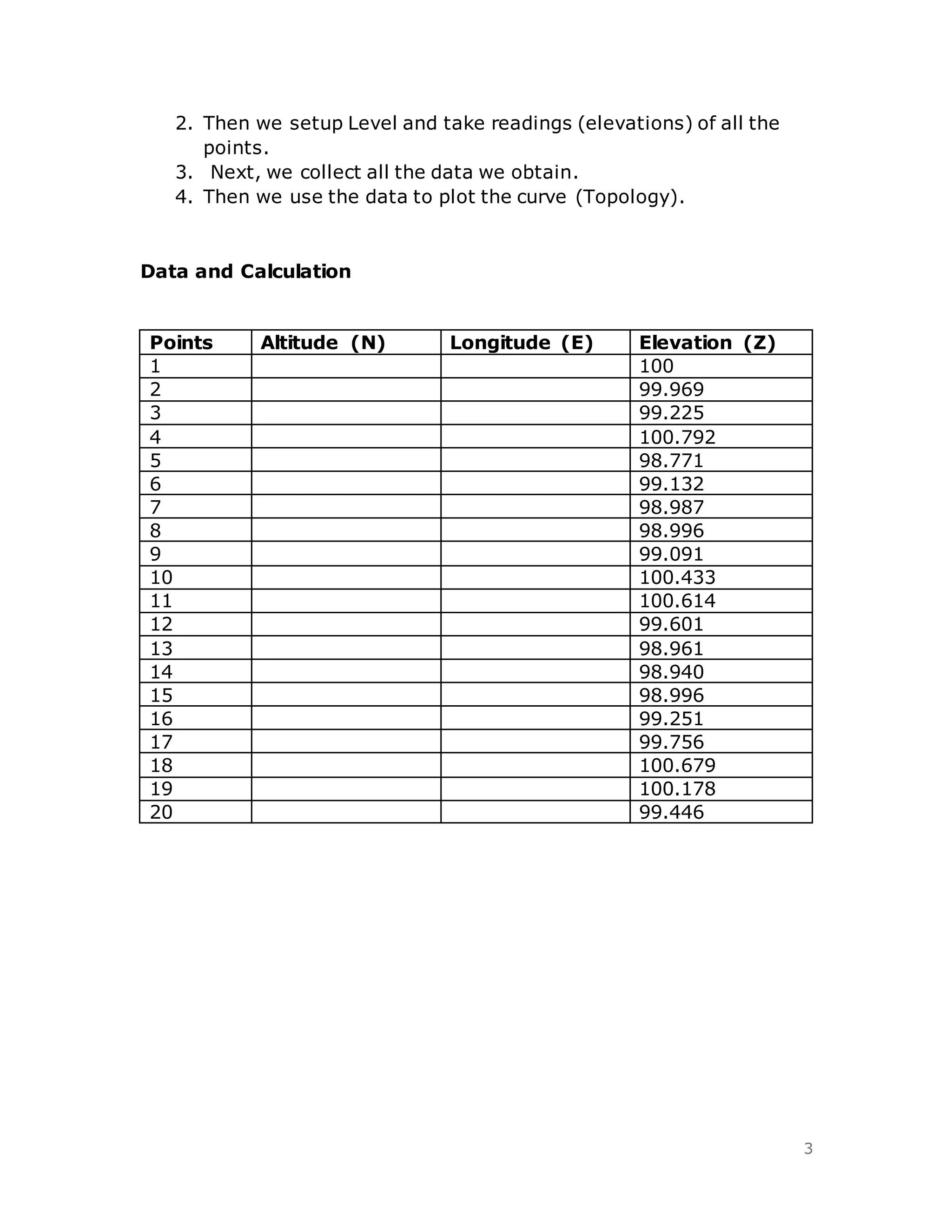
1. First, we select some points in the ground, and setup staff on
each of this points.
3
2. Then we setup Level and take readings (elevations) of all the
points.
3. Next, we collect all the data we obtain.
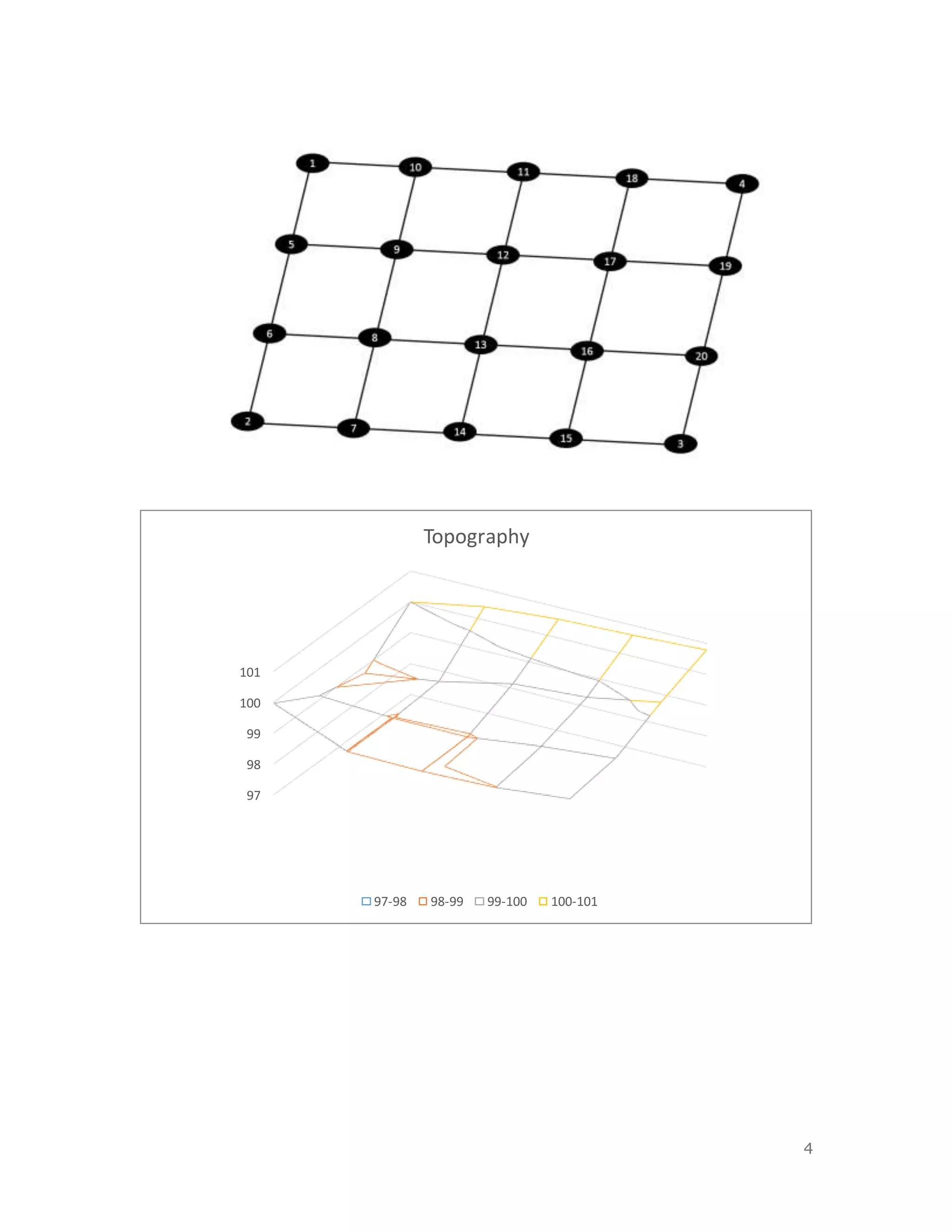
4. Then we use the data to plot the curve (Topology).
Data and Calculation
Points Altitude (N) Longitude (E) Elevation (Z)
1 100
2 99.969
3 99.225
4 100.792
5 98.771
6 99.132
7 98.987
8 98.996
9 99.091
10 100.433
11 100.614
12 99.601
13 98.961
14 98.940
15 98.996
16 99.251
17 99.756
18 100.679
19 100.178
20 99.446
4
97
98
99
100
101
Topography
97-98 98-99 99-100 100-101
5
Result and Conclusion
In conclusion we know that there is a lot of different Coordinate
systems types which are used to indicate the position of points or
objects on earth’s surface (or in a plane). One of the most used of this
types is the Geographic Coordinate System, which uses latitude and
longitude to describe locations on the Earth’s surface.
In this method by knowing the latitude, longitude, and elevation of a
point, we can select the position of the point in the space, by getting
the (N, E, Z) data of several points in an area we can sketch the
topology of the area.

Coordinates (Surveying) - Report

  • 1.
    1 Soran University Faculty ofEngineering - Civil Engineering Department COORDINATES Student: Sarchia Khursheed Group: 2nd Date: 12.04.2016 Supervisor: Eng. Anwar Jabbar Introduction A coordinate system is a way to reference, or locate, everything on the Earth’s surface in x and y space. The method used to portray a part of
  • 2.
    2 the spherical Earthon a flat surface, whether a paper map or a computer screen, is called a map projection. Each map projection used on a paper map or in a GIS is associated with a coordinate system. The coordinate systems enable geographic datasets to use common locations for integration. A coordinate system is a reference system used to represent the locations of geographic features, imagery, and observations, such as Global Positioning System (GPS) locations, within a common geographic framework. Each coordinate system is defined by the following:  Its measurement framework, which is either geographic (in which spherical coordinates are measured from the earth’s center) or plan metric (in which the earth’s coordinates are projected onto a two-dimensional planar surface).  Units of measurement (typically feet or meters for projected coordinate systems or decimal degrees for latitude-longitude).  The definition of the map projection for projected coordinate systems.  Other measurement system properties such as a spheroid of reference, a datum, one or more standard parallels, a central meridian, and possible shifts in the x- and y-directions. Objective The purpose of a coordinate system is to uniquely determine the position of an object or data point in space. Equipment  Optical Level  Tape  Tripod  Staff  Steel Rod  Rope Procedure 1. First, we select some points in the ground, and setup staff on each of this points.
  • 3.
    3 2. Then wesetup Level and take readings (elevations) of all the points. 3. Next, we collect all the data we obtain. 4. Then we use the data to plot the curve (Topology). Data and Calculation Points Altitude (N) Longitude (E) Elevation (Z) 1 100 2 99.969 3 99.225 4 100.792 5 98.771 6 99.132 7 98.987 8 98.996 9 99.091 10 100.433 11 100.614 12 99.601 13 98.961 14 98.940 15 98.996 16 99.251 17 99.756 18 100.679 19 100.178 20 99.446
  • 4.
  • 5.
    5 Result and Conclusion Inconclusion we know that there is a lot of different Coordinate systems types which are used to indicate the position of points or objects on earth’s surface (or in a plane). One of the most used of this types is the Geographic Coordinate System, which uses latitude and longitude to describe locations on the Earth’s surface. In this method by knowing the latitude, longitude, and elevation of a point, we can select the position of the point in the space, by getting the (N, E, Z) data of several points in an area we can sketch the topology of the area.