PREPARED BY:-
Karm Balar
ASST. Prof.
S.S.A.S.I.T.
S.S.A.S.I.T G.T.U
SHREE SWAMI ATMANAND SARASWATI INSTITUTE OF
TECHNOLOGY, SURAT
Construction Economics
Construction management
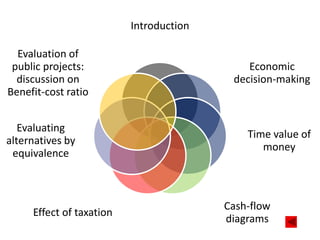
Introduction
Economic
decision-making
Time value of
money
Cash-flow
diagrams
Effect of taxation
Evaluating
alternatives by
equivalence
Evaluation of
public projects:
discussion on
Benefit-cost ratio
• In case of construction projects, economics affects decision
making in many ways from the cost of materials to
purchase, scrapping of equipment, and so on.
• In this chapter some important aspects of decision making
are discussed.
• The relationship between concepts such as economic
decision making, its method's, methods of equivalence,
equivalence of projects are also studied.
Introduction
Decision making is the process of identifying alternative
courses of action and selecting.
◦ This definition presents two Important Parts:
1. Identifying alternative courses of action means that an ideal solution
may not exist or might not be identifiable.
2. Selecting an appropriate alternative implies that there may be a
number of alternatives and that alternatives are to be evaluated and
rejected.
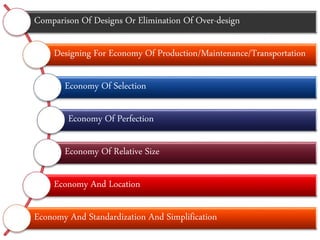
WHEN I GO FOR ECONOMIC DECISION-MAKING ?
There are various situations such as…
Comparison Of Designs Or Elimination Of Over-design
Designing For Economy Of Production/Maintenance/Transportation
Economy Of Selection
Economy Of Perfection
Economy Of Relative Size
Economy And Location
Economy And Standardization And Simplification
An engineer has to take a decision among the competing
alternatives. In such situations, time value of money
method also helpful but decision maker may not consider.
The three most common methods of evaluation are…
out-of-pocket method(commitment comparison)
payback period
average annual rate of return
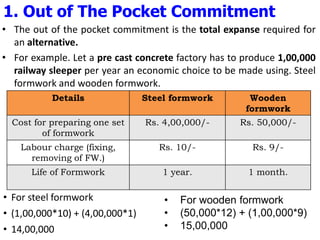
• The out of the pocket commitment is the total expanse required for
an alternative.
• For example. Let a pre cast concrete factory has to produce 1,00,000
railway sleeper per year an economic choice to be made using. Steel
formwork and wooden formwork.
• For steel formwork
• (1,00,000*10) + (4,00,000*1)
• 14,00,000
• For wooden formwork
• (50,000*12) + (1,00,000*9)
• 15,00,000
1. Out of The Pocket Commitment
Details Steel formwork Wooden
formwork
Cost for preparing one set
of formwork
Rs. 4,00,000/- Rs. 50,000/-
Labour charge (fixing,
removing of FW.)
Rs. 10/- Rs. 9/-
Life of Formwork 1 year. 1 month.
2. Payback Period
• Payback period for an investment may be taken as the number of the
years it takes to repay the original invested capital.
• This method is very simple for evaluating project and investments.
• It is understood that the shorter the payback period, the higher the
likelihood of the project being profitable.
For example let a contractor have two brands of excavators, A
& B. The brand is available for down payment of Rs. 4 lakhs.
Both can be Useful for a period of life 5 Years.
BRAND A (YEAR) GIVE RETURN IN Rs.
1 50,000
2 1,00,000
3 1,00,000
4 1,50,000
5 1,50,000
TOTAL 5,50,000
BRAND B (YEAR) GIVE RETURN IN Rs.
1 1,00,000
2 1,50,000
3 1,50,000
4 1,00,000
5 1,00,000
TOTAL 6,00,000
From above table we see that brand A return invested Rs.
Within 4 years…
Where brand B return invested Rs. Within 3 years… so its
good to go with brand B…
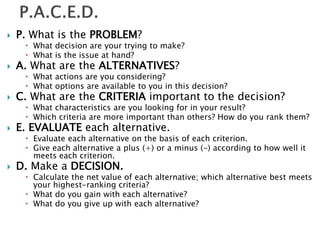
 A very useful 5 step tool to help managers to
reach project economic decisions.
 The five steps are:
◦ Problem
◦ Alternatives
◦ Criteria
◦ Evaluate
◦ Decision
 P. What is the PROBLEM?
 What decision are your trying to make?
 What is the issue at hand?
 A. What are the ALTERNATIVES?
 What actions are you considering?
 What options are available to you in this decision?
 C. What are the CRITERIA important to the decision?
 What characteristics are you looking for in your result?
 Which criteria are more important than others? How do you rank them?
 E. EVALUATE each alternative.
 Evaluate each alternative on the basis of each criterion.
 Give each alternative a plus (+) or a minus (-) according to how well it
meets each criterion.
 D. Make a DECISION.
 Calculate the net value of each alternative; which alternative best meets
your highest-ranking criteria?
 What do you gain with each alternative?
 What do you give up with each alternative?
Cash flow diagrams
• Cash flow may be define as the movement of money into or
out of projects.
• Purpose of cash flow analysis
• To ensure that sufficient cash is available to meet the demand
• To ensure the cash resources are fully utilize for the benefit of
the owner and for company
• To know project funding pattern.
Cash flow consist two part…
1 cash out flow
2 cash inflow
1 cash outflow
Payment made by contractor over a period of time for the
resources he uses in a project is known as.... And its include
Material purchase
Labour wages
Equipment purchase/hire etc.
2 Cash inflow
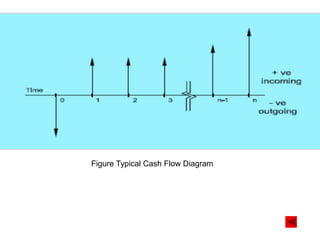
• In the cash inflow diagram time is drawn on the x axis wish
appropriate scale, in terms of week, month, year, etc.
• When on y axis the amount involved in the transaction.
• Cash inflow drawn on the positive side of y axis, while
outflow drawn negative side of y axis.
Figure Typical Cash Flow Diagram
 The project cash flow is basically a graph of receipts versus time. The
project cash flow can be prepared form different perspectives of
contractor, owner etc.,
 Normally it is represented in months.
Project Cash-Flow
 mobilization advance
 The margin in a project,
 Retention,
 Extra claims,
 Distribution of margin
 Certification type
 Certification period,
Factors affecting project cash flow
MOBILIZATION ADVANCE it is an advance taken by contractor (2 to 5%) from client for
various resources at a site for smooth work and maintain cash flow.
MARGIN the margin (profit margin or contributions) is the excess over cost. Higher the margin
in a project the better it is for cash flow.
RETENTION whenever any claims for payment of a sum of money arises out of the contract
against the contractor, the site engineer handle such claimed amount. This amount known as.....
MEASUREMENT PERIOD – It is usual for the contractors to be paid on a monthly basis. The
payment can be made fortnightly or sometimes bimonthly as well. These conditions can be found
under ‘terms of payment’ given in the tender document.
CERTIFICATION TIME TAKEN BY THE OWNER – In normal conditions owner takes
about 3-4 weeks time to process the bill and release the payment to the constructor or contractor.
Evaluation of public projects
• The objective of private project is to maximize the project profit, but objective of
public project it to provide services /goods to the public at the minimum costs.
• The project fund by state/central government are known as public projects.
• Public projects here mean those, which are funded by Government (State or Centre)
• The Government has a responsibility towards public welfare. Some examples of
Public projects are:
• Dams
• Defense projects
• Highways
• Education
• Health
• Unlike private projects, many Government projects cannot be evaluated strictly in
commercial terms. Profit, taxes, payoff periods take a back seat in public projects.
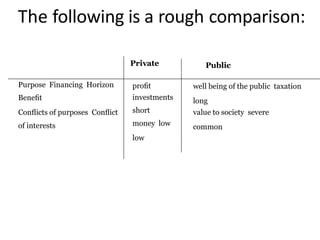
2The following is a rough comparison:
Private Public
Purpose Financing Horizon
Benefit
Conflicts of purposes Conflict
of interests
profit
investments
short
money low
low
well being of the public taxation
long
value to society severe
common
 One of the most commonly used criteria to evaluate public projects is Benefit-Cost
Ratio (B/C).
 B/C ratio is defined as the ratio of benefit to public and cost to Government.
 B/C ratio can be obtained using Present Worth analysis, Future Worth Method and
Annual Cost method.
 if B/C ratio ≥ 1 means benefits outweighs cost thus, the investment is justified.
 if B/C ratio ≤ 1 means benefits decreased from the project & more cost required to
invest thus investment is not justifiable.
Benefit-Cost Ratio
26

Mod 3 construction economics

  • 1.
    PREPARED BY:- Karm Balar ASST.Prof. S.S.A.S.I.T. S.S.A.S.I.T G.T.U SHREE SWAMI ATMANAND SARASWATI INSTITUTE OF TECHNOLOGY, SURAT Construction Economics Construction management
  • 2.
    Introduction Economic decision-making Time value of money Cash-flow diagrams Effectof taxation Evaluating alternatives by equivalence Evaluation of public projects: discussion on Benefit-cost ratio
  • 3.
    • In caseof construction projects, economics affects decision making in many ways from the cost of materials to purchase, scrapping of equipment, and so on. • In this chapter some important aspects of decision making are discussed. • The relationship between concepts such as economic decision making, its method's, methods of equivalence, equivalence of projects are also studied. Introduction
  • 4.
    Decision making isthe process of identifying alternative courses of action and selecting. ◦ This definition presents two Important Parts: 1. Identifying alternative courses of action means that an ideal solution may not exist or might not be identifiable. 2. Selecting an appropriate alternative implies that there may be a number of alternatives and that alternatives are to be evaluated and rejected.
  • 5.
    WHEN I GOFOR ECONOMIC DECISION-MAKING ? There are various situations such as…
  • 6.
    Comparison Of DesignsOr Elimination Of Over-design Designing For Economy Of Production/Maintenance/Transportation Economy Of Selection Economy Of Perfection Economy Of Relative Size Economy And Location Economy And Standardization And Simplification
  • 7.
    An engineer hasto take a decision among the competing alternatives. In such situations, time value of money method also helpful but decision maker may not consider. The three most common methods of evaluation are… out-of-pocket method(commitment comparison) payback period average annual rate of return
  • 8.
    • The outof the pocket commitment is the total expanse required for an alternative. • For example. Let a pre cast concrete factory has to produce 1,00,000 railway sleeper per year an economic choice to be made using. Steel formwork and wooden formwork. • For steel formwork • (1,00,000*10) + (4,00,000*1) • 14,00,000 • For wooden formwork • (50,000*12) + (1,00,000*9) • 15,00,000 1. Out of The Pocket Commitment Details Steel formwork Wooden formwork Cost for preparing one set of formwork Rs. 4,00,000/- Rs. 50,000/- Labour charge (fixing, removing of FW.) Rs. 10/- Rs. 9/- Life of Formwork 1 year. 1 month.
  • 9.
    2. Payback Period •Payback period for an investment may be taken as the number of the years it takes to repay the original invested capital. • This method is very simple for evaluating project and investments. • It is understood that the shorter the payback period, the higher the likelihood of the project being profitable.
  • 10.
    For example leta contractor have two brands of excavators, A & B. The brand is available for down payment of Rs. 4 lakhs. Both can be Useful for a period of life 5 Years. BRAND A (YEAR) GIVE RETURN IN Rs. 1 50,000 2 1,00,000 3 1,00,000 4 1,50,000 5 1,50,000 TOTAL 5,50,000 BRAND B (YEAR) GIVE RETURN IN Rs. 1 1,00,000 2 1,50,000 3 1,50,000 4 1,00,000 5 1,00,000 TOTAL 6,00,000 From above table we see that brand A return invested Rs. Within 4 years… Where brand B return invested Rs. Within 3 years… so its good to go with brand B…
  • 12.
     A veryuseful 5 step tool to help managers to reach project economic decisions.  The five steps are: ◦ Problem ◦ Alternatives ◦ Criteria ◦ Evaluate ◦ Decision
  • 13.
     P. Whatis the PROBLEM?  What decision are your trying to make?  What is the issue at hand?  A. What are the ALTERNATIVES?  What actions are you considering?  What options are available to you in this decision?  C. What are the CRITERIA important to the decision?  What characteristics are you looking for in your result?  Which criteria are more important than others? How do you rank them?  E. EVALUATE each alternative.  Evaluate each alternative on the basis of each criterion.  Give each alternative a plus (+) or a minus (-) according to how well it meets each criterion.  D. Make a DECISION.  Calculate the net value of each alternative; which alternative best meets your highest-ranking criteria?  What do you gain with each alternative?  What do you give up with each alternative?
  • 14.
    Cash flow diagrams •Cash flow may be define as the movement of money into or out of projects. • Purpose of cash flow analysis • To ensure that sufficient cash is available to meet the demand • To ensure the cash resources are fully utilize for the benefit of the owner and for company • To know project funding pattern.
  • 15.
    Cash flow consisttwo part… 1 cash out flow 2 cash inflow 1 cash outflow Payment made by contractor over a period of time for the resources he uses in a project is known as.... And its include Material purchase Labour wages Equipment purchase/hire etc.
  • 16.
    2 Cash inflow •In the cash inflow diagram time is drawn on the x axis wish appropriate scale, in terms of week, month, year, etc. • When on y axis the amount involved in the transaction. • Cash inflow drawn on the positive side of y axis, while outflow drawn negative side of y axis.
  • 17.
    Figure Typical CashFlow Diagram
  • 20.
     The projectcash flow is basically a graph of receipts versus time. The project cash flow can be prepared form different perspectives of contractor, owner etc.,  Normally it is represented in months. Project Cash-Flow
  • 21.
     mobilization advance The margin in a project,  Retention,  Extra claims,  Distribution of margin  Certification type  Certification period, Factors affecting project cash flow
  • 22.
    MOBILIZATION ADVANCE itis an advance taken by contractor (2 to 5%) from client for various resources at a site for smooth work and maintain cash flow. MARGIN the margin (profit margin or contributions) is the excess over cost. Higher the margin in a project the better it is for cash flow. RETENTION whenever any claims for payment of a sum of money arises out of the contract against the contractor, the site engineer handle such claimed amount. This amount known as..... MEASUREMENT PERIOD – It is usual for the contractors to be paid on a monthly basis. The payment can be made fortnightly or sometimes bimonthly as well. These conditions can be found under ‘terms of payment’ given in the tender document. CERTIFICATION TIME TAKEN BY THE OWNER – In normal conditions owner takes about 3-4 weeks time to process the bill and release the payment to the constructor or contractor.
  • 23.
    Evaluation of publicprojects • The objective of private project is to maximize the project profit, but objective of public project it to provide services /goods to the public at the minimum costs. • The project fund by state/central government are known as public projects. • Public projects here mean those, which are funded by Government (State or Centre) • The Government has a responsibility towards public welfare. Some examples of Public projects are: • Dams • Defense projects • Highways • Education • Health • Unlike private projects, many Government projects cannot be evaluated strictly in commercial terms. Profit, taxes, payoff periods take a back seat in public projects.
  • 24.
    2The following isa rough comparison: Private Public Purpose Financing Horizon Benefit Conflicts of purposes Conflict of interests profit investments short money low low well being of the public taxation long value to society severe common
  • 25.
     One ofthe most commonly used criteria to evaluate public projects is Benefit-Cost Ratio (B/C).  B/C ratio is defined as the ratio of benefit to public and cost to Government.  B/C ratio can be obtained using Present Worth analysis, Future Worth Method and Annual Cost method.  if B/C ratio ≥ 1 means benefits outweighs cost thus, the investment is justified.  if B/C ratio ≤ 1 means benefits decreased from the project & more cost required to invest thus investment is not justifiable. Benefit-Cost Ratio
  • 26.