Angular
Measurement
PROF. DHAVAL PARMAR
CIVIL ENGG. DEPARTMENT
BVM ENGINEERING COLLEGE
Introduction
Instrument use for Angular Measurement:
Instrument used for the direct measurement of directions of survey lines.
 Compass
Instruments used for the measurement of horizontal angles between survey
lines.
 Theodolite
 Total Station
Traversing
A traverse is a circuit of survey lines. It may be open or closed. When the linear
measurements are done with a chain and a tape and the directions or horizontal
angles are measured with a compass or a theodolite respectively, the survey is
called traversing.
In one of the methods, the angles (Direction) measuring instrument used is the
Compass.
Hence, in compass surveying direction of survey lines are determined with a
compass and the length of the lines are measured with tape or chain. This process
is known as compass traversing.
Principle of Compass Surveying
The Principle of compass surveying is traversing.
The magnetic bearing of the line are measured by prismatic compass and the
distance(Length) of the lines are measured by chain.
Such survey does not require the formation of network of triangles.
Interior details are located by taking offset from the main survey lines.
Compass survey is not recommended for areas, undulating and crowded with
many details.
Types of Compass
A compass is a small instrument essentially consisting of magnetic needle, a graduated
circle and line of Sight.
The compass can not measure angle between two lines directly but can measure angle
of a line with reference to magnetic meridian at the instrument station point is called
magnetic bearing of these two line.
The angle between two lines is then calculated by getting bearing of these two lines.
• There are two forms of Compass
1. Prismatic compass
2. Surveyor’s compass
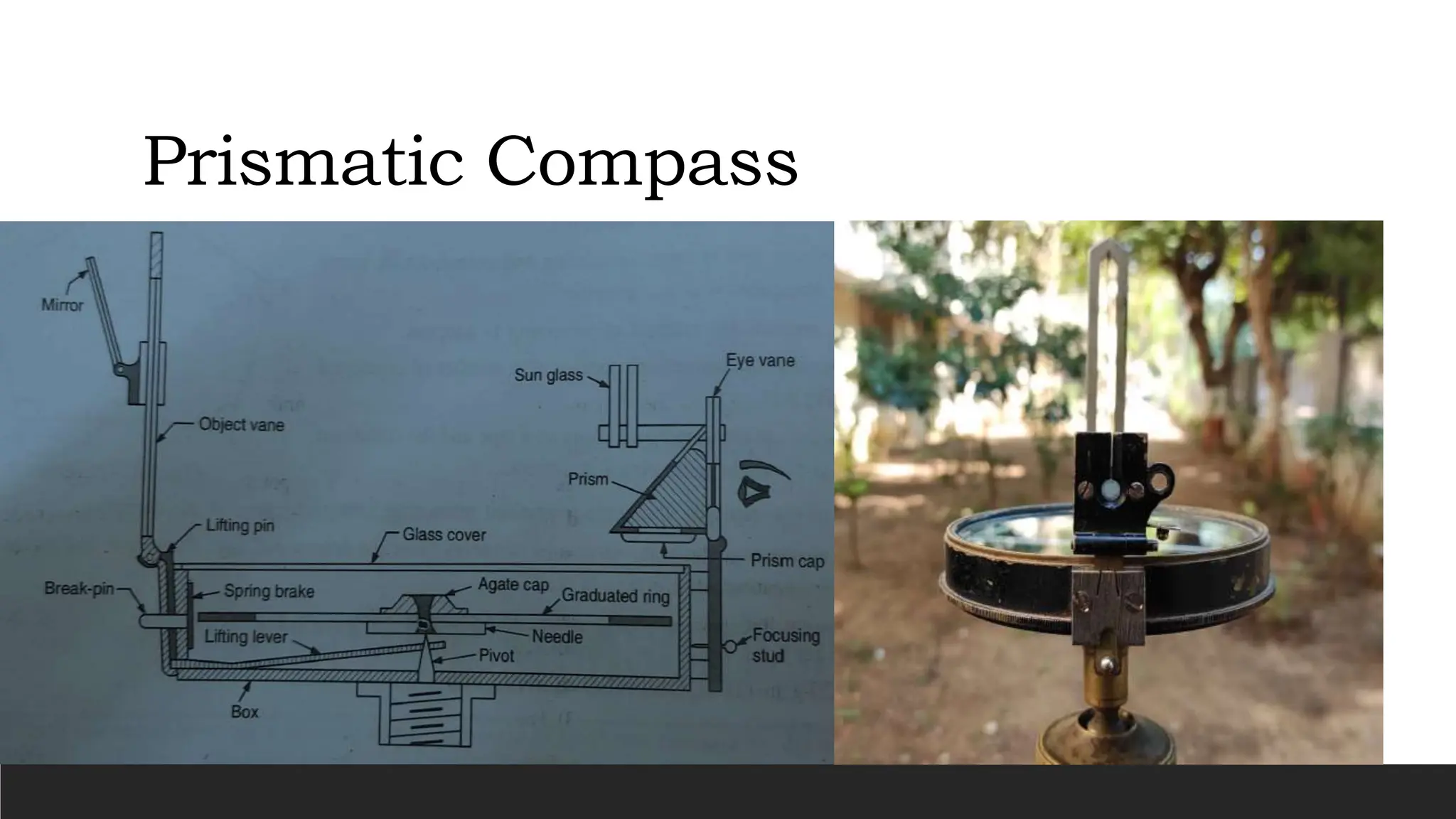
Prismatic Compass
Prismatic Compass
The Prismatic Compass is a magnetic compass which consists of following
parts.
1. Cylindrical Metal Box : Cylindrical metal box having diameter of 8 to 12
cm.it protects compass from dust, rain, ETC.
2. Pivot : Pivot is provided at the centre of the compass and supports freely
suspended magnetic needle over it.
3. Magnetic Needle : Magnetic needle is the heart of the instrument. This needle
measures angle of line from magnetic meridian. The needle always remains
pointed towards North and South pole at two end of the needle when freely
suspended on any support.
Prismatic Compass
4. Prism : Prism is used to read graduation on ring and to take exact reading by
Compass. It is placed exactly opposite to object vane.
5. Graduated Circle or Ring : this is an aluminium graduated ring marked with
0 ͦ to 360 ͦ to measure all possible bearings of lines, and attached with
magnetic needle.
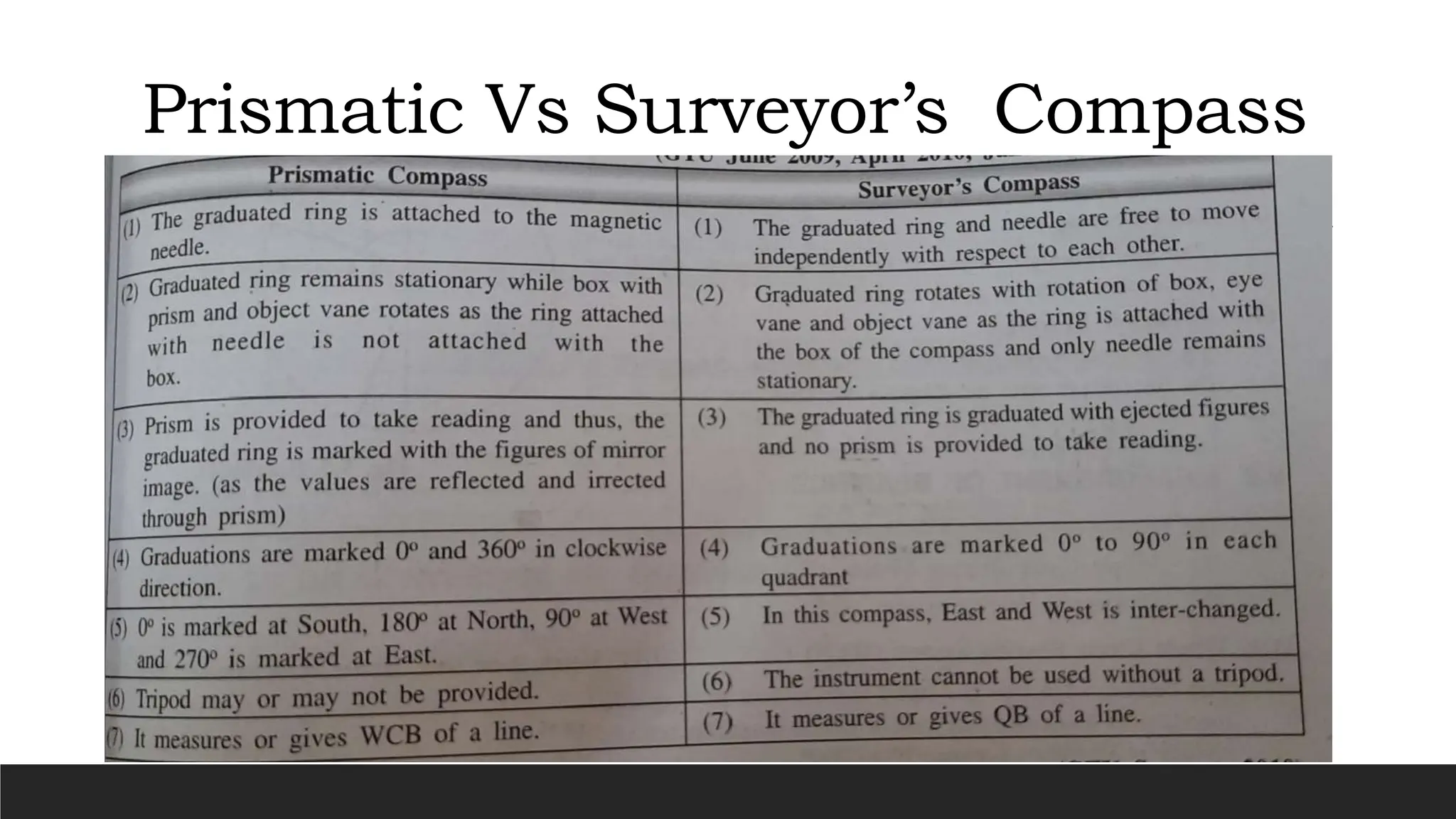
Prismatic Vs Surveyor’s Compass
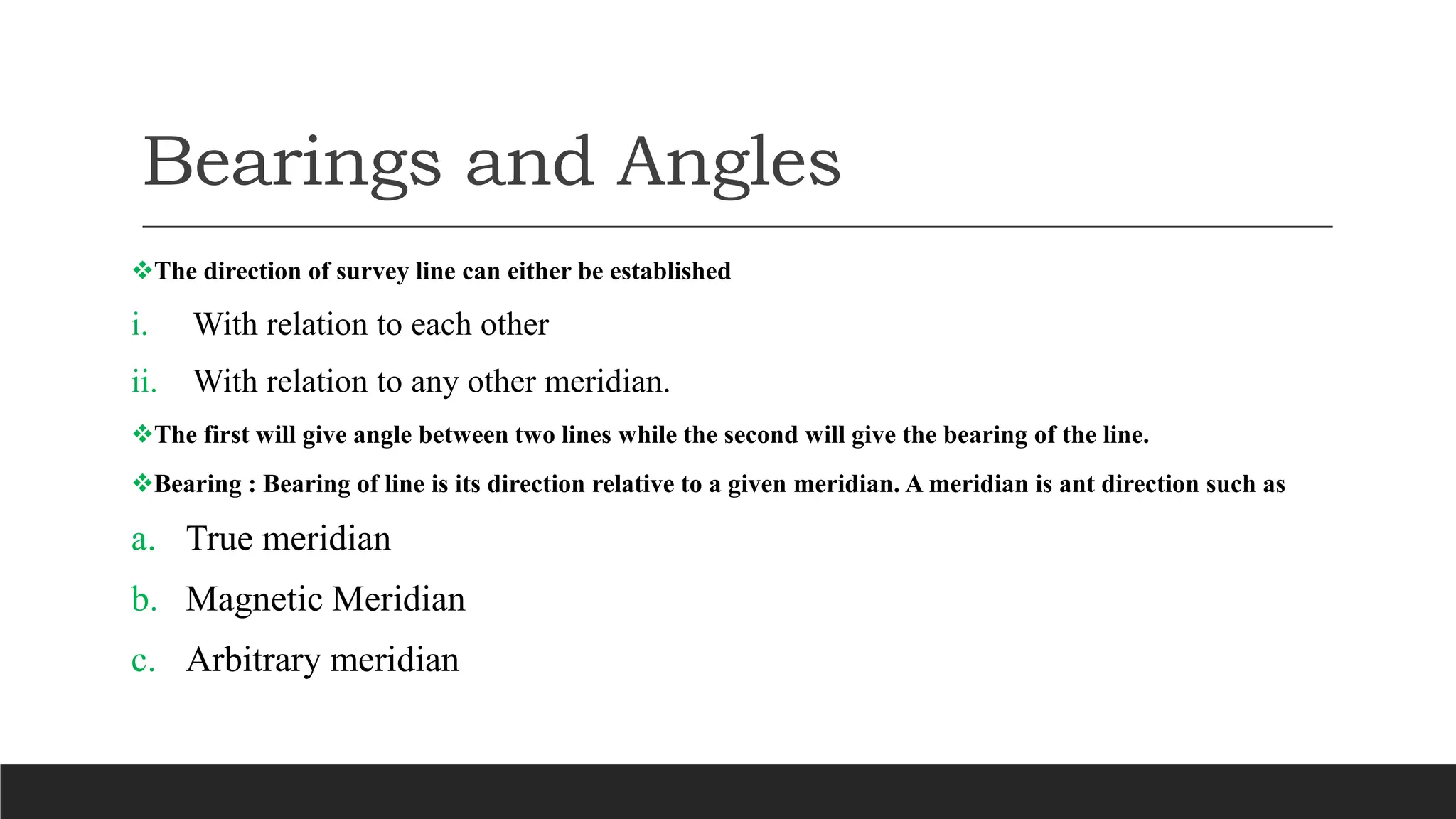
Bearings and Angles
The direction of survey line can either be established
i. With relation to each other
ii. With relation to any other meridian.
The first will give angle between two lines while the second will give the bearing of the line.
Bearing : Bearing of line is its direction relative to a given meridian. A meridian is ant direction such as
a. True meridian
b. Magnetic Meridian
c. Arbitrary meridian

Angular Measurement.pptx

  • 1.
    Angular Measurement PROF. DHAVAL PARMAR CIVILENGG. DEPARTMENT BVM ENGINEERING COLLEGE
  • 2.
    Introduction Instrument use forAngular Measurement: Instrument used for the direct measurement of directions of survey lines.  Compass Instruments used for the measurement of horizontal angles between survey lines.  Theodolite  Total Station
  • 3.
    Traversing A traverse isa circuit of survey lines. It may be open or closed. When the linear measurements are done with a chain and a tape and the directions or horizontal angles are measured with a compass or a theodolite respectively, the survey is called traversing. In one of the methods, the angles (Direction) measuring instrument used is the Compass. Hence, in compass surveying direction of survey lines are determined with a compass and the length of the lines are measured with tape or chain. This process is known as compass traversing.
  • 4.
    Principle of CompassSurveying The Principle of compass surveying is traversing. The magnetic bearing of the line are measured by prismatic compass and the distance(Length) of the lines are measured by chain. Such survey does not require the formation of network of triangles. Interior details are located by taking offset from the main survey lines. Compass survey is not recommended for areas, undulating and crowded with many details.
  • 5.
    Types of Compass Acompass is a small instrument essentially consisting of magnetic needle, a graduated circle and line of Sight. The compass can not measure angle between two lines directly but can measure angle of a line with reference to magnetic meridian at the instrument station point is called magnetic bearing of these two line. The angle between two lines is then calculated by getting bearing of these two lines. • There are two forms of Compass 1. Prismatic compass 2. Surveyor’s compass
  • 6.
  • 7.
    Prismatic Compass The PrismaticCompass is a magnetic compass which consists of following parts. 1. Cylindrical Metal Box : Cylindrical metal box having diameter of 8 to 12 cm.it protects compass from dust, rain, ETC. 2. Pivot : Pivot is provided at the centre of the compass and supports freely suspended magnetic needle over it. 3. Magnetic Needle : Magnetic needle is the heart of the instrument. This needle measures angle of line from magnetic meridian. The needle always remains pointed towards North and South pole at two end of the needle when freely suspended on any support.
  • 8.
    Prismatic Compass 4. Prism: Prism is used to read graduation on ring and to take exact reading by Compass. It is placed exactly opposite to object vane. 5. Graduated Circle or Ring : this is an aluminium graduated ring marked with 0 ͦ to 360 ͦ to measure all possible bearings of lines, and attached with magnetic needle.
  • 9.
  • 10.
    Bearings and Angles Thedirection of survey line can either be established i. With relation to each other ii. With relation to any other meridian. The first will give angle between two lines while the second will give the bearing of the line. Bearing : Bearing of line is its direction relative to a given meridian. A meridian is ant direction such as a. True meridian b. Magnetic Meridian c. Arbitrary meridian