Contouring
Unit-III
Contouring
Contouring
• Contour – définitions, objectives, contour
interval, horizontal equivalent, uses and
characteristics of contour lines, methods of
plotting contours, direct and indirect methods
of contouring, Contour gradient.
Levelling and Contouring
Contour Line
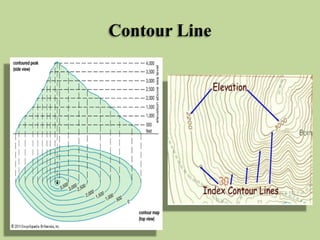
• A contour line may be defined as “An imaginary
line passing through points of equal reduced
levels”. A contour line may also be defined “as
the intersection of a level surface with the
surface of the earth”. Thus, contour lines on a
plan illustrates the topography of the area.
• For ex a contour of 90 m indicates that all the
points on this line have RL of 90 m. Similarly, in
a contour of 89 m all the points have RL of 89 m
and so on.
Contour Line
Contour Interval
• The vertical distance between two consecutive
contours is known as a contour interval.
• For ex, a map indicates contour lines of 90 m, 89
m, 88 m and so on, the contour interval is 1m.
• This interval depends upon the following
factors:
• The nature of the ground (i.e. . Whether flat or
steep)
• The scale of the map, and The purpose of the
survey.
Contour Interval
Contour Interval
• Contour intervals for flat ground are generally small,
e.g.. 0.25 m, 0.5 m, 0.75 m
• The contour interval for a steep slope in a hilly area is
generally greater, e.g.. 5 m, 10 m, 15 m, etc.
• Again, for a small scale map, the interval may be of 1
m, 2 m, 3 m, etc.
• Contour interval is kept large up to 2 m for projects
such as highways and railways, whereas it is kept as
small as 0.5 m for measurement of earthwork, building
sites, dams, etc.
• It is desirable to have a constant contour interval for a
particular map.
Horizontal Equivalent
• The horizontal distance between any two
consecutive contours is known as horizontal
equivalent. It is not constant. It varies from
point to point depending upon the steepness of
the ground. Steeper the ground, lesser is the
horizontal equivalent.
Use of Contour Map
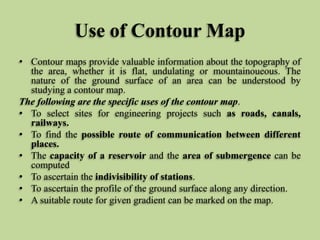
• Contour maps provide valuable information about the topography of
the area, whether it is flat, undulating or mountainoueous. The
nature of the ground surface of an area can be understood by
studying a contour map.
The following are the specific uses of the contour map.
• To select sites for engineering projects such as roads, canals,
railways.
• To find the possible route of communication between different
places.
• The capacity of a reservoir and the area of submergence can be
computed
• To ascertain the indivisibility of stations.
• To ascertain the profile of the ground surface along any direction.
• A suitable route for given gradient can be marked on the map.
Use of Contour Map
• To estimate the quantity of
cutting, filling, etc.
• To know the drainage characteristics of the
area. It helps to select sites for
culverts, bridges, drainage system.
Use of Contour Map
Characteristics of Contours
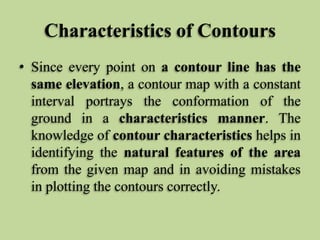
• Since every point on a contour line has the
same elevation, a contour map with a constant
interval portrays the conformation of the
ground in a characteristics manner. The
knowledge of contour characteristics helps in
identifying the natural features of the area
from the given map and in avoiding mistakes
in plotting the contours correctly.
Characteristics of Contours
• The following characteristics help in plotting or
reading a constant map.
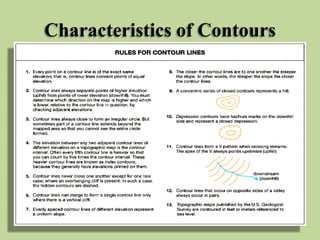
• All the points on a contour line have the same
elevation. The elevations of the contour are indicated
either by inserting the figure in a break in respective
contour or printed close to the contour.
• Two contour lines do not intersect with each other.
• Contour lines always from a closed circuit. But these
lines may be within or outside the limit of the map.
• Contour do not have sharp turning.
Characteristics of Contours
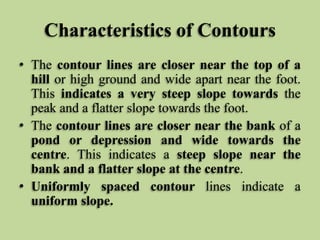
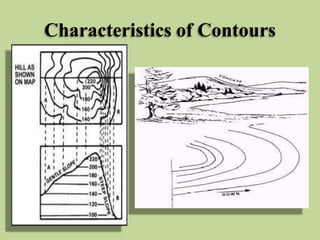
• The contour lines are closer near the top of a
hill or high ground and wide apart near the foot.
This indicates a very steep slope towards the
peak and a flatter slope towards the foot.
• The contour lines are closer near the bank of a
pond or depression and wide towards the
centre. This indicates a steep slope near the
bank and a flatter slope at the centre.
• Uniformly spaced contour lines indicate a
uniform slope.
Characteristics of Contours
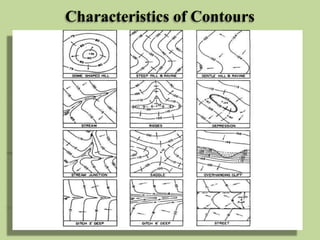
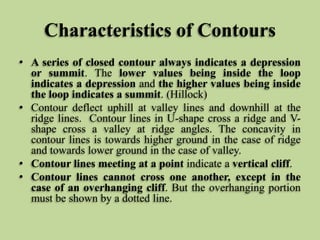
• A series of closed contour always indicates a depression
or summit. The lower values being inside the loop
indicates a depression and the higher values being inside
the loop indicates a summit. (Hillock)
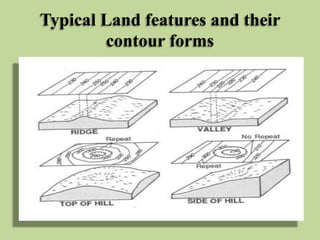
• Contour deflect uphill at valley lines and downhill at the
ridge lines. Contour lines in U-shape cross a ridge and V-
shape cross a valley at ridge angles. The concavity in
contour lines is towards higher ground in the case of ridge
and towards lower ground in the case of valley.
• Contour lines meeting at a point indicate a vertical cliff.
• Contour lines cannot cross one another, except in the
case of an overhanging cliff. But the overhanging portion
must be shown by a dotted line.
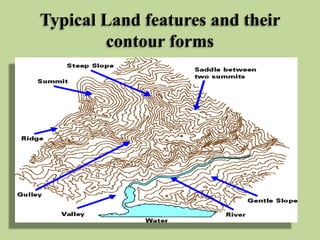
Typical Land features and their
contour forms
Typical Land features and their
contour forms
Typical Land features and their
contour forms
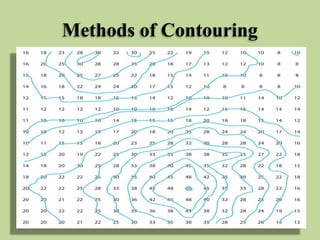
Methods of Contouring
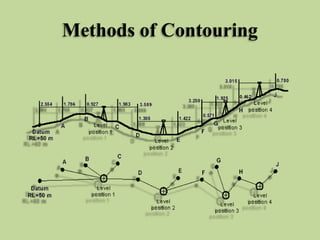
• Contouring requires the planimetric position of
the points whose elevation have been
determined by leveling. The methods of
locating contours, therefore depending upon
the instruments used to determine the
horizontal as well as vertical position of
several points in the area.
Methods of Contouring
• Broadly, the method can be divided into the
following two classes.
• Direct methods
• Indirect methods
Methods of Contouring
Direct Method
• In the direct method of contouring, the reduced level of
various selected points on a contour line are obtained and
their positions are located. The contours are then drawn
by joining these points. It is a very accurate method but it
is slow and tedious.
• This method is employed only for small area where
superior accuracy is demanded. The method of locating
contours directly consists of horizontal and vertical
control. The horizontal control for a small area can be
exercised by a chain or tape and a large area by compass,
theodolite or plane table. For vertical control either a level
and staff or a hand level may be used.
Methods of Contouring
By Level and Staff
• The method consists of locating a series of points on
the ground having the same elevation by using a level
and leveling staff. Instrument is setup in such a way
that number of readings can be taken from the area to
be surveyed. The instrument is set up and RL of HI is
determined from the nearest benchmark. For a
particular contour value, the staff reading is worked
out. A series of points having the same staff reading is
worked out, and thus the same elevations are plotted
and joined by a smooth curve.
Methods of Contouring
By Hand Level
• The principle used is the same as that used in
the method using a level and staff. Instead of
the hand level, an abbey level may also be
used. However this method is very rapid and is
preferred for certain works.
Methods of Contouring
Indirect Methods
• Indirect methods are less expensive, less time
consuming and less tedious as compared with
the direct methods. These methods are
commonly employed in small scale survey of
large areas.
Methods of Contouring
• There are three different ways of employing
the indirect methods of contouring
• (i) Grid Method
• (ii) Cross-Sectional Method
• (iii) Radial line method or
Tachometric method
Methods of Contouring
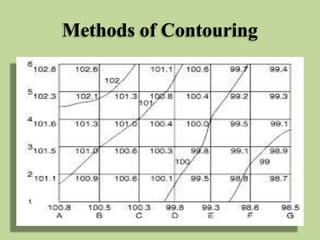
Grid Method
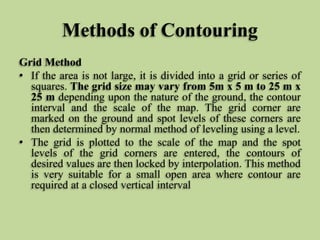
• If the area is not large, it is divided into a grid or series of
squares. The grid size may vary from 5m x 5 m to 25 m x
25 m depending upon the nature of the ground, the contour
interval and the scale of the map. The grid corner are
marked on the ground and spot levels of these corners are
then determined by normal method of leveling using a level.
• The grid is plotted to the scale of the map and the spot
levels of the grid corners are entered, the contours of
desired values are then locked by interpolation. This method
is very suitable for a small open area where contour are
required at a closed vertical interval
Methods of Contouring
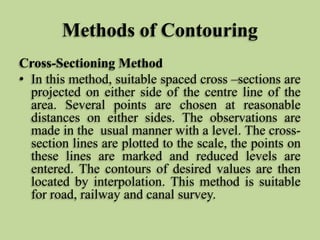
Cross-Sectioning Method
• In this method, suitable spaced cross –sections are
projected on either side of the centre line of the
area. Several points are chosen at reasonable
distances on either sides. The observations are
made in the usual manner with a level. The cross-
section lines are plotted to the scale, the points on
these lines are marked and reduced levels are
entered. The contours of desired values are then
located by interpolation. This method is suitable
for road, railway and canal survey.
Methods of Contouring
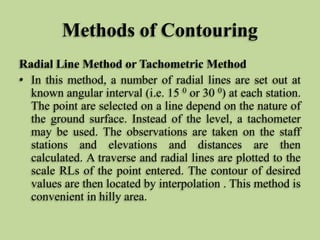
Radial Line Method or Tachometric Method
• In this method, a number of radial lines are set out at
known angular interval (i.e. 15 0 or 30 0) at each station.
The point are selected on a line depend on the nature of
the ground surface. Instead of the level, a tachometer
may be used. The observations are taken on the staff
stations and elevations and distances are then
calculated. A traverse and radial lines are plotted to the
scale RLs of the point entered. The contour of desired
values are then located by interpolation . This method is
convenient in hilly area.
Methods of Contouring
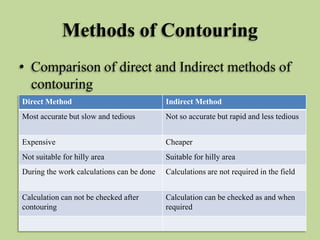
• Comparison of direct and Indirect methods of
contouring
Direct Method Indirect Method
Most accurate but slow and tedious Not so accurate but rapid and less tedious
Expensive Cheaper
Not suitable for hilly area Suitable for hilly area
During the work calculations can be done Calculations are not required in the field
Calculation can not be checked after
contouring
Calculation can be checked as and when
required
Radial Line Method
Interpolation of Contours
• The process of locating the contours
proportionately between the plotted point is
termed interpolation may be done by:
• Estimation
• Arithmetical Calculation
• Graphical Method
Interpolation of Contours
Estimation
• The points on the required contour are located
by eye judgment or estimation between points
whose elevations are already known. This
method is good for small scale maps. It is
assumed that slope between the ground points
is uniform.
Interpolation of Contours
Arithmetic Calculations
• This methods is used when high accuracy is
required and scale of the map is of
intermediate or large. In this method the
distances between two points of known
elevation are accurately measured. Then with
the help of arithmetic calculations, the
positions of the required elevation points are
computed.
Interpolation of Contours
Graphical Method
• When high accuracy is required and many
interpolation are to be made, this method of
plotting contours proves to be most rapid and
convenient. For this purpose tracing paper is
used.
Plotting of a Contour Map
• Before plotting the contour map, suitable scale is
selected.
• e.g. 1 cm = 1 m, 1 cm = 2 m, 1 cm = 2.5 m, 1 cm
= 4 m or 1 cm = 5 m etc. Here 1 cm = 2m is
selected.
• A horizontal line is drawn as the centre line
• The chainages are marked along the horizontal
line according to the scale.
• Ground levels are written from the level book
according to the chainage.
Plotting of a Contour Map
• The cross-section (L/s and R/S) are also plotted
(perpendicular lines) at each of the chainage.
• By interpolation contours are joined by smooth
curves keeping in mind the characteristics of
contour.
• First find out maximum and minimum RL values
and then first plot full values contour lines i.e.. 47
, 48, 49 etc. Contour interval is 1 m. After plotting
these contour lines reduces contour interval and it
is taken 0.5 m and contour lines i.e. 47.5, 48.5,
49.5 etc are plotted.
• Contour lines are then inked.
Plotting of a Contour Map
References
• “Surveying and Levelling” Vol- I
Kanetkar and Kulkarni (2011)
• “ Surveying” Vol- I
Dr. B.C. Punamia
Thanks !

Contouring

  • 1.
  • 2.
    Contouring Contouring • Contour –définitions, objectives, contour interval, horizontal equivalent, uses and characteristics of contour lines, methods of plotting contours, direct and indirect methods of contouring, Contour gradient.
  • 3.
  • 4.
    Contour Line • Acontour line may be defined as “An imaginary line passing through points of equal reduced levels”. A contour line may also be defined “as the intersection of a level surface with the surface of the earth”. Thus, contour lines on a plan illustrates the topography of the area. • For ex a contour of 90 m indicates that all the points on this line have RL of 90 m. Similarly, in a contour of 89 m all the points have RL of 89 m and so on.
  • 5.
  • 6.
    Contour Interval • Thevertical distance between two consecutive contours is known as a contour interval. • For ex, a map indicates contour lines of 90 m, 89 m, 88 m and so on, the contour interval is 1m. • This interval depends upon the following factors: • The nature of the ground (i.e. . Whether flat or steep) • The scale of the map, and The purpose of the survey.
  • 7.
  • 8.
    Contour Interval • Contourintervals for flat ground are generally small, e.g.. 0.25 m, 0.5 m, 0.75 m • The contour interval for a steep slope in a hilly area is generally greater, e.g.. 5 m, 10 m, 15 m, etc. • Again, for a small scale map, the interval may be of 1 m, 2 m, 3 m, etc. • Contour interval is kept large up to 2 m for projects such as highways and railways, whereas it is kept as small as 0.5 m for measurement of earthwork, building sites, dams, etc. • It is desirable to have a constant contour interval for a particular map.
  • 9.
    Horizontal Equivalent • Thehorizontal distance between any two consecutive contours is known as horizontal equivalent. It is not constant. It varies from point to point depending upon the steepness of the ground. Steeper the ground, lesser is the horizontal equivalent.
  • 10.
    Use of ContourMap • Contour maps provide valuable information about the topography of the area, whether it is flat, undulating or mountainoueous. The nature of the ground surface of an area can be understood by studying a contour map. The following are the specific uses of the contour map. • To select sites for engineering projects such as roads, canals, railways. • To find the possible route of communication between different places. • The capacity of a reservoir and the area of submergence can be computed • To ascertain the indivisibility of stations. • To ascertain the profile of the ground surface along any direction. • A suitable route for given gradient can be marked on the map.
  • 11.
    Use of ContourMap • To estimate the quantity of cutting, filling, etc. • To know the drainage characteristics of the area. It helps to select sites for culverts, bridges, drainage system.
  • 12.
  • 13.
    Characteristics of Contours •Since every point on a contour line has the same elevation, a contour map with a constant interval portrays the conformation of the ground in a characteristics manner. The knowledge of contour characteristics helps in identifying the natural features of the area from the given map and in avoiding mistakes in plotting the contours correctly.
  • 14.
  • 15.
    Characteristics of Contours •The following characteristics help in plotting or reading a constant map. • All the points on a contour line have the same elevation. The elevations of the contour are indicated either by inserting the figure in a break in respective contour or printed close to the contour. • Two contour lines do not intersect with each other. • Contour lines always from a closed circuit. But these lines may be within or outside the limit of the map. • Contour do not have sharp turning.
  • 16.
  • 17.
    Characteristics of Contours •The contour lines are closer near the top of a hill or high ground and wide apart near the foot. This indicates a very steep slope towards the peak and a flatter slope towards the foot. • The contour lines are closer near the bank of a pond or depression and wide towards the centre. This indicates a steep slope near the bank and a flatter slope at the centre. • Uniformly spaced contour lines indicate a uniform slope.
  • 18.
  • 19.
  • 20.
  • 21.
  • 22.
    Characteristics of Contours •A series of closed contour always indicates a depression or summit. The lower values being inside the loop indicates a depression and the higher values being inside the loop indicates a summit. (Hillock) • Contour deflect uphill at valley lines and downhill at the ridge lines. Contour lines in U-shape cross a ridge and V- shape cross a valley at ridge angles. The concavity in contour lines is towards higher ground in the case of ridge and towards lower ground in the case of valley. • Contour lines meeting at a point indicate a vertical cliff. • Contour lines cannot cross one another, except in the case of an overhanging cliff. But the overhanging portion must be shown by a dotted line.
  • 23.
    Typical Land featuresand their contour forms
  • 24.
    Typical Land featuresand their contour forms
  • 25.
    Typical Land featuresand their contour forms
  • 26.
    Methods of Contouring •Contouring requires the planimetric position of the points whose elevation have been determined by leveling. The methods of locating contours, therefore depending upon the instruments used to determine the horizontal as well as vertical position of several points in the area.
  • 27.
    Methods of Contouring •Broadly, the method can be divided into the following two classes. • Direct methods • Indirect methods
  • 28.
    Methods of Contouring DirectMethod • In the direct method of contouring, the reduced level of various selected points on a contour line are obtained and their positions are located. The contours are then drawn by joining these points. It is a very accurate method but it is slow and tedious. • This method is employed only for small area where superior accuracy is demanded. The method of locating contours directly consists of horizontal and vertical control. The horizontal control for a small area can be exercised by a chain or tape and a large area by compass, theodolite or plane table. For vertical control either a level and staff or a hand level may be used.
  • 29.
  • 30.
    Methods of Contouring ByLevel and Staff • The method consists of locating a series of points on the ground having the same elevation by using a level and leveling staff. Instrument is setup in such a way that number of readings can be taken from the area to be surveyed. The instrument is set up and RL of HI is determined from the nearest benchmark. For a particular contour value, the staff reading is worked out. A series of points having the same staff reading is worked out, and thus the same elevations are plotted and joined by a smooth curve.
  • 31.
  • 32.
    Methods of Contouring ByHand Level • The principle used is the same as that used in the method using a level and staff. Instead of the hand level, an abbey level may also be used. However this method is very rapid and is preferred for certain works.
  • 33.
  • 34.
    Methods of Contouring IndirectMethods • Indirect methods are less expensive, less time consuming and less tedious as compared with the direct methods. These methods are commonly employed in small scale survey of large areas.
  • 35.
    Methods of Contouring •There are three different ways of employing the indirect methods of contouring • (i) Grid Method • (ii) Cross-Sectional Method • (iii) Radial line method or Tachometric method
  • 36.
    Methods of Contouring GridMethod • If the area is not large, it is divided into a grid or series of squares. The grid size may vary from 5m x 5 m to 25 m x 25 m depending upon the nature of the ground, the contour interval and the scale of the map. The grid corner are marked on the ground and spot levels of these corners are then determined by normal method of leveling using a level. • The grid is plotted to the scale of the map and the spot levels of the grid corners are entered, the contours of desired values are then locked by interpolation. This method is very suitable for a small open area where contour are required at a closed vertical interval
  • 37.
  • 38.
  • 39.
    Methods of Contouring Cross-SectioningMethod • In this method, suitable spaced cross –sections are projected on either side of the centre line of the area. Several points are chosen at reasonable distances on either sides. The observations are made in the usual manner with a level. The cross- section lines are plotted to the scale, the points on these lines are marked and reduced levels are entered. The contours of desired values are then located by interpolation. This method is suitable for road, railway and canal survey.
  • 40.
    Methods of Contouring RadialLine Method or Tachometric Method • In this method, a number of radial lines are set out at known angular interval (i.e. 15 0 or 30 0) at each station. The point are selected on a line depend on the nature of the ground surface. Instead of the level, a tachometer may be used. The observations are taken on the staff stations and elevations and distances are then calculated. A traverse and radial lines are plotted to the scale RLs of the point entered. The contour of desired values are then located by interpolation . This method is convenient in hilly area.
  • 41.
    Methods of Contouring •Comparison of direct and Indirect methods of contouring Direct Method Indirect Method Most accurate but slow and tedious Not so accurate but rapid and less tedious Expensive Cheaper Not suitable for hilly area Suitable for hilly area During the work calculations can be done Calculations are not required in the field Calculation can not be checked after contouring Calculation can be checked as and when required
  • 42.
  • 43.
    Interpolation of Contours •The process of locating the contours proportionately between the plotted point is termed interpolation may be done by: • Estimation • Arithmetical Calculation • Graphical Method
  • 44.
    Interpolation of Contours Estimation •The points on the required contour are located by eye judgment or estimation between points whose elevations are already known. This method is good for small scale maps. It is assumed that slope between the ground points is uniform.
  • 45.
    Interpolation of Contours ArithmeticCalculations • This methods is used when high accuracy is required and scale of the map is of intermediate or large. In this method the distances between two points of known elevation are accurately measured. Then with the help of arithmetic calculations, the positions of the required elevation points are computed.
  • 46.
    Interpolation of Contours GraphicalMethod • When high accuracy is required and many interpolation are to be made, this method of plotting contours proves to be most rapid and convenient. For this purpose tracing paper is used.
  • 47.
    Plotting of aContour Map • Before plotting the contour map, suitable scale is selected. • e.g. 1 cm = 1 m, 1 cm = 2 m, 1 cm = 2.5 m, 1 cm = 4 m or 1 cm = 5 m etc. Here 1 cm = 2m is selected. • A horizontal line is drawn as the centre line • The chainages are marked along the horizontal line according to the scale. • Ground levels are written from the level book according to the chainage.
  • 48.
    Plotting of aContour Map • The cross-section (L/s and R/S) are also plotted (perpendicular lines) at each of the chainage. • By interpolation contours are joined by smooth curves keeping in mind the characteristics of contour. • First find out maximum and minimum RL values and then first plot full values contour lines i.e.. 47 , 48, 49 etc. Contour interval is 1 m. After plotting these contour lines reduces contour interval and it is taken 0.5 m and contour lines i.e. 47.5, 48.5, 49.5 etc are plotted. • Contour lines are then inked.
  • 49.
    Plotting of aContour Map
  • 50.
    References • “Surveying andLevelling” Vol- I Kanetkar and Kulkarni (2011) • “ Surveying” Vol- I Dr. B.C. Punamia
  • 51.