(Dr. M K Manik)
HOD.mechccetb@gmail.com
Surveying
Chain Surveying can be done when the
area of the surveying is
Area is flat/level to the ground
Comparatively Small
compass surveying is recommended
But when the area is large
There are large many hindrance to pull the
chain
Traversing
Traversing is the frame work consist of
connecting lines
The line are measured by the chain or tape
Direction are measured with the help of angle
measuring
devices called compass
Compass surveying direction are measured by
compass
and distance are measured by tape or chain
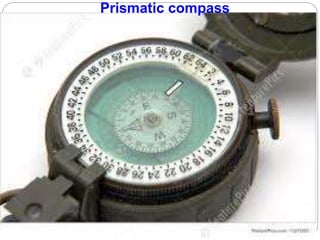
Compass survey
A prismatic compass is used for navigation and for
surveying instrument
which is extensively used to find out the
bearing(Angle) of the traversing and included
angles between them,
Compass surveying is a type of surveying in which the
directions of surveying lines are determined with a
magnetic compass,
 And the length of the surveying lines are measured
with a tape or chain or laser range finder
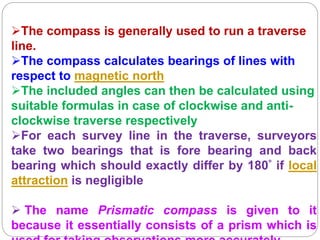
Prismatic compass
The compass is generally used to run a traverse
line.
The compass calculates bearings of lines with
respect to magnetic north
The included angles can then be calculated using
suitable formulas in case of clockwise and anti-
clockwise traverse respectively
For each survey line in the traverse, surveyors
take two bearings that is fore bearing and back
bearing which should exactly differ by 180° if local
attraction is negligible
 The name Prismatic compass is given to it
because it essentially consists of a prism which is
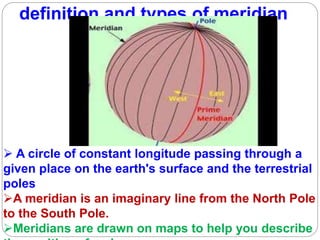
definition and types of meridian
 A circle of constant longitude passing through a
given place on the earth's surface and the terrestrial
poles
A meridian is an imaginary line from the North Pole
to the South Pole.
Meridians are drawn on maps to help you describe
The meridian through Greenwich (inside Greenwich
Park), England, called the Prime Meridian, was set at
zero degrees of longitude, while other meridians
were defined by the angle at the center of the
earth between where it and the prime meridian cross
the equator
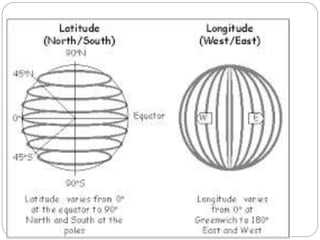
Latitude is distance north or south of the equator
(an imaginary circle around the Earth halfway
between the North Pole and the South Pole)
and longitude is distance east or west of the prime
meridian (an imaginary line running from north to
south through Greenwich, England).
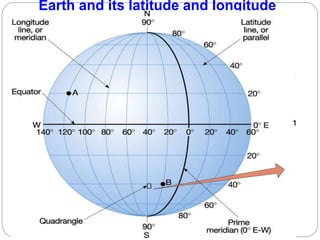
Earth and its latitude and longitude
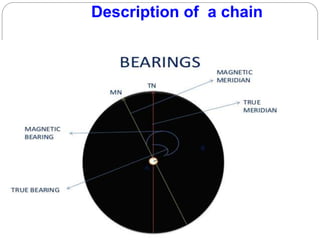
Description of a chain
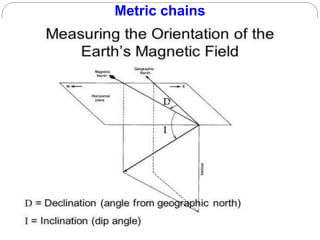
Metric chains
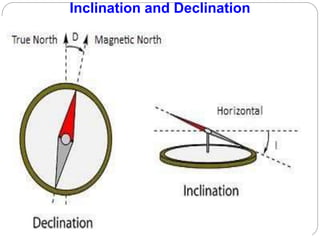
Inclination and Declination
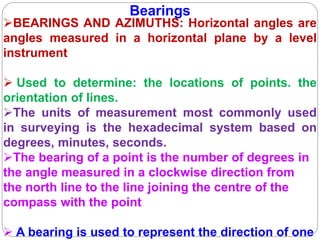
Bearings
BEARINGS AND AZIMUTHS: Horizontal angles are
angles measured in a horizontal plane by a level
instrument
 Used to determine: the locations of points. the
orientation of lines.
The units of measurement most commonly used
in surveying is the hexadecimal system based on
degrees, minutes, seconds.
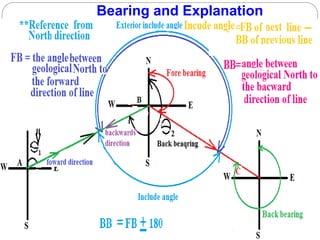
The bearing of a point is the number of degrees in
the angle measured in a clockwise direction from
the north line to the line joining the centre of the
compass with the point
 A bearing is used to represent the direction of one
Bearing and Explanation
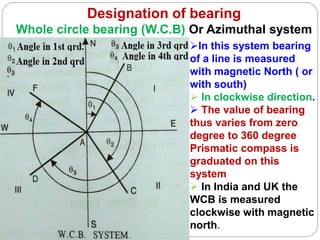
Designation of bearing
Whole circle bearing (W.C.B) Or Azimuthal system
In this system bearing
of a line is measured
with magnetic North ( or
with south)
 In clockwise direction.
 The value of bearing
thus varies from zero
degree to 360 degree
Prismatic compass is
graduated on this
system
 In India and UK the
WCB is measured
clockwise with magnetic
north.
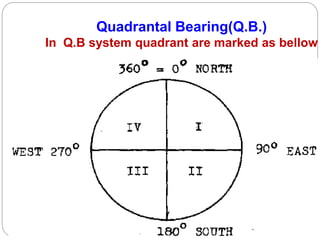
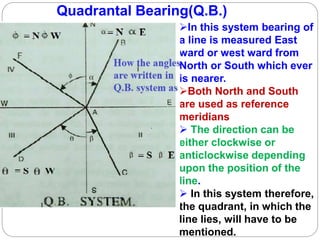
Quadrantal Bearing(Q.B.)
In Q.B system quadrant are marked as bellow
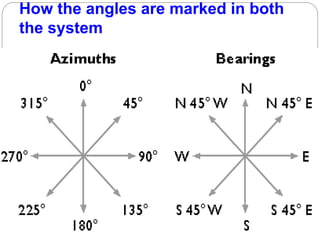
How the angles are marked in both
the system
Quadrantal Bearing(Q.B.)
In this system bearing of
a line is measured East
ward or west ward from
North or South which ever
is nearer.
Both North and South
are used as reference
meridians
 The direction can be
either clockwise or
anticlockwise depending
upon the position of the
line.
 In this system therefore,
the quadrant, in which the
line lies, will have to be
mentioned.
Various type of lines used in surveying
For 2nd quadrantFor 1st Quadrant
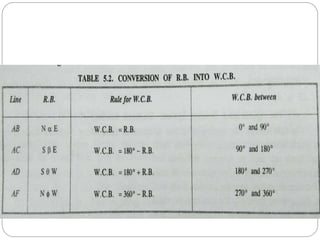
(1) For the first
quadrant
the W.C.B will
be equal to
R.B. because
both of them it
starts from the
north the
directions. for
R.B. direction
will be North to
East (NE)
W.C.B+R.B. = 180° SO [ R.B.=180°-
W.C.B.]
The directions for reduced bearing is
South to East (SE)
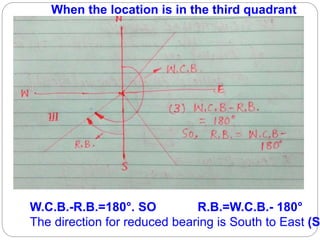
W.C.B.-R.B.=180°. SO R.B.=W.C.B.- 180°
The direction for reduced bearing is South to East (S
When the location is in the third quadrant
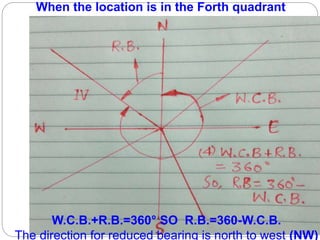
When the location is in the Forth quadrant
W.C.B.+R.B.=360° SO R.B.=360-W.C.B.
The direction for reduced bearing is north to west (NW)
Problem-1
The following interior angles were measured with a sextant in
a
closed traverse, the bearing of the line AB was measured as
60°00´
with prismatic compass. Calculate the bearing of all other line
if A=140°10´; B= 99°8´; C=60°22´ ;D=69°20´
Solution:
To find the bearing of a line = The
measured clockwise angle to the bearing
of the previous line + Include angle
between the line and previous line (In
clockwise direction) - 180°
Then Bearing of line AD = clockwise bearing of line
AB + include angle between
BA and AD
i.e. 140°10´ - 180°
= (60° + 180) + 140°10´ ± 180
= 200°10´
Problem-2
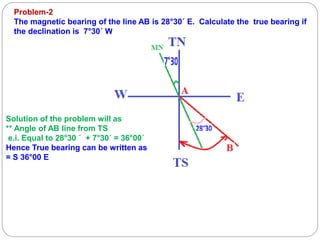
The magnetic bearing of the line AB is 28°30´ E. Calculate the true bearing if
the declination is 7°30´ West.
Solution of the problem will as
** Angle of AB line from TS
e.i. Equal to 28°30 ´ + 7°30´ = 36°00´
Hence True bearing can be written as
= S 36°00 E
Problem-3
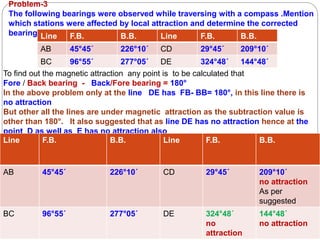
The following bearings were observed while traversing with a compass .Mention
which stations were affected by local attraction and determine the corrected
bearingsLine F.B. B.B. Line F.B. B.B.
AB 45°45´ 226°10´ CD 29°45´ 209°10´
BC 96°55´ 277°05´ DE 324°48´ 144°48´
To find out the magnetic attraction any point is to be calculated that
Fore / Back bearing - Back/Fore bearing = 180°
In the above problem only at the line DE has FB- BB= 180°, in this line there is
no attraction
But other all the lines are under magnetic attraction as the subtraction value is
other than 180°. It also suggested that as line DE has no attraction hence at the
point D as well as E has no attraction also
Line F.B. B.B. Line F.B. B.B.
AB 45°45´ 226°10´ CD 29°45´ 209°10´
no attraction
As per
suggested
BC 96°55´ 277°05´ DE 324°48´
no
attraction
144°48´
no attraction
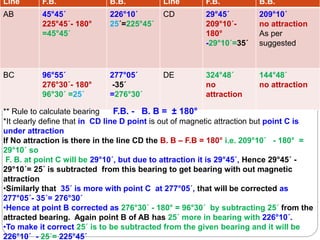
Line F.B. B.B. Line F.B. B.B.
AB 45°45´
225°45´- 180°
=45°45´
226°10´
25´=225°45´
CD 29°45´
209°10´-
180°
-29°10´=35´
209°10´
no attraction
As per
suggested
BC 96°55´
276°30´- 180°
96°30´ =25´
277°05´
-35´
=276°30´
DE 324°48´
no
attraction
144°48´
no attraction
** Rule to calculate bearing F.B. - B. B = ± 180°
*It clearly define that in CD line D point is out of magnetic attraction but point C is
under attraction
If No attraction is there in the line CD the B. B – F.B = 180° i.e. 209°10´ - 180° =
29°10´ so
F. B. at point C will be 29°10´, but due to attraction it is 29°45´, Hence 29°45´ -
29°10´= 25´ is subtracted from this bearing to get bearing with out magnetic
attraction
•Similarly that 35´ is more with point C at 277°05´, that will be corrected as
277°05´- 35´= 276°30´
•Hence at point B corrected as 276°30´ - 180° = 96°30´ by subtracting 25´ from the
attracted bearing. Again point B of AB has 25´ more in bearing with 226°10´.
•To make it correct 25´ is to be subtracted from the given bearing and it will be
226°10´ - 25´= 225°45´
Adjustment in Prismatic compass
The following adjustment are necessary in the piezometric
compass
a) Station or Temporary adjustments
i) Centering ii) Leveling iii) Focusing the prism
b) Permanent adjustments
 The permanent adjustment of prismatic compass are
almost the same as that of the surveyor’s compass
except that there are no bubble tubes to be adjusted and
the needle can not be straightened.
 The sight vanes are not adjustable
i)Centering
Centering is the process of keeping the instrument exactly
over the station
Ordinarily prismatic compass is not provided with fine
centering devices as is generally fitted to engineers
theodolite.
The centering is done by adjusting the legs of tripod
A plum bob may be used to judge the center if it is not
available, it may be judge by dropping a pebble from
the center of the bottom of the instrument
ii) Leveling
If the instrument is a hand instrument, it must be held in
hand in such a way that the graduated disc is swinging freely
and appears to be level as judged from the top edge of the
case.
Generally a tripod is provided with ball and socket
arrangement with the help of which the top of the box can be
leveled
Thank youTo
all

Compass surveying

  • 1.
    (Dr. M KManik) HOD.mechccetb@gmail.com
  • 2.
    Surveying Chain Surveying canbe done when the area of the surveying is Area is flat/level to the ground Comparatively Small compass surveying is recommended But when the area is large There are large many hindrance to pull the chain
  • 3.
    Traversing Traversing is theframe work consist of connecting lines The line are measured by the chain or tape Direction are measured with the help of angle measuring devices called compass Compass surveying direction are measured by compass and distance are measured by tape or chain
  • 4.
    Compass survey A prismaticcompass is used for navigation and for surveying instrument which is extensively used to find out the bearing(Angle) of the traversing and included angles between them, Compass surveying is a type of surveying in which the directions of surveying lines are determined with a magnetic compass,  And the length of the surveying lines are measured with a tape or chain or laser range finder
  • 5.
  • 6.
    The compass isgenerally used to run a traverse line. The compass calculates bearings of lines with respect to magnetic north The included angles can then be calculated using suitable formulas in case of clockwise and anti- clockwise traverse respectively For each survey line in the traverse, surveyors take two bearings that is fore bearing and back bearing which should exactly differ by 180° if local attraction is negligible  The name Prismatic compass is given to it because it essentially consists of a prism which is
  • 7.
    definition and typesof meridian  A circle of constant longitude passing through a given place on the earth's surface and the terrestrial poles A meridian is an imaginary line from the North Pole to the South Pole. Meridians are drawn on maps to help you describe
  • 8.
    The meridian throughGreenwich (inside Greenwich Park), England, called the Prime Meridian, was set at zero degrees of longitude, while other meridians were defined by the angle at the center of the earth between where it and the prime meridian cross the equator Latitude is distance north or south of the equator (an imaginary circle around the Earth halfway between the North Pole and the South Pole) and longitude is distance east or west of the prime meridian (an imaginary line running from north to south through Greenwich, England).
  • 10.
    Earth and itslatitude and longitude
  • 11.
  • 12.
  • 13.
  • 14.
    Bearings BEARINGS AND AZIMUTHS:Horizontal angles are angles measured in a horizontal plane by a level instrument  Used to determine: the locations of points. the orientation of lines. The units of measurement most commonly used in surveying is the hexadecimal system based on degrees, minutes, seconds. The bearing of a point is the number of degrees in the angle measured in a clockwise direction from the north line to the line joining the centre of the compass with the point  A bearing is used to represent the direction of one
  • 15.
  • 16.
    Designation of bearing Wholecircle bearing (W.C.B) Or Azimuthal system In this system bearing of a line is measured with magnetic North ( or with south)  In clockwise direction.  The value of bearing thus varies from zero degree to 360 degree Prismatic compass is graduated on this system  In India and UK the WCB is measured clockwise with magnetic north.
  • 17.
    Quadrantal Bearing(Q.B.) In Q.Bsystem quadrant are marked as bellow
  • 18.
    How the anglesare marked in both the system
  • 19.
    Quadrantal Bearing(Q.B.) In thissystem bearing of a line is measured East ward or west ward from North or South which ever is nearer. Both North and South are used as reference meridians  The direction can be either clockwise or anticlockwise depending upon the position of the line.  In this system therefore, the quadrant, in which the line lies, will have to be mentioned.
  • 20.
    Various type oflines used in surveying
  • 22.
    For 2nd quadrantFor1st Quadrant (1) For the first quadrant the W.C.B will be equal to R.B. because both of them it starts from the north the directions. for R.B. direction will be North to East (NE) W.C.B+R.B. = 180° SO [ R.B.=180°- W.C.B.] The directions for reduced bearing is South to East (SE)
  • 23.
    W.C.B.-R.B.=180°. SO R.B.=W.C.B.-180° The direction for reduced bearing is South to East (S When the location is in the third quadrant
  • 24.
    When the locationis in the Forth quadrant W.C.B.+R.B.=360° SO R.B.=360-W.C.B. The direction for reduced bearing is north to west (NW)
  • 25.
    Problem-1 The following interiorangles were measured with a sextant in a closed traverse, the bearing of the line AB was measured as 60°00´ with prismatic compass. Calculate the bearing of all other line if A=140°10´; B= 99°8´; C=60°22´ ;D=69°20´ Solution: To find the bearing of a line = The measured clockwise angle to the bearing of the previous line + Include angle between the line and previous line (In clockwise direction) - 180° Then Bearing of line AD = clockwise bearing of line AB + include angle between BA and AD i.e. 140°10´ - 180° = (60° + 180) + 140°10´ ± 180 = 200°10´
  • 26.
    Problem-2 The magnetic bearingof the line AB is 28°30´ E. Calculate the true bearing if the declination is 7°30´ West. Solution of the problem will as ** Angle of AB line from TS e.i. Equal to 28°30 ´ + 7°30´ = 36°00´ Hence True bearing can be written as = S 36°00 E
  • 27.
    Problem-3 The following bearingswere observed while traversing with a compass .Mention which stations were affected by local attraction and determine the corrected bearingsLine F.B. B.B. Line F.B. B.B. AB 45°45´ 226°10´ CD 29°45´ 209°10´ BC 96°55´ 277°05´ DE 324°48´ 144°48´ To find out the magnetic attraction any point is to be calculated that Fore / Back bearing - Back/Fore bearing = 180° In the above problem only at the line DE has FB- BB= 180°, in this line there is no attraction But other all the lines are under magnetic attraction as the subtraction value is other than 180°. It also suggested that as line DE has no attraction hence at the point D as well as E has no attraction also Line F.B. B.B. Line F.B. B.B. AB 45°45´ 226°10´ CD 29°45´ 209°10´ no attraction As per suggested BC 96°55´ 277°05´ DE 324°48´ no attraction 144°48´ no attraction
  • 28.
    Line F.B. B.B.Line F.B. B.B. AB 45°45´ 225°45´- 180° =45°45´ 226°10´ 25´=225°45´ CD 29°45´ 209°10´- 180° -29°10´=35´ 209°10´ no attraction As per suggested BC 96°55´ 276°30´- 180° 96°30´ =25´ 277°05´ -35´ =276°30´ DE 324°48´ no attraction 144°48´ no attraction ** Rule to calculate bearing F.B. - B. B = ± 180° *It clearly define that in CD line D point is out of magnetic attraction but point C is under attraction If No attraction is there in the line CD the B. B – F.B = 180° i.e. 209°10´ - 180° = 29°10´ so F. B. at point C will be 29°10´, but due to attraction it is 29°45´, Hence 29°45´ - 29°10´= 25´ is subtracted from this bearing to get bearing with out magnetic attraction •Similarly that 35´ is more with point C at 277°05´, that will be corrected as 277°05´- 35´= 276°30´ •Hence at point B corrected as 276°30´ - 180° = 96°30´ by subtracting 25´ from the attracted bearing. Again point B of AB has 25´ more in bearing with 226°10´. •To make it correct 25´ is to be subtracted from the given bearing and it will be 226°10´ - 25´= 225°45´
  • 29.
    Adjustment in Prismaticcompass The following adjustment are necessary in the piezometric compass a) Station or Temporary adjustments i) Centering ii) Leveling iii) Focusing the prism b) Permanent adjustments  The permanent adjustment of prismatic compass are almost the same as that of the surveyor’s compass except that there are no bubble tubes to be adjusted and the needle can not be straightened.  The sight vanes are not adjustable
  • 30.
    i)Centering Centering is theprocess of keeping the instrument exactly over the station Ordinarily prismatic compass is not provided with fine centering devices as is generally fitted to engineers theodolite. The centering is done by adjusting the legs of tripod A plum bob may be used to judge the center if it is not available, it may be judge by dropping a pebble from the center of the bottom of the instrument ii) Leveling If the instrument is a hand instrument, it must be held in hand in such a way that the graduated disc is swinging freely and appears to be level as judged from the top edge of the case. Generally a tripod is provided with ball and socket arrangement with the help of which the top of the box can be leveled
  • 31.