
1
2
VITAMIN B12
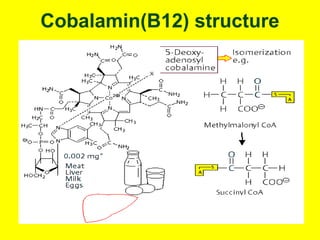
• Cobalamin was not discovered until 1948;
its structure became known in 1955.
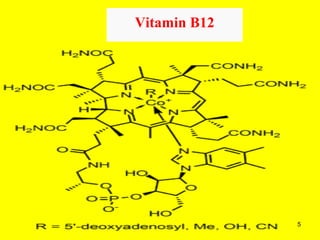
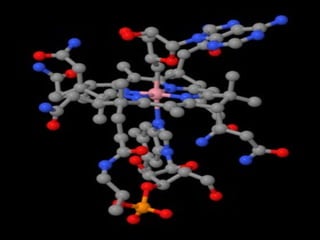
Chemically, cobalamin is a corrin ring
system consisting of pyrrole rings that hold
in their centre a Co atom, to which
variable ligands (R) are attached.
Cobalamin(B12) structure
5
Vitamin B12
6
7
VITAMIN B12
vitamin B12 is complex organomatrix
compound called as cobalamine which is
cobalt containing porphyrin.
it is freely soluble in water.
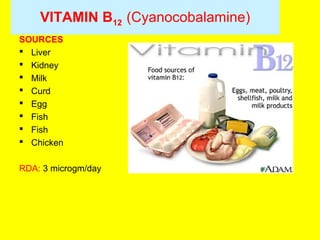
VITAMIN B12 (Cyanocobalamine)
SOURCES
 Liver
 Kidney
 Milk
 Curd
 Egg
 Fish
 Fish
 Chicken
RDA: 3 microgm/day
Absorption & excretion
The presence of sufficient gastric juice is
essential to facilitate its absorption in
intestine.
Storage – liver.
Excretion –feces and urine & breast milk
10
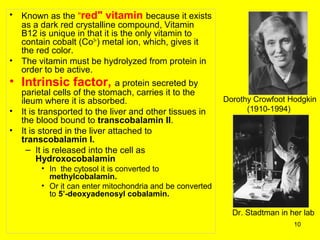
• Known as the "red" vitamin because it exists
as a dark red crystalline compound, Vitamin
B12 is unique in that it is the only vitamin to
contain cobalt (Co3+
) metal ion, which, gives it
the red color.
• The vitamin must be hydrolyzed from protein in
order to be active.
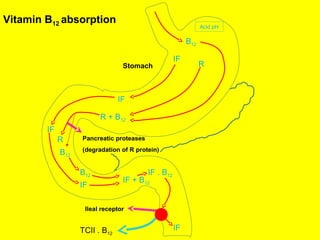
• Intrinsic factor, a protein secreted by
parietal cells of the stomach, carries it to the
ileum where it is absorbed.
• It is transported to the liver and other tissues in
the blood bound to transcobalamin II.
• It is stored in the liver attached to
transcobalamin I.
– It is released into the cell as
Hydroxocobalamin
• In the cytosol it is converted to
methylcobalamin.
• Or it can enter mitochondria and be converted
to 5’-deoxyadenosyl cobalamin.
Dorothy Crowfoot Hodgkin
(1910-1994)
Dr. Stadtman in her lab
B12
R + B12
B12
B12
IF + B12
IF . B12
TCII . B12
IF
IF
IF
IF
IF
R
R
Pancreatic proteases
(degradation of R protein)
Acid pH
Ileal receptor
Stomach
Vitamin B12 absorption
• Metabolism
• hepatic
• Half-life
• Approximately 6 days
(400 days in the liver)
• Excretion
• renal
FUNCTION:
 Required with folic acid for development of RBCs.
 Stimulates appetite and required for normal
health.
 Cures neurological symptoms of pernicious
anaemia.
15
FUNCTION
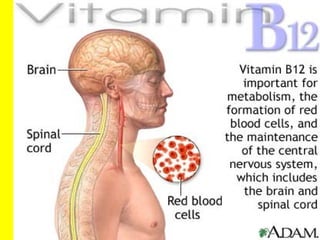
Red Blood Cells – it is essential for production
of RBCs
Nervous – It improves concentration, memory,
& balance.
It is important for metabolism of fat,
carbohydrate ,proteins, folic acid.
It promotes growth and increases apatite.
BIOCHEMICAL FUNCTIONS OF B12
1. Methylmalonyl-CoA-isomerase: It
catalyzes the reaction using B12 as a
coenzyme
Methylmalonyl-CoA → succinyl-CoA
2. Methionine synthase or homocysteine
methyl transferase requires B12 as
coenzyme:
3. Conversion of Ribonucleotide to
deoxyribonucleotide also needs B12. It is
important in the synthesis of DNA hence
deficiency of B12 leads to the defective
synthesis of DNA.
4. Role as Hemopoietic Factor: Like folic acid,
vitamin B12 is also concerned with
hemopoiesis and is needed for maturation
of RBCs.
5. Abnormal Homocysteine Level: In
vitamin B12 deficiency, Homocysteine
Conversion to methionine a block so that
homocysteine is accumulated, leading to
homocystienuria. Homocysteine level in
blood is related with myocardial
infarction. So1, B12 is protective against
cardiac disease.
Demyelination and Neurological Deficits: In
B12 deficiency, methylation of
phosphatidyl ethanolamine to phosphatidyl
choline is not adequate. This leads to
deficient formation of myelin sheaths of
nerves, demyelination and neurological
lesions.
20
Daily requirement
Men – women – 1 mcg
Children –.2-1 mcg.
Infant – 0.2 mcg
CAUSES OF B12 DEFICIENCY:
1. Nutritional B12 deficiency.
2. Decrease in absorption due to non-
availability of absorptive sufface caused
by gastrectomy, resection of ileum, blind
loop syndrome.
3. Elderly people are unable to absorb B12
4. Addisonian anemia is pernicious [fatal] without
any remedy. It is manifested in persons 40
years of age. It is an autoimmune disease and
antibodies are formed against IF. The
deficiency of IF leads to defective absorption of
B12.
5. Atrophy of gastric epithelium: It leads to
decreased IF and decreased absorption of
B12.
6. Drugs: Some drugs interfere with
absorption of B12. These are phenphormin,
cholchicine, neomycine, ethanol and KCl.
7. Increased requirement of B12 in pregnancy
is common cause for vitamin B12
deficiency.
24
DEFICIENCY
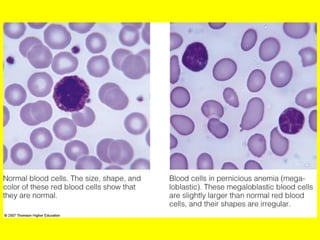
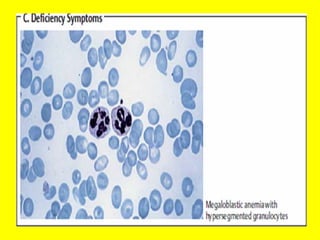
ANEMIA it leads to Megaloblastic or
pernicious anemia
Demyelination & irreversible nerve cell death.
ORAL
There is sore painful tongue, glossitis and
glossodynia.
Tongue is inflamed & beefy red in colour
small shallow ulcers resembling Apthous
ulcers on the tongue with atrophy of papillae
with a loss of normal muscle tone is called
hunters glossitis
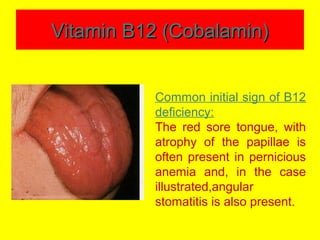
Vitamin B12 (Cobalamin)Vitamin B12 (Cobalamin)
Common initial sign of B12
deficiency:
The red sore tongue, with
atrophy of the papillae is
often present in pernicious
anemia and, in the case
illustrated,angular
stomatitis is also present.
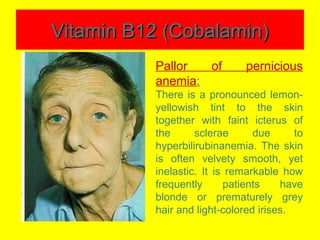
Vitamin B12 (Cobalamin)Vitamin B12 (Cobalamin)
Pallor of pernicious
anemia:
There is a pronounced lemon-
yellowish tint to the skin
together with faint icterus of
the sclerae due to
hyperbilirubinanemia. The skin
is often velvety smooth, yet
inelastic. It is remarkable how
frequently patients have
blonde or prematurely grey
hair and light-colored irises.
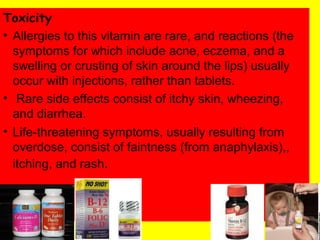
Toxicity
• Allergies to this vitamin are rare, and reactions (the
symptoms for which include acne, eczema, and a
swelling or crusting of skin around the lips) usually
occur with injections, rather than tablets.
• Rare side effects consist of itchy skin, wheezing,
and diarrhea.
• Life-threatening symptoms, usually resulting from
overdose, consist of faintness (from anaphylaxis),,
itching, and rash.
31
MANAGEMENT
oral – in a dose from 6 to 150mcg. taken
in these doses it helps in the treatment of
lack of concentration, depression, poor
memory
parental – 1000mcg of vitamin given twice
weekly in cases of anemia
BIOCHEMISTRY PEARLS
Vitamin B12 (cobalamin) plays a critical
role in DNA synthesis and neurologic
function.
Cobalmin deficiency can lead to a wide
spectrum of hematologic,
neuropsychiatric, and cardiovascular
disorders that can often be reversed by
early diagnosis and prompt treatment.
Cobalamin absorption from the
gastrointestinal tract requires the
presence of a protein (the intrinsic factor,
IF) secreted from the parietal cells the
stomach to bind cobalamin and aid in its
absorption in ileum.
• A 38-year old vegetarian (vegan)
Caucasian female presents to her primary
care doctor with fatigue and tingling/
numbness in her extremities (bilateral).
The symptoms have been gradually
getting worse over the last year. Upon
further questioning she reports frequent
episodes of diarrhea and weight loss.
• On exam, she is pale and tachycardic. Her
tongue is beefy red and a neurologic
exam reveals numbness in all extremities
with decreased vibration senses. A CBC
demonstrates megaloblastic anemia.
What is the most likely diagnosis?
What is the most likely underlying problem
for this patient?
What are the two most common causes of
megaloblastic anemia and how would this
patient’s history and examination
differentiate the two?

Vitamin B12 MUHAMMAD MUSTANSAR

  • 1.
  • 2.
  • 3.
    • Cobalamin wasnot discovered until 1948; its structure became known in 1955. Chemically, cobalamin is a corrin ring system consisting of pyrrole rings that hold in their centre a Co atom, to which variable ligands (R) are attached.
  • 4.
  • 5.
  • 6.
  • 7.
    7 VITAMIN B12 vitamin B12is complex organomatrix compound called as cobalamine which is cobalt containing porphyrin. it is freely soluble in water.
  • 8.
    VITAMIN B12 (Cyanocobalamine) SOURCES Liver  Kidney  Milk  Curd  Egg  Fish  Fish  Chicken RDA: 3 microgm/day
  • 9.
    Absorption & excretion Thepresence of sufficient gastric juice is essential to facilitate its absorption in intestine. Storage – liver. Excretion –feces and urine & breast milk
  • 10.
    10 • Known asthe "red" vitamin because it exists as a dark red crystalline compound, Vitamin B12 is unique in that it is the only vitamin to contain cobalt (Co3+ ) metal ion, which, gives it the red color. • The vitamin must be hydrolyzed from protein in order to be active. • Intrinsic factor, a protein secreted by parietal cells of the stomach, carries it to the ileum where it is absorbed. • It is transported to the liver and other tissues in the blood bound to transcobalamin II. • It is stored in the liver attached to transcobalamin I. – It is released into the cell as Hydroxocobalamin • In the cytosol it is converted to methylcobalamin. • Or it can enter mitochondria and be converted to 5’-deoxyadenosyl cobalamin. Dorothy Crowfoot Hodgkin (1910-1994) Dr. Stadtman in her lab
  • 11.
    B12 R + B12 B12 B12 IF+ B12 IF . B12 TCII . B12 IF IF IF IF IF R R Pancreatic proteases (degradation of R protein) Acid pH Ileal receptor Stomach Vitamin B12 absorption
  • 12.
    • Metabolism • hepatic •Half-life • Approximately 6 days (400 days in the liver) • Excretion • renal
  • 14.
    FUNCTION:  Required withfolic acid for development of RBCs.  Stimulates appetite and required for normal health.  Cures neurological symptoms of pernicious anaemia.
  • 15.
    15 FUNCTION Red Blood Cells– it is essential for production of RBCs Nervous – It improves concentration, memory, & balance. It is important for metabolism of fat, carbohydrate ,proteins, folic acid. It promotes growth and increases apatite.
  • 16.
    BIOCHEMICAL FUNCTIONS OFB12 1. Methylmalonyl-CoA-isomerase: It catalyzes the reaction using B12 as a coenzyme Methylmalonyl-CoA → succinyl-CoA 2. Methionine synthase or homocysteine methyl transferase requires B12 as coenzyme:
  • 17.
    3. Conversion ofRibonucleotide to deoxyribonucleotide also needs B12. It is important in the synthesis of DNA hence deficiency of B12 leads to the defective synthesis of DNA. 4. Role as Hemopoietic Factor: Like folic acid, vitamin B12 is also concerned with hemopoiesis and is needed for maturation of RBCs.
  • 18.
    5. Abnormal HomocysteineLevel: In vitamin B12 deficiency, Homocysteine Conversion to methionine a block so that homocysteine is accumulated, leading to homocystienuria. Homocysteine level in blood is related with myocardial infarction. So1, B12 is protective against cardiac disease.
  • 19.
    Demyelination and NeurologicalDeficits: In B12 deficiency, methylation of phosphatidyl ethanolamine to phosphatidyl choline is not adequate. This leads to deficient formation of myelin sheaths of nerves, demyelination and neurological lesions.
  • 20.
    20 Daily requirement Men –women – 1 mcg Children –.2-1 mcg. Infant – 0.2 mcg
  • 21.
    CAUSES OF B12DEFICIENCY: 1. Nutritional B12 deficiency. 2. Decrease in absorption due to non- availability of absorptive sufface caused by gastrectomy, resection of ileum, blind loop syndrome. 3. Elderly people are unable to absorb B12
  • 22.
    4. Addisonian anemiais pernicious [fatal] without any remedy. It is manifested in persons 40 years of age. It is an autoimmune disease and antibodies are formed against IF. The deficiency of IF leads to defective absorption of B12. 5. Atrophy of gastric epithelium: It leads to decreased IF and decreased absorption of B12.
  • 23.
    6. Drugs: Somedrugs interfere with absorption of B12. These are phenphormin, cholchicine, neomycine, ethanol and KCl. 7. Increased requirement of B12 in pregnancy is common cause for vitamin B12 deficiency.
  • 24.
    24 DEFICIENCY ANEMIA it leadsto Megaloblastic or pernicious anemia Demyelination & irreversible nerve cell death. ORAL There is sore painful tongue, glossitis and glossodynia.
  • 25.
    Tongue is inflamed& beefy red in colour small shallow ulcers resembling Apthous ulcers on the tongue with atrophy of papillae with a loss of normal muscle tone is called hunters glossitis
  • 28.
    Vitamin B12 (Cobalamin)VitaminB12 (Cobalamin) Common initial sign of B12 deficiency: The red sore tongue, with atrophy of the papillae is often present in pernicious anemia and, in the case illustrated,angular stomatitis is also present.
  • 29.
    Vitamin B12 (Cobalamin)VitaminB12 (Cobalamin) Pallor of pernicious anemia: There is a pronounced lemon- yellowish tint to the skin together with faint icterus of the sclerae due to hyperbilirubinanemia. The skin is often velvety smooth, yet inelastic. It is remarkable how frequently patients have blonde or prematurely grey hair and light-colored irises.
  • 30.
    Toxicity • Allergies tothis vitamin are rare, and reactions (the symptoms for which include acne, eczema, and a swelling or crusting of skin around the lips) usually occur with injections, rather than tablets. • Rare side effects consist of itchy skin, wheezing, and diarrhea. • Life-threatening symptoms, usually resulting from overdose, consist of faintness (from anaphylaxis),, itching, and rash.
  • 31.
    31 MANAGEMENT oral – ina dose from 6 to 150mcg. taken in these doses it helps in the treatment of lack of concentration, depression, poor memory parental – 1000mcg of vitamin given twice weekly in cases of anemia
  • 32.
    BIOCHEMISTRY PEARLS Vitamin B12(cobalamin) plays a critical role in DNA synthesis and neurologic function. Cobalmin deficiency can lead to a wide spectrum of hematologic, neuropsychiatric, and cardiovascular disorders that can often be reversed by early diagnosis and prompt treatment.
  • 33.
    Cobalamin absorption fromthe gastrointestinal tract requires the presence of a protein (the intrinsic factor, IF) secreted from the parietal cells the stomach to bind cobalamin and aid in its absorption in ileum.
  • 34.
    • A 38-yearold vegetarian (vegan) Caucasian female presents to her primary care doctor with fatigue and tingling/ numbness in her extremities (bilateral). The symptoms have been gradually getting worse over the last year. Upon further questioning she reports frequent episodes of diarrhea and weight loss.
  • 35.
    • On exam,she is pale and tachycardic. Her tongue is beefy red and a neurologic exam reveals numbness in all extremities with decreased vibration senses. A CBC demonstrates megaloblastic anemia.
  • 36.
    What is themost likely diagnosis? What is the most likely underlying problem for this patient? What are the two most common causes of megaloblastic anemia and how would this patient’s history and examination differentiate the two?