CARCINOGENS
CANCER
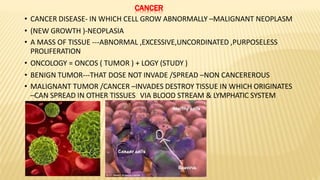
• CANCER DISEASE- IN WHICH CELL GROW ABNORMALLY –MALIGNANT NEOPLASM
• (NEW GROWTH )-NEOPLASIA
• A MASS OF TISSUE ---ABNORMAL ,EXCESSIVE,UNCORDINATED ,PURPOSELESS
PROLIFERATION
• ONCOLOGY = ONCOS ( TUMOR ) + LOGY (STUDY )
• BENIGN TUMOR---THAT DOSE NOT INVADE /SPREAD –NON CANCEREROUS
• MALIGNANT TUMOR /CANCER –INVADES DESTROY TISSUE IN WHICH ORIGINATES
–CAN SPREAD IN OTHER TISSUES VIA BLOOD STREAM & LYMPHATIC SYSTEM
PROPERTIES OF CANCERCELLS
• UNRESTRAINED GROWTH
• INVANSION OF LOCAL TISSUE
• METASTASIS
MORPHOLOGICAL CHANGES
SHAPE ---ROUNDER
MOTILITY ---LOSS OF CONTACT INHIBITION OF MOVEMENTS
GROWTH --- LOSS OF CONTACT INHIBITION –MULTILAYER /NUMBER OF NUCLEI
BIOCHEMICAL CHANGES
ALTERED GENE REGULATION ---DNA SYNTHESIS ---RNA SYNTHESIS ---PROTEIN
SYNTHESIS---ANABOLISM---GROWTH
BIOCHEMICAL CHANGES
ALTERED GENE REGULATION
INCREASED DNA SYNTHESIS
INCREASED RNA SYNTHESIS
 INCREASED PROTEIN SYNTHESIS
ANABOLISM---GROWTH FACTORS &HORMONES
INCREASED AEROBIC & ANAEROBIC GLYCOLYSIS
SYNTHESIS OF LACTIC ACID & LACTIC ACIDOSIS
ALTERATION OF CELL SURFACE DUE CHANGES IN COMPOSITION OF
GLYCOPROTEINS & GLYCOSPHINGOLIPIDS
DECREASED
BIOCHEMICAL CHANGES
• CARCINOMAS –CANCER ARISES FROM EPITHELIAL TISSUE
• SARCOMAS –MESENCHYMAL TISSUE
• LEUKAEMIAS-WBC
• LYMPHOMAS
• HEPATOMAS –HEPATOCYTES
ETIOLOGY
FAMILIAL GENETIC FACTOR
GEOGRAPHIC FACTORS
• ASIANS-NASOPHARYNGEAL
• JAPNESE –BREAST
• AFRICA –SKIN
• EUROPEANS--COLON
• ENVRIMENTAL FACTORS
• AGE->50YRS
• SEX- MEN >WOMEN
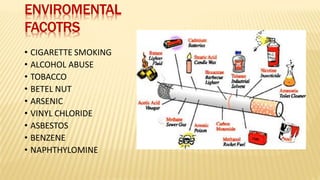
ENVIROMENTAL
FACOTRS
• CIGARETTE SMOKING
• ALCOHOL ABUSE
• TOBACCO
• BETEL NUT
• ARSENIC
• VINYL CHLORIDE
• ASBESTOS
• BENZENE
• NAPHTHYLOMINE
PHYSICAL CARCINOGENS
• RADIENT ENERGY ---UV LIGHT ,IONIZING RADIATIONS
• EXAMPLS –SUNLIGHT ,WELDERS ARC ,UV LAMPS ---SKIN CANCER
• FORMATION OF PYRIMIDINE DIMER IN DNA STRAND
• FORMATION OF APURINIC OR APYRIMIDINE SITE ELIMINATION OF BASES
• BREAKING OF CROSS LINKING OF SINGLE OR DOUBLE STRAND OF DNA
IONIZING RADIATIONS –X RAYS ,ALPHA ,BETA ,GAMMA RAYS ,RADIOACTIVE
ISOTOPES ,PROTONS ,NEUTRONS
• IONIZING RADIATIONS---DAMAGE DNA ,DISLODGE IONS FROM H2O&
BIOMOLECULES ,INTERACT WITH PROTEINS, DNA-----CANCER
(MUTAGENESIS)
HORMONAL
CARCINOGENESIS
• HORMONE SENSITIVE TISSUE ---BREAST ,ENDOMETRIUM,
MYOMETRIUM,VAGINA THYROID, ,LIVER ,PROSTRATE,TESTIES
• ESTROGENS---OVARIAN,ENDOMETRIUM CARCINOMA
• CONTRACEPTIVE HORMONES ---BREAST CANCER
• ANABOLIC STEROIDS---ATHLETS,LIVER CANCER
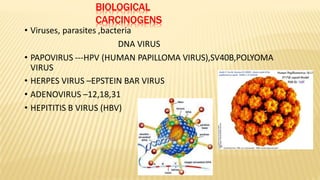
BIOLOGICAL
CARCINOGENS
• Viruses, parasites ,bacteria
DNA VIRUS
• PAPOVIRUS ---HPV (HUMAN PAPILLOMA VIRUS),SV40B,POLYOMA
VIRUS
• HERPES VIRUS –EPSTEIN BAR VIRUS
• ADENOVIRUS –12,18,31
• HEPITITIS B VIRUS (HBV)
RNA
VIRUS
ACUTE TRANSFORMING VIRUS :ROUS SARCOMA VIRUS :LEUKEMIA
VIRUS
SLOW TRANSFORMING :MOUSE MAMMARY TUMOR VIRUS
HUMAN T CELL LYMPHOTROPIC VIRUS --- HTLV -1,HTLV II
RNA REVERSE TRANSCRIPATASE
RNA –DNA NEOPLASIA
NOT ALL RETROVIRUSES ARE CARCINOGENIC
CHEMICAL CARCINOGENS
WHAT IS A CARCINOGEN?
Any substance that is capable of causing cancer.
Cancer is the abnormal or uncontrolled growth of new cells in any part of
the body, characterized by cells that tend to invade
surrounding tissue and metastasize to new body sites.
Carcinogens are chronic toxins. They cause damage after repeated or long-
duration exposure. They may have not immediate apparent
harmful effects, with cancer developing only after a long latency period.
CARCINOGENESIS &CHEMICAL CARCINOGENS
INITIATORS
DIRECT –DO NOT REQUIRE METABOLIC ACTIVATION
EXAMPLES ---ALKYLATING AGENTS—
CYCLOPHOSPAHMIDE
ACYLATING AGENTS-- NITROSOUREA
WHAT ARE REPRODUCTIVE TOXINS?
Mutagens
cause damage to chromo- somes
by introducing changes to DNA.
Mutagens have adverse effects
on fertility and general
reproductive performance.
Mutagens are chronic toxins
Teratogens
act during pregnancy to cause
adverse effects on the embryo or
fetus including malformations,
retarded growth and post- natal
deficiencies.
Reproductive toxins can affect
both men and women.
WHAT MATERIALS ARE CARCINOGENS?
Asbestos
Certain chemicals
Coal tars and coke oven emissions Hardwood
sawdust (certain species) Ionizing radiation
Natural products (progesterone, safrole) Tobacco
smoke
Ultraviolet radiation
WHAT IS A CHEMICAL CARCINOGEN?
Any discrete chemical compound which has been shown
to cause cancer in human or animal studies.
Hundreds of individual compounds have been shown
to induce cancers. Many thousands of
additional compounds are “suspect” carcinogens.
Many are commonly used in laboratory operations,
shops and art studios.
HOW IS CHEMICAL CARCINOGENICITY DETERMINED?
Epidemiological studies determine the relationship between a cancer
suspect chemical and a human population over a long period of time.
Animal studies directly induce cancer in test animals using a large sample of
animals, usually of two or more species with varying dose and time
parameters.
Experiments with animals are based on the premise that chemicals that
produce cancer in animals will have similar effects on human cells.
Most known human carcinogens produce cancer in
experimental animals.
WHICH CLASSES OF CHEMICALS TEND TO BE CARCINOGENS?
 Epoxides:
 Ethylene oxide Propylene
oxide
 Organohalogen comp.:
Vinyl chloride Carbon
tetrachloride Chloroform
 Hexachlorobenzene
Trichloroethylene
 Hydrazines:
 Hydrazine (and salts) 1,2-
Dimethylhydrazine
 N-Nitroso compounds:
 N-Nitrosodimethylamine
 Aromatic Amines:
Benzidine Aniline
 o-Anisidine o-Toluidine
 Aromatic hydrocarbons:
Benzene Benz[a]anthracene
Benzo[a]pyrene
CLASSES OF CARCINOGENS (CONT.)
Misc. organic compounds:
Formaldehyde Acetaldehyde
1,4-Dioxane Ethyl
carbamate 2-Nitropropane
Styrene Thiourea
Thioacetamide
Misc. inorganic comp.: Arsenic
and compounds Chromium and
comp.
Thorium dioxide Beryllium and
compounds Cadmium and
compounds Lead and compounds
Nickel and compounds Selenium
sulfide
HOW DO CARCINOGENS ENTER THE
BODY?
Skin absorption. Many solvents and other chemicals
go directly through the skin.
Ingestion. Swallowing of a carcinogen.
Inhalation. Breathing gases, fumes and vapors is the
most common form of exposure.
WHAT ORGANS TO CARCINOGENS ATTACK?
Lungs Liver
Kidney
Reproductive system Skin
Many other organs and tissues
WHAT FACTORS INFLUENCE THE DEVELOPMENT OF CANCER?
Dose--amount and length of exposure. The lower the dose the
least likely you are to develop cancer or related diseases.
Environmental or “lifestyle” factors.
Cigarette smoking (co-carcinogen) Alcohol consumption
(co-carcinogen)
Diet--high fat consumption, natural antioxidants Geographic
location--industrial areas, UV light Therapeutic drugs--some are
known carcinogens Inherited conditions
HOW DO I REDUCE MY EXPOSURE TO CARCINOGENS?
Engineering controls--exhaust ventilation and equipment Personal
protective equipment
Personal hygiene
Labeling and storage of containers Housekeeping
and maintenance Regulated areas
Decontamination and emergency procedures Monitoring
Administrative controls
ENGINEERING CONTROLS--EXHAUST VENTILATION AND EQUIPMENT
Fume hoods--full open face velocity of 80 to 100 f.p.m.
Local ventilation--exhaust (sometimes supply) at the point of use of a
chemical. “Elephant trunk” or slot hood.
Carcinogen glove box or environmental chamber. Biosafety cabinet--
used for anticancer drugs, viruses. No benchtop work in a laboratory
setting.
PERSONAL HYGIENE
No smoking, eating, drinking or application of cosmetics is permitted in areas
where carcinogens are in use (or in any lab area!). No mouth pipetting!
Wash hands and any exposed skin if potentially contaminated--
face, neck, forearms, etc.
No shorts or open toed shoes.
Remove lab coat or other potentially contaminated protective clothing
before leaving the work area.Lab coats need to be cleaned regularly;
special washing instructions may be needed. Contaminated
disposable clothing should be treated as hazardous waste
HOW DO I DISPOSE OF WASTE CARCINOGENS?
Carcinogens may never be disposed of in the ordinary
trash or be discharged to the sanitary sewer.
Waste bottles must be properly labeled, tightly capped
at all times (except when adding or removing waste)
and they must have secondary containment.
CARCINOGENESIS & CHEMICAL
CARCINOGENS
INDIRECT –
AROMATIC HYDROCARBONS---BENZOPYRENES
TOBACO
COAL
TAR
SMOKE
AROMATIC AMINES
NATURALLY OCCURING
AZO DYES
BETA NAPHTHYL AMINE
ACETALAMINO FLUORENE
ALF TOXIN
BETEL NUT
MISCELLENEOUS ----- VINYL CHLORIDE ,ASBESTOS ,NI, CARBON MONOXIDE
APOPTOSIS
• Dropping /falling of the normal programmed destruction of cells
.,during embryogenesis, development of adult life.
• Destruction of apoptosis promote inappropriate cell division ,cell
survival ---development of cancer
Proto-oncogenes –normal genes –stimulate celldivision
Proto-oncogenes (activated by physical, chemical, biological carcinogens )-----
oncogenes ---growth factor ,growth factor receptors ,signal transductionproteins
Tumor suppressor gene –inhibit cell division
Normal cell –balanced activity of tumor suppressor & protooncogene activator
genes ---normal growth & repair
Neoplasia –uncontrol cell division ---(1)decreased suppressor activity
(2)increased proto-oncogene activity
ONCOGENE
EXPRESSION
proto –oncogenes control normal growth &cell division
Mutated versions of proto-oncogenes act as oncogenes
examples
• Growth factors
• Growth factor receptors
• Protein involved in signal transduction(protein kinase that phosphorylates
tyrosine /serine residue )---GTP binding protein
• Proteins involved in signaling gene expression in nucleus
• some growth factor induce growth but not cell division –cell grows large in size
without ever dividing
• 50 types of growth factors identified –first platelet diving growth factor(PDGF)
MECHANISMS OF ACTIVATION OF PROTO-ONCOGENES
TOONCOGENES
• Promoter and enhancer insertion
• Chromosomal translocation
• Gene amplification
• Point mutation
• Effect of oncogene on growth ---putting one foot on accelerator of
automobile
• Tumor suppressor gene ---taking one foot from the break
TUMOR
MARKERS
• DEFINITION –BIOLOGICAL SUBSTANCES SYNTHESIZED OR RELEASED
BY CANCER CELLS AND FOUND IN INCREASED AMOUNT IN BLOOD
,BODY FLUID OR TISSUES INDICATING PRESENCE OF CANCER
APPLICATIONS OF TUMOR MARKERS
• DIAGNOSIS (SCREENING )
• DIFFENTIAL DIAGNOSIS
• STAGING OF CANCER
• DETECTION OF RECURRENCE
• MONITORING RESPOSE TO THERAPY (PROGNOSIS)
TUMOR
MARKERS
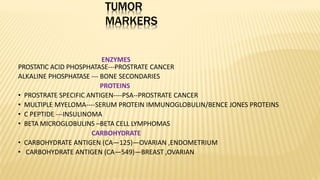
ENZYMES
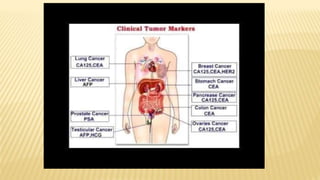
PROSTATIC ACID PHOSPHATASE---PROSTRATE CANCER
ALKALINE PHOSPHATASE --- BONE SECONDARIES
PROTEINS
• PROSTRATE SPECIFIC ANTIGEN----PSA--PROSTRATE CANCER
• MULTIPLE MYELOMA----SERUM PROTEIN IMMUNOGLOBULIN/BENCE JONES PROTEINS
• C PEPTIDE ---INSULINOMA
• BETA MICROGLOBULINS –BETA CELL LYMPHOMAS
CARBOHYDRATE
• CARBOHYDRATE ANTIGEN (CA—125)—OVARIAN ,ENDOMETRIUM
• CARBOHYDRATE ANTIGEN (CA—549)—BREAST ,OVARIAN
TUMOR
MARKERS
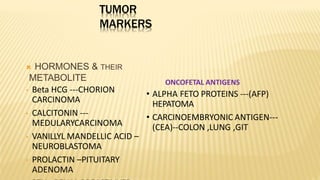
 HORMONES & THEIR
METABOLITE
• Beta HCG ---CHORION
CARCINOMA
• CALCITONIN ---
MEDULARYCARCINOMA
• VANILLYL MANDELLIC ACID –
NEUROBLASTOMA
• PROLACTIN –PITUITARY
ADENOMA
ONCOFETAL ANTIGENS
• ALPHA FETO PROTEINS ---(AFP)
HEPATOMA
• CARCINOEMBRYONIC ANTIGEN---
(CEA)--COLON ,LUNG ,GIT
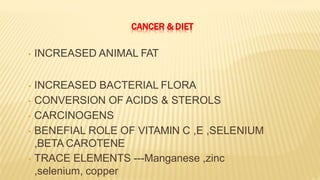
CANCER & DIET
• INCREASED ANIMAL FAT
• INCREASED BACTERIAL FLORA
• CONVERSION OF ACIDS & STEROLS
• CARCINOGENS
• BENEFIAL ROLE OF VITAMIN C ,E ,SELENIUM
,BETA CAROTENE
• TRACE ELEMENTS ---Manganese ,zinc
,selenium, copper
CANCER THERAPY
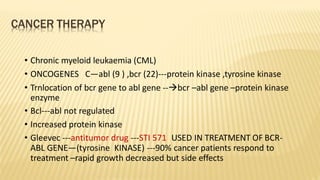
• Chronic myeloid leukaemia (CML)
• ONCOGENES C—abl (9 ) ,bcr (22)---protein kinase ,tyrosine kinase
• Trnlocation of bcr gene to abl gene --bcr –abl gene –protein kinase
enzyme
• Bcl---abl not regulated
• Increased protein kinase
• Gleevec ---antitumor drug ---STI 571 USED IN TREATMENT OF BCR-
ABL GENE—(tyrosine KINASE) ---90% cancer patients respond to
treatment –rapid growth decreased but side effects
IMAGES FROM GOOGLE

Carcinogen

  • 1.
  • 2.
    CANCER • CANCER DISEASE-IN WHICH CELL GROW ABNORMALLY –MALIGNANT NEOPLASM • (NEW GROWTH )-NEOPLASIA • A MASS OF TISSUE ---ABNORMAL ,EXCESSIVE,UNCORDINATED ,PURPOSELESS PROLIFERATION • ONCOLOGY = ONCOS ( TUMOR ) + LOGY (STUDY ) • BENIGN TUMOR---THAT DOSE NOT INVADE /SPREAD –NON CANCEREROUS • MALIGNANT TUMOR /CANCER –INVADES DESTROY TISSUE IN WHICH ORIGINATES –CAN SPREAD IN OTHER TISSUES VIA BLOOD STREAM & LYMPHATIC SYSTEM
  • 3.
    PROPERTIES OF CANCERCELLS •UNRESTRAINED GROWTH • INVANSION OF LOCAL TISSUE • METASTASIS MORPHOLOGICAL CHANGES SHAPE ---ROUNDER MOTILITY ---LOSS OF CONTACT INHIBITION OF MOVEMENTS GROWTH --- LOSS OF CONTACT INHIBITION –MULTILAYER /NUMBER OF NUCLEI BIOCHEMICAL CHANGES ALTERED GENE REGULATION ---DNA SYNTHESIS ---RNA SYNTHESIS ---PROTEIN SYNTHESIS---ANABOLISM---GROWTH
  • 4.
    BIOCHEMICAL CHANGES ALTERED GENEREGULATION INCREASED DNA SYNTHESIS INCREASED RNA SYNTHESIS  INCREASED PROTEIN SYNTHESIS ANABOLISM---GROWTH FACTORS &HORMONES INCREASED AEROBIC & ANAEROBIC GLYCOLYSIS SYNTHESIS OF LACTIC ACID & LACTIC ACIDOSIS ALTERATION OF CELL SURFACE DUE CHANGES IN COMPOSITION OF GLYCOPROTEINS & GLYCOSPHINGOLIPIDS DECREASED
  • 5.
    BIOCHEMICAL CHANGES • CARCINOMAS–CANCER ARISES FROM EPITHELIAL TISSUE • SARCOMAS –MESENCHYMAL TISSUE • LEUKAEMIAS-WBC • LYMPHOMAS • HEPATOMAS –HEPATOCYTES
  • 6.
    ETIOLOGY FAMILIAL GENETIC FACTOR GEOGRAPHICFACTORS • ASIANS-NASOPHARYNGEAL • JAPNESE –BREAST • AFRICA –SKIN • EUROPEANS--COLON • ENVRIMENTAL FACTORS • AGE->50YRS • SEX- MEN >WOMEN
  • 7.
    ENVIROMENTAL FACOTRS • CIGARETTE SMOKING •ALCOHOL ABUSE • TOBACCO • BETEL NUT • ARSENIC • VINYL CHLORIDE • ASBESTOS • BENZENE • NAPHTHYLOMINE
  • 8.
    PHYSICAL CARCINOGENS • RADIENTENERGY ---UV LIGHT ,IONIZING RADIATIONS • EXAMPLS –SUNLIGHT ,WELDERS ARC ,UV LAMPS ---SKIN CANCER • FORMATION OF PYRIMIDINE DIMER IN DNA STRAND • FORMATION OF APURINIC OR APYRIMIDINE SITE ELIMINATION OF BASES • BREAKING OF CROSS LINKING OF SINGLE OR DOUBLE STRAND OF DNA IONIZING RADIATIONS –X RAYS ,ALPHA ,BETA ,GAMMA RAYS ,RADIOACTIVE ISOTOPES ,PROTONS ,NEUTRONS • IONIZING RADIATIONS---DAMAGE DNA ,DISLODGE IONS FROM H2O& BIOMOLECULES ,INTERACT WITH PROTEINS, DNA-----CANCER (MUTAGENESIS)
  • 9.
    HORMONAL CARCINOGENESIS • HORMONE SENSITIVETISSUE ---BREAST ,ENDOMETRIUM, MYOMETRIUM,VAGINA THYROID, ,LIVER ,PROSTRATE,TESTIES • ESTROGENS---OVARIAN,ENDOMETRIUM CARCINOMA • CONTRACEPTIVE HORMONES ---BREAST CANCER • ANABOLIC STEROIDS---ATHLETS,LIVER CANCER
  • 10.
    BIOLOGICAL CARCINOGENS • Viruses, parasites,bacteria DNA VIRUS • PAPOVIRUS ---HPV (HUMAN PAPILLOMA VIRUS),SV40B,POLYOMA VIRUS • HERPES VIRUS –EPSTEIN BAR VIRUS • ADENOVIRUS –12,18,31 • HEPITITIS B VIRUS (HBV)
  • 11.
    RNA VIRUS ACUTE TRANSFORMING VIRUS:ROUS SARCOMA VIRUS :LEUKEMIA VIRUS SLOW TRANSFORMING :MOUSE MAMMARY TUMOR VIRUS HUMAN T CELL LYMPHOTROPIC VIRUS --- HTLV -1,HTLV II RNA REVERSE TRANSCRIPATASE RNA –DNA NEOPLASIA NOT ALL RETROVIRUSES ARE CARCINOGENIC
  • 12.
  • 13.
    WHAT IS ACARCINOGEN? Any substance that is capable of causing cancer. Cancer is the abnormal or uncontrolled growth of new cells in any part of the body, characterized by cells that tend to invade surrounding tissue and metastasize to new body sites. Carcinogens are chronic toxins. They cause damage after repeated or long- duration exposure. They may have not immediate apparent harmful effects, with cancer developing only after a long latency period.
  • 14.
    CARCINOGENESIS &CHEMICAL CARCINOGENS INITIATORS DIRECT–DO NOT REQUIRE METABOLIC ACTIVATION EXAMPLES ---ALKYLATING AGENTS— CYCLOPHOSPAHMIDE ACYLATING AGENTS-- NITROSOUREA
  • 15.
    WHAT ARE REPRODUCTIVETOXINS? Mutagens cause damage to chromo- somes by introducing changes to DNA. Mutagens have adverse effects on fertility and general reproductive performance. Mutagens are chronic toxins Teratogens act during pregnancy to cause adverse effects on the embryo or fetus including malformations, retarded growth and post- natal deficiencies. Reproductive toxins can affect both men and women.
  • 16.
    WHAT MATERIALS ARECARCINOGENS? Asbestos Certain chemicals Coal tars and coke oven emissions Hardwood sawdust (certain species) Ionizing radiation Natural products (progesterone, safrole) Tobacco smoke Ultraviolet radiation
  • 17.
    WHAT IS ACHEMICAL CARCINOGEN? Any discrete chemical compound which has been shown to cause cancer in human or animal studies. Hundreds of individual compounds have been shown to induce cancers. Many thousands of additional compounds are “suspect” carcinogens. Many are commonly used in laboratory operations, shops and art studios.
  • 18.
    HOW IS CHEMICALCARCINOGENICITY DETERMINED? Epidemiological studies determine the relationship between a cancer suspect chemical and a human population over a long period of time. Animal studies directly induce cancer in test animals using a large sample of animals, usually of two or more species with varying dose and time parameters. Experiments with animals are based on the premise that chemicals that produce cancer in animals will have similar effects on human cells. Most known human carcinogens produce cancer in experimental animals.
  • 19.
    WHICH CLASSES OFCHEMICALS TEND TO BE CARCINOGENS?  Epoxides:  Ethylene oxide Propylene oxide  Organohalogen comp.: Vinyl chloride Carbon tetrachloride Chloroform  Hexachlorobenzene Trichloroethylene  Hydrazines:  Hydrazine (and salts) 1,2- Dimethylhydrazine  N-Nitroso compounds:  N-Nitrosodimethylamine  Aromatic Amines: Benzidine Aniline  o-Anisidine o-Toluidine  Aromatic hydrocarbons: Benzene Benz[a]anthracene Benzo[a]pyrene
  • 20.
    CLASSES OF CARCINOGENS(CONT.) Misc. organic compounds: Formaldehyde Acetaldehyde 1,4-Dioxane Ethyl carbamate 2-Nitropropane Styrene Thiourea Thioacetamide Misc. inorganic comp.: Arsenic and compounds Chromium and comp. Thorium dioxide Beryllium and compounds Cadmium and compounds Lead and compounds Nickel and compounds Selenium sulfide
  • 21.
    HOW DO CARCINOGENSENTER THE BODY? Skin absorption. Many solvents and other chemicals go directly through the skin. Ingestion. Swallowing of a carcinogen. Inhalation. Breathing gases, fumes and vapors is the most common form of exposure.
  • 22.
    WHAT ORGANS TOCARCINOGENS ATTACK? Lungs Liver Kidney Reproductive system Skin Many other organs and tissues
  • 23.
    WHAT FACTORS INFLUENCETHE DEVELOPMENT OF CANCER? Dose--amount and length of exposure. The lower the dose the least likely you are to develop cancer or related diseases. Environmental or “lifestyle” factors. Cigarette smoking (co-carcinogen) Alcohol consumption (co-carcinogen) Diet--high fat consumption, natural antioxidants Geographic location--industrial areas, UV light Therapeutic drugs--some are known carcinogens Inherited conditions
  • 24.
    HOW DO IREDUCE MY EXPOSURE TO CARCINOGENS? Engineering controls--exhaust ventilation and equipment Personal protective equipment Personal hygiene Labeling and storage of containers Housekeeping and maintenance Regulated areas Decontamination and emergency procedures Monitoring Administrative controls
  • 25.
    ENGINEERING CONTROLS--EXHAUST VENTILATIONAND EQUIPMENT Fume hoods--full open face velocity of 80 to 100 f.p.m. Local ventilation--exhaust (sometimes supply) at the point of use of a chemical. “Elephant trunk” or slot hood. Carcinogen glove box or environmental chamber. Biosafety cabinet-- used for anticancer drugs, viruses. No benchtop work in a laboratory setting.
  • 26.
    PERSONAL HYGIENE No smoking,eating, drinking or application of cosmetics is permitted in areas where carcinogens are in use (or in any lab area!). No mouth pipetting! Wash hands and any exposed skin if potentially contaminated-- face, neck, forearms, etc. No shorts or open toed shoes. Remove lab coat or other potentially contaminated protective clothing before leaving the work area.Lab coats need to be cleaned regularly; special washing instructions may be needed. Contaminated disposable clothing should be treated as hazardous waste
  • 27.
    HOW DO IDISPOSE OF WASTE CARCINOGENS? Carcinogens may never be disposed of in the ordinary trash or be discharged to the sanitary sewer. Waste bottles must be properly labeled, tightly capped at all times (except when adding or removing waste) and they must have secondary containment.
  • 28.
    CARCINOGENESIS & CHEMICAL CARCINOGENS INDIRECT– AROMATIC HYDROCARBONS---BENZOPYRENES TOBACO COAL TAR SMOKE AROMATIC AMINES NATURALLY OCCURING AZO DYES BETA NAPHTHYL AMINE ACETALAMINO FLUORENE ALF TOXIN BETEL NUT MISCELLENEOUS ----- VINYL CHLORIDE ,ASBESTOS ,NI, CARBON MONOXIDE
  • 29.
    APOPTOSIS • Dropping /fallingof the normal programmed destruction of cells .,during embryogenesis, development of adult life. • Destruction of apoptosis promote inappropriate cell division ,cell survival ---development of cancer
  • 30.
    Proto-oncogenes –normal genes–stimulate celldivision Proto-oncogenes (activated by physical, chemical, biological carcinogens )----- oncogenes ---growth factor ,growth factor receptors ,signal transductionproteins Tumor suppressor gene –inhibit cell division Normal cell –balanced activity of tumor suppressor & protooncogene activator genes ---normal growth & repair Neoplasia –uncontrol cell division ---(1)decreased suppressor activity (2)increased proto-oncogene activity
  • 31.
    ONCOGENE EXPRESSION proto –oncogenes controlnormal growth &cell division Mutated versions of proto-oncogenes act as oncogenes examples • Growth factors • Growth factor receptors • Protein involved in signal transduction(protein kinase that phosphorylates tyrosine /serine residue )---GTP binding protein • Proteins involved in signaling gene expression in nucleus • some growth factor induce growth but not cell division –cell grows large in size without ever dividing • 50 types of growth factors identified –first platelet diving growth factor(PDGF)
  • 32.
    MECHANISMS OF ACTIVATIONOF PROTO-ONCOGENES TOONCOGENES • Promoter and enhancer insertion • Chromosomal translocation • Gene amplification • Point mutation • Effect of oncogene on growth ---putting one foot on accelerator of automobile • Tumor suppressor gene ---taking one foot from the break
  • 34.
    TUMOR MARKERS • DEFINITION –BIOLOGICALSUBSTANCES SYNTHESIZED OR RELEASED BY CANCER CELLS AND FOUND IN INCREASED AMOUNT IN BLOOD ,BODY FLUID OR TISSUES INDICATING PRESENCE OF CANCER
  • 35.
    APPLICATIONS OF TUMORMARKERS • DIAGNOSIS (SCREENING ) • DIFFENTIAL DIAGNOSIS • STAGING OF CANCER • DETECTION OF RECURRENCE • MONITORING RESPOSE TO THERAPY (PROGNOSIS)
  • 36.
    TUMOR MARKERS ENZYMES PROSTATIC ACID PHOSPHATASE---PROSTRATECANCER ALKALINE PHOSPHATASE --- BONE SECONDARIES PROTEINS • PROSTRATE SPECIFIC ANTIGEN----PSA--PROSTRATE CANCER • MULTIPLE MYELOMA----SERUM PROTEIN IMMUNOGLOBULIN/BENCE JONES PROTEINS • C PEPTIDE ---INSULINOMA • BETA MICROGLOBULINS –BETA CELL LYMPHOMAS CARBOHYDRATE • CARBOHYDRATE ANTIGEN (CA—125)—OVARIAN ,ENDOMETRIUM • CARBOHYDRATE ANTIGEN (CA—549)—BREAST ,OVARIAN
  • 37.
    TUMOR MARKERS  HORMONES &THEIR METABOLITE • Beta HCG ---CHORION CARCINOMA • CALCITONIN --- MEDULARYCARCINOMA • VANILLYL MANDELLIC ACID – NEUROBLASTOMA • PROLACTIN –PITUITARY ADENOMA ONCOFETAL ANTIGENS • ALPHA FETO PROTEINS ---(AFP) HEPATOMA • CARCINOEMBRYONIC ANTIGEN--- (CEA)--COLON ,LUNG ,GIT
  • 38.
    CANCER & DIET •INCREASED ANIMAL FAT • INCREASED BACTERIAL FLORA • CONVERSION OF ACIDS & STEROLS • CARCINOGENS • BENEFIAL ROLE OF VITAMIN C ,E ,SELENIUM ,BETA CAROTENE • TRACE ELEMENTS ---Manganese ,zinc ,selenium, copper
  • 39.
    CANCER THERAPY • Chronicmyeloid leukaemia (CML) • ONCOGENES C—abl (9 ) ,bcr (22)---protein kinase ,tyrosine kinase • Trnlocation of bcr gene to abl gene --bcr –abl gene –protein kinase enzyme • Bcl---abl not regulated • Increased protein kinase • Gleevec ---antitumor drug ---STI 571 USED IN TREATMENT OF BCR- ABL GENE—(tyrosine KINASE) ---90% cancer patients respond to treatment –rapid growth decreased but side effects
  • 41.