• Aerobic organisms produce a number of reactive free radicals
continuously in cells during respiration, metabolism and
phagocytosis.
• Out of these, the most important source of free radicals being
the respiratory chain where ~ 1 to 2% oxygen is converted into
superoxide radicals (O2•−).
• Oxidation reactions ensure that molecular oxygen is
completely reduced to water
• Products of partial reduction of oxygen are highly reactive and
make havoc in the living systems
• Hence they are also called Reactive oxygen species (ROS)
Introduction
• The oxygen is needed for each living organism
for survival .but oxygen is toxic as well.
According to Salvemini oxygen is double edge
sword :it is vital for life but leads to formation
of toxic by products such as superoxide (o-
2)
anion. Oxygen is more prone to produce
superoxide radicals because molecular oxygen
contain two unpaired electrons with parallel
spins
Free radicals
• These unpaired electrons reside in separate
orbitals unless their spins are opposed.
Reduction of o2 by direct insertion of a pair of
electrons,e-,into its partially filled orbitals is
not possible without inversion of one
electronic spin and such inversion of spin is a
slow process
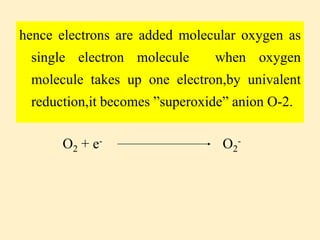
hence electrons are added molecular oxygen as
single electron molecule when oxygen
molecule takes up one electron,by univalent
reduction,it becomes ”superoxide” anion O-2.
O2 + e- O2
-
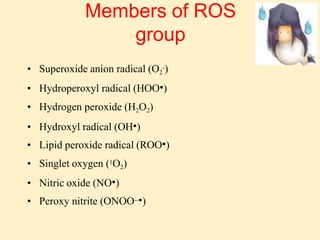
Members of ROS
group
• Superoxide anion radical (O2
-)
• Hydroperoxyl radical (HOO●)
• Hydrogen peroxide (H2O2)
• Hydroxyl radical (OH●)
• Lipid peroxide radical (ROO●)
• Singlet oxygen (1O2)
• Nitric oxide (NO●)
• Peroxy nitrite (ONOO--●)
Ionizing radiation (x-rays and UV) can lyse
water, leading to the formation of hydroxyl
radicals. Transition metal ions, including Cu+,
Co2+, Ni2+ and Fe2+ can react nonenzymically
with oxygen or hydrogen peroxide, again
leading to the formation of hydroxyl radicals.
There Are Multiple Sources of Oxygen
radicals in the Body
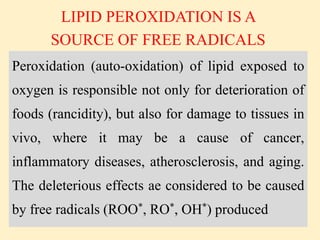
Peroxidation (auto-oxidation) of lipid exposed to
oxygen is responsible not only for deterioration of
foods (rancidity), but also for damage to tissues in
vivo, where it may be a cause of cancer,
inflammatory diseases, atherosclerosis, and aging.
The deleterious effects ae considered to be caused
by free radicals (ROO*, RO*, OH*) produced
LIPID PEROXIDATION IS A
SOURCE OF FREE RADICALS
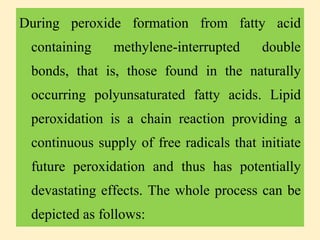
During peroxide formation from fatty acid
containing methylene-interrupted double
bonds, that is, those found in the naturally
occurring polyunsaturated fatty acids. Lipid
peroxidation is a chain reaction providing a
continuous supply of free radicals that initiate
future peroxidation and thus has potentially
devastating effects. The whole process can be
depicted as follows:
1. Initiation:
ROOH + Metal(n)+ → ROO* + Metal(n-1)+ + H+
X* + RH → R* + XH
2. Propagation:
R* + O2 → ROO*
ROO* + RH → ROOH + R*, etc
3. Termination:
ROO* + ROO* → ROOR + O2
ROO* + R* → ROOR
R* + R* → RR
Initiation
phase
• During this phase, the primary event is the production of R●
(PUFA radical) or ROO● (lipid peroxide radical) by the
interaction of a PUFA with free radicals generated by other
means
R●
RH + OH● + H2O
ROOH ROO● + H+
•The R● and ROO●, in turn, are degraded to malondialdehyde
which is estimated as an indicator of fatty acid breakdown by
free radicals
Propagation
phase
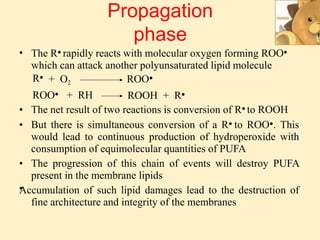
• The R● rapidly reacts with molecular oxygen forming ROO●
which can attack another polyunsaturated lipid molecule
R●
+ O2
ROO● + RH
ROO●
ROOH + R●
•
• The net result of two reactions is conversion of R● to ROOH
• But there is simultaneous conversion of a R● to ROO●. This
would lead to continuous production of hydroperoxide with
consumption of equimolecular quantities of PUFA
• The progression of this chain of events will destroy PUFA
present in the membrane lipids
Accumulation of such lipid damages lead to the destruction of
fine architecture and integrity of the membranes
Termination
phase
• The reaction would proceed unchecked till a peroxyl
radical reacts with another peroxy radical to form inactive
products
ROO● + ROO● RO-OR + O2
R-R RO-ORR●
+ R●
ROO● + R●
Free radicals are highly reactive molecular
species with an unpaired electron; they persist
for only a very short time (of the order of 10-9
to 10-12 sec) before they collide with another
molecule and either abstract or donate an
electron in order to achieve stability.
Free Radical Reactions Are Self-
Perpetuating Chain Reactions
Damage produced by
ROS
• Free radicals are extremely reactive
• Their mean effective radius of action is only 30Å
• Their half life is only a few milliseconds
• When a free radical reacts with a normal compound, other free
radicals are generated
• Peroxidation of PUFA in plasma membrane leads to loss of
membrane functions
• Lipid peroxidation and consequent degradation products such as
malondialdehyde are seen in biological fluids
• Their estimation in serum is often employed to assess the
oxidative stress
Damage produced by
ROS
• Almost all biological macromolecules are damaged by the
free radicals
•Oxidation of sulfhydryl containing enzymes,
modification of amino acids, loss of function and
fragmentation of proteins are noticed
•Polysaccharides undergo degradation
•DNA is damaged by strand breaks
•The DNA damage may directly cause inhibition of
protein and enzyme synthesis and indirectly cause cell
death or mutation and carcinogenesis
Free radicals are formed in the body under
normal conditions. They cause damage to
nucleic acids, proteins, and lipids in cell
membranes and plasma lipoproteins. This can
cause cancer, atherosclerosis and coronary
artery disease, and autoimmune diseases.
BIOMEDICAL IMPORTANCE
Superoxide
dismutase
• SOD is a non-heme protein
• The gene coding SOD is on chromosome 21
• Different iso-enzymes of SOD are described.
• The mitochondrial enzyme is manganese dependent;
cytoplasmic enzyme is copper-zinc dependent
• A defect in SOD gene is seen in some patients with
amylotrophic lateral sclerosis
Glutathione
peroxidase
• The H2O2 generated is
removed by glutathione
peroxidase (POD)
• It is a selenium containing
enzyme
Glutathione
reductase
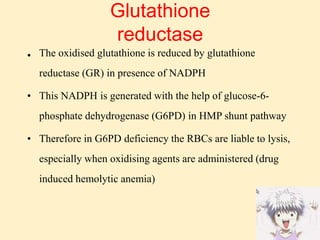
• The oxidised glutathione is reduced by glutathione
reductase (GR) in presence of NADPH
• This NADPH is generated with the help of glucose-6-
phosphate dehydrogenase (G6PD) in HMP shunt pathway
• Therefore in G6PD deficiency the RBCs are liable to lysis,
especially when oxidising agents are administered (drug
induced hemolytic anemia)
Catalase
• When H2O2 is generated in
large quantities, the
enzyme catalase is also
used for its removal
Alpha-
tocopherol
• Alpha tocopherol (T-OH) would intercept the peroxyl free
radical and inactivate it before a PUFA can be attacked
T-OH + ROO● TO● + ROOH
• The phenolic hydrogen of the alpha tocopherol reacts with the
peroxyl radical, converting it to a hydroperoxide product
• The tocopherol radical thus formed is stable and will not
propagate the cycle any further
• The tocopherol radical can react with another peroxyl radical
getting converted to inactive products
TO● + ROO● inactive products
Alpha
tocopherol
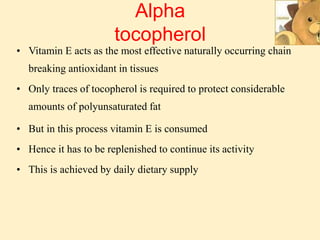
• Vitamin E acts as the most effective naturally occurring chain
breaking antioxidant in tissues
• Only traces of tocopherol is required to protect considerable
amounts of polyunsaturated fat
• But in this process vitamin E is consumed
• Hence it has to be replenished to continue its activity
• This is achieved by daily dietary supply
Vitamin C
• Vitamin C, or ascorbic acid, is a water-soluble vitamin.
• This vitamin is a free radical scavenger, it is considered
to be one of the most important antioxidants in extra
cellular fluids.
• Its protective effects extend to cancer, coronary artery
disease, arthritis and aging.
• superoxide dismutase:this enzyme is present In
both cytosol and mitochondria.It can destroy
superoxide anions O-
2
• 2H+ + 2 O-
2
superoxide dismutase H2O2+O2
Scavengers of free radicals
• The enzyme is present in all major aerobic
tissues protecting aerobic organisms against
the potential toxic effects of superoxide anion
O-
2 .
• Catalase
• This enzyme having high Km value situated
close to aerobic dehydrogenases , like liver
peroxisomes, can destroy H2o2 formed in the
tissues to O2.
• H2o2+H2O2 CATALASE 2H2O+O2
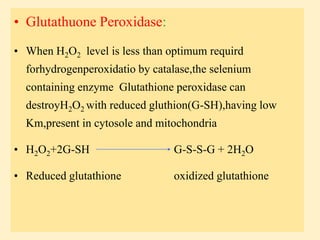
• Glutathuone Peroxidase:
• When H2O2 level is less than optimum requird
forhydrogenperoxidatio by catalase,the selenium
containing enzyme Glutathione peroxidase can
destroyH2O2 with reduced gluthion(G-SH),having low
Km,present in cytosole and mitochondria
• H2O2+2G-SH G-S-S-G + 2H2O
• Reduced glutathione oxidized glutathione
SOME MORE
ANTIOXIDENTS
ROS  ANTIOXIDENTS
ROS  ANTIOXIDENTS
ROS  ANTIOXIDENTS
ROS  ANTIOXIDENTS

ROS ANTIOXIDENTS

  • 2.
    • Aerobic organismsproduce a number of reactive free radicals continuously in cells during respiration, metabolism and phagocytosis. • Out of these, the most important source of free radicals being the respiratory chain where ~ 1 to 2% oxygen is converted into superoxide radicals (O2•−). • Oxidation reactions ensure that molecular oxygen is completely reduced to water • Products of partial reduction of oxygen are highly reactive and make havoc in the living systems • Hence they are also called Reactive oxygen species (ROS) Introduction
  • 3.
    • The oxygenis needed for each living organism for survival .but oxygen is toxic as well. According to Salvemini oxygen is double edge sword :it is vital for life but leads to formation of toxic by products such as superoxide (o- 2) anion. Oxygen is more prone to produce superoxide radicals because molecular oxygen contain two unpaired electrons with parallel spins Free radicals
  • 4.
    • These unpairedelectrons reside in separate orbitals unless their spins are opposed. Reduction of o2 by direct insertion of a pair of electrons,e-,into its partially filled orbitals is not possible without inversion of one electronic spin and such inversion of spin is a slow process
  • 5.
    hence electrons areadded molecular oxygen as single electron molecule when oxygen molecule takes up one electron,by univalent reduction,it becomes ”superoxide” anion O-2. O2 + e- O2 -
  • 6.
    Members of ROS group •Superoxide anion radical (O2 -) • Hydroperoxyl radical (HOO●) • Hydrogen peroxide (H2O2) • Hydroxyl radical (OH●) • Lipid peroxide radical (ROO●) • Singlet oxygen (1O2) • Nitric oxide (NO●) • Peroxy nitrite (ONOO--●)
  • 7.
    Ionizing radiation (x-raysand UV) can lyse water, leading to the formation of hydroxyl radicals. Transition metal ions, including Cu+, Co2+, Ni2+ and Fe2+ can react nonenzymically with oxygen or hydrogen peroxide, again leading to the formation of hydroxyl radicals. There Are Multiple Sources of Oxygen radicals in the Body
  • 9.
    Peroxidation (auto-oxidation) oflipid exposed to oxygen is responsible not only for deterioration of foods (rancidity), but also for damage to tissues in vivo, where it may be a cause of cancer, inflammatory diseases, atherosclerosis, and aging. The deleterious effects ae considered to be caused by free radicals (ROO*, RO*, OH*) produced LIPID PEROXIDATION IS A SOURCE OF FREE RADICALS
  • 10.
    During peroxide formationfrom fatty acid containing methylene-interrupted double bonds, that is, those found in the naturally occurring polyunsaturated fatty acids. Lipid peroxidation is a chain reaction providing a continuous supply of free radicals that initiate future peroxidation and thus has potentially devastating effects. The whole process can be depicted as follows:
  • 11.
    1. Initiation: ROOH +Metal(n)+ → ROO* + Metal(n-1)+ + H+ X* + RH → R* + XH 2. Propagation: R* + O2 → ROO* ROO* + RH → ROOH + R*, etc 3. Termination: ROO* + ROO* → ROOR + O2 ROO* + R* → ROOR R* + R* → RR
  • 12.
    Initiation phase • During thisphase, the primary event is the production of R● (PUFA radical) or ROO● (lipid peroxide radical) by the interaction of a PUFA with free radicals generated by other means R● RH + OH● + H2O ROOH ROO● + H+ •The R● and ROO●, in turn, are degraded to malondialdehyde which is estimated as an indicator of fatty acid breakdown by free radicals
  • 13.
    Propagation phase • The R●rapidly reacts with molecular oxygen forming ROO● which can attack another polyunsaturated lipid molecule R● + O2 ROO● + RH ROO● ROOH + R● • • The net result of two reactions is conversion of R● to ROOH • But there is simultaneous conversion of a R● to ROO●. This would lead to continuous production of hydroperoxide with consumption of equimolecular quantities of PUFA • The progression of this chain of events will destroy PUFA present in the membrane lipids Accumulation of such lipid damages lead to the destruction of fine architecture and integrity of the membranes
  • 14.
    Termination phase • The reactionwould proceed unchecked till a peroxyl radical reacts with another peroxy radical to form inactive products ROO● + ROO● RO-OR + O2 R-R RO-ORR● + R● ROO● + R●
  • 15.
    Free radicals arehighly reactive molecular species with an unpaired electron; they persist for only a very short time (of the order of 10-9 to 10-12 sec) before they collide with another molecule and either abstract or donate an electron in order to achieve stability. Free Radical Reactions Are Self- Perpetuating Chain Reactions
  • 16.
    Damage produced by ROS •Free radicals are extremely reactive • Their mean effective radius of action is only 30Å • Their half life is only a few milliseconds • When a free radical reacts with a normal compound, other free radicals are generated • Peroxidation of PUFA in plasma membrane leads to loss of membrane functions • Lipid peroxidation and consequent degradation products such as malondialdehyde are seen in biological fluids • Their estimation in serum is often employed to assess the oxidative stress
  • 17.
    Damage produced by ROS •Almost all biological macromolecules are damaged by the free radicals •Oxidation of sulfhydryl containing enzymes, modification of amino acids, loss of function and fragmentation of proteins are noticed •Polysaccharides undergo degradation •DNA is damaged by strand breaks •The DNA damage may directly cause inhibition of protein and enzyme synthesis and indirectly cause cell death or mutation and carcinogenesis
  • 18.
    Free radicals areformed in the body under normal conditions. They cause damage to nucleic acids, proteins, and lipids in cell membranes and plasma lipoproteins. This can cause cancer, atherosclerosis and coronary artery disease, and autoimmune diseases. BIOMEDICAL IMPORTANCE
  • 26.
    Superoxide dismutase • SOD isa non-heme protein • The gene coding SOD is on chromosome 21 • Different iso-enzymes of SOD are described. • The mitochondrial enzyme is manganese dependent; cytoplasmic enzyme is copper-zinc dependent • A defect in SOD gene is seen in some patients with amylotrophic lateral sclerosis
  • 27.
    Glutathione peroxidase • The H2O2generated is removed by glutathione peroxidase (POD) • It is a selenium containing enzyme
  • 28.
    Glutathione reductase • The oxidisedglutathione is reduced by glutathione reductase (GR) in presence of NADPH • This NADPH is generated with the help of glucose-6- phosphate dehydrogenase (G6PD) in HMP shunt pathway • Therefore in G6PD deficiency the RBCs are liable to lysis, especially when oxidising agents are administered (drug induced hemolytic anemia)
  • 29.
    Catalase • When H2O2is generated in large quantities, the enzyme catalase is also used for its removal
  • 30.
    Alpha- tocopherol • Alpha tocopherol(T-OH) would intercept the peroxyl free radical and inactivate it before a PUFA can be attacked T-OH + ROO● TO● + ROOH • The phenolic hydrogen of the alpha tocopherol reacts with the peroxyl radical, converting it to a hydroperoxide product • The tocopherol radical thus formed is stable and will not propagate the cycle any further • The tocopherol radical can react with another peroxyl radical getting converted to inactive products TO● + ROO● inactive products
  • 31.
    Alpha tocopherol • Vitamin Eacts as the most effective naturally occurring chain breaking antioxidant in tissues • Only traces of tocopherol is required to protect considerable amounts of polyunsaturated fat • But in this process vitamin E is consumed • Hence it has to be replenished to continue its activity • This is achieved by daily dietary supply
  • 32.
    Vitamin C • VitaminC, or ascorbic acid, is a water-soluble vitamin. • This vitamin is a free radical scavenger, it is considered to be one of the most important antioxidants in extra cellular fluids. • Its protective effects extend to cancer, coronary artery disease, arthritis and aging.
  • 33.
    • superoxide dismutase:thisenzyme is present In both cytosol and mitochondria.It can destroy superoxide anions O- 2 • 2H+ + 2 O- 2 superoxide dismutase H2O2+O2 Scavengers of free radicals
  • 34.
    • The enzymeis present in all major aerobic tissues protecting aerobic organisms against the potential toxic effects of superoxide anion O- 2 .
  • 35.
    • Catalase • Thisenzyme having high Km value situated close to aerobic dehydrogenases , like liver peroxisomes, can destroy H2o2 formed in the tissues to O2. • H2o2+H2O2 CATALASE 2H2O+O2
  • 36.
    • Glutathuone Peroxidase: •When H2O2 level is less than optimum requird forhydrogenperoxidatio by catalase,the selenium containing enzyme Glutathione peroxidase can destroyH2O2 with reduced gluthion(G-SH),having low Km,present in cytosole and mitochondria • H2O2+2G-SH G-S-S-G + 2H2O • Reduced glutathione oxidized glutathione
  • 37.