Megaloblastic anaemia
Prof. S c kohli
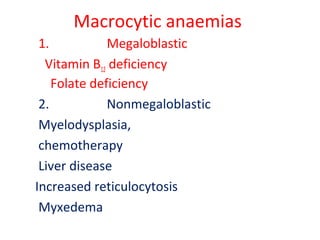
Macrocytic anaemias
1. Megaloblastic
Vitamin B12 deficiency
Folate deficiency
2. Nonmegaloblastic
Myelodysplasia,
chemotherapy
Liver disease
Increased reticulocytosis
Myxedema
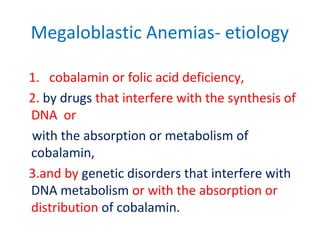
Megaloblastic Anemias- etiology
1. cobalamin or folic acid deficiency,
2. by drugs that interfere with the synthesis of
DNA or
with the absorption or metabolism of
cobalamin,
3.and by genetic disorders that interfere with
DNA metabolism or with the absorption or
distribution of cobalamin.
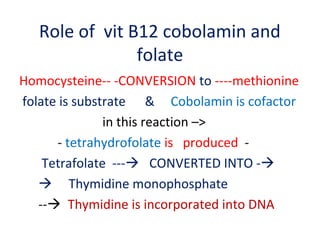
Role of vit B12 cobolamin and
folate
Homocysteine-- -CONVERSION to ----methionine
folate is substrate & Cobolamin is cofactor
in this reaction –>
- tetrahydrofolate is produced -
Tetrafolate --- CONVERTED INTO -
 Thymidine monophosphate
-- Thymidine is incorporated into DNA
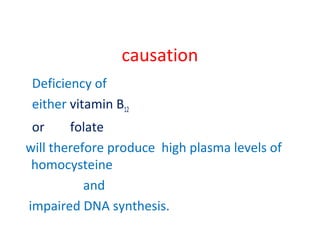
causation
Deficiency of
either vitamin B12
or folate
will therefore produce high plasma levels of
homocysteine
and
impaired DNA synthesis.
Morphological changes
The end result is production of cells
with arrested nuclear maturation
but normal cytoplasmic development
So-called
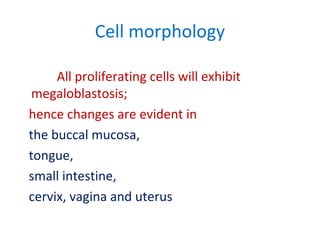
nucleo-cytoplasmic asynchrony.
Megalocytosis results
nucleo-cytoplasmic asynchrony.
Megalocytosis
Cell morphology
All proliferating cells will exhibit
megaloblastosis;
hence changes are evident in
the buccal mucosa,
tongue,
small intestine,
cervix, vagina and uterus
Morphological changes in
bone marrow
Cells become arrested in
development
and die within the marrow;
intramedullary haemolysis
results in a
raised bilirubin and lactate dehydrogenase
Iron stores are usually raised.
Morphological changes
bone marrow
This ineffective erythropoiesis results in an
expanded hypercellular marrow.
The megaloblastic changes are most evident
in the early nucleated red cell precursors,
The mature red cells are large and oval,
and sometimes contain nuclear remnants.
Morphology
bone marrow
• Nuclear changes are seen in the immature
granulocyte precursors
and a characteristic appearance is that of
'giant' metamyelocytes with a large
'sausage-shaped' nucleus.
Cellular morphology
The mature neutrophils show
hypersegmentation of their nuclei,
with cells having six or more nuclear lobes.
If severe,
a pancytopenia may be present in the
peripheral blood.
Peripheral smear
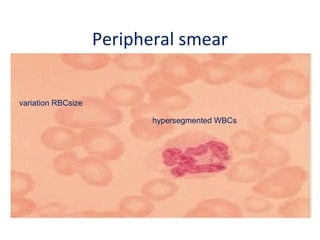
• In folic acid or cobalamin deficiency,
• the smear is characterized by
• variation in erythrocyte size
• and by distinct macrocytosis.
• Occasionally, fish-tailed erythrocytes are
present, along with
• hypersegmented neutrophils
Peripheral smear
variation RBCsize
hypersegmented WBCs
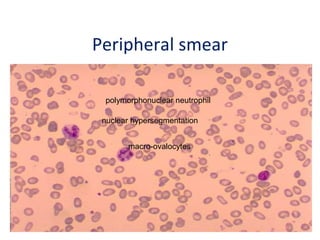
Peripheral smear
nuclear hypersegmentation
polymorphonuclear neutrophil
macro-ovalocytes
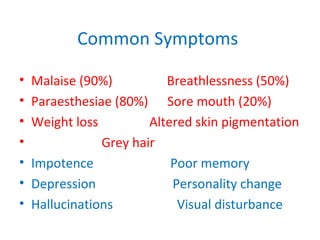
Common Symptoms
• Malaise (90%) Breathlessness (50%)
• Paraesthesiae (80%) Sore mouth (20%)
• Weight loss Altered skin pigmentation
• Grey hair
• Impotence Poor memory
• Depression Personality change
• Hallucinations Visual disturbance
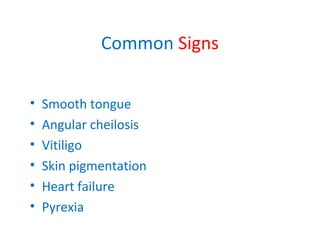
Common Signs
• Smooth tongue
• Angular cheilosis
• Vitiligo
• Skin pigmentation
• Heart failure
• Pyrexia
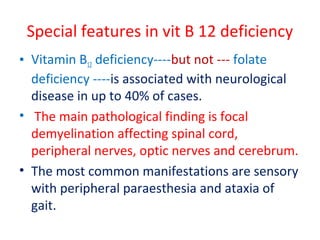
Special features in vit B 12 deficiency
• Vitamin B12 deficiency----but not --- folate
deficiency ----is associated with neurological
disease in up to 40% of cases.
• The main pathological finding is focal
demyelination affecting spinal cord,
peripheral nerves, optic nerves and cerebrum.
• The most common manifestations are sensory
with peripheral paraesthesia and ataxia of
gait.
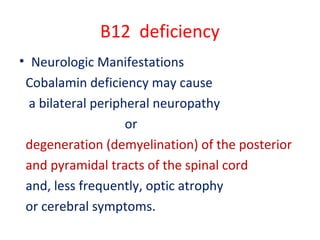
B12 deficiency
• Neurologic Manifestations
Cobalamin deficiency may cause
a bilateral peripheral neuropathy
or
degeneration (demyelination) of the posterior
and pyramidal tracts of the spinal cord
and, less frequently, optic atrophy
or cerebral symptoms.
Symptoms neurological
• The patient, more frequently male, presents
with
• paresthesias,
• muscle weakness,
• or difficulty in walking
• and sometimes dementia,
• psychotic disturbances,
• or visual impairment.
NEUROLOGICAL FEATURES
• Patients with severe cobalamin deficiency
initially complain of paresthesia.
• sense of touch and temperature sensitivity
The may be minimally impaired
• The disease may progress, involving the dorsal
columns, causing ataxia and weakness.
• The physical examination reveals a broad-base
gait, Romberg sign, slowed reflexes, and loss
of sense of position and feeling of vibration
NEUROLOGICAL FEATURES
• If the disorder is not detected and treated,
• the lateral columns become involved
resulting in weakness, spasticity,
inability to walk,
sustained clonus, hyperreflexia,
and Babinski sign.
NEUROLOGICAL FEATURES
• Because the peripheral nerves,
• as well as the dorsal
• and lateral columns, are involved,
• these neurologic manifestations are
sometimes termed
• subacute combined degeneration
SUMMARY OF NEUROLOGICAL
FINDINGS IN VIT B12 DEFICIENCY
• Peripheral nerves Glove and stocking
paraesthesiae
• Spinal cord Subacute combined degeneration
• Posterior columns-diminished vibration and
proprioception
• Corticospinal tracts-upper motor neuron signs
• Cerebrum Dementia
• Optic atrophy
• Autonomic neuropathy
VIT B12 ABSORPTION
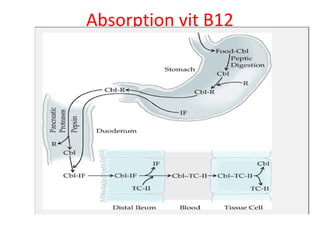
• The average daily diet contains 5-30 μg of
vitamin B12,
• mainly in meat, fish, eggs and milk
• - 1 μg is daily requirement
ABSORBTION OF VIT.B12
• In the stomach, gastric enzymes release
vitamin B12 from food
• At gastric pH it binds to a carrier protein
• ----termed R protein.-------
Vit B12 absorption (contd) step 2
• The gastric parietal cells produce
intrinsic factor, a vitamin B12-binding protein
which optimally binds vitamin B12 at pH 8.
• As gastric emptying occurs, pancreatic
secretion raises the pH
and vitamin B12 released from the diet
switches from the R protein to intrinsic factor.
VIT B 12 ABSORPTION STEP 3
• The vitamin B12 intrinsic factor complex binds
to specific receptors in the terminal ileum
and vitamin B12 is actively transported by the
enterocytes to plasma, where it binds to
transcobalamin II, a transport protein
produced by the liver,
which carries it to the tissues for utilisation.
Absorption vit B12
Absorption vit B12
The liver stores enough vitamin B12 for 3
years
Bile also contains vitamin B12 which is available
for reabsorption in the intestine.
ENTERO HEPATIC CICULATION due to these
vitamin B12 deficiency takes years to become
manifest even if all dietary intake is stopped.
CAUSES VIT B12 DEFICIENCY
Dietary deficiency
This only occurs in strict vegans
The breastfed offspring of vegan mothers
are at risk of developing nutritional vitamin B12 deficiency.
Less strict vegetarians often have slightly low vitamin
B12 levels
but are not tissue vitamin B12-deficient.
Causes vit B12 Deficiency
Gastric factors
Normal gastric acid and enzyme secretion is
required for the release of vitamin B12 from the
food.
Hypochlorhydria in elderly patients or following
gastric surgery can impair the release of
vitamin B12 from food. Total gastrectomy
invariably results in vitamin B12 deficiency
within 5 years,
B12 DEFICIENCY contd
Pernicious anaemia
• This is an autoimmune disorder in which
the gastric mucosa is atrophic with loss of
parietal cells causing intrinsic factor
deficiency.
• In the absence of intrinsic factor less than
1% of dietary vitamin B12 is absorbed
B12 DEFICIENCY
• It is more common in individuals with other
autoimmune disease
• (Hashimoto's thyroiditis, Graves' disease,
vitiligo, hypoparathyroidism or Addison's
disease)
• or a family history of these
or pernicious anaemia.
ANTIBODIES 2 types
1 --Anti-parietal cell antibodies
are present in over 90%
2-- Antibodies to intrisic factor
are found in the serum of 60%
Pernicious anaemia
• Anti-parietal cell antibodies are present in
over 90% of cases but are also present in 20%
of normal females over the age of 60 years.
• A negative result makes pernicious anaemia
less likely but a positive result is not
diagnostic.
• Antibodies to intrisic factor are found in the
serum of 60% of patients with pernicious
anaemia and, if present, are diagnostic.
VIT B 12 DEFICIENCY contd
Small bowel
factors
One-third of all patients with
pancreatic insufficiency
fail to transfer dietary vitamin B12
from R protein to intrinsic factor.
VIT B 12
Motility disorders
or hypogammaglobulinaemia
can result in bacterial overgrowth
and
the resulting competition for free vitamin B12
can result in deficiency.
Vit B12 deficiency
A small number of people heavily infected
with the fish tapeworm develop vitamin B12
deficiency.
Inflammatory disease of the terminal ileum,
such as Crohn's disease, may impair the
interaction of the vitamin B12-intrinsic factor
complex with its receptor AND
surgery on this part of
the bowel will both result in malabsorption of
Vit B12.
Diagnostic workup
• The evaluation of suspected cobalamin
deficiency generally proceeds in two stages:
• documenting the presence of the vitamin
deficiency
• and determining its cause (e.g., pernicious
anemia, malabsorption, dietary lack).
Diagnostic workup
• The diagnosis can often be established by
• 1) measurement of the serum cobalamin
concentration,
• 2) evaluation of specific metabolites,
and
• 3) use of the Schilling test to establish
malabsorption of cobalamin.
Peripheral blood smear
• The peripheral smear shows
• macro-ovalocytes, fish-tailed red blood cells,
hypersegmented neutrophils, and,
occasionally, nucleated red blood cells
Examination of the bone marrow reveals
megaloblastic erythroid hyperplasia
and giant metamyelocytes.
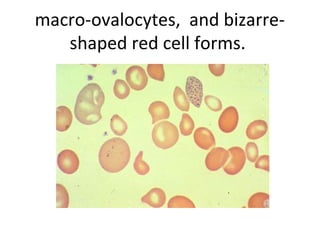
macro-ovalocytes, and bizarre-
shaped red cell forms.
SCHILLING,S TEST part 1
• Give 1 mg radio-labelled B12 orally+1 mg
ordinary B12 intramuscularily to block
transcobalamin binding sites to ensure any radio-
labelled B12absorbed is excreted by kidneys.
If normal gut & normal intrinsic factor
B12-----Normally absorbed
>30% excreated in urine in next 24 hours
If excretion < 30%--malabsorbtion/perncious
anaemia---part 2 of test to differentiate
SCHILLING,S TEST PART 2
• Give 1 mg radiolabelled B12 + intrinsic factor
orally + 1 mg ordinary B12 intramuscularily.
If gut disease---diminished absorbtion
<30% urinary excretion
In pernitious anaemia
addition intrinsic factor normalises absorbtion
> 30 % extreted in urine.
Treatment vit B12 deficiency
Vitamin B12 deficiency
Vitamin B12 deficiency is treated with
hydroxycobalamin 1000 μg i.m.
in five doses 2 or 3 days apart
followed by maintenance therapy of 1000 μg every 3
months for life.
The reticulocyte count will peak by the 5th-10th day
after therapy and may be as high as 50%.
The haemoglobin will rise by 10 g/l (1 gm%) every
week.
treatment
Vitamin B12 deficiency is treated with
hydroxycobalamin 1000 μg i.m.
in five doses 2 or 3 days apart followed by
maintenance therapy of 1000 μg every 3
months for life.
The reticulocyte count will peak by the 5th-
10th day after therapy and may be as high as
50%.
The haemoglobin will rise by 10 g/l
(1 gm %)every week.
Treatment vit B12 deficiency
The response of the marrow is associated with
a fall in plasma potassium levels and rapid
depletion of iron stores.
If an initial response is not maintained and the
blood film is dimorphic, the patient may need
additional iron therapy.
A sensory neuropathy may take 6-12 months to
correct; long-standing neurological damage
may not improve.
FOLATE DEFICIENCY
Diet Poor intake of vegetables
• Malabsorption e.g. Coeliac disease
• Increased demand Pregnancy
• Cell proliferation, e.g. haemolysis
• Drugs* Certain anticonvulsants (e.g.
phenytoin)
• Contraceptive pill
• Certain cytotoxic drugs eg Methotrexate
Clinical features
• Clinical features IN FOLATE DEFICIENCY
are similar to vit B12 deficiency
EXCEPT THAT
NEUROLOGICAL FEATURES ARE
NOT PRESENT IN
FOLATE DEFICIENCY
Diagnosis Folate deficiency
• Low serum folate levels (fasting blood
sample)
• Red cell folate levels low (but may be normal
if folate deficiency is of very recent onset)
• Corroborative findings
• Macrocytic dysplastic blood picture
• Megaloblastic marrow
DIAGNOSIS
• A serum folic acid level
less than 2 ng/ml is consistent with folic acid
deficiency,
as is a red blood cell folic acid level
less than 150 ng/ml.
Folate absorbtion
• Folates are produced by plants and bacteria;
hence dietary leafy vegetables (spinach,
broccoli, lettuce), fruits (bananas, melons) and
animal protein (liver, kidney) are a rich source.
• An average Western diet contains more than
the minimum daily intake of 50 μg but excess
cooking for longer than 15 minutes destroys
folates.
Folate absorption
• Most dietary folate is present as
polyglutamates; these are converted to
monoglutamate in the upper small bowel and
actively transported into plasma.
• Plasma folate is loosely bound to plasma
proteins such as albumin and there is an
enterohepatic circulation.
• Total body stores of folate are small and
deficiency can occur in a matter of weeks.
Causes of Folic Acid Deficiency
• inadequate intake
• Alcoholism ,Nutritional deficiencies
• resulting from increased folic acid
requirements
Pregnancy ,Severe hemolysis ,Chronic
hemodialysis or peritoneal dialysis
Causes of Folic Acid Deficiency
• Inadequate absorption
• Tropical sprue
• Gluten-sensitive enteropathy (nontropical
sprue)
• Crohn disease
• Lymphoma or amyloidosis of small bowel
Diabetic enteropathy
• Intestinal resections or diversions
Causes of Folic Acid Deficiency
Drug-induced interference with folic acid
metabolism
Action of dihydrofolate reductase blocked by
methotrexate, trimethoprim, pyrimethamine
• Reduced folate absorption and tissue folate
depletion caused by sulfasalazine
Interference of unknown mechanism caused
by phenytoin, ethanol, antituberculosis
drugs, ?oral contraceptives
Treatment Folate deficiency
Oral folic acid 5 mg daily for 3 weeks will
treat acute deficiency
and 5 mg once weekly is adequate
maintenance therapy.
Prophylactic folic acid in pregnancy will
prevent megaloblastosis in women at risk.
Treatment folate deficiency
• Folic acid supplementation may reduce the
risk of neural tube defects, and in some
countries all pregnant women receive routine
folic acid supplementation.
• Prophylactic supplementation is also given in
chronic haematological disease associated
with reduced red cell lifespan (e.g.
autoimmune haemolytic anaemia or
haemoglobinopathies).
thanks

Megaloblastic anaemia

  • 1.
  • 2.
    Macrocytic anaemias 1. Megaloblastic VitaminB12 deficiency Folate deficiency 2. Nonmegaloblastic Myelodysplasia, chemotherapy Liver disease Increased reticulocytosis Myxedema
  • 3.
    Megaloblastic Anemias- etiology 1.cobalamin or folic acid deficiency, 2. by drugs that interfere with the synthesis of DNA or with the absorption or metabolism of cobalamin, 3.and by genetic disorders that interfere with DNA metabolism or with the absorption or distribution of cobalamin.
  • 4.
    Role of vitB12 cobolamin and folate Homocysteine-- -CONVERSION to ----methionine folate is substrate & Cobolamin is cofactor in this reaction –> - tetrahydrofolate is produced - Tetrafolate --- CONVERTED INTO -  Thymidine monophosphate -- Thymidine is incorporated into DNA
  • 5.
    causation Deficiency of either vitaminB12 or folate will therefore produce high plasma levels of homocysteine and impaired DNA synthesis.
  • 6.
    Morphological changes The endresult is production of cells with arrested nuclear maturation but normal cytoplasmic development So-called nucleo-cytoplasmic asynchrony. Megalocytosis results
  • 7.
  • 8.
    Cell morphology All proliferatingcells will exhibit megaloblastosis; hence changes are evident in the buccal mucosa, tongue, small intestine, cervix, vagina and uterus
  • 9.
    Morphological changes in bonemarrow Cells become arrested in development and die within the marrow; intramedullary haemolysis results in a raised bilirubin and lactate dehydrogenase Iron stores are usually raised.
  • 10.
    Morphological changes bone marrow Thisineffective erythropoiesis results in an expanded hypercellular marrow. The megaloblastic changes are most evident in the early nucleated red cell precursors, The mature red cells are large and oval, and sometimes contain nuclear remnants.
  • 11.
    Morphology bone marrow • Nuclearchanges are seen in the immature granulocyte precursors and a characteristic appearance is that of 'giant' metamyelocytes with a large 'sausage-shaped' nucleus.
  • 12.
    Cellular morphology The matureneutrophils show hypersegmentation of their nuclei, with cells having six or more nuclear lobes. If severe, a pancytopenia may be present in the peripheral blood.
  • 13.
    Peripheral smear • Infolic acid or cobalamin deficiency, • the smear is characterized by • variation in erythrocyte size • and by distinct macrocytosis. • Occasionally, fish-tailed erythrocytes are present, along with • hypersegmented neutrophils
  • 14.
  • 15.
  • 16.
    Common Symptoms • Malaise(90%) Breathlessness (50%) • Paraesthesiae (80%) Sore mouth (20%) • Weight loss Altered skin pigmentation • Grey hair • Impotence Poor memory • Depression Personality change • Hallucinations Visual disturbance
  • 17.
    Common Signs • Smoothtongue • Angular cheilosis • Vitiligo • Skin pigmentation • Heart failure • Pyrexia
  • 18.
    Special features invit B 12 deficiency • Vitamin B12 deficiency----but not --- folate deficiency ----is associated with neurological disease in up to 40% of cases. • The main pathological finding is focal demyelination affecting spinal cord, peripheral nerves, optic nerves and cerebrum. • The most common manifestations are sensory with peripheral paraesthesia and ataxia of gait.
  • 19.
    B12 deficiency • NeurologicManifestations Cobalamin deficiency may cause a bilateral peripheral neuropathy or degeneration (demyelination) of the posterior and pyramidal tracts of the spinal cord and, less frequently, optic atrophy or cerebral symptoms.
  • 20.
    Symptoms neurological • Thepatient, more frequently male, presents with • paresthesias, • muscle weakness, • or difficulty in walking • and sometimes dementia, • psychotic disturbances, • or visual impairment.
  • 21.
    NEUROLOGICAL FEATURES • Patientswith severe cobalamin deficiency initially complain of paresthesia. • sense of touch and temperature sensitivity The may be minimally impaired • The disease may progress, involving the dorsal columns, causing ataxia and weakness. • The physical examination reveals a broad-base gait, Romberg sign, slowed reflexes, and loss of sense of position and feeling of vibration
  • 22.
    NEUROLOGICAL FEATURES • Ifthe disorder is not detected and treated, • the lateral columns become involved resulting in weakness, spasticity, inability to walk, sustained clonus, hyperreflexia, and Babinski sign.
  • 23.
    NEUROLOGICAL FEATURES • Becausethe peripheral nerves, • as well as the dorsal • and lateral columns, are involved, • these neurologic manifestations are sometimes termed • subacute combined degeneration
  • 24.
    SUMMARY OF NEUROLOGICAL FINDINGSIN VIT B12 DEFICIENCY • Peripheral nerves Glove and stocking paraesthesiae • Spinal cord Subacute combined degeneration • Posterior columns-diminished vibration and proprioception • Corticospinal tracts-upper motor neuron signs • Cerebrum Dementia • Optic atrophy • Autonomic neuropathy
  • 25.
    VIT B12 ABSORPTION •The average daily diet contains 5-30 μg of vitamin B12, • mainly in meat, fish, eggs and milk • - 1 μg is daily requirement ABSORBTION OF VIT.B12 • In the stomach, gastric enzymes release vitamin B12 from food • At gastric pH it binds to a carrier protein • ----termed R protein.-------
  • 26.
    Vit B12 absorption(contd) step 2 • The gastric parietal cells produce intrinsic factor, a vitamin B12-binding protein which optimally binds vitamin B12 at pH 8. • As gastric emptying occurs, pancreatic secretion raises the pH and vitamin B12 released from the diet switches from the R protein to intrinsic factor.
  • 27.
    VIT B 12ABSORPTION STEP 3 • The vitamin B12 intrinsic factor complex binds to specific receptors in the terminal ileum and vitamin B12 is actively transported by the enterocytes to plasma, where it binds to transcobalamin II, a transport protein produced by the liver, which carries it to the tissues for utilisation.
  • 28.
  • 29.
    Absorption vit B12 Theliver stores enough vitamin B12 for 3 years Bile also contains vitamin B12 which is available for reabsorption in the intestine. ENTERO HEPATIC CICULATION due to these vitamin B12 deficiency takes years to become manifest even if all dietary intake is stopped.
  • 30.
    CAUSES VIT B12DEFICIENCY Dietary deficiency This only occurs in strict vegans The breastfed offspring of vegan mothers are at risk of developing nutritional vitamin B12 deficiency. Less strict vegetarians often have slightly low vitamin B12 levels but are not tissue vitamin B12-deficient.
  • 31.
    Causes vit B12Deficiency Gastric factors Normal gastric acid and enzyme secretion is required for the release of vitamin B12 from the food. Hypochlorhydria in elderly patients or following gastric surgery can impair the release of vitamin B12 from food. Total gastrectomy invariably results in vitamin B12 deficiency within 5 years,
  • 32.
    B12 DEFICIENCY contd Perniciousanaemia • This is an autoimmune disorder in which the gastric mucosa is atrophic with loss of parietal cells causing intrinsic factor deficiency. • In the absence of intrinsic factor less than 1% of dietary vitamin B12 is absorbed
  • 33.
    B12 DEFICIENCY • Itis more common in individuals with other autoimmune disease • (Hashimoto's thyroiditis, Graves' disease, vitiligo, hypoparathyroidism or Addison's disease) • or a family history of these or pernicious anaemia.
  • 34.
    ANTIBODIES 2 types 1--Anti-parietal cell antibodies are present in over 90% 2-- Antibodies to intrisic factor are found in the serum of 60%
  • 35.
    Pernicious anaemia • Anti-parietalcell antibodies are present in over 90% of cases but are also present in 20% of normal females over the age of 60 years. • A negative result makes pernicious anaemia less likely but a positive result is not diagnostic. • Antibodies to intrisic factor are found in the serum of 60% of patients with pernicious anaemia and, if present, are diagnostic.
  • 36.
    VIT B 12DEFICIENCY contd Small bowel factors One-third of all patients with pancreatic insufficiency fail to transfer dietary vitamin B12 from R protein to intrinsic factor.
  • 37.
    VIT B 12 Motilitydisorders or hypogammaglobulinaemia can result in bacterial overgrowth and the resulting competition for free vitamin B12 can result in deficiency.
  • 38.
    Vit B12 deficiency Asmall number of people heavily infected with the fish tapeworm develop vitamin B12 deficiency. Inflammatory disease of the terminal ileum, such as Crohn's disease, may impair the interaction of the vitamin B12-intrinsic factor complex with its receptor AND surgery on this part of the bowel will both result in malabsorption of Vit B12.
  • 39.
    Diagnostic workup • Theevaluation of suspected cobalamin deficiency generally proceeds in two stages: • documenting the presence of the vitamin deficiency • and determining its cause (e.g., pernicious anemia, malabsorption, dietary lack).
  • 40.
    Diagnostic workup • Thediagnosis can often be established by • 1) measurement of the serum cobalamin concentration, • 2) evaluation of specific metabolites, and • 3) use of the Schilling test to establish malabsorption of cobalamin.
  • 41.
    Peripheral blood smear •The peripheral smear shows • macro-ovalocytes, fish-tailed red blood cells, hypersegmented neutrophils, and, occasionally, nucleated red blood cells Examination of the bone marrow reveals megaloblastic erythroid hyperplasia and giant metamyelocytes.
  • 42.
  • 43.
    SCHILLING,S TEST part1 • Give 1 mg radio-labelled B12 orally+1 mg ordinary B12 intramuscularily to block transcobalamin binding sites to ensure any radio- labelled B12absorbed is excreted by kidneys. If normal gut & normal intrinsic factor B12-----Normally absorbed >30% excreated in urine in next 24 hours If excretion < 30%--malabsorbtion/perncious anaemia---part 2 of test to differentiate
  • 44.
    SCHILLING,S TEST PART2 • Give 1 mg radiolabelled B12 + intrinsic factor orally + 1 mg ordinary B12 intramuscularily. If gut disease---diminished absorbtion <30% urinary excretion In pernitious anaemia addition intrinsic factor normalises absorbtion > 30 % extreted in urine.
  • 45.
    Treatment vit B12deficiency Vitamin B12 deficiency Vitamin B12 deficiency is treated with hydroxycobalamin 1000 μg i.m. in five doses 2 or 3 days apart followed by maintenance therapy of 1000 μg every 3 months for life. The reticulocyte count will peak by the 5th-10th day after therapy and may be as high as 50%. The haemoglobin will rise by 10 g/l (1 gm%) every week.
  • 46.
    treatment Vitamin B12 deficiencyis treated with hydroxycobalamin 1000 μg i.m. in five doses 2 or 3 days apart followed by maintenance therapy of 1000 μg every 3 months for life. The reticulocyte count will peak by the 5th- 10th day after therapy and may be as high as 50%. The haemoglobin will rise by 10 g/l (1 gm %)every week.
  • 47.
    Treatment vit B12deficiency The response of the marrow is associated with a fall in plasma potassium levels and rapid depletion of iron stores. If an initial response is not maintained and the blood film is dimorphic, the patient may need additional iron therapy. A sensory neuropathy may take 6-12 months to correct; long-standing neurological damage may not improve.
  • 48.
    FOLATE DEFICIENCY Diet Poorintake of vegetables • Malabsorption e.g. Coeliac disease • Increased demand Pregnancy • Cell proliferation, e.g. haemolysis • Drugs* Certain anticonvulsants (e.g. phenytoin) • Contraceptive pill • Certain cytotoxic drugs eg Methotrexate
  • 49.
    Clinical features • Clinicalfeatures IN FOLATE DEFICIENCY are similar to vit B12 deficiency EXCEPT THAT NEUROLOGICAL FEATURES ARE NOT PRESENT IN FOLATE DEFICIENCY
  • 50.
    Diagnosis Folate deficiency •Low serum folate levels (fasting blood sample) • Red cell folate levels low (but may be normal if folate deficiency is of very recent onset) • Corroborative findings • Macrocytic dysplastic blood picture • Megaloblastic marrow
  • 51.
    DIAGNOSIS • A serumfolic acid level less than 2 ng/ml is consistent with folic acid deficiency, as is a red blood cell folic acid level less than 150 ng/ml.
  • 52.
    Folate absorbtion • Folatesare produced by plants and bacteria; hence dietary leafy vegetables (spinach, broccoli, lettuce), fruits (bananas, melons) and animal protein (liver, kidney) are a rich source. • An average Western diet contains more than the minimum daily intake of 50 μg but excess cooking for longer than 15 minutes destroys folates.
  • 53.
    Folate absorption • Mostdietary folate is present as polyglutamates; these are converted to monoglutamate in the upper small bowel and actively transported into plasma. • Plasma folate is loosely bound to plasma proteins such as albumin and there is an enterohepatic circulation. • Total body stores of folate are small and deficiency can occur in a matter of weeks.
  • 54.
    Causes of FolicAcid Deficiency • inadequate intake • Alcoholism ,Nutritional deficiencies • resulting from increased folic acid requirements Pregnancy ,Severe hemolysis ,Chronic hemodialysis or peritoneal dialysis
  • 55.
    Causes of FolicAcid Deficiency • Inadequate absorption • Tropical sprue • Gluten-sensitive enteropathy (nontropical sprue) • Crohn disease • Lymphoma or amyloidosis of small bowel Diabetic enteropathy • Intestinal resections or diversions
  • 56.
    Causes of FolicAcid Deficiency Drug-induced interference with folic acid metabolism Action of dihydrofolate reductase blocked by methotrexate, trimethoprim, pyrimethamine • Reduced folate absorption and tissue folate depletion caused by sulfasalazine Interference of unknown mechanism caused by phenytoin, ethanol, antituberculosis drugs, ?oral contraceptives
  • 57.
    Treatment Folate deficiency Oralfolic acid 5 mg daily for 3 weeks will treat acute deficiency and 5 mg once weekly is adequate maintenance therapy. Prophylactic folic acid in pregnancy will prevent megaloblastosis in women at risk.
  • 58.
    Treatment folate deficiency •Folic acid supplementation may reduce the risk of neural tube defects, and in some countries all pregnant women receive routine folic acid supplementation. • Prophylactic supplementation is also given in chronic haematological disease associated with reduced red cell lifespan (e.g. autoimmune haemolytic anaemia or haemoglobinopathies).
  • 59.